1
Church of st. Leonard
in Lipnica Murowana
St. Leonard church - a wooden
cemetery church, located in Lipnica
Dolna in Bochnia county. In 2003, it
was entered along with other wooden
churches in southern Małopolska, on
the UNESCO World Heritage List.
The church is located by the Uszwica
river, behind the historical border of
the old town fortifications of Lipnica
Murowana. The church was probably
built at the end of the 15th century on
the site of an earlier temple. However, according to local tradition, it dates from 1143 or 1203
- this date can be read on the north-eastern wall of the chancel - and stands on the site of a
former pagan temple. It has survived to this day in an almost unchanged condition and is one
of the most valuable wooden Gothic churches in Poland.
2
Castle in Wiśnicz
The castle is located on the
forested hill above the
Leksandrówka River in the
village of Stary Wiśnicz,
erected by Jan Kmita in the
second half of the 14th
century.
The early Baroque body of
the castle with Renaissance
elements was built on a
quadrilateral plan with an
internal courtyard. It was
topped with four towers in the
corners. On the north-eastern
side, a chapel with a tomb of the Lubomirski family was added, and on the south-eastern side,
the so-called Kmitówka. On
the second floor, next to the
Knight's Hall, there is a
balcony from which you can
admire the Nowy Wiśnicz
town.
. The building is surrounded
by bastion fortifications
with an entrance gate from
the beginning of the 17th
century.
3
Museum of Jan Matejko Memorabilia –
“Koryznówka” in Nowy Wiśnicz
Museum of Jan Matejko Memorabilia - a building built around 1864. In the vicinity of the
castle and the monastery, there is a wooden
manor house called "Koryznówka", which
houses the Museum of Jan Matejka
Memorabilia. It is a place where time in
symbiosis with nature stopped in a silent
reflection. There is a pleasant, characteristic
smell of impregnated wood mixed with the
scent of the surrounding vegetation around the
house.
4
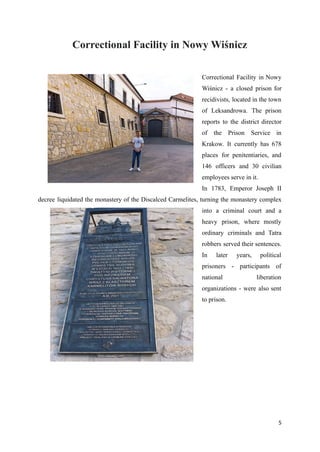
Correctional Facility in Nowy Wiśnicz
Correctional Facility in Nowy
Wiśnicz - a closed prison for
recidivists, located in the town
of Leksandrowa. The prison
reports to the district director
of the Prison Service in
Krakow. It currently has 678
places for penitentiaries, and
146 officers and 30 civilian
employees serve in it.
In 1783, Emperor Joseph II
decree liquidated the monastery of the Discalced Carmelites, turning the monastery complex
into a criminal court and a
heavy prison, where mostly
ordinary criminals and Tatra
robbers served their sentences.
In later years, political
prisoners - participants of
national liberation
organizations - were also sent
to prison.
5
St. Nicholas Basilica in Bochnia
St. Nicholas was built in the first
half of the fifteenth century. As a
result of fires in 1447 and around
1485, it was damaged, and then it
was rebuilt at the turn of the 15th
and 16th centuries. In its original
shape, it was a Gothic hall church
with a relatively long, three-sided
chancel, next to which a sacristy
and a chapel of Eleven Thousand
Virgins (later renamed the Chapel
of St. Kinga) were erected from
the north.
The church was significantly
damaged by the fire of the city in
1655, during the Swedish Deluge. It
has been destroyed, among others
roof and vaults. The reconstruction of
the church in the baroque style was
carried out with funds provided by
King Jan Kazimierz and it was
completed in 1665.
In 1998, the church received the
dignity of a minor basilica. In 2003, a
collegiate chapter was erected at the
church, and the church itself was elevated to the dignity of a collegiate church.
6
Belfry in Bochnia
In the
south-west
corner of
the church
square there
is a massive
wooden
belfry. It
was one of
the most
valuable
monuments
of wooden
religious
architecture
in Poland.
Unfortunately, it burnt down in unknown circumstances on the night of 7/8 October 1987.
Today's building is a reconstruction, realized in 1990–1993 according to a design by Elżbieta
Langer and Krzysztof Kępa.
7
The Bochnia salt mine
The salt mine in Bochnia (from the
13th century to 1772 is part of the
Krakow Żupa) is the oldest
industrial plant in Europe. The
Bochnia Salt Mine is the oldest
rock salt mine in Poland. The
history of salt mining in the vicinity
of Bochnia dates back to 3.5
thousand years BC. The salt was
obtained by evaporating the salt
from the brine.
8
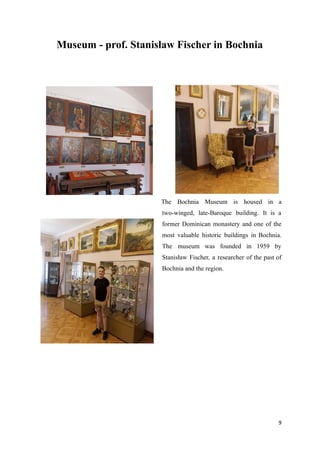
Museum - prof. Stanisław Fischer in Bochnia
The Bochnia Museum is housed in a
two-winged, late-Baroque building. It is a
former Dominican monastery and one of the
most valuable historic buildings in Bochnia.
The museum was founded in 1959 by
Stanisław Fischer, a researcher of the past of
Bochnia and the region.
9
Monument of King Casimir the Great in Bochnia
It is the work of Walery Gadomski, an
outstanding sculptor from Kraków,
professor at the School of Fine Arts.
The king holds the Wiślica statutes in his
hand, and in the lower part you can
see the inscription: "To the king of
peasants, guardian of the cities,
Casimir the Great, his benefactor,
Bochnia 1871.
10
Monument to the "Fallen for Freedom 1914-1920"
Located at the intersection
of Regis and Oracka
streets, the monument "Fallen for Freedom
1914-1920" is the place where every year, on
November 11, Bochnia and local authorities
officially celebrate Poland's Independence Day.
The monument was erected on the initiative of
the Poviat Legionnaires' Union in Bochnia - on
the 20th anniversary of the march of the youth
battalion from Bochnia to the Legions.
There are bronze plaques on the monument
with the names of those who died in the fight for independence and the consolidation of
Poland's borders, coming from the area of ​
​
the Bochnia county. These plaques were removed
by the Germans during World War II and probably melted down.
11
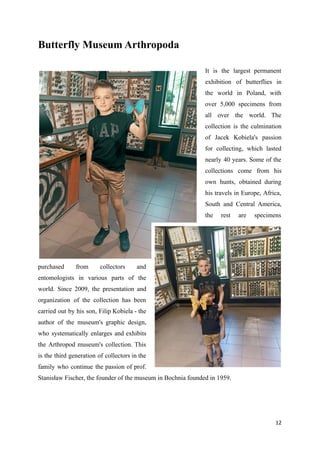
Butterfly Museum Arthropoda
It is the largest permanent
exhibition of butterflies in
the world in Poland, with
over 5,000 specimens from
all over the world. The
collection is the culmination
of Jacek Kobiela's passion
for collecting, which lasted
nearly 40 years. Some of the
collections come from his
own hunts, obtained during
his travels in Europe, Africa,
South and Central America,
the rest are specimens
purchased from collectors and
entomologists in various parts of the
world. Since 2009, the presentation and
organization of the collection has been
carried out by his son, Filip Kobiela - the
author of the museum's graphic design,
who systematically enlarges and exhibits
the Arthropod museum's collection. This
is the third generation of collectors in the
family who continue the passion of prof.
Stanisław Fischer, the founder of the museum in Bochnia founded in 1959.
12
The Krakow Saltworks Museum in Wieliczka
The Krakow Saltworks Museum in Wieliczka is one of the largest mining museums in the
world. It has exhibitions at the Saltworks Castle and the Wieliczka Salt Mine at a depth of 135
meters. From the end of the 13th century to 1945, the Castle and the Mine were one salt
producing enterprise. Both sites are on the UNESCO World Heritage List.
The founder of the Krakow Saltworks Museum in Wieliczka was Alfons Długosz - educator,
visionary, social worker, photographer and artist. He was an enthusiast who saved numerous
mining monuments. The official opening of the Museum in the Salt Mine exhibition took
place on 30th September 1966 and was included in the celebrations of the 1000th anniversary
of the Polish State. The Central Castle, available since 1985, was intended for exhibitions and
collections, while the Gothic Hall also serves as the Wedding Palace in Wieliczka.
13
Wieliczka salt mine
"Wieliczka" Salt Mine - rock salt mine, in
Wieliczka near Krakow. From the thirteenth
century to 1772, together with the "Bochnia"
salt mine, it was the part of the Krakow
Saltworks. The salts mined in the mine come
from the Miocene.
In 1976, the mine was entered into the
national register of monuments. Two years
later, it was entered by UNESCO on the first
World Heritage List. In 1989, the
"Wieliczka" Salt Mine extended the List of
World Heritage in Danger, from which it
was deleted in 1998. Since 1994, it is also a
monument to the history of Poland. On June 30, 1996, the exploitation of the deposit was
completely stopped. In 2007, the Wieliczka salt mine was recognized in the "Rzeczpospolita"
poll as one of the seven wonders of Poland, winning the largest number of votes.
In 2006, the mine was visited by 1,065,857 guests, 58% of visitors were foreigners. Most of
them were British - over 57,000 and Germans - over 50,000.
14

Monuments_Bartosz.pdf

  • 1.
  • 2.
    Church of st.Leonard in Lipnica Murowana St. Leonard church - a wooden cemetery church, located in Lipnica Dolna in Bochnia county. In 2003, it was entered along with other wooden churches in southern Małopolska, on the UNESCO World Heritage List. The church is located by the Uszwica river, behind the historical border of the old town fortifications of Lipnica Murowana. The church was probably built at the end of the 15th century on the site of an earlier temple. However, according to local tradition, it dates from 1143 or 1203 - this date can be read on the north-eastern wall of the chancel - and stands on the site of a former pagan temple. It has survived to this day in an almost unchanged condition and is one of the most valuable wooden Gothic churches in Poland. 2
  • 3.
    Castle in Wiśnicz Thecastle is located on the forested hill above the Leksandrówka River in the village of Stary Wiśnicz, erected by Jan Kmita in the second half of the 14th century. The early Baroque body of the castle with Renaissance elements was built on a quadrilateral plan with an internal courtyard. It was topped with four towers in the corners. On the north-eastern side, a chapel with a tomb of the Lubomirski family was added, and on the south-eastern side, the so-called Kmitówka. On the second floor, next to the Knight's Hall, there is a balcony from which you can admire the Nowy Wiśnicz town. . The building is surrounded by bastion fortifications with an entrance gate from the beginning of the 17th century. 3
  • 4.
    Museum of JanMatejko Memorabilia – “Koryznówka” in Nowy Wiśnicz Museum of Jan Matejko Memorabilia - a building built around 1864. In the vicinity of the castle and the monastery, there is a wooden manor house called "Koryznówka", which houses the Museum of Jan Matejka Memorabilia. It is a place where time in symbiosis with nature stopped in a silent reflection. There is a pleasant, characteristic smell of impregnated wood mixed with the scent of the surrounding vegetation around the house. 4
  • 5.
    Correctional Facility inNowy Wiśnicz Correctional Facility in Nowy Wiśnicz - a closed prison for recidivists, located in the town of Leksandrowa. The prison reports to the district director of the Prison Service in Krakow. It currently has 678 places for penitentiaries, and 146 officers and 30 civilian employees serve in it. In 1783, Emperor Joseph II decree liquidated the monastery of the Discalced Carmelites, turning the monastery complex into a criminal court and a heavy prison, where mostly ordinary criminals and Tatra robbers served their sentences. In later years, political prisoners - participants of national liberation organizations - were also sent to prison. 5
  • 6.
    St. Nicholas Basilicain Bochnia St. Nicholas was built in the first half of the fifteenth century. As a result of fires in 1447 and around 1485, it was damaged, and then it was rebuilt at the turn of the 15th and 16th centuries. In its original shape, it was a Gothic hall church with a relatively long, three-sided chancel, next to which a sacristy and a chapel of Eleven Thousand Virgins (later renamed the Chapel of St. Kinga) were erected from the north. The church was significantly damaged by the fire of the city in 1655, during the Swedish Deluge. It has been destroyed, among others roof and vaults. The reconstruction of the church in the baroque style was carried out with funds provided by King Jan Kazimierz and it was completed in 1665. In 1998, the church received the dignity of a minor basilica. In 2003, a collegiate chapter was erected at the church, and the church itself was elevated to the dignity of a collegiate church. 6
  • 7.
    Belfry in Bochnia Inthe south-west corner of the church square there is a massive wooden belfry. It was one of the most valuable monuments of wooden religious architecture in Poland. Unfortunately, it burnt down in unknown circumstances on the night of 7/8 October 1987. Today's building is a reconstruction, realized in 1990–1993 according to a design by Elżbieta Langer and Krzysztof Kępa. 7
  • 8.
    The Bochnia saltmine The salt mine in Bochnia (from the 13th century to 1772 is part of the Krakow Żupa) is the oldest industrial plant in Europe. The Bochnia Salt Mine is the oldest rock salt mine in Poland. The history of salt mining in the vicinity of Bochnia dates back to 3.5 thousand years BC. The salt was obtained by evaporating the salt from the brine. 8
  • 9.
    Museum - prof.Stanisław Fischer in Bochnia The Bochnia Museum is housed in a two-winged, late-Baroque building. It is a former Dominican monastery and one of the most valuable historic buildings in Bochnia. The museum was founded in 1959 by Stanisław Fischer, a researcher of the past of Bochnia and the region. 9
  • 10.
    Monument of KingCasimir the Great in Bochnia It is the work of Walery Gadomski, an outstanding sculptor from Kraków, professor at the School of Fine Arts. The king holds the Wiślica statutes in his hand, and in the lower part you can see the inscription: "To the king of peasants, guardian of the cities, Casimir the Great, his benefactor, Bochnia 1871. 10
  • 11.
    Monument to the"Fallen for Freedom 1914-1920" Located at the intersection of Regis and Oracka streets, the monument "Fallen for Freedom 1914-1920" is the place where every year, on November 11, Bochnia and local authorities officially celebrate Poland's Independence Day. The monument was erected on the initiative of the Poviat Legionnaires' Union in Bochnia - on the 20th anniversary of the march of the youth battalion from Bochnia to the Legions. There are bronze plaques on the monument with the names of those who died in the fight for independence and the consolidation of Poland's borders, coming from the area of ​ ​ the Bochnia county. These plaques were removed by the Germans during World War II and probably melted down. 11
  • 12.
    Butterfly Museum Arthropoda Itis the largest permanent exhibition of butterflies in the world in Poland, with over 5,000 specimens from all over the world. The collection is the culmination of Jacek Kobiela's passion for collecting, which lasted nearly 40 years. Some of the collections come from his own hunts, obtained during his travels in Europe, Africa, South and Central America, the rest are specimens purchased from collectors and entomologists in various parts of the world. Since 2009, the presentation and organization of the collection has been carried out by his son, Filip Kobiela - the author of the museum's graphic design, who systematically enlarges and exhibits the Arthropod museum's collection. This is the third generation of collectors in the family who continue the passion of prof. Stanisław Fischer, the founder of the museum in Bochnia founded in 1959. 12
  • 13.
    The Krakow SaltworksMuseum in Wieliczka The Krakow Saltworks Museum in Wieliczka is one of the largest mining museums in the world. It has exhibitions at the Saltworks Castle and the Wieliczka Salt Mine at a depth of 135 meters. From the end of the 13th century to 1945, the Castle and the Mine were one salt producing enterprise. Both sites are on the UNESCO World Heritage List. The founder of the Krakow Saltworks Museum in Wieliczka was Alfons Długosz - educator, visionary, social worker, photographer and artist. He was an enthusiast who saved numerous mining monuments. The official opening of the Museum in the Salt Mine exhibition took place on 30th September 1966 and was included in the celebrations of the 1000th anniversary of the Polish State. The Central Castle, available since 1985, was intended for exhibitions and collections, while the Gothic Hall also serves as the Wedding Palace in Wieliczka. 13
  • 14.
    Wieliczka salt mine "Wieliczka"Salt Mine - rock salt mine, in Wieliczka near Krakow. From the thirteenth century to 1772, together with the "Bochnia" salt mine, it was the part of the Krakow Saltworks. The salts mined in the mine come from the Miocene. In 1976, the mine was entered into the national register of monuments. Two years later, it was entered by UNESCO on the first World Heritage List. In 1989, the "Wieliczka" Salt Mine extended the List of World Heritage in Danger, from which it was deleted in 1998. Since 1994, it is also a monument to the history of Poland. On June 30, 1996, the exploitation of the deposit was completely stopped. In 2007, the Wieliczka salt mine was recognized in the "Rzeczpospolita" poll as one of the seven wonders of Poland, winning the largest number of votes. In 2006, the mine was visited by 1,065,857 guests, 58% of visitors were foreigners. Most of them were British - over 57,000 and Germans - over 50,000. 14