/ 20
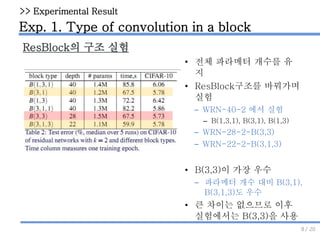
ResBlock의 구조실험
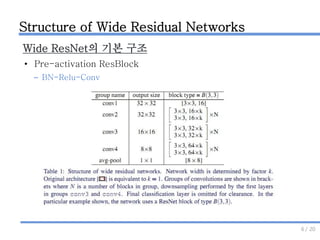
• 전체 파라메터 개수를 유
지
• ResBlock구조를 바꿔가며
실험
– WRN-40-2 에서 실험
– B(1,3,1), B(3,1), B(1,3)
– WRN-28-2-B(3,3)
– WRN-22-2-B(3,1,3)
• B(3,3)이 가장 우수
– 파라메터 개수 대비 B(3,1),
B(3,1,3)도 우수
• 큰 차이는 없으므로 이후
실험에서는 B(3,3)을 사용
8
Exp. 1. Type of convolution in a block
>> Experimental Result
9.
/ 20
ResBlock 내부Conv층의 개수
• WRN-40-2 에서
• 𝑙 ∈ [1,2,3,4] 변경하며 실험
– 총 depth는 유지(=40)
• 𝑙 = 2 경우 가장 우수
• 이후 실험에서 𝑙 = 2 로 고정
9
Exp. 2. Number of convolutions per block
>> Experimental Result
10.
/ 20
폭(width), 깊이(depth),파라메터 개수(# params) 실험 1
• WRN의 여러 변형 실험
• 같은 깊이 넓을수록 우수
• 같은 폭 깊을수록 우수
• 같은 파라메터 개수 상황마다 다름 최적 깊이, 폭 고려 필요함
10
Exp. 3. Width of residual blocks
>> Experimental Result
11.
/ 20
폭(width), 깊이(depth),파라메터 개수(# params) 실험 2
• WRN과 다른 방법 비교
• 앞선 실험과 비슷한 경향
• WRN이 우수함 - 폭과 깊이의 적정점을 찾아냄
11
Exp. 3. Width of residual blocks
>> Experimental Result
12.
/ 20
폭(width), 깊이(depth),파라메터 개수(# params) 실험 3
• ResNet-164와 WRN-28-10의 크기 차이와 학습 난이도
– # params 차이 : 1.7M vs. 36.5M
– WRN-28-10이 훨씬 큰 모델이지만 학습이 잘됨
12
Exp. 3. Width of residual blocks
>> Experimental Result
13.
/ 20
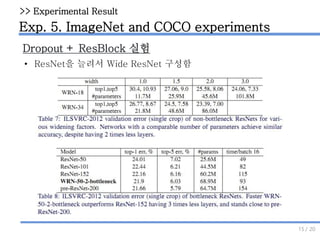
Dropout +ResBlock 실험
• K. He의 실험과는 다름
– K. He는 Dropout으로 효과를 보지 못함
– Conv - Dropout - Conv 구조
• 대체로 dropout 사용이 유리함
13
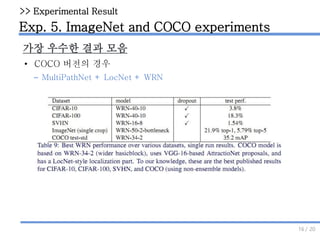
Exp. 4. Dropout in residual blocks
>> Experimental Result


![/ 20
ResBlock 내부 Conv층의 개수
• WRN-40-2 에서
• 𝑙 ∈ [1,2,3,4] 변경하며 실험
– 총 depth는 유지(=40)
• 𝑙 = 2 경우 가장 우수
• 이후 실험에서 𝑙 = 2 로 고정
9
Exp. 2. Number of convolutions per block
>> Experimental Result](https://image.slidesharecdn.com/wideresnet-180607113145/85/Review-Wide-Resnet-9-320.jpg)





![[2020 CVPR Efficient DET paper review]](https://cdn.slidesharecdn.com/ss_thumbnails/efficientdetleechanhyuk-210615060443-thumbnail.jpg?width=640&height=640&fit=bounds)


![[DL輪読会]モデルベース強化学習とEnergy Based Model](https://cdn.slidesharecdn.com/ss_thumbnails/energybasedmodel-191129002008-thumbnail.jpg?width=640&height=640&fit=bounds)

![[DL輪読会]V-MPO: On-Policy Maximum a Posteriori Policy Optimization for Discrete...](https://cdn.slidesharecdn.com/ss_thumbnails/20200904furuta-200904014839-thumbnail.jpg?width=640&height=640&fit=bounds)


![[한국어] Neural Architecture Search with Reinforcement Learning](https://cdn.slidesharecdn.com/ss_thumbnails/nas-170612232020-thumbnail.jpg?width=640&height=640&fit=bounds)


![[컴퓨터비전과 인공지능] 8. 합성곱 신경망 아키텍처 4 - ResNet](https://cdn.slidesharecdn.com/ss_thumbnails/lec8convolutionnetworksarcitecture4resnet-210214112234-thumbnail.jpg?width=640&height=640&fit=bounds)

![[컴퓨터비전과 인공지능] 8. 합성곱 신경망 아키텍처 3 - GoogLeNet](https://cdn.slidesharecdn.com/ss_thumbnails/lec8convolutionnetworksarcitecture3googlenet-210214112100-thumbnail.jpg?width=640&height=640&fit=bounds)


![[컴퓨터비전과 인공지능] 8. 합성곱 신경망 아키텍처 5 - Others](https://cdn.slidesharecdn.com/ss_thumbnails/lec8convolutionnetworksarcitecture5others-210215060452-thumbnail.jpg?width=640&height=640&fit=bounds)


