Factors affecting participation 
in OCoP: A case study of 
Webheads in Action (WiA) 
Ali Bostancioglu 
November, 2014
Contents 
1. Introduction 
2. Sociocultural learning and activity theory 
3. Participants 
4. Results 
5. Conclusion and “What is next?”
1. Introduction 
 Aim: to find out factors affecting 
participation in OCoPs 
 Why Webheads? 
 What did the study involve? 
 Focus of the session (Interview findings)
2. Sociocultural learning theory 
 Learning is a social process that 
occurs through our interactions with 
others. 
 Situated learning (Lave & Wenger, 
1990), 
 Distributed cognition (Hutchinson, 
1995), 
 Activity Theory ( Engestrom, 1987).
2. Sociocultural learning theory 
 Activity Theory: “Misnamed” 
(Masterman 2008, p. 224) 
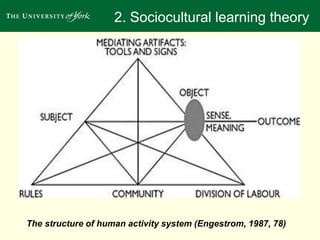
 In fact, provides an analytical tool to 
explore sociocultural learning
2. Sociocultural learning theory 
The structure of human activity system (Engestrom, 1987, 78)
 Any Questions so far?
3. Participants 
 69 survey participants 
 24 interviews (ranging between 35 and 
almost 2 hour).
4. Results 
 A) Community 
 B) Tools 
 C) Norms 
 D) Division of Labour
4. Results 
 A) Community 
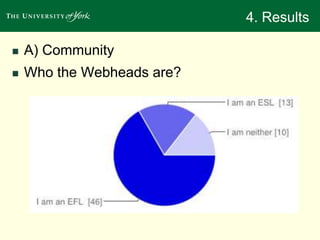
 Who the Webheads are?
4. Results A) Community 
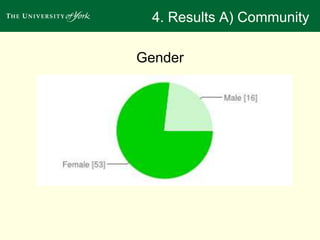
Gender
4. Results A) Community 
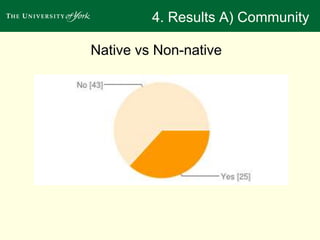
Native vs Non-native
4. Results A) Community 
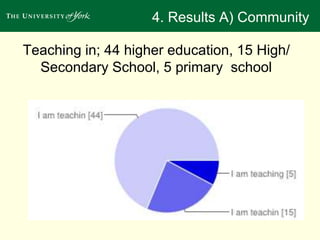
Teaching in; 44 higher education, 15 High/ 
Secondary School, 5 primary school
4. Results A) Community 
 A diverse community members of which are 
from all over the world (6 continents). 
 Homogenous in that they are all interested 
in learning about technology and it’s 
educational applications (particularly in 
language teaching).
4. Results 
 B) Tools 
 Yahoo Group 
 Learning2gether platforms 
 Skype 
 Google + and Facebook WiA groups
4. Results- B) Tools 
 Yahoo Group 
 “This is the central channel, that’s why. I 
mean if you follow the Yahoo Group then 
you don’t really miss anything” 
 “(E)verybody is there and eventually 
everybody will read the message” 
 “A lot of us started with the Yahoo group. 
We like it because […] it works and it's 
technologically friendly to most people”
4. Results- B) Tools, Learning2gether 
 “(B)ecause you can see people, you can 
listen to them, you can you know visualize 
what they are talking about through the 
power points and all that and the photos 
and drawings. So I think it's a very powerful 
means of communication” 
 Timing and date problems 
 Flexible 
 Catch up from recordings
4. Results- B) Tools 
 Skype 
 More used by members that were 
considered as active or core members. 
 “I prefer Skype because it's very practical 
uhm because we can start chat any time 
you know that I am here at the computer. If 
somebody needs me I am here”
4. Results- B) Tools 
 Google + and Facebook WiA groups 
 Visually appealing 
 No discussions taking place 
 To follow events
4. Results- B) Tools 
 Google +, is it good for community 
building? Yes/ No, why?
4. Results 
 C) Norms 
 Support 
 Politeness and respect 
 Avoiding religious discussions 
 Avoiding political discussions 
 Avoiding spamming 
 Regular meetings
4. Results- C) Norms 
 Support 
 Social support (sharing emotions, 
successes, sadness, holiday messages) 
 Technical support
4. Results- C) Norms 
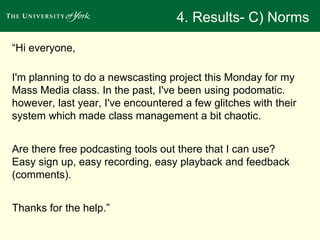
“Hi everyone, 
I'm planning to do a newscasting project this Monday for my 
Mass Media class. In the past, I've been using podomatic. 
however, last year, I've encountered a few glitches with their 
system which made class management a bit chaotic. 
Are there free podcasting tools out there that I can use? 
Easy sign up, easy recording, easy playback and feedback 
(comments). 
Thanks for the help.”
 That help request received a response 
within 24 hours. Within the next day a total 
of 5 different suggestions were provided to 
the member seeking advice.
4. Results C) Norms 
 Politeness and respect 
 “Politeness is at the top” within the WiA 
community. Members “use ‘Dear [name]’”, 
“say ‘Thank you!’ to show gratitude”, and “if 
there is a problem or a situation, we always 
say ‘We are sorry about these’ or ‘We 
apologize for this’”.
4. Results C) Norms 
Respect “is something that [Webheads] 
value”. Members have “ideas and share 
ideas, you may like them or not and you may 
discuss why you don't like this or the other 
always respectfully”.
4. Results C) Norms 
 Avoiding political and religious discussions 
 WiA community members “don’t talk about 
politics or religion […] because [they] want 
to be open to anybody” 
 “We have always gotten along very well, 
there are things that we don't discuss but I 
think I don't discuss them ever. Things such 
as religion, politics and so on…We avoid 
these topics but we avoid them in a natural 
way”
Further elaboration on avoiding 
politics 
 “Yeah or politics is ok if it has got some relevance to 
teaching or to uhm methodology but if it's politics... Uhm 
let's take an obvious example, the Israel and Palestinian 
situation. If someone was to start saying 'Well Israel is 
good because of this or Israel is bad because of that', 
Vance would step and then say 'That's not what this list is 
for'. We all know we have different opinions but it's just... 
It's not a place where we want to have an argument. […] 
We can have a vigorous debate about the pros and cons 
of a particular teaching approach and people would 
disagree and be quite strong in their disagreement so 
that's okay but we don't do that for politics or religion for 
example”
4. Results C) Norms 
 Avoiding spamming 
 Regular meetings
4. Results 
 D) Division of Labour 
 Volunteering 
 Leadership 
 Training opportunities
4. Results D) Div. of Lab. 
 Volunteering 
 contributions to the WiA community is 
“done on people’s initiatives” 
 “So I thought that besides learning with the 
Webheads, I needed to give my share 
because I had learned so much with them 
so I felt compelled to share with them and 
with my network.”
4. Results D) Div. of Lab. 
 Leadership 
 Core members seen as leaders 
 But in general it was Vance who was 
mentioned the most. 
 He maintains the Learning2gether, makes 
announcements, is the admin of the Yahoo, 
Facebook, and Google + WiA groups 
 He can use some help for the 
Learning2gether events
5. Conclusion & What is next? 
 There is not one yet but to summarize I 
tried to reflect on my findings today 
 Look into more details of the differences 
between different membership levels 
 Lurkers vs Active and Core members 
 Try and create a coherent story from the 
findings
6. Questions 
Any questions? 
 Are there any points that 
people would like to add to or 
clarify in case you think my 
interpretation was wrong?
6. Questions 
Thank you!

Factors effecting participation in online communities of practice: A case study of WiA (Preliminary results- 23.11.2014)

  • 1.
    Factors affecting participation in OCoP: A case study of Webheads in Action (WiA) Ali Bostancioglu November, 2014
  • 2.
    Contents 1. Introduction 2. Sociocultural learning and activity theory 3. Participants 4. Results 5. Conclusion and “What is next?”
  • 3.
    1. Introduction Aim: to find out factors affecting participation in OCoPs  Why Webheads?  What did the study involve?  Focus of the session (Interview findings)
  • 4.
    2. Sociocultural learningtheory  Learning is a social process that occurs through our interactions with others.  Situated learning (Lave & Wenger, 1990),  Distributed cognition (Hutchinson, 1995),  Activity Theory ( Engestrom, 1987).
  • 5.
    2. Sociocultural learningtheory  Activity Theory: “Misnamed” (Masterman 2008, p. 224)  In fact, provides an analytical tool to explore sociocultural learning
  • 6.
    2. Sociocultural learningtheory The structure of human activity system (Engestrom, 1987, 78)
  • 7.
  • 8.
    3. Participants 69 survey participants  24 interviews (ranging between 35 and almost 2 hour).
  • 9.
    4. Results A) Community  B) Tools  C) Norms  D) Division of Labour
  • 10.
    4. Results A) Community  Who the Webheads are?
  • 11.
    4. Results A)Community Gender
  • 12.
    4. Results A)Community Native vs Non-native
  • 13.
    4. Results A)Community Teaching in; 44 higher education, 15 High/ Secondary School, 5 primary school
  • 14.
    4. Results A)Community  A diverse community members of which are from all over the world (6 continents).  Homogenous in that they are all interested in learning about technology and it’s educational applications (particularly in language teaching).
  • 15.
    4. Results B) Tools  Yahoo Group  Learning2gether platforms  Skype  Google + and Facebook WiA groups
  • 16.
    4. Results- B)Tools  Yahoo Group  “This is the central channel, that’s why. I mean if you follow the Yahoo Group then you don’t really miss anything”  “(E)verybody is there and eventually everybody will read the message”  “A lot of us started with the Yahoo group. We like it because […] it works and it's technologically friendly to most people”
  • 17.
    4. Results- B)Tools, Learning2gether  “(B)ecause you can see people, you can listen to them, you can you know visualize what they are talking about through the power points and all that and the photos and drawings. So I think it's a very powerful means of communication”  Timing and date problems  Flexible  Catch up from recordings
  • 18.
    4. Results- B)Tools  Skype  More used by members that were considered as active or core members.  “I prefer Skype because it's very practical uhm because we can start chat any time you know that I am here at the computer. If somebody needs me I am here”
  • 19.
    4. Results- B)Tools  Google + and Facebook WiA groups  Visually appealing  No discussions taking place  To follow events
  • 20.
    4. Results- B)Tools  Google +, is it good for community building? Yes/ No, why?
  • 21.
    4. Results C) Norms  Support  Politeness and respect  Avoiding religious discussions  Avoiding political discussions  Avoiding spamming  Regular meetings
  • 22.
    4. Results- C)Norms  Support  Social support (sharing emotions, successes, sadness, holiday messages)  Technical support
  • 23.
    4. Results- C)Norms “Hi everyone, I'm planning to do a newscasting project this Monday for my Mass Media class. In the past, I've been using podomatic. however, last year, I've encountered a few glitches with their system which made class management a bit chaotic. Are there free podcasting tools out there that I can use? Easy sign up, easy recording, easy playback and feedback (comments). Thanks for the help.”
  • 24.
     That helprequest received a response within 24 hours. Within the next day a total of 5 different suggestions were provided to the member seeking advice.
  • 25.
    4. Results C)Norms  Politeness and respect  “Politeness is at the top” within the WiA community. Members “use ‘Dear [name]’”, “say ‘Thank you!’ to show gratitude”, and “if there is a problem or a situation, we always say ‘We are sorry about these’ or ‘We apologize for this’”.
  • 26.
    4. Results C)Norms Respect “is something that [Webheads] value”. Members have “ideas and share ideas, you may like them or not and you may discuss why you don't like this or the other always respectfully”.
  • 27.
    4. Results C)Norms  Avoiding political and religious discussions  WiA community members “don’t talk about politics or religion […] because [they] want to be open to anybody”  “We have always gotten along very well, there are things that we don't discuss but I think I don't discuss them ever. Things such as religion, politics and so on…We avoid these topics but we avoid them in a natural way”
  • 28.
    Further elaboration onavoiding politics  “Yeah or politics is ok if it has got some relevance to teaching or to uhm methodology but if it's politics... Uhm let's take an obvious example, the Israel and Palestinian situation. If someone was to start saying 'Well Israel is good because of this or Israel is bad because of that', Vance would step and then say 'That's not what this list is for'. We all know we have different opinions but it's just... It's not a place where we want to have an argument. […] We can have a vigorous debate about the pros and cons of a particular teaching approach and people would disagree and be quite strong in their disagreement so that's okay but we don't do that for politics or religion for example”
  • 29.
    4. Results C)Norms  Avoiding spamming  Regular meetings
  • 30.
    4. Results D) Division of Labour  Volunteering  Leadership  Training opportunities
  • 31.
    4. Results D)Div. of Lab.  Volunteering  contributions to the WiA community is “done on people’s initiatives”  “So I thought that besides learning with the Webheads, I needed to give my share because I had learned so much with them so I felt compelled to share with them and with my network.”
  • 32.
    4. Results D)Div. of Lab.  Leadership  Core members seen as leaders  But in general it was Vance who was mentioned the most.  He maintains the Learning2gether, makes announcements, is the admin of the Yahoo, Facebook, and Google + WiA groups  He can use some help for the Learning2gether events
  • 33.
    5. Conclusion &What is next?  There is not one yet but to summarize I tried to reflect on my findings today  Look into more details of the differences between different membership levels  Lurkers vs Active and Core members  Try and create a coherent story from the findings
  • 34.
    6. Questions Anyquestions?  Are there any points that people would like to add to or clarify in case you think my interpretation was wrong?
  • 35.