page
WHY YOU REALLY WANT SQL IN A REAL-
TIME ENTERPRISE ENVIRONMENT
page© 2016 VoltDB PROPRIETARY
WHO YOU WILL BE HEARING
2	
  
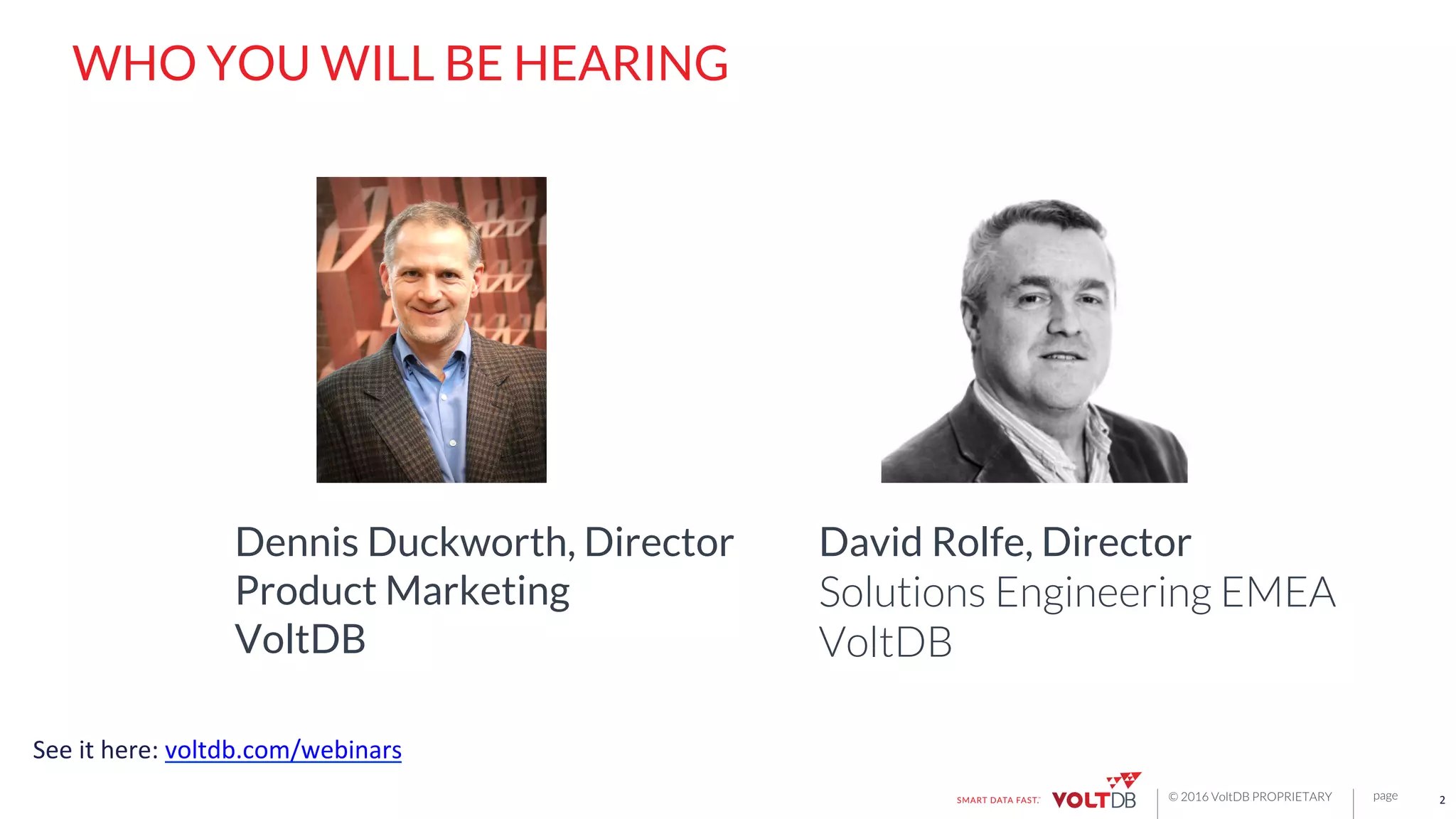
Dennis Duckworth, Director
Product Marketing
VoltDB
David Rolfe, Director
Solutions Engineering EMEA
VoltDB
See	
  it	
  here:	
  voltdb.com/webinars	
  
page© 2016 VoltDB PROPRIETARY
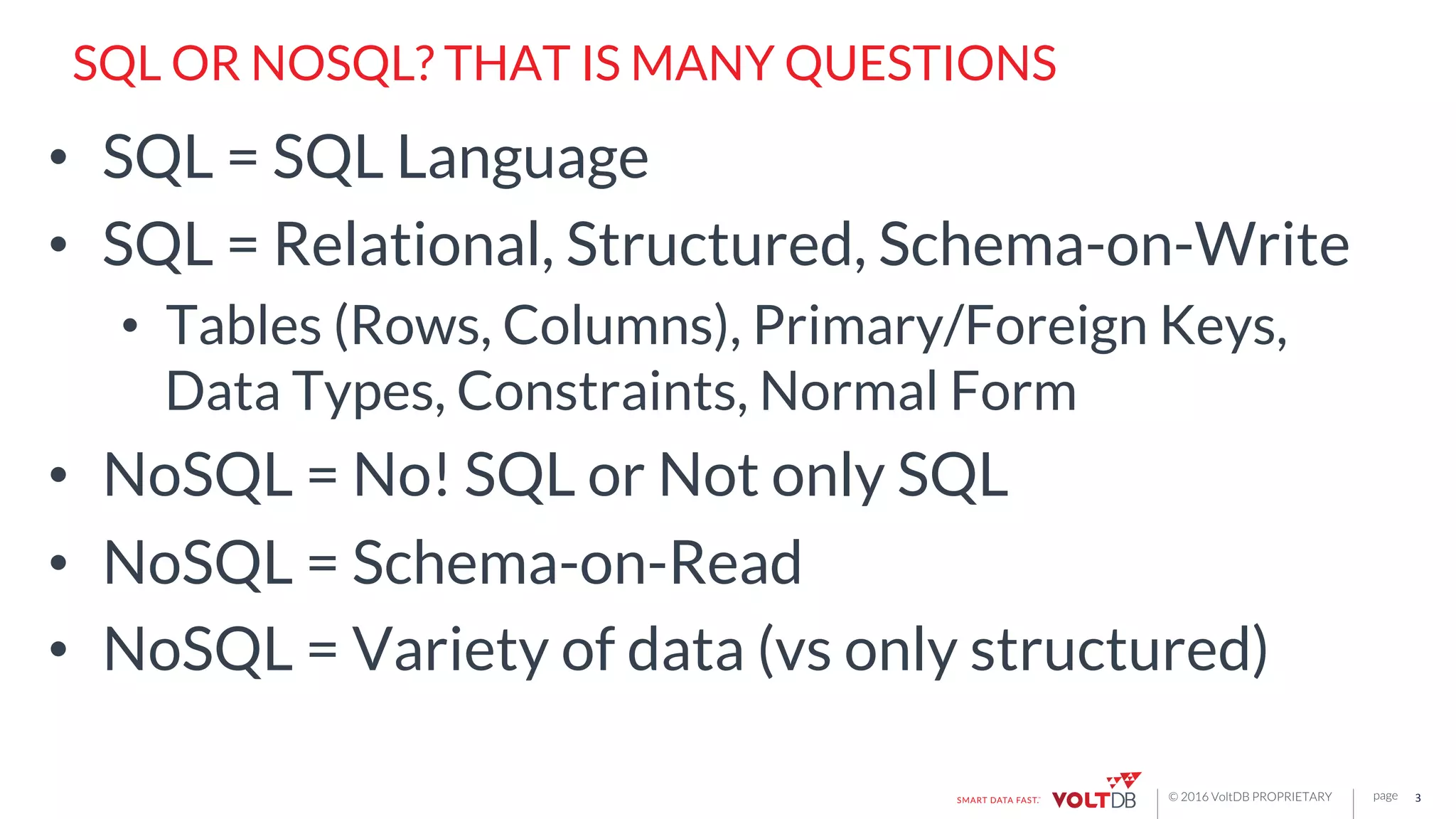
SQL OR NOSQL? THAT IS MANY QUESTIONS
•  SQL = SQL Language
•  SQL = Relational, Structured, Schema-on-Write
•  Tables (Rows, Columns), Primary/Foreign Keys,
Data Types, Constraints, Normal Form
•  NoSQL = No! SQL or Not only SQL
•  NoSQL = Schema-on-Read
•  NoSQL = Variety of data (vs only structured)
3	
  
page© 2016 VoltDB PROPRIETARY
SQL OR NOSQL? THE REAL QUESTIONS
•  How do you access the data?
•  How do you store the data?
•  Which do you use for a particular application:
•  [Old]SQL
•  NoSQL
•  NewSQL
4	
  
page© 2016 VoltDB PROPRIETARY
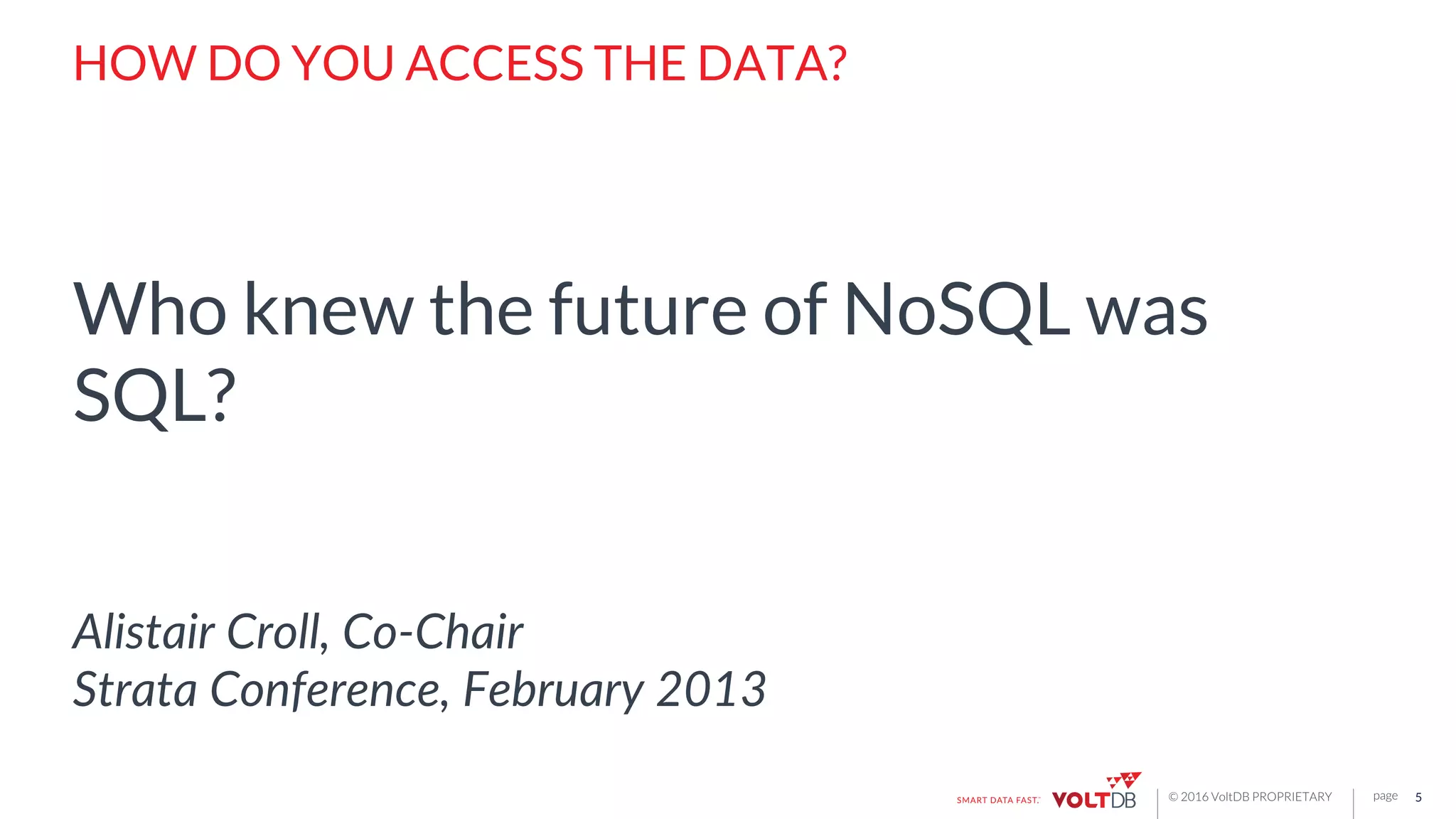
HOW DO YOU ACCESS THE DATA?
Who knew the future of NoSQL was
SQL?
Alistair  Croll,  Co-­‐Chair  
Strata  Conference,  February  2013  
5
page© 2016 VoltDB PROPRIETARY
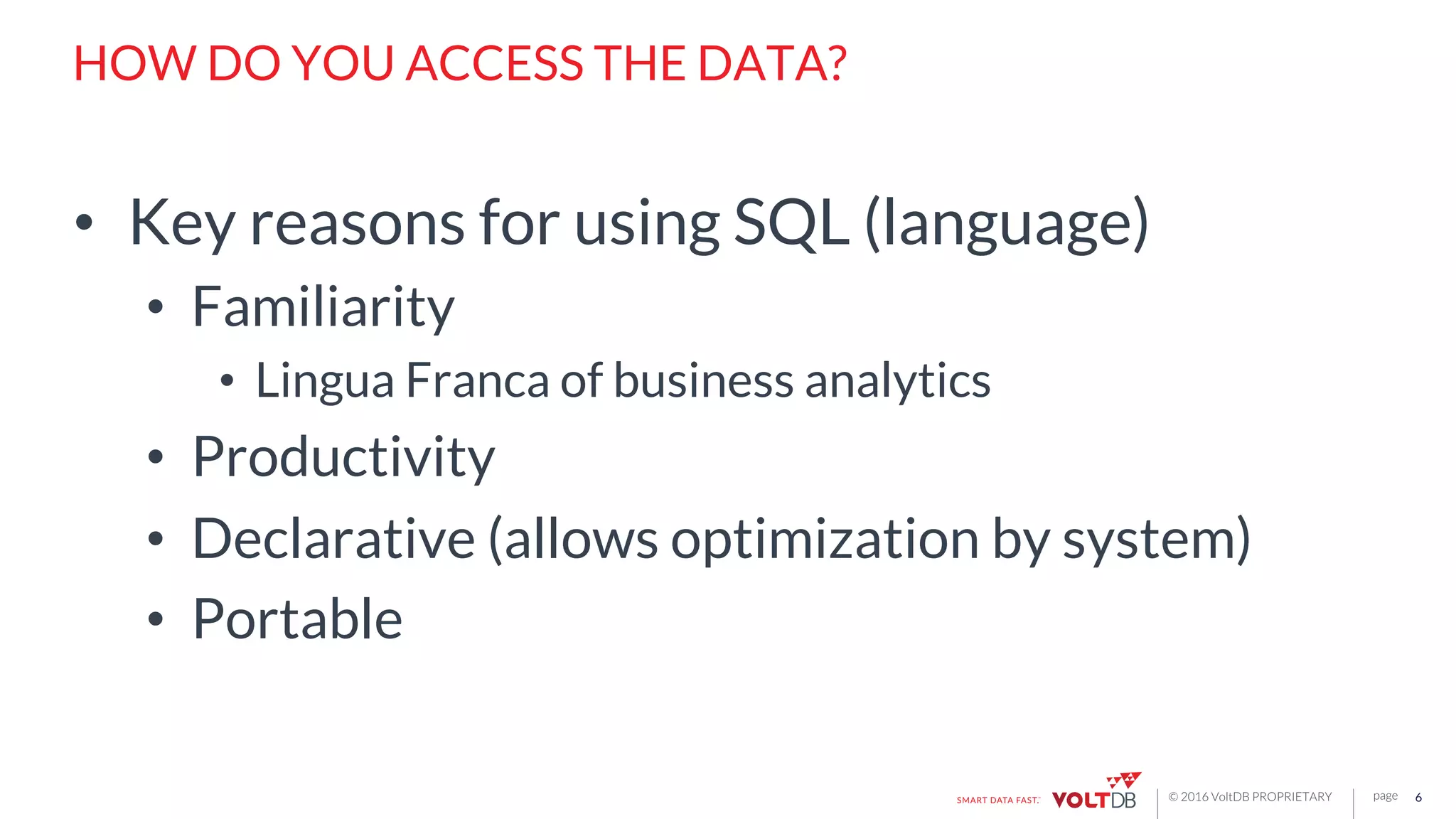
HOW DO YOU ACCESS THE DATA?
•  Key reasons for using SQL (language)
•  Familiarity
•  Lingua Franca of business analytics
•  Productivity
•  Declarative (allows optimization by system)
•  Portable
6
page© 2016 VoltDB PROPRIETARY
HOW DO YOU STORE THE DATA?
•  Now that’s a question!
7
page© 2016 VoltDB PROPRIETARY
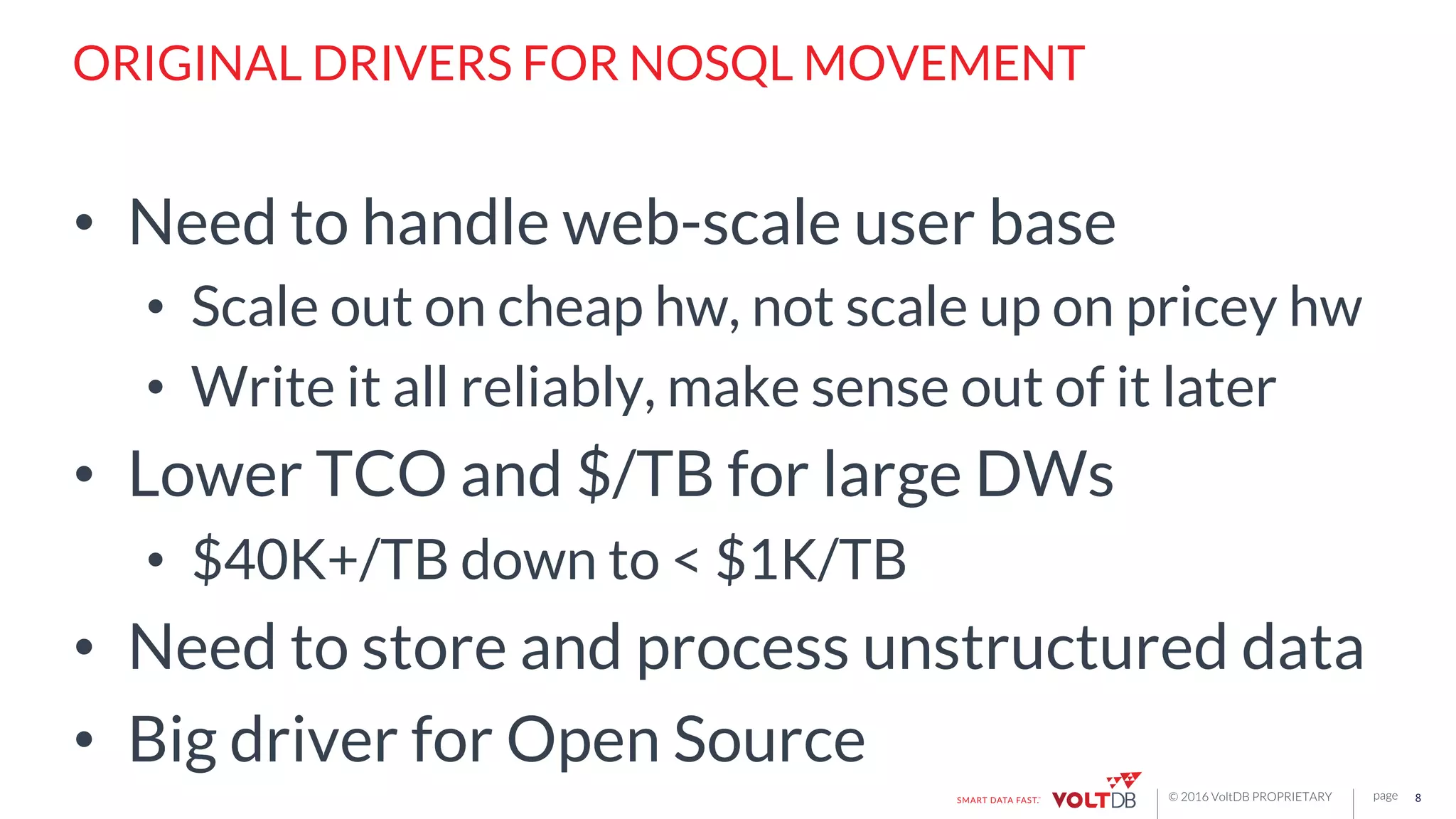
ORIGINAL DRIVERS FOR NOSQL MOVEMENT
•  Need to handle web-scale user base
•  Scale out on cheap hw, not scale up on pricey hw
•  Write it all reliably, make sense out of it later
•  Lower TCO and $/TB for large DWs
•  $40K+/TB down to < $1K/TB
•  Need to store and process unstructured data
•  Big driver for Open Source
8	
  
page© 2016 VoltDB PROPRIETARY
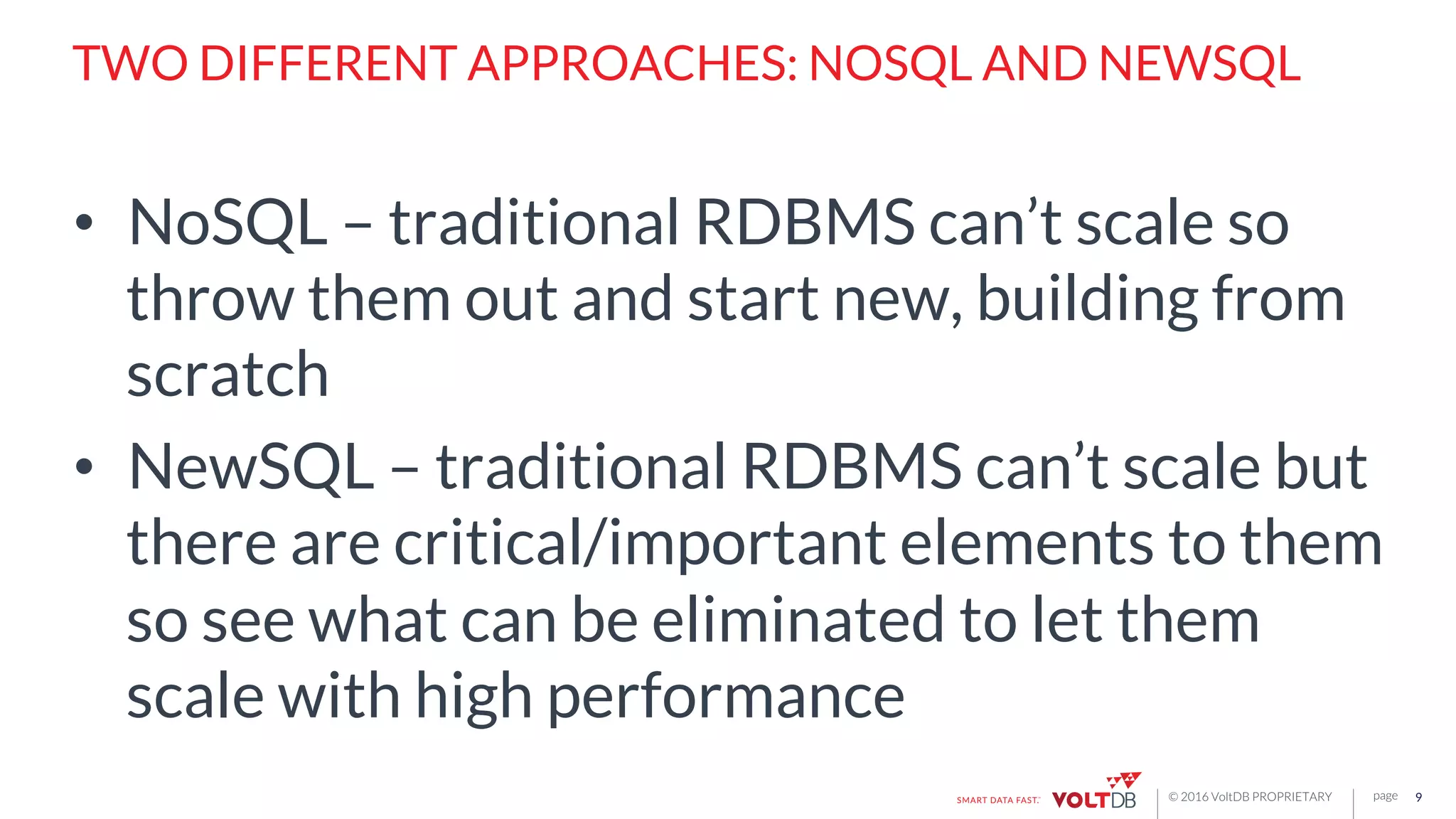
TWO DIFFERENT APPROACHES: NOSQL AND NEWSQL
•  NoSQL – traditional RDBMS can’t scale so
throw them out and start new, building from
scratch
•  NewSQL – traditional RDBMS can’t scale but
there are critical/important elements to them
so see what can be eliminated to let them
scale with high performance
9
page© 2016 VoltDB PROPRIETARY
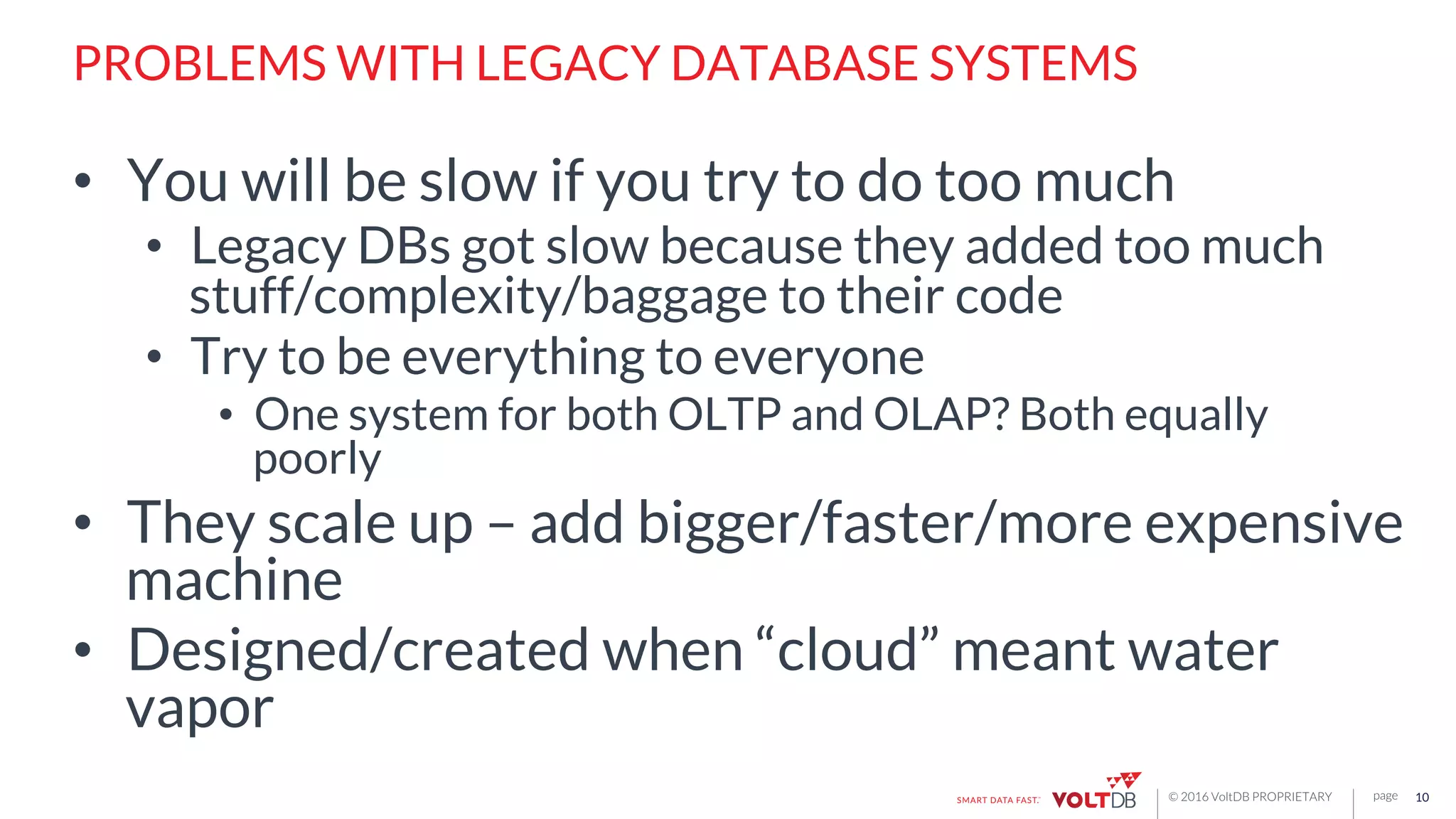
PROBLEMS WITH LEGACY DATABASE SYSTEMS
•  You will be slow if you try to do too much
•  Legacy DBs got slow because they added too much
stuff/complexity/baggage to their code
•  Try to be everything to everyone
•  One system for both OLTP and OLAP? Both equally
poorly
•  They scale up – add bigger/faster/more expensive
machine
•  Designed/created when “cloud” meant water
vapor
10
page© 2016 VoltDB PROPRIETARY
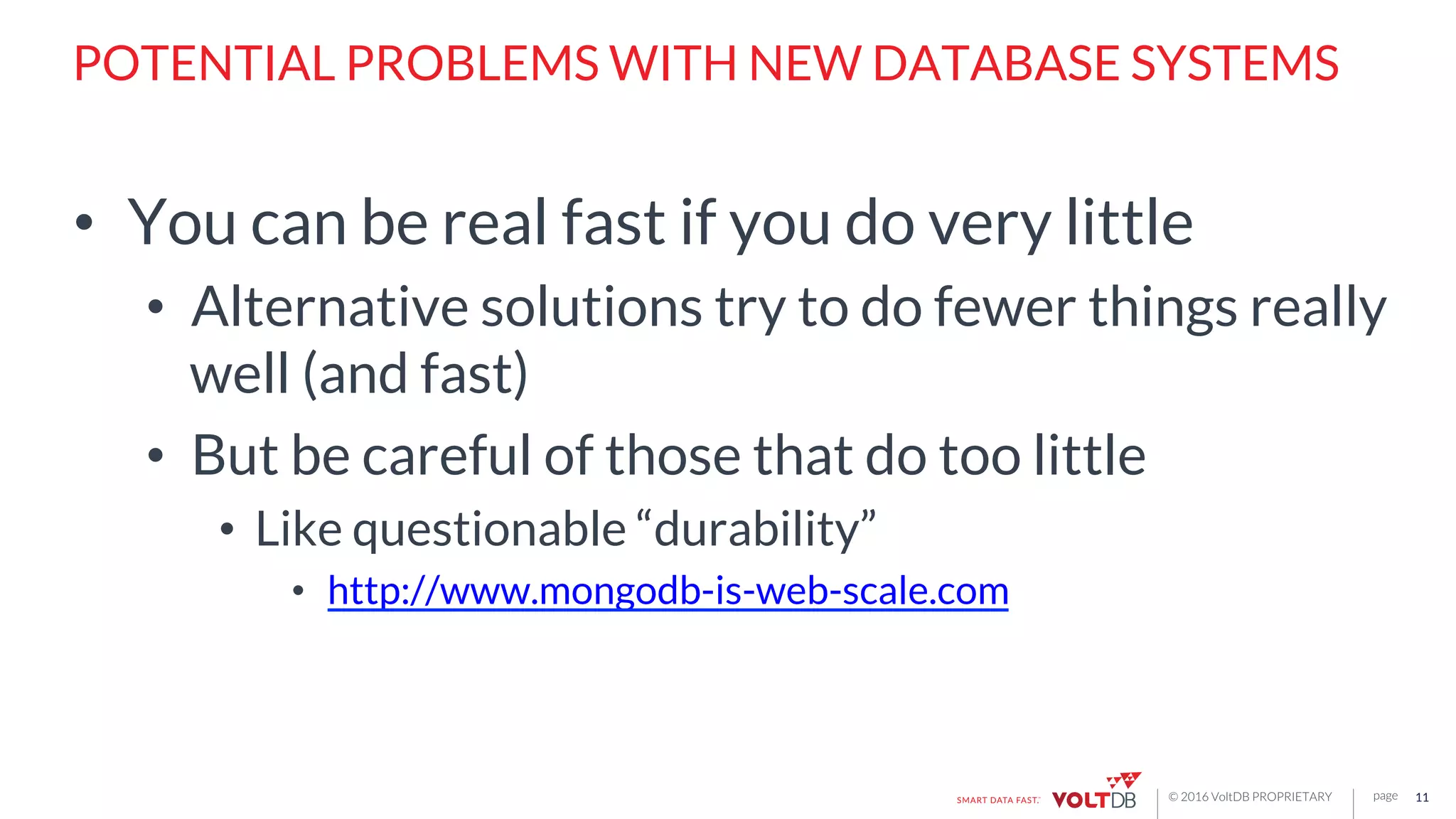
POTENTIAL PROBLEMS WITH NEW DATABASE SYSTEMS
•  You can be real fast if you do very little
•  Alternative solutions try to do fewer things really
well (and fast)
•  But be careful of those that do too little
•  Like questionable “durability”
•  http://www.mongodb-is-web-scale.com
11
page© 2016 VoltDB PROPRIETARY
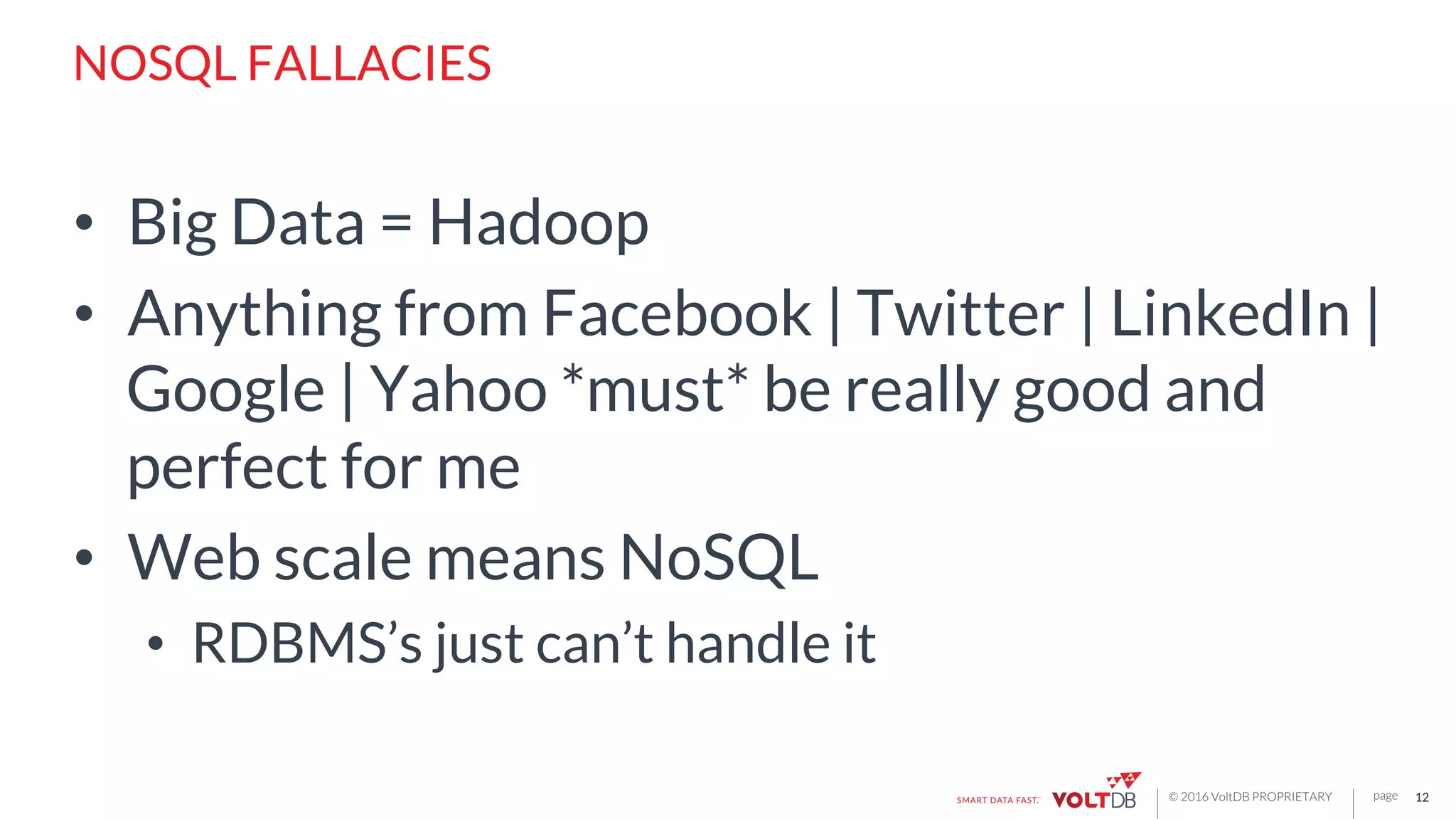
NOSQL FALLACIES
•  Big Data = Hadoop
•  Anything from Facebook | Twitter | LinkedIn |
Google | Yahoo *must* be really good and
perfect for me
•  Web scale means NoSQL
•  RDBMS’s just can’t handle it
12
page© 2016 VoltDB PROPRIETARY
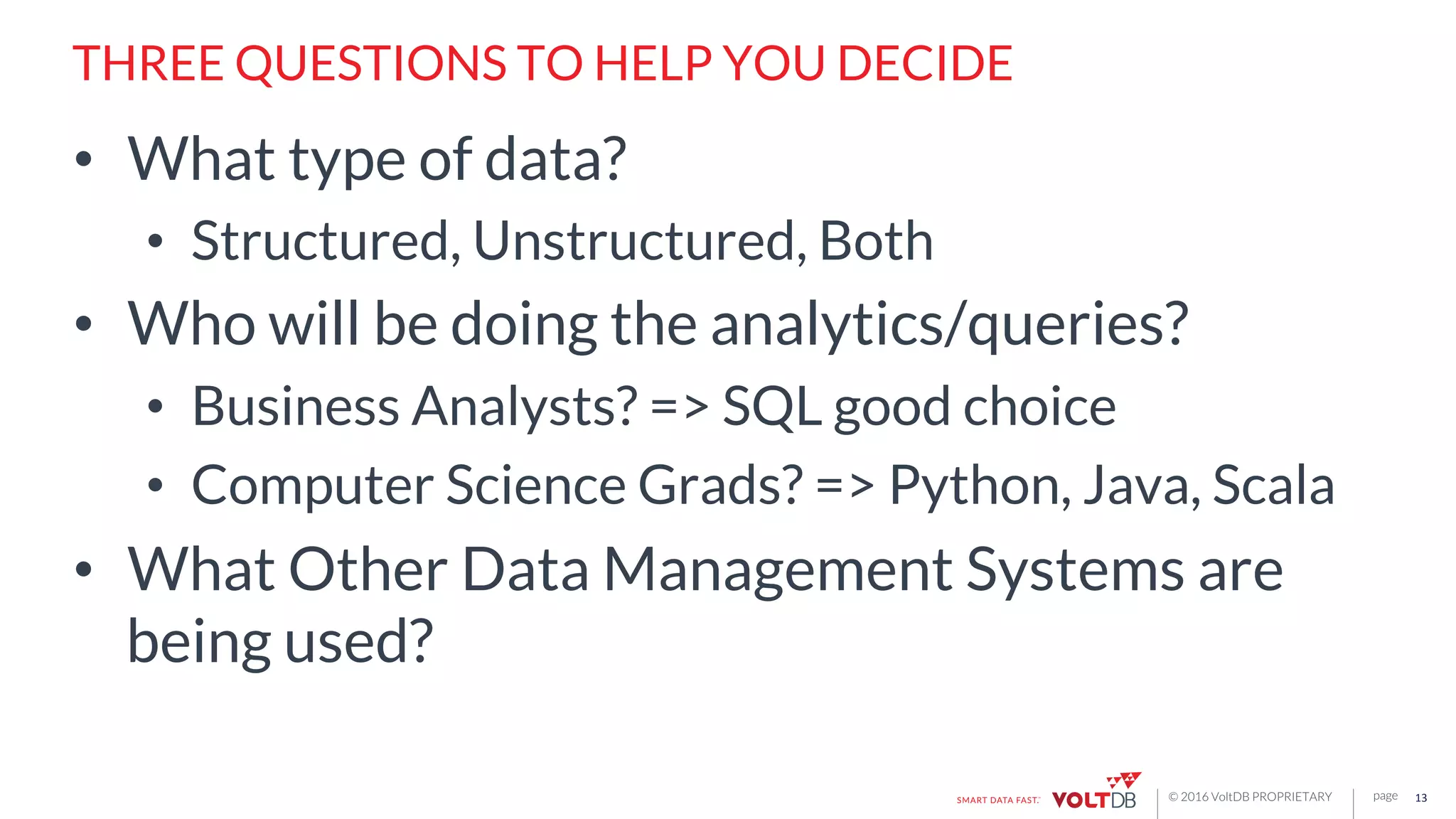
THREE QUESTIONS TO HELP YOU DECIDE
•  What type of data?
•  Structured, Unstructured, Both
•  Who will be doing the analytics/queries?
•  Business Analysts? => SQL good choice
•  Computer Science Grads? => Python, Java, Scala
•  What Other Data Management Systems are
being used?
13	
  
page© 2016 VoltDB PROPRIETARY
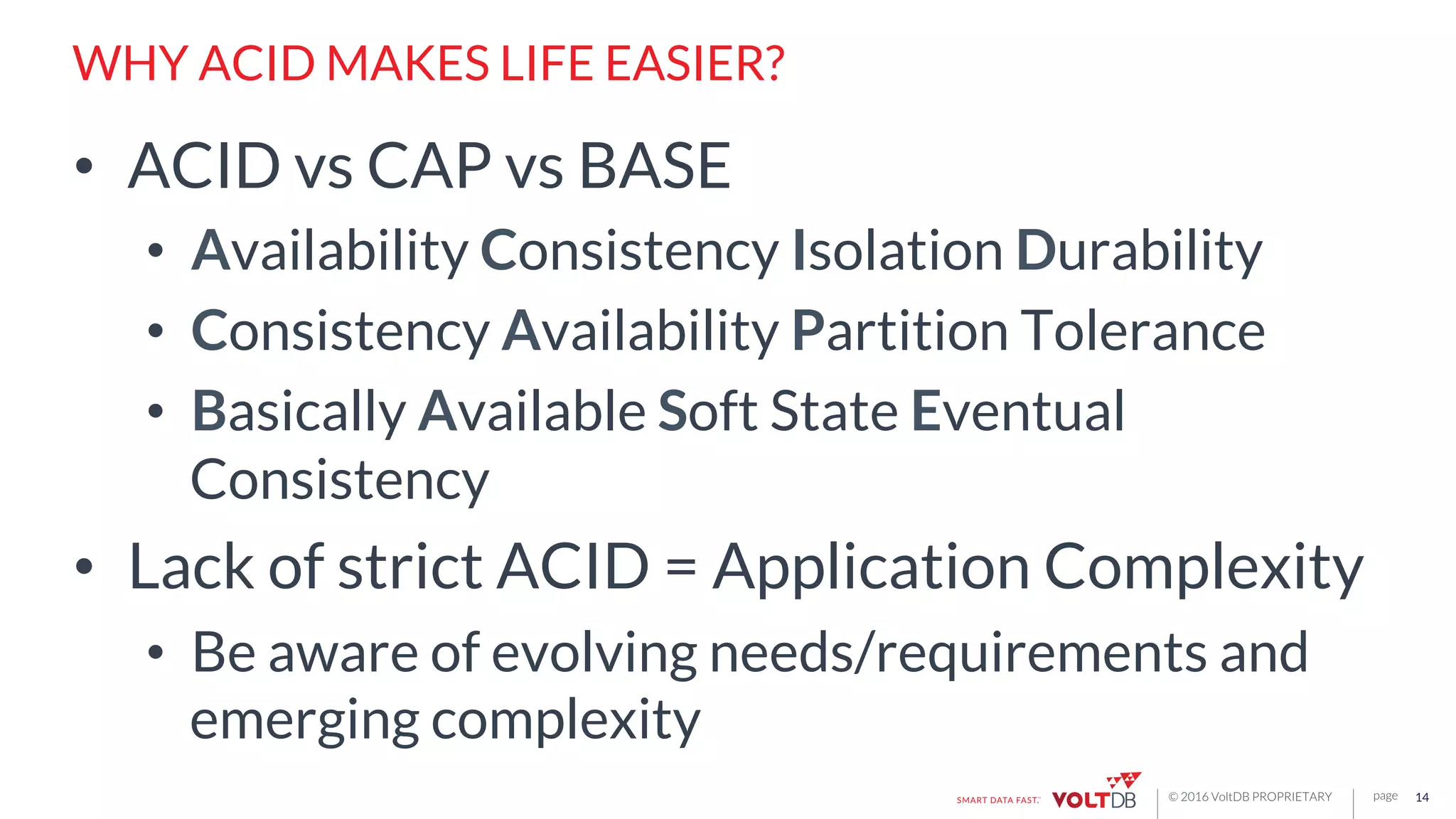
WHY ACID MAKES LIFE EASIER?
•  ACID vs CAP vs BASE
•  Availability Consistency Isolation Durability
•  Consistency Availability Partition Tolerance
•  Basically Available Soft State Eventual
Consistency
•  Lack of strict ACID = Application Complexity
•  Be aware of evolving needs/requirements and
emerging complexity
14
page© 2016 VoltDB PROPRIETARY
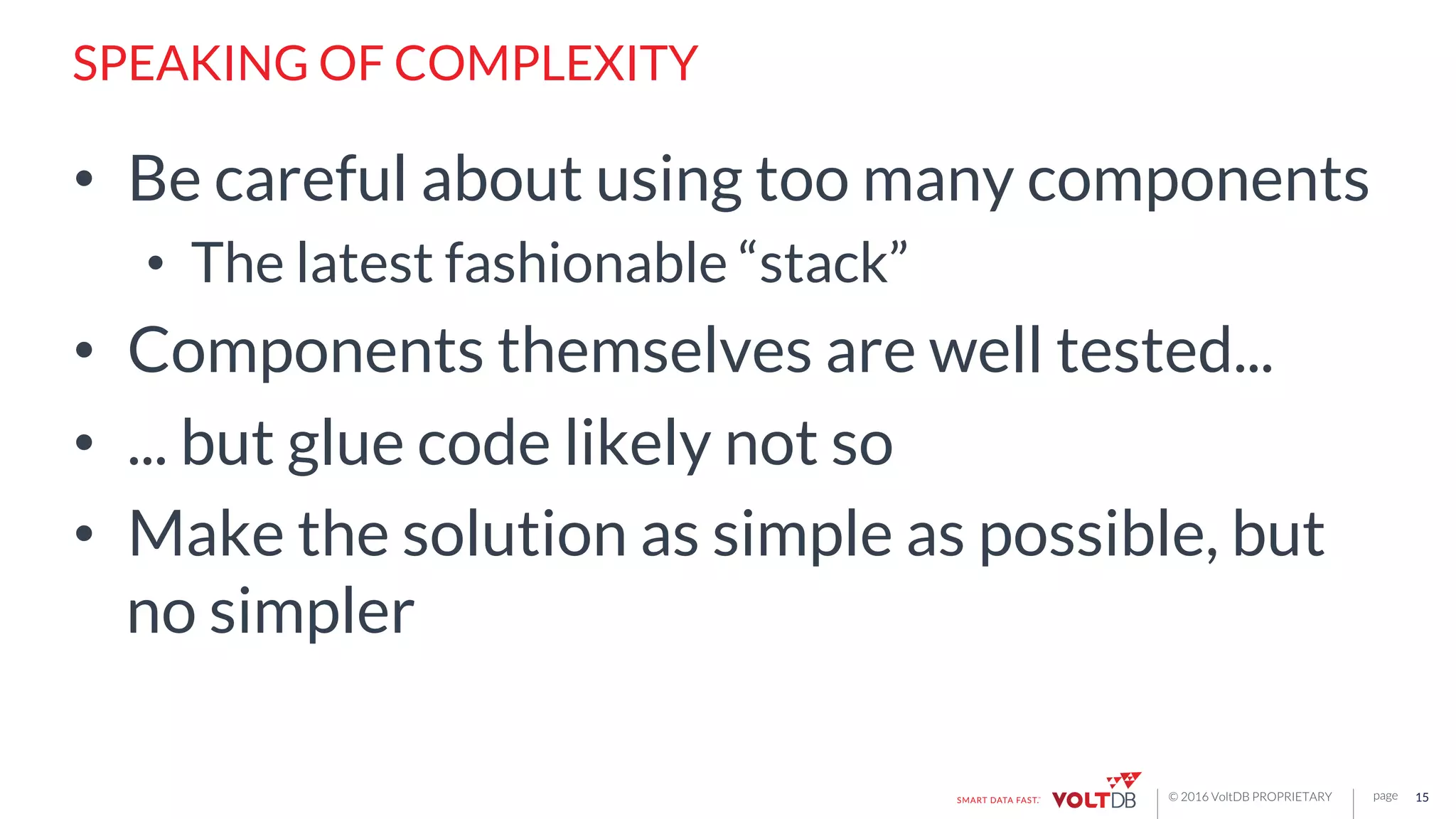
SPEAKING OF COMPLEXITY
•  Be careful about using too many components
•  The latest fashionable “stack”
•  Components themselves are well tested...
•  ... but glue code likely not so
•  Make the solution as simple as possible, but
no simpler
15
page© 2016 VoltDB PROPRIETARY
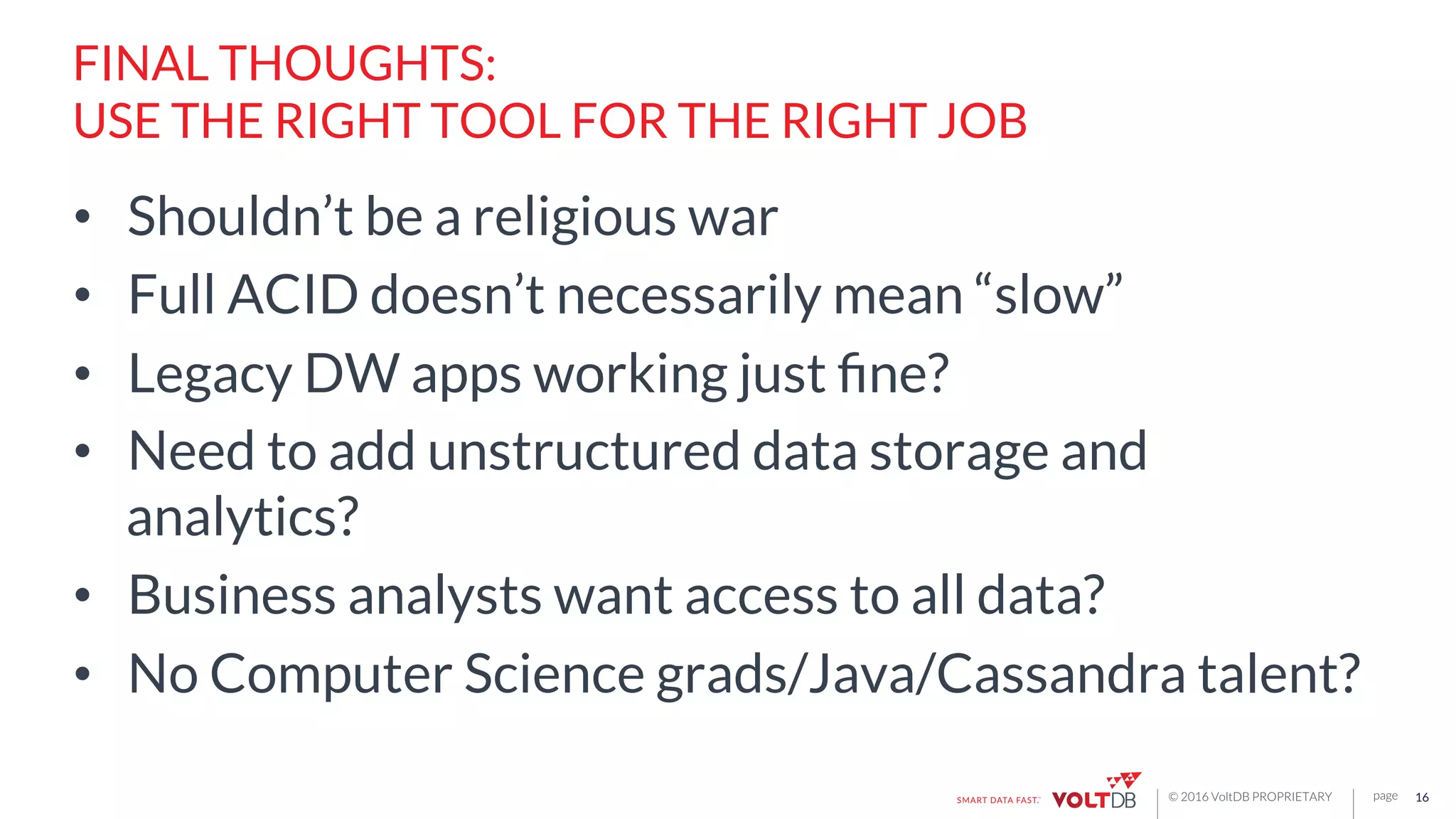
FINAL THOUGHTS:
USE THE RIGHT TOOL FOR THE RIGHT JOB
•  Shouldn’t be a religious war
•  Full ACID doesn’t necessarily mean “slow”
•  Legacy DW apps working just fine?
•  Need to add unstructured data storage and
analytics?
•  Business analysts want access to all data?
•  No Computer Science grads/Java/Cassandra talent?
16
page© 2016 VoltDB PROPRIETARY
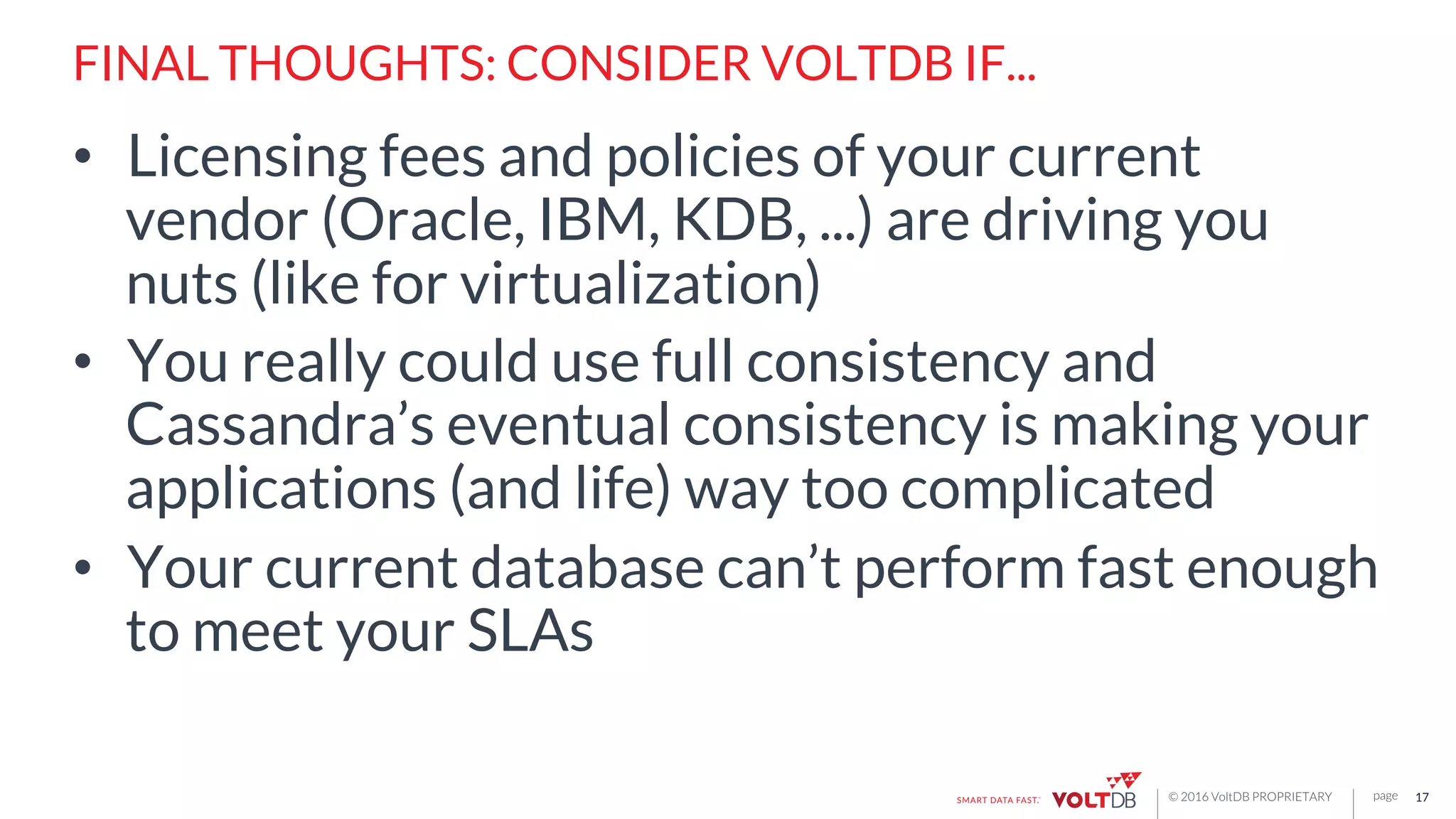
FINAL THOUGHTS: CONSIDER VOLTDB IF...
•  Licensing fees and policies of your current
vendor (Oracle, IBM, KDB, ...) are driving you
nuts (like for virtualization)
•  You really could use full consistency and
Cassandra’s eventual consistency is making your
applications (and life) way too complicated
•  Your current database can’t perform fast enough
to meet your SLAs
17

Why you really want SQL in a Real-Time Enterprise Environment

  • 1.
    page WHY YOU REALLYWANT SQL IN A REAL- TIME ENTERPRISE ENVIRONMENT
  • 2.
    page© 2016 VoltDBPROPRIETARY WHO YOU WILL BE HEARING 2   Dennis Duckworth, Director Product Marketing VoltDB David Rolfe, Director Solutions Engineering EMEA VoltDB See  it  here:  voltdb.com/webinars  
  • 3.
    page© 2016 VoltDBPROPRIETARY SQL OR NOSQL? THAT IS MANY QUESTIONS •  SQL = SQL Language •  SQL = Relational, Structured, Schema-on-Write •  Tables (Rows, Columns), Primary/Foreign Keys, Data Types, Constraints, Normal Form •  NoSQL = No! SQL or Not only SQL •  NoSQL = Schema-on-Read •  NoSQL = Variety of data (vs only structured) 3  
  • 4.
    page© 2016 VoltDBPROPRIETARY SQL OR NOSQL? THE REAL QUESTIONS •  How do you access the data? •  How do you store the data? •  Which do you use for a particular application: •  [Old]SQL •  NoSQL •  NewSQL 4  
  • 5.
    page© 2016 VoltDBPROPRIETARY HOW DO YOU ACCESS THE DATA? Who knew the future of NoSQL was SQL? Alistair  Croll,  Co-­‐Chair   Strata  Conference,  February  2013   5
  • 6.
    page© 2016 VoltDBPROPRIETARY HOW DO YOU ACCESS THE DATA? •  Key reasons for using SQL (language) •  Familiarity •  Lingua Franca of business analytics •  Productivity •  Declarative (allows optimization by system) •  Portable 6
  • 7.
    page© 2016 VoltDBPROPRIETARY HOW DO YOU STORE THE DATA? •  Now that’s a question! 7
  • 8.
    page© 2016 VoltDBPROPRIETARY ORIGINAL DRIVERS FOR NOSQL MOVEMENT •  Need to handle web-scale user base •  Scale out on cheap hw, not scale up on pricey hw •  Write it all reliably, make sense out of it later •  Lower TCO and $/TB for large DWs •  $40K+/TB down to < $1K/TB •  Need to store and process unstructured data •  Big driver for Open Source 8  
  • 9.
    page© 2016 VoltDBPROPRIETARY TWO DIFFERENT APPROACHES: NOSQL AND NEWSQL •  NoSQL – traditional RDBMS can’t scale so throw them out and start new, building from scratch •  NewSQL – traditional RDBMS can’t scale but there are critical/important elements to them so see what can be eliminated to let them scale with high performance 9
  • 10.
    page© 2016 VoltDBPROPRIETARY PROBLEMS WITH LEGACY DATABASE SYSTEMS •  You will be slow if you try to do too much •  Legacy DBs got slow because they added too much stuff/complexity/baggage to their code •  Try to be everything to everyone •  One system for both OLTP and OLAP? Both equally poorly •  They scale up – add bigger/faster/more expensive machine •  Designed/created when “cloud” meant water vapor 10
  • 11.
    page© 2016 VoltDBPROPRIETARY POTENTIAL PROBLEMS WITH NEW DATABASE SYSTEMS •  You can be real fast if you do very little •  Alternative solutions try to do fewer things really well (and fast) •  But be careful of those that do too little •  Like questionable “durability” •  http://www.mongodb-is-web-scale.com 11
  • 12.
    page© 2016 VoltDBPROPRIETARY NOSQL FALLACIES •  Big Data = Hadoop •  Anything from Facebook | Twitter | LinkedIn | Google | Yahoo *must* be really good and perfect for me •  Web scale means NoSQL •  RDBMS’s just can’t handle it 12
  • 13.
    page© 2016 VoltDBPROPRIETARY THREE QUESTIONS TO HELP YOU DECIDE •  What type of data? •  Structured, Unstructured, Both •  Who will be doing the analytics/queries? •  Business Analysts? => SQL good choice •  Computer Science Grads? => Python, Java, Scala •  What Other Data Management Systems are being used? 13  
  • 14.
    page© 2016 VoltDBPROPRIETARY WHY ACID MAKES LIFE EASIER? •  ACID vs CAP vs BASE •  Availability Consistency Isolation Durability •  Consistency Availability Partition Tolerance •  Basically Available Soft State Eventual Consistency •  Lack of strict ACID = Application Complexity •  Be aware of evolving needs/requirements and emerging complexity 14
  • 15.
    page© 2016 VoltDBPROPRIETARY SPEAKING OF COMPLEXITY •  Be careful about using too many components •  The latest fashionable “stack” •  Components themselves are well tested... •  ... but glue code likely not so •  Make the solution as simple as possible, but no simpler 15
  • 16.
    page© 2016 VoltDBPROPRIETARY FINAL THOUGHTS: USE THE RIGHT TOOL FOR THE RIGHT JOB •  Shouldn’t be a religious war •  Full ACID doesn’t necessarily mean “slow” •  Legacy DW apps working just fine? •  Need to add unstructured data storage and analytics? •  Business analysts want access to all data? •  No Computer Science grads/Java/Cassandra talent? 16
  • 17.
    page© 2016 VoltDBPROPRIETARY FINAL THOUGHTS: CONSIDER VOLTDB IF... •  Licensing fees and policies of your current vendor (Oracle, IBM, KDB, ...) are driving you nuts (like for virtualization) •  You really could use full consistency and Cassandra’s eventual consistency is making your applications (and life) way too complicated •  Your current database can’t perform fast enough to meet your SLAs 17