Comprehensive Tobacco
Prevention and Cessation Programs
Work!
They Save Lives, Save Money
State-specific data needed to customize this presentation can be
found at http://www.tobaccofreekids.org/ or by sending an email to
info@tobaccofreekids.org
• Tobacco use is the leading preventable cause of health
problems and health care costs in [STATE]
• The Tobacco Industry continues to aggressively market
and promote their products and oppose real policy
change
• Comprehensive tobacco prevention and cessation
programs are evidence-based and work when
adequately funded
• States have not addressed the problem adequately
despite the opportunity provided by the MSA
Four Key Points
TOBACCO’S TOLL
IN [STATE NAME]
• X,XXX tobacco-related deaths annually
• XX,XXX additional kids become regular
daily smokers every year
• XXX,XXX kids alive today will die from
tobacco use
• XX% of [STATE] high school students are
current smokers
• XX% of [STATE] adults are current
smokers
TOBACCO’S TOLL
IN [STATE NAME]
• $XX million in annual health care costs
related to tobacco use
• $XX million in Medicaid costs alone
• [STATE] taxpayers pay $XXX per
household to treat tobacco related
disease
Now The Tobacco Industry
Claims It Has Changed...
… BUT
Big Tobacco is
• Still Marketing to Kids &
Targeting Young Adults
• Still Lying About Their
Products and Introducing New
Ones
• Still Opposing Real Policy
Change
• Still Attacking Real Prevention
Programs and Promoting
Phony Ones
Domestic Cigarette Advertising and
Promotional Expenditures 1998 - 2005
(Billions of dollars)
0
2
4
6
8
10
12
14
16
18
1998 1999 2000 2001 2002 2003 2004 2005 2006
Source: Federal Trade Commission Cigarette Report for 2006
$6.73
$8.24
$9.59
$11.22
$12.47
$15.15
$14.15
$13.11
$12.49
“From the 1950s to the
Present, Different
Defendants, at Different
Times and Using
Different Methods, Have
Intentionally Marketed
to Young People Under
the Age of Twenty-One
in Order to Recruit
“Replacement
Smokers” to Ensure the
Economic Future of the
Tobacco Industry”
“The trial record amply
demonstrates that
Defendants have made
false, deceptive, and
misleading public
statements about
cigarettes and smoking
from at least January
1954, when the Frank
Statement was published
up until the present.”
“Defendants continue to
make affirmative
statements on smoking
and health issues that
are fraudulent.”
Increased Nicotine Levels in Cigarettes
Average Nicotine Yields Per Cigarette 1998-2004
MA Tobacco Control Program analysis, 2006
1.71
1.81
1.83
1.89
1.841.85
1.72
1.6
1.65
1.7
1.75
1.8
1.85
1.9
1.95
1998 1999 2000 2001 2002 2003 2004
Year
Milligramspercigarette
9.9% increase from 1998 to 2004
WE HAVE THE SOLUTION
COMPREHENSIVE
PREVENTION & CESSATION
PROGRAMS
Comprehensive Programs
Essential Elements
• Community-Based Programs
• Public Education (Media)
• Helping Smokers Quit
• School-Based Programs
• Enforcement
• Evaluation
Must be well-funded and sustained
Insert slides that describe what
programs and counter-marketing
campaigns YOUR PROGRAM funds
in your community and schools
Comprehensive State Programs
1. Community Based Programs
Comprehensive State Programs
2. Public Education -- Counter Marketing
Comprehensive State Programs
3. Programs to Help Smokers Quit
Comprehensive State Programs
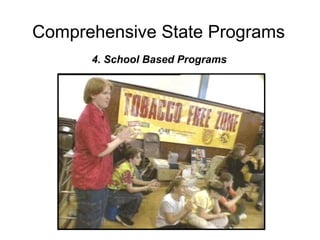
4. School Based Programs
Comprehensive State Programs
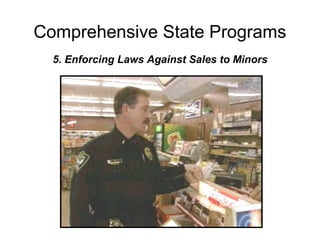
5. Enforcing Laws Against Sales to Minors
EVALUATION
Rigorous evaluation is crucial for:
• Accountability
• Continuous program improvement
• Demonstration of program success
Here’s How [STATE] Would Spend
Additional Money:
• Expansion of cessation services?
• Additional community-based programs?
• Comprehensive public education
campaign?
Be sure to know how you would spend any
additional dollars – you WILL get asked
this question
Comprehensive Programs WORK!
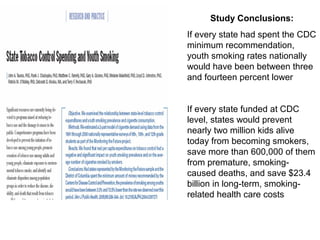
Study Conclusions:
If every state had spent the CDC
minimum recommendation,
youth smoking rates nationally
would have been between three
and fourteen percent lower
If every state funded at CDC
level, states would prevent
nearly two million kids alive
today from becoming smokers,
save more than 600,000 of them
from premature, smoking-
caused deaths, and save $23.4
billion in long-term, smoking-
related health care costs
Reductions in
tobacco smoking are
major factor in the
decrease in cancer
mortality rates
Sustained progress in tobacco
control is essential if we are to
continue to make progress
against cancer.
Comprehensive Programs Help
Adult Smokers Quit
Massachusetts:
Cut adult
smoking by 21%
between
1993 and
2000
California: Cut
adult smoking by
35% between
1988 and 2007
Maine: Cut
adult
smoking by
12.5% b/t
2001 and
2004
WA: Cut adult
smoking by
30% between
1999 and 2008
New York:
cut adult
smoking by
22.6%
between
2000 and
2008
Comprehensive Programs
Reduce Youth Smoking
Maine: Cut
high school
smoking by
64% b/w
1997 and 2007
Mississippi: Cut
smoking among
public middle school
students by
48% in 5 years
Ohio: Cut high
school
smoking by
45% b/w 1999
and 2003
WA: Cut
youth
smoking by
50% b/w
2000 and
2006
IN: Cut high
school
smoking by
42% b/w
2000 and
2008
Comprehensive Programs Work
Saves Money for Taxpayers
California:
Saving more than $3 in
direct health costs
for every dollar
spent on tobacco prevention
Massachusetts:
Saved $2 in direct
health costs for
every dollar
spent on tobacco
prevention
Comprehensive Programs Work
Saves Lives
California:
Studies show program
prevented tens of thousands
of deaths from heart
disease and lung
cancer due to smoking
What Have We Achieved in
[State]?
Insert Your STATE’s declines in
youth and adult smoking
Adult Smoking Declines in
[STATE]: Insert your state’s data
10
12
14
16
18
20
22
24
26
28
30
2002 2004
Smokingprevalence
25.0%
22.7%
These declines mean:
• More than xxx,xxx adults have stopped smoking
• $xxx million in tobacco-related healthcare costs have been saved
9% decline
Data are from the BRFSS
Youth Smoking Declines in
[STATE]: Insert your state’s data
10
12
14
16
18
20
22
24
26
28
30
2000 2002
Smokingprevalence
27.6%
23.1%
These declines mean the program has prevented:
• XXX,XXX fewer youth from ever beginning to smoke
• XX,XXX fewer youth from dying from tobacco-related disease
16% decline
Data are from the Youth Tobacco Survey
We Are NOT Addressing
the Problem
FY2009 Tobacco Money
for Tobacco Prevention
in [INSERT YOUR STATE]
0
200
400
600
800
1000
1200
1400
1600
Total State Tobacco
Revenues
CDC Minimum
Prevention
Spending
Actual State
Tobacco Prevention
Spending
Million
$65.6 Million $32.9 Million
$ 1.38 Billion
$1.03 Billion
Tobacco Tax
Revenues
$351 Million
Tobacco
Settlement
Revenues
And the tobacco industry
spends $XXX per YEAR,
marketing its products
in [STATE]
WE KNOW WE HAVE A PROBLEM
• Not an evidence problem – we have
evidence-based solution
• Not really a revenue problem – we
have the revenue to fund program
• It’s a political problem – we need
the POLITICAL WILL to fund
programs
THE TIME TO ACT IS NOW!!!
• Tobacco remains by far the number one
preventable cause of death and disease
• The tobacco industry HAS NOT CHANGED AND
IS NOT GOING AWAY – they continue to find
ways to reach kids and keep adult smokers
hooked
• Comprehensive, well-funded prevention and
cessation programs will protect our kids, Save
Lives and Save Money

Why states should fund comprehensive tc programs

  • 1.
    Comprehensive Tobacco Prevention andCessation Programs Work! They Save Lives, Save Money State-specific data needed to customize this presentation can be found at http://www.tobaccofreekids.org/ or by sending an email to info@tobaccofreekids.org
  • 2.
    • Tobacco useis the leading preventable cause of health problems and health care costs in [STATE] • The Tobacco Industry continues to aggressively market and promote their products and oppose real policy change • Comprehensive tobacco prevention and cessation programs are evidence-based and work when adequately funded • States have not addressed the problem adequately despite the opportunity provided by the MSA Four Key Points
  • 3.
    TOBACCO’S TOLL IN [STATENAME] • X,XXX tobacco-related deaths annually • XX,XXX additional kids become regular daily smokers every year • XXX,XXX kids alive today will die from tobacco use • XX% of [STATE] high school students are current smokers • XX% of [STATE] adults are current smokers
  • 4.
    TOBACCO’S TOLL IN [STATENAME] • $XX million in annual health care costs related to tobacco use • $XX million in Medicaid costs alone • [STATE] taxpayers pay $XXX per household to treat tobacco related disease
  • 5.
    Now The TobaccoIndustry Claims It Has Changed...
  • 6.
    … BUT Big Tobaccois • Still Marketing to Kids & Targeting Young Adults • Still Lying About Their Products and Introducing New Ones • Still Opposing Real Policy Change • Still Attacking Real Prevention Programs and Promoting Phony Ones
  • 7.
    Domestic Cigarette Advertisingand Promotional Expenditures 1998 - 2005 (Billions of dollars) 0 2 4 6 8 10 12 14 16 18 1998 1999 2000 2001 2002 2003 2004 2005 2006 Source: Federal Trade Commission Cigarette Report for 2006 $6.73 $8.24 $9.59 $11.22 $12.47 $15.15 $14.15 $13.11 $12.49
  • 8.
    “From the 1950sto the Present, Different Defendants, at Different Times and Using Different Methods, Have Intentionally Marketed to Young People Under the Age of Twenty-One in Order to Recruit “Replacement Smokers” to Ensure the Economic Future of the Tobacco Industry”
  • 9.
    “The trial recordamply demonstrates that Defendants have made false, deceptive, and misleading public statements about cigarettes and smoking from at least January 1954, when the Frank Statement was published up until the present.” “Defendants continue to make affirmative statements on smoking and health issues that are fraudulent.”
  • 10.
    Increased Nicotine Levelsin Cigarettes Average Nicotine Yields Per Cigarette 1998-2004 MA Tobacco Control Program analysis, 2006 1.71 1.81 1.83 1.89 1.841.85 1.72 1.6 1.65 1.7 1.75 1.8 1.85 1.9 1.95 1998 1999 2000 2001 2002 2003 2004 Year Milligramspercigarette 9.9% increase from 1998 to 2004
  • 11.
    WE HAVE THESOLUTION COMPREHENSIVE PREVENTION & CESSATION PROGRAMS
  • 12.
    Comprehensive Programs Essential Elements •Community-Based Programs • Public Education (Media) • Helping Smokers Quit • School-Based Programs • Enforcement • Evaluation Must be well-funded and sustained
  • 13.
    Insert slides thatdescribe what programs and counter-marketing campaigns YOUR PROGRAM funds in your community and schools
  • 14.
    Comprehensive State Programs 1.Community Based Programs
  • 15.
    Comprehensive State Programs 2.Public Education -- Counter Marketing
  • 16.
    Comprehensive State Programs 3.Programs to Help Smokers Quit
  • 17.
    Comprehensive State Programs 4.School Based Programs
  • 18.
    Comprehensive State Programs 5.Enforcing Laws Against Sales to Minors
  • 19.
    EVALUATION Rigorous evaluation iscrucial for: • Accountability • Continuous program improvement • Demonstration of program success
  • 20.
    Here’s How [STATE]Would Spend Additional Money: • Expansion of cessation services? • Additional community-based programs? • Comprehensive public education campaign? Be sure to know how you would spend any additional dollars – you WILL get asked this question
  • 21.
  • 22.
    Study Conclusions: If everystate had spent the CDC minimum recommendation, youth smoking rates nationally would have been between three and fourteen percent lower If every state funded at CDC level, states would prevent nearly two million kids alive today from becoming smokers, save more than 600,000 of them from premature, smoking- caused deaths, and save $23.4 billion in long-term, smoking- related health care costs
  • 23.
    Reductions in tobacco smokingare major factor in the decrease in cancer mortality rates Sustained progress in tobacco control is essential if we are to continue to make progress against cancer.
  • 24.
    Comprehensive Programs Help AdultSmokers Quit Massachusetts: Cut adult smoking by 21% between 1993 and 2000 California: Cut adult smoking by 35% between 1988 and 2007 Maine: Cut adult smoking by 12.5% b/t 2001 and 2004 WA: Cut adult smoking by 30% between 1999 and 2008 New York: cut adult smoking by 22.6% between 2000 and 2008
  • 25.
    Comprehensive Programs Reduce YouthSmoking Maine: Cut high school smoking by 64% b/w 1997 and 2007 Mississippi: Cut smoking among public middle school students by 48% in 5 years Ohio: Cut high school smoking by 45% b/w 1999 and 2003 WA: Cut youth smoking by 50% b/w 2000 and 2006 IN: Cut high school smoking by 42% b/w 2000 and 2008
  • 26.
    Comprehensive Programs Work SavesMoney for Taxpayers California: Saving more than $3 in direct health costs for every dollar spent on tobacco prevention Massachusetts: Saved $2 in direct health costs for every dollar spent on tobacco prevention
  • 27.
    Comprehensive Programs Work SavesLives California: Studies show program prevented tens of thousands of deaths from heart disease and lung cancer due to smoking
  • 28.
    What Have WeAchieved in [State]? Insert Your STATE’s declines in youth and adult smoking
  • 29.
    Adult Smoking Declinesin [STATE]: Insert your state’s data 10 12 14 16 18 20 22 24 26 28 30 2002 2004 Smokingprevalence 25.0% 22.7% These declines mean: • More than xxx,xxx adults have stopped smoking • $xxx million in tobacco-related healthcare costs have been saved 9% decline Data are from the BRFSS
  • 30.
    Youth Smoking Declinesin [STATE]: Insert your state’s data 10 12 14 16 18 20 22 24 26 28 30 2000 2002 Smokingprevalence 27.6% 23.1% These declines mean the program has prevented: • XXX,XXX fewer youth from ever beginning to smoke • XX,XXX fewer youth from dying from tobacco-related disease 16% decline Data are from the Youth Tobacco Survey
  • 31.
    We Are NOTAddressing the Problem
  • 32.
    FY2009 Tobacco Money forTobacco Prevention in [INSERT YOUR STATE] 0 200 400 600 800 1000 1200 1400 1600 Total State Tobacco Revenues CDC Minimum Prevention Spending Actual State Tobacco Prevention Spending Million $65.6 Million $32.9 Million $ 1.38 Billion $1.03 Billion Tobacco Tax Revenues $351 Million Tobacco Settlement Revenues
  • 33.
    And the tobaccoindustry spends $XXX per YEAR, marketing its products in [STATE]
  • 34.
    WE KNOW WEHAVE A PROBLEM • Not an evidence problem – we have evidence-based solution • Not really a revenue problem – we have the revenue to fund program • It’s a political problem – we need the POLITICAL WILL to fund programs
  • 35.
    THE TIME TOACT IS NOW!!! • Tobacco remains by far the number one preventable cause of death and disease • The tobacco industry HAS NOT CHANGED AND IS NOT GOING AWAY – they continue to find ways to reach kids and keep adult smokers hooked • Comprehensive, well-funded prevention and cessation programs will protect our kids, Save Lives and Save Money

Editor's Notes

  • #3 <number>
  • #4 <number>
  • #5 <number>
  • #9 In August, 2006 the tobacco industry was found guilty of lying to the American people and marketing their deadly and addictive products to children. These quotes come from the Judge’s Final Order.
  • #11 A new report from the Massachusetts Department of Health finds that tobacco companies secretly and significantly increased the levels of nicotine in cigarette smoke between 1998 and 2004.
  • #13 <number> Comprehensive tobacco prevention and cessation programs prevent kids from starting to smoking, help adult smokers quit, educate the public, the media and policymakers about policies that reduce tobacco use, address disparities, and serve as a counter to the ever-present tobacco industry. The CDC recommends that states establish tobacco control programs that are comprehensive, sustainable, and accountable and include the following programmatic elements: public education efforts, community and school based programs, cessation programs, enforcement efforts, and monitoring and evaluation
  • #15 <number> First is community programs to reach people where they live, play, work and worship with prevention and cessation programs. Community programs include grants to community organizations, faith groups, schools, local businesses, and other local partners Have strict criteria for eligibility, accountability, and conflict of interest
  • #16 <number> The second of these components is public education to fight the $15 billion the tobacco industry spends to market cigarettes and make them so appealing. Elements of public education – include multiple media (radio, print, TV), as well as public relations and special events
  • #17 <number> Third is to have programs to help smokers quit. Most smokers want to stop, but because cigarettes are so addictive, without help in quitting many won’t be able to do so.
  • #18 <number> The fourth component involves school based programs. School based programs develop and enforce school tobacco policy, address consequences, social influences and peer norms, and teach refusal skills and media literacy.
  • #19 <number> Finally, enforcement of laws against sales to minors is critical in keeping cigarettes out of the hands of kids. States should perform frequent compliance checks, with goal of 95% compliance. Enforcement should include meaningful fines and ultimately license suspension for repeat offenders.
  • #20 <number>
  • #25 <number>
  • #26 <number>
  • #27 <number>
  • #28 <number>
  • #30 Highlight your state’s accomplishments with charts like these.
  • #32 <number> Although the toll from tobacco is enormously high, we have not addressed the problem adequately.
  • #33 This slide shows the amount of tobacco revenue our state receives annually from the tobacco settlement and tax revenue. You can see that we receive an enormous amount of money, but only spend a pittance of it on our state tobacco control program. We still have a ways to go to reach CDC’s recommended minimum level.
  • #36 <number>