By: Sandra Mansueto
Index
I. Introduction and Problem Statement
II. Medical Aspect
III. Proposed Strategy for Improved Disease
Control
IV. Potential Barriers to Implementation of
Strategy
V. Discussion and Conclusions
Alcoholism
• Gaining Control of an Uncontrolled Problem
In America
• Problem Statement
• Introduction
U.S. Alcohol Abuse is a Public Health Dilemma
• 50% of Americans Drink Alcohol
• 14 Million Americans are Alcoholics
• 100,000 Alcohol Related deaths yearly
• $179 Billion alcohol expenditures yearly
USHHS (2009) (Grant et al. 1997; Census, 2010
).
(NIAAA, 2006)
Medical Aspect
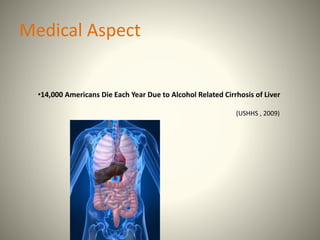
•14,000 Americans Die Each Year Due to Alcohol Related Cirrhosis of Liver
(USHHS , 2009)
Effects
Alcohol dependency leads to:
•Health complications
•Family Crisis
•Financial Issues
•Mental Health Issues
•Violence
•Strain on Economy
•Community Disparities
(Nag, 2008)
Causes
•Genetics (Haughey, 2008)
•Family History (Chena,2010)
•Gender (Greenfield 2000).
•Culture (Heath, 1995)
•Underage Drinking (Clark, 2010)
Current Strategies for Controlling
Alcohol Use
•Limiting Access (Middleton, 2010)
•Cognitive Therapy (Fadardi, 2006)
•The Epidemiological Triangle (Miller, 1993)
•Screening (Cunningham, 2010).
•Intervention (Cunningham, 2010)
Need For Change
Most Current Alcohol Strategies use disease model
Problem: Fails to treat the WHOLE person
Does not consider:
Environmental – Genetics –
Family History – Culture –
Mental Health - Behavior.
(Miller,1993)
continued
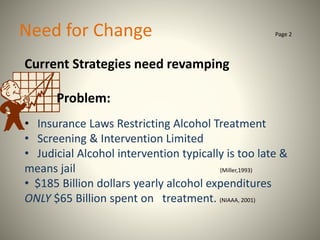
Need for Change Page 2
Current Strategies need revamping
Problem:
• Insurance Laws Restricting Alcohol Treatment
• Screening & Intervention Limited
• Judicial Alcohol intervention typically is too late &
means jail (Miller,1993)
• $185 Billion dollars yearly alcohol expenditures
ONLY $65 Billion spent on treatment. (NIAAA, 2001)
Proposed Strategy
Federal Policies: Emergency Room & Police - Alcohol
Screening & Intervention
•Create new polices
•Train professionals
•Implement
(Cunningham, 2010)
Barriers
•Insurance Laws - Limiting Claim Benefits (chezem, 2004)
•Public Health Priority- Police maintain order (Deflem, 1997)
•Institutional Barrier- Less then 10% ER screen (chezem, 2004)
•Teen Drinking Culture – Underage Drinking (Green, 2006)
•Society Views – American way of life (Frances, 1980)
•Lucrative Alcohol Industry -$115 Billion a year in sales (AMA. 2002)
Overcoming Barriers
Push for Expansion on General Guidelines that restrict Insurance
Companies from denying Alcohol related Claims(Chezman, 2004)
Educate Institutions & Professionals on Alcohol Screenings (NIAAA,
2005)
Revamp Screening Tools To Fit Needs Effectively (Cunningham, 2010)
Initiate & Promote Education to Youths Health Offices & Police
Interactions
Initiate Education & Screening on Reservations & Minority Communities
(Fadardi, 2006)
Outcome Prospective
•Lower Alcohol Consumption of Youth In The United States
•Lower Alcohol Related Disparities in The United States
•Decrease $178 Billion spending on Alcohol Related Issues
•Decrease Alcohol Related Incidences: Suicide-Murder-
Violence-Crime
•Decrease Alcohol Related Mortality Rate in The United
States
•Treat the whole persona affected by alcohol using the
Epidemiological Triangle
References
ref.docx

Aa

  • 1.
  • 2.
    Index I. Introduction andProblem Statement II. Medical Aspect III. Proposed Strategy for Improved Disease Control IV. Potential Barriers to Implementation of Strategy V. Discussion and Conclusions
  • 3.
    Alcoholism • Gaining Controlof an Uncontrolled Problem In America • Problem Statement
  • 4.
    • Introduction U.S. AlcoholAbuse is a Public Health Dilemma • 50% of Americans Drink Alcohol • 14 Million Americans are Alcoholics • 100,000 Alcohol Related deaths yearly • $179 Billion alcohol expenditures yearly USHHS (2009) (Grant et al. 1997; Census, 2010 ). (NIAAA, 2006)
  • 5.
    Medical Aspect •14,000 AmericansDie Each Year Due to Alcohol Related Cirrhosis of Liver (USHHS , 2009)
  • 6.
    Effects Alcohol dependency leadsto: •Health complications •Family Crisis •Financial Issues •Mental Health Issues •Violence •Strain on Economy •Community Disparities (Nag, 2008)
  • 7.
    Causes •Genetics (Haughey, 2008) •FamilyHistory (Chena,2010) •Gender (Greenfield 2000). •Culture (Heath, 1995) •Underage Drinking (Clark, 2010)
  • 8.
    Current Strategies forControlling Alcohol Use •Limiting Access (Middleton, 2010) •Cognitive Therapy (Fadardi, 2006) •The Epidemiological Triangle (Miller, 1993) •Screening (Cunningham, 2010). •Intervention (Cunningham, 2010)
  • 9.
    Need For Change MostCurrent Alcohol Strategies use disease model Problem: Fails to treat the WHOLE person Does not consider: Environmental – Genetics – Family History – Culture – Mental Health - Behavior. (Miller,1993) continued
  • 10.
    Need for ChangePage 2 Current Strategies need revamping Problem: • Insurance Laws Restricting Alcohol Treatment • Screening & Intervention Limited • Judicial Alcohol intervention typically is too late & means jail (Miller,1993) • $185 Billion dollars yearly alcohol expenditures ONLY $65 Billion spent on treatment. (NIAAA, 2001)
  • 11.
    Proposed Strategy Federal Policies:Emergency Room & Police - Alcohol Screening & Intervention •Create new polices •Train professionals •Implement (Cunningham, 2010)
  • 12.
    Barriers •Insurance Laws -Limiting Claim Benefits (chezem, 2004) •Public Health Priority- Police maintain order (Deflem, 1997) •Institutional Barrier- Less then 10% ER screen (chezem, 2004) •Teen Drinking Culture – Underage Drinking (Green, 2006) •Society Views – American way of life (Frances, 1980) •Lucrative Alcohol Industry -$115 Billion a year in sales (AMA. 2002)
  • 13.
    Overcoming Barriers Push forExpansion on General Guidelines that restrict Insurance Companies from denying Alcohol related Claims(Chezman, 2004) Educate Institutions & Professionals on Alcohol Screenings (NIAAA, 2005) Revamp Screening Tools To Fit Needs Effectively (Cunningham, 2010) Initiate & Promote Education to Youths Health Offices & Police Interactions Initiate Education & Screening on Reservations & Minority Communities (Fadardi, 2006)
  • 14.
    Outcome Prospective •Lower AlcoholConsumption of Youth In The United States •Lower Alcohol Related Disparities in The United States •Decrease $178 Billion spending on Alcohol Related Issues •Decrease Alcohol Related Incidences: Suicide-Murder- Violence-Crime •Decrease Alcohol Related Mortality Rate in The United States •Treat the whole persona affected by alcohol using the Epidemiological Triangle
  • 15.

Editor's Notes

  • #2 Topic
  • #3 Index
  • #4 Problem Statement
  • #16 Problems attaching reference list. Right Click and open hyperlink