Downloaded 11 times




![These three solutions are integrated
in PostGIS
- Geometry types for Points, LineStrings, Polygons, MultiPoints, MultiLineStrings, MultipPolygons and
GeometryCollections.
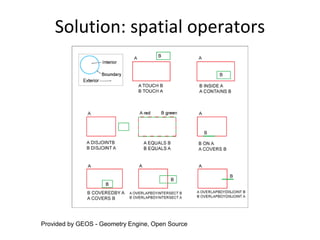
- Spatial predicates for determining the interactions of geometries using the 3x3 DE-9IM (provided by the GEOS
software library).
- Spatial operators for determining geospatial measurements like area, distance, length and perimeter.
- Spatial operators for determining geospatial set operations, like union, difference, symmetric difference and
buffers (provided by GEOS).
- R-tree-over-GiST (Generalized Search Tree) spatial indexes for high speed spatial querying.
- Index selectivity support, to provide high performance query plans for mixed spatial/non-spatial queries.
- For raster data, PostGIS WKT Raster (now integrated into PostGIS 2.0+ and renamed PostGIS Raster)
- The PostGIS implementation is based on "light-weight" geometries and indexes optimized to reduce disk and
memory footprint. Using light-weight geometries helps servers increase the amount of data migrated up from
physical disk storage into RAM, improving query performance substantially.
- PostGIS is registered as "implements the specified standard" for "Simple Features for SQL" by the OGC.[2]
PostGIS has not been certified as compliant by the OGC. For the OGC's definition of compliant, see What does
"Compliant" mean?.
Source: wikipedia](https://image.slidesharecdn.com/presentatiepostgis-161118080844/85/Why-is-postgis-awesome-16-320.jpg)


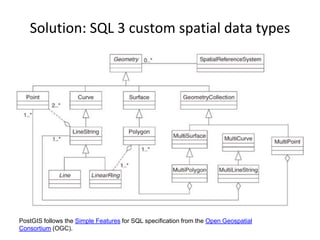
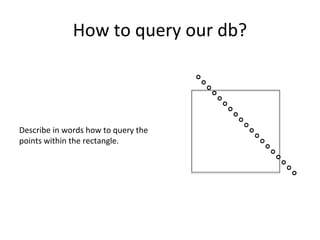
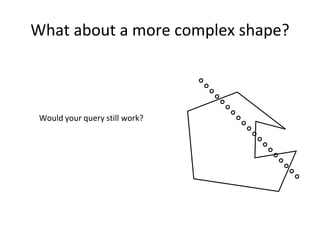
PostGIS is an open-source extension for SQL that addresses challenges in spatial data storage and querying by providing custom spatial data types and spatial operators for geometry manipulations. It integrates spatial indexes like R-trees for fast querying, improving performance for geospatial analysis. PostGIS follows the OGC's Simple Features for SQL specification, enhancing SQL capabilities with lightweight geometries and optimized indexes.


![[DSC Europe 25] Elena Menshikova - AI-Powered Operational Excellence: Revolut...](https://cdn.slidesharecdn.com/ss_thumbnails/es6nholbqy3zaao2c2yd-2-elena-menshikova-data-ai-in-decision-making-260115093812-4fba8b38-thumbnail.jpg?width=640&height=640&fit=bounds)


![[DSC Europe 25] Slobodan Dolinic - Smart and Intelligent Green Region.pptx](https://cdn.slidesharecdn.com/ss_thumbnails/0bribinjsp6ghwtvsvor-2-sigre-slobodan-dolinic-260115093812-c9c10e90-thumbnail.jpg?width=640&height=640&fit=bounds)


![[DSC Europe 25] Stefan Brankovic - #ResumeIsDead. AI-Powered Interviews and C...](https://cdn.slidesharecdn.com/ss_thumbnails/qnmbsv0xq3uysdrq3sev-2-stefan-brankovic-job-bolt-260114111931-a065aa3d-thumbnail.jpg?width=640&height=640&fit=bounds)
![[DSC Europe 25] Mijat Kustudic - Building Financial Intelligence with AI Agen...](https://cdn.slidesharecdn.com/ss_thumbnails/38y2lb5lse6wstegtvas-3-mijat-kustudic-building-financial-intelligence-with-ai-agents-260114111931-1a4783ce-thumbnail.jpg?width=640&height=640&fit=bounds)


