Functional Income inequality
and the post 2015 Agenda
Rolph van der Hoeven, ISS
DSA Conference Birmingham
16 November 2013
Session 25
Organised by the Broker
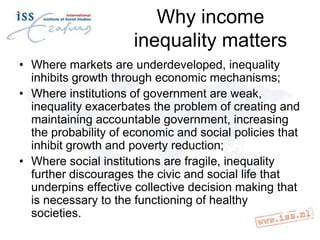
Why income
inequality matters
• Where markets are underdeveloped, inequality
inhibits growth through economic mechanisms;
• Where institutions of government are weak,
inequality exacerbates the problem of creating and
maintaining accountable government, increasing
the probability of economic and social policies that
inhibit growth and poverty reduction;
• Where social institutions are fragile, inequality
further discourages the civic and social life that
underpins effective collective decision making that
is necessary to the functioning of healthy
societies.
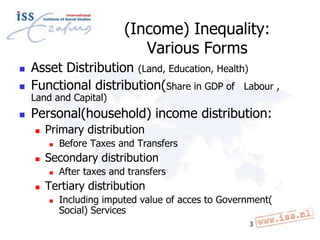
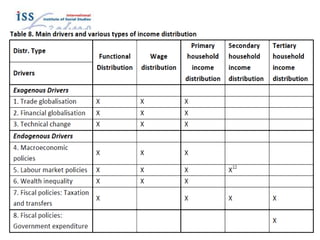
(Income) Inequality:
Various Forms


Asset Distribution (Land, Education, Health)
Functional distribution(Share in GDP of Labour ,



Personal(household) income distribution:



Land and Capital)



Primary distribution




Secondary distribution




Before Taxes and Transfers
After taxes and transfers

Tertiary distribution


Including imputed value of acces to Government(
Social) Services
3
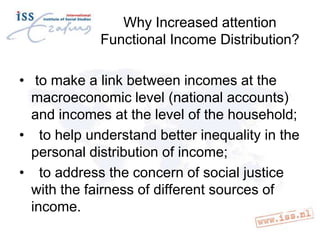
Why Increased attention
Functional Income Distribution?
• to make a link between incomes at the
macroeconomic level (national accounts)
and incomes at the level of the household;
• to help understand better inequality in the
personal distribution of income;
• to address the concern of social justice
with the fairness of different sources of
income.
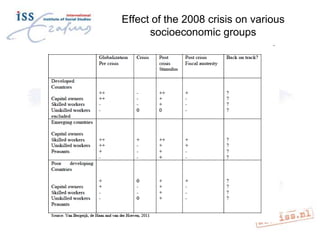
Effect of the 2008 crisis on various
socioeconomic groups
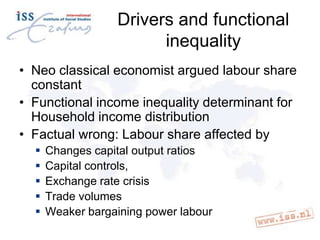
Drivers and functional
inequality
• Neo classical economist argued labour share
constant
• Functional income inequality determinant for
Household income distribution
• Factual wrong: Labour share affected by






Changes capital output ratios
Capital controls,
Exchange rate crisis
Trade volumes
Weaker bargaining power labour
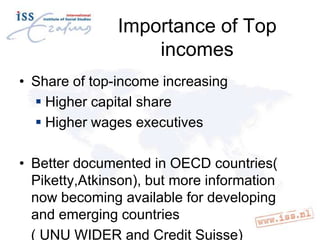
Importance of Top
incomes
• Share of top-income increasing
 Higher capital share
 Higher wages executives
• Better documented in OECD countries(
Piketty,Atkinson), but more information
now becoming available for developing
and emerging countries
( UNU WIDER and Credit Suisse)
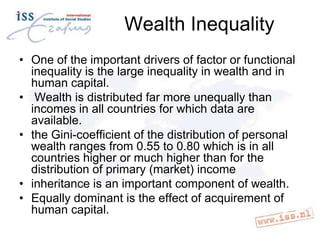
Wealth Inequality
• One of the important drivers of factor or functional
inequality is the large inequality in wealth and in
human capital.
• Wealth is distributed far more unequally than
incomes in all countries for which data are
available.
• the Gini-coefficient of the distribution of personal
wealth ranges from 0.55 to 0.80 which is in all
countries higher or much higher than for the
distribution of primary (market) income
• inheritance is an important component of wealth.
• Equally dominant is the effect of acquirement of
human capital.
Decline in wage share in both developed
and developing countries
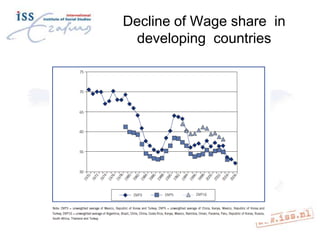
Decline of Wage share in
developing countries
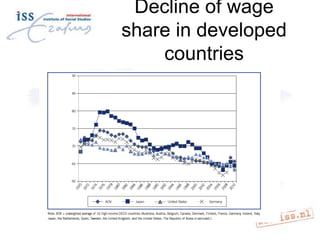
Decline of wage
share in developed
countries
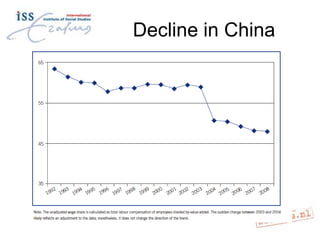
Decline in China
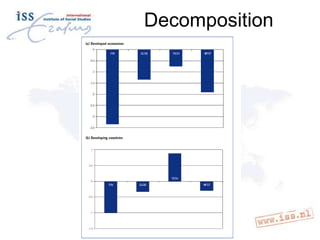
Decomposition
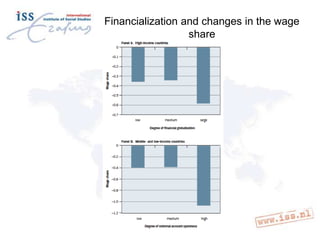
Financialization and changes in the wage
share
Wage inequality
share of wages in National income declined but
also the distribution of wages themselves has
also become more unequal
Consequence of mix of openness, skill
premiums and institutional factors ( incl.
gender)
Schooling often not able to offset
Tinbergen theory of 1975 race between
technology and education relevant again
Macro Polices and
Functional Inequality
Macro Economic policies:
• preventing crises (from external shocks) is achieved by
controlling foreign indebtedness, controls on portfolio flows, a
managed exchange rate regime) and macro prudential
banking regulation.
• ensuring a reasonable macroeconomic balance (low inflation,
control of aggregate demand with employment and
distributive concerns) is achieved by a balanced current
account policy, countercyclical fiscal policies( with social
safety nets as automatic stabilizers), greater use of
progressive taxation as well as moderate ,countercyclical
monetary policy.
• promoting equitable growth is achieved by a managed
exchange regime, managed open trade policy and fiscal
policy.
Example of Latin American
path ways ( Cornia )
• The ‘competitive real exchange rateunemployment reduction-inequality pathway.

• The higher taxation-redistribution pathway.
• The growth-inequality pathway.

• The prevention of external crises - lower instability
– inequality pathway.
• The banking regulation- domestic banking
stability-inequality pathway.
In Short
Financialization and skills based technical change have been important
drivers of functional and wage inequality. These drivers have in various
cases also strengthened existing patterns of inequality through a still
stubbornly high wealth inequality and through intergenerational
transfers of inequality through skewed access to higher-level education.
National policies, including the a strengthening of institutions to deal
with inequality can be important drivers of income distribution. Several
countries in Europe manage to drive a high primary income distribution
down to a modest or low level of secondary and tertiary income
distribution, however functional inequality is increasing and
redistributive policies are weakening

Various Latin American countries have been able to arrest the upward
trend of growing inequality and to drive inequality in the region( the
highest in the world ) down to lower, but still at yet high levels of
inequality. They used an extended mix of macro economic, exchange
rate , structural and social policies to that end.
Post 2015 development
agenda goal on inequality
• Inequality target based on Palma ratio:
• Ratio share top 10 % income earners to
the bottom 40%
• Full equality 0.25 but for more equal
societies around 1.
• In unequal society ratio can go up to 7
HLP report (spring 2013)
When everyone, irrespective of household income, gender, location, ethnicity,
age, or disability, has access to health, nutrition, education, and other vital
services, many of the worst effects of inequality will be over (p.16).
The report looks at inequality purely from a supply side argument and fails
to recognise the importance of economic and social transformation in
bringing about employment and income equality
Furthermore for emerging and developed economies the issue of inequality
is perhaps more important than the issue of poverty alleviation. It remains
thus important to include a goal on reducing inequality, with appropriate
indicators, in a post 2105 system

Functional Income inequality and the post 2015 Agenda - presentation by Rolph van der Hoeven

  • 1.
    Functional Income inequality andthe post 2015 Agenda Rolph van der Hoeven, ISS DSA Conference Birmingham 16 November 2013 Session 25 Organised by the Broker
  • 2.
    Why income inequality matters •Where markets are underdeveloped, inequality inhibits growth through economic mechanisms; • Where institutions of government are weak, inequality exacerbates the problem of creating and maintaining accountable government, increasing the probability of economic and social policies that inhibit growth and poverty reduction; • Where social institutions are fragile, inequality further discourages the civic and social life that underpins effective collective decision making that is necessary to the functioning of healthy societies.
  • 3.
    (Income) Inequality: Various Forms  AssetDistribution (Land, Education, Health) Functional distribution(Share in GDP of Labour ,  Personal(household) income distribution:  Land and Capital)  Primary distribution   Secondary distribution   Before Taxes and Transfers After taxes and transfers Tertiary distribution  Including imputed value of acces to Government( Social) Services 3
  • 4.
    Why Increased attention FunctionalIncome Distribution? • to make a link between incomes at the macroeconomic level (national accounts) and incomes at the level of the household; • to help understand better inequality in the personal distribution of income; • to address the concern of social justice with the fairness of different sources of income.
  • 5.
    Effect of the2008 crisis on various socioeconomic groups
  • 7.
    Drivers and functional inequality •Neo classical economist argued labour share constant • Functional income inequality determinant for Household income distribution • Factual wrong: Labour share affected by      Changes capital output ratios Capital controls, Exchange rate crisis Trade volumes Weaker bargaining power labour
  • 8.
    Importance of Top incomes •Share of top-income increasing  Higher capital share  Higher wages executives • Better documented in OECD countries( Piketty,Atkinson), but more information now becoming available for developing and emerging countries ( UNU WIDER and Credit Suisse)
  • 9.
    Wealth Inequality • Oneof the important drivers of factor or functional inequality is the large inequality in wealth and in human capital. • Wealth is distributed far more unequally than incomes in all countries for which data are available. • the Gini-coefficient of the distribution of personal wealth ranges from 0.55 to 0.80 which is in all countries higher or much higher than for the distribution of primary (market) income • inheritance is an important component of wealth. • Equally dominant is the effect of acquirement of human capital.
  • 10.
    Decline in wageshare in both developed and developing countries
  • 11.
    Decline of Wageshare in developing countries
  • 12.
    Decline of wage sharein developed countries
  • 13.
  • 14.
  • 15.
  • 16.
    Wage inequality share ofwages in National income declined but also the distribution of wages themselves has also become more unequal Consequence of mix of openness, skill premiums and institutional factors ( incl. gender) Schooling often not able to offset Tinbergen theory of 1975 race between technology and education relevant again
  • 17.
    Macro Polices and FunctionalInequality Macro Economic policies: • preventing crises (from external shocks) is achieved by controlling foreign indebtedness, controls on portfolio flows, a managed exchange rate regime) and macro prudential banking regulation. • ensuring a reasonable macroeconomic balance (low inflation, control of aggregate demand with employment and distributive concerns) is achieved by a balanced current account policy, countercyclical fiscal policies( with social safety nets as automatic stabilizers), greater use of progressive taxation as well as moderate ,countercyclical monetary policy. • promoting equitable growth is achieved by a managed exchange regime, managed open trade policy and fiscal policy.
  • 18.
    Example of LatinAmerican path ways ( Cornia ) • The ‘competitive real exchange rateunemployment reduction-inequality pathway. • The higher taxation-redistribution pathway. • The growth-inequality pathway. • The prevention of external crises - lower instability – inequality pathway. • The banking regulation- domestic banking stability-inequality pathway.
  • 19.
    In Short Financialization andskills based technical change have been important drivers of functional and wage inequality. These drivers have in various cases also strengthened existing patterns of inequality through a still stubbornly high wealth inequality and through intergenerational transfers of inequality through skewed access to higher-level education. National policies, including the a strengthening of institutions to deal with inequality can be important drivers of income distribution. Several countries in Europe manage to drive a high primary income distribution down to a modest or low level of secondary and tertiary income distribution, however functional inequality is increasing and redistributive policies are weakening Various Latin American countries have been able to arrest the upward trend of growing inequality and to drive inequality in the region( the highest in the world ) down to lower, but still at yet high levels of inequality. They used an extended mix of macro economic, exchange rate , structural and social policies to that end.
  • 20.
    Post 2015 development agendagoal on inequality • Inequality target based on Palma ratio: • Ratio share top 10 % income earners to the bottom 40% • Full equality 0.25 but for more equal societies around 1. • In unequal society ratio can go up to 7
  • 21.
    HLP report (spring2013) When everyone, irrespective of household income, gender, location, ethnicity, age, or disability, has access to health, nutrition, education, and other vital services, many of the worst effects of inequality will be over (p.16). The report looks at inequality purely from a supply side argument and fails to recognise the importance of economic and social transformation in bringing about employment and income equality Furthermore for emerging and developed economies the issue of inequality is perhaps more important than the issue of poverty alleviation. It remains thus important to include a goal on reducing inequality, with appropriate indicators, in a post 2105 system