Miss Shaymaa
Sabbagh
Class 5S
 In class 5S, we have adopted the Game Sense
approach which is variation of Bunker and Thorpe’s
Teaching Games for Understanding (TGfU) model
(Pill, 2013).
 Game Sense is an innovative student centered,
inquiry based approach that focuses on rules, skills
and strategies in a game environment rather than
technique development in drill context (Castro, 2012).
 This approach uses modified games to promotes
tactical awareness, problem solving and decision
making whilst developing a skill within a realistic
game context.
Modified games build up knowledge, understanding and movement
capability to reduce stress on the skill.
Through game sense students execute and practice fundamental
movement skills that are required in game environments (NSW
Department of Education and Training, 2000).
Game sequence is developed within a game context from simple to
complex to final form.
Teachers create the learning environment using continuous sequence of
modified small sided games then emphasis questions and reflection
rather than instructions (Georgakis, Wilson & Evans, 2015).
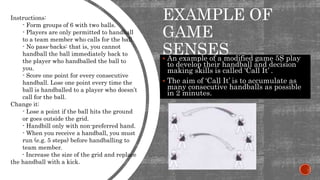
EXAMPLE OF
GAME
SENSES An example of a modified game 5S play
to develop their handball and decision
making skills is called ‘Call It’ .
 The aim of ‘Call It’ is to accumulate as
many consecutive handballs as possible
in 2 minutes.
Instructions:
- Form groups of 6 with two balls.
- Players are only permitted to handball
to a team member who calls for the ball.
- No pass-backs: that is, you cannot
handball the ball immediately back to
the player who handballed the ball to
you.
- Score one point for every consecutive
handball. Lose one point every time the
ball is handballed to a player who doesn’t
call for the ball.
Change it:
- Lose a point if the ball hits the ground
or goes outside the grid.
- Handbill only with non-preferred hand.
- When you receive a handball, you must
run (e.g. 5 steps) before handballing to
team member.
- Increase the size of the grid and replace
the handball with a kick.
 Research has shown there are many benefits to using a game sense
approach in PE. Game sense is identified as a package that integrate
fundamental movements skills, game recognition and concentration,
tactical awareness and physical control which are all vital skills required in
sports and realistic game setting (Castro, 2012).
 Strengths of game senses in PE as a teaching approach include the
following:
 Increase in confidence and motivational levels.
 Promotes maximum participation and engagement.
 Caters and involves all ability (inclusive and equal environment).
 Encourages reflection.
 Promotes long term learning.
 Supports children's understanding of the need for rules.
 Increase social skills
 Promotes inquiry based learning and discussion.
 Encourages critical thinking and reflection. (Rankin et al., 2018), (Pill,
2014).
More strengths of Game Sense as a teaching approach
• Game sense approach is identified as playing modified games followed by reflection that
include question, problem solving and decision making. After reflecting students are
given the opportunity to practice the skill and play another modified game . This
approach encourages high levels of students participation. Moreover students are
exposed to new games while developing an in-depth understanding of physical activity.
Game sense targets all 5 PDHPE skills (Interacting, moving, decision making, problem
solving and communication).
Links to then NSW PDHPE Syllabus
• With reference to the NSW PDHPE Syllabus, the Game Sense approach is directly linked
to the Game and Sport strand. The strands aims to develop students communication,
problem solving and decision making skills prompted by questions and student reflection
in a game sense (NESA, 2018).
• Stage 2- Students practice fundamental movement skills such as shooting, throwing and
catching when playing modified games i.e. netball/basketball.
• Students participate in regular physical activity and discusses progress through
questioning and reflection.
• Students demonstrate fun ways of practicing skills with team members.
 Castro, J. (2012). Game sense: pedagogy for performance, participation and enjoyment. Sports
Coaching Review, 1(2), 157-159. https://doi.org/10.1080/21640629.2013.790176
 Georgakis, S., Wilson, R., Evans, J. (2015) Authentic assessment in physical education: A case study
of game sesnse pedagogy. The Physical Educator, 72(1), 67-86.
 NSW Department of Education and Training. (2000). Get skilled: Get active: A K-6 resource to
support the teaching of fundamental movement skills.
 NSW Education Standards Authority. (2018). Personal development, health and physical education
K-10 syllabus. Sydney: Author. Retrieved from NESA website:
http://educationstandards.nsw.edu.au/wps/portal/nesa/k - 10/ learning-areas/pdhpe/pdhpe-k-10-
2018.
 Pill, S. (2014). An appreciative inquiry exploring game sense teaching in physical education. Sport,
Education And Society, 21(2), 279-297. https://doi.org/10.1080/13573322.2014.912624
 Pill, S. (2013). Using appreciative inquiry to explore Australian coaches’ experience with game sense
coaching. Sport, Education and Society. DOI: 10.1080/13573322.2013.831343
 Rankin, J., Pill, S., & Magias, T. (2018). Informing the Coaching Pedagogy of Game Modification in
a Game Sense Approach with Affordance Theory. Ágora Para La Educación Física Y El
Deporte, 20(1), 68. https://doi.org/10.24197/aefd.1.2018.68-89

Shaymaa Sabbagh's Game sense ppt

  • 1.
  • 2.
     In class5S, we have adopted the Game Sense approach which is variation of Bunker and Thorpe’s Teaching Games for Understanding (TGfU) model (Pill, 2013).  Game Sense is an innovative student centered, inquiry based approach that focuses on rules, skills and strategies in a game environment rather than technique development in drill context (Castro, 2012).  This approach uses modified games to promotes tactical awareness, problem solving and decision making whilst developing a skill within a realistic game context.
  • 3.
    Modified games buildup knowledge, understanding and movement capability to reduce stress on the skill. Through game sense students execute and practice fundamental movement skills that are required in game environments (NSW Department of Education and Training, 2000). Game sequence is developed within a game context from simple to complex to final form. Teachers create the learning environment using continuous sequence of modified small sided games then emphasis questions and reflection rather than instructions (Georgakis, Wilson & Evans, 2015).
  • 4.
    EXAMPLE OF GAME SENSES Anexample of a modified game 5S play to develop their handball and decision making skills is called ‘Call It’ .  The aim of ‘Call It’ is to accumulate as many consecutive handballs as possible in 2 minutes. Instructions: - Form groups of 6 with two balls. - Players are only permitted to handball to a team member who calls for the ball. - No pass-backs: that is, you cannot handball the ball immediately back to the player who handballed the ball to you. - Score one point for every consecutive handball. Lose one point every time the ball is handballed to a player who doesn’t call for the ball. Change it: - Lose a point if the ball hits the ground or goes outside the grid. - Handbill only with non-preferred hand. - When you receive a handball, you must run (e.g. 5 steps) before handballing to team member. - Increase the size of the grid and replace the handball with a kick.
  • 5.
     Research hasshown there are many benefits to using a game sense approach in PE. Game sense is identified as a package that integrate fundamental movements skills, game recognition and concentration, tactical awareness and physical control which are all vital skills required in sports and realistic game setting (Castro, 2012).  Strengths of game senses in PE as a teaching approach include the following:  Increase in confidence and motivational levels.  Promotes maximum participation and engagement.  Caters and involves all ability (inclusive and equal environment).  Encourages reflection.  Promotes long term learning.  Supports children's understanding of the need for rules.  Increase social skills  Promotes inquiry based learning and discussion.  Encourages critical thinking and reflection. (Rankin et al., 2018), (Pill, 2014).
  • 6.
    More strengths ofGame Sense as a teaching approach • Game sense approach is identified as playing modified games followed by reflection that include question, problem solving and decision making. After reflecting students are given the opportunity to practice the skill and play another modified game . This approach encourages high levels of students participation. Moreover students are exposed to new games while developing an in-depth understanding of physical activity. Game sense targets all 5 PDHPE skills (Interacting, moving, decision making, problem solving and communication). Links to then NSW PDHPE Syllabus • With reference to the NSW PDHPE Syllabus, the Game Sense approach is directly linked to the Game and Sport strand. The strands aims to develop students communication, problem solving and decision making skills prompted by questions and student reflection in a game sense (NESA, 2018). • Stage 2- Students practice fundamental movement skills such as shooting, throwing and catching when playing modified games i.e. netball/basketball. • Students participate in regular physical activity and discusses progress through questioning and reflection. • Students demonstrate fun ways of practicing skills with team members.
  • 7.
     Castro, J.(2012). Game sense: pedagogy for performance, participation and enjoyment. Sports Coaching Review, 1(2), 157-159. https://doi.org/10.1080/21640629.2013.790176  Georgakis, S., Wilson, R., Evans, J. (2015) Authentic assessment in physical education: A case study of game sesnse pedagogy. The Physical Educator, 72(1), 67-86.  NSW Department of Education and Training. (2000). Get skilled: Get active: A K-6 resource to support the teaching of fundamental movement skills.  NSW Education Standards Authority. (2018). Personal development, health and physical education K-10 syllabus. Sydney: Author. Retrieved from NESA website: http://educationstandards.nsw.edu.au/wps/portal/nesa/k - 10/ learning-areas/pdhpe/pdhpe-k-10- 2018.  Pill, S. (2014). An appreciative inquiry exploring game sense teaching in physical education. Sport, Education And Society, 21(2), 279-297. https://doi.org/10.1080/13573322.2014.912624  Pill, S. (2013). Using appreciative inquiry to explore Australian coaches’ experience with game sense coaching. Sport, Education and Society. DOI: 10.1080/13573322.2013.831343  Rankin, J., Pill, S., & Magias, T. (2018). Informing the Coaching Pedagogy of Game Modification in a Game Sense Approach with Affordance Theory. Ágora Para La Educación Física Y El Deporte, 20(1), 68. https://doi.org/10.24197/aefd.1.2018.68-89