Miss J Saji
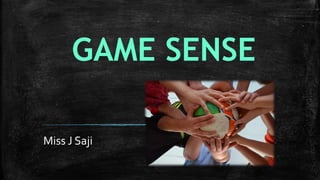
GAME SENSE
Game Sense? What is it?
▪ The Game Sense approach is a student-centred teaching
approach used in physical education and sport.
▪ It is used to motivate and challenge students in the
development of athletic/game skills.
▪ Game Sense also encourages tactical collaboration in a
team atmosphere.
(Light, Curry, & Mooney, 2014; Light & Harvey, 2017)
Game Sense: What does it look like?
Initially, games are played according to their original rules, equipment, etc.
As the games begin new rounds, modifications are made to the following to
create challenge:
 Equipment
 Number of players
 Game instructions
 General rules of the game
(Pill, 2016)
Game Sense: What does it look like?
• Commonly, several games occur simultaneously in a
circuit.
• Each game may be the same game, or different game
types.
• Students are given the chance to “coach” their group
members.
(Pill, 2016)
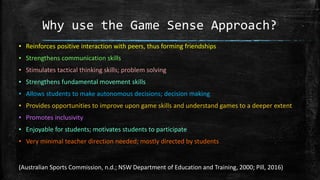
Why use the Game Sense Approach?
▪ Reinforces positive interaction with peers, thus forming friendships
▪ Strengthens communication skills
▪ Stimulates tactical thinking skills; problem solving
▪ Strengthens fundamental movement skills
▪ Allows students to make autonomous decisions; decision making
▪ Provides opportunities to improve upon game skills and understand games to a deeper extent
▪ Promotes inclusivity
▪ Enjoyable for students; motivates students to participate
▪ Very minimal teacher direction needed; mostly directed by students
(Australian Sports Commission, n.d.; NSW Department of Education and Training, 2000; Pill, 2016)
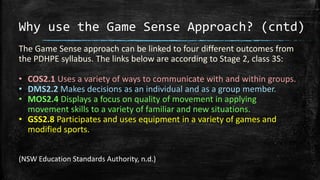
Why use the Game Sense Approach? (cntd)
The Game Sense approach can be linked to four different outcomes from
the PDHPE syllabus. The links below are according to Stage 2, class 3S:
• COS2.1 Uses a variety of ways to communicate with and within groups.
• DMS2.2 Makes decisions as an individual and as a group member.
• MOS2.4 Displays a focus on quality of movement in applying
movement skills to a variety of familiar and new situations.
• GSS2.8 Participates and uses equipment in a variety of games and
modified sports.
(NSW Education Standards Authority, n.d.)
References
Australian Sports Commission. (n.d.). Game sense approach. Retrieved from
https://sportingschools.gov.au/resources-and-pd/schools/playing-for-life-resources/game-sense-approach
Light, R., Curry, C., & Mooney, A. (2014). Game sense as a model for delivering quality teaching in physical
education. Asia-Pacific Journal of Health, Sport and Physical Education, 5(1), 67-81,
doi:10.1080/18377122.2014.868291
Light, R. L., & Harvey, S. (2017). Positive pedagogy for sport coaching. Sport, Education and Society, 22(2), 271-287,
doi:10.1080/13573322.2015.1015977
NSW Department of Education and Training. (2000). Get skilled: Get active: A k-6 resource to support the teaching
of fundamental movement skills. Retrieved from
https://www.healthykids.nsw.gov.au/downloads/file/teacherschildcare/Get_skilled_get_active_booklet.pdf
NSW Education Standards Authority (n.d.). Personal development, health and physical education K-6 syllabus.
Retrieved 20 May, 2018, from https://educationstandards.nsw.edu.au/wps/wcm/connect/f63e7d9d-fa2a-
471b-bf3c-d5b362fddb00/k6_pdhpe_syl.pdf?MOD=AJPERES&CVID=
Pill, S. (2016). An appreciative inquiry exploring game sense teaching in physical education. Sport, Education and
Society, 21(2), 279-297, doi:10.1080/13573322.2014.912624

Game Sense

  • 1.
  • 2.
    Game Sense? Whatis it? ▪ The Game Sense approach is a student-centred teaching approach used in physical education and sport. ▪ It is used to motivate and challenge students in the development of athletic/game skills. ▪ Game Sense also encourages tactical collaboration in a team atmosphere. (Light, Curry, & Mooney, 2014; Light & Harvey, 2017)
  • 3.
    Game Sense: Whatdoes it look like? Initially, games are played according to their original rules, equipment, etc. As the games begin new rounds, modifications are made to the following to create challenge:  Equipment  Number of players  Game instructions  General rules of the game (Pill, 2016)
  • 4.
    Game Sense: Whatdoes it look like? • Commonly, several games occur simultaneously in a circuit. • Each game may be the same game, or different game types. • Students are given the chance to “coach” their group members. (Pill, 2016)
  • 5.
    Why use theGame Sense Approach? ▪ Reinforces positive interaction with peers, thus forming friendships ▪ Strengthens communication skills ▪ Stimulates tactical thinking skills; problem solving ▪ Strengthens fundamental movement skills ▪ Allows students to make autonomous decisions; decision making ▪ Provides opportunities to improve upon game skills and understand games to a deeper extent ▪ Promotes inclusivity ▪ Enjoyable for students; motivates students to participate ▪ Very minimal teacher direction needed; mostly directed by students (Australian Sports Commission, n.d.; NSW Department of Education and Training, 2000; Pill, 2016)
  • 6.
    Why use theGame Sense Approach? (cntd) The Game Sense approach can be linked to four different outcomes from the PDHPE syllabus. The links below are according to Stage 2, class 3S: • COS2.1 Uses a variety of ways to communicate with and within groups. • DMS2.2 Makes decisions as an individual and as a group member. • MOS2.4 Displays a focus on quality of movement in applying movement skills to a variety of familiar and new situations. • GSS2.8 Participates and uses equipment in a variety of games and modified sports. (NSW Education Standards Authority, n.d.)
  • 7.
    References Australian Sports Commission.(n.d.). Game sense approach. Retrieved from https://sportingschools.gov.au/resources-and-pd/schools/playing-for-life-resources/game-sense-approach Light, R., Curry, C., & Mooney, A. (2014). Game sense as a model for delivering quality teaching in physical education. Asia-Pacific Journal of Health, Sport and Physical Education, 5(1), 67-81, doi:10.1080/18377122.2014.868291 Light, R. L., & Harvey, S. (2017). Positive pedagogy for sport coaching. Sport, Education and Society, 22(2), 271-287, doi:10.1080/13573322.2015.1015977 NSW Department of Education and Training. (2000). Get skilled: Get active: A k-6 resource to support the teaching of fundamental movement skills. Retrieved from https://www.healthykids.nsw.gov.au/downloads/file/teacherschildcare/Get_skilled_get_active_booklet.pdf NSW Education Standards Authority (n.d.). Personal development, health and physical education K-6 syllabus. Retrieved 20 May, 2018, from https://educationstandards.nsw.edu.au/wps/wcm/connect/f63e7d9d-fa2a- 471b-bf3c-d5b362fddb00/k6_pdhpe_syl.pdf?MOD=AJPERES&CVID= Pill, S. (2016). An appreciative inquiry exploring game sense teaching in physical education. Sport, Education and Society, 21(2), 279-297, doi:10.1080/13573322.2014.912624