
Why Development Projects Fail?
The Smarter Everyday project is owned and operated by CTE Solutions Inc.

Jean-Francois Bilodeau
jf@ctesolutions.com
About J-F
●

20+ years of professional experience

●

Certified in Java, Delphi & C#

●

Practical BA and project management
experience
Overview
●

Let's talk about:
–
–
–
–
–

Why project fail and succeed
Activities that BAs should do
Intergrating BA with the development project
Dealing with changes
Testing
Caveat!
●

This is a descriptive presentation
–

●

not prescriptive

No magic potion or silver bullets
Why Project Fail?
●

Is it because of:
–

Poor leadership?

–

Poor requirement?

–

Lack of technical skill?

–

Poor communication?

–

Client changing their minds?

–

Changes in business?

–

Changes in technology?

●

List is not comprehensive

●

First four are internal and can be controlled

●

Last three are external and must be managed
Let's flip that around...
Why Project Succeed?
●

Is it because of:
–
–

Good requirements?

–

Good technical skills?

–

Good communication?

–
●

Good leadership?

Managing changes?

'Good enough' is good enough
What can a BA do about it?
●

A BA plays a leadership position (yes, really!)

●

BA is responsible for requirements

●

Technical skills may not be necessary for a BA, but
are handy

●

BA is all about communication

●

BA must be responsive to changes
A BA by any other name...
●

The role of a BA can be synthetized
into two distinct responsibilities:
–
–

A BA is responsible to ellicit and
understand requirements
A BA is responsible to communicate and
validate implementation of requirements
“But wait! That's not how we do things!!?!”
●

Yes, I know
–

Every development team is unique

–

Every development endeavour is also unique

●

Are you a BA by name or by function?

●

What is under your control or influence?

●

What is outside your control or influence?

●

Write it down!
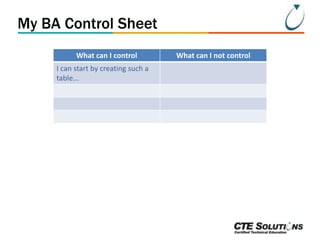
My BA Control Sheet
What can I control
I can start by creating such a
table...

What can I not control
How can I help my project succeed?
●

Know the difference between poor, good and great requirements
–

Poor is of little to no value to the development team

–

Good provide value to the development team

–

Great provice immediate and measurable value to the development team

●

A 300 page requirement binder does not equate great requirement

●

Good enough is often synonimous with great
How can I help my project succeed? ../2
●

Prioritize!
–

●

Do you know what your client considers important about
the endeavour?
–

●

Spend effort on high-value and high-risk requirements before
low-value or low-risk requirements

Is it in writing?

Do you understand what are the risks?
–

If not, ask!
How can I help my project succeed? ../3
●

Requirements should not be locked
away
–
–

How easy is it for your development team
to access the requirements?
How early will they have access to the
requirements?
So, to succeed:
●

The BA needs to create great requirements!

●

Easier said than done...
–

How do I know my requirements are correct?

–

How do I deal with changes?

–

How can I ensure that the client is getting ROI?
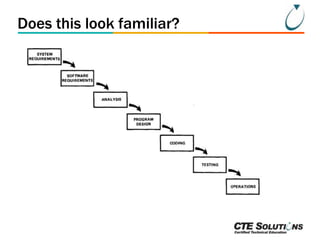
Does this look familiar?
The Waterfall Model
●
●

●
●

●

What's wrong with this picture?
How can we assume that requirements are correct from
the very get-go?
Any flaws in our requirements will trickle down
Flaws might only be discovered late into the testing
phase
Sounds familiar?
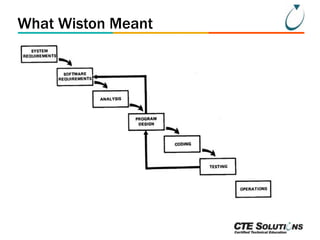
The (unfortunate) origin of the Waterfall Model
●

Popularized by the paper ―Managing the
Development of Large Software System‖

●

Published in 1970 by Wiston W. Royce

●

Never used the term Waterfall

●

Argued against the waterfall model
What Wiston Meant
In other words...
●
●

●

Software are not built...they are 'grown'
It is dangerous to assume that
requirements can gathered and be correct
in a single pass
It is dangerous to assume that testing
needs to be performed in a single pass
Grown...Not Built
●

Houses are built. Roads are built. Bridges are built

●

Software is grown

●

No two house or road or bridge can be build the same
–
–

●

Different terrain, material, etc...

–
●

Designs may be shared

Once a bridge is build, it cannot be copy-pasted

Developing software is more akin to designing a house than building a house, road
or bridge
Once software is written, it can be copied and pasted
Grown...Not Build ../2
●

The BA plays the role of the architect
–

●

Just like architectural drawings gives a sense of the final
product The requirements paint a picture of the finished
software
–

●

(Not that of the technical architect!)

The requirements are not the finished product!

Until the product is complete, it is difficult—if not
impossible—to fully test the requirements
Would you buy a car if...
●

●

The dealer got you to fill out a questionaire and
choose the vehicle for you?
The dealer gave you only rough drawing of the
vehicle?

●

You had a chance to sit down in it and test drive it?

●

The same applies to software
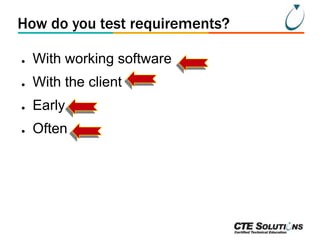
How do you test requirements?
●

With working software

●

With the client

●

Early

●

Often
How do you test requirements?
●

Get to the 'test phase' as quickly as
possible!

●

Prioritize base on value and risk

●

Stop using the waterfall
Stop Using the Waterfall
●

●

―How can we develop software if we don't have
requirements??!?‖

You do not need all the requirements before you get
started
–
–

●

Not even most
Not even a lot

Work with the development team as a unified whole
BA and the Development Team
●
●

●

●

The BA is an integral member of the team

The BA is the 'interface' between the client and the
developer
The BA is involved from the beginning to the end
of the project

There should not be 'BA/Development Team'
dichotomy
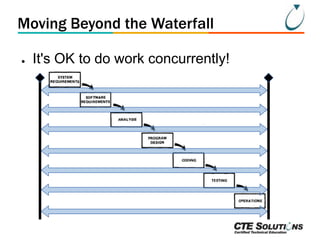
Moving Beyond the Waterfall
●

It's OK to do work concurrently!
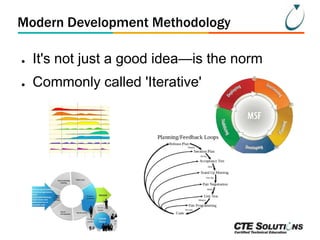
Modern Development Methodology
●

It's not just a good idea—is the norm

●

Commonly called 'Iterative'
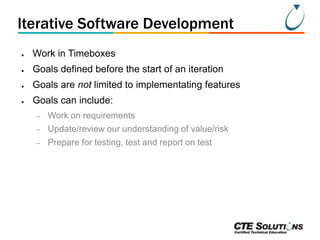
Iterative Software Development
●

Work in Timeboxes

●

Goals defined before the start of an iteration

●

Goals are not limited to implementating features

●

Goals can include:
–

Work on requirements

–

Update/review our understanding of value/risk

–

Prepare for testing, test and report on test
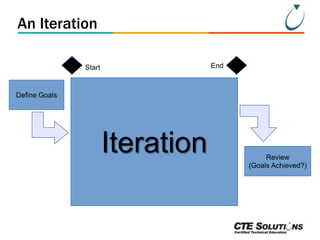
An Iteration
End

Start

Define Goals

Iteration

Review
(Goals Achieved?)
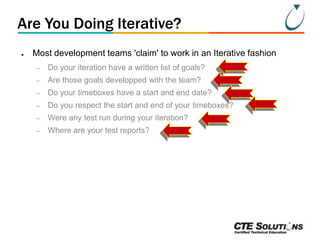
Are You Doing Iterative?
●

Most development teams 'claim' to work in an Iterative fashion
–

Do your iteration have a written list of goals?

–

Are those goals developped with the team?

–

Do your timeboxes have a start and end date?

–

Do you respect the start and end of your timeboxes?

–

Were any test run during your iteration?

–

Where are your test reports?
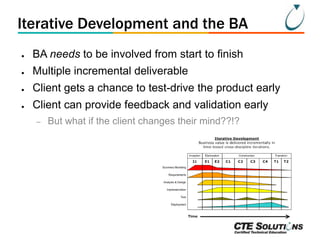
Iterative Development and the BA
●

BA needs to be involved from start to finish

●

Multiple incremental deliverable

●

Client gets a chance to test-drive the product early

●

Client can provide feedback and validation early
–

But what if the client changes their mind??!?
Software Development and Change
●

●

●
●

How many BAs ever worked on a project that
required changes to their requirements?
How many Bas ever worked on a project that
required no changes to their requirements?
Change is not an exception—it's normal!

Remember: It is difficult, if not impossible to know
everything from the get-go
Dealing with Changes
●

Change is a reality in the software
development field
–

●

Otherwise, would we will have a job ;)

It's not a question of protecting against—
or resisting—changes, but to manage
changes
How to Deal with Changes
●
●

Agile Project Management

Developped in 2001 by 17 software
developers

●

Intergrates naturaly with iterative

●

Agile is a philosophy—not a method!
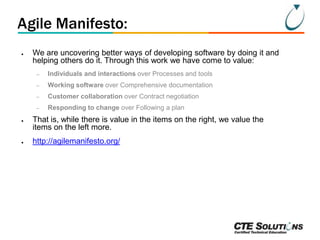
Agile Manifesto:
●

We are uncovering better ways of developing software by doing it and
helping others do it. Through this work we have come to value:
–
–

Customer collaboration over Contract negotiation

–

●

Working software over Comprehensive documentation

–

●

Individuals and interactions over Processes and tools

Responding to change over Following a plan

That is, while there is value in the items on the right, we value the
items on the left more.
http://agilemanifesto.org/
Agile and Iterative
●

Two separate approach
but

●
●

Integrate naturally
Spread from software development into
most project management disciplines
Caveats!
●

Agile and Interative is not a free-for-all!
–

Requires discipline

●

Requires good leadership

●

Test, test, test
BA and Testing
●

The BA is not the tester

●

The BA is accountable for the testing!

●

The BA works with the test team and
ensures that they can and do the tests
BA and Testing ../2
●

Do you:
–
–
–

●

have a test team?
have a test plan?
have a test lab?

If not, are they on your iteration goals?
In summary...
●

Prioritize base on value and risk

●

It's OK for the team to work in parallel

●

It's OK to start writing code while requirements are begin
gathered

●

Change happens and it's normal. Manage it

●

It's OK Necessary to start testing as soon as possible
Homework
●

Write down what you can and cannot control

●

Identify what your client considers value

●

Identify risks that would put the endeavour in jeopardy

●

Write down short term goals that you need to achieve

●

Commit to a date for the above goal and review them
when that date rolls around.
Final Wisdom
Write a list of short-term and long-term
goals you would like to achieve as a BA
then

Take small, incremental steps to reach
those goal
TECHNICAL
Microsoft
VMware
Cloud Computing
IT and Cyber Security
CompTIA
Java ProgrammingLanguages
Novell
UNIX

Training with impact
MANAGEMEN BUSINESS
Change Management
TOGAF
T
Enterprise
Architecture
ITIL
COBiT
Agile and Scrum
Business Analysis
Project
Management

Communication Skills
Leadership Skills
Negotiation Skills
Problem Solving Skills
Facilitation Skills
and many more…
CTE Solutions Inc. - Ottawa
11 Holland Avenue, Suite 100
Ottawa, Ontario, K1Y 4S1
Tel: (613) 798-5353
Toll Free: 1 (866) 635-5353
Fax: (613) 798-5574
CTE Solutions Inc. - Toronto
77 Bloor St. West, Suite 1406
Toronto, Ontario M5S 1M2
Tel: (416) 284-2700
Toll Free: 1 (866) 635-5353
Fax: (416) 284-6797

Development Projects Failing? What can the Business Analyst Do?

  • 1.
    Why Development ProjectsFail? The Smarter Everyday project is owned and operated by CTE Solutions Inc. Jean-Francois Bilodeau jf@ctesolutions.com
  • 2.
    About J-F ● 20+ yearsof professional experience ● Certified in Java, Delphi & C# ● Practical BA and project management experience
  • 3.
    Overview ● Let's talk about: – – – – – Whyproject fail and succeed Activities that BAs should do Intergrating BA with the development project Dealing with changes Testing
  • 4.
    Caveat! ● This is adescriptive presentation – ● not prescriptive No magic potion or silver bullets
  • 5.
    Why Project Fail? ● Isit because of: – Poor leadership? – Poor requirement? – Lack of technical skill? – Poor communication? – Client changing their minds? – Changes in business? – Changes in technology? ● List is not comprehensive ● First four are internal and can be controlled ● Last three are external and must be managed
  • 6.
    Let's flip thataround...
  • 7.
    Why Project Succeed? ● Isit because of: – – Good requirements? – Good technical skills? – Good communication? – ● Good leadership? Managing changes? 'Good enough' is good enough
  • 8.
    What can aBA do about it? ● A BA plays a leadership position (yes, really!) ● BA is responsible for requirements ● Technical skills may not be necessary for a BA, but are handy ● BA is all about communication ● BA must be responsive to changes
  • 9.
    A BA byany other name... ● The role of a BA can be synthetized into two distinct responsibilities: – – A BA is responsible to ellicit and understand requirements A BA is responsible to communicate and validate implementation of requirements
  • 10.
    “But wait! That'snot how we do things!!?!” ● Yes, I know – Every development team is unique – Every development endeavour is also unique ● Are you a BA by name or by function? ● What is under your control or influence? ● What is outside your control or influence? ● Write it down!
  • 11.
    My BA ControlSheet What can I control I can start by creating such a table... What can I not control
  • 12.
    How can Ihelp my project succeed? ● Know the difference between poor, good and great requirements – Poor is of little to no value to the development team – Good provide value to the development team – Great provice immediate and measurable value to the development team ● A 300 page requirement binder does not equate great requirement ● Good enough is often synonimous with great
  • 13.
    How can Ihelp my project succeed? ../2 ● Prioritize! – ● Do you know what your client considers important about the endeavour? – ● Spend effort on high-value and high-risk requirements before low-value or low-risk requirements Is it in writing? Do you understand what are the risks? – If not, ask!
  • 14.
    How can Ihelp my project succeed? ../3 ● Requirements should not be locked away – – How easy is it for your development team to access the requirements? How early will they have access to the requirements?
  • 15.
    So, to succeed: ● TheBA needs to create great requirements! ● Easier said than done... – How do I know my requirements are correct? – How do I deal with changes? – How can I ensure that the client is getting ROI?
  • 16.
    Does this lookfamiliar?
  • 17.
    The Waterfall Model ● ● ● ● ● What'swrong with this picture? How can we assume that requirements are correct from the very get-go? Any flaws in our requirements will trickle down Flaws might only be discovered late into the testing phase Sounds familiar?
  • 18.
    The (unfortunate) originof the Waterfall Model ● Popularized by the paper ―Managing the Development of Large Software System‖ ● Published in 1970 by Wiston W. Royce ● Never used the term Waterfall ● Argued against the waterfall model
  • 19.
  • 20.
    In other words... ● ● ● Softwareare not built...they are 'grown' It is dangerous to assume that requirements can gathered and be correct in a single pass It is dangerous to assume that testing needs to be performed in a single pass
  • 21.
    Grown...Not Built ● Houses arebuilt. Roads are built. Bridges are built ● Software is grown ● No two house or road or bridge can be build the same – – ● Different terrain, material, etc... – ● Designs may be shared Once a bridge is build, it cannot be copy-pasted Developing software is more akin to designing a house than building a house, road or bridge Once software is written, it can be copied and pasted
  • 22.
    Grown...Not Build ../2 ● TheBA plays the role of the architect – ● Just like architectural drawings gives a sense of the final product The requirements paint a picture of the finished software – ● (Not that of the technical architect!) The requirements are not the finished product! Until the product is complete, it is difficult—if not impossible—to fully test the requirements
  • 23.
    Would you buya car if... ● ● The dealer got you to fill out a questionaire and choose the vehicle for you? The dealer gave you only rough drawing of the vehicle? ● You had a chance to sit down in it and test drive it? ● The same applies to software
  • 24.
    How do youtest requirements? ● With working software ● With the client ● Early ● Often
  • 25.
    How do youtest requirements? ● Get to the 'test phase' as quickly as possible! ● Prioritize base on value and risk ● Stop using the waterfall
  • 26.
    Stop Using theWaterfall ● ● ―How can we develop software if we don't have requirements??!?‖ You do not need all the requirements before you get started – – ● Not even most Not even a lot Work with the development team as a unified whole
  • 27.
    BA and theDevelopment Team ● ● ● ● The BA is an integral member of the team The BA is the 'interface' between the client and the developer The BA is involved from the beginning to the end of the project There should not be 'BA/Development Team' dichotomy
  • 28.
    Moving Beyond theWaterfall ● It's OK to do work concurrently!
  • 29.
    Modern Development Methodology ● It'snot just a good idea—is the norm ● Commonly called 'Iterative'
  • 30.
    Iterative Software Development ● Workin Timeboxes ● Goals defined before the start of an iteration ● Goals are not limited to implementating features ● Goals can include: – Work on requirements – Update/review our understanding of value/risk – Prepare for testing, test and report on test
  • 31.
  • 32.
    Are You DoingIterative? ● Most development teams 'claim' to work in an Iterative fashion – Do your iteration have a written list of goals? – Are those goals developped with the team? – Do your timeboxes have a start and end date? – Do you respect the start and end of your timeboxes? – Were any test run during your iteration? – Where are your test reports?
  • 33.
    Iterative Development andthe BA ● BA needs to be involved from start to finish ● Multiple incremental deliverable ● Client gets a chance to test-drive the product early ● Client can provide feedback and validation early – But what if the client changes their mind??!?
  • 34.
    Software Development andChange ● ● ● ● How many BAs ever worked on a project that required changes to their requirements? How many Bas ever worked on a project that required no changes to their requirements? Change is not an exception—it's normal! Remember: It is difficult, if not impossible to know everything from the get-go
  • 35.
    Dealing with Changes ● Changeis a reality in the software development field – ● Otherwise, would we will have a job ;) It's not a question of protecting against— or resisting—changes, but to manage changes
  • 36.
    How to Dealwith Changes ● ● Agile Project Management Developped in 2001 by 17 software developers ● Intergrates naturaly with iterative ● Agile is a philosophy—not a method!
  • 37.
    Agile Manifesto: ● We areuncovering better ways of developing software by doing it and helping others do it. Through this work we have come to value: – – Customer collaboration over Contract negotiation – ● Working software over Comprehensive documentation – ● Individuals and interactions over Processes and tools Responding to change over Following a plan That is, while there is value in the items on the right, we value the items on the left more. http://agilemanifesto.org/
  • 38.
    Agile and Iterative ● Twoseparate approach but ● ● Integrate naturally Spread from software development into most project management disciplines
  • 39.
    Caveats! ● Agile and Interativeis not a free-for-all! – Requires discipline ● Requires good leadership ● Test, test, test
  • 40.
    BA and Testing ● TheBA is not the tester ● The BA is accountable for the testing! ● The BA works with the test team and ensures that they can and do the tests
  • 41.
    BA and Testing../2 ● Do you: – – – ● have a test team? have a test plan? have a test lab? If not, are they on your iteration goals?
  • 42.
    In summary... ● Prioritize baseon value and risk ● It's OK for the team to work in parallel ● It's OK to start writing code while requirements are begin gathered ● Change happens and it's normal. Manage it ● It's OK Necessary to start testing as soon as possible
  • 43.
    Homework ● Write down whatyou can and cannot control ● Identify what your client considers value ● Identify risks that would put the endeavour in jeopardy ● Write down short term goals that you need to achieve ● Commit to a date for the above goal and review them when that date rolls around.
  • 44.
    Final Wisdom Write alist of short-term and long-term goals you would like to achieve as a BA then Take small, incremental steps to reach those goal
  • 45.
    TECHNICAL Microsoft VMware Cloud Computing IT andCyber Security CompTIA Java ProgrammingLanguages Novell UNIX Training with impact MANAGEMEN BUSINESS Change Management TOGAF T Enterprise Architecture ITIL COBiT Agile and Scrum Business Analysis Project Management Communication Skills Leadership Skills Negotiation Skills Problem Solving Skills Facilitation Skills and many more…
  • 46.
    CTE Solutions Inc.- Ottawa 11 Holland Avenue, Suite 100 Ottawa, Ontario, K1Y 4S1 Tel: (613) 798-5353 Toll Free: 1 (866) 635-5353 Fax: (613) 798-5574 CTE Solutions Inc. - Toronto 77 Bloor St. West, Suite 1406 Toronto, Ontario M5S 1M2 Tel: (416) 284-2700 Toll Free: 1 (866) 635-5353 Fax: (416) 284-6797