1WHO/SEARO Technical Notes for Emergencies Technical Note No. 9
Minimum water quantity needed
for domestic uses
WHO Regional Office for South-East Asia
How much water is needed?
A water supply is an essential requirement for all
people. Determining how much is needed is one of
the first steps in providing that supply. Providing
enough water to meet everybody’s needs may be
difficult in the short-term so water can be made
available in stages. Continuous checking - including
talking to the various users of the supply (especially
women) will enable limited resources to be focused
effectively. Providing water is never free; the water
needs to be collected, stored, treated and distributed
- providing too much water is a waste of money.
Taking too much water from a limited source may
deprive people elsewhere of water and have adverse
environmental and health impacts.
Collect basic information
How many people are there?
How much does each individual use?
How many people are there?
Establishing the population to be supplied may not
be easy after an emergency, but consulting
administrators, feeding centres, community leaders
and making direct observations (such as the average
number of people per shelter and then counting
shelters) can give various estimates of the population
- don’t just rely on one figure but compare
independent assessments. Displaced people will
also be moving about, so estimate changes in
population. Include local populations as well as
displaced people.
How much does each
individual use?
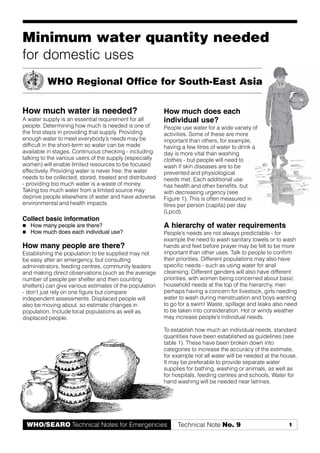
People use water for a wide variety of
activities. Some of these are more
important than others, for example,
having a few litres of water to drink a
day is more vital than washing
clothes - but people will need to
wash if skin diseases are to be
prevented and physiological
needs met. Each additional use
has health and other benefits, but
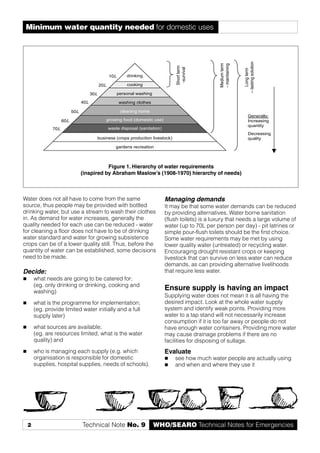
with decreasing urgency (see
Figure 1). This is often measured in
litres per person (capita) per day
(Lpcd).
A hierarchy of water requirements
People’s needs are not always predictable - for
example the need to wash sanitary towels or to wash
hands and feet before prayer may be felt to be more
important than other uses. Talk to people to confirm
their priorities. Different populations may also have
specific needs - such as using water for anal
cleansing. Different genders will also have different
priorities, with women being concerned about basic
household needs at the top of the hierarchy, men
perhaps having a concern for livestock, girls needing
water to wash during menstruation and boys wanting
to go for a swim! Waste, spillage and leaks also need
to be taken into consideration. Hot or windy weather
may increase people’s individual needs.
To establish how much an individual needs, standard
quantities have been established as guidelines (see
table 1). These have been broken down into
categories to increase the accuracy of the estimate,
for example not all water will be needed at the house.
It may be preferable to provide separate water
supplies for bathing, washing or animals, as well as
for hospitals, feeding centres and schools. Water for
hand washing will be needed near latrines.
2 WHO/SEARO Technical Notes for EmergenciesTechnical Note No. 9
Minimum water quantity needed for domestic uses
Figure 1. Hierarchy of water requirements
(inspired by Abraham Maslow’s (1908-1970) hierarchy of needs)
Water does not all have to come from the same
source, thus people may be provided with bottled
drinking water, but use a stream to wash their clothes
in. As demand for water increases, generally the
quality needed for each use can be reduced - water
for cleaning a floor does not have to be of drinking
water standard and water for growing subsistence
crops can be of a lower quality still. Thus, before the
quantity of water can be established, some decisions
need to be made.
Decide:
what needs are going to be catered for;
(eg. only drinking or drinking, cooking and
washing)
what is the programme for implementation;
(eg. provide limited water initially and a full
supply later)
what sources are available;
(eg. are resources limited, what is the water
quality) and
who is managing each supply (e.g. which
organisation is responsible for domestic
supplies, hospital supplies, needs of schools).
business (crops production livestock)
waste disposal (sanitation)
gardens recreation
Generally:
Increasing
quantity
Decreasing
quality
Longterm
–lastingsolution
Mediumterm
-maintaining
Shortterm
-survival
washing clothes
personal washing
growing food (domestic use)
cleaning home
drinking
cooking
70L
10L
20L
30L
40L
50L
60L
Managing demands
It may be that some water demands can be reduced
by providing alternatives. Water borne sanitation
(flush toilets) is a luxury that needs a large volume of
water (up to 70L per person per day) - pit latrines or
simple pour-flush toilets should be the first choice.
Some water requirements may be met by using
lower quality water (untreated) or recycling water.
Encouraging drought resistant crops or keeping
livestock that can survive on less water can reduce
demands, as can providing alternative livelihoods
that require less water.
Ensure supply is having an impact
Supplying water does not mean it is all having the
desired impact. Look at the whole water supply
system and identify weak points. Providing more
water to a tap stand will not necessarily increase
consumption if it is too far away or people do not
have enough water containers. Providing more water
may cause drainage problems if there are no
facilities for disposing of sullage.
Evaluate
see how much water people are actually using
and when and where they use it
3WHO/SEARO Technical Notes for Emergencies Technical Note No. 9
Minimum water quantity needed for domestic uses
From the water point to the home
Even if plenty of water is provided, there may be
other limits to its use, such as the time taken for
people to travel and queue to get it. If people take
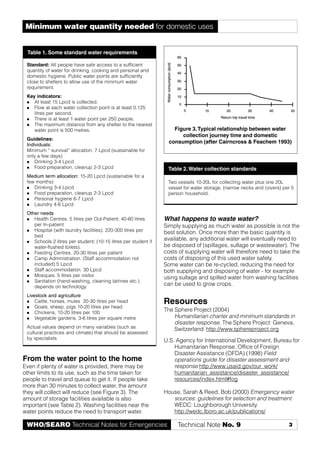
more than 30 minutes to collect water, the amount
they will collect will reduce (see Figure 3). The
amount of storage facilities available is also
important (see Table 2). Washing facilities near the
water points reduce the need to transport water.
What happens to waste water?
Simply supplying as much water as possible is not the
best solution. Once more than the basic quantity is
available, any additional water will eventually need to
be disposed of (spillages, sullage or wastewater). The
costs of supplying water will therefore need to take the
costs of disposing of this used water safely.
Some water can be re-cycled, reducing the need for
both supplying and disposing of water - for example
using sullage and spilled water from washing facilities
can be used to grow crops.
Resources
The Sphere Project (2004)
Humanitarian charter and minimum standards in
disaster response. The Sphere Project: Geneva,
Switzerland http://www.sphereproject.org
U.S. Agency for International Development, Bureau for
Humanitarian Response, Office of Foreign
Disaster Assistance (OFDA) (1998) Field
operations guide for disaster assessment and
response http://www.usaid.gov/our_work/
humanitarian_assistance/disaster_assistance/
resources/index.html#fog
House, Sarah & Reed, Bob (2000) Emergency water
sources: guidelines for selection and treatment
WEDC: Loughborough University
http://wedc.lboro.ac.uk/publications/
Figure 3.Typical relationship between water
collection journey time and domestic
consumption (after Cairncross & Feachem 1993)
Table 2.Water collection standards
Two vessels 10-20L for collecting water plus one 20L
vessel for water storage, (narrow necks and covers) per 5
person household.
Table 1. Some standard water requirements
Standard: All people have safe access to a sufficient
quantity of water for drinking, cooking and personal and
domestic hygiene. Public water points are sufficiently
close to shelters to allow use of the minimum water
requirement.
Key indicators:
At least 15 Lpcd is collected.
Flow at each water collection point is at least 0.125
litres per second.
There is at least 1 water point per 250 people.
The maximum distance from any shelter to the nearest
water point is 500 metres.
Guidelines:
Individuals:
Minimum “ survival” allocation. 7 Lpcd (sustainable for
only a few days)
Drinking 3-4 Lpcd
Food preparation, cleanup 2-3 Lpcd
Medium term allocation: 15-20 Lpcd (sustainable for a
few months)
Drinking 3-4 Lpcd
Food preparation, cleanup 2-3 Lpcd
Personal hygiene 6-7 Lpcd
Laundry 4-6 Lpcd
Other needs
Health Centres. 5 litres per Out-Patient; 40-60 litres
per In-patient
Hospital (with laundry facilities). 220-300 litres per
bed
Schools 2 litres per student; (10-15 litres per student if
water-flushed toilets).
Feeding Centres. 20-30 litres per patient
Camp Administration. (Staff accommodation not
included) 5 Lpcd
Staff accommodation. 30 Lpcd
Mosques. 5 litres per visitor
Sanitation (hand-washing, cleaning latrines etc.).
depends on technology.
Livestock and agriculture
Cattle, horses, mules 20-30 litres per head
Goats, sheep, pigs 10-20 litres per head
Chickens, 10-20 litres per 100
Vegetable gardens. 3-6 litres per square metre
Actual values depend on many variables (such as
cultural practices and climate) that should be assessed
by specialists
4 WHO/SEARO Technical Notes for EmergenciesTechnical Note No. 9
World Health Organization
Regional Office for South-East Asia
Mahatma Gandhi Marg
New Delhi, 110002,
India
This information has been prepared by WEDC
Author: B. J. Reed Series Editor: R. A. Reed Design: G. McMahon Illustrations: R. J. Shaw Graphics:Graphics:Graphics:Graphics:Graphics: Ken Chatterton
Water, Engineering and Development Centre, Loughborough University, Leicestershire, UK.
Phone: +44 1509 222885 Fax: +44 1509 211079 E-mail: WEDC@lboro.ac.uk www.lboro.ac.uk/wedc
Phone: (+91-11) 2337-0804
Fax: (+91-11) 2337-8438
E-mail: wsh@whosea.org
http://www.whosea.org
Minimum water quantity needed for domestic uses
Sample calculation
How much water is needed for a refugee camp for 5,000 displaced people (including 2000 school
age children), 25 relief agency staff, and 75 cows?
Decisions
Water for crops will not be provided
Water for livestock will rely on a river
Water for the hospital is the responsibility of another agency and will be a separate supply system.
A feeding centre, however, will be supplied with water.
Staff will be resident during the initial stages but will be able to travel into the camp at a later date
and are not included in that calculation
Assume 10% wastage (from spills, leaks, waste)
School will not be operational until after phase 1 and will not have flush toilets
Assume some further population movement
Phase 1 - an emergency supply
Domestic use: 5000 x 7 litres = 35,000L (7 Lpcd)
Feeding centre 5000 x 20 litres = 100,000 L (20 Lpcd)
Staff centre 25 x (5 + 30) litres = 875 L (5 Lcpd for office plus 30 Lcpd for
accommodation)
total = 135,875 L plus 10% leakage
≈ 150,000 litres per day
Phase 2 - a long-term solution
Domestic use: 4500 x 20 litres = 90,000 L (planned decrease in population, but
increase allowance to 20 Lpcd)
Feeding centre 1000 x 30 litres = 30,000 L (feeding vulnerable groups only but providing
30 Lpcd)
Staff centre 25 x 5 litres = 125 L (staff no-longer resident)
School 2000 x 2 litres = 4,000 L (2L per pupil)
total = 124,125 L plus 10% leakage
≈ 137,000 litres per day
Evaluate
Long term treatment facilities limited due to difficulties in importing chemicals, so reduce domestic
demand by providing washing facilities using partially treated water.

Who5 minimum water quantity needed for domestic use

  • 1.
    1WHO/SEARO Technical Notesfor Emergencies Technical Note No. 9 Minimum water quantity needed for domestic uses WHO Regional Office for South-East Asia How much water is needed? A water supply is an essential requirement for all people. Determining how much is needed is one of the first steps in providing that supply. Providing enough water to meet everybody’s needs may be difficult in the short-term so water can be made available in stages. Continuous checking - including talking to the various users of the supply (especially women) will enable limited resources to be focused effectively. Providing water is never free; the water needs to be collected, stored, treated and distributed - providing too much water is a waste of money. Taking too much water from a limited source may deprive people elsewhere of water and have adverse environmental and health impacts. Collect basic information How many people are there? How much does each individual use? How many people are there? Establishing the population to be supplied may not be easy after an emergency, but consulting administrators, feeding centres, community leaders and making direct observations (such as the average number of people per shelter and then counting shelters) can give various estimates of the population - don’t just rely on one figure but compare independent assessments. Displaced people will also be moving about, so estimate changes in population. Include local populations as well as displaced people. How much does each individual use? People use water for a wide variety of activities. Some of these are more important than others, for example, having a few litres of water to drink a day is more vital than washing clothes - but people will need to wash if skin diseases are to be prevented and physiological needs met. Each additional use has health and other benefits, but with decreasing urgency (see Figure 1). This is often measured in litres per person (capita) per day (Lpcd). A hierarchy of water requirements People’s needs are not always predictable - for example the need to wash sanitary towels or to wash hands and feet before prayer may be felt to be more important than other uses. Talk to people to confirm their priorities. Different populations may also have specific needs - such as using water for anal cleansing. Different genders will also have different priorities, with women being concerned about basic household needs at the top of the hierarchy, men perhaps having a concern for livestock, girls needing water to wash during menstruation and boys wanting to go for a swim! Waste, spillage and leaks also need to be taken into consideration. Hot or windy weather may increase people’s individual needs. To establish how much an individual needs, standard quantities have been established as guidelines (see table 1). These have been broken down into categories to increase the accuracy of the estimate, for example not all water will be needed at the house. It may be preferable to provide separate water supplies for bathing, washing or animals, as well as for hospitals, feeding centres and schools. Water for hand washing will be needed near latrines.
  • 2.
    2 WHO/SEARO TechnicalNotes for EmergenciesTechnical Note No. 9 Minimum water quantity needed for domestic uses Figure 1. Hierarchy of water requirements (inspired by Abraham Maslow’s (1908-1970) hierarchy of needs) Water does not all have to come from the same source, thus people may be provided with bottled drinking water, but use a stream to wash their clothes in. As demand for water increases, generally the quality needed for each use can be reduced - water for cleaning a floor does not have to be of drinking water standard and water for growing subsistence crops can be of a lower quality still. Thus, before the quantity of water can be established, some decisions need to be made. Decide: what needs are going to be catered for; (eg. only drinking or drinking, cooking and washing) what is the programme for implementation; (eg. provide limited water initially and a full supply later) what sources are available; (eg. are resources limited, what is the water quality) and who is managing each supply (e.g. which organisation is responsible for domestic supplies, hospital supplies, needs of schools). business (crops production livestock) waste disposal (sanitation) gardens recreation Generally: Increasing quantity Decreasing quality Longterm –lastingsolution Mediumterm -maintaining Shortterm -survival washing clothes personal washing growing food (domestic use) cleaning home drinking cooking 70L 10L 20L 30L 40L 50L 60L Managing demands It may be that some water demands can be reduced by providing alternatives. Water borne sanitation (flush toilets) is a luxury that needs a large volume of water (up to 70L per person per day) - pit latrines or simple pour-flush toilets should be the first choice. Some water requirements may be met by using lower quality water (untreated) or recycling water. Encouraging drought resistant crops or keeping livestock that can survive on less water can reduce demands, as can providing alternative livelihoods that require less water. Ensure supply is having an impact Supplying water does not mean it is all having the desired impact. Look at the whole water supply system and identify weak points. Providing more water to a tap stand will not necessarily increase consumption if it is too far away or people do not have enough water containers. Providing more water may cause drainage problems if there are no facilities for disposing of sullage. Evaluate see how much water people are actually using and when and where they use it
  • 3.
    3WHO/SEARO Technical Notesfor Emergencies Technical Note No. 9 Minimum water quantity needed for domestic uses From the water point to the home Even if plenty of water is provided, there may be other limits to its use, such as the time taken for people to travel and queue to get it. If people take more than 30 minutes to collect water, the amount they will collect will reduce (see Figure 3). The amount of storage facilities available is also important (see Table 2). Washing facilities near the water points reduce the need to transport water. What happens to waste water? Simply supplying as much water as possible is not the best solution. Once more than the basic quantity is available, any additional water will eventually need to be disposed of (spillages, sullage or wastewater). The costs of supplying water will therefore need to take the costs of disposing of this used water safely. Some water can be re-cycled, reducing the need for both supplying and disposing of water - for example using sullage and spilled water from washing facilities can be used to grow crops. Resources The Sphere Project (2004) Humanitarian charter and minimum standards in disaster response. The Sphere Project: Geneva, Switzerland http://www.sphereproject.org U.S. Agency for International Development, Bureau for Humanitarian Response, Office of Foreign Disaster Assistance (OFDA) (1998) Field operations guide for disaster assessment and response http://www.usaid.gov/our_work/ humanitarian_assistance/disaster_assistance/ resources/index.html#fog House, Sarah & Reed, Bob (2000) Emergency water sources: guidelines for selection and treatment WEDC: Loughborough University http://wedc.lboro.ac.uk/publications/ Figure 3.Typical relationship between water collection journey time and domestic consumption (after Cairncross & Feachem 1993) Table 2.Water collection standards Two vessels 10-20L for collecting water plus one 20L vessel for water storage, (narrow necks and covers) per 5 person household. Table 1. Some standard water requirements Standard: All people have safe access to a sufficient quantity of water for drinking, cooking and personal and domestic hygiene. Public water points are sufficiently close to shelters to allow use of the minimum water requirement. Key indicators: At least 15 Lpcd is collected. Flow at each water collection point is at least 0.125 litres per second. There is at least 1 water point per 250 people. The maximum distance from any shelter to the nearest water point is 500 metres. Guidelines: Individuals: Minimum “ survival” allocation. 7 Lpcd (sustainable for only a few days) Drinking 3-4 Lpcd Food preparation, cleanup 2-3 Lpcd Medium term allocation: 15-20 Lpcd (sustainable for a few months) Drinking 3-4 Lpcd Food preparation, cleanup 2-3 Lpcd Personal hygiene 6-7 Lpcd Laundry 4-6 Lpcd Other needs Health Centres. 5 litres per Out-Patient; 40-60 litres per In-patient Hospital (with laundry facilities). 220-300 litres per bed Schools 2 litres per student; (10-15 litres per student if water-flushed toilets). Feeding Centres. 20-30 litres per patient Camp Administration. (Staff accommodation not included) 5 Lpcd Staff accommodation. 30 Lpcd Mosques. 5 litres per visitor Sanitation (hand-washing, cleaning latrines etc.). depends on technology. Livestock and agriculture Cattle, horses, mules 20-30 litres per head Goats, sheep, pigs 10-20 litres per head Chickens, 10-20 litres per 100 Vegetable gardens. 3-6 litres per square metre Actual values depend on many variables (such as cultural practices and climate) that should be assessed by specialists
  • 4.
    4 WHO/SEARO TechnicalNotes for EmergenciesTechnical Note No. 9 World Health Organization Regional Office for South-East Asia Mahatma Gandhi Marg New Delhi, 110002, India This information has been prepared by WEDC Author: B. J. Reed Series Editor: R. A. Reed Design: G. McMahon Illustrations: R. J. Shaw Graphics:Graphics:Graphics:Graphics:Graphics: Ken Chatterton Water, Engineering and Development Centre, Loughborough University, Leicestershire, UK. Phone: +44 1509 222885 Fax: +44 1509 211079 E-mail: WEDC@lboro.ac.uk www.lboro.ac.uk/wedc Phone: (+91-11) 2337-0804 Fax: (+91-11) 2337-8438 E-mail: wsh@whosea.org http://www.whosea.org Minimum water quantity needed for domestic uses Sample calculation How much water is needed for a refugee camp for 5,000 displaced people (including 2000 school age children), 25 relief agency staff, and 75 cows? Decisions Water for crops will not be provided Water for livestock will rely on a river Water for the hospital is the responsibility of another agency and will be a separate supply system. A feeding centre, however, will be supplied with water. Staff will be resident during the initial stages but will be able to travel into the camp at a later date and are not included in that calculation Assume 10% wastage (from spills, leaks, waste) School will not be operational until after phase 1 and will not have flush toilets Assume some further population movement Phase 1 - an emergency supply Domestic use: 5000 x 7 litres = 35,000L (7 Lpcd) Feeding centre 5000 x 20 litres = 100,000 L (20 Lpcd) Staff centre 25 x (5 + 30) litres = 875 L (5 Lcpd for office plus 30 Lcpd for accommodation) total = 135,875 L plus 10% leakage ≈ 150,000 litres per day Phase 2 - a long-term solution Domestic use: 4500 x 20 litres = 90,000 L (planned decrease in population, but increase allowance to 20 Lpcd) Feeding centre 1000 x 30 litres = 30,000 L (feeding vulnerable groups only but providing 30 Lpcd) Staff centre 25 x 5 litres = 125 L (staff no-longer resident) School 2000 x 2 litres = 4,000 L (2L per pupil) total = 124,125 L plus 10% leakage ≈ 137,000 litres per day Evaluate Long term treatment facilities limited due to difficulties in importing chemicals, so reduce domestic demand by providing washing facilities using partially treated water.