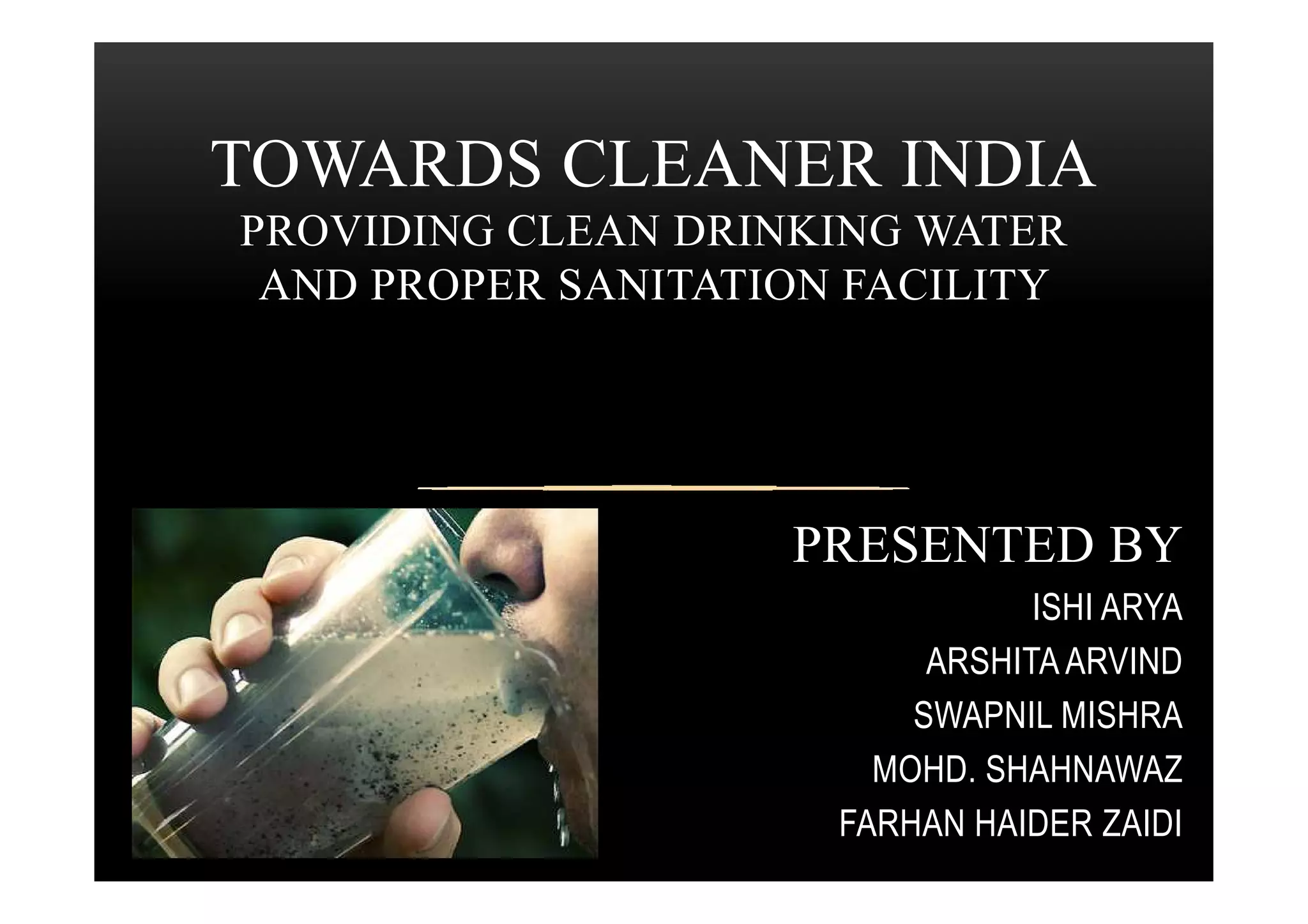
TOWARDS CLEANER INDIA
PROVIDING CLEAN DRINKING WATER
AND PROPER SANITATION FACILITY
PRESENTED BY
ISHI ARYA
ARSHITA ARVIND
SWAPNIL MISHRA
MOHD. SHAHNAWAZ
FARHAN HAIDER ZAIDI
SCOPE OF THE PROBLEM
• 36% of world’s population lacked improved sanitation
facility.
• 768 million people still use unsafe drinking water sources.
• More than 3.4 million people die each year from water,
sanitation, and hygiene-related causes.sanitation, and hygiene-related causes.
• Of the 60 million people added to the world's towns and
cities every year, most move to informal settlements (i.e.
slums) with no sanitation facilities.
• Every year, 1.5 million children die due to diarrhea caused
by the combined effects of inadequate sanitation, unsafe
water supply, and poor personal hygiene.
CAUSES
Clean drinking water-
• Salivation of drinking water.
• Increased consumption of water.
• Global warming and decreased rainfall.
• Water pollution by industrial and domestic wastes.• Water pollution by industrial and domestic wastes.
Sanitation-
• Unawareness, misconceptions.
• Poverty, personal habits and lack of facilities.
PROCEDURE
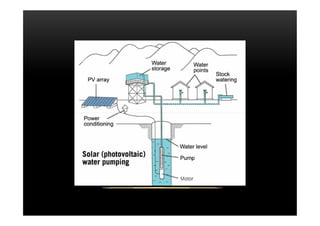
• A protected hole is drilled 100m down into the earth to
reach a water source.
• An electric motor charged by the solar panels, in turn,
powers an underground water pump.
• This pump can draw up to 30,000 litres of clean, fresh
water, every single day.
• All of this fresh water is stored in a water tank.• All of this fresh water is stored in a water tank.
• The tank is then connected to water pumps and taps
around the village by a system of pipes.
• Every house has a pipeline attached to its terrace as well
so as to harvest the rain water during the rainy seasons
when the solar panels do not work.
• This technique can be easily adopted in rural as well as
urban areas.
SOLUTIONS
• Awareness and participation
• Installation of solar water pumps in drought affected areas as
well as areas having scarcity of water.
Applications:
• clean water supply
• livestock watering
• irrigation• irrigation
Merits:
• unattended operation, no fuel cost, low maintenance, easy
installation, long life(20 years)
• easy access to fresh and clean water
• life, free from water-borne diseases
• clean water will also be useful in sanitation
IMPLEMENTATION
• funding for solar water pumps by the govt. to be set up
which even comprises of rainwater harvesting techniques.
• An integrated approach of the govt. to create a demand for
sanitation and hygiene promotion, groundwater
conservation and rainwater harvesting .e.g., five year
plans.plans.
• effective decentralization for empowering local
communities, NGOs, panchayati raj ,gram panchayats,
municipal corporations, etc.
• special provisions for collection,transport and disposal of
waste-a cleaner India.
CHALLENGES
• high capital cost
• Repair require skilled technicians
• Continuously changing govt. policies
• Unavailability of technologies and its know how• Unavailability of technologies and its know how
• Proper maintenance
• unaccepting attitude of public
• Corruption
MITIGATION
• Private sector firms must take initiative by investing
in this project.
• Proper training and knowledge must be imparted.
• Creative and innovative campaign.
• Stringent laws must be passed to avoid hindrance
• Continuation of project despite the political parties.
• Nirmal shahar puraskar is awarded for recognizing
sanitation initiative of cities by GOI.
REFERENCES
• http://sanitationupdates.wordpress.com/2009/09/22/india-poor-sanitation-
and-water-contamination/
• http://www.slideshare.net/purohit1323/sanitation-in-india-12066973
• http://www.google.co.in/#newwindow=1&q=water+and+sanitation+problems+• http://www.google.co.in/#newwindow=1&q=water+and+sanitation+problems+
in+india&safe=off
• http://practicalaction.org/health-and-hygiene-education-1
• http://www.ncbi.nlm.nih.gov/books/NBK11755/
• https://www.google.co.in/#newwindow=1&q=methods+to+promote+sanitation
&safe=off
THANK YOU

lumbans

  • 1.
    TOWARDS CLEANER INDIA PROVIDINGCLEAN DRINKING WATER AND PROPER SANITATION FACILITY PRESENTED BY ISHI ARYA ARSHITA ARVIND SWAPNIL MISHRA MOHD. SHAHNAWAZ FARHAN HAIDER ZAIDI
  • 2.
    SCOPE OF THEPROBLEM • 36% of world’s population lacked improved sanitation facility. • 768 million people still use unsafe drinking water sources. • More than 3.4 million people die each year from water, sanitation, and hygiene-related causes.sanitation, and hygiene-related causes. • Of the 60 million people added to the world's towns and cities every year, most move to informal settlements (i.e. slums) with no sanitation facilities. • Every year, 1.5 million children die due to diarrhea caused by the combined effects of inadequate sanitation, unsafe water supply, and poor personal hygiene.
  • 4.
    CAUSES Clean drinking water- •Salivation of drinking water. • Increased consumption of water. • Global warming and decreased rainfall. • Water pollution by industrial and domestic wastes.• Water pollution by industrial and domestic wastes. Sanitation- • Unawareness, misconceptions. • Poverty, personal habits and lack of facilities.
  • 6.
    PROCEDURE • A protectedhole is drilled 100m down into the earth to reach a water source. • An electric motor charged by the solar panels, in turn, powers an underground water pump. • This pump can draw up to 30,000 litres of clean, fresh water, every single day. • All of this fresh water is stored in a water tank.• All of this fresh water is stored in a water tank. • The tank is then connected to water pumps and taps around the village by a system of pipes. • Every house has a pipeline attached to its terrace as well so as to harvest the rain water during the rainy seasons when the solar panels do not work. • This technique can be easily adopted in rural as well as urban areas.
  • 7.
    SOLUTIONS • Awareness andparticipation • Installation of solar water pumps in drought affected areas as well as areas having scarcity of water. Applications: • clean water supply • livestock watering • irrigation• irrigation Merits: • unattended operation, no fuel cost, low maintenance, easy installation, long life(20 years) • easy access to fresh and clean water • life, free from water-borne diseases • clean water will also be useful in sanitation
  • 8.
    IMPLEMENTATION • funding forsolar water pumps by the govt. to be set up which even comprises of rainwater harvesting techniques. • An integrated approach of the govt. to create a demand for sanitation and hygiene promotion, groundwater conservation and rainwater harvesting .e.g., five year plans.plans. • effective decentralization for empowering local communities, NGOs, panchayati raj ,gram panchayats, municipal corporations, etc. • special provisions for collection,transport and disposal of waste-a cleaner India.
  • 9.
    CHALLENGES • high capitalcost • Repair require skilled technicians • Continuously changing govt. policies • Unavailability of technologies and its know how• Unavailability of technologies and its know how • Proper maintenance • unaccepting attitude of public • Corruption
  • 10.
    MITIGATION • Private sectorfirms must take initiative by investing in this project. • Proper training and knowledge must be imparted. • Creative and innovative campaign. • Stringent laws must be passed to avoid hindrance • Continuation of project despite the political parties. • Nirmal shahar puraskar is awarded for recognizing sanitation initiative of cities by GOI.
  • 11.
    REFERENCES • http://sanitationupdates.wordpress.com/2009/09/22/india-poor-sanitation- and-water-contamination/ • http://www.slideshare.net/purohit1323/sanitation-in-india-12066973 •http://www.google.co.in/#newwindow=1&q=water+and+sanitation+problems+• http://www.google.co.in/#newwindow=1&q=water+and+sanitation+problems+ in+india&safe=off • http://practicalaction.org/health-and-hygiene-education-1 • http://www.ncbi.nlm.nih.gov/books/NBK11755/ • https://www.google.co.in/#newwindow=1&q=methods+to+promote+sanitation &safe=off
  • 12.