Rachel Baggaley, MBBS, MSc
WHO Geneva
Overview of HIV Self-testing:
What We Know & Where to Go
Bill and Melinda Gates Foundation, Meeting on the Status & Future of HIV Self-Testing
27 February 2015
Source: UNAIDS, Gap report 2014
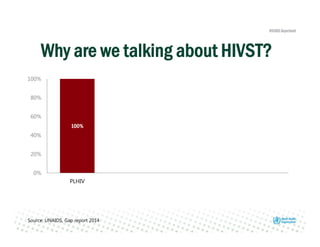
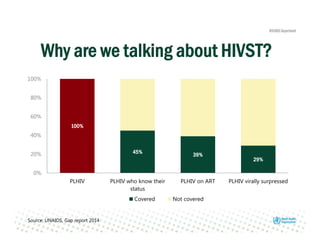
Why are we talking about HIVST?
100%
0%
20%
40%
60%
80%
100%
PLHIV PLHIV who know their
status
PLHIV on ART PLHIV virally surpressed
Covered Not covered
Source: UNAIDS, Gap report 2014
Why are we talking about HIVST?
100%
45%
39%
29%
0%
20%
40%
60%
80%
100%
PLHIV PLHIV who know their
status
PLHIV on ART PLHIV virally surpressed
Covered Not covered
Source: UNAIDS, Gap report 2014
Why are we talking about HIVST?
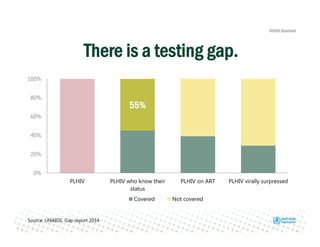
There is a testing gap.
55%
0%
20%
40%
60%
80%
100%
PLHIV PLHIV who know their
status
PLHIV on ART PLHIV virally surpressed
Covered Not covered
Source: UNAIDS, Gap report 2014
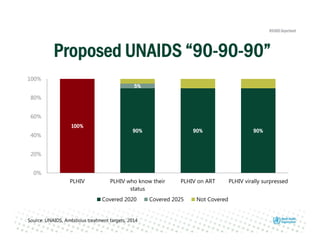
Proposed UNAIDS “90-90-90”
100%
90% 90% 90%
5%
0%
20%
40%
60%
80%
100%
PLHIV PLHIV who know their
status
PLHIV on ART PLHIV virally surpressed
Covered 2020 Covered 2025 Not Covered
Source: UNAIDS, Ambitious treatment targets, 2014
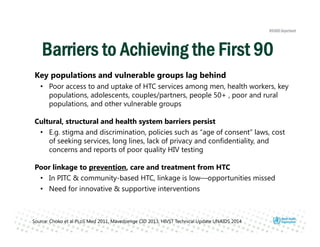
Source: Choko et al PLoS Med 2011, Mavedzenge CID 2013, HIVST Technical Update UNAIDS 2014
Barriers to Achieving the First 90
Key populations and vulnerable groups lag behind
• Poor access to and uptake of HTC services among men, health workers, key
populations, adolescents, couples/partners, people 50+ , poor and rural
populations, and other vulnerable groups
Cultural, structural and health system barriers persist
• E.g. stigma and discrimination, policies such as “age of consent” laws, cost
of seeking services, long lines, lack of privacy and confidentiality, and
concerns and reports of poor quality HIV testing
Poor linkage to prevention, care and treatment from HTC
• In PITC & community-based HTC, linkage is low—opportunities missed
• Need for innovative & supportive interventions
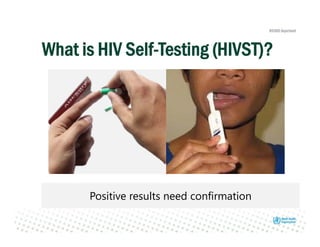
Positive results need confirmation
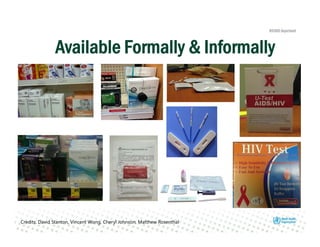
What is HIV Self-Testing (HIVST)?
Credits: David Stanton, Vincent Wong, Cheryl Johnson, Matthew Rosenthal
Available Formally & Informally
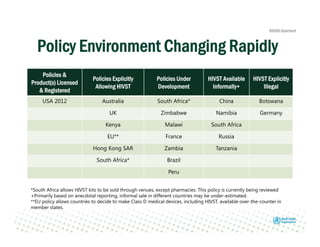
Policy Environment Changing Rapidly
Policies &
Product(s) Licensed
& Registered
Policies Explicitly
Allowing HIVST
Policies Under
Development
HIVST Available
Informally+
HIVST Explicitly
Illegal
USA 2012 Australia South Africa* China Botswana
UK Zimbabwe Namibia Germany
Kenya Malawi South Africa
EU** France Russia
Hong Kong SAR Zambia Tanzania
South Africa* Brazil
Peru
*South Africa allows HIVST kits to be sold through venues, except pharmacies. This policy is currently being reviewed
+Primarily based on anecdotal reporting, informal sale in different countries may be under-estimated.
**EU policy allows countries to decide to make Class D medical devices, including HIVST, available over-the-counter in
member states.
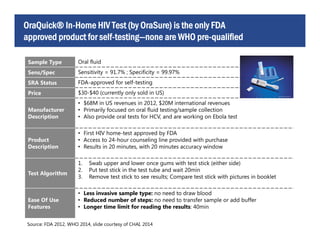
Sample Type Oral fluid
Sens/Spec Sensitivity = 91.7% ; Specificity = 99.97%
SRA Status FDA-approved for self-testing
Price $30-$40 (currently only sold in US)
Manufacturer
Description
• $68M in US revenues in 2012, $20M international revenues
• Primarily focused on oral fluid testing/sample collection
• Also provide oral tests for HCV, and are working on Ebola test
Product
Description
• First HIV home-test approved by FDA
• Access to 24-hour counseling line provided with purchase
• Results in 20 minutes, with 20 minutes accuracy window
Test Algorithm
1. Swab upper and lower once gums with test stick (either side)
2. Put test stick in the test tube and wait 20min
3. Remove test stick to see results; Compare test stick with pictures in booklet
Ease Of Use
Features
• Less invasive sample type: no need to draw blood
• Reduced number of steps: no need to transfer sample or add buffer
• Longer time limit for reading the results: 40min
OraQuick® In-Home HIV Test (by OraSure) is the only FDA
approved product for self-testing—none are WHO pre-qualified
Source: FDA 2012, WHO 2014, slide courtesy of CHAI, 2014
12
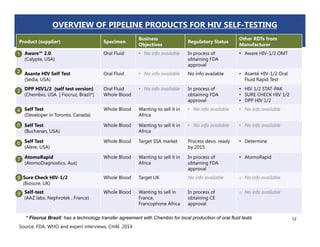
Product (supplier) Specimen
Business
Objectives
Regulatory Status
Other RDTs from
Manufacturer
• Aware™ 2.0
(Calypte, USA)
Oral Fluid • No info available In process of
obtaining FDA
approval
• Aware HIV-1/2 OMT
• Asante HIV Self Test
(Sedia, USA)
Oral Fluid • No info available No info available • Asanté HIV-1/2 Oral
Fluid Rapid Test
• DPP HIV1/2 (self test version)
(Chembio, USA | Fiocruz, Brazil*)
Oral Fluid
Whole Blood
• No info available In process of
obtaining FDA
approval
• HIV 1/2 STAT-PAK
• SURE CHECK HIV 1/2
• DPP HIV 1/2
• Self Test
(Developer in Toronto, Canada)
Whole Blood Wanting to sell it in
Africa
• No info available • No info available
• Self Test
(Buchanan, USA)
Whole Blood Wanting to sell it in
Africa
• No info available • No info available
• Self Test
(Alere, USA)
Whole Blood Target SSA market Process devo. ready
by 2015
• Determine
• AtomoRapid
(AtomoDiagnostics, Aus)
Whole Blood Wanting to sell it in
Africa
In process of
obtaining FDA
approval
• AtomoRapid
Sure Check HIV-1/2
(Biosure, UK)
Whole Blood Target UK No info available o No info available
• Self-test
(AAZ labs, Nephrotek , France)
Whole Blood Wanting to sell in
France,
Francophone Africa
In process of
obtaining CE
approval
o No info available
Source: FDA, WHO and expert interviews, CHAI 2014
1
2
3
4
5
* Fiocruz Brazil: has a technology transfer agreement with Chembio for local production of oral fluid tests
6
7
8
OVERVIEW OF PIPELINE PRODUCTS FOR HIV SELF-TESTING
9
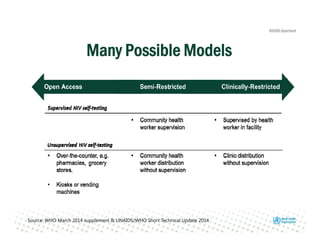
Source: WHO March 2014 supplement & UNAIDS/WHO Short Technical Update 2014
Many Possible Models
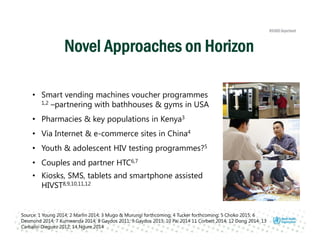
Source: 1 Young 2014; 2 Marlin 2014; 3 Mugo & Murungi forthcoming; 4 Tucker forthcoming; 5 Choko 2015; 6
Desmond 2014; 7 Kumwenda 2014; 8 Gaydos 2011; 9 Gaydos 2013; 10 Pai 2014 11 Corbett 2014; 12 Dong 2014: 13
Carballo-Dieguez 2012; 14 Ngure 2014
• Smart vending machines voucher programmes
1,2 –partnering with bathhouses & gyms in USA
• Pharmacies & key populations in Kenya3
• Via Internet & e-commerce sites in China4
• Youth & adolescent HIV testing programmes?5
• Couples and partner HTC6,7
• Kiosks, SMS, tablets and smartphone assisted
HIVST8,9,10,11,12
Novel Approaches on Horizon
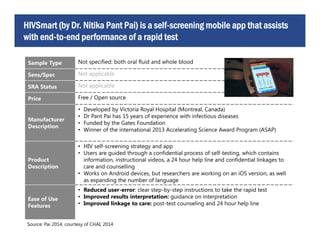
Sample Type Not specified: both oral fluid and whole blood
Sens/Spec Not applicable
SRA Status Not applicable
Price Free / Open source
Manufacturer
Description
• Developed by Victoria Royal Hospital (Montreal, Canada)
• Dr Pant Pai has 15 years of experience with infectious diseases
• Funded by the Gates Foundation
• Winner of the international 2013 Accelerating Science Award Program (ASAP)
Product
Description
• HIV self-screening strategy and app
• Users are guided through a confidential process of self-testing, which contains
information, instructional videos, a 24 hour help line and confidential linkages to
care and counselling
• Works on Android devices, but researchers are working on an iOS version, as well
as expanding the number of language
Ease of Use
Features
• Reduced user-error: clear step-by-step instructions to take the rapid test
• Improved results interpretation: guidance on interpretation
• Improved linkage to care: post-test counseling and 24 hour help line
HIVSmart (by Dr. Nitika Pant Pai) is a self-screening mobile app that assists
with end-to-end performance of a rapid test
Source: Pai 2014, courtesy of CHAI, 2014
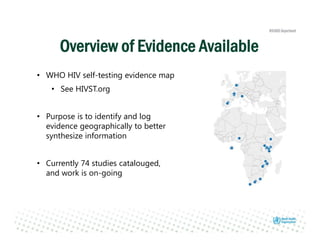
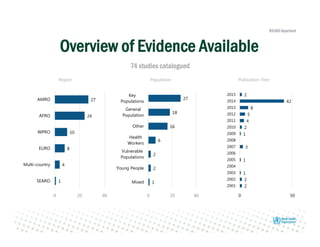
• WHO HIV self-testing evidence map
• See HIVST.org
• Purpose is to identify and log
evidence geographically to better
synthesize information
• Currently 74 studies catalouged,
and work is on-going
Overview of Evidence Available
1
2
2
6
16
18
27
0 20 40
Mixed
Young People
Vulnerable
Populations
Health
Workers
Other
General
Population
Key
Populations
1
4
8
10
24
27
0 20 40
SEARO
Multi-country
EURO
WPRO
AFRO
AMRO
2
2
1
1
3
1
2
4
5
8
42
2
0 50
2001
2002
2003
2004
2005
2006
2007
2008
2009
2010
2011
2012
2013
2014
2015
Population
74 studies catalogued
Region Publication Year
Overview of Evidence Available
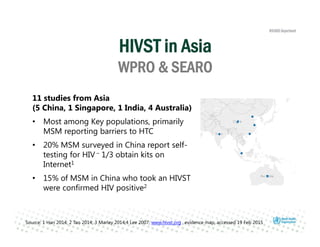
HIVST in Asia
WPRO & SEARO
11 studies from Asia
(5 China, 1 Singapore, 1 India, 4 Australia)
• Most among Key populations, primarily
MSM reporting barriers to HTC
• 20% MSM surveyed in China report self-
testing for HIV – 1/3 obtain kits on
Internet1
• 15% of MSM in China who took an HIVST
were confirmed HIV positive2
Source: 1 Han 2014; 2 Tao 2014; 3 Marley 2014;4 Lee 2007, www.hivst.org , evidence map, accessed 19 Feb 2015
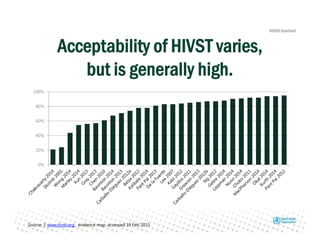
Acceptability of HIVST varies,
but is generally high.
Source: 1 www.hivst.org , evidence map, accessed 19 Feb 2015
0%
20%
40%
60%
80%
100%
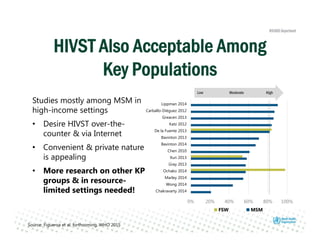
Studies mostly among MSM in
high-income settings
• Desire HIVST over-the-
counter & via Internet
• Convenient & private nature
is appealing
• More research on other KP
groups & in resource-
limited settings needed!
0% 20% 40% 60% 80% 100%
Chakravarty 2014
Wong 2014
Marley 2014
Ochako 2014
Gray 2013
Xun 2013
Chen 2010
Bavinton 2014
Bavinton 2013
De la Fuente 2013
Katz 2012
Greacen 2013
Carballo-Diéguez 2012
Lippman 2014
FSW MSM
Source: Figueroa et al. forthcoming, WHO 2015
ModerateLow High
HIVST Also Acceptable Among
Key Populations
0%
25%
50%
75%
100%
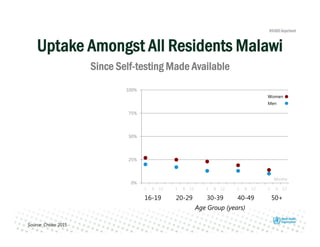
1 6 12 1 6 12 1 6 12 1 6 12 1 6 12
20-2916-19 30-39 40-49 50+
Age Group (years)
Months
Source: Choko 2015
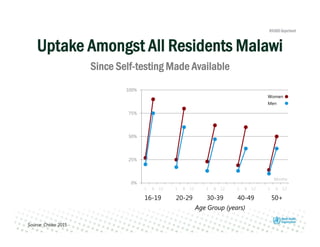
Uptake Amongst All Residents Malawi
Since Self-testing Made Available
Men
Women
0%
25%
50%
75%
100%
1 6 12 1 6 12 1 6 12 1 6 12 1 6 12
20-2916-19 30-39 40-49 50+
Age Group (years)
Months
Source: Choko 2015
Men
Women
Uptake Amongst All Residents Malawi
Since Self-testing Made Available
0%
25%
50%
75%
100%
1 6 12 1 6 12 1 6 12 1 6 12 1 6 12
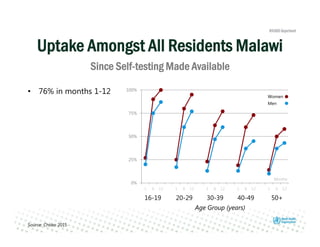
• 76% in months 1-12
20-2916-19 30-39 40-49 50+
Age Group (years)
Months
Source: Choko 2015
Men
Women
Uptake Amongst All Residents Malawi
Since Self-testing Made Available
0%
25%
50%
75%
100%
1 6 12 1 6 12 1 6 12 1 6 12 1 6 12
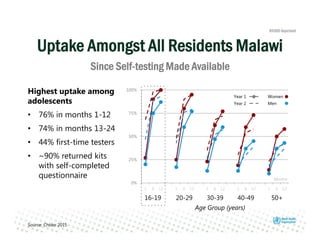
Highest uptake among
adolescents
• 76% in months 1-12
• 74% in months 13-24
• 44% first-time testers
• ~90% returned kits
with self-completed
questionnaire
20-2916-19 30-39 40-49 50+
Age Group (years)
Months
Source: Choko 2015
Year 2
Year 1
Men
Women
Uptake Amongst All Residents Malawi
Since Self-testing Made Available
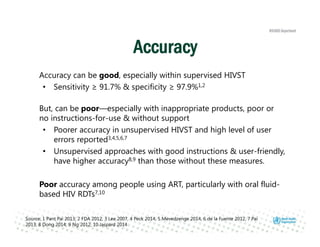
Accuracy can be good, especially within supervised HIVST
• Sensitivity ≥ 91.7% & specificity ≥ 97.9%1,2
But, can be poor—especially with inappropriate products, poor or
no instructions-for-use & without support
• Poorer accuracy in unsupervised HIVST and high level of user
errors reported3,4,5,6,7
• Unsupervised approaches with good instructions & user-friendly,
have higher accuracy8,9 than those without these measures.
Poor accuracy among people using ART, particularly with oral fluid-
based HIV RDTs7,10
Source: 1 Pant Pai 2013; 2 FDA 2012; 3 Lee 2007, 4 Peck 2014, 5 Mevedzenge 2014, 6 de la Fuente 2012, 7 Pai
2013; 8 Dong 2014; 9 Ng 2012; 10 Jaspard 2014
Accuracy
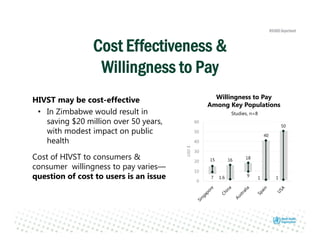
HIVST may be cost-effective
• In Zimbabwe would result in
saving $20 million over 50 years,
with modest impact on public
health
Cost of HIVST to consumers &
consumer willingness to pay varies—
question of cost to users is an issue 0
10
20
30
40
50
60
USD$
Willingness to Pay
Among Key Populations
Studies, n=8
Cost Effectiveness &
Willingness to Pay
11.6
16
1
9
18
40
15
50
7
Linkage
Source: 1 MacPherson 2014; 2 Choko 2014; Figueroa Guerro forthcoming
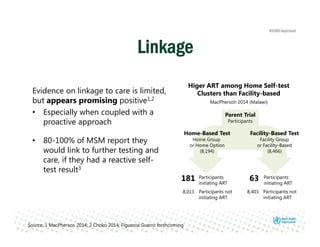
Evidence on linkage to care is limited,
but appears promising positive1,2
• Especially when coupled with a
proactive approach
• 80-100% of MSM report they
would link to further testing and
care, if they had a reactive self-
test result3
Higer ART among Home Self-test
Clusters than Facility-based
MacPherson 2014 (Malawi)
181 Participants
initiating ART
63 Participants
initiating ART
8,403 Participants not
initiating ART
8,013 Participants not
initiating ART
Home-Based Test
Home Group
or Home Option
(8,194)
Facility-Based Test
Facility Group
or Facility-Based
(8,466)
Parent Trial
Participants
Adverse Events
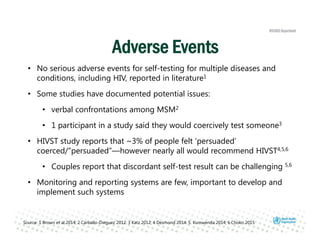
• No serious adverse events for self-testing for multiple diseases and
conditions, including HIV, reported in literature1
• Some studies have documented potential issues:
• verbal confrontations among MSM2
• 1 participant in a study said they would coercively test someone3
• HIVST study reports that ~3% of people felt ‘persuaded’
coerced/”persuaded”—however nearly all would recommend HIVST4,5,6
• Couples report that discordant self-test result can be challenging 5,6
• Monitoring and reporting systems are few, important to develop and
implement such systems
Source: 1 Brown et al 2014; 2 Carballo-Dieguez 2012: 3 Katz 2012; 4 Desmond 2014: 5. Kumwenda 2014; 6 Choko 2015
Solutions
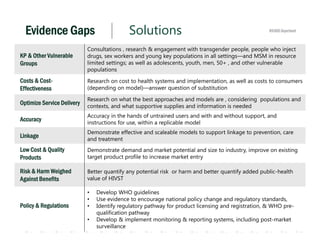
KP & Other Vulnerable
Groups
Consultations , research & engagement with transgender people, people who inject
drugs, sex workers and young key populations in all settings—and MSM in resource
limited settings; as well as adolescents, youth, men, 50+ , and other vulnerable
populations
Costs & Cost-
Effectiveness
Research on cost to health systems and implementation, as well as costs to consumers
(depending on model)—answer question of substitution
Optimize Service Delivery
Research on what the best approaches and models are , considering populations and
contexts, and what supportive supplies and information is needed
Accuracy
Accuracy in the hands of untrained users and with and without support, and
instructions for use, within a replicable model
Linkage
Demonstrate effective and scaleable models to support linkage to prevention, care
and treatment
Low Cost & Quality
Products
Demonstrate demand and market potential and size to industry, improve on existing
target product profile to increase market entry
Risk & Harm Weighed
Against Benefits
Better quantify any potential risk or harm and better quantify added public-health
value of HIVST
Policy & Regulations
• Develop WHO guidelines
• Use evidence to encourage national policy change and regulatory standards,
• Identify regulatory pathway for product licensing and registration, & WHO pre-
qualification pathway
• Develop & implement monitoring & reporting systems, including post-market
surveillance
Evidence Gaps
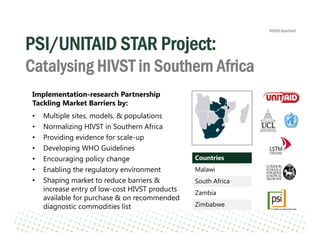
PSI/UNITAID STAR Project:
Catalysing HIVST in Southern Africa
Countries
Malawi
South Africa
Zambia
Zimbabwe
Implementation-research Partnership
Tackling Market Barriers by:
• Multiple sites, models, & populations
• Normalizing HIVST in Southern Africa
• Providing evidence for scale-up
• Developing WHO Guidelines
• Encouraging policy change
• Enabling the regulatory environment
• Shaping market to reduce barriers &
increase entry of low-cost HIVST products
available for purchase & on recommended
diagnostic commodities list
• Evidence is growing and appears promising—however
evidence gaps remain and need to be addressed
• Momentum is building, policy change and desire for
WHO guidance is growing
• Important to press ahead with building evidence &
creating pathways to move ahead, with a focus on
covering present knowledge gaps
Conclusions
Cheryl Johnson, WHO HIV Dept, Geneva, Switzerland
Elizabeth Corbett and Augustine Choko, London School of Hygiene and
Tropical Medicine, MLW, Wellcome Trust, Blantyre, Malawi
Frederic Seghers, Clinton Health Access Initiative
Carmen Figueroa Guerro, National School of Public Health. Instituto de
Salud Carlos III
Acknowledgments

WHO - BMGF_HIVST overview_feb 24 RB

  • 1.
    Rachel Baggaley, MBBS,MSc WHO Geneva Overview of HIV Self-testing: What We Know & Where to Go Bill and Melinda Gates Foundation, Meeting on the Status & Future of HIV Self-Testing 27 February 2015
  • 2.
    Source: UNAIDS, Gapreport 2014 Why are we talking about HIVST?
  • 3.
    100% 0% 20% 40% 60% 80% 100% PLHIV PLHIV whoknow their status PLHIV on ART PLHIV virally surpressed Covered Not covered Source: UNAIDS, Gap report 2014 Why are we talking about HIVST?
  • 4.
    100% 45% 39% 29% 0% 20% 40% 60% 80% 100% PLHIV PLHIV whoknow their status PLHIV on ART PLHIV virally surpressed Covered Not covered Source: UNAIDS, Gap report 2014 Why are we talking about HIVST?
  • 5.
    There is atesting gap. 55% 0% 20% 40% 60% 80% 100% PLHIV PLHIV who know their status PLHIV on ART PLHIV virally surpressed Covered Not covered Source: UNAIDS, Gap report 2014
  • 6.
    Proposed UNAIDS “90-90-90” 100% 90%90% 90% 5% 0% 20% 40% 60% 80% 100% PLHIV PLHIV who know their status PLHIV on ART PLHIV virally surpressed Covered 2020 Covered 2025 Not Covered Source: UNAIDS, Ambitious treatment targets, 2014
  • 7.
    Source: Choko etal PLoS Med 2011, Mavedzenge CID 2013, HIVST Technical Update UNAIDS 2014 Barriers to Achieving the First 90 Key populations and vulnerable groups lag behind • Poor access to and uptake of HTC services among men, health workers, key populations, adolescents, couples/partners, people 50+ , poor and rural populations, and other vulnerable groups Cultural, structural and health system barriers persist • E.g. stigma and discrimination, policies such as “age of consent” laws, cost of seeking services, long lines, lack of privacy and confidentiality, and concerns and reports of poor quality HIV testing Poor linkage to prevention, care and treatment from HTC • In PITC & community-based HTC, linkage is low—opportunities missed • Need for innovative & supportive interventions
  • 8.
    Positive results needconfirmation What is HIV Self-Testing (HIVST)?
  • 9.
    Credits: David Stanton,Vincent Wong, Cheryl Johnson, Matthew Rosenthal Available Formally & Informally
  • 10.
    Policy Environment ChangingRapidly Policies & Product(s) Licensed & Registered Policies Explicitly Allowing HIVST Policies Under Development HIVST Available Informally+ HIVST Explicitly Illegal USA 2012 Australia South Africa* China Botswana UK Zimbabwe Namibia Germany Kenya Malawi South Africa EU** France Russia Hong Kong SAR Zambia Tanzania South Africa* Brazil Peru *South Africa allows HIVST kits to be sold through venues, except pharmacies. This policy is currently being reviewed +Primarily based on anecdotal reporting, informal sale in different countries may be under-estimated. **EU policy allows countries to decide to make Class D medical devices, including HIVST, available over-the-counter in member states.
  • 11.
    Sample Type Oralfluid Sens/Spec Sensitivity = 91.7% ; Specificity = 99.97% SRA Status FDA-approved for self-testing Price $30-$40 (currently only sold in US) Manufacturer Description • $68M in US revenues in 2012, $20M international revenues • Primarily focused on oral fluid testing/sample collection • Also provide oral tests for HCV, and are working on Ebola test Product Description • First HIV home-test approved by FDA • Access to 24-hour counseling line provided with purchase • Results in 20 minutes, with 20 minutes accuracy window Test Algorithm 1. Swab upper and lower once gums with test stick (either side) 2. Put test stick in the test tube and wait 20min 3. Remove test stick to see results; Compare test stick with pictures in booklet Ease Of Use Features • Less invasive sample type: no need to draw blood • Reduced number of steps: no need to transfer sample or add buffer • Longer time limit for reading the results: 40min OraQuick® In-Home HIV Test (by OraSure) is the only FDA approved product for self-testing—none are WHO pre-qualified Source: FDA 2012, WHO 2014, slide courtesy of CHAI, 2014
  • 12.
    12 Product (supplier) Specimen Business Objectives RegulatoryStatus Other RDTs from Manufacturer • Aware™ 2.0 (Calypte, USA) Oral Fluid • No info available In process of obtaining FDA approval • Aware HIV-1/2 OMT • Asante HIV Self Test (Sedia, USA) Oral Fluid • No info available No info available • Asanté HIV-1/2 Oral Fluid Rapid Test • DPP HIV1/2 (self test version) (Chembio, USA | Fiocruz, Brazil*) Oral Fluid Whole Blood • No info available In process of obtaining FDA approval • HIV 1/2 STAT-PAK • SURE CHECK HIV 1/2 • DPP HIV 1/2 • Self Test (Developer in Toronto, Canada) Whole Blood Wanting to sell it in Africa • No info available • No info available • Self Test (Buchanan, USA) Whole Blood Wanting to sell it in Africa • No info available • No info available • Self Test (Alere, USA) Whole Blood Target SSA market Process devo. ready by 2015 • Determine • AtomoRapid (AtomoDiagnostics, Aus) Whole Blood Wanting to sell it in Africa In process of obtaining FDA approval • AtomoRapid Sure Check HIV-1/2 (Biosure, UK) Whole Blood Target UK No info available o No info available • Self-test (AAZ labs, Nephrotek , France) Whole Blood Wanting to sell in France, Francophone Africa In process of obtaining CE approval o No info available Source: FDA, WHO and expert interviews, CHAI 2014 1 2 3 4 5 * Fiocruz Brazil: has a technology transfer agreement with Chembio for local production of oral fluid tests 6 7 8 OVERVIEW OF PIPELINE PRODUCTS FOR HIV SELF-TESTING 9
  • 13.
    Source: WHO March2014 supplement & UNAIDS/WHO Short Technical Update 2014 Many Possible Models
  • 14.
    Source: 1 Young2014; 2 Marlin 2014; 3 Mugo & Murungi forthcoming; 4 Tucker forthcoming; 5 Choko 2015; 6 Desmond 2014; 7 Kumwenda 2014; 8 Gaydos 2011; 9 Gaydos 2013; 10 Pai 2014 11 Corbett 2014; 12 Dong 2014: 13 Carballo-Dieguez 2012; 14 Ngure 2014 • Smart vending machines voucher programmes 1,2 –partnering with bathhouses & gyms in USA • Pharmacies & key populations in Kenya3 • Via Internet & e-commerce sites in China4 • Youth & adolescent HIV testing programmes?5 • Couples and partner HTC6,7 • Kiosks, SMS, tablets and smartphone assisted HIVST8,9,10,11,12 Novel Approaches on Horizon
  • 15.
    Sample Type Notspecified: both oral fluid and whole blood Sens/Spec Not applicable SRA Status Not applicable Price Free / Open source Manufacturer Description • Developed by Victoria Royal Hospital (Montreal, Canada) • Dr Pant Pai has 15 years of experience with infectious diseases • Funded by the Gates Foundation • Winner of the international 2013 Accelerating Science Award Program (ASAP) Product Description • HIV self-screening strategy and app • Users are guided through a confidential process of self-testing, which contains information, instructional videos, a 24 hour help line and confidential linkages to care and counselling • Works on Android devices, but researchers are working on an iOS version, as well as expanding the number of language Ease of Use Features • Reduced user-error: clear step-by-step instructions to take the rapid test • Improved results interpretation: guidance on interpretation • Improved linkage to care: post-test counseling and 24 hour help line HIVSmart (by Dr. Nitika Pant Pai) is a self-screening mobile app that assists with end-to-end performance of a rapid test Source: Pai 2014, courtesy of CHAI, 2014
  • 16.
    • WHO HIVself-testing evidence map • See HIVST.org • Purpose is to identify and log evidence geographically to better synthesize information • Currently 74 studies catalouged, and work is on-going Overview of Evidence Available
  • 17.
    1 2 2 6 16 18 27 0 20 40 Mixed YoungPeople Vulnerable Populations Health Workers Other General Population Key Populations 1 4 8 10 24 27 0 20 40 SEARO Multi-country EURO WPRO AFRO AMRO 2 2 1 1 3 1 2 4 5 8 42 2 0 50 2001 2002 2003 2004 2005 2006 2007 2008 2009 2010 2011 2012 2013 2014 2015 Population 74 studies catalogued Region Publication Year Overview of Evidence Available
  • 18.
    HIVST in Asia WPRO& SEARO 11 studies from Asia (5 China, 1 Singapore, 1 India, 4 Australia) • Most among Key populations, primarily MSM reporting barriers to HTC • 20% MSM surveyed in China report self- testing for HIV – 1/3 obtain kits on Internet1 • 15% of MSM in China who took an HIVST were confirmed HIV positive2 Source: 1 Han 2014; 2 Tao 2014; 3 Marley 2014;4 Lee 2007, www.hivst.org , evidence map, accessed 19 Feb 2015
  • 19.
    Acceptability of HIVSTvaries, but is generally high. Source: 1 www.hivst.org , evidence map, accessed 19 Feb 2015 0% 20% 40% 60% 80% 100%
  • 20.
    Studies mostly amongMSM in high-income settings • Desire HIVST over-the- counter & via Internet • Convenient & private nature is appealing • More research on other KP groups & in resource- limited settings needed! 0% 20% 40% 60% 80% 100% Chakravarty 2014 Wong 2014 Marley 2014 Ochako 2014 Gray 2013 Xun 2013 Chen 2010 Bavinton 2014 Bavinton 2013 De la Fuente 2013 Katz 2012 Greacen 2013 Carballo-Diéguez 2012 Lippman 2014 FSW MSM Source: Figueroa et al. forthcoming, WHO 2015 ModerateLow High HIVST Also Acceptable Among Key Populations
  • 21.
    0% 25% 50% 75% 100% 1 6 121 6 12 1 6 12 1 6 12 1 6 12 20-2916-19 30-39 40-49 50+ Age Group (years) Months Source: Choko 2015 Uptake Amongst All Residents Malawi Since Self-testing Made Available Men Women
  • 22.
    0% 25% 50% 75% 100% 1 6 121 6 12 1 6 12 1 6 12 1 6 12 20-2916-19 30-39 40-49 50+ Age Group (years) Months Source: Choko 2015 Men Women Uptake Amongst All Residents Malawi Since Self-testing Made Available
  • 23.
    0% 25% 50% 75% 100% 1 6 121 6 12 1 6 12 1 6 12 1 6 12 • 76% in months 1-12 20-2916-19 30-39 40-49 50+ Age Group (years) Months Source: Choko 2015 Men Women Uptake Amongst All Residents Malawi Since Self-testing Made Available
  • 24.
    0% 25% 50% 75% 100% 1 6 121 6 12 1 6 12 1 6 12 1 6 12 Highest uptake among adolescents • 76% in months 1-12 • 74% in months 13-24 • 44% first-time testers • ~90% returned kits with self-completed questionnaire 20-2916-19 30-39 40-49 50+ Age Group (years) Months Source: Choko 2015 Year 2 Year 1 Men Women Uptake Amongst All Residents Malawi Since Self-testing Made Available
  • 25.
    Accuracy can begood, especially within supervised HIVST • Sensitivity ≥ 91.7% & specificity ≥ 97.9%1,2 But, can be poor—especially with inappropriate products, poor or no instructions-for-use & without support • Poorer accuracy in unsupervised HIVST and high level of user errors reported3,4,5,6,7 • Unsupervised approaches with good instructions & user-friendly, have higher accuracy8,9 than those without these measures. Poor accuracy among people using ART, particularly with oral fluid- based HIV RDTs7,10 Source: 1 Pant Pai 2013; 2 FDA 2012; 3 Lee 2007, 4 Peck 2014, 5 Mevedzenge 2014, 6 de la Fuente 2012, 7 Pai 2013; 8 Dong 2014; 9 Ng 2012; 10 Jaspard 2014 Accuracy
  • 26.
    HIVST may becost-effective • In Zimbabwe would result in saving $20 million over 50 years, with modest impact on public health Cost of HIVST to consumers & consumer willingness to pay varies— question of cost to users is an issue 0 10 20 30 40 50 60 USD$ Willingness to Pay Among Key Populations Studies, n=8 Cost Effectiveness & Willingness to Pay 11.6 16 1 9 18 40 15 50 7
  • 27.
    Linkage Source: 1 MacPherson2014; 2 Choko 2014; Figueroa Guerro forthcoming Evidence on linkage to care is limited, but appears promising positive1,2 • Especially when coupled with a proactive approach • 80-100% of MSM report they would link to further testing and care, if they had a reactive self- test result3 Higer ART among Home Self-test Clusters than Facility-based MacPherson 2014 (Malawi) 181 Participants initiating ART 63 Participants initiating ART 8,403 Participants not initiating ART 8,013 Participants not initiating ART Home-Based Test Home Group or Home Option (8,194) Facility-Based Test Facility Group or Facility-Based (8,466) Parent Trial Participants
  • 28.
    Adverse Events • Noserious adverse events for self-testing for multiple diseases and conditions, including HIV, reported in literature1 • Some studies have documented potential issues: • verbal confrontations among MSM2 • 1 participant in a study said they would coercively test someone3 • HIVST study reports that ~3% of people felt ‘persuaded’ coerced/”persuaded”—however nearly all would recommend HIVST4,5,6 • Couples report that discordant self-test result can be challenging 5,6 • Monitoring and reporting systems are few, important to develop and implement such systems Source: 1 Brown et al 2014; 2 Carballo-Dieguez 2012: 3 Katz 2012; 4 Desmond 2014: 5. Kumwenda 2014; 6 Choko 2015
  • 29.
    Solutions KP & OtherVulnerable Groups Consultations , research & engagement with transgender people, people who inject drugs, sex workers and young key populations in all settings—and MSM in resource limited settings; as well as adolescents, youth, men, 50+ , and other vulnerable populations Costs & Cost- Effectiveness Research on cost to health systems and implementation, as well as costs to consumers (depending on model)—answer question of substitution Optimize Service Delivery Research on what the best approaches and models are , considering populations and contexts, and what supportive supplies and information is needed Accuracy Accuracy in the hands of untrained users and with and without support, and instructions for use, within a replicable model Linkage Demonstrate effective and scaleable models to support linkage to prevention, care and treatment Low Cost & Quality Products Demonstrate demand and market potential and size to industry, improve on existing target product profile to increase market entry Risk & Harm Weighed Against Benefits Better quantify any potential risk or harm and better quantify added public-health value of HIVST Policy & Regulations • Develop WHO guidelines • Use evidence to encourage national policy change and regulatory standards, • Identify regulatory pathway for product licensing and registration, & WHO pre- qualification pathway • Develop & implement monitoring & reporting systems, including post-market surveillance Evidence Gaps
  • 30.
    PSI/UNITAID STAR Project: CatalysingHIVST in Southern Africa Countries Malawi South Africa Zambia Zimbabwe Implementation-research Partnership Tackling Market Barriers by: • Multiple sites, models, & populations • Normalizing HIVST in Southern Africa • Providing evidence for scale-up • Developing WHO Guidelines • Encouraging policy change • Enabling the regulatory environment • Shaping market to reduce barriers & increase entry of low-cost HIVST products available for purchase & on recommended diagnostic commodities list
  • 31.
    • Evidence isgrowing and appears promising—however evidence gaps remain and need to be addressed • Momentum is building, policy change and desire for WHO guidance is growing • Important to press ahead with building evidence & creating pathways to move ahead, with a focus on covering present knowledge gaps Conclusions
  • 32.
    Cheryl Johnson, WHOHIV Dept, Geneva, Switzerland Elizabeth Corbett and Augustine Choko, London School of Hygiene and Tropical Medicine, MLW, Wellcome Trust, Blantyre, Malawi Frederic Seghers, Clinton Health Access Initiative Carmen Figueroa Guerro, National School of Public Health. Instituto de Salud Carlos III Acknowledgments