Page 1Page 1
HIV Self-testing in
global and UNITAID
strategy
Carmen Pérez-Casas
UNITAID
27, February, 2015
BMGF
Page 2
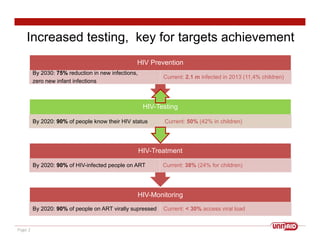
HIV-Monitoring
By 2020: 90% of people on ART virally supressed Current: < 30% access viral load
HIV-Treatment
By 2020: 90% of HIV-infected people on ART Current: 38% (24% for children)
HIV-Testing
By 2020: 90% of people know their HIV status Current: 50% (42% in children)
HIV Prevention
By 2030: 75% reduction in new infections,
zero new infant infections
Current: 2.1 m infected in 2013 (11,4% children)
Increased testing, key for targets achievement
Page 3
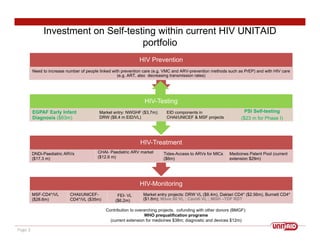
Investment on Self-testing within current HIV UNITAID
portfolio
HIV-Monitoring
MSF-CD4*/VL
($28.6m)
CHAI/UNICEF-
CD4*/VL ($35m)
FEI- VL
($6.2m)
Market entry projects: DRW VL ($8.4m), Daktari CD4* ($2.56m), Burnett CD4*
($1.6m); Wave 80 VL ; Cavidi VL ; MGH –TDF RDT
HIV-Treatment
DNDi-Paediatric ARVs
($17.3 m)
CHAI- Paediatric ARV market
($12.6 m)
Tides-Access to ARVs for MICs
($6m)
Medicines Patent Pool (current
extension $29m)
HIV-Testing
EGPAF Early Infant
Diagnosis ($63m)
Market entry: NWGHF ($3,7m);
DRW ($8.4 m EID/VL)
EID components in
CHAI/UNICEF & MSF projects
PSI Self-testing
($23 m for Phase I)
HIV Prevention
Need to increase number of people linked with prevention care (e.g. VMC and ARV-prevention methods such as PrEP) and with HIV care
(e.g. ART, also decreasing transmission rates)
Contribution to overarching projects, cofunding with other donors (BMGF):
WHO prequalification programe
(current extension for medicines $38m; diagnostic and devices $12m)
Page 4
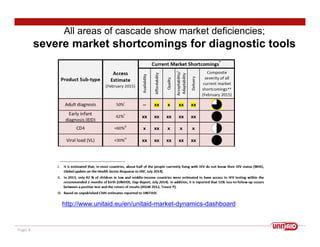
All areas of cascade show market deficiencies;
severe market shortcomings for diagnostic tools
http://www.unitaid.eu/en/unitaid-market-dynamics-dashboard
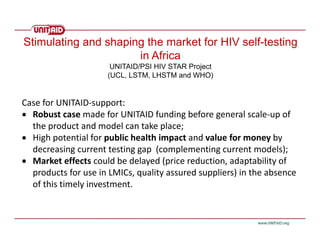
Case for UNITAID‐support:
 Robust case made for UNITAID funding before general scale‐up of 
the product and model can take place; 
 High potential for public health impact and value for money by 
decreasing current testing gap  (complementing current models);
 Market effects could be delayed (price reduction, adaptability of 
products for use in LMICs, quality assured suppliers) in the absence 
of this timely investment. 
Stimulating and shaping the market for HIV self-testing
in Africa
UNITAID/PSI HIV STAR Project
(UCL, LSTM, LHSTM and WHO)
THANK YOU FOR YOUR ATTENTION

Unitaid bmgf st meeting intro

  • 1.
    Page 1Page 1 HIV Self-testing in globaland UNITAID strategy Carmen Pérez-Casas UNITAID 27, February, 2015 BMGF
  • 2.
    Page 2 HIV-Monitoring By 2020: 90%of people on ART virally supressed Current: < 30% access viral load HIV-Treatment By 2020: 90% of HIV-infected people on ART Current: 38% (24% for children) HIV-Testing By 2020: 90% of people know their HIV status Current: 50% (42% in children) HIV Prevention By 2030: 75% reduction in new infections, zero new infant infections Current: 2.1 m infected in 2013 (11,4% children) Increased testing, key for targets achievement
  • 3.
    Page 3 Investment on Self-testingwithin current HIV UNITAID portfolio HIV-Monitoring MSF-CD4*/VL ($28.6m) CHAI/UNICEF- CD4*/VL ($35m) FEI- VL ($6.2m) Market entry projects: DRW VL ($8.4m), Daktari CD4* ($2.56m), Burnett CD4* ($1.6m); Wave 80 VL ; Cavidi VL ; MGH –TDF RDT HIV-Treatment DNDi-Paediatric ARVs ($17.3 m) CHAI- Paediatric ARV market ($12.6 m) Tides-Access to ARVs for MICs ($6m) Medicines Patent Pool (current extension $29m) HIV-Testing EGPAF Early Infant Diagnosis ($63m) Market entry: NWGHF ($3,7m); DRW ($8.4 m EID/VL) EID components in CHAI/UNICEF & MSF projects PSI Self-testing ($23 m for Phase I) HIV Prevention Need to increase number of people linked with prevention care (e.g. VMC and ARV-prevention methods such as PrEP) and with HIV care (e.g. ART, also decreasing transmission rates) Contribution to overarching projects, cofunding with other donors (BMGF): WHO prequalification programe (current extension for medicines $38m; diagnostic and devices $12m)
  • 4.
    Page 4 All areas ofcascade show market deficiencies; severe market shortcomings for diagnostic tools http://www.unitaid.eu/en/unitaid-market-dynamics-dashboard
  • 5.
    Case for UNITAID‐support:  Robust case made for UNITAID funding before general scale‐up of  the product and model can take place;   High potential for public health impact and value for money by  decreasing current testing gap  (complementing current models); Market effects could be delayed (price reduction, adaptability of  products for use in LMICs, quality assured suppliers) in the absence  of this timely investment.  Stimulating and shaping the market for HIV self-testing in Africa UNITAID/PSI HIV STAR Project (UCL, LSTM, LHSTM and WHO)
  • 6.
    THANK YOU FORYOUR ATTENTION