Metrics for Monitoring the
Cascade of HIV Services
Dr Yu Dongbao
WHO Regional Office for the Western Pacific 
21 Nov. 2013
FHI360/WHO Session: Improving the HIV Cascade of Services:
Advances in Reducing Loss to Follow Up between HIV Testing, PreARV Care and Sustained Adherence to ARV. 21 Nov. 2013 Hall G
Outline
 What are the Metrics
 How to use the metrics
 Issues/challenges and plan

2|

World Health
Organization
Western Pacific Region
Let’s fix it…

Source: FHI360
What are the Metrics?

4|

World Health
Organization
Western Pacific Region
TB‐HIV
PMTCT
PROGRAMME

CASCADES

HIV

CONTINUUM 
OF CARE

CONCEPTUAL FRAMEWORK
Enrollment in 
Care

Diagnosis

Retention

Linkage to care

% of PLHIV  
who  know 
their status 

Ratio (or %) 
of # PLHIV 
newly 
enrolled in  
care to # 
newly 
diagnosed

Antiretroviral 
Treatment

% of PLHIV 
enrolled in 
care

% of 
pre‐ART 
patients 
retained in 
care

Outcome
(Viral suppression or MTCT)
Retention

% of eligible 
PLHIV 
receiving 
ART

% of ART 
patients 
retained in 
care

% of TB patients
tested for HIV

% of incident TB‐HIV cases treated 
for TB & HIV

% of pregnant women 
tested for HIV

% of pregnant women with HIV who 
receive ARV drugs during pregnancy

% of PLHIV on 
ART with 
undetectable
VL

% of HIV‐exposed infants who 
receive ARV prophylaxis

%  of key populations (SW, MSM, 
PWID) tested for HIV 

CD4 count at time of 
enrollment

% of PLHIV initiating ART within 30 
days of eligibility

% of PLHIV enrolled in care whose 
partner has been tested

% of on time drug pick up

% of HIV‐positive pregnant women 
whose partner has been tested

% of months in reporting period  
with no ARV stock outs

% of HIV‐exposed infants tested 
within 2 months of birth 

% of tested HIV‐exposed infants 
who are HIV‐positive
Objectives and target audiences
• Objectives: 
To identify the bottlenecks and gaps along the cascade of HIV 
services; and
To assist national programmes in prioritizing key indicators to 
monitor the cascade of HIV services

• Target audience: program managers, staff and 
M&E officers at national and subnational levels
How to use the Metrics?
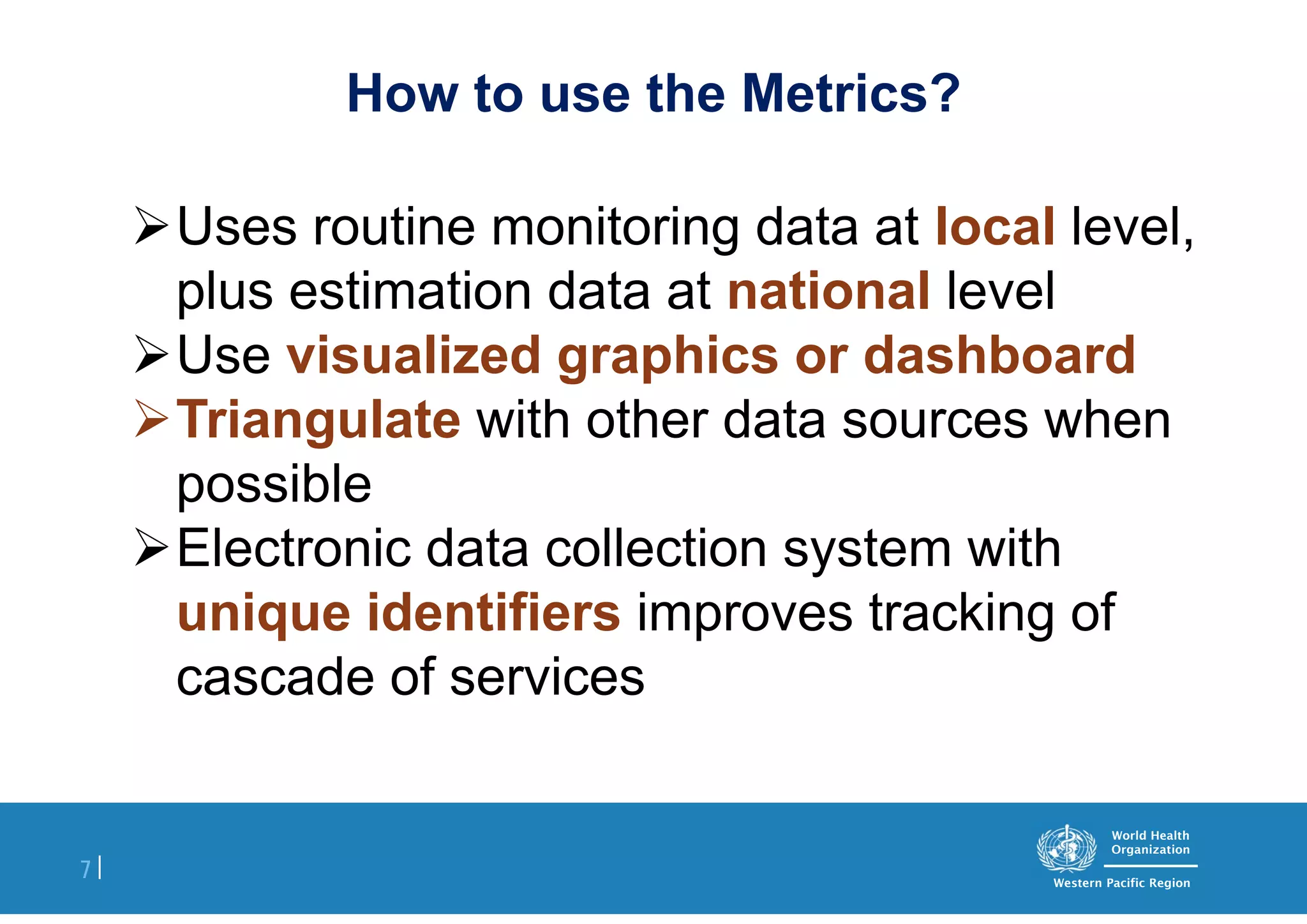
Uses routine monitoring data at local level,
plus estimation data at national level
Use visualized graphics or dashboard
Triangulate with other data sources when
possible
Electronic data collection system with
unique identifiers improves tracking of
cascade of services

7|

World Health
Organization
Western Pacific Region
The field test …
 Field test in Cambodia and Viet Nam, with data collected from
China, Indonesia and Myanmar in Oct. 2013
 Purpose: To validate the data availability and usefulness
 Results:
 The metrics provide useful framework for programme
assessment and data interpretation
 All indicators can be calculated using aggregated data, but
unique identifier code (UIC) would improve the monitoring
 Adapt the indicators and analysis to country situation as
necessary
 Capacity building required at subnational level
8|

World Health
Organization
Western Pacific Region
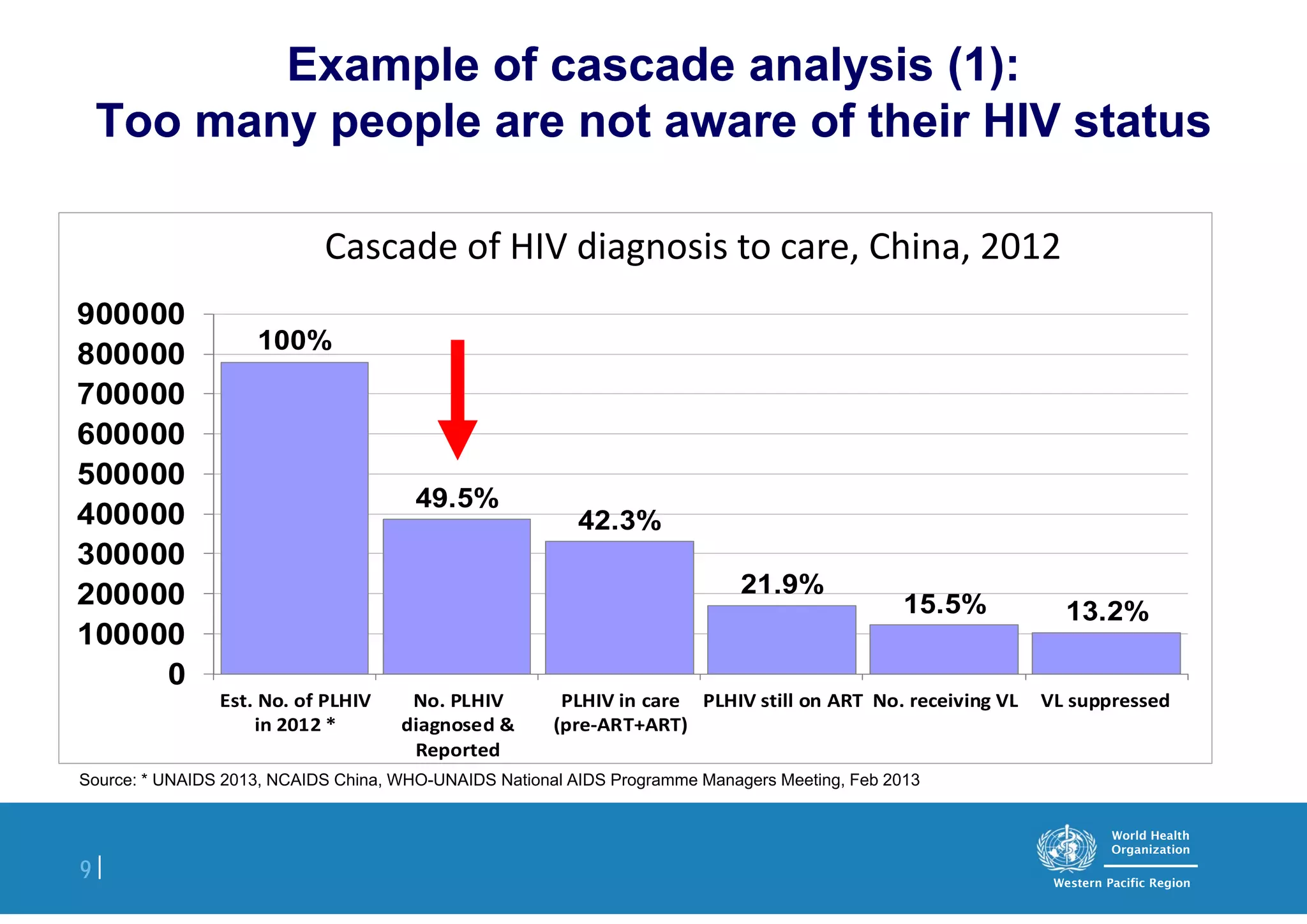
Example of cascade analysis (1):
Too many people are not aware of their HIV status
Cascade of HIV diagnosis to care, China, 2012
900000
800000
700000
600000
500000
400000
300000
200000
100000
0

100%

49.5%

42.3%
21.9%

Est. No. of PLHIV
in 2012 *

No. PLHIV
diagnosed &
Reported

15.5%

PLHIV in care PLHIV still on ART No. receiving VL
(pre‐ART+ART)

13.2%
VL suppressed

Source: * UNAIDS 2013, NCAIDS China, WHO-UNAIDS National AIDS Programme Managers Meeting, Feb 2013

9|

World Health
Organization
Western Pacific Region
Example of cascade analysis (2):
Too many people are lost after diagnosis

300,000

Cascade of HIV diagnosis to care, Vietnam, 2012
256,845

250,000

Many lost after diagnosis

201,703

200,000
150,000
82,241

100,000

Many 72,711 after diagnosis
loss

50,000
n.a

Estimated of
PLHIV *

n.a

PLHIV
PLHIV in care
PLHIV
No. receiving
VL
diagnosed
(precurrently
VL
suppressed
and reported ART+ART) receiving ART

Source: * UNAIDS 2013, VAAC Vietnam, WHO-UNAIDS National AIDS Programme Managers Meeting, Feb 2013

10 |

World Health
Organization
Western Pacific Region
Issues and challenges 
•
•
•
•
•

Local vs. national use: local capacity 
Programme data vs. estimation data
Definition of and monitoring retention of “care”
Cohort vs. cross sectional analysis
Use of data and programmatic actions
The Guide and timeline…
 The Asia Pacific Metrics for Monitoring Cascade of HIV
Services contains:
 A framework
 Core indicators: cascade and programme indicators
 Guide on data presentation, analysis and interpretation
 Guide on use of the Metrics for programme improvement

 Timeline: finalization by Dec. 2013; and publish in early
2014

12 |

World Health
Organization
Western Pacific Region
In summary…
• A useful tool for improve the linkages and 
retention across the full cascade of services and 
reduce loss to follow up
• There are issues/challenges: capacity, data quality, 
and UIC, etc…  
• Suggestions and inputs welcome
Acknowledgement 
• Government partners from Cambodia, Viet Nam, China, 
Indonesia and Myanmar for their leadership and support
• Celine Daly and Tobi Saidel
• Ying‐ru Lo, Masami Fujita, Masaya Kato, Nicole Seguy, 
Zhang Lan, Razia Pendse, Oscar Barreneche and 
colleagues from WHO, UNAIDS, CDC, FHI360,
• Members of the Technical Advisory Group
Thank you!

15 |

World Health
Organization
Western Pacific Region

Metrics