1
Whitepaper
Maximizing the
Success of Your
CRO Partnerships
ABSTRACT:
With intense pressure to deliver a
measureable return on investment,
pharmaceutical and biotech
companies are increasingly
leveraging outsourcing in an effort
to realize gains in productivity.
While investment in clinical
and non-clinical outsourcing
grows steadily, and the number
of molecules in development
continues to climb, the number
of new drugs reaching the market
remains relatively flat.
Can a new approach to outsourcing
help remedy this trend?
This whitepaper discusses the
biggest obstacles to achieving a
shared vision and strategies to
create a culture of partnership with
your CRO.
FOR MORE INFORMATION
CONTACT:
+1 816 767 3900 North America
+44 131 451 2451 Europe
email: info@aptuit.com
or visit our website: www.aptuit.com
Author:	 Colin Terry
Executive Vice President
Commercial Operations
Published:	 January 2011
2 Whitepaper: Maximizing the Success of Your CRO Partnerships January 2011
The Dynamics Impacting the Pharmaceutical Industry
It’s certainly true that pharmaceutical companies are under intense
pressure to replenish pipelines and reverse a trend in which R&D returns
are falling below the costs of capital. These financial pressures, along
with the need for cost containment efficiencies and time-to-market
improvements, have made outsourcing an increasingly attractive option.
And yet based on published statistics, it is clear that the sponsor/CRO
model still needs to evolve further to address and reverse these trends.
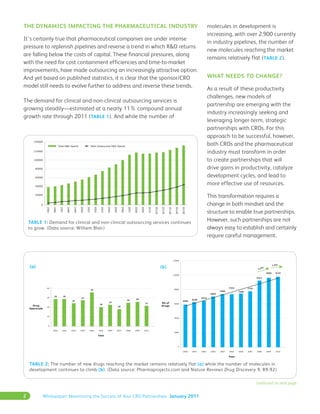
The demand for clinical and non-clinical outsourcing services is
growing steadily—estimated at a nearly 11% compound annual
growth rate through 2011 (Table 1). And while the number of
molecules in development is
increasing, with over 2,900 currently
in industry pipelines, the number of
new molecules reaching the market
remains relatively flat (Table 2).
What Needs to Change?
As a result of these productivity
challenges, new models of
partnership are emerging with the
industry increasingly seeking and
leveraging longer-term, strategic
partnerships with CROs. For this
approach to be successful, however,
both CROs and the pharmaceutical
industry must transform in order
to create partnerships that will
drive gains in productivity, catalyze
development cycles, and lead to
more effective use of resources.
This transformation requires a
change in both mindset and the
structure to enable true partnerships.
However, such partnerships are not
always easy to establish and certainly
require careful management.
continued on next page
Table 1: Demand for clinical and non-clinical outsourcing services continues
to grow. (Data source: William Blair)
Table 2: The number of new drugs reaching the market remains relatively flat (a) while the number of molecules in
development continues to climb (b). (Data source: Pharmaprojects.com and Nature Reviews Drug Discovery 9, 89-92)
(a) (b)
3 Whitepaper: Maximizing the Success of Your CRO Partnerships January 2011
The traditional “transactional” approach to leveraging CROs is probably
contributing to the ongoing productivity issues that are plaguing the
industry. This approach can be described as:
•	 Fee for service
•	 Small, discrete pieces of work
•	 Tactical in nature, with the CRO being cast as an “extra set
of hands”
•	 Use of multiple vendors by the sponsor
•	 Initiated by and managed at project team level
Too often, the services a CRO provides simply mirror the internal
processes of the sponsor company and their functional silos. In this
sense, nothing new is brought to the table by the CRO. And so despite
the outsourcing relationship, the drug developer remains mired in the
same productivity challenges.
What we are now seeing is that some pharmaceutical companies
increasingly view outsourcing as part of their overall development
strategy. For many companies, this is a significant change in mindset
and approach.
They are seeking fewer partners able to offer a more integrated array
of services across the entire discovery and development value chain. In
some cases we see, the companies are attempting to reduce hundreds
of service partners to a strategic handful.
Companies are beginning to
look more at leveraging early
development services—what
had once been considered core
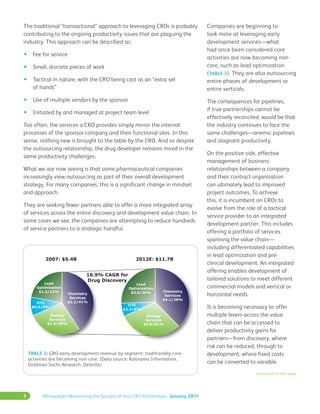
activities are now becoming non-
core, such as lead optimization
(Table 3). They are also outsourcing
entire phases of development or
entire verticals.
The consequences for pipelines,
if true partnerships cannot be
effectively reconciled, would be that
the industry continues to face the
same challenges—anemic pipelines
and stagnant productivity.
On the positive side, effective
management of business
relationships between a company
and their contract organization
can ultimately lead to improved
project outcomes. To achieve
this, it is incumbent on CROs to
evolve from the role of a tactical
service provider to an integrated
development partner. This includes
offering a portfolio of services
spanning the value chain—
including differentiated capabilities
in lead optimization and pre-
clinical development. An integrated
offering enables development of
tailored solutions to meet different
commercial models and vertical or
horizontal needs.
It is becoming necessary to offer
multiple levers across the value
chain that can be accessed to
deliver productivity gains for
partners—from discovery, where
risk can be reduced, through to
development, where fixed costs
can be converted to variable.
continued on next page
Table 3: CRO early development revenue by segment: traditionally-core
activities are becoming non-core. (Data source: Kalorama Information,
Goldman Sachs Research, Deloitte)
4 Whitepaper: Maximizing the Success of Your CRO Partnerships January 2011
Critical Success Factors
For a high-performing partnership that effectively leverages the core
strengths of the sponsor and partner, the benefits can be significant:
•	 Increased productivity, catalyzing time and cost efficiencies
•	 Improvements to the ROI of R&D
•	 Strengthening of pipelines
•	 Accelerated development cycles
Many elements must be in place, however, to create a true partnership
between a CRO and a pharmaceutical company.
A critical success factor is that the approach to partnering be driven
by a senior-level, strategic vision rather than by procurement. Senior-
level involvement from both sides helps to ensure the alignment of
priorities and facilitates timely and informed decisions from a strategic
perspective. As more companies seek to consolidate their partners, a
senior-level, strategic view and management of these relationships
becomes more vital. As part of these partnerships, the organizations
should set up routine business reviews to make sure expectations and
goals are being met on both sides.
If a sponsor has multiple partners, they should encourage and allow
information to be shared among those partners so that transfers
of information, data, and materials become more seamless. If the
partners aren’t communicating well, it is unlikely the company will
recognize significant gains in productivity.
Sponsor companies should be willing to provide long-term visibility
and communicate long-term objectives to their partners. This visibility
can change or guide an early-stage approach that will better position
a project for success down the road. Greater visibility can also change
the way the partner may structure their approach. On a practical
level, this lead time can also allow the partner to proactively put in
place the necessary equipment and resources to further position both
organizations for productivity gains.
A Path Forward to Greater Operational Efficiency
While the ultimate goal remains to produce high quality therapies that
help improve patient outcomes, many companies are seeking to not
only evolve the way in which they develop drugs but to also change
models of financing their development.
As we talk with clients and look for strategic ways to work together, we
see several financial trends emerging across the sector. These include
alignment of internal resources
with areas in which they will have
the greatest impact on ROI, a
sharper focus on shared risk and
reward partnership structures, and a
reduction in fixed-cost assets.
In recent months, pharmaceutical
companies and outsourcing
providers have inked a variety of
strategic deals across all facets of
drug development. In some cases,
entire areas of development or
facilities have been transferred to
the strategic outsourcing provider.
The nature of these deals is in step
with the financial trends in the
industry in that they better align
resources with the areas of highest
anticipated return, enable sharing
of risk and reward, and reduce
fixed costs.
Aptuit operated in very much the
same mindset in our recent deal to
purchase GlaxoSmithKline’s Verona
Medicines Research Centre. Whereas
a pharmaceutical company, such
as our partner GSK, might advance
15 to 20 molecules through R&D
processes at a site like the Verona,
Aptuit can leverage this same
resource to progress any number of
the over 2,000 molecules we work
on each year.
It is safe to assume that we’re
just beginning to see the ways
that these partnerships will tackle
the current financial, operational,
and productivity challenges facing
drug development. These types
of strategic deals have clear
advantages, and they illustrate the
innovative solutions the industry
must take to achieve greater financial
and operational efficiency. •

Whitepaper-Maximizing-the-Success-of-Your-CRO-Partnerships

  • 1.
    1 Whitepaper Maximizing the Success ofYour CRO Partnerships ABSTRACT: With intense pressure to deliver a measureable return on investment, pharmaceutical and biotech companies are increasingly leveraging outsourcing in an effort to realize gains in productivity. While investment in clinical and non-clinical outsourcing grows steadily, and the number of molecules in development continues to climb, the number of new drugs reaching the market remains relatively flat. Can a new approach to outsourcing help remedy this trend? This whitepaper discusses the biggest obstacles to achieving a shared vision and strategies to create a culture of partnership with your CRO. FOR MORE INFORMATION CONTACT: +1 816 767 3900 North America +44 131 451 2451 Europe email: info@aptuit.com or visit our website: www.aptuit.com Author: Colin Terry Executive Vice President Commercial Operations Published: January 2011
  • 2.
    2 Whitepaper: Maximizingthe Success of Your CRO Partnerships January 2011 The Dynamics Impacting the Pharmaceutical Industry It’s certainly true that pharmaceutical companies are under intense pressure to replenish pipelines and reverse a trend in which R&D returns are falling below the costs of capital. These financial pressures, along with the need for cost containment efficiencies and time-to-market improvements, have made outsourcing an increasingly attractive option. And yet based on published statistics, it is clear that the sponsor/CRO model still needs to evolve further to address and reverse these trends. The demand for clinical and non-clinical outsourcing services is growing steadily—estimated at a nearly 11% compound annual growth rate through 2011 (Table 1). And while the number of molecules in development is increasing, with over 2,900 currently in industry pipelines, the number of new molecules reaching the market remains relatively flat (Table 2). What Needs to Change? As a result of these productivity challenges, new models of partnership are emerging with the industry increasingly seeking and leveraging longer-term, strategic partnerships with CROs. For this approach to be successful, however, both CROs and the pharmaceutical industry must transform in order to create partnerships that will drive gains in productivity, catalyze development cycles, and lead to more effective use of resources. This transformation requires a change in both mindset and the structure to enable true partnerships. However, such partnerships are not always easy to establish and certainly require careful management. continued on next page Table 1: Demand for clinical and non-clinical outsourcing services continues to grow. (Data source: William Blair) Table 2: The number of new drugs reaching the market remains relatively flat (a) while the number of molecules in development continues to climb (b). (Data source: Pharmaprojects.com and Nature Reviews Drug Discovery 9, 89-92) (a) (b)
  • 3.
    3 Whitepaper: Maximizingthe Success of Your CRO Partnerships January 2011 The traditional “transactional” approach to leveraging CROs is probably contributing to the ongoing productivity issues that are plaguing the industry. This approach can be described as: • Fee for service • Small, discrete pieces of work • Tactical in nature, with the CRO being cast as an “extra set of hands” • Use of multiple vendors by the sponsor • Initiated by and managed at project team level Too often, the services a CRO provides simply mirror the internal processes of the sponsor company and their functional silos. In this sense, nothing new is brought to the table by the CRO. And so despite the outsourcing relationship, the drug developer remains mired in the same productivity challenges. What we are now seeing is that some pharmaceutical companies increasingly view outsourcing as part of their overall development strategy. For many companies, this is a significant change in mindset and approach. They are seeking fewer partners able to offer a more integrated array of services across the entire discovery and development value chain. In some cases we see, the companies are attempting to reduce hundreds of service partners to a strategic handful. Companies are beginning to look more at leveraging early development services—what had once been considered core activities are now becoming non- core, such as lead optimization (Table 3). They are also outsourcing entire phases of development or entire verticals. The consequences for pipelines, if true partnerships cannot be effectively reconciled, would be that the industry continues to face the same challenges—anemic pipelines and stagnant productivity. On the positive side, effective management of business relationships between a company and their contract organization can ultimately lead to improved project outcomes. To achieve this, it is incumbent on CROs to evolve from the role of a tactical service provider to an integrated development partner. This includes offering a portfolio of services spanning the value chain— including differentiated capabilities in lead optimization and pre- clinical development. An integrated offering enables development of tailored solutions to meet different commercial models and vertical or horizontal needs. It is becoming necessary to offer multiple levers across the value chain that can be accessed to deliver productivity gains for partners—from discovery, where risk can be reduced, through to development, where fixed costs can be converted to variable. continued on next page Table 3: CRO early development revenue by segment: traditionally-core activities are becoming non-core. (Data source: Kalorama Information, Goldman Sachs Research, Deloitte)
  • 4.
    4 Whitepaper: Maximizingthe Success of Your CRO Partnerships January 2011 Critical Success Factors For a high-performing partnership that effectively leverages the core strengths of the sponsor and partner, the benefits can be significant: • Increased productivity, catalyzing time and cost efficiencies • Improvements to the ROI of R&D • Strengthening of pipelines • Accelerated development cycles Many elements must be in place, however, to create a true partnership between a CRO and a pharmaceutical company. A critical success factor is that the approach to partnering be driven by a senior-level, strategic vision rather than by procurement. Senior- level involvement from both sides helps to ensure the alignment of priorities and facilitates timely and informed decisions from a strategic perspective. As more companies seek to consolidate their partners, a senior-level, strategic view and management of these relationships becomes more vital. As part of these partnerships, the organizations should set up routine business reviews to make sure expectations and goals are being met on both sides. If a sponsor has multiple partners, they should encourage and allow information to be shared among those partners so that transfers of information, data, and materials become more seamless. If the partners aren’t communicating well, it is unlikely the company will recognize significant gains in productivity. Sponsor companies should be willing to provide long-term visibility and communicate long-term objectives to their partners. This visibility can change or guide an early-stage approach that will better position a project for success down the road. Greater visibility can also change the way the partner may structure their approach. On a practical level, this lead time can also allow the partner to proactively put in place the necessary equipment and resources to further position both organizations for productivity gains. A Path Forward to Greater Operational Efficiency While the ultimate goal remains to produce high quality therapies that help improve patient outcomes, many companies are seeking to not only evolve the way in which they develop drugs but to also change models of financing their development. As we talk with clients and look for strategic ways to work together, we see several financial trends emerging across the sector. These include alignment of internal resources with areas in which they will have the greatest impact on ROI, a sharper focus on shared risk and reward partnership structures, and a reduction in fixed-cost assets. In recent months, pharmaceutical companies and outsourcing providers have inked a variety of strategic deals across all facets of drug development. In some cases, entire areas of development or facilities have been transferred to the strategic outsourcing provider. The nature of these deals is in step with the financial trends in the industry in that they better align resources with the areas of highest anticipated return, enable sharing of risk and reward, and reduce fixed costs. Aptuit operated in very much the same mindset in our recent deal to purchase GlaxoSmithKline’s Verona Medicines Research Centre. Whereas a pharmaceutical company, such as our partner GSK, might advance 15 to 20 molecules through R&D processes at a site like the Verona, Aptuit can leverage this same resource to progress any number of the over 2,000 molecules we work on each year. It is safe to assume that we’re just beginning to see the ways that these partnerships will tackle the current financial, operational, and productivity challenges facing drug development. These types of strategic deals have clear advantages, and they illustrate the innovative solutions the industry must take to achieve greater financial and operational efficiency. •