Data center design decisions and their
impact on power system infrastructure
When designing an enterprise data
center, owners, architects and
engineers have to understand and
decide on everything from site to
signage. Some of the most critical
decisions revolve around the best
power distribution infrastructure to
suit the facility’s needs. This white
paper reviews three key factors to
consider when determining the power
distribution infrastructure: the size of
the system, the reliability architecture
that is selected, and the operational
complexity of delivering power to the
critical loads. Once the team knows
these factors, they will have a solid
foundation on which to design and
build a comprehensive, integrated
electrical power distribution system.
Factor one: the size of
the power distribution
infrastructure
It may seem hard to believe, but the heat generated
by IT equipment in a data center is a critical data
point in defining the power system infrastructure
for the entire facility. (Typically this equipment is
in a room with a raised floor for air distribution,
although some data centers have a technology
room without a raised floor. For the purposes of
this paper the technology room will be generically
referred to as the raised floor area, but the following
applies to both styles of technology room design.)
Because the technology equipment and the
mechanical infrastructure to keep it cool are the
largest consumers of electricity in the building,
their maximum electricity consumption defines the
power needs of the facility.
Calculation of the electrical
consumption of the
technology equipment
Data center facility managers have traditionally used
watts per square area (foot or meter) when describing
the heat load of the equipment within the raised
floor area. Recently, however, some managers have
started to use kilowatts per rack. Either way, in order
to calculate a useful electrical load, one must convert
these numbers to watts.
Power topic #9020 | Technical information from Cummins Power Generation
White Paper
By Richard Hallahan, Senior Manager – Strategic Accounts
02Powertopic#9020
Both methods are described and illustrated below:
Method 1 — raised floor heat load x raised
floor area
Once the size of the raised floor area where the
technology equipment will reside has been defined, it’s
a simple calculation of multiplying the number of watts
per square foot (or watts per meter squared) times the
number of total square feet (or meters) in the raised
floor area to determine the watts required to support
the technology equipment.
Example:
Raised floor heat load 150 watts per square foot (w/ft²)
Raised floor area x 48,000 total square feetx 48,000 total square feet
Electrical consumption 7,200,000 watts = 7,200 kW =
7.2 MW
Similar example in metric units:
Raised floor heat load 1,500 watts per meter squared (w/m²)
Raised floor area x 4,500 total meters squaredx 4,500 total meters squared
Electrical consumption 6,750,000 watts = 6,750 kW =
6.8 MW
Method 2 — technology rack heat load x total
number of racks in raised floor area
The watts-per-rack calculation is somewhat area-
independent. It focuses on the heat generated at
each rack or cabinet as a kilowatt-per-rack value. This
approach requires defining the number of technology
racks that will reside within the raised floor area when
the data center is fully utilized. (This value will lead to
the raised floor area size, once row and aisle sizes are
determined.) Multiplying kilowatts per rack times the
number of racks then provides the power consumption
value for the technology equipment in the raised floor
area, similar to method one.
Example:
Technology rack heat load 12 kilowatts per rack (kW/rack)
Racks in raised floor area x 600 total number of racks
Electrical consumption 7,200 kW = 7.2 MW
Calculation of the electrical
consumption of the data center
Once the kilowatt load of the technology space
has been determined, a rule of thumb is to double
it to obtain the approximate maximum electricity
consumption load for the entire data center. In the case
of the earlier examples, the approximate load
of the whole data center facility would be 2 x 7.2 MW
or 14.4 MW. This rule of thumb assumes that
the mechanical systems that cool the technology
equipment, e.g., the chiller, pumps, computer room air
conditioners and handlers (CRACs/CRAHs), consume
approximately the same amount of power as the technology
equipment itself in the raised floor area. These two loads
combined account for over 95% of the electrical power
consumption of a typical greenfield data center.
Factor 2: the reliability architecture
The second key decision concerns the reliability architecture.
In the mid-1990s, the Uptime Institute™ published the
first version of its white paper “Tier Classifications Define
Site Infrastructure Performance.” Regularly updated,
this document has provided the guiding principles for
infrastructure reliability at many data centers; it also serves as a
commonly used metric to compare data center infrastructures.
The document establishes four performance levels or tiers
associated with the infrastructure of a data center facility —
from a facility with the minimum or basic infrastructure needed
to support a data center (Tier I) to a fault-tolerant architecture
with twice the infrastructure needed to support a data center
(Tier IV). With each successive tier the “representative site
availability” increases. Or to put it conversely, the average
amount of time offline decreases with each tier level from I
to IV. The higher the tier level, theoretically, the more reliable
the data center facility. While this is not the only way to
establish the reliability architecture of a data center, it is a
widely accepted way to set parameters that define the desired
infrastructure characteristics.
Once the reliability architecture of the data center is selected,
certain characteristics of the power infrastructure will become
better defined. For example, if a reliability architecture that
meets Tier II guidelines is chosen, certain power system
elements will have redundant components, i.e., an N+1
configuration. See Figure 1. Accordingly, a facility that needs
one 2000 kW generator to support the base electrical load
would purchase and install two 2000 kW generators. The
second generator would represent the redundant component.
Continuing with the same example, this reliability architecture
decision would also drive the power system infrastructure;
instead of using a transfer switch to integrate the generator,
the choice would most likely be to use paralleling switchgear
to integrate both generators into the power infrastructure.
The cost of an installation rises proportionately with the degree
of reliability. In general, as the facility is designed to be more
reliable (i.e., meeting higher tier levels), more infrastructure
equipment is needed to meet the reliability architecture needs.
More equipment means greater initial costs associated with
the construction of the data center facility, as well as greater
costs for maintaining that equipment.
The choice of operating voltage for the power infrastructure
will also impact the power system architecture and the initial
cost of the facility. The impact on the equipment cost can
be quite variable, however, and there is no rule of thumb
relating operating voltage to initial equipment cost. If operating
voltage is a variable in the power infrastructure design, it is
recommended that a cost comparison of designs at different
operating voltages be performed, to enable the most informed
decision about what is best for the data center.
www.cumminspower.com
©2011 Cummins Power Generation
03Powertopic#9020
Factor 3: operational complexity
The third factor that influences the power system
infrastructure design is the operational complexity of
the system. If a higher tier level is chosen, that choice
drives other decisions, such as implementing paralleling
switchgear and other automatically controlled devices
within the power system architecture. As a result, there
is added complexity in the sequence of operations —
the automatically initiated program of directions within
the power distribution equipment to react to a change
in normal operating conditions, such as a loss of
utility power.
This sequence of operations implements the transfer
to the redundant power path interconnections of the
electrical distribution. These interconnections keep
the facility operational during the potentially mission-
disabling event, such as a power failure. There are
many choices associated with operational complexity,
from simple designs with just two power paths, to
complex designs that control multiple redundant
power paths. Once the reliability architecture decision
about which tier level is made, the range of choices is
reduced, but still a number of options remain.
Commonly used power system architecture designs
are one way to simplify the choices associated
with operational complexity. The one that best suits
the needs of a particular data center design will
be determined by earlier decisions in the process,
as noted above. These power system architecture
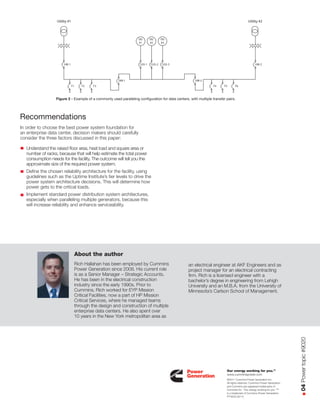
configurations are commonly known by names such as
isolated bus, multiple transfer pairs, or main-tie-main
split generator bus, to name a few. See Figure 2. The
standard control blocks — paralleling controls, power
transfer controls and system controls — are typically
integrated into the larger power distribution system for
the facility, which may include additional supervisory
control in the form of a SCADA system.
Standard architectures have advantages over custom-
designed ones. The most important advantage is that
the programming associated with a standard sequence
of operations has been used in multiple applications of
this type of power system architecture. The associated
sequence of operations has been subjected to many
hours of operation, which should reveal any major
software issues that might cause operational instability.
To put it another way, standard power system
architectures can be considered more reliable than
custom-designed ones because the programming
associated with the sequence of operation is more
stable, thanks to many hours of operation.
Interchangeability is another benefit associated
with standard power system architectures. Most
components of the power system design would be “off
the shelf” if they are used in a standard design. Should
any component need to be replaced for any reason,
it should be readily available and easily integrated
into the power system infrastructure, reducing
potential downtime. An inability to easily replace bad
components is one of the main drivers that impact the
serviceability of the equipment.
In addition, custom-designed, operationally complex
systems have some less obvious costs associated with
them. Complexity increases hardware costs because
of the custom nature of the product, but complexity
also adds cost associated with verifying the operational
capability and long-term maintenance costs. These
aspects should also be taken into account when deciding
on the level of complexity of the power distribution system.
www.cumminspower.com
©2011 Cummins Power Generation
Figure 1 - Sample Tier II topology, with redundant capacity components and single, non-redundant distribution paths.
Genset (N)
Genset (N+1)
Paralleling
Switchgear
Utility
Utility
Switchgear
Mechanical
Switchgear
Mechanical
Systems
UPS
(N)
UPS
(N+1)
Switchgear
PDU
IT
Equipment
Utility #1
UM-1
Utility #2
UM-2
GM-2GM-1
F1 F2 F3 F4 F5 F6
52G-3
DG
#1
DG
#2
DG
#3
52G-252G-1
Figure 2 - Example of a commonly used paralleling configuration for data centers, with multiple transfer pairs.
04Powertopic#9020
www.cumminspower.com
Understand the raised floor area, heat load and square area or
number of racks, because that will help estimate the total power
consumption needs for the facility. The outcome will tell you the
approximate size of the required power system.
Define the chosen reliability architecture for the facility, using
guidelines such as the Uptime Institute’s tier levels to drive the
power system architecture decisions. This will determine how
power gets to the critical loads.
Implement standard power distribution system architectures,
especially when paralleling multiple generators, because this
will increase reliability and enhance serviceability.
Recommendations
In order to choose the best power system foundation for
an enterprise data center, decision makers should carefully
consider the three factors discussed in this paper:
About the author
Rich Hallahan has been employed by Cummins
Power Generation since 2008. His current role
is as a Senior Manager – Strategic Accounts.
He has been in the electrical construction
industry since the early 1990s. Prior to
Cummins, Rich worked for EYP Mission
Critical Facilities, now a part of HP Mission
Critical Services, where he managed teams
through the design and construction of multiple
enterprise data centers. He also spent over
10 years in the New York metropolitan area as
an electrical engineer at AKF Engineers and as
project manager for an electrical contracting
firm. Rich is a licensed engineer with a
bachelor’s degree in engineering from Lehigh
University and an M.B.A. from the University of
Minnesota’s Carlson School of Management.
©2011 Cummins Power Generation Inc.
All rights reserved. Cummins Power Generation
and Cummins are registered trademarks of
Cummins Inc. “Our energy working for you. TM
”
is a trademark of Cummins Power Generation.
PT-9020 (9/11)

White Paper-Data Centers Design Decisions

  • 1.
    Data center designdecisions and their impact on power system infrastructure When designing an enterprise data center, owners, architects and engineers have to understand and decide on everything from site to signage. Some of the most critical decisions revolve around the best power distribution infrastructure to suit the facility’s needs. This white paper reviews three key factors to consider when determining the power distribution infrastructure: the size of the system, the reliability architecture that is selected, and the operational complexity of delivering power to the critical loads. Once the team knows these factors, they will have a solid foundation on which to design and build a comprehensive, integrated electrical power distribution system. Factor one: the size of the power distribution infrastructure It may seem hard to believe, but the heat generated by IT equipment in a data center is a critical data point in defining the power system infrastructure for the entire facility. (Typically this equipment is in a room with a raised floor for air distribution, although some data centers have a technology room without a raised floor. For the purposes of this paper the technology room will be generically referred to as the raised floor area, but the following applies to both styles of technology room design.) Because the technology equipment and the mechanical infrastructure to keep it cool are the largest consumers of electricity in the building, their maximum electricity consumption defines the power needs of the facility. Calculation of the electrical consumption of the technology equipment Data center facility managers have traditionally used watts per square area (foot or meter) when describing the heat load of the equipment within the raised floor area. Recently, however, some managers have started to use kilowatts per rack. Either way, in order to calculate a useful electrical load, one must convert these numbers to watts. Power topic #9020 | Technical information from Cummins Power Generation White Paper By Richard Hallahan, Senior Manager – Strategic Accounts
  • 2.
    02Powertopic#9020 Both methods aredescribed and illustrated below: Method 1 — raised floor heat load x raised floor area Once the size of the raised floor area where the technology equipment will reside has been defined, it’s a simple calculation of multiplying the number of watts per square foot (or watts per meter squared) times the number of total square feet (or meters) in the raised floor area to determine the watts required to support the technology equipment. Example: Raised floor heat load 150 watts per square foot (w/ft²) Raised floor area x 48,000 total square feetx 48,000 total square feet Electrical consumption 7,200,000 watts = 7,200 kW = 7.2 MW Similar example in metric units: Raised floor heat load 1,500 watts per meter squared (w/m²) Raised floor area x 4,500 total meters squaredx 4,500 total meters squared Electrical consumption 6,750,000 watts = 6,750 kW = 6.8 MW Method 2 — technology rack heat load x total number of racks in raised floor area The watts-per-rack calculation is somewhat area- independent. It focuses on the heat generated at each rack or cabinet as a kilowatt-per-rack value. This approach requires defining the number of technology racks that will reside within the raised floor area when the data center is fully utilized. (This value will lead to the raised floor area size, once row and aisle sizes are determined.) Multiplying kilowatts per rack times the number of racks then provides the power consumption value for the technology equipment in the raised floor area, similar to method one. Example: Technology rack heat load 12 kilowatts per rack (kW/rack) Racks in raised floor area x 600 total number of racks Electrical consumption 7,200 kW = 7.2 MW Calculation of the electrical consumption of the data center Once the kilowatt load of the technology space has been determined, a rule of thumb is to double it to obtain the approximate maximum electricity consumption load for the entire data center. In the case of the earlier examples, the approximate load of the whole data center facility would be 2 x 7.2 MW or 14.4 MW. This rule of thumb assumes that the mechanical systems that cool the technology equipment, e.g., the chiller, pumps, computer room air conditioners and handlers (CRACs/CRAHs), consume approximately the same amount of power as the technology equipment itself in the raised floor area. These two loads combined account for over 95% of the electrical power consumption of a typical greenfield data center. Factor 2: the reliability architecture The second key decision concerns the reliability architecture. In the mid-1990s, the Uptime Institute™ published the first version of its white paper “Tier Classifications Define Site Infrastructure Performance.” Regularly updated, this document has provided the guiding principles for infrastructure reliability at many data centers; it also serves as a commonly used metric to compare data center infrastructures. The document establishes four performance levels or tiers associated with the infrastructure of a data center facility — from a facility with the minimum or basic infrastructure needed to support a data center (Tier I) to a fault-tolerant architecture with twice the infrastructure needed to support a data center (Tier IV). With each successive tier the “representative site availability” increases. Or to put it conversely, the average amount of time offline decreases with each tier level from I to IV. The higher the tier level, theoretically, the more reliable the data center facility. While this is not the only way to establish the reliability architecture of a data center, it is a widely accepted way to set parameters that define the desired infrastructure characteristics. Once the reliability architecture of the data center is selected, certain characteristics of the power infrastructure will become better defined. For example, if a reliability architecture that meets Tier II guidelines is chosen, certain power system elements will have redundant components, i.e., an N+1 configuration. See Figure 1. Accordingly, a facility that needs one 2000 kW generator to support the base electrical load would purchase and install two 2000 kW generators. The second generator would represent the redundant component. Continuing with the same example, this reliability architecture decision would also drive the power system infrastructure; instead of using a transfer switch to integrate the generator, the choice would most likely be to use paralleling switchgear to integrate both generators into the power infrastructure. The cost of an installation rises proportionately with the degree of reliability. In general, as the facility is designed to be more reliable (i.e., meeting higher tier levels), more infrastructure equipment is needed to meet the reliability architecture needs. More equipment means greater initial costs associated with the construction of the data center facility, as well as greater costs for maintaining that equipment. The choice of operating voltage for the power infrastructure will also impact the power system architecture and the initial cost of the facility. The impact on the equipment cost can be quite variable, however, and there is no rule of thumb relating operating voltage to initial equipment cost. If operating voltage is a variable in the power infrastructure design, it is recommended that a cost comparison of designs at different operating voltages be performed, to enable the most informed decision about what is best for the data center. www.cumminspower.com ©2011 Cummins Power Generation
  • 3.
    03Powertopic#9020 Factor 3: operationalcomplexity The third factor that influences the power system infrastructure design is the operational complexity of the system. If a higher tier level is chosen, that choice drives other decisions, such as implementing paralleling switchgear and other automatically controlled devices within the power system architecture. As a result, there is added complexity in the sequence of operations — the automatically initiated program of directions within the power distribution equipment to react to a change in normal operating conditions, such as a loss of utility power. This sequence of operations implements the transfer to the redundant power path interconnections of the electrical distribution. These interconnections keep the facility operational during the potentially mission- disabling event, such as a power failure. There are many choices associated with operational complexity, from simple designs with just two power paths, to complex designs that control multiple redundant power paths. Once the reliability architecture decision about which tier level is made, the range of choices is reduced, but still a number of options remain. Commonly used power system architecture designs are one way to simplify the choices associated with operational complexity. The one that best suits the needs of a particular data center design will be determined by earlier decisions in the process, as noted above. These power system architecture configurations are commonly known by names such as isolated bus, multiple transfer pairs, or main-tie-main split generator bus, to name a few. See Figure 2. The standard control blocks — paralleling controls, power transfer controls and system controls — are typically integrated into the larger power distribution system for the facility, which may include additional supervisory control in the form of a SCADA system. Standard architectures have advantages over custom- designed ones. The most important advantage is that the programming associated with a standard sequence of operations has been used in multiple applications of this type of power system architecture. The associated sequence of operations has been subjected to many hours of operation, which should reveal any major software issues that might cause operational instability. To put it another way, standard power system architectures can be considered more reliable than custom-designed ones because the programming associated with the sequence of operation is more stable, thanks to many hours of operation. Interchangeability is another benefit associated with standard power system architectures. Most components of the power system design would be “off the shelf” if they are used in a standard design. Should any component need to be replaced for any reason, it should be readily available and easily integrated into the power system infrastructure, reducing potential downtime. An inability to easily replace bad components is one of the main drivers that impact the serviceability of the equipment. In addition, custom-designed, operationally complex systems have some less obvious costs associated with them. Complexity increases hardware costs because of the custom nature of the product, but complexity also adds cost associated with verifying the operational capability and long-term maintenance costs. These aspects should also be taken into account when deciding on the level of complexity of the power distribution system. www.cumminspower.com ©2011 Cummins Power Generation Figure 1 - Sample Tier II topology, with redundant capacity components and single, non-redundant distribution paths. Genset (N) Genset (N+1) Paralleling Switchgear Utility Utility Switchgear Mechanical Switchgear Mechanical Systems UPS (N) UPS (N+1) Switchgear PDU IT Equipment
  • 4.
    Utility #1 UM-1 Utility #2 UM-2 GM-2GM-1 F1F2 F3 F4 F5 F6 52G-3 DG #1 DG #2 DG #3 52G-252G-1 Figure 2 - Example of a commonly used paralleling configuration for data centers, with multiple transfer pairs. 04Powertopic#9020 www.cumminspower.com Understand the raised floor area, heat load and square area or number of racks, because that will help estimate the total power consumption needs for the facility. The outcome will tell you the approximate size of the required power system. Define the chosen reliability architecture for the facility, using guidelines such as the Uptime Institute’s tier levels to drive the power system architecture decisions. This will determine how power gets to the critical loads. Implement standard power distribution system architectures, especially when paralleling multiple generators, because this will increase reliability and enhance serviceability. Recommendations In order to choose the best power system foundation for an enterprise data center, decision makers should carefully consider the three factors discussed in this paper: About the author Rich Hallahan has been employed by Cummins Power Generation since 2008. His current role is as a Senior Manager – Strategic Accounts. He has been in the electrical construction industry since the early 1990s. Prior to Cummins, Rich worked for EYP Mission Critical Facilities, now a part of HP Mission Critical Services, where he managed teams through the design and construction of multiple enterprise data centers. He also spent over 10 years in the New York metropolitan area as an electrical engineer at AKF Engineers and as project manager for an electrical contracting firm. Rich is a licensed engineer with a bachelor’s degree in engineering from Lehigh University and an M.B.A. from the University of Minnesota’s Carlson School of Management. ©2011 Cummins Power Generation Inc. All rights reserved. Cummins Power Generation and Cummins are registered trademarks of Cummins Inc. “Our energy working for you. TM ” is a trademark of Cummins Power Generation. PT-9020 (9/11)