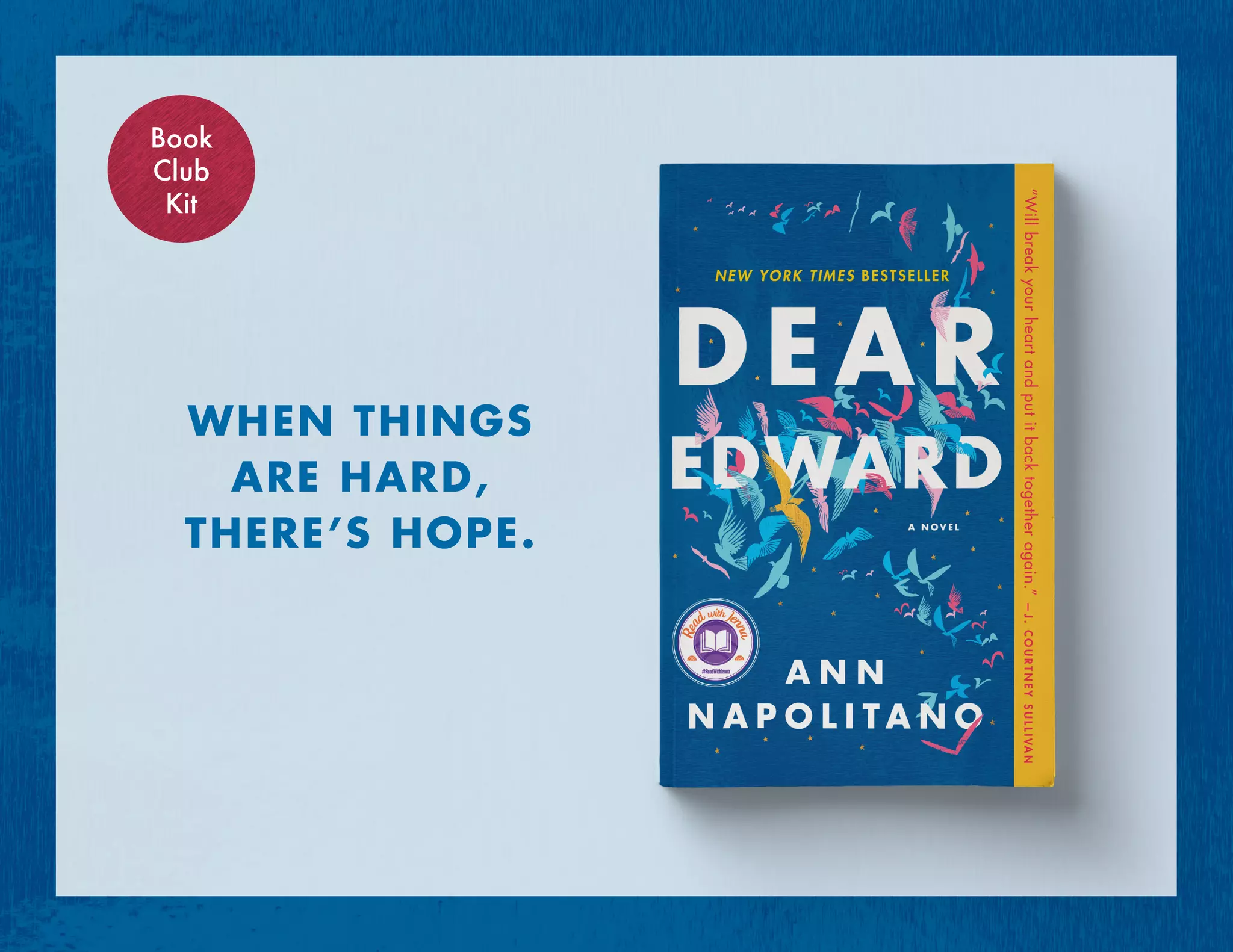
WHEN THINGS
ARE HARD, 
THERE’S HOPE.
Book
Club
Kit
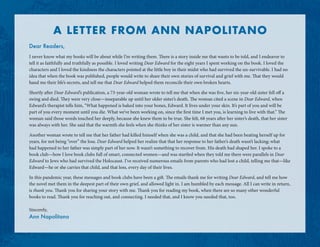
A LETTER FROM ANN NAPOLITANO
Dear Readers,
I never know what my books will be about while I’m writing them. There is a story inside me that wants to be told, and I endeavor to
tell it as faithfully and truthfully as possible. I loved writing Dear Edward for the eight years I spent working on the book. I loved the
characters and I loved the kindness the characters pointed at the little boy in their midst who had survived the un-survivable. I had no
idea that when the book was published, people would write to share their own stories of survival and grief with me. That they would
hand me their life’s secrets, and tell me that Dear Edward helped them reconcile their own broken hearts.
Shortly after Dear Edward’s publication, a 73-year-old woman wrote to tell me that when she was five, her six-year-old sister fell off a
swing and died. They were very close—inseparable up until her older sister’s death. The woman cited a scene in Dear Edward, when
Edward’s therapist tells him, “What happened is baked into your bones, Edward. It lives under your skin. It’s part of you and will be
part of you every moment until you die. What we’ve been working on, since the first time I met you, is learning to live with that.” The
woman said those words touched her deeply, because she knew them to be true. She felt, 68 years after her sister’s death, that her sister
was always with her. She said that the warmth she feels when she thinks of her sister is warmer than any sun.
Another woman wrote to tell me that her father had killed himself when she was a child, and that she had been beating herself up for
years, for not being “over” the loss. Dear Edward helped her realize that that her response to her father’s death wasn’t lacking; what
had happened to her father was simply part of her now. It wasn’t something to recover from. His death had shaped her. I spoke to a
book club—how I love book clubs full of smart, connected women—and was startled when they told me there were parallels in Dear
Edward to Jews who had survived the Holocaust. I’ve received numerous emails from parents who had lost a child, telling me that—like
Edward—he or she carries that child, and that loss, every day of their lives.
In this pandemic year, these messages and book clubs have been a gift. The emails thank me for writing Dear Edward, and tell me how
the novel met them in the deepest part of their own grief, and allowed light in. I am humbled by each message. All I can write in return,
is thank you. Thank you for sharing your story with me. Thank you for reading my book, when there are so many other wonderful
books to read. Thank you for reaching out, and connecting. I needed that, and I know you needed that, too.
Sincerely,
Ann Napolitano
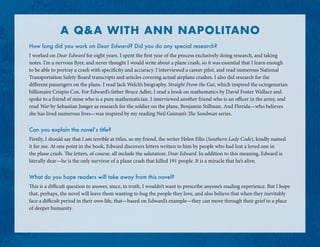
A QA WITH ANN NAPOLITANO
How long did you work on Dear Edward? Did you do any special research?
I worked on Dear Edward for eight years. I spent the first year of the process exclusively doing research, and taking
notes. I’m a nervous flyer, and never thought I would write about a plane crash, so it was essential that I learn enough
to be able to portray a crash with specificity and accuracy. I interviewed a career pilot, and read numerous National
Transportation Safety Board transcripts and articles covering actual airplane crashes. I also did research for the
different passengers on the plane. I read Jack Welch’s biography, Straight From the Gut, which inspired the octogenarian
billionaire Crispin Cox. For Edward’s father Bruce Adler, I read a book on mathematics by David Foster Wallace and
spoke to a friend of mine who is a pure mathematician. I interviewed another friend who is an officer in the army, and
read War by Sebastian Junger as research for the soldier on the plane, Benjamin Stillman. And Florida—who believes
she has lived numerous lives—was inspired by my reading Neil Gaiman’s The Sandman series.
Can you explain the novel’s title?
Firstly, I should say that I am terrible at titles, so my friend, the writer Helen Ellis (Southern Lady Code), kindly named
it for me. At one point in the book, Edward discovers letters written to him by people who had lost a loved one in
the plane crash. The letters, of course, all include the salutation: Dear Edward. In addition to this meaning, Edward is
literally dear—he is the only survivor of a plane crash that killed 191 people. It is a miracle that he’s alive.
What do you hope readers will take away from this novel?
This is a difficult question to answer, since, in truth, I wouldn’t want to prescribe anyone’s reading experience. But I hope
that, perhaps, the novel will leave them wanting to hug the people they love, and also believe that when they inevitably
face a difficult period in their own life, that—based on Edward’s example—they can move through their grief to a place
of deeper humanity.
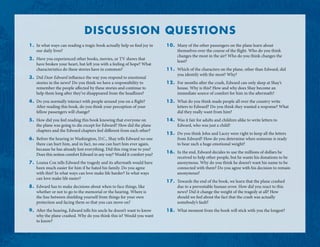
DISCUSSION QUESTIONS
1.	 In what ways can reading a tragic book actually help us find joy in
our daily lives?
2.	 Have you experienced other books, movies, or TV shows that
have broken your heart, but left you with a feeling of hope? What
characteristics do these stories have in common?
3.	 Did Dear Edward influence the way you respond to emotional
stories in the news? Do you think we have a responsibility to
remember the people affected by these stories and continue to
help them long after they’ve disappeared from the headlines?
4.	 Do you normally interact with people around you on a flight?
After reading this book, do you think your perception of your
fellow passengers will change?
5.	 How did you feel reading this book knowing that everyone on
the plane was going to die except for Edward? How did the plane
chapters and the Edward chapters feel different from each other?
6.	 Before the hearing in Washington, D.C., Shay tells Edward no one
there can hurt him, and in fact, no one can hurt him ever again,
because he has already lost everything. Did this ring true to you?
Does this notion comfort Edward in any way? Would it comfort you?
7.	 Louisa Cox tells Edward the tragedy and its aftermath would have
been much easier for him if he hated his family. Do you agree
with this? In what ways can love make life harder? In what ways
can love make life easier?
8.	 Edward has to make decisions about when to face things, like
whether or not to go to the memorial or the hearing. Where is
the line between shielding yourself from things for your own
protection and facing them so that you can move on?
9.	 After the hearing, Edward tells his uncle he doesn’t want to know
why the plane crashed. Why do you think this is? Would you want
to know?
10.	 Many of the other passengers on the plane learn about
themselves over the course of the flight. Who do you think
changes the most in the air? Who do you think changes the
least?
11.	 Which of the characters on the plane, other than Edward, did
you identify with the most? Why?
12.	 For months after the crash, Edward can only sleep at Shay’s
house. Why is this? How and why does Shay become an
immediate source of comfort for him in the aftermath?
13.	 What do you think made people all over the country write
letters to Edward? Do you think they wanted a response? What
did they really want from him?
14.	 Was it fair for adults and children alike to write letters to
Edward, who was just a child?
15.	 Do you think John and Lacey were right to keep all the letters
from Edward? How do you determine when someone is ready
to bear such a huge emotional weight?
16.	 In the end, Edward decides to use the millions of dollars he
received to help other people, but he wants his donations to be
anonymous. Why do you think he doesn’t want his name to be
connected with them? Do you agree with his decision to remain
anonymous?
17.	 Towards the end of the book, we learn that the plane crashed
due to a preventable human error. How did you react to this
news? Did it change the weight of the tragedy at all? How
should we feel about the fact that the crash was actually
somebody’s fault?
18.	 What moment from the book will stick with you the longest?
SELF-CARE AND HEALING
FERNS
The calm and ritualistic nature of caring for plants helps Edward heal. Here are three tips for caring for a Kangaroo
Paw fern.
1.	 If it’s indoors, keep it in medium to bright indirect light. If it’s outdoors, keep it in the shade.
2.	 If roots have filled the existing pot, repot the fern in the spring.
3.	 Remove dead fronds as soon as they appear: cut them off at the soil line.
FRIENDSHIP
Edward relies on friendships to ease the burden of his sadness and trauma. Here are some topics to discuss with
your friends.
1.	 In your opinion, what would a perfect day look like?
2.	 Picture yourself 10 years in the future. What is your life like?
3.	 Share tips for coping with sadness. Do you and your friends listen to music? Do you go for a walk in nature?
Are there things you can do together?
LETTER-WRITING
Writing letters to Edward was a form of therapy for people who lost loved ones. Letter-writing can help you make
sense of your feelings and find catharsis—even if you never send them. Here are some topics to get you started.
1.	 Write a letter to someone who hurt you. What would you like to say to them? How did writing the letter
make you feel? Have you forgiven them?
2.	 Write a letter to someone you may have hurt. What would you like to say to them? How did writing the letter
make you feel? What did you learn from it? Do you need to ask forgiveness? Have you forgiven yourself?
3.	 Write a letter to someone you admire. What have you learned from them? What do you love about them?
What aspects of their life do you want to bring into your own?
From Chloe Flavor by Chloe Coscarelli
SERVES 6
Ingredients
1 large bag tortilla chips
1 (15-ounce) can black beans, drained and
rinsed
2 tablespoons olive oil
8 ounces ground seitan
1 tablespoon taco seasoning
½ teaspoon smoked paprika
½ teaspoon chipotle powder
Sea salt
1 avocado, diced
2 teaspoons lime juice
Cashew Queso (see below)
Optional Toppings
½ cup fresh tomato salsa
Lime Sour Cream (as seen in the Chloe Flavor
cookbook)
Finely chopped red cabbage
Thinly sliced jalapeño
Chopped fresh cilantro
Pickled Red Onion (as seen in the Chloe
Flavor cookbook)
For the Cashew Queso
MAKES 2½ CUPS
1 cup water
1 cup raw cashews
2 tablespoons nutritional yeast flakes
4 ounces canned tomato sauce (about ⅓ cup)
1 teaspoon sea salt
½ teaspoon chili powder
¼ teaspoon ground turmeric
¼ teaspoon cayenne pepper
2 teaspoons agave nectar
In a blender, combine all the ingredients and
blend until smooth.
Transfer to a small saucepan and stir over
medium-low heat for about 5 minutes, until
warmed through and thickened.
For the California Nachos
Preheat the oven to 425°F.
Pile the chips into a 9 x 13-inch baking dish.
Add the black beans. Bake for 10 to 15 minutes,
until the beans are warmed through.
Meanwhile, in a large skillet, heat the olive
oil over medium heat. When it shimmers, add
the seitan, taco seasoning, smoked paprika, and
chipotle powder and cook for about 5 minutes,
until the seitan is heated through. Add water as
needed if the skillet seems dry. Season with salt.
Remove the skillet from the heat.
In a small bowl, mash together the avocado
and lime juice. Season with salt.
Remove the baking dish from the oven and
add the Cashew Queso. Scatter over the seitan.
Top off the nachos with the mashed avocado
and any additional toppings you desire. Serve
immediately.
Shay stays for dinner that night, and when
they slide into their seats in front of plates of
pork chops, broccoli, and mashed potatoes,
Edward says, “I guess I should tell you guys
that I’m eating vegan now.”
. . .
“Why the dietary change?” John says.
Edward tells the truth, because that’s what
Jordan would have done. “I’m doing it for my
brother.” He pauses, and it occurs to him that
his aunt and uncle probably hadn’t been up
to date on his brother’s eating habits. He says,
“Jordan became vegan a few months before
he died.”
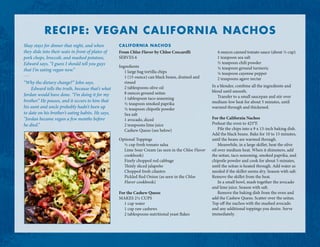
RECIPE: VEGAN CALIFORNIA NACHOS
CALIFORNIA NACHOS

When things are hard there's hope

  • 1.
    WHEN THINGS ARE HARD, THERE’S HOPE. Book Club Kit
  • 2.
    A LETTER FROMANN NAPOLITANO Dear Readers, I never know what my books will be about while I’m writing them. There is a story inside me that wants to be told, and I endeavor to tell it as faithfully and truthfully as possible. I loved writing Dear Edward for the eight years I spent working on the book. I loved the characters and I loved the kindness the characters pointed at the little boy in their midst who had survived the un-survivable. I had no idea that when the book was published, people would write to share their own stories of survival and grief with me. That they would hand me their life’s secrets, and tell me that Dear Edward helped them reconcile their own broken hearts. Shortly after Dear Edward’s publication, a 73-year-old woman wrote to tell me that when she was five, her six-year-old sister fell off a swing and died. They were very close—inseparable up until her older sister’s death. The woman cited a scene in Dear Edward, when Edward’s therapist tells him, “What happened is baked into your bones, Edward. It lives under your skin. It’s part of you and will be part of you every moment until you die. What we’ve been working on, since the first time I met you, is learning to live with that.” The woman said those words touched her deeply, because she knew them to be true. She felt, 68 years after her sister’s death, that her sister was always with her. She said that the warmth she feels when she thinks of her sister is warmer than any sun. Another woman wrote to tell me that her father had killed himself when she was a child, and that she had been beating herself up for years, for not being “over” the loss. Dear Edward helped her realize that that her response to her father’s death wasn’t lacking; what had happened to her father was simply part of her now. It wasn’t something to recover from. His death had shaped her. I spoke to a book club—how I love book clubs full of smart, connected women—and was startled when they told me there were parallels in Dear Edward to Jews who had survived the Holocaust. I’ve received numerous emails from parents who had lost a child, telling me that—like Edward—he or she carries that child, and that loss, every day of their lives. In this pandemic year, these messages and book clubs have been a gift. The emails thank me for writing Dear Edward, and tell me how the novel met them in the deepest part of their own grief, and allowed light in. I am humbled by each message. All I can write in return, is thank you. Thank you for sharing your story with me. Thank you for reading my book, when there are so many other wonderful books to read. Thank you for reaching out, and connecting. I needed that, and I know you needed that, too. Sincerely, Ann Napolitano
  • 3.
    A QA WITHANN NAPOLITANO How long did you work on Dear Edward? Did you do any special research? I worked on Dear Edward for eight years. I spent the first year of the process exclusively doing research, and taking notes. I’m a nervous flyer, and never thought I would write about a plane crash, so it was essential that I learn enough to be able to portray a crash with specificity and accuracy. I interviewed a career pilot, and read numerous National Transportation Safety Board transcripts and articles covering actual airplane crashes. I also did research for the different passengers on the plane. I read Jack Welch’s biography, Straight From the Gut, which inspired the octogenarian billionaire Crispin Cox. For Edward’s father Bruce Adler, I read a book on mathematics by David Foster Wallace and spoke to a friend of mine who is a pure mathematician. I interviewed another friend who is an officer in the army, and read War by Sebastian Junger as research for the soldier on the plane, Benjamin Stillman. And Florida—who believes she has lived numerous lives—was inspired by my reading Neil Gaiman’s The Sandman series. Can you explain the novel’s title? Firstly, I should say that I am terrible at titles, so my friend, the writer Helen Ellis (Southern Lady Code), kindly named it for me. At one point in the book, Edward discovers letters written to him by people who had lost a loved one in the plane crash. The letters, of course, all include the salutation: Dear Edward. In addition to this meaning, Edward is literally dear—he is the only survivor of a plane crash that killed 191 people. It is a miracle that he’s alive. What do you hope readers will take away from this novel? This is a difficult question to answer, since, in truth, I wouldn’t want to prescribe anyone’s reading experience. But I hope that, perhaps, the novel will leave them wanting to hug the people they love, and also believe that when they inevitably face a difficult period in their own life, that—based on Edward’s example—they can move through their grief to a place of deeper humanity.
  • 4.
    DISCUSSION QUESTIONS 1. Inwhat ways can reading a tragic book actually help us find joy in our daily lives? 2. Have you experienced other books, movies, or TV shows that have broken your heart, but left you with a feeling of hope? What characteristics do these stories have in common? 3. Did Dear Edward influence the way you respond to emotional stories in the news? Do you think we have a responsibility to remember the people affected by these stories and continue to help them long after they’ve disappeared from the headlines? 4. Do you normally interact with people around you on a flight? After reading this book, do you think your perception of your fellow passengers will change? 5. How did you feel reading this book knowing that everyone on the plane was going to die except for Edward? How did the plane chapters and the Edward chapters feel different from each other? 6. Before the hearing in Washington, D.C., Shay tells Edward no one there can hurt him, and in fact, no one can hurt him ever again, because he has already lost everything. Did this ring true to you? Does this notion comfort Edward in any way? Would it comfort you? 7. Louisa Cox tells Edward the tragedy and its aftermath would have been much easier for him if he hated his family. Do you agree with this? In what ways can love make life harder? In what ways can love make life easier? 8. Edward has to make decisions about when to face things, like whether or not to go to the memorial or the hearing. Where is the line between shielding yourself from things for your own protection and facing them so that you can move on? 9. After the hearing, Edward tells his uncle he doesn’t want to know why the plane crashed. Why do you think this is? Would you want to know? 10. Many of the other passengers on the plane learn about themselves over the course of the flight. Who do you think changes the most in the air? Who do you think changes the least? 11. Which of the characters on the plane, other than Edward, did you identify with the most? Why? 12. For months after the crash, Edward can only sleep at Shay’s house. Why is this? How and why does Shay become an immediate source of comfort for him in the aftermath? 13. What do you think made people all over the country write letters to Edward? Do you think they wanted a response? What did they really want from him? 14. Was it fair for adults and children alike to write letters to Edward, who was just a child? 15. Do you think John and Lacey were right to keep all the letters from Edward? How do you determine when someone is ready to bear such a huge emotional weight? 16. In the end, Edward decides to use the millions of dollars he received to help other people, but he wants his donations to be anonymous. Why do you think he doesn’t want his name to be connected with them? Do you agree with his decision to remain anonymous? 17. Towards the end of the book, we learn that the plane crashed due to a preventable human error. How did you react to this news? Did it change the weight of the tragedy at all? How should we feel about the fact that the crash was actually somebody’s fault? 18. What moment from the book will stick with you the longest?
  • 5.
    SELF-CARE AND HEALING FERNS Thecalm and ritualistic nature of caring for plants helps Edward heal. Here are three tips for caring for a Kangaroo Paw fern. 1. If it’s indoors, keep it in medium to bright indirect light. If it’s outdoors, keep it in the shade. 2. If roots have filled the existing pot, repot the fern in the spring. 3. Remove dead fronds as soon as they appear: cut them off at the soil line. FRIENDSHIP Edward relies on friendships to ease the burden of his sadness and trauma. Here are some topics to discuss with your friends. 1. In your opinion, what would a perfect day look like? 2. Picture yourself 10 years in the future. What is your life like? 3. Share tips for coping with sadness. Do you and your friends listen to music? Do you go for a walk in nature? Are there things you can do together? LETTER-WRITING Writing letters to Edward was a form of therapy for people who lost loved ones. Letter-writing can help you make sense of your feelings and find catharsis—even if you never send them. Here are some topics to get you started. 1. Write a letter to someone who hurt you. What would you like to say to them? How did writing the letter make you feel? Have you forgiven them? 2. Write a letter to someone you may have hurt. What would you like to say to them? How did writing the letter make you feel? What did you learn from it? Do you need to ask forgiveness? Have you forgiven yourself? 3. Write a letter to someone you admire. What have you learned from them? What do you love about them? What aspects of their life do you want to bring into your own?
  • 6.
    From Chloe Flavorby Chloe Coscarelli SERVES 6 Ingredients 1 large bag tortilla chips 1 (15-ounce) can black beans, drained and rinsed 2 tablespoons olive oil 8 ounces ground seitan 1 tablespoon taco seasoning ½ teaspoon smoked paprika ½ teaspoon chipotle powder Sea salt 1 avocado, diced 2 teaspoons lime juice Cashew Queso (see below) Optional Toppings ½ cup fresh tomato salsa Lime Sour Cream (as seen in the Chloe Flavor cookbook) Finely chopped red cabbage Thinly sliced jalapeño Chopped fresh cilantro Pickled Red Onion (as seen in the Chloe Flavor cookbook) For the Cashew Queso MAKES 2½ CUPS 1 cup water 1 cup raw cashews 2 tablespoons nutritional yeast flakes 4 ounces canned tomato sauce (about ⅓ cup) 1 teaspoon sea salt ½ teaspoon chili powder ¼ teaspoon ground turmeric ¼ teaspoon cayenne pepper 2 teaspoons agave nectar In a blender, combine all the ingredients and blend until smooth. Transfer to a small saucepan and stir over medium-low heat for about 5 minutes, until warmed through and thickened. For the California Nachos Preheat the oven to 425°F. Pile the chips into a 9 x 13-inch baking dish. Add the black beans. Bake for 10 to 15 minutes, until the beans are warmed through. Meanwhile, in a large skillet, heat the olive oil over medium heat. When it shimmers, add the seitan, taco seasoning, smoked paprika, and chipotle powder and cook for about 5 minutes, until the seitan is heated through. Add water as needed if the skillet seems dry. Season with salt. Remove the skillet from the heat. In a small bowl, mash together the avocado and lime juice. Season with salt. Remove the baking dish from the oven and add the Cashew Queso. Scatter over the seitan. Top off the nachos with the mashed avocado and any additional toppings you desire. Serve immediately. Shay stays for dinner that night, and when they slide into their seats in front of plates of pork chops, broccoli, and mashed potatoes, Edward says, “I guess I should tell you guys that I’m eating vegan now.” . . . “Why the dietary change?” John says. Edward tells the truth, because that’s what Jordan would have done. “I’m doing it for my brother.” He pauses, and it occurs to him that his aunt and uncle probably hadn’t been up to date on his brother’s eating habits. He says, “Jordan became vegan a few months before he died.” RECIPE: VEGAN CALIFORNIA NACHOS CALIFORNIA NACHOS