Download to read offline
![What is Scrum?
Scrum is an iterative and incremental agile software development framework for managing
product development.[1][2]
It defines "a flexible, holistic product development strategy where a
development team works as a unit to reach a common goal",[3]
challenges assumptions of the
"traditional, sequential approach"[3]
to product development, and enables teams to self-organize
by encouraging physical co-location or close online collaboration of all team members, as well as
daily face-to-face communication among all team members and disciplines involved.
A key principle of Scrum is its recognition that during product development, the customers can
change their minds about what they want and need (often called requirements volatility[4]
), and
that unpredicted challenges cannot be easily addressed in a traditional predictive or planned
manner. As such, Scrum adopts an evidence-based empirical approach—accepting that the
problem cannot be fully understood or defined, focusing instead on maximizing the team's ability
to deliver quickly, to respond to emerging requirements and to adapt to evolving technologies
and changes in market conditions.
Contents
[hide]
1History
2Values
3Roles
o 3.1Product Owner
o 3.2Development Team
o 3.3Scrum Master
4Workflow
o 4.1Planning
o 4.2Daily Scrum
o 4.3Review and retrospective
o 4.4Extensions
4.4.1Backlog refinement
4.4.2Scrum of Scrums
5Artifacts
o 5.1Product backlog
5.1.1Management
o 5.2Sprint Backlog
o 5.3Product Increment
o 5.4Extensions
5.4.1Sprint burn-down chart
5.4.2Release burn-up chart
6Terminology
7Limitations
8Scrumban
9Tools for implementation
10Adaptations
11See also
12References
13Further reading
14External links
History[edit]](https://image.slidesharecdn.com/whatyouneedtonowaboutscrum-170119063419/75/What-you-need-to-now-about-scrum-1-2048.jpg)
![Hirotaka Takeuchi and Ikujiro Nonaka introduced the word 'scrum' as a term in the context of
product development in 1986 in their article on the New New Product Development
Game.[3]
Takeuchi and Nonaka later argued in The Knowledge Creating Company[5]
that it is a
form of "organizational knowledge creation, [...] especially good at bringing about innovation
continuously, incrementally and spirally".
The authors described a new approach to commercial product-development that would increase
speed and flexibility, based on case studies from manufacturing firms in the automotive,
photocopier and printer industries.[3]
They called this the holistic or rugby approach, as the whole
process is performed by one cross-functional team across multiple overlapping phases, where
the team "tries to go the distance as a unit, passing the ball back and forth".[3]
(In rugby football,
a scrum refers to a tight-packed formation of players with their heads down who attempt to gain
possession of the ball.[6]
)
In the early 1990s Ken Schwaber used what would become Scrum at his company, Advanced
Development Methods; while Jeff Sutherland, John Scumniotales and Jeff McKenna, developed
a similar approach at Easel Corporation, referring to it using the single word Scrum.[7]
In 1995
Sutherland and Schwaber jointly presented a paper describing the Scrum methodology at the
Business Object Design and Implementation Workshop held as part of Object-Oriented
Programming, Systems, Languages & Applications '95 (OOPSLA '95) in Austin, Texas.[8]
Over
the following years, Schwaber and Sutherland collaborated to combine this material—with their
experience and evolving good practice—to develop what became known as Scrum.[9]
In 2001 Schwaber worked with Mike Beedle to describe the method in the book Agile Software
Development with Scrum.[10]
Scrum's approach to planning and managing product development
involves bringing decision-making authority to the level of operation properties and
certainties.[11]
Although the word 'Scrum' is not an acronym, it is sometimes seen in all capitals as
'SCRUM'.[12]
This may be due to one of Ken Schwaber's early papers, which capitalized SCRUM
in the title.[11][13]
In 2002 Schwaber with others founded the Scrum Alliance[14]
and set up the Certified Scrum
Master program and its derivatives. Schwaber left the Scrum Alliance in late 2009 and founded
Scrum.org.
Values[edit]
Scrum is a feedback-driven empirical approach which is, like all empirical process control,
underpinned by the three pillars of transparency, inspection, and adaptation. All work within the
Scrum framework should be visible to those responsible for the outcome: the process, the
workflow, progress, etc. In order to make these things visible, Scrum Teams need to frequently
inspect the product being developed and how well the team is working. With frequent inspection,
the team can spot when their work deviates outside of acceptable limits and adapt their process
or the product under development.
These three pillars require trust and openness in the team, which the following five values of
Scrum enable:[9]
Commitment
Team members individually commit to achieving their team
goals, each and every Sprint.
Courage
Team members know they have the courage to work through
conflict and challenges together so that they can do the right
thing.
Focus
Team members focus exclusively on their team goals and
the Sprint Backlog; there should be no work done other than
through their backlog.
Openness](https://image.slidesharecdn.com/whatyouneedtonowaboutscrum-170119063419/75/What-you-need-to-now-about-scrum-2-2048.jpg)
![Team members and their stakeholders agree to be
transparent about their work and any challenges they face.
Respect
Team members respect each other to be technically capable
and to work with good intent.
Roles[edit]
There are three core roles[15]
in the Scrum
framework. These core roles are
ideally colocated to deliver potentially shippable
Product Increments. They represent the Scrum
Team. Although other roles involved with
product development may be encountered,
Scrum does not define any team roles other
than those described below.[9]
Product Owner[edit]
The Product Owner represents the
product's stakeholders and the voice of the
customer; and is accountable for ensuring that
the team delivers value to the business. The
Product Owner writes customer-centric items
(typically user stories), prioritizes them based
on importance and dependencies, and adds
them to the Product Backlog. Scrum Teams
should have one Product Owner. This role
should not be combined with that of the Scrum
Master. The Product Owner should focus on the
business side of product development and
spend the majority of their time liaising with
stakeholders and should not dictate how the
team reaches a technical
solution.[16][better source needed]
This role is equivalent to
the customer representative role in some other
agile frameworks such as extreme
programming (XP).
Communication is a core responsibility of the
Product Owner. The ability to convey priorities
and empathize with team members and
stakeholders is vital to steer product
development in the right direction. Product
Owners bridge the communication gap between
the team and its stakeholders. They serve as a
proxy for stakeholders to the team and as a
team representative to the overall stakeholder
community.[17][18]
As the face of the team to the stakeholders, the
following are some of the communication tasks
of the Product Owner to the stakeholders:[citation
needed]
demonstrates the solution to key
stakeholders who were not present at a
Sprint Review;
defines and announces releases;](https://image.slidesharecdn.com/whatyouneedtonowaboutscrum-170119063419/75/What-you-need-to-now-about-scrum-3-2048.jpg)
![ communicates team status;
organizes milestone reviews;
educates stakeholders in the development
process;
negotiates priorities, scope, funding, and
schedule;
ensures that the Product Backlog is visible,
transparent, and clear.
Empathy is a key attribute for a Product Owner
to have—the ability to put one's self in another's
shoes. A Product Owner converses with
different stakeholders, who have a variety of
backgrounds, job roles, and objectives. A
Product Owner must be able to see from these
different points of view. To be effective, it is
wise for a Product Owner to know the level of
detail the audience needs. The Development
Team needs thorough feedback and
specifications so they can build a product up to
expectation, while an executive sponsor may
just need summaries of progress. Providing
more information than necessary may lose
stakeholder interest and waste time. A direct
means of communication is the most preferred
by seasoned agile Product Owners.[19]
A Product Owner’s ability to communicate
effectively is also enhanced by being skilled in
techniques that identify stakeholder needs,
negotiate priorities between stakeholder
interests, and collaborate with developers to
ensure effective implementation of
requirements.
Development Team[edit]
The Development Team is responsible for
delivering potentially shippable increments
(PSIs) of product at the end of each Sprint (the
Sprint goal). A team is made up of 3–9
individuals who do the actual work (analyse,
design, develop, test, technical communication,
document, etc.). Development Teams are
cross-functional, with all of the skills as a team
necessary to create a Product Increment. The
Development Team in Scrum is self-organizing,
even though there may be some interaction
with a project management office (PMOs).
Scrum Master[edit]
Scrum is facilitated by a Scrum Master, who is
accountable for removing impediments to the
ability of the team to deliver the product goals
and deliverables. The Scrum Master is not a
traditional team lead or project manager, but
acts as a buffer between the team and any
distracting influences. The Scrum Master](https://image.slidesharecdn.com/whatyouneedtonowaboutscrum-170119063419/75/What-you-need-to-now-about-scrum-4-2048.jpg)
![ensures that the Scrum framework is followed.
The Scrum Master helps to ensure the team
follows the agreed processes in the Scrum
framework, often facilitates key sessions, and
encourages the team to improve. The role has
also been referred to as a team
facilitator[20]
or servant-leader to reinforce these
dual perspectives.
The core responsibilities of a Scrum Master
include (but are not limited to):[21]
Helping the Product Owner maintain the
Product Backlog in a way that ensures the
needed work is well understood so the
team can continually make forward
progress
Helping the team to determine the definition
of done for the product, with input from key
stakeholders
Coaching the team, within the Scrum
principles, in order to deliver high-quality
features for its product
Promoting self-organization within the team
Helping the Scrum Team to avoid or
remove impediments to its progress,
whether internal or external to the team
Facilitating team events to ensure regular
progress
Educating key stakeholders in the product
on Scrum principles
Coaching the Development Team in self-
organization and cross-functionality[22]
One of the ways the Scrum Master role differs
from a project manager is that the latter may
have people management responsibilities and
the Scrum Master does not. Scrum does not
formally recognise the role of project manager,
as traditional command and control tendencies
would cause difficulties.[23]
Workflow[edit]
Scrum framework](https://image.slidesharecdn.com/whatyouneedtonowaboutscrum-170119063419/75/What-you-need-to-now-about-scrum-5-2048.jpg)
![The Scrum process
A Sprint (or iteration) is the basic unit of
development in Scrum. The Sprint is
a timeboxed effort; that is, it is restricted to a
specific duration.[24]
The duration is fixed in
advance for each Sprint and is normally
between one week and one month, with two
weeks being the most common.[11]
Each Sprint starts with a Sprint Planning event
that aims to define a Sprint Backlog, identify the
work for the Sprint, and make an estimated
commitment for the Sprint goal. Each Sprint
ends with a Sprint Review and Sprint
Retrospective,[7]
that reviews progress to show
to stakeholders and identify lessons and
improvements for the next Sprints.
Scrum emphasizes working product at the end
of the Sprint that is really done. In the case of
software, this likely includes that the software
has been fully integrated, tested and
documented, and is potentially shippable.[23]
Planning[edit]
At the beginning of a Sprint, the Scrum Team
holds a Sprint Planning event[24]
to:
Communicate the scope of work that is
intended to be done during that Sprint
Select Product Backlog Items that can be
completed in one Sprint
Prepare the Sprint Backlog that details the
work needed to finish the selected Product
Backlog Items
Time-boxed to a four-hour limit for a two-
week Sprint (pro rata for other Sprint
durations) [9]
During the first half, the whole Scrum
Team (Development Team, Scrum
Master, and Product Owner) selects
the Product Backlog Items might be
achievable in that Sprint
During the second half, the
Development Team decomposes the
work items (tasks) required to deliver
those Product Backlog Items; resulting
in a confirmed Sprint Backlog](https://image.slidesharecdn.com/whatyouneedtonowaboutscrum-170119063419/75/What-you-need-to-now-about-scrum-6-2048.jpg)
![ Some Product Backlog Items may
be split or deprioritized if the
identified work is not achievable in
that Sprint
Once the Development Team prepares
the Sprint Backlog, they commit (usually by
voting) to deliver tasks within the Sprint.
Daily Scrum[edit]
A Daily Scrum in the computing room. This
centralized location helps the team start on time.
Each day during a Sprint, the team holds
a Daily Scrum (or stand-up) with specific
guidelines:
All members of the Development Team
come prepared. The Daily Scrum...
...starts precisely on time even if some
Development Team members are
missing
...should happen at the same time and
place every day
...is limited (timeboxed) to fifteen
minutes
Anyone is welcome, though normally only
Scrum Team roles contribute.
During the Daily Scrum, each team-
member answers three questions:
What did I do yesterday that helped the
Development Team meet the Sprint
goal?
What will I do today to help the
Development Team meet the Sprint
goal?
Do I see any impediment that prevents
me or the Development Team from
meeting the Sprint goal?
Any impediment (e.g., stumbling block, risk,
issue, delayed dependency, assumption proved
unfounded) identified in the Daily Scrum should
be captured by the Scrum Master and displayed
on the team's Scrum board or on a shared
resolved, owned, accepted, mitigated (ROAM)
board, with an agreed person designated to](https://image.slidesharecdn.com/whatyouneedtonowaboutscrum-170119063419/75/What-you-need-to-now-about-scrum-7-2048.jpg)
![working toward a resolution (outside of the
Daily Scrum). No detailed discussions should
happen during the Daily Scrum.
Review and retrospective[edit]
At the end of a Sprint, the team holds two
events: the Sprint Review and the Sprint
Retrospective.
At the Sprint Review, the team:
Reviews the work that was completed and
the planned work that was not completed
Presents the completed work to the
stakeholders (a.k.a. the demo)
Guidelines for Sprint Reviews:
Incomplete work cannot be demonstrated
The recommended duration is two hours for
a two-week Sprint (pro-rata for other Sprint
durations)
At the Sprint Retrospective, the team:
Reflects on the past Sprint
Identifies and agrees on continuous
process improvement actions
Guidelines for Sprint Retrospectives:
Two main questions are asked in the Sprint
Retrospective: What went well during the
Sprint? What could be improved in the next
Sprint?
The recommended duration is one-and-a-
half hours for a two-week Sprint (pro-rata
for other Sprint durations)
This event is facilitated by the Scrum
Master
Extensions[edit]
The following activities are commonly done,
although not considered by all as a core part of
Scrum:
Backlog refinement[edit]
Backlog refinement (once called backlog
grooming) is the ongoing process of reviewing
Product Backlog Items and checking that they
are appropriately prioritised and prepared in a
way that makes them clear and executable for
teams once they enter Sprints via the Sprint
Planning activity. Product Backlog Items may
be broken into multiple smaller ones;
acceptance criteria may be clarified; and
dependencies, investigation, and preparatory](https://image.slidesharecdn.com/whatyouneedtonowaboutscrum-170119063419/75/What-you-need-to-now-about-scrum-8-2048.jpg)
![work may be identified and agreed as technical
spikes.
Although not originally a core Scrum practice,
backlog refinement has been adopted as a way
of managing the quality of Product Backlog
Items entering a Sprint, with a recommended
investment of up to 10% of a team's Sprint
capacity.[25]
Scrum of Scrums[edit]
The Scrum of Scrums is a technique to operate
Scrum at scale, for multiple teams working on
the same product, allowing them to discuss
progress on their interdependencies, focusing
on how to coordinate delivering
software,[26]
especially on areas of overlap and
integration. Depending on the cadence (timing)
of the Scrum of Scrums, the relevant Daily
Scrum for each Scrum Team ends by
designating one member as an ambassador to
participate in the Scrum of Scrums with
ambassadors from other teams. Depending on
the context, the ambassadors may be technical
contributors or each team's Scrum Master.[26]
Rather than simply a progress update, the
Scrum of Scrums should focus on how teams
are collectively working to resolve, mitigate, or
accept any risks, impediments, dependencies,
and assumptions (RIDAs) that have been
identified. The Scrum of Scrums tracks these
RIDAs via a backlog of its own, such as a
ROAM board,[27]
which typically leads to greater
coordination and collaboration between
teams.[26]
This should run similar to a Daily Scrum, with
each ambassador answering the following four
questions:[28]
What risks, impediments, dependencies,
and assumptions has your team moved on
since we last met?
What risks, impediments, dependencies,
and assumptions will your team move on
before we meet again?
Are there any new risks, impediments,
dependencies, and assumptions slowing
your team down or getting in their way?
Are you about to introduce a new risk,
impediment, dependency, and assumption
that will get in another team's way?
As Jeff Sutherland commented,[26]
Since I originally defined the Scrum of Scrums
(Ken Schwaber was at IDX working with me), I
can definitively say the Scrum of Scrums is not](https://image.slidesharecdn.com/whatyouneedtonowaboutscrum-170119063419/75/What-you-need-to-now-about-scrum-9-2048.jpg)
![a "meta Scrum". The Scrum of Scrums as I
have used it is responsible for delivering the
working software of all teams to the Definition of
Done at the end of the Sprint, or for releases
during the Sprint. PatientKeeper delivered to
production four times per Sprint. Ancestry.com
delivers to production 220 times per two-week
Sprint. Hubspot delivers live software 100-300
times a day. The Scrum of Scrums Master is
held accountable for making this work. So the
Scrum of Scrums is an operational delivery
mechanism.
Artifacts[edit]
This section needs additional citations
for verification. Please help improve this
article by adding citations to reliable sources.
Unsourced material may be challenged and
removed. (March 2013) (Learn how and when to remove this
template message)
Product backlog[edit]
The product backlog comprises an ordered list
of requirements that a Scrum Team maintains
for a product. It consists of features, bug
fixes, non-functional requirements, etc.—
whatever must be done to successfully deliver a
viable product. The Product Owner orders
the Product Backlog Items (PBIs) based on
considerations such as risk, business value,
dependencies, and date needed.
Items added to a backlog are commonly written
in story format. The Product Backlog is what will
be delivered, ordered into the sequence in
which it should be delivered. It is visible to
everyone but may only be changed with the
consent of the Product Owner, who is ultimately
responsible for ordering Product Backlog Items
for the Development Team to choose.
The Product Backlog contains the Product
Owner's assessment of business value and the
Development Team's assessment of
development effort, which are often, but not
always, stated in story points using a
rounded Fibonacci sequence. These estimates
help the Product Owner to gauge the timeline
and may influence ordering of Product Backlog
Items; for example, if two features have the
same business value, the Product Owner may
schedule earlier delivery of the one with the
lower development effort (because the return
on investment is higher) or the one with higher
development effort (because it is more complex
or riskier, and they want to retire that risk
earlier).[29]
Requirements' implementation risks](https://image.slidesharecdn.com/whatyouneedtonowaboutscrum-170119063419/75/What-you-need-to-now-about-scrum-10-2048.jpg)
![is also considered for prioritization and can
effectively be assessed by analyzing
dependencies among requirements
(aka requirements traceability) that are
frequently captured as by-product in tools.[30]
The Product Backlog and the business value of
each Product Backlog Item is the responsibility
of the Product Owner. The size (i.e. estimated
complexity or effort) of each item is, however,
determined by the Development Team, who
contributes by sizing in story points or in
estimated hours.
There is a common misunderstanding that
only user stories are allowed in a Product
Backlog. By contrast, Scrum is neutral on
requirement techniques. As the Scrum
Primer[23]
states,
Product Backlog Items are articulated in any
way that is clear and sustainable. Contrary to
popular misunderstanding, the Product Backlog
does not contain "user stories"; it simply
contains items. Those items can be expressed
as user stories, use cases, or any other
requirements approach that the group finds
useful. But whatever the approach, most items
should focus on delivering value to customers.
Scrum advocates that the role of Product
Owner be assigned. The Product Owner is
responsible for maximizing the value of the
product. The Product Owner gathers input and
takes feedback from, and is lobbied by, many
people, but ultimately makes the call on what
gets built.
The Product Backlog:
Captures requests to modify a product—
including new features, replacing old
features, removing features, and fixing
issues
Ensures the Development Team has work
that maximizes business benefit to the
Product Owner
Typically, the Product Owner and the Scrum
Team come together and write down everything
that must be prioritized, and this becomes
content for the first Sprint—which is a block of
time meant for focused work on selected items
that can be accommodated within a timeframe.
The Product Backlog can evolve as new
information surfaces about the product and
about its customers, and so later Sprints may
address new work.](https://image.slidesharecdn.com/whatyouneedtonowaboutscrum-170119063419/75/What-you-need-to-now-about-scrum-11-2048.jpg)
![The following items typically comprise a
Product Backlog: features, bugs, technical
work, and knowledge acquisition. A feature
is wanted, while a bug
is unintended or unwanted (but may not be
necessarily something defective). An example
of technical work could be to run a virus check
on all developers' workstations. An example of
knowledge acquisition could be to research
Wordpress plugin libraries and making a
selection.
Management[edit]
A Product Backlog, in its simplest form, is
merely a list of items to work on. Having well-
established rules about how work is added,
removed and ordered helps the whole team
make better decisions about how to change the
product.[31]
The Product Owner prioritizes which Product
Backlog Items are most needed. The team then
chooses which items they can complete in the
coming Sprint. On the Scrum board, the team
moves items from the Product Backlog to the
Sprint Backlog, which is the list of items they
will build. Conceptually, it is ideal for the team
to only select what they think they can
accomplish from the top of the list, but it is not
unusual to see in practice that teams are able
to take lower-priority items from the list along
with the top ones selected. This normally
happens because there is time left within the
Sprint to accommodate more work. Items at the
top of the backlog, the items to work on first,
should be broken down into stories that are
suitable for the Development Team to work on.
The further down the backlog goes, the less
refined the items should be. As Schwaber and
Beedle put it "The lower the priority, the less
detail, until you can barely make out the
backlog item."[11]
As the team works through the backlog, it must
be assumed that change happens outside their
environment—the team can learn about new
market opportunities to take advantage of,
competitor threats that arise, and feedback from
customers that can change the way the product
was meant to work. All of these new ideas tend
to trigger the team to adapt the backlog to
incorporate new knowledge. This is part of the
fundamental mindset of an agile team. The
world changes, the backlog is never finished.[17]
Sprint Backlog[edit]](https://image.slidesharecdn.com/whatyouneedtonowaboutscrum-170119063419/75/What-you-need-to-now-about-scrum-12-2048.jpg)
![A Scrum task board
The Sprint Backlog is the list of work the
Development Team must address during the
next Sprint. The list is derived by the Scrum
Team progressively selecting Product Backlog
Items in priority order from the top of the
Product Backlog until they feel they have
enough work to fill the Sprint. The Development
Team should keep in mind its past performance
assessing its capacity for the new Sprint, and
use this as a guide line of how much 'effort' they
can complete.
The Product Backlog Items may be broken
down into tasks by the Development Team.
Tasks on the Sprint Backlog are never
assigned; rather, tasks are signed up for by the
team members as needed according to the set
priority and the Development Team member
skills. This promotes self-organization of the
Development Team, and developer buy-in.
The Sprint Backlog is the property of the
Development Team, and all included estimates
are provided by the Development Team. Often
an accompanying task board is used to see and
change the state of the tasks of the current
Sprint, like 'to do', 'in progress' and 'done'.
Once a Sprint Backlog is committed, no
additional work can be added to the Sprint
Backlog except by the team. Once a Sprint has
been delivered, the Product Backlog is
analyzed and reprioritized if necessary, and the
next set of functionality is selected for the next
Sprint.
Product Increment[edit]](https://image.slidesharecdn.com/whatyouneedtonowaboutscrum-170119063419/75/What-you-need-to-now-about-scrum-13-2048.jpg)
![The increment (or potentially shippable
increment, PSI) is the sum of all the Product
Backlog Items completed during a Sprint,
integrated with the work of all previous Sprints.
At the end of a Sprint, the increment must be
complete, according to the Scrum Team's
definition of done (DoD), fully functioning, and
in a usable condition regardless of whether the
Product Owner decides to actually release it.
Extensions[edit]
The following artifacts are commonly used,
although not considered by all as a core part of
Scrum:
Sprint burn-down chart[edit]
A sample burn-down chart for a completed
Sprint, showing remaining effort at the end of
each day.
Main article: Burn down chart
The Sprint burn-down chart is a public
displayed chart showing remaining work in the
Sprint Backlog. Updated every day, it gives a
simple view of the Sprint progress. It also
provides quick visualizations for reference. The
horizontal axis of the Sprint burn-down chart
shows the days in a Sprint, while the vertical
axis shows the amount of work remaining each
day (typically representing estimate of hours of
work remaining).
During Sprint Planning the ideal burndown chart
is plotted. Then, during the Sprint, each
member picks up tasks from the Sprint Backlog
and works on them. At the end of the day, they
update the remaining hours for tasks to be
completed. In such a way, the actual burndown
chart is updated day by day.
It should not be confused with an earned value
chart.
Release burn-up chart[edit]](https://image.slidesharecdn.com/whatyouneedtonowaboutscrum-170119063419/75/What-you-need-to-now-about-scrum-14-2048.jpg)
![A sample burn-up chart for a release, showing
scope completed each Sprint.
The release burn-up chart is a way for the team
to provide visibility and track progress toward a
release. Updated at the end of each Sprint, it
shows progress toward delivering a forecast
scope. The horizontal axis of the release burn-
up chart shows the Sprints in a release, while
the vertical axis shows the amount of work
completed at the end of each Sprint (typically
representing cumulative story points of work
completed). Progress is plotted as a line that
grows up to meet a horizontal line that
represents the forecast scope; often shown with
a forecast, based on progress to date, that
indicates how much scope might be completed
by a given release date or how many sprints it
will take to complete the given scope.
The release burn-up chart makes it easy to see
how much work has been completed, how
much work has been added or removed (if the
horizontal scope line moves), and how much
work is left to be done.
Terminology[edit]
The following terms are often used in product
development using the Scrum framework:
Scrum Team
Product Owner, Scrum Master and Development Team
Product Owner
The person responsible for maintaining the Product Backlog
by representing the interests of the stakeholders, and
ensuring the value of the work the Development Team does.
Scrum Master
The person responsible for the Scrum framework, making
sure it is used correctly and maximizing its benefits.
Development Team
A cross-functional group of people responsible for delivering
potentially shippable increments of product at the end of
every Sprint.
Sprint burn-down chart
Daily progress for a Sprint over the Sprint's length.
Release burn-down chart](https://image.slidesharecdn.com/whatyouneedtonowaboutscrum-170119063419/75/What-you-need-to-now-about-scrum-15-2048.jpg)
![Feature level progress of completed Product Backlog Items
in the Product Backlog.
Product Backlog
(PBL) list
A prioritized list of high-level requirements.
Sprint Backlog
(SBL) list
A prioritized list of tasks to complete during the Sprint.
Sprint
A time period (typically 1–4 weeks) in which development
occurs on a set of Product Backlog Items that the team has
committed to—commonly referred to as a time-box or
iteration
Spike
A time boxed period used to research a concept or create a
simple prototype. Spikes can either be planned to take place
in between Sprints or, for larger teams, a spike might be
accepted as one of many Sprint delivery objectives. Spikes
are often introduced before the delivery of large or complex
Product Backlog Items in order to secure budget, expand
knowledge, or produce a proof of concept. The duration and
objective(s) of a spike is agreed between Product Owner
and Development Team before the start. Unlike Sprint
commitments, spikes may or may not deliver tangible,
shippable, valuable functionality. For example, the objective
of a spike might be to successfully reach a decision on a
course of action. The spike is over when the time is up, not
necessarily when the objective has been delivered.[32]
Trace
r
bullet
Also called a 'drone spike', a tracer bullet is a spike with the
current architecture, current technology set, current set of
best practices that results in production quality code. It might
just be a very narrow implementation of the functionality but
is not throw away code. It is of production quality, and the
rest of the iterations can build on this code. The name has
military origins as ammunition that makes the path of the
bullet visible, allowing for corrections. Often these
implementations are a 'quick shot' through all layers of an
application, such as connecting a single form's input field to
the back-end, to prove the layers connect as expected.[33]
T
as
ks
Work items added to the Sprint Backlog in Sprint Planning,
or during the Sprint, with an estimate of hours to complete.
Generally, each task should be small enough to be easily
completed within a single day.
D
e
f
i
n
i
t](https://image.slidesharecdn.com/whatyouneedtonowaboutscrum-170119063419/75/What-you-need-to-now-about-scrum-16-2048.jpg)
![i
o
n
o
f
d
o
n
e
(
D
o
D
)
The exit-criteria to determine whether a Product Backlog
Item is complete. In many cases the DoD requires that
all regression tests should be successful. The definition of
done may vary from one Scrum Team to another, but must
be consistent within one team.[34]
V
e
l
o
c
i
t
y
The total effort a team is capable of in a Sprint. The number
is derived by evaluating the work (typically in user
story points) completed in the last Sprint. The collection of
historical velocity data is a guideline for assisting the team in
understanding how much work they can likely achieve in a
future Sprint.
I
m
p
e
d
i
m
e
n
t
Anything that prevents a team member from performing work
as efficiently as possible.[35]
S
a
s
h
i
m
i
A term used to describe one or more user stories, indicating
that they are thin slices of a product feature or capability.](https://image.slidesharecdn.com/whatyouneedtonowaboutscrum-170119063419/75/What-you-need-to-now-about-scrum-17-2048.jpg)
![The Product Owner can cancel a Sprint if necessary.[9]
The
Product Owner may do so with input from the team, Scrum
Master or management. For instance, management may
wish to cancel a Sprint if external circumstances negate the
value of the Sprint goal. If a Sprint is abnormally terminated,
the next step is to conduct a new Sprint Planning, where the
reason for the termination is reviewed.
ScrumBut (or Scrum but) is a term to describe the approach
of a team who have heavily adapted the Scrum framework to
their own needs in some way contradictory to the principles
of Scrum.[36][37]](https://image.slidesharecdn.com/whatyouneedtonowaboutscrum-170119063419/75/What-you-need-to-now-about-scrum-18-2048.jpg)















































































































































































































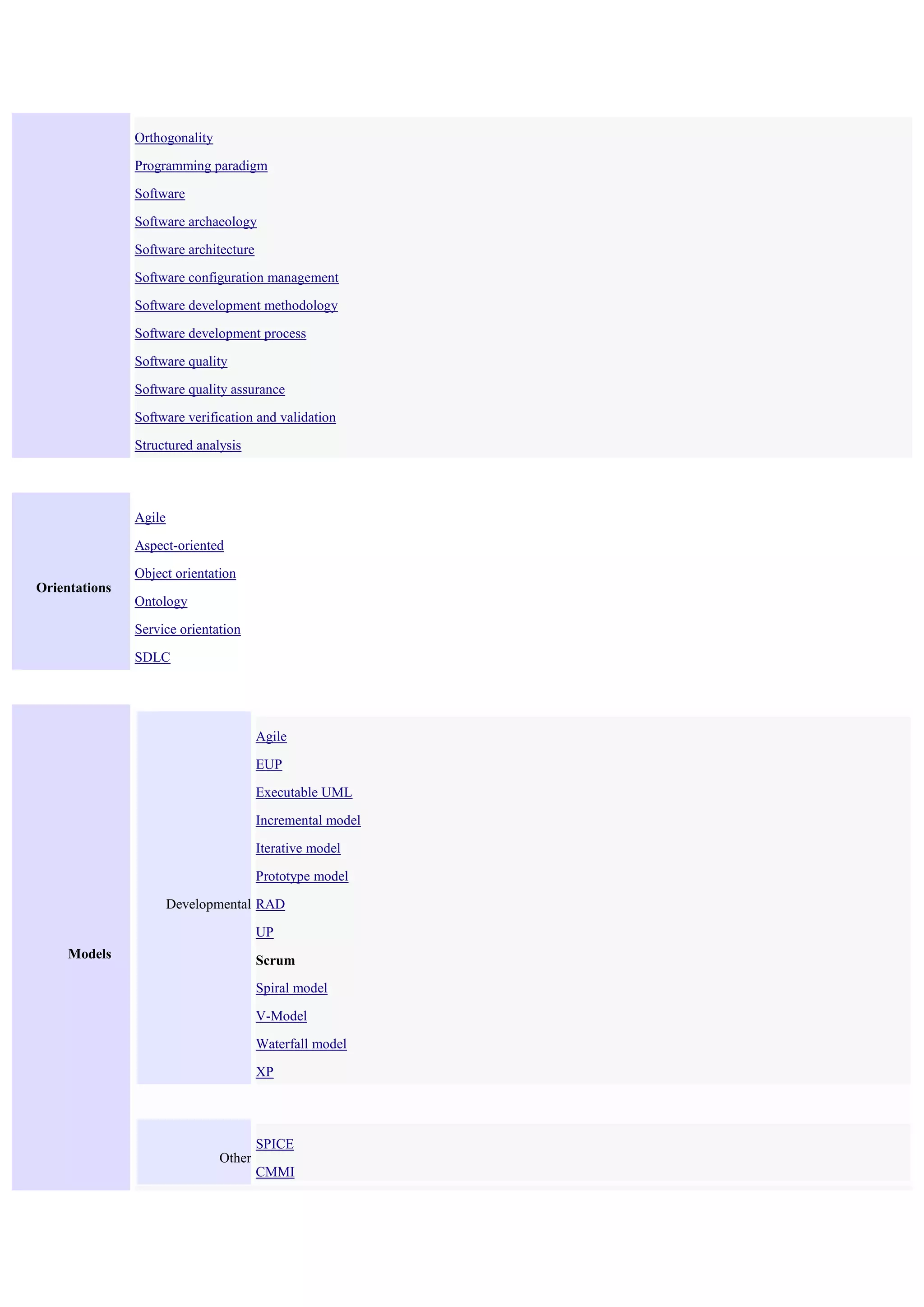
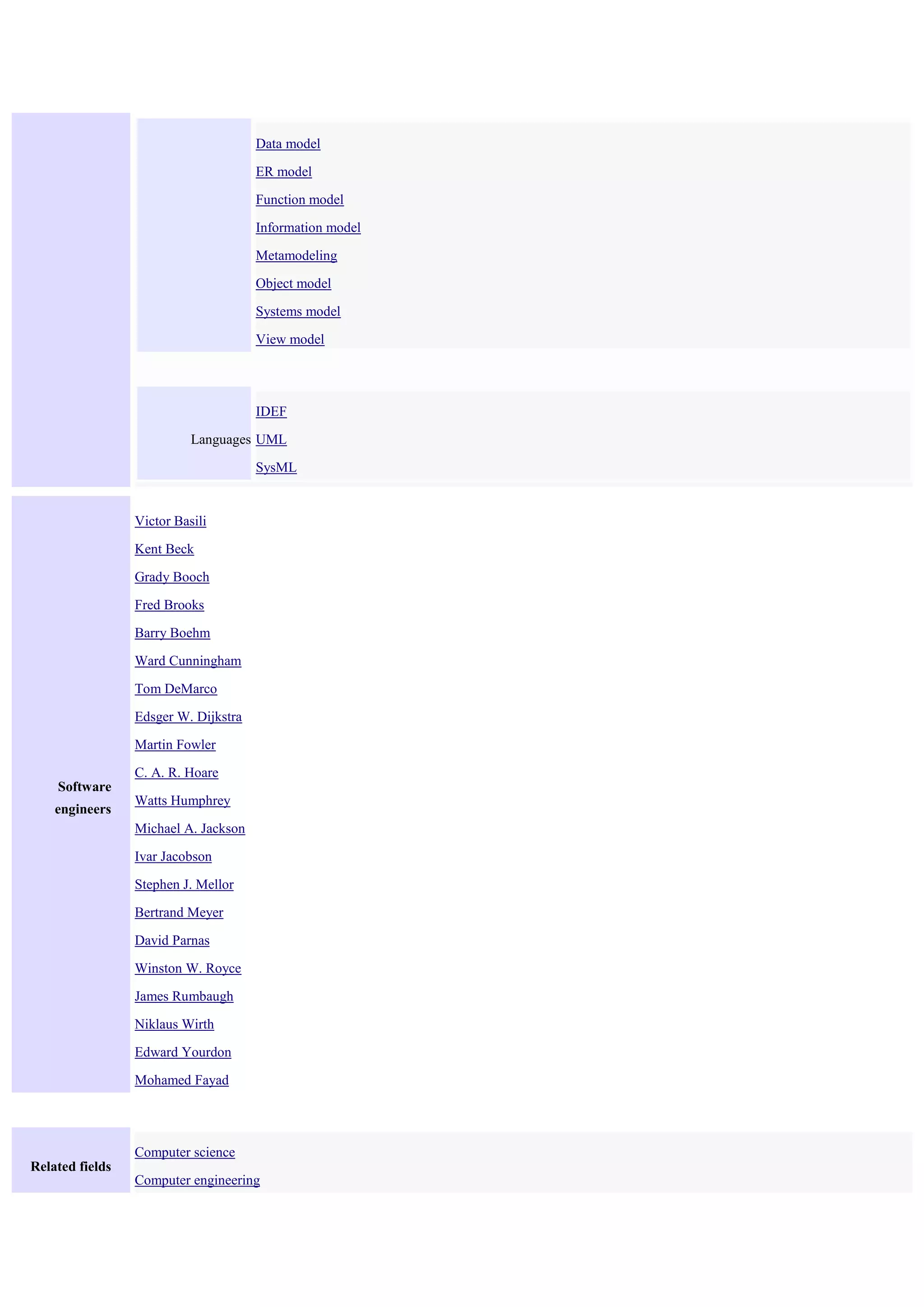
![[hide]
v
t
e
Software engineering
Fields
Computer programming
Requirements engineering
Software deployment
Software design
Software maintenance
Software testing
Systems analysis
Formal methods
Concepts
Data modeling
Enterprise architecture
Functional specification
Modeling language](https://image.slidesharecdn.com/whatyouneedtonowaboutscrum-170119063419/75/What-you-need-to-now-about-scrum-226-2048.jpg)






























Scrum is an agile framework for managing product development that emphasizes transparency, inspection, and adaptation. It defines roles of Product Owner, Development Team, and Scrum Master. The Product Owner represents stakeholders and prioritizes items in the Product Backlog. The cross-functional Development Team works to deliver increments each sprint. The Scrum Master removes impediments and ensures the team follows Scrum practices.


