What We Talk About
When We Talk About
Unit Testing
@KevlinHenney
kevlin@curbralan.com
Write down the problem.
Think real hard.
Write down the solution.
The Feynman Problem-Solving Algorithm
The update to SMARS was intended
to replace old, unused code
referred to as “Power Peg” —
functionality that Knight hadn’t
used in 8-years.
Doug Seven
http://dougseven.com/2014/04/17/knightmare-a-devops-cautionary-tale/
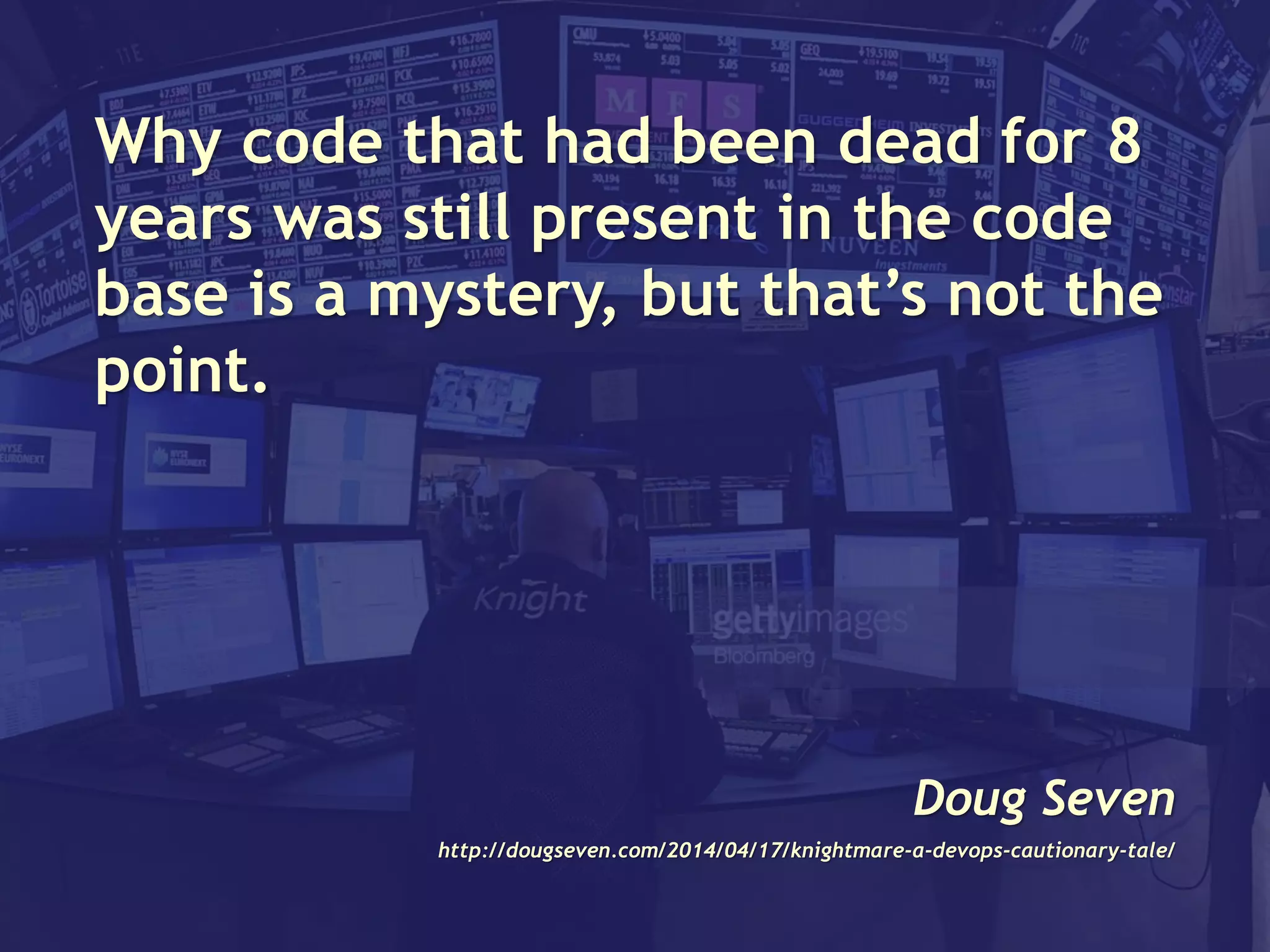
Why code that had been dead for 8
years was still present in the code
base is a mystery, but that’s not the
point.
Doug Seven
http://dougseven.com/2014/04/17/knightmare-a-devops-cautionary-tale/
In the first 45 minutes the market
was open the Power Peg code
received and processed 212 parent
orders. As a result SMARS sent
millions of child orders into the
market resulting in 4 million
transactions against 154 stocks for
more than 397 million shares.
Doug Seven
http://dougseven.com/2014/04/17/knightmare-a-devops-cautionary-tale/
Knight Capital Group realized a
$460 million loss in 45 minutes.
Doug Seven
http://dougseven.com/2014/04/17/knightmare-a-devops-cautionary-tale/
RUD, noun
 Rapid Unscheduled Disassembly
 Rocket science and amateur rocketry jargon that's acronymous,
euphemistic and explosively self-explanatory
WordFriday
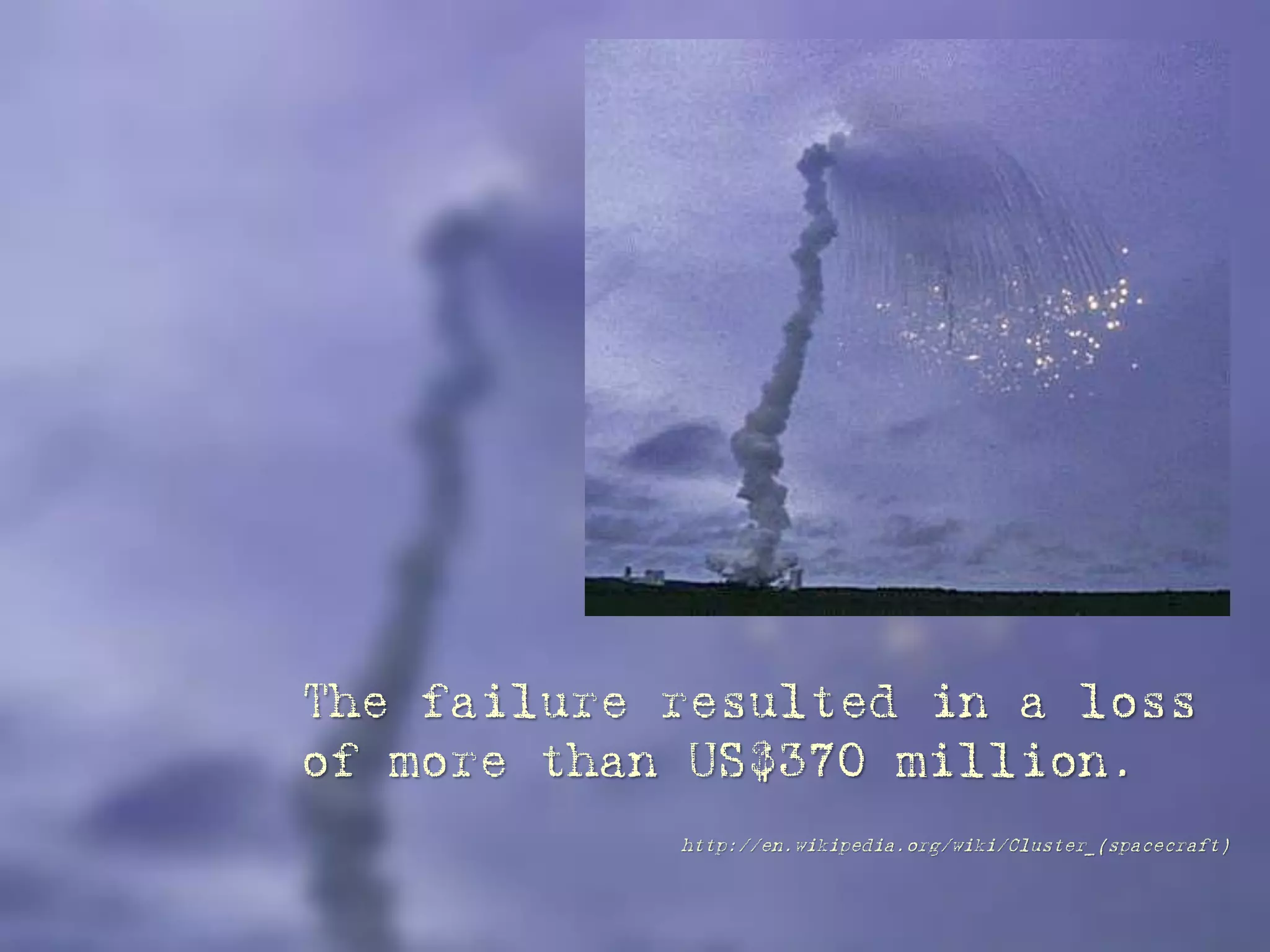
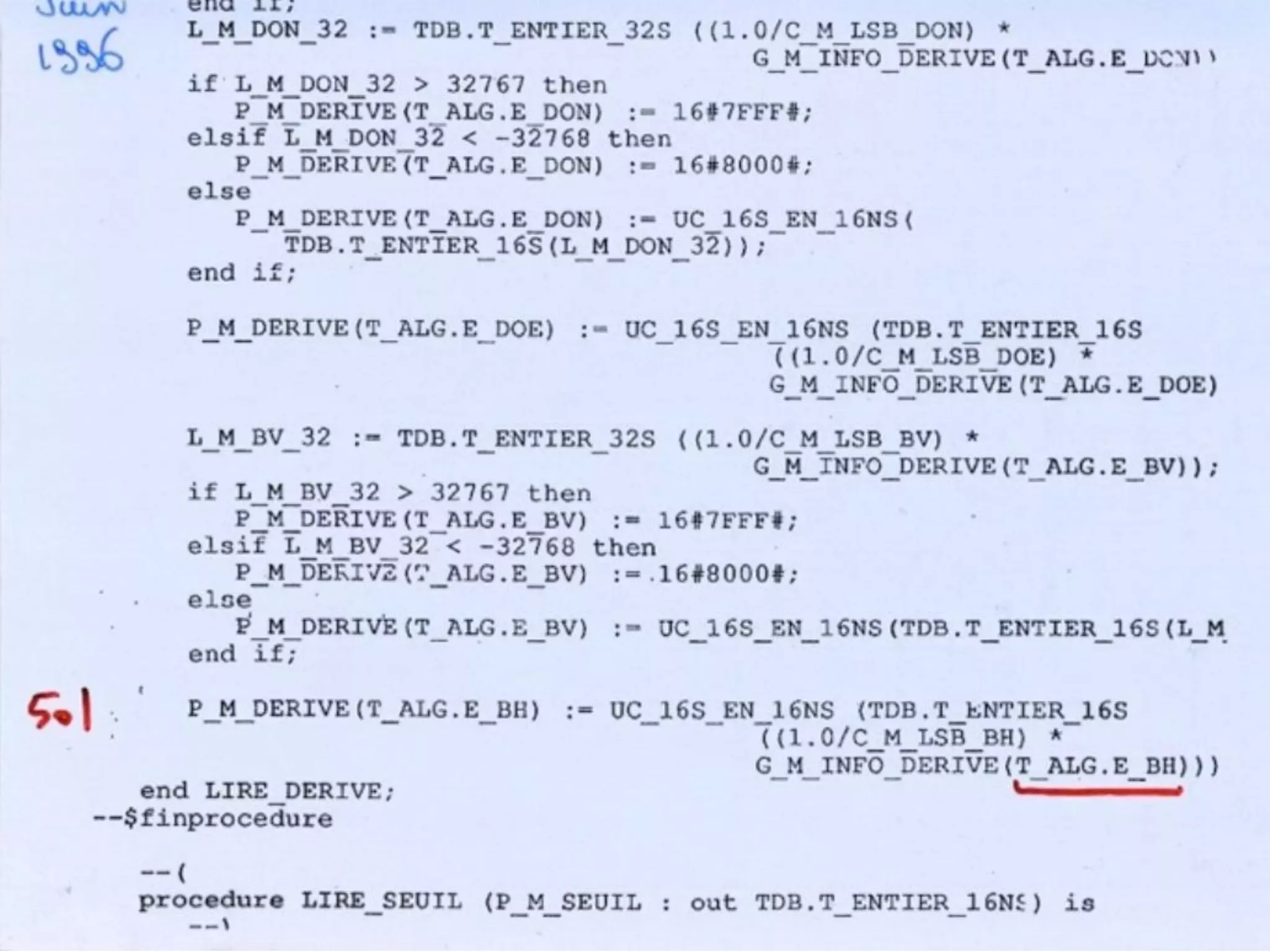
The failure resulted in a loss
of more than US$370 million.
http://en.wikipedia.org/wiki/Cluster_(spacecraft)
Um. What's the name of the word for
things not being the same always. You
know, I'm sure there is one. Isn't there?
There's must be a word for it... the thing
that lets you know time is happening. Is
there a word?
Change.
Oh. I was afraid of that.
Neil Gaiman
The Sandman
What experience and
history teach is that
nations and governments
have never learned
anything from history.
Georg Wilhelm Friedrich Hegel
Write down the problem.
Think real hard.
Write down the solution.
Check it.
assert
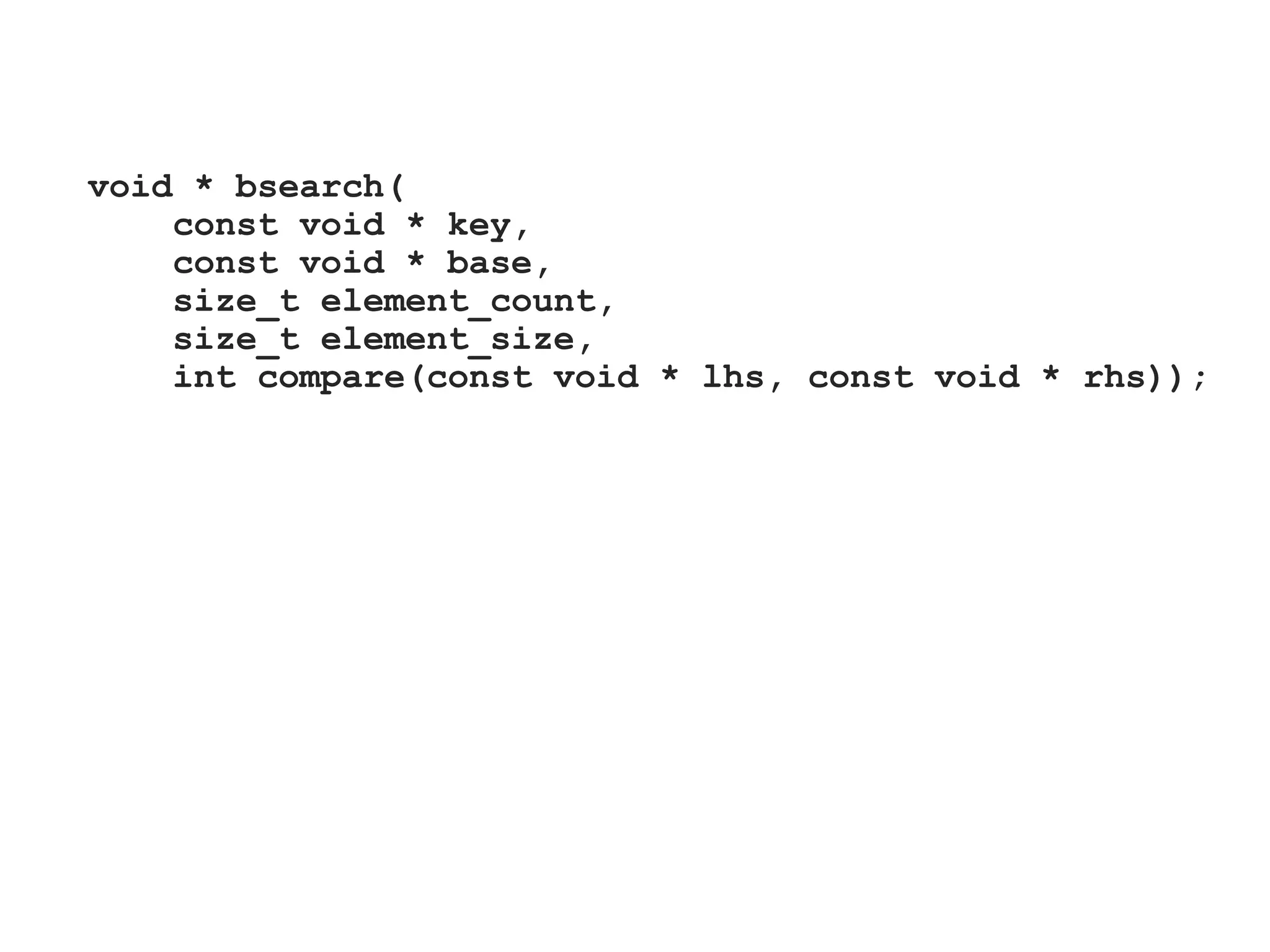
void * bsearch(
const void * key,
const void * base,
size_t element_count,
size_t element_size,
int compare(const void * lhs, const void * rhs));
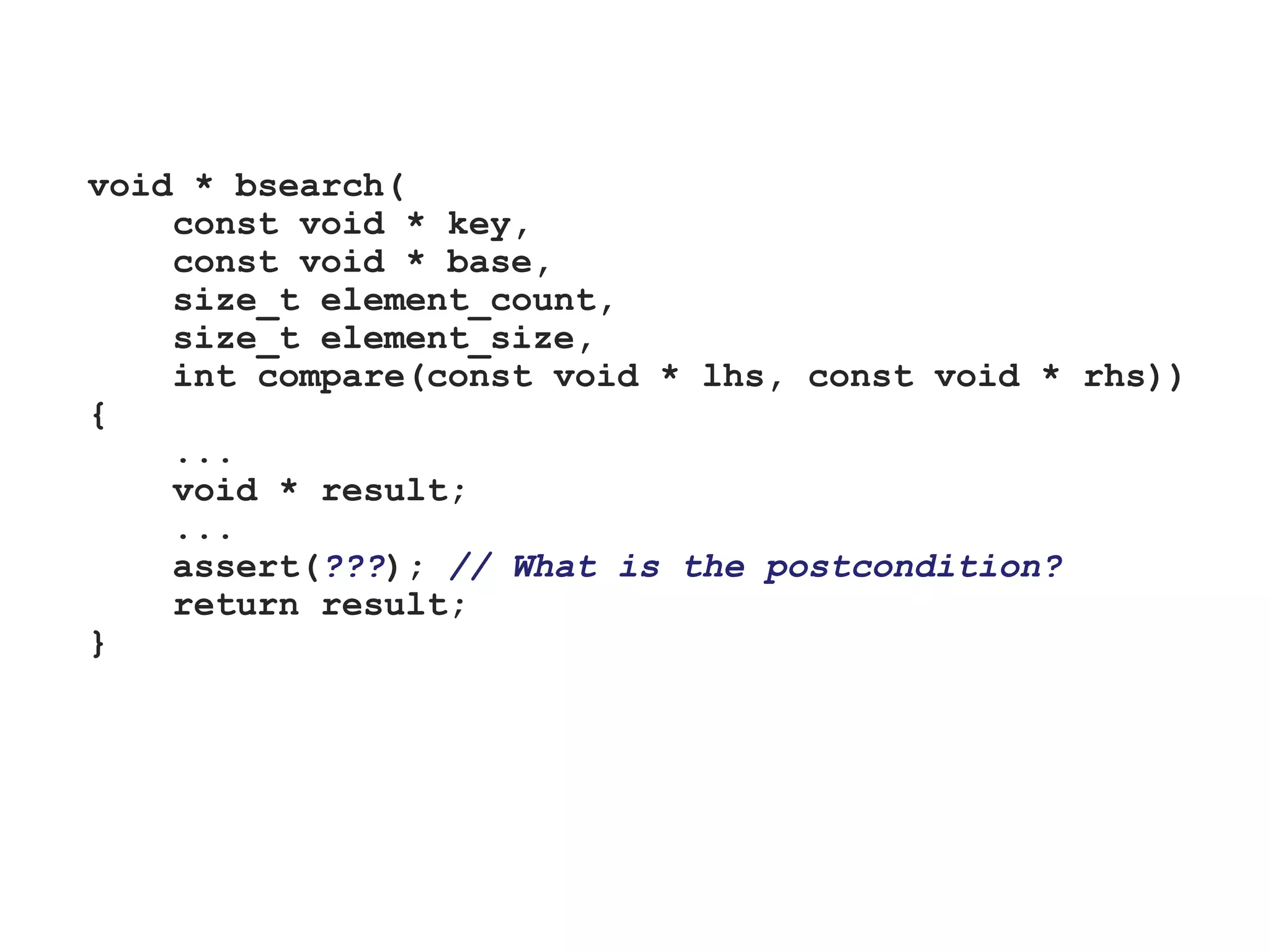
void * bsearch(
const void * key,
const void * base,
size_t element_count,
size_t element_size,
int compare(const void * lhs, const void * rhs))
{
...
void * result;
...
assert(???); // What is the postcondition?
return result;
}
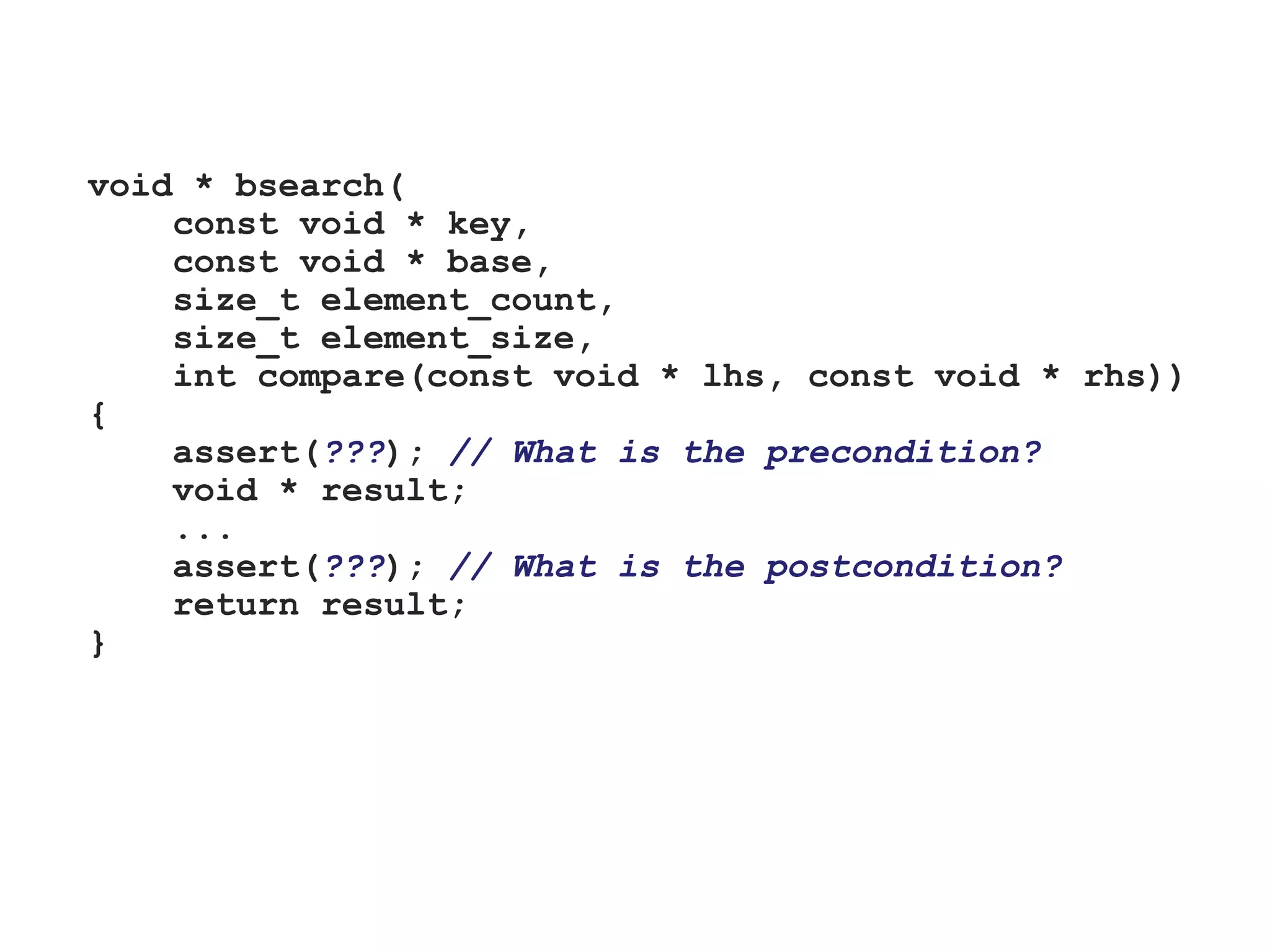
void * bsearch(
const void * key,
const void * base,
size_t element_count,
size_t element_size,
int compare(const void * lhs, const void * rhs))
{
assert(???); // What is the precondition?
void * result;
...
assert(???); // What is the postcondition?
return result;
}
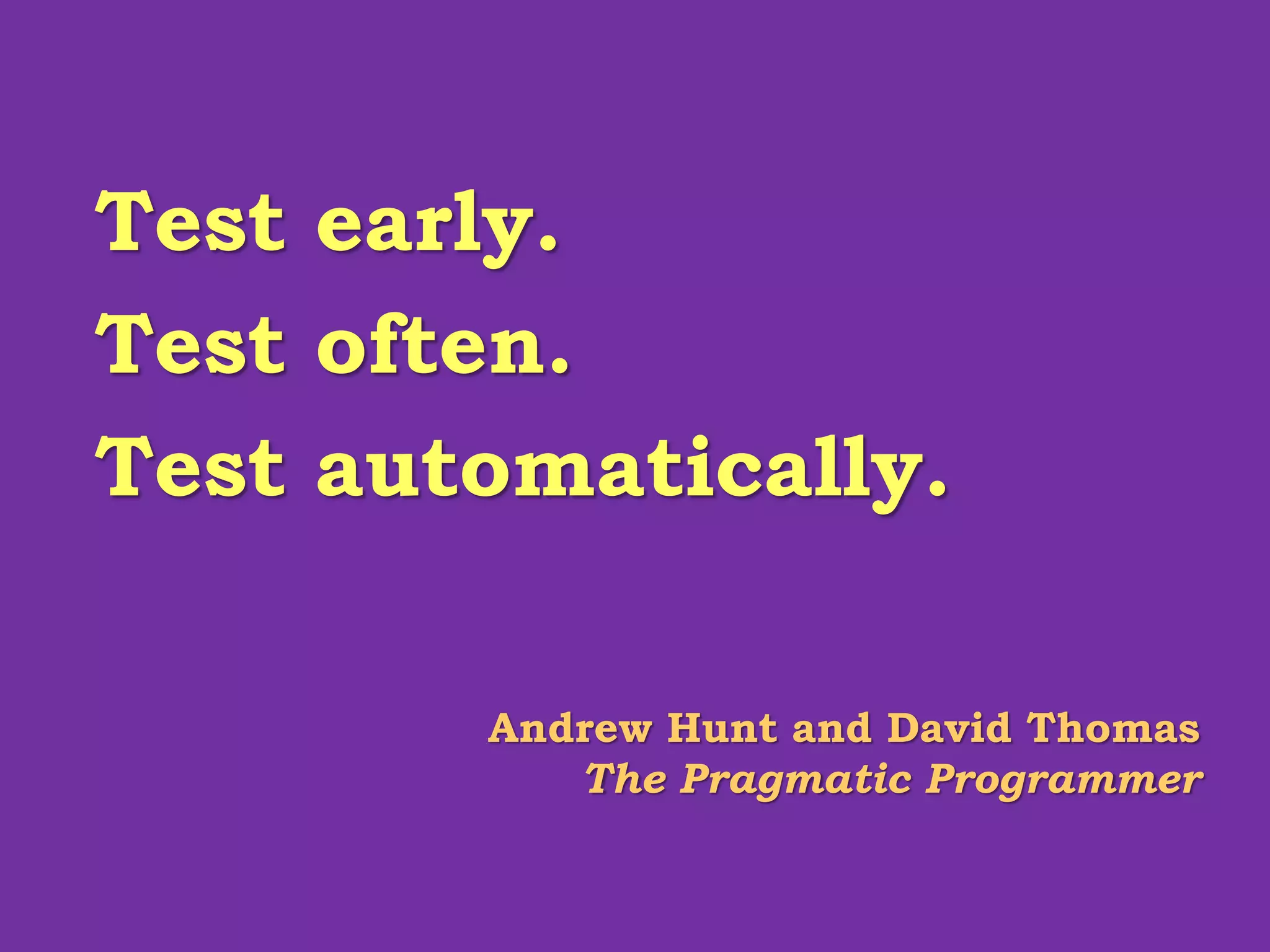
Test early.
Test often.
Test automatically.
Andrew Hunt and David Thomas
The Pragmatic Programmer
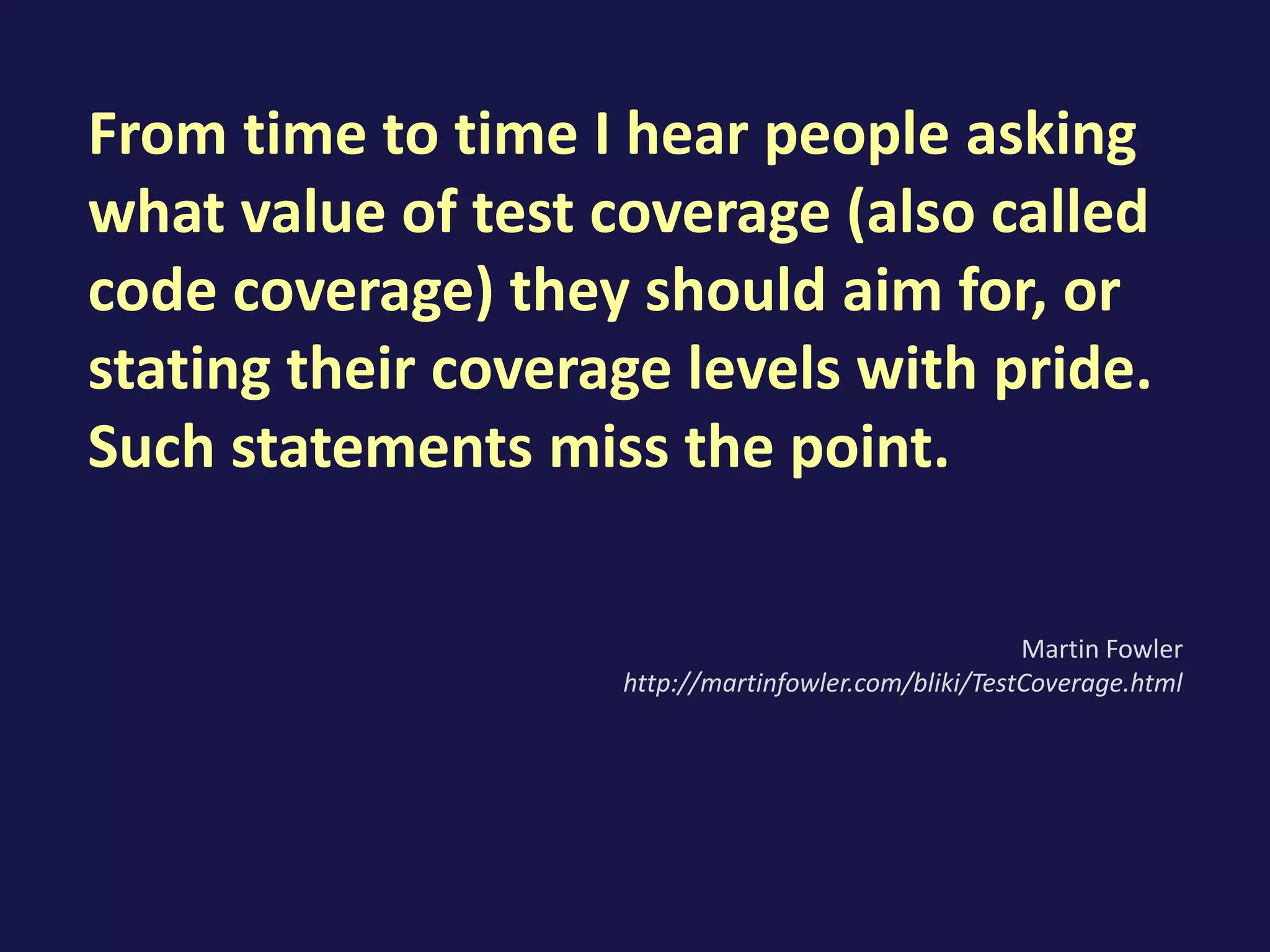
From time to time I hear people asking
what value of test coverage (also called
code coverage) they should aim for, or
stating their coverage levels with pride.
Such statements miss the point.
Martin Fowler
http://martinfowler.com/bliki/TestCoverage.html
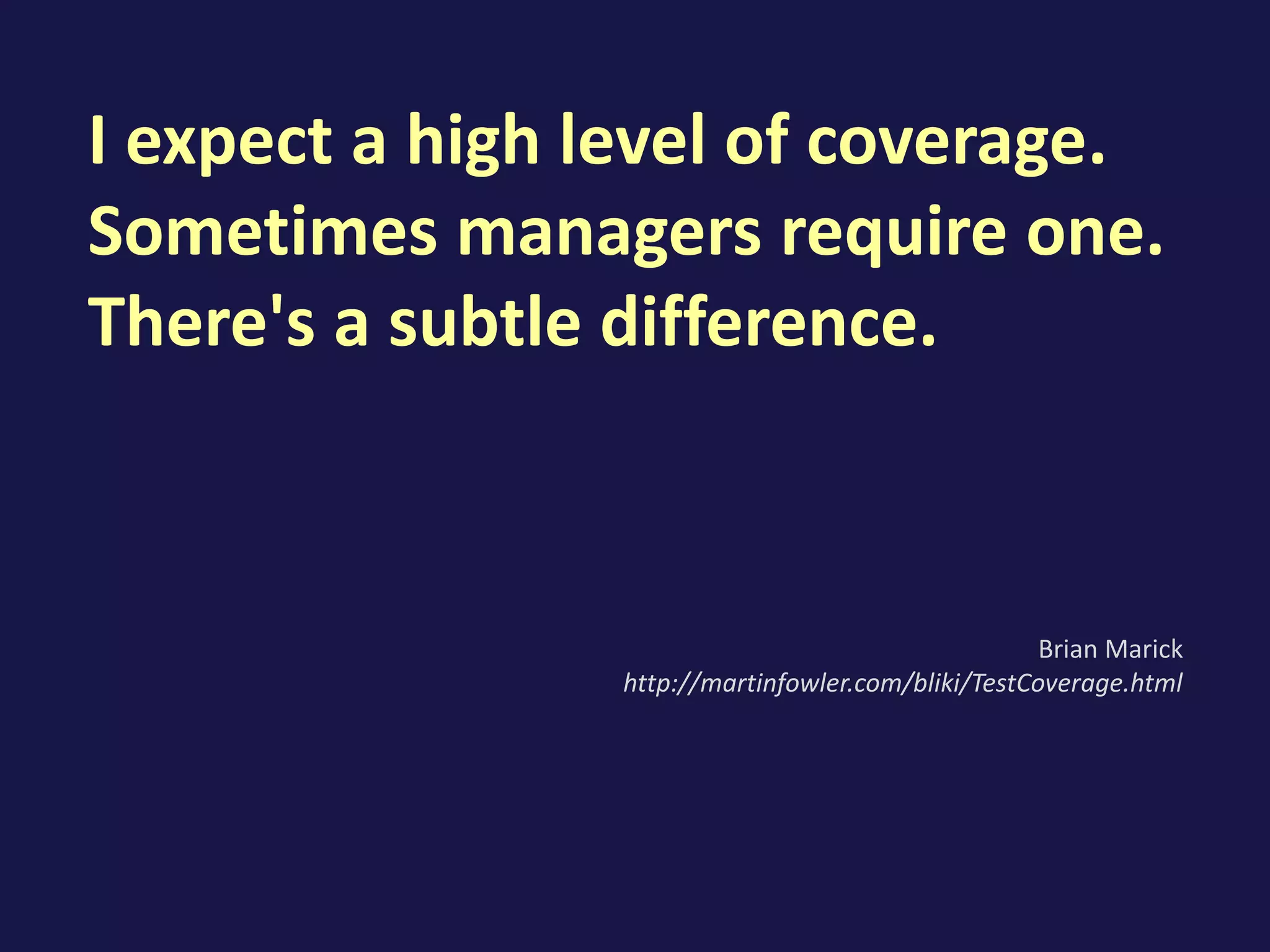
I expect a high level of coverage.
Sometimes managers require one.
There's a subtle difference.
Brian Marick
http://martinfowler.com/bliki/TestCoverage.html
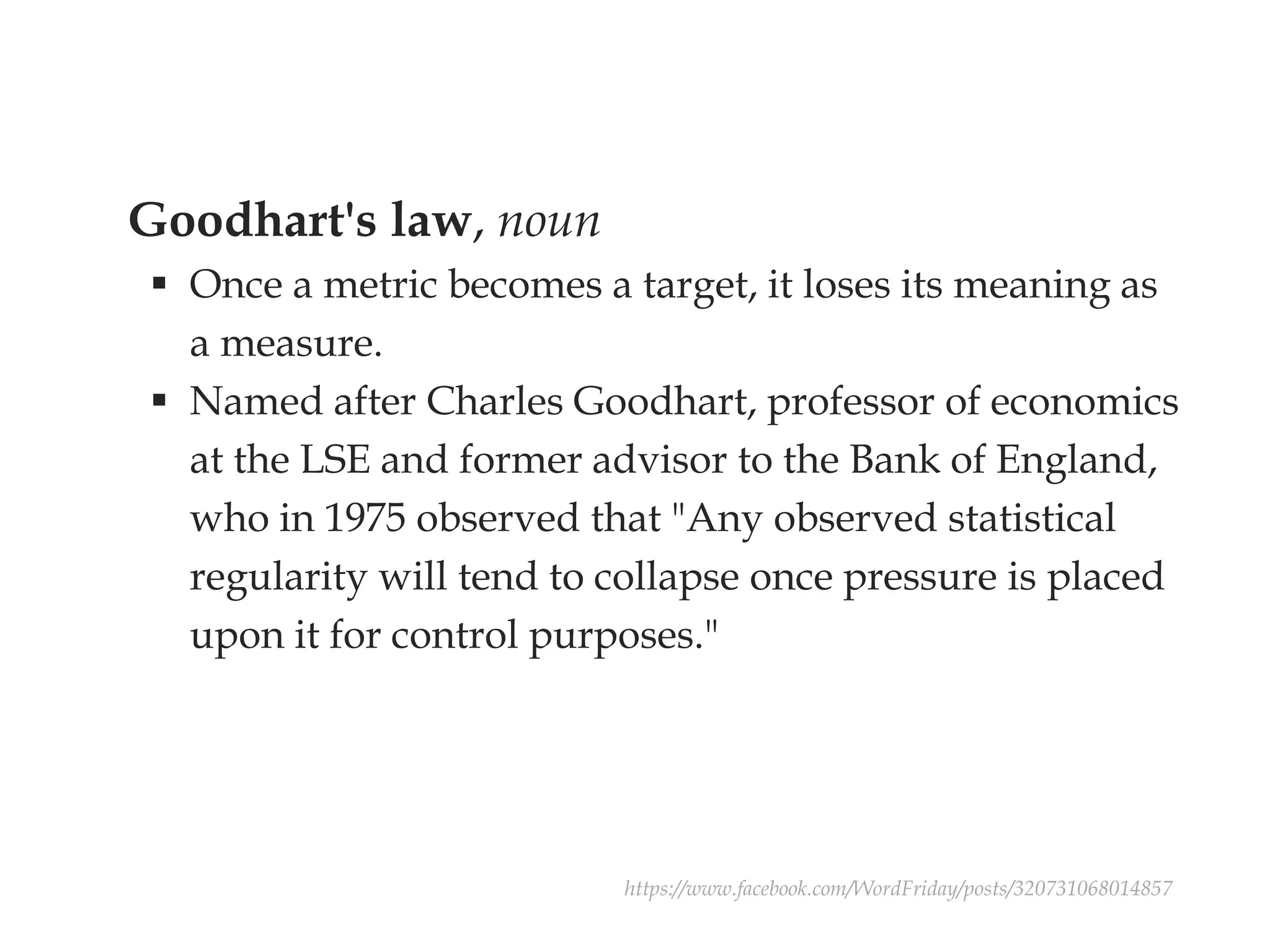
Goodhart's law, noun
 Once a metric becomes a target, it loses its meaning as
a measure.
 Named after Charles Goodhart, professor of economics
at the LSE and former advisor to the Bank of England,
who in 1975 observed that "Any observed statistical
regularity will tend to collapse once pressure is placed
upon it for control purposes."
https://www.facebook.com/WordFriday/posts/320731068014857
Developer Controls Process
Responsibilities of Developers
include understanding
requirements, reviewing the
solution structure and algorithm
with peers, building the
implementation, and unit testing.
A Generative Development-Process Pattern Language
James O Coplien
When you write unit tests, TDD-
style or after your development,
you scrutinize, you think, and
often you prevent problems
without even encountering a test
failure.
Michael Feathers
"The Flawed Theory Behind Unit Testing"
http://michaelfeathers.typepad.com/michael_feathers_blog/2008/06/the-flawed-theo.html
Very many people say "TDD"
when they really mean, "I have
good unit tests" ("I have GUTs"?).
Ron Jeffries tried for years to
explain what this was, but we
never got a catch-phrase for it,
and now TDD is being watered
down to mean GUTs.
Alistair Cockburn
"The modern programming professional has GUTs"
http://alistair.cockburn.us/The+modern+programming+professional+has+GUTs
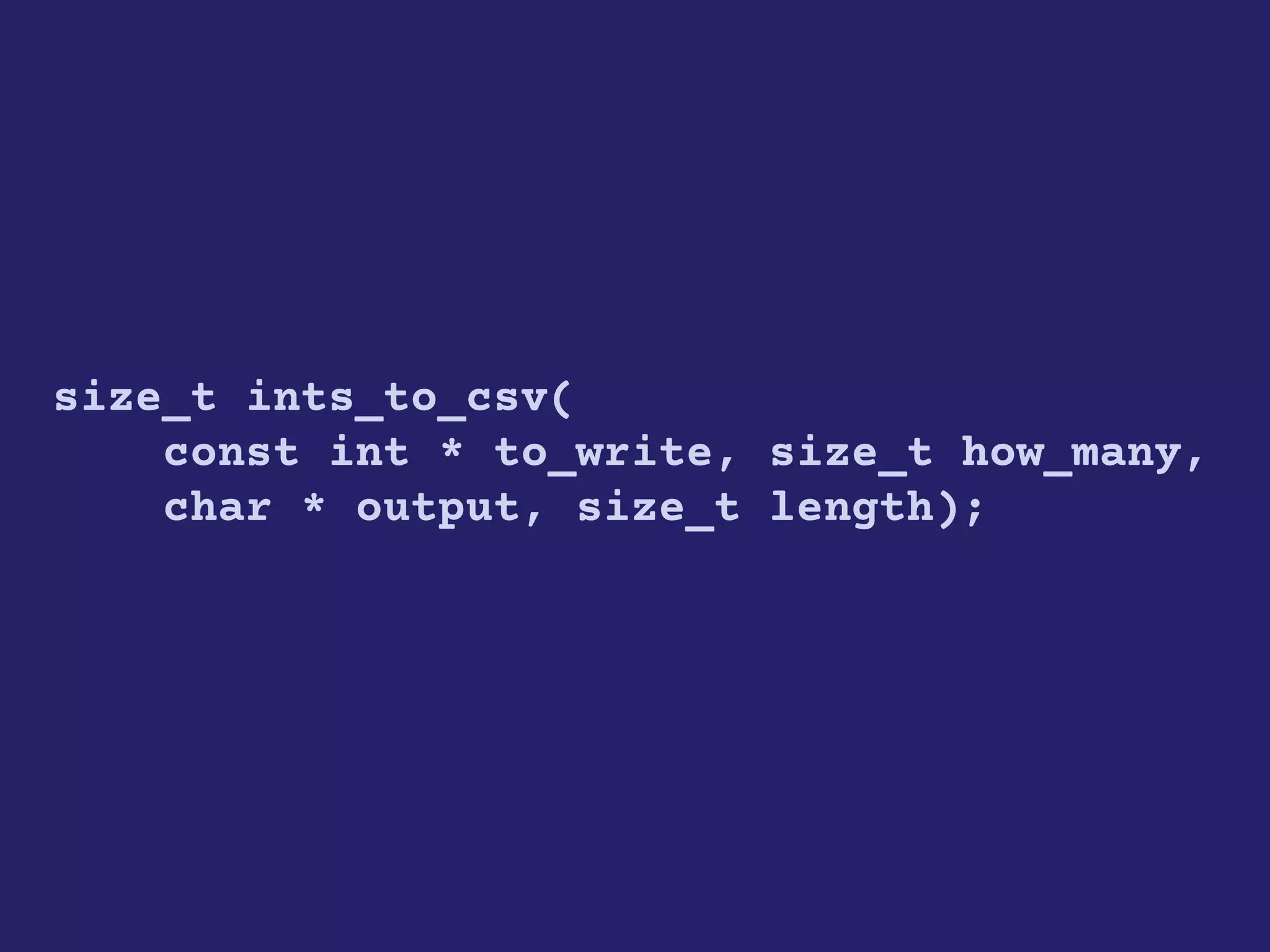
size_t ints_to_csv(
const int * to_write, size_t how_many,
char * output, size_t length);
size_t ints_to_csv(
const int * to_write, size_t how_many, char * output, size_t length)
{
size_t result = 0;
if(length != 0)
{
if(how_many == 0)
{
output[0] = '0';
}
else
{
for(size_t which = 0; which != how_many && result != length; ++which)
{
result +=
snprintf(
output + result, length - result,
which == 0 ? "%i" : ",%i",
to_write[which]);
}
result = result > length - 1 ? length - 1 : result;
}
}
return result;
}
extern "C" size_t ints_to_csv(
const int * to_write, size_t how_many, char * output, size_t length)
{
size_t result = 0;
if(length != 0)
{
output[length - 1] = '0';
std::ostrstream buffer(output, length - 1);
for(size_t which = 0; which != how_many; ++which)
buffer << (which == 0 ? "" : ",") << to_write[which];
buffer << std::ends;
result = std::strlen(output);
}
return result;
}
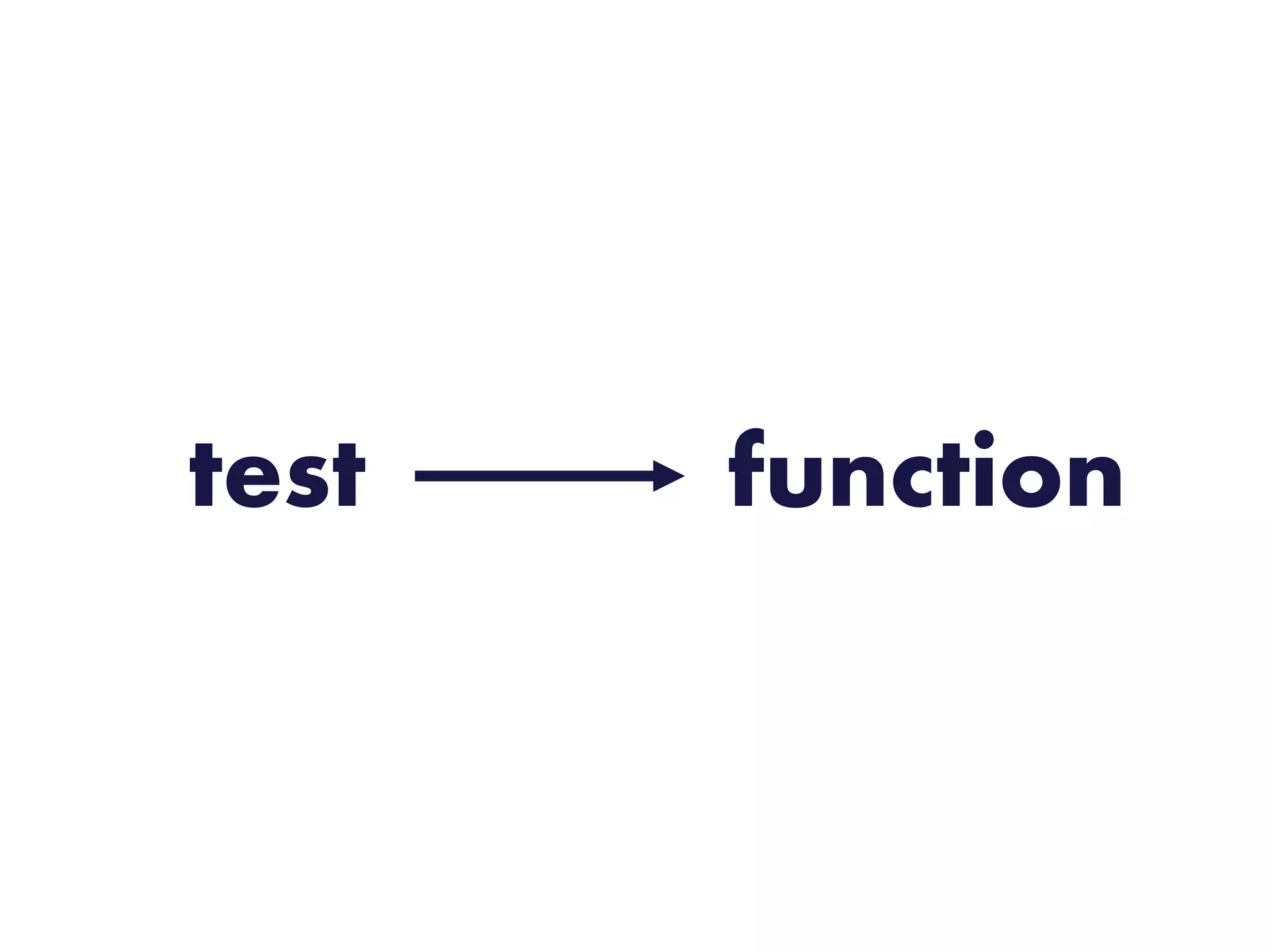
functiontest
void test_ints_to_csv()
{
size_t written = ints_to_csv(NULL, 0, NULL, 0);
assert(written == 0);
const int input[] = { 42 };
written = ints_to_csv(input, 1, NULL, 0);
assert(written == 0);
char output[3] = "+++";
written = ints_to_csv(NULL, 0, output, sizeof output);
assert(written == 0);
assert(output[0] == '0');
memcpy(output, "+++", sizeof output);
written = ints_to_csv(input, 1, output, sizeof output);
assert(written == 2);
assert(strcmp(output, "42") == 0);
...
}
void test_ints_to_csv()
{
// No values from null to null output writes nothing
size_t written = ints_to_csv(NULL, 0, NULL, 0);
assert(written == 0);
// Value to null output writes nothing
const int input[] = { 42 };
written = ints_to_csv(input, 1, NULL, 0);
assert(written == 0);
// No values to sufficient output writes empty
char output[3] = "+++";
written = ints_to_csv(NULL, 0, output, sizeof output);
assert(written == 0);
assert(output[0] == '0');
// Positive value to sufficient output writes value without sign
memcpy(output, "+++", sizeof output);
written = ints_to_csv(input, 1, output, sizeof output);
assert(written == 2);
assert(strcmp(output, "42") == 0);
...
}
void test_ints_to_csv()
{
// No values from null to null output writes nothing
{
size_t written = ints_to_csv(NULL, 0, NULL, 0);
assert(written == 0);
}
// Value to null output writes nothing
{
const int input[] = { 42 };
size_t written = ints_to_csv(input, 1, NULL, 0);
assert(written == 0);
}
// No values to sufficient output writes empty
{
char output[3] = "+++";
size_t written = ints_to_csv(NULL, 0, output, sizeof output);
assert(written == 0);
assert(output[0] == '0');
}
// Positive value to sufficient output writes value without sign
{
const int input[] = { 42 };
char output[3] = "+++";
size_t written = ints_to_csv(input, 1, output, sizeof output);
assert(written == 2);
assert(strcmp(output, "42") == 0);
void No_values_from_null_to_null_output_writes_nothing()
{
size_t written = ints_to_csv(NULL, 0, NULL, 0);
assert(written == 0);
}
void Value_to_null_output_writes_nothing()
{
const int input[] = { 42 };
size_t written = ints_to_csv(input, 1, NULL, 0);
assert(written == 0);
}
void No_values_to_sufficient_output_writes_empty()
{
char output[3] = "+++";
size_t written = ints_to_csv(NULL, 0, output, sizeof output);
assert(written == 0);
assert(output[0] == '0');
}
void Positive_value_to_sufficient_output_writes_value_without_sign()
{
const int input[] = { 42 };
char output[3] = "+++";
size_t written = ints_to_csv(input, 1, output, sizeof output);
assert(written == 2);
assert(strcmp(output, "42") == 0);
}
void Negative_value_to_sufficient_output_writes_value_with_sign()
{
const int input[] = { -42 };
char output[4] = "++++";
size_t written = ints_to_csv(input, 1, output, sizeof output);
assert(written == 3);
assert(strcmp(output, "-42") == 0);
}
void Value_to_insufficient_output_writes_truncated_value()
{
const int input[] = { 42 };
char output[2] = "++";
size_t written = ints_to_csv(input, 1, output, sizeof output);
assert(written == 1);
assert(strcmp(output, "4") == 0);
}
void Multiple_values_to_sufficient_output_writes_comma_separated_values()
{
const int input[] = { 42, -273, 0, 7 };
char output[12] = "++++++++++++";
size_t written = ints_to_csv(input, 4, output, sizeof output);
assert(written == 11);
assert(strcmp(output, "42,-273,0,7") == 0);
}
void Multiple_values_to_insufficient_output_writes_truncated_value_sequence()
{
const int input[] = { 42, -273, 0, 7 };
char output[9] = "+++++++++";
size_t written = ints_to_csv(input, 4, output, sizeof output);
assert(written == 8);
assert(strcmp(output, "42,-273,") == 0);
}
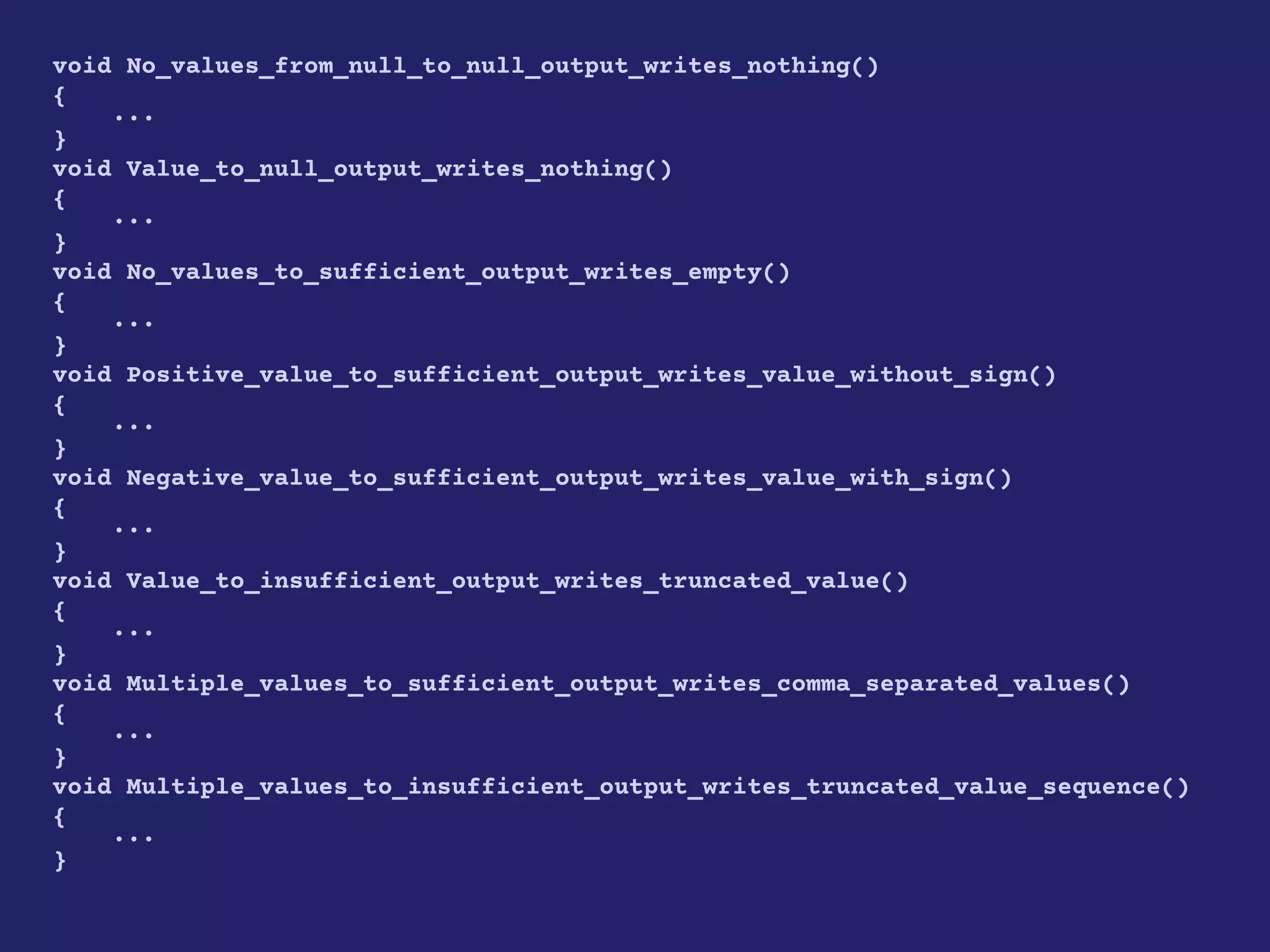
void No_values_from_null_to_null_output_writes_nothing()
{
...
}
void Value_to_null_output_writes_nothing()
{
...
}
void No_values_to_sufficient_output_writes_empty()
{
...
}
void Positive_value_to_sufficient_output_writes_value_without_sign()
{
...
}
void Negative_value_to_sufficient_output_writes_value_with_sign()
{
...
}
void Value_to_insufficient_output_writes_truncated_value()
{
...
}
void Multiple_values_to_sufficient_output_writes_comma_separated_values()
{
...
}
void Multiple_values_to_insufficient_output_writes_truncated_value_sequence()
{
...
}
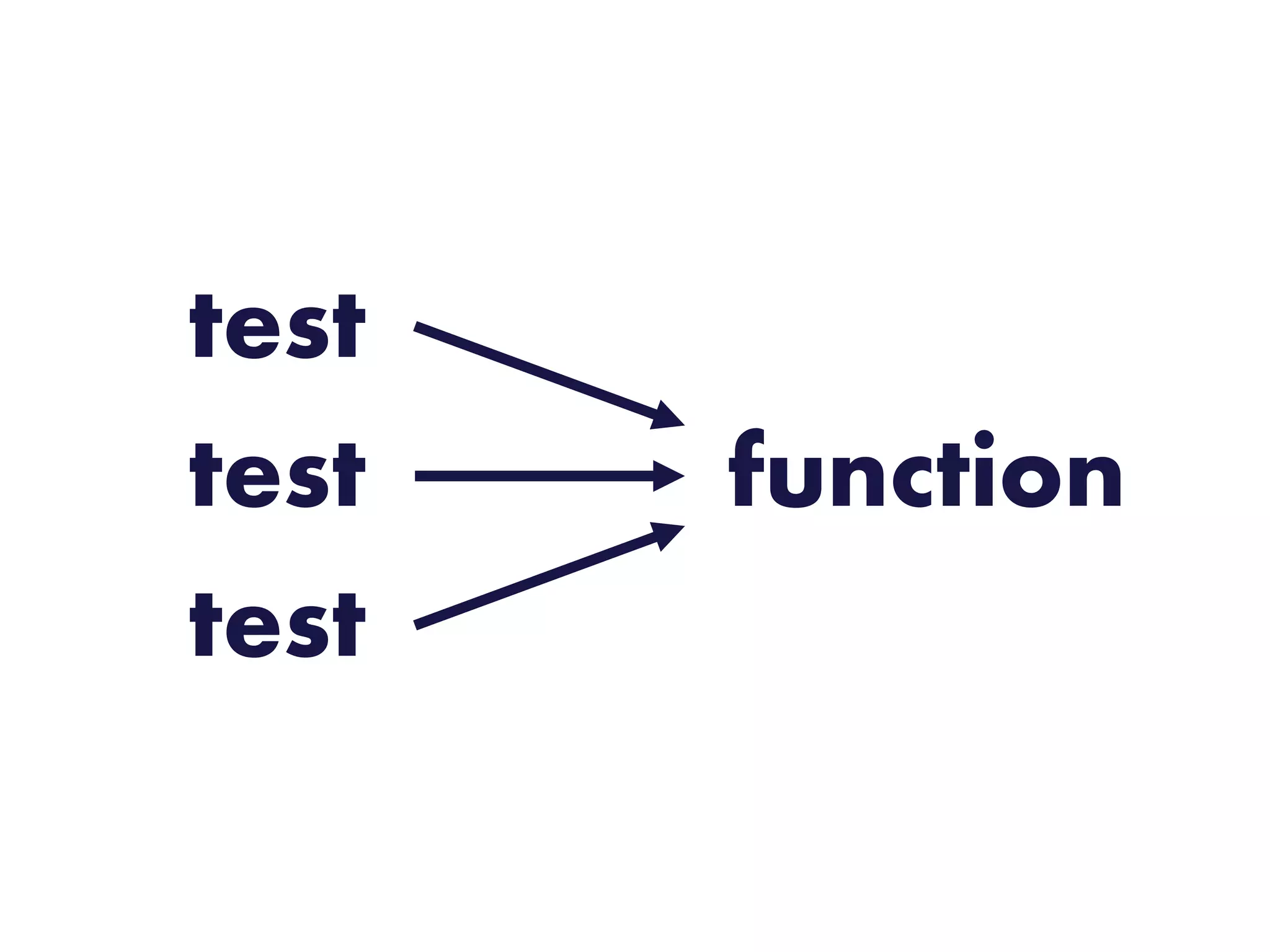
functiontest
test
test
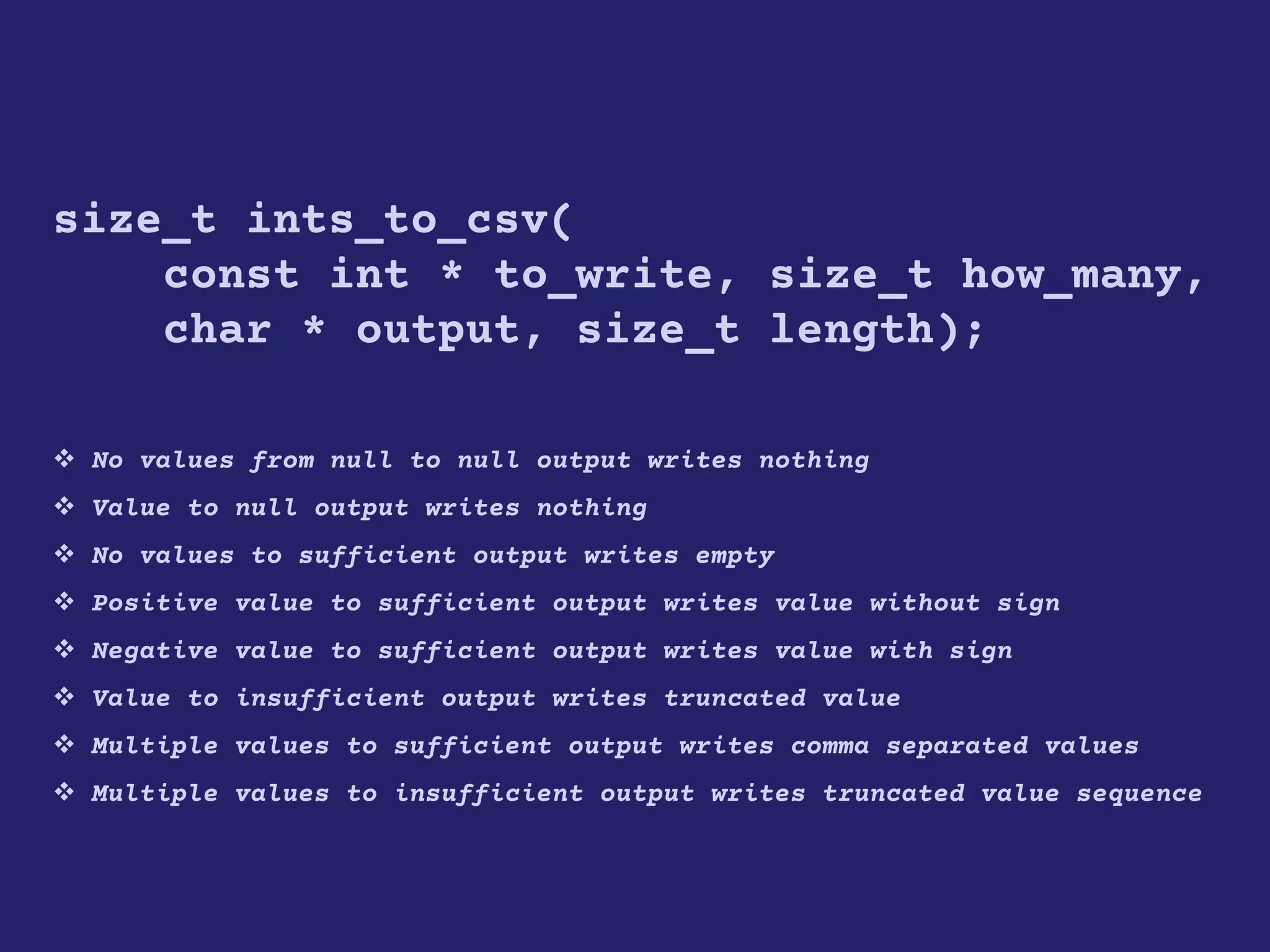
size_t ints_to_csv(
const int * to_write, size_t how_many,
char * output, size_t length);
 No values from null to null output writes nothing
 Value to null output writes nothing
 No values to sufficient output writes empty
 Positive value to sufficient output writes value without sign
 Negative value to sufficient output writes value with sign
 Value to insufficient output writes truncated value
 Multiple values to sufficient output writes comma separated values
 Multiple values to insufficient output writes truncated value sequence
Tests that are not written with their
role as specifications in mind can
be very confusing to read. The
difficulty in understanding what
they are testing can greatly
reduce the velocity at which a
codebase can be changed.
Nat Pryce and Steve Freeman
"Are Your Tests Really Driving Your Development?"
Propositions
are vehicles
for stating
how things are
or might be.
Thus only indicative
sentences which it
makes sense to think
of as being true or as
being false are
capable of expressing
propositions.
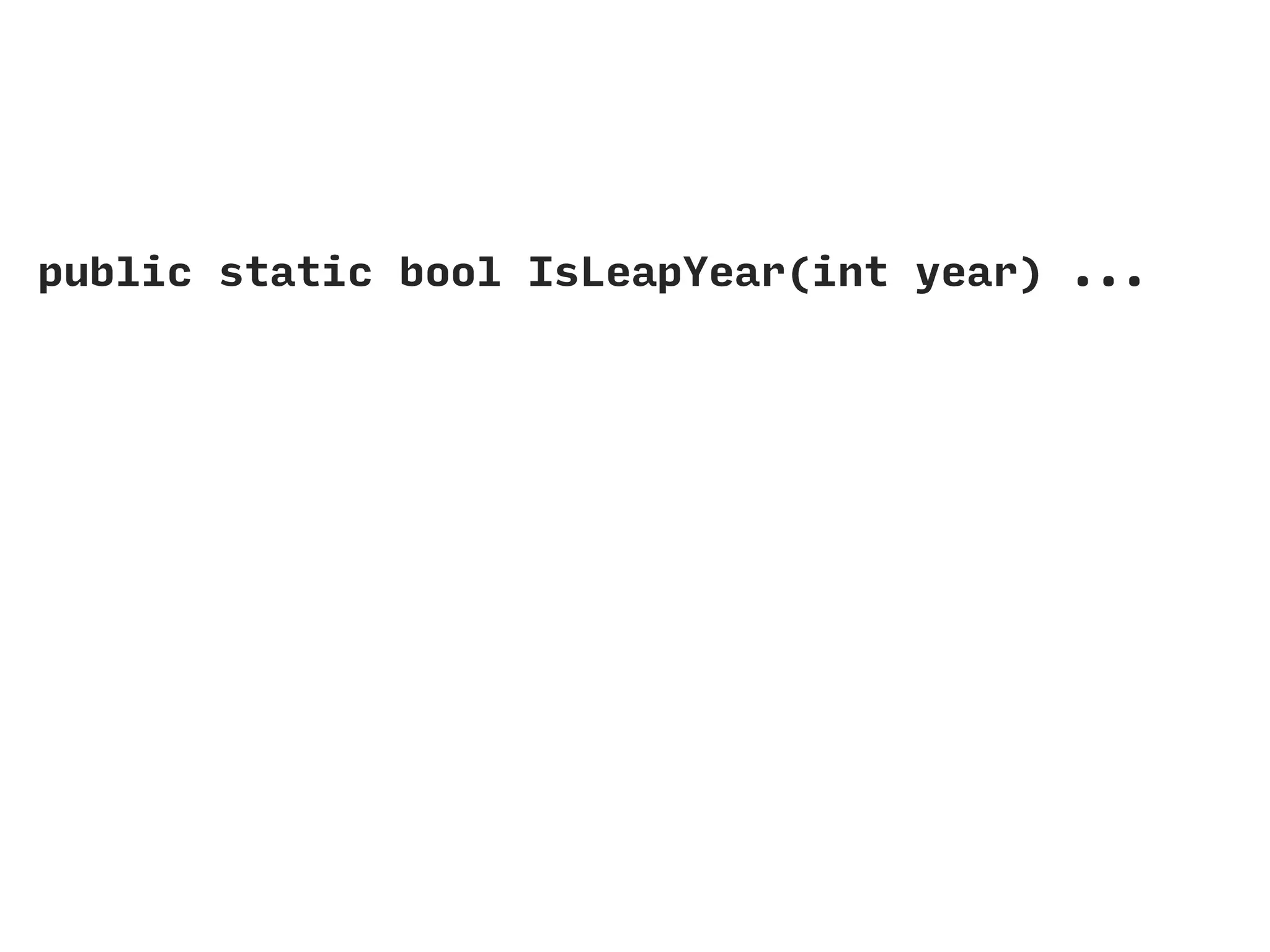
public static bool IsLeapYear(int year) ...
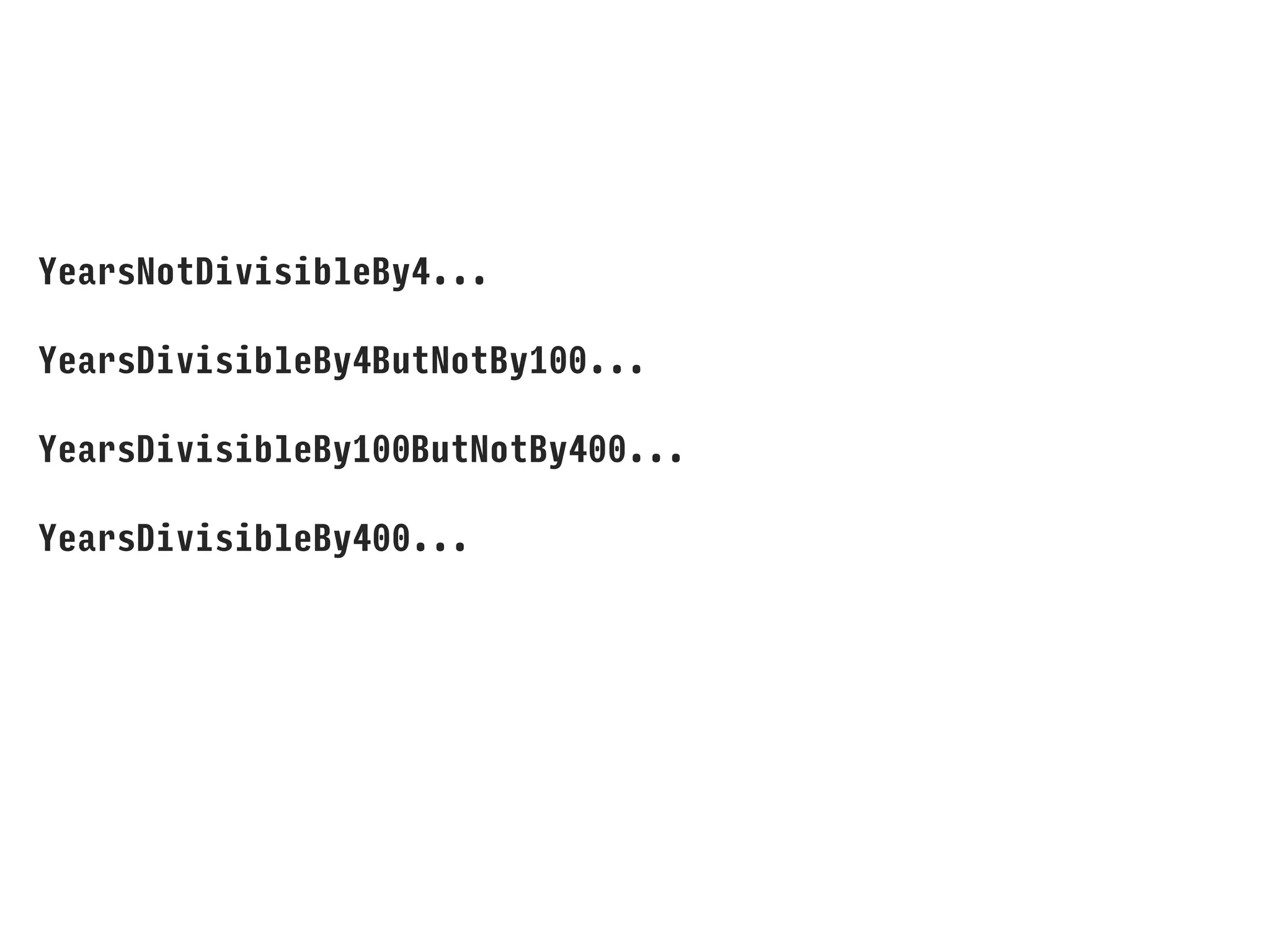
YearsNotDivisibleBy4...
YearsDivisibleBy4ButNotBy100...
YearsDivisibleBy100ButNotBy400...
YearsDivisibleBy400...
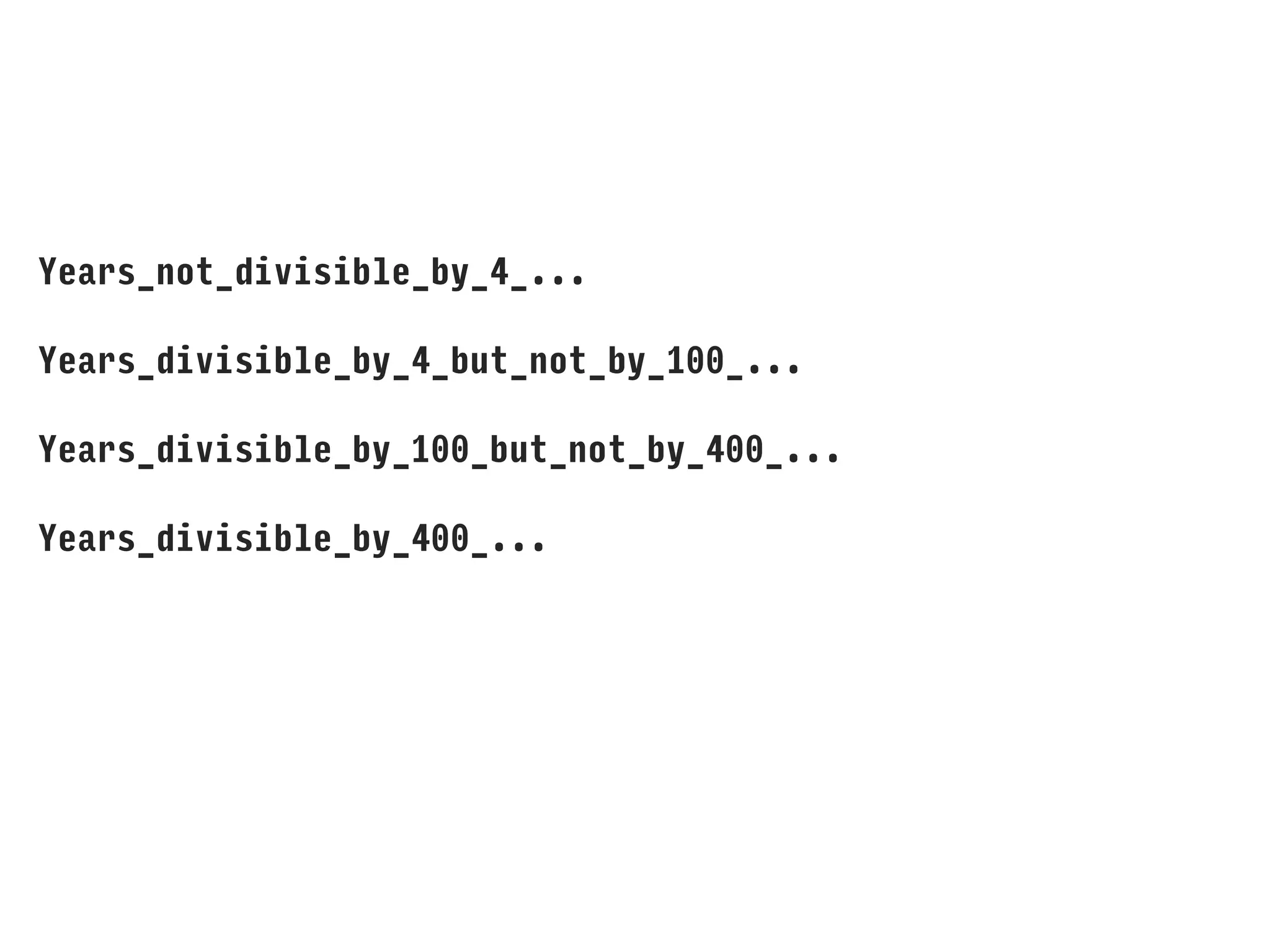
Years_not_divisible_by_4_...
Years_divisible_by_4_but_not_by_100_...
Years_divisible_by_100_but_not_by_400_...
Years_divisible_by_400_...
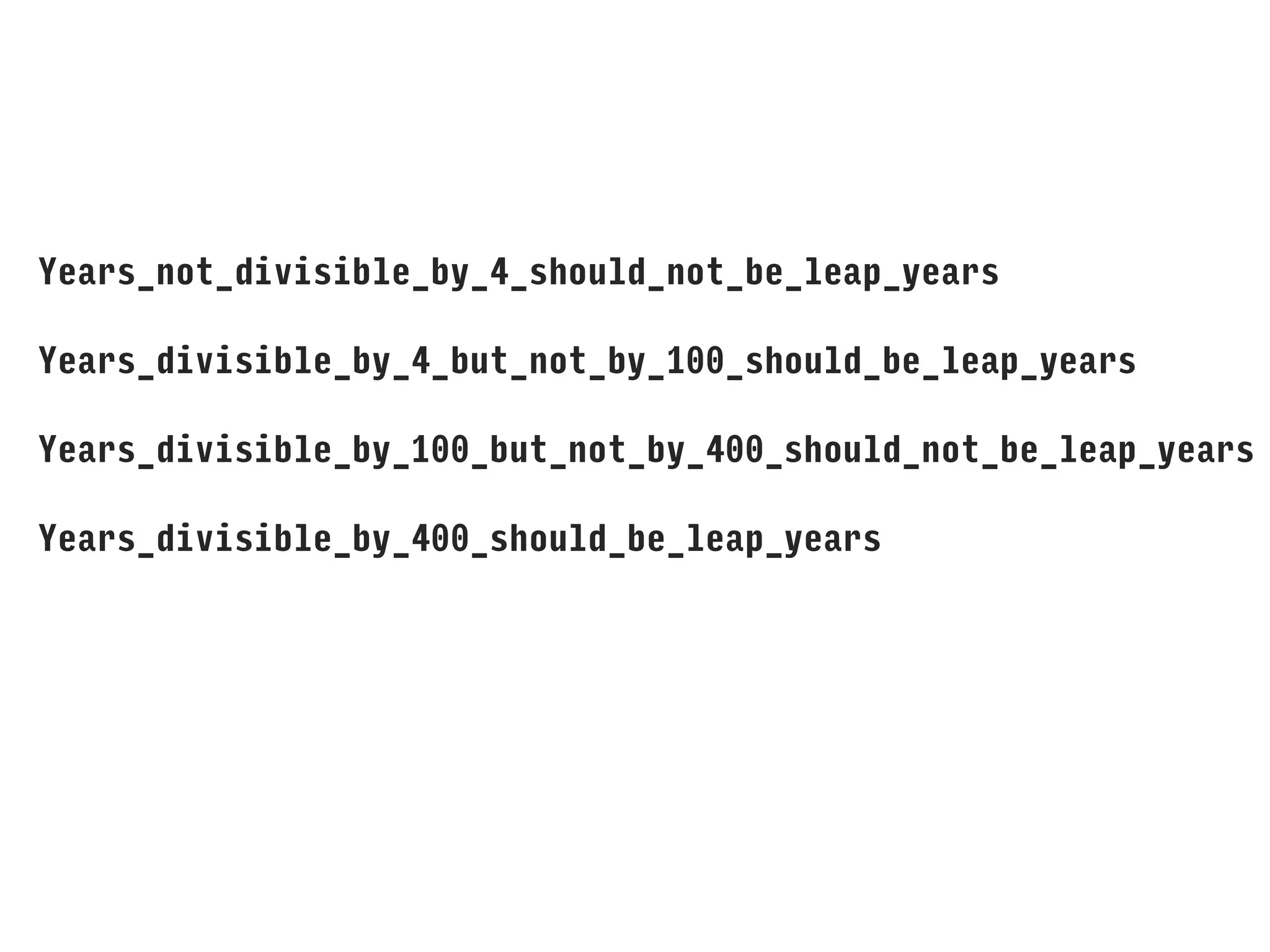
Years_not_divisible_by_4_should_not_be_leap_years
Years_divisible_by_4_but_not_by_100_should_be_leap_years
Years_divisible_by_100_but_not_by_400_should_not_be_leap_years
Years_divisible_by_400_should_be_leap_years
Make definite assertions. Avoid tame,
colourless, hesitating, noncommittal
language.
Note [...] that when a sentence is made
stronger, it usually becomes shorter. Thus
brevity is a by-product of vigour.
William Strunk and E B White
The Elements of Style
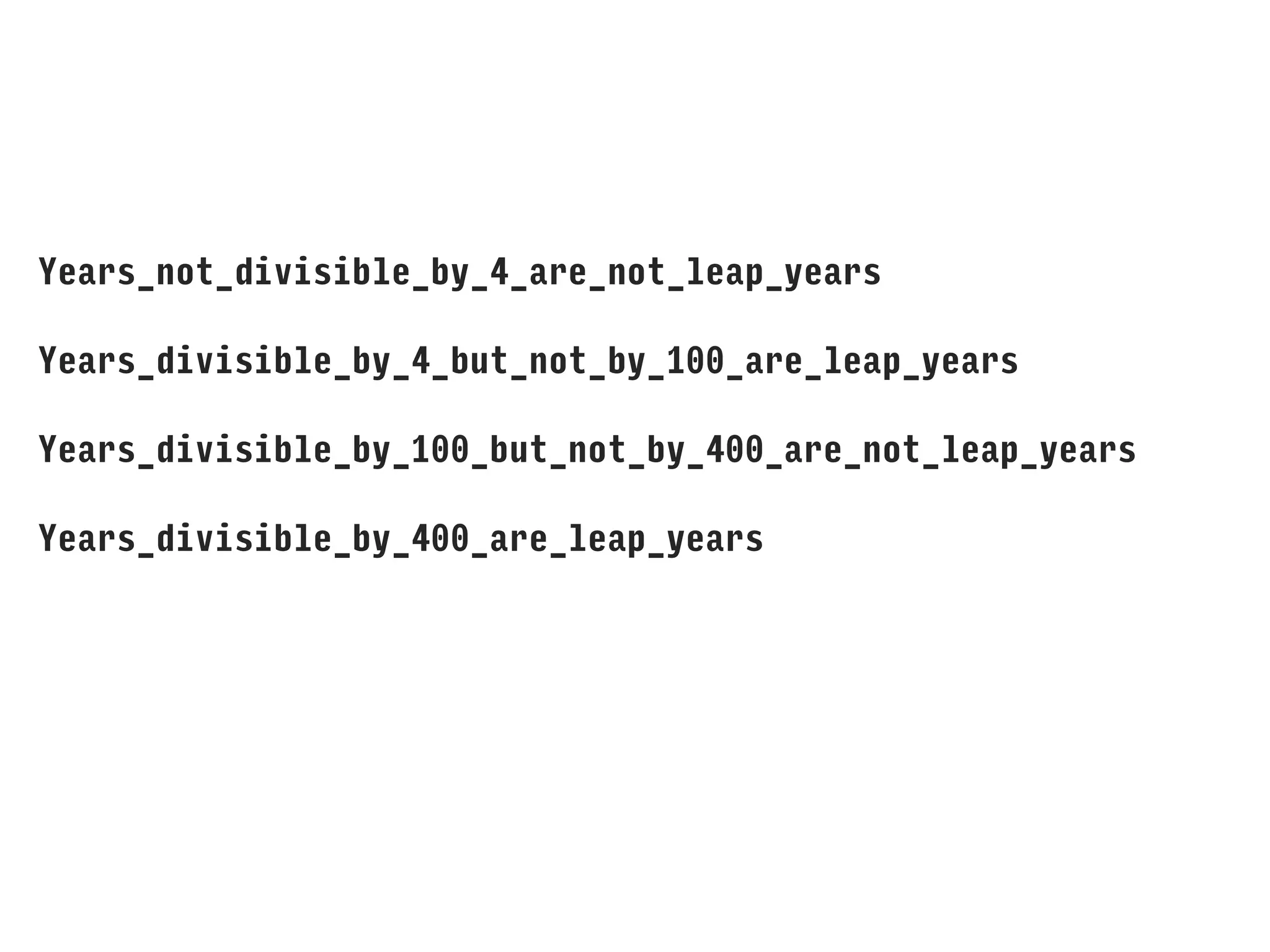
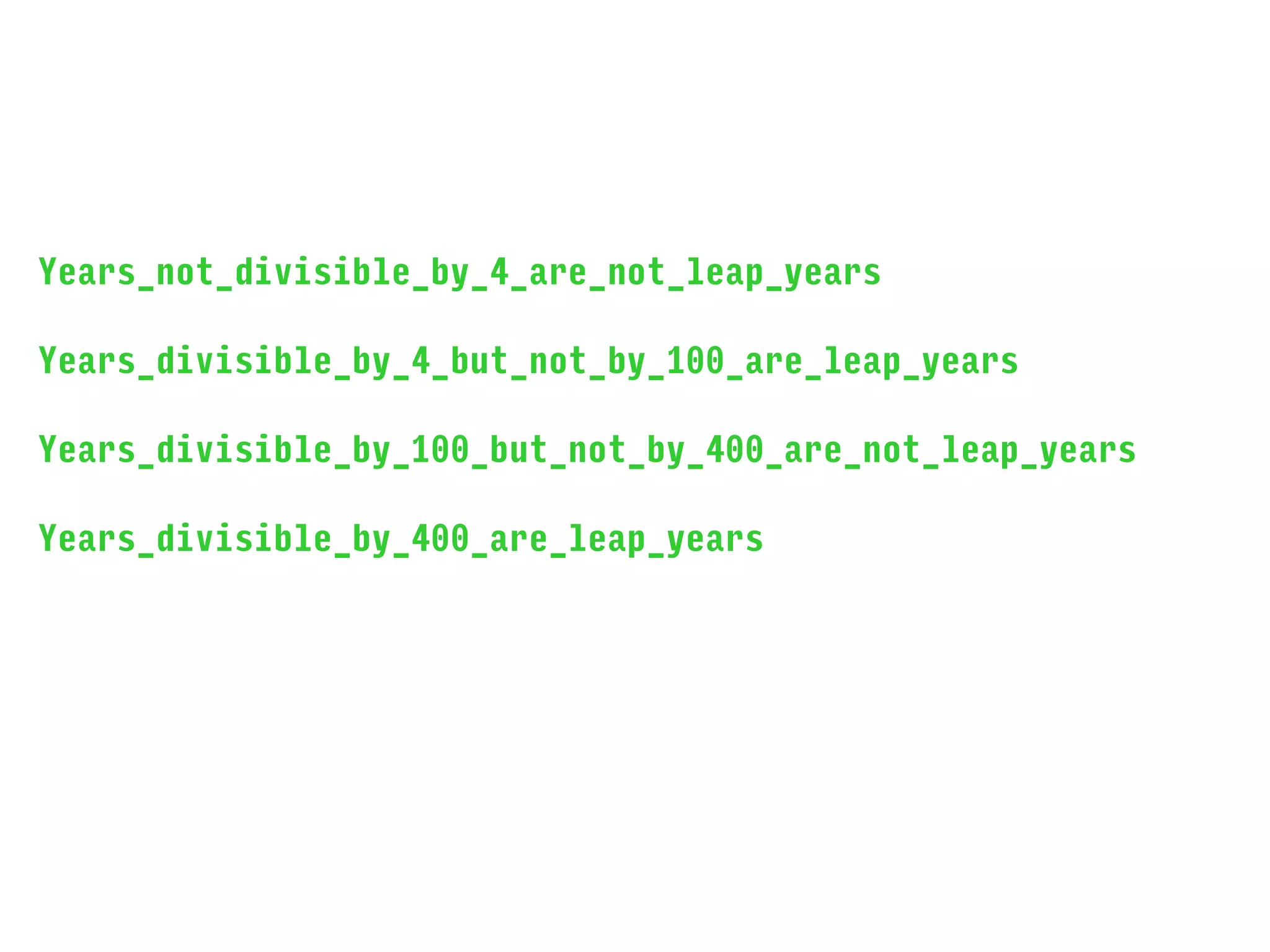
Years_not_divisible_by_4_are_not_leap_years
Years_divisible_by_4_but_not_by_100_are_leap_years
Years_divisible_by_100_but_not_by_400_are_not_leap_years
Years_divisible_by_400_are_leap_years
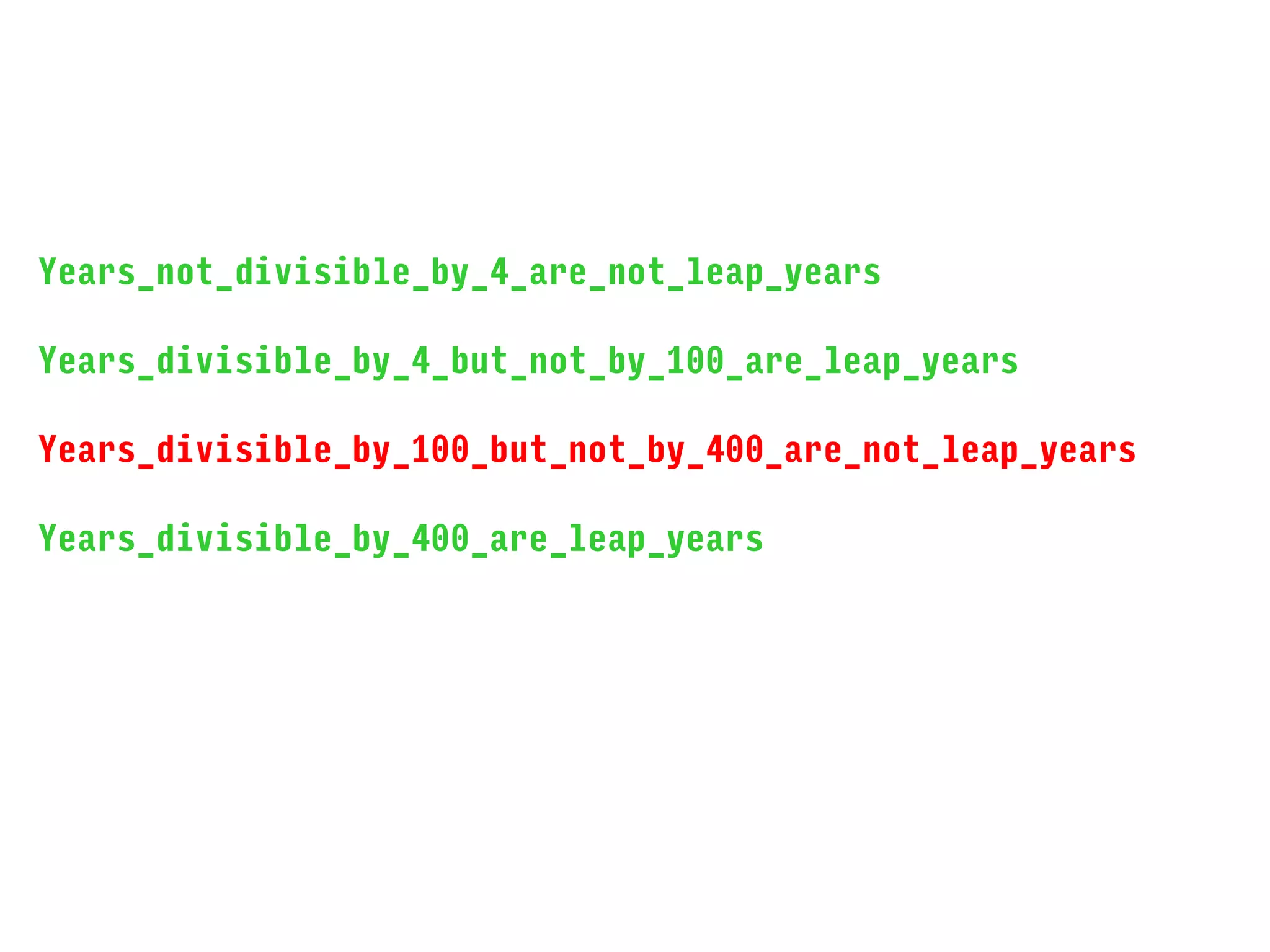
Years_not_divisible_by_4_are_not_leap_years
Years_divisible_by_4_but_not_by_100_are_leap_years
Years_divisible_by_100_but_not_by_400_are_not_leap_years
Years_divisible_by_400_are_leap_years
Years_not_divisible_by_4_are_not_leap_years
Years_divisible_by_4_but_not_by_100_are_leap_years
Years_divisible_by_100_but_not_by_400_are_not_leap_years
Years_divisible_by_400_are_leap_years
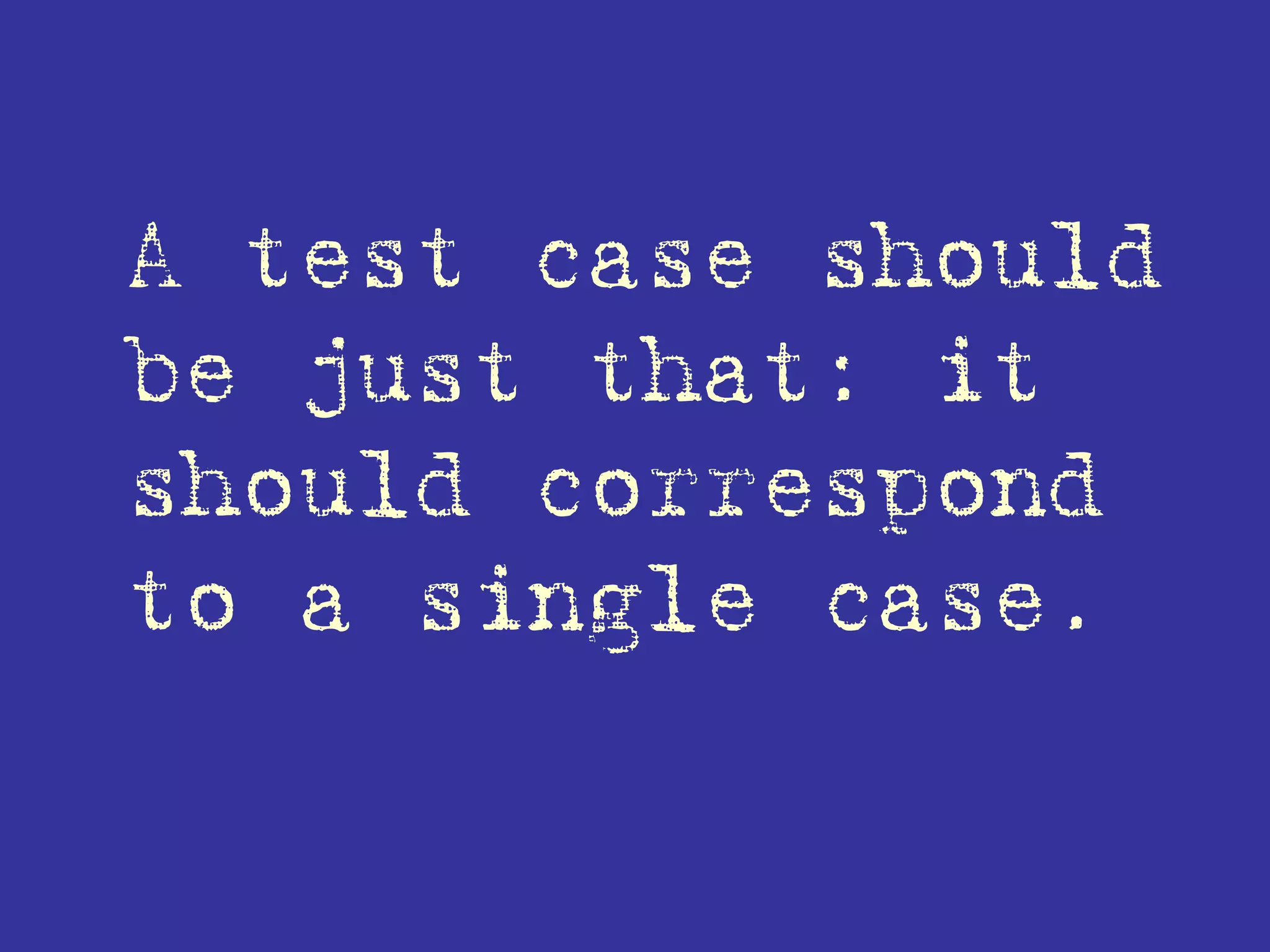
A test case should
be just that: it
should correspond
to a single case.
namespace Leap_year_spec
{
[TestFixture]
public class A_year_is_a_leap_year
{
[Test] public void If_it_is_divisible_by_4_but_not_by_100() 
[Test] public void If_it_is_divisible_by_400() 
}
[TestFixture]
public class A_year_is_not_a_leap_year
{
[Test] public void If_it_is_not_divisible_by_4() 
[Test] public void If_it_is_divisible_by_100_but_not_by_400() 
}
}
namespace Leap_year_spec
{
[TestFixture]
public class A_year_is_a_leap_year
{
[Test] public void If_it_is_divisible_by_4_but_not_by_100() 
[Test] public void If_it_is_divisible_by_400() 
}
[TestFixture]
public class A_year_is_not_a_leap_year
{
[Test] public void If_it_is_not_divisible_by_4() 
[Test] public void If_it_is_divisible_by_100_but_not_by_400() 
}
}
namespace Leap_year_spec
{
[TestFixture]
public class A_year_is_a_leap_year
{
[Test] public void If_it_is_divisible_by_4_but_not_by_100() 
[Test] public void If_it_is_divisible_by_400() 
}
[TestFixture]
public class A_year_is_not_a_leap_year
{
[Test] public void If_it_is_not_divisible_by_4() 
[Test] public void If_it_is_divisible_by_100_but_not_by_400() 
}
}
namespace Leap_year_spec
{
[TestFixture]
public class A_year_is_a_leap_year
{
[Test]
public void If_it_is_divisible_by_4_but_not_by_100(
[Values(2012, 1984, 4)] int year)
{
Assert.IsTrue(IsLeapYear(year));
}
[Test]
public void If_it_is_divisible_by_400(
[Range(400, 2400, 400)] int year)
{
Assert.IsTrue(IsLeapYear(year));
}
}
[TestFixture]
public class A_year_is_not_a_leap_year
{
[Test] public void If_it_is_not_divisible_by_4() 
[Test] public void If_it_is_divisible_by_100_but_not_by_400() 
}
}
namespace Leap_year_spec
{
[TestFixture]
public class A_year_is_a_leap_year
{
[Test]
public void If_it_is_divisible_by_4_but_not_by_100(
[Values(2012, 1984, 4)] int year)
{
Assert.IsTrue(IsLeapYear(year));
}
[Test]
public void If_it_is_divisible_by_400(
[Range(400, 2400, 400)] int year)
{
Assert.IsTrue(IsLeapYear(year));
}
}
[TestFixture]
public class A_year_is_not_a_leap_year
{
[Test] public void If_it_is_not_divisible_by_4() 
[Test] public void If_it_is_divisible_by_100_but_not_by_400() 
}
}
namespace Leap_year_spec
{
[TestFixture]
public class A_year_is_either_a_leap_year_or_not
{
[Test]
public void IsLeapYear_is_correct([Range(1, 10000)] int year) 
}
}
namespace Leap_year_spec
{
[TestFixture]
public class A_year_is_either_a_leap_year_or_not
{
[Test]
public void IsLeapYear_is_correct([Range(1, 10000)] int year)
{
Assert.AreEqual(
year % 4 == 0 && year % 100 != 0 || year % 400 == 0,
IsLeapYear(year));
}
}
}
namespace Leap_year_spec
{
[TestFixture]
public class A_year_is_either_a_leap_year_or_not
{
[Test]
public void IsLeapYear_is_correct([Range(1, 10000)] int year)
{
Assert.AreEqual(LeapYearExpectation(year), IsLeapYear(year));
}
public static bool LeapYearExpectation(int year)
{
return year % 4 == 0 && year % 100 != 0 || year % 400 == 0;
}
}
}
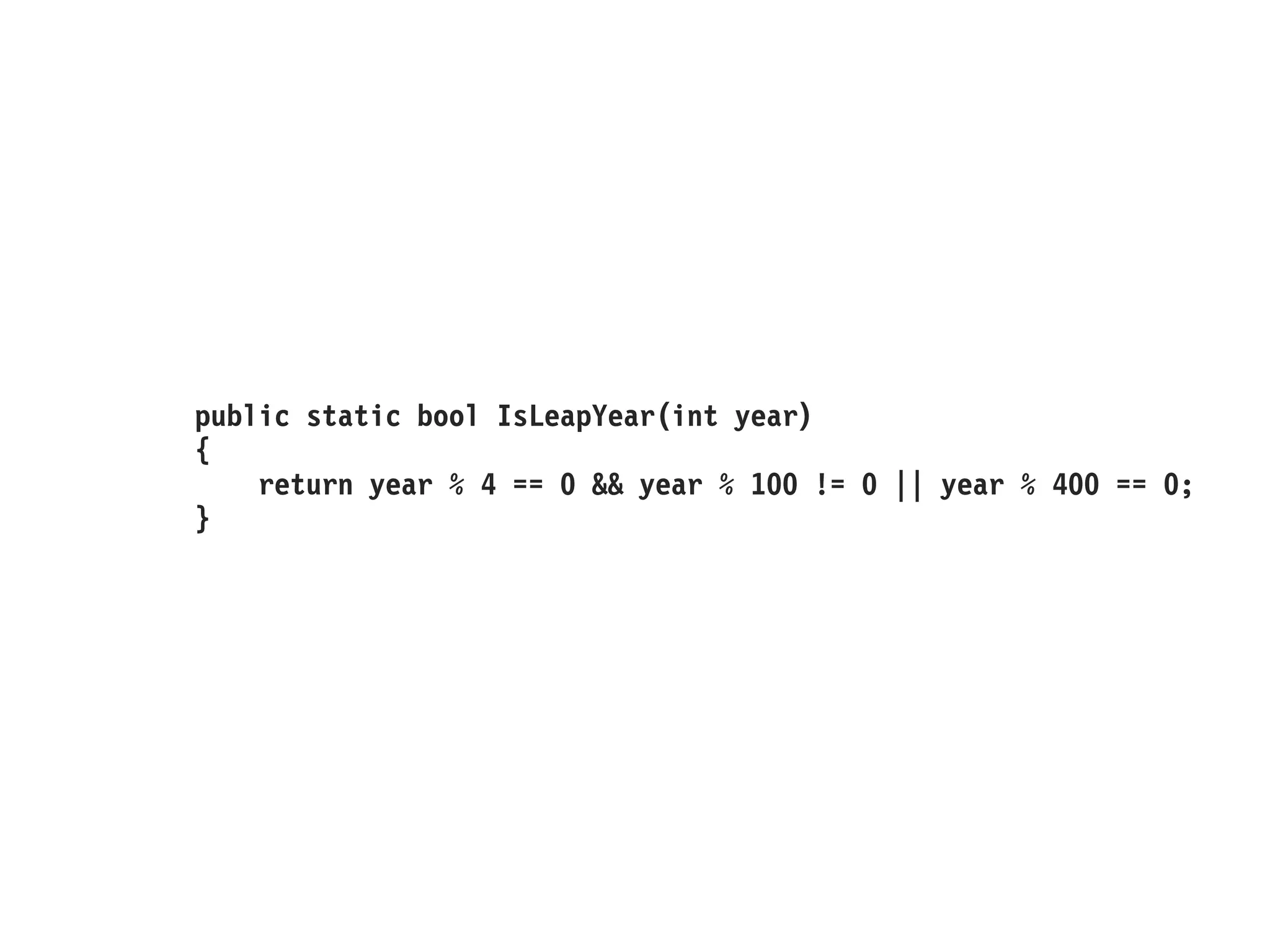
public static bool IsLeapYear(int year)
{
return year % 4 == 0 && year % 100 != 0 || year % 400 == 0;
}
All happy families are alike;
each unhappy family is
unhappy in its own way.
Leo Tolstoy
Anna Karenina
proposition isbn_spec[] =
{
...
"Test validation", []
{
CATCH(isbn("97805968094857"), isbn::malformed);
CATCH(isbn("978059680948"), isbn::malformed);
CATCH(isbn("978Q5968=9485"), isbn::malformed);
CATCH(isbn("9780596809486"), isbn::malformed);
},
...
};
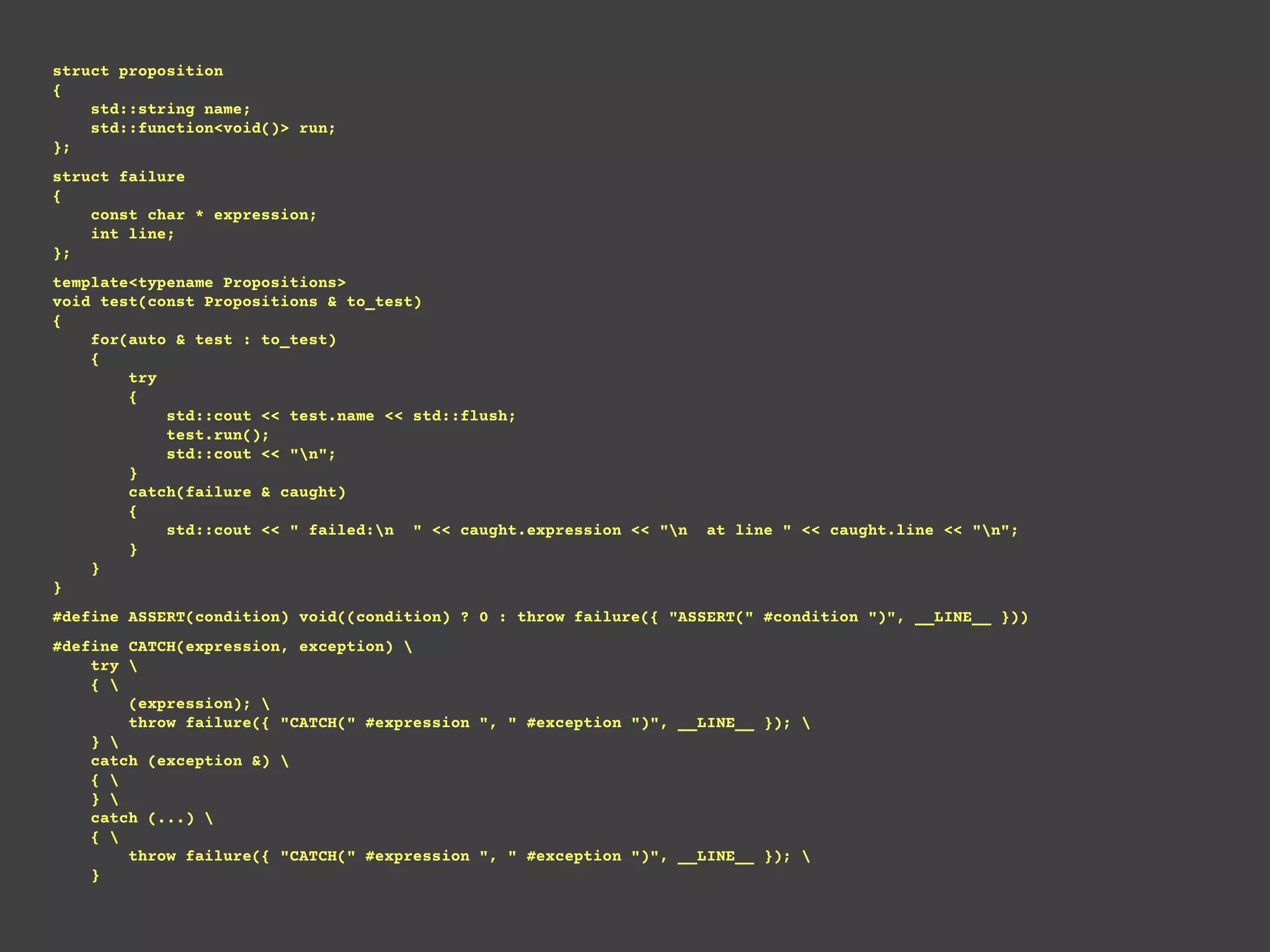
struct proposition
{
std::string name;
std::function<void()> run;
};
struct failure
{
const char * expression;
int line;
};
template<typename Propositions>
void test(const Propositions & to_test)
{
for(auto & test : to_test)
{
try
{
std::cout << test.name << std::flush;
test.run();
std::cout << "n";
}
catch(failure & caught)
{
std::cout << " failed:n " << caught.expression << "n at line " << caught.line << "n";
}
}
}
#define ASSERT(condition) void((condition) ? 0 : throw failure({ "ASSERT(" #condition ")", __LINE__ }))
#define CATCH(expression, exception) 
try 
{ 
(expression); 
throw failure({ "CATCH(" #expression ", " #exception ")", __LINE__ }); 
} 
catch (exception &) 
{ 
} 
catch (...) 
{ 
throw failure({ "CATCH(" #expression ", " #exception ")", __LINE__ }); 
}
proposition isbn_spec[] =
{
...
"Test validation", []
{
CATCH(isbn("97805968094857"), isbn::malformed);
CATCH(isbn("978059680948"), isbn::malformed);
CATCH(isbn("978Q5968=9485"), isbn::malformed);
CATCH(isbn("9780596809486"), isbn::malformed);
},
...
};
proposition isbn_spec[] =
{
...
"Test validation", []
{
CATCH(isbn("97805968094857"), isbn::malformed);
CATCH(isbn("978059680948"), isbn::malformed);
CATCH(isbn("978Q5968=9485"), isbn::malformed);
CATCH(isbn("9780596809486"), isbn::malformed);
},
...
};
proposition isbn_spec[] =
{
...
"Test validation works", []
{
CATCH(isbn("97805968094857"), isbn::malformed);
CATCH(isbn("978059680948"), isbn::malformed);
CATCH(isbn("978Q5968=9485"), isbn::malformed);
CATCH(isbn("9780596809486"), isbn::malformed);
},
...
};
proposition isbn_spec[] =
{
...
"Test validation works", []
{
CATCH(isbn("97805968094857"), isbn::malformed);
CATCH(isbn("978059680948"), isbn::malformed);
CATCH(isbn("978Q5968=9485"), isbn::malformed);
CATCH(isbn("9780596809486"), isbn::malformed);
},
...
};
proposition isbn_spec[] =
{
...
"ISBNs with more than 13 digits are malformed", []
{
CATCH(isbn("97805968094857"), isbn::malformed);
},
"ISBNs with fewer than 13 digits are malformed", []
{
CATCH(isbn("978059680948"), isbn::malformed);
},
"ISBNs with non-digits are malformed", []
{
CATCH(isbn("978Q5968=9485"), isbn::malformed);
},
"ISBNs with an incorrect check digit are malformed", []
{
CATCH(isbn("9780596809486"), isbn::malformed);
},
...
};
proposition isbn_spec[] =
{
...
"ISBNs with more than 13 digits are malformed", []
{
CATCH(isbn("97805968094857"), isbn::malformed);
},
"ISBNs with fewer than 13 digits are malformed", []
{
CATCH(isbn("978059680948"), isbn::malformed);
},
"ISBNs with non-digits are malformed", []
{
CATCH(isbn("978Q5968=9485"), isbn::malformed);
},
"ISBNs with an incorrect check digit are malformed", []
{
CATCH(isbn("9780596809486"), isbn::malformed);
},
...
};
Validation is not
a behaviour; the
consequence of
validation is.
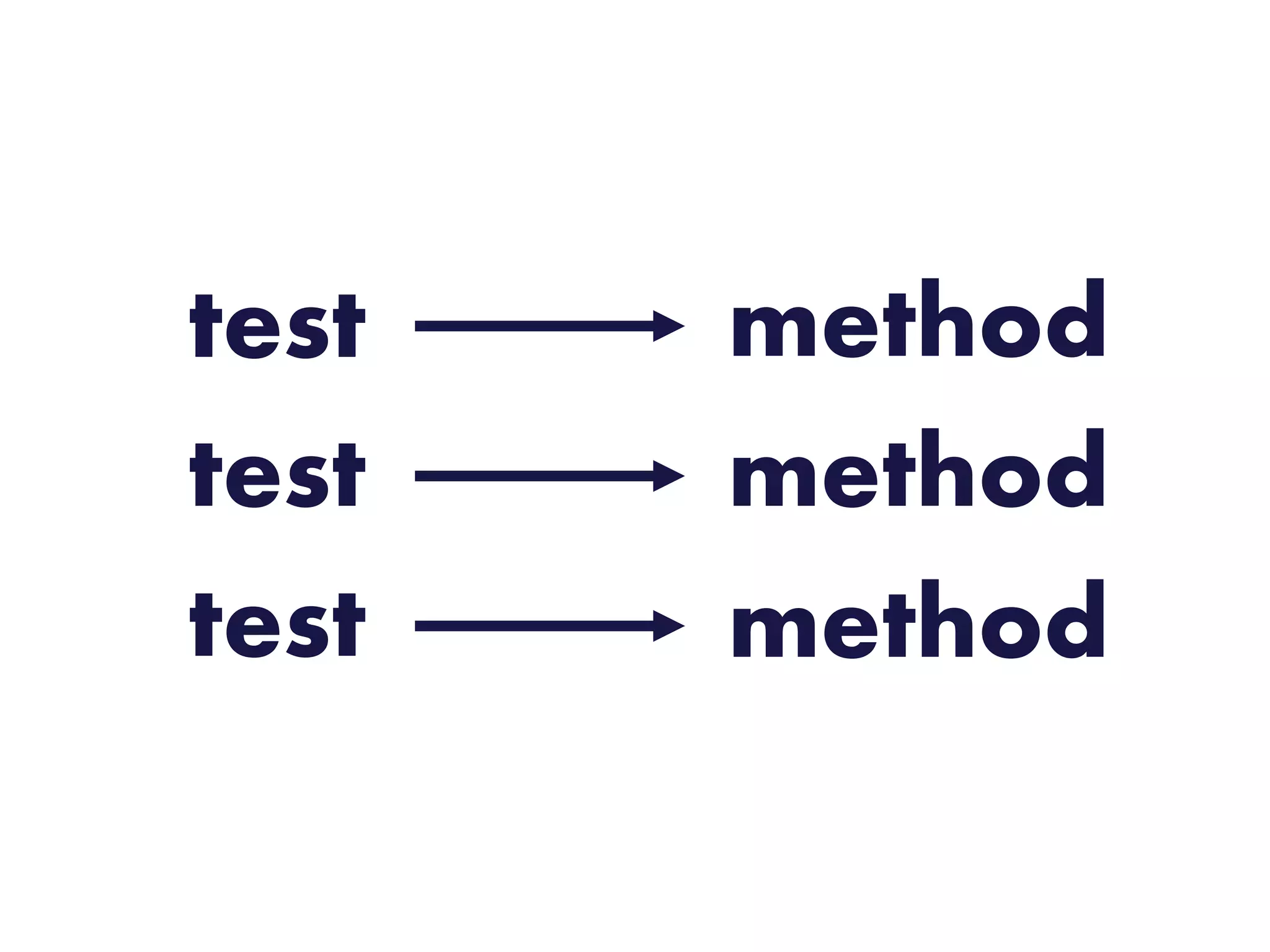
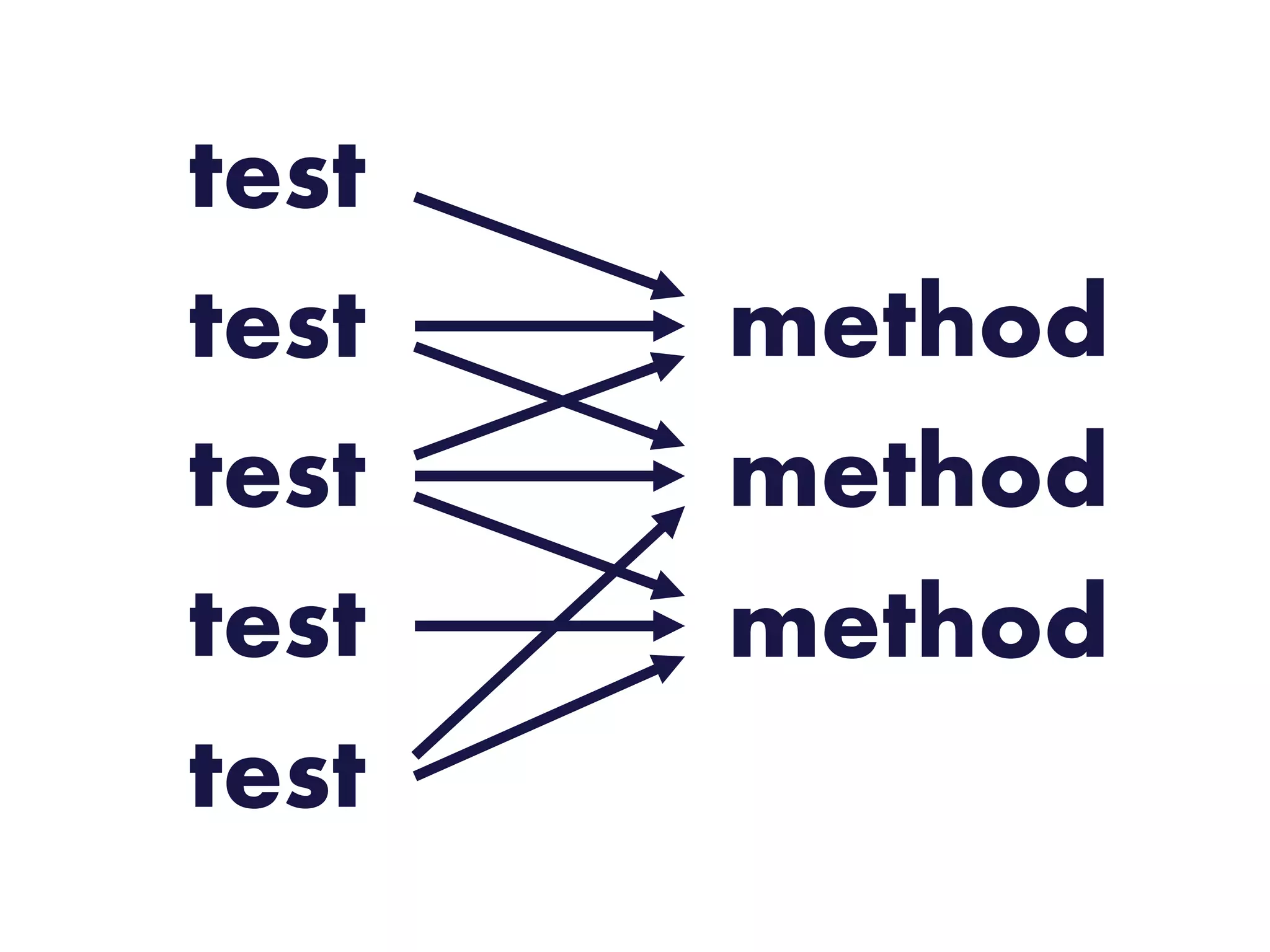
methodtest
test
test
method
method
public class RecentlyUsedList
{
...
public RecentlyUsedList() ...
public int Count
{
get...
}
public string this[int index]
{
get...
}
public void Add(string newItem) ...
...
}
[TestFixture]
public class RecentlyUsedListTests
{
[Test]
public void TestConstructor() ...
[Test]
public void TestCountGet() ...
[Test]
public void TestIndexerGet() ...
[Test]
public void TestAdd() ...
...
}
methodtest
test
test
method
method
test
test
namespace RecentlyUsedList_spec
{
[TestFixture]
public class A_new_list
{
[Test] public void Is_empty() 
}
[TestFixture]
public class An_empty_list
{
[Test] public void Retains_a_single_addition() 
[Test] public void Retains_unique_additions_in_stack_order() 
}
[TestFixture]
public class A_non_empty_list
{
[Test] public void Is_unchanged_when_head_item_is_readded() 
[Test] public void Moves_non_head_item_to_head_when_it_is_readded() 
}
[TestFixture]
public class Any_list_rejects
{
[Test] public void Addition_of_null_items() 
[Test] public void Indexing_past_its_end() 
[Test] public void Negative_indexing() 
}
}
namespace RecentlyUsedList_spec
{
[TestFixture]
public class A_new_list
{
[Test] public void Is_empty() 
}
[TestFixture]
public class An_empty_list
{
[Test] public void Retains_a_single_addition() 
[Test] public void Retains_unique_additions_in_stack_order() 
}
[TestFixture]
public class A_non_empty_list
{
[Test] public void Is_unchanged_when_head_item_is_readded() 
[Test] public void Moves_non_head_item_to_head_when_it_is_readded() 
}
[TestFixture]
public class Any_list_rejects
{
[Test] public void Addition_of_null_items() 
[Test] public void Indexing_past_its_end() 
[Test] public void Negative_indexing() 
}
}
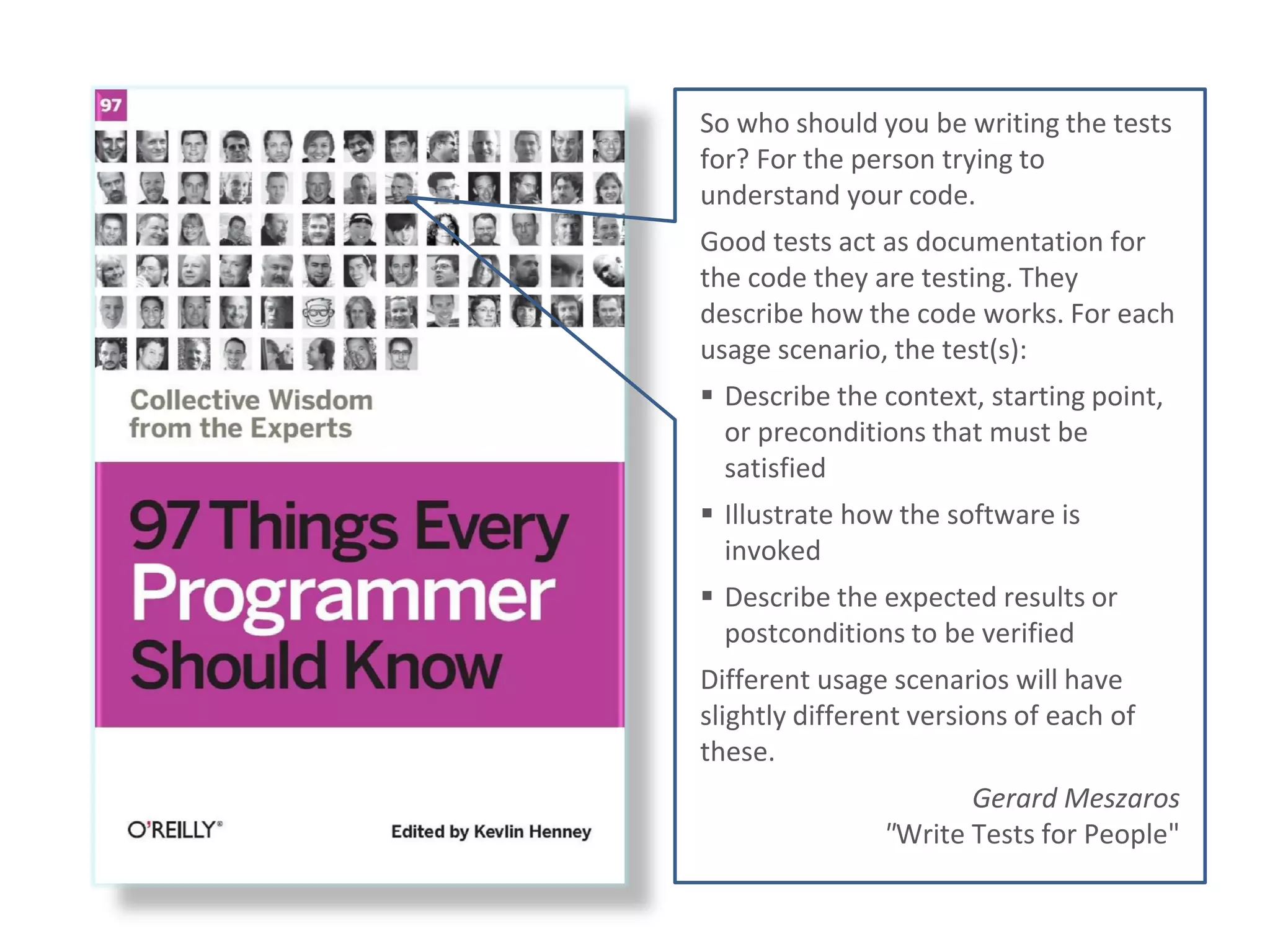
So who should you be writing the tests
for? For the person trying to
understand your code.
Good tests act as documentation for
the code they are testing. They
describe how the code works. For each
usage scenario, the test(s):
 Describe the context, starting point,
or preconditions that must be
satisfied
 Illustrate how the software is
invoked
 Describe the expected results or
postconditions to be verified
Different usage scenarios will have
slightly different versions of each of
these.
Gerard Meszaros
"Write Tests for People"
namespace RecentlyUsedList_spec
{
[TestFixture]
public class A_new_list ...
[TestFixture]
public class An_empty_list
{
[Test]
public void Retains_a_single_addition(
[Values("Oxford", "Bristol", "London")] string addend)
{
var items = new RecentlyUsedList(); // Given...
items.Add(addend); // When...
Assert.AreEqual(1, items.Count); // Then...
Assert.AreEqual(addend, list[0]);
}
[Test] public void Retains_unique_additions_in_stack_order() 
}
[TestFixture]
public class A_non_empty_list ...
[TestFixture]
public class Any_list_rejects ...
}
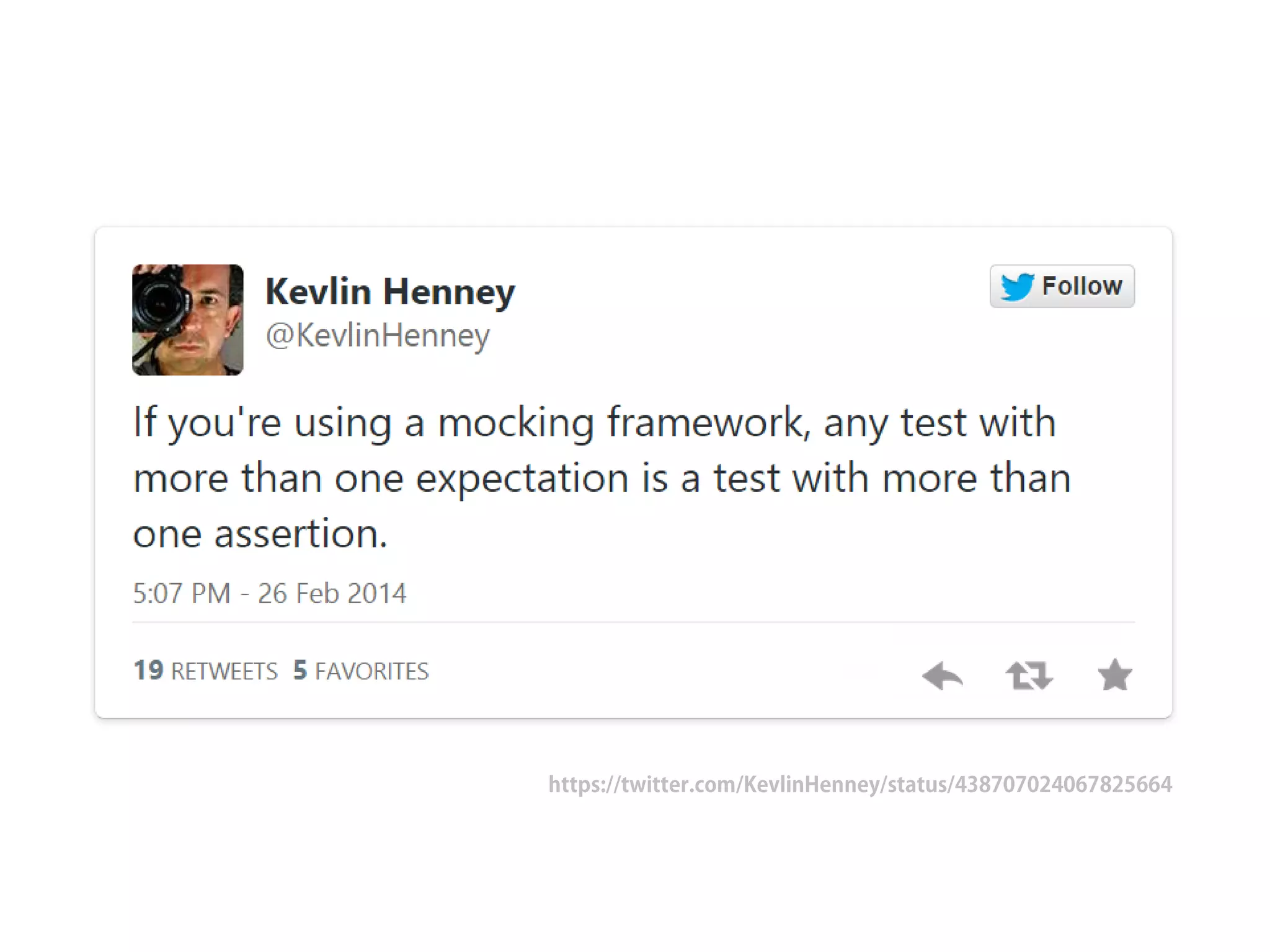
One of the things that Osherove warns
against is multiple asserts in unit tests.
Owen Pellegrin
http://www.owenpellegrin.com/blog/testing/how-do-you-solve-multiple-asserts/
Proper unit tests should fail for exactly
one reason, that’s why you should be
using one assert per unit test.
http://rauchy.net/oapt/
string[] itinerary = ...;
string[] expected =
{
"London", "Bristol", "Oslo"
};
Assert.AreEqual(expected, itinerary);
Assert.IsNotNull(itinerary);
Assert.AreEqual(3, itinerary.Length);
Assert.AreEqual("London", itinerary[0]);
Assert.AreEqual("Bristol", itinerary[1]);
Assert.AreEqual("Oslo", itinerary[2]);
Assert.DoesNotThrow(() =>
{
string[] itinerary = ...;
string[] expected = ...;
});
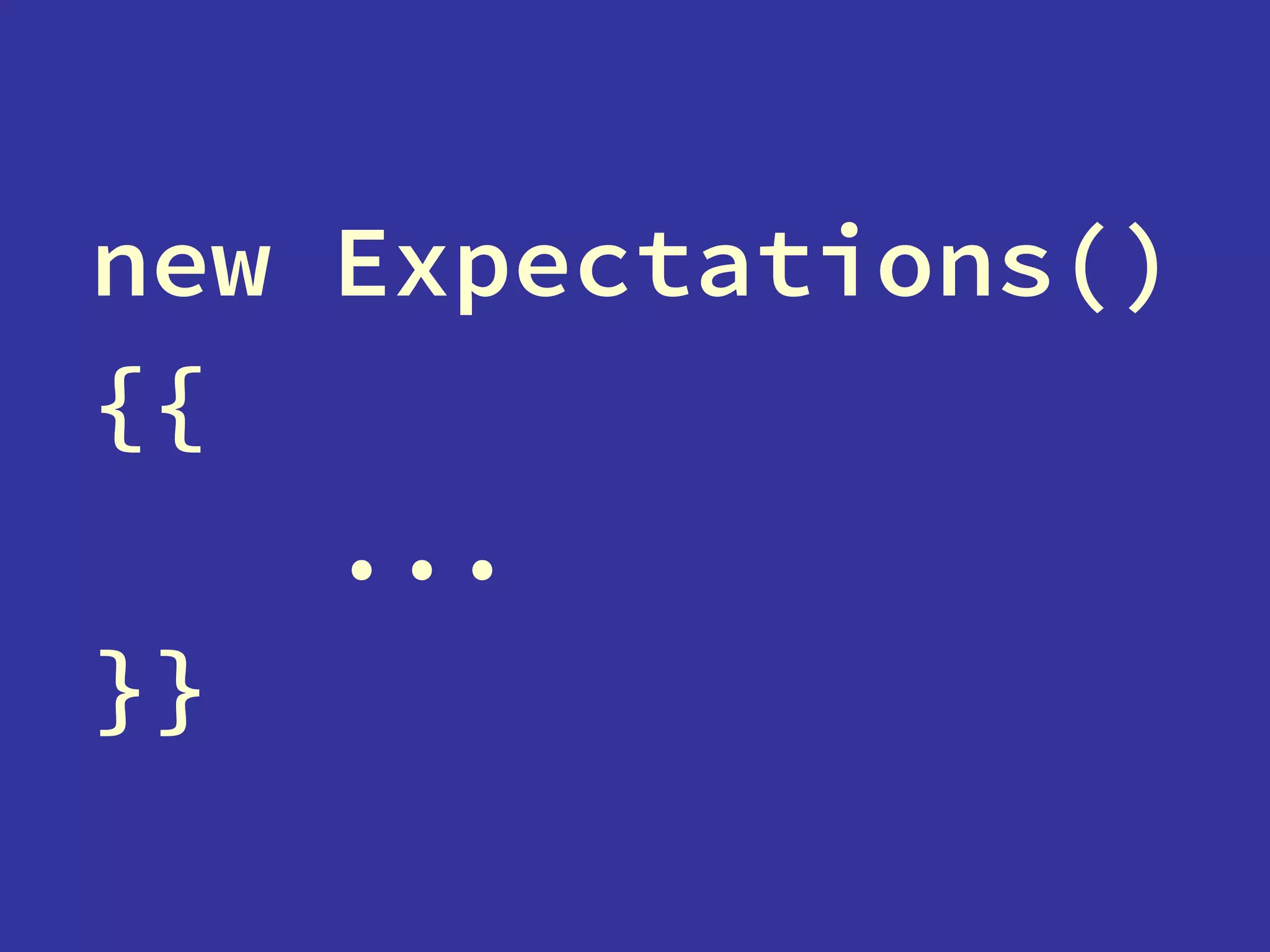
new Expectations()
{{
...
}}
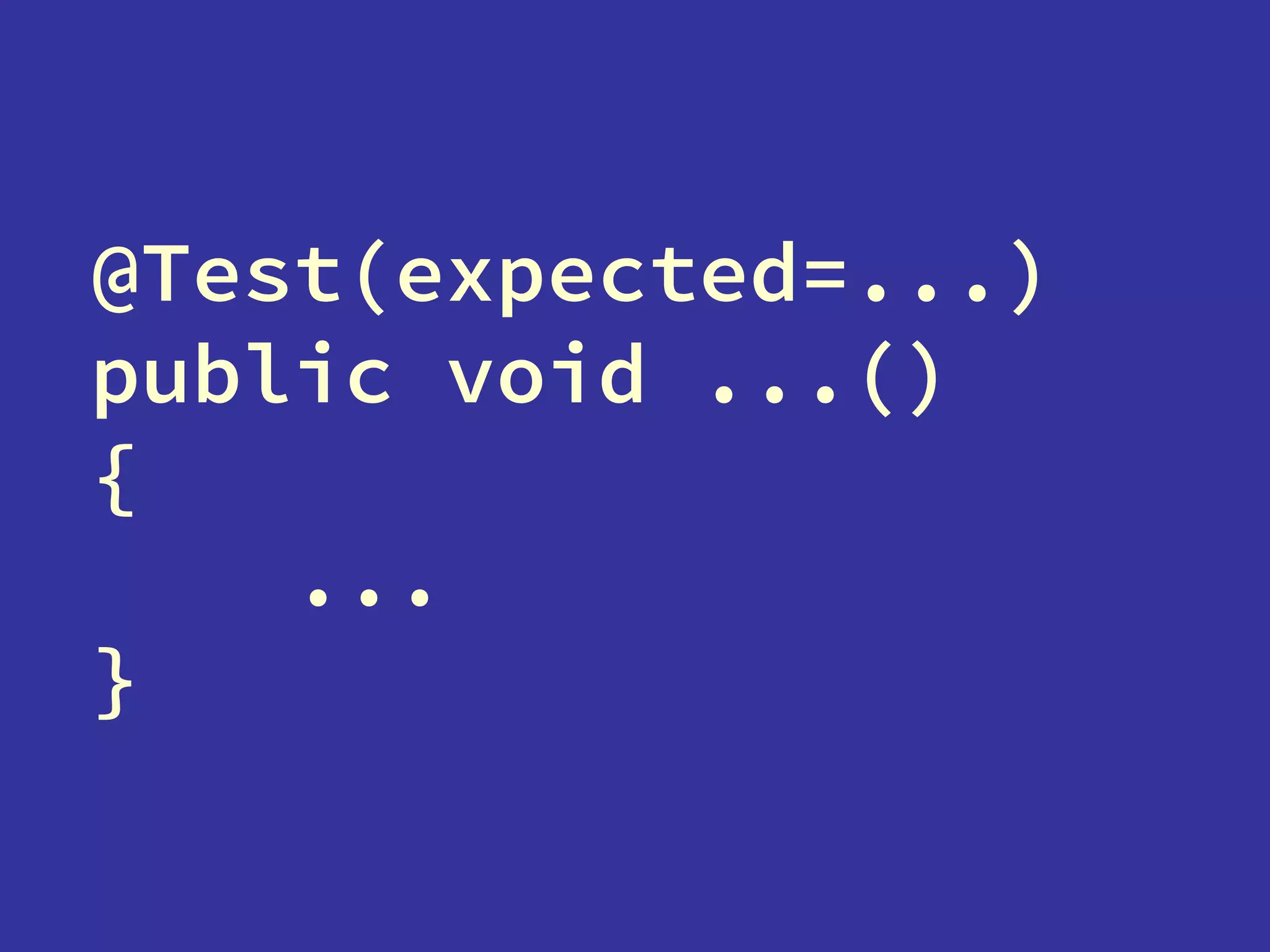
@Test(expected=...)
public void ...()
{
...
}
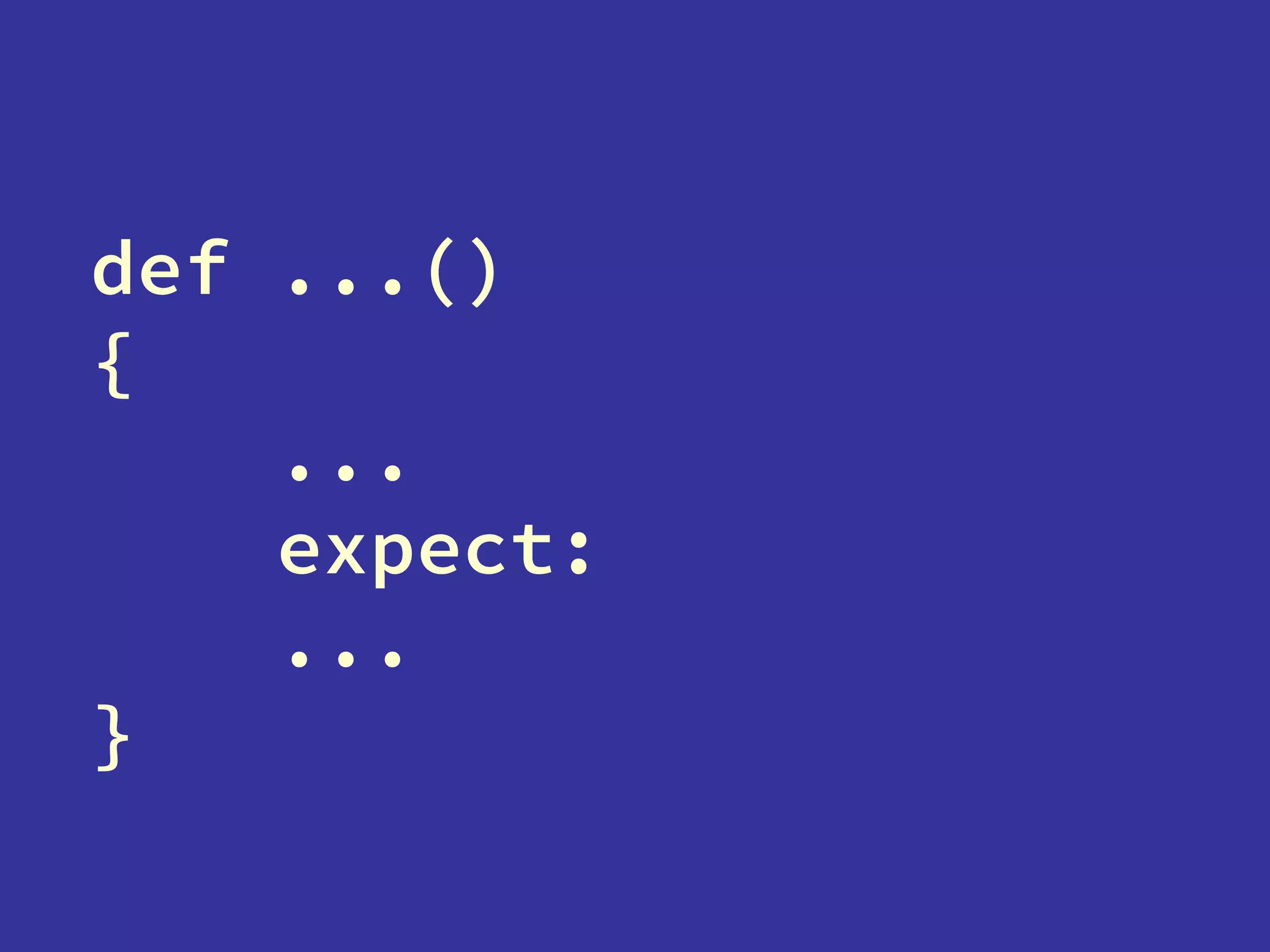
def ...()
{
...
expect:
...
}
My guideline is usually that you test
one logical concept per test. You can
have multiple asserts on the same
object. They will usually be the same
concept being tested.
Roy Osherove
http://www.owenpellegrin.com/blog/testing/how-do-you-solve-multiple-asserts/
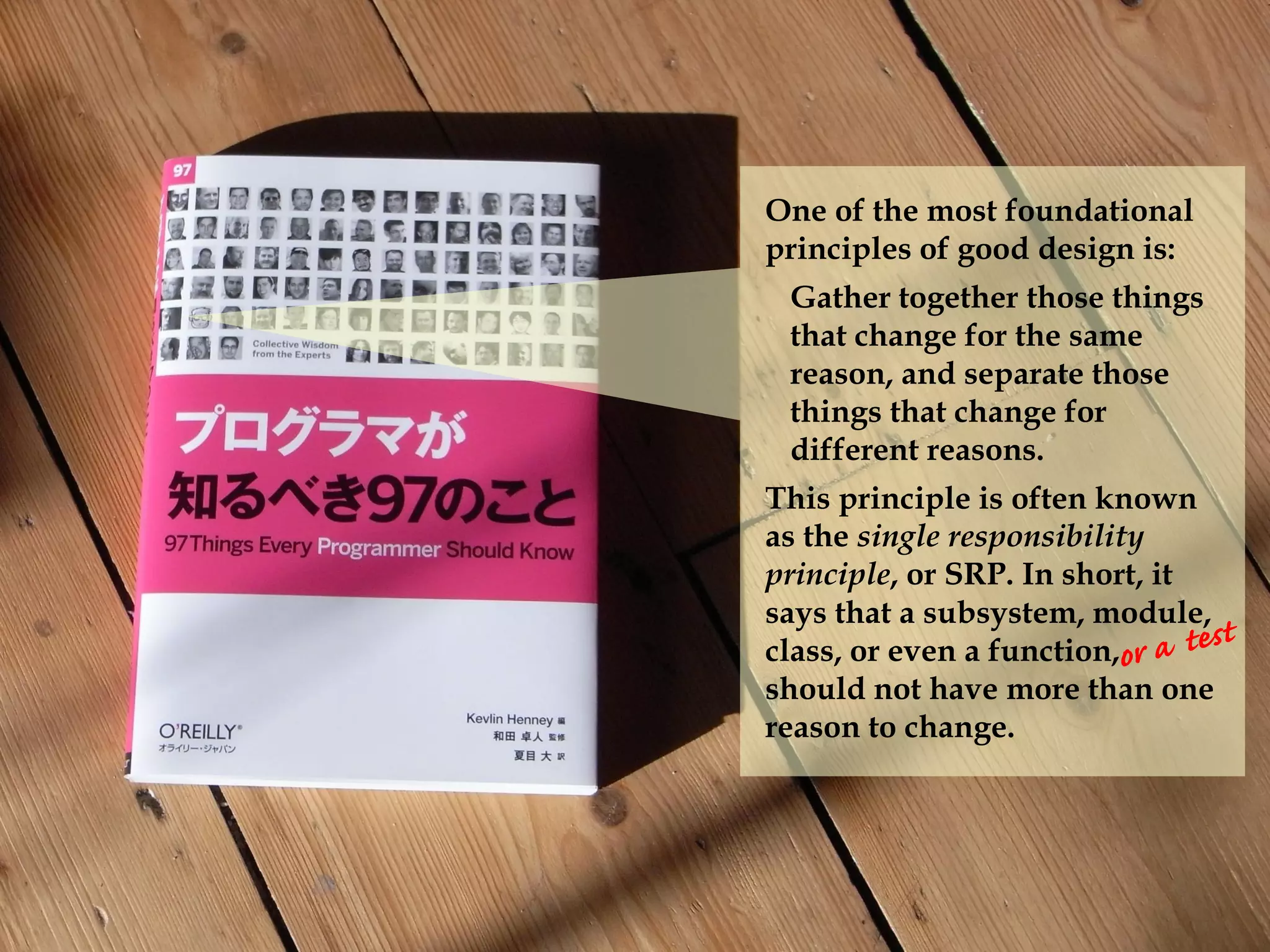
One of the most foundational
principles of good design is:
Gather together those things
that change for the same
reason, and separate those
things that change for
different reasons.
This principle is often known
as the single responsibility
principle, or SRP. In short, it
says that a subsystem, module,
class, or even a function,
should not have more than one
reason to change.
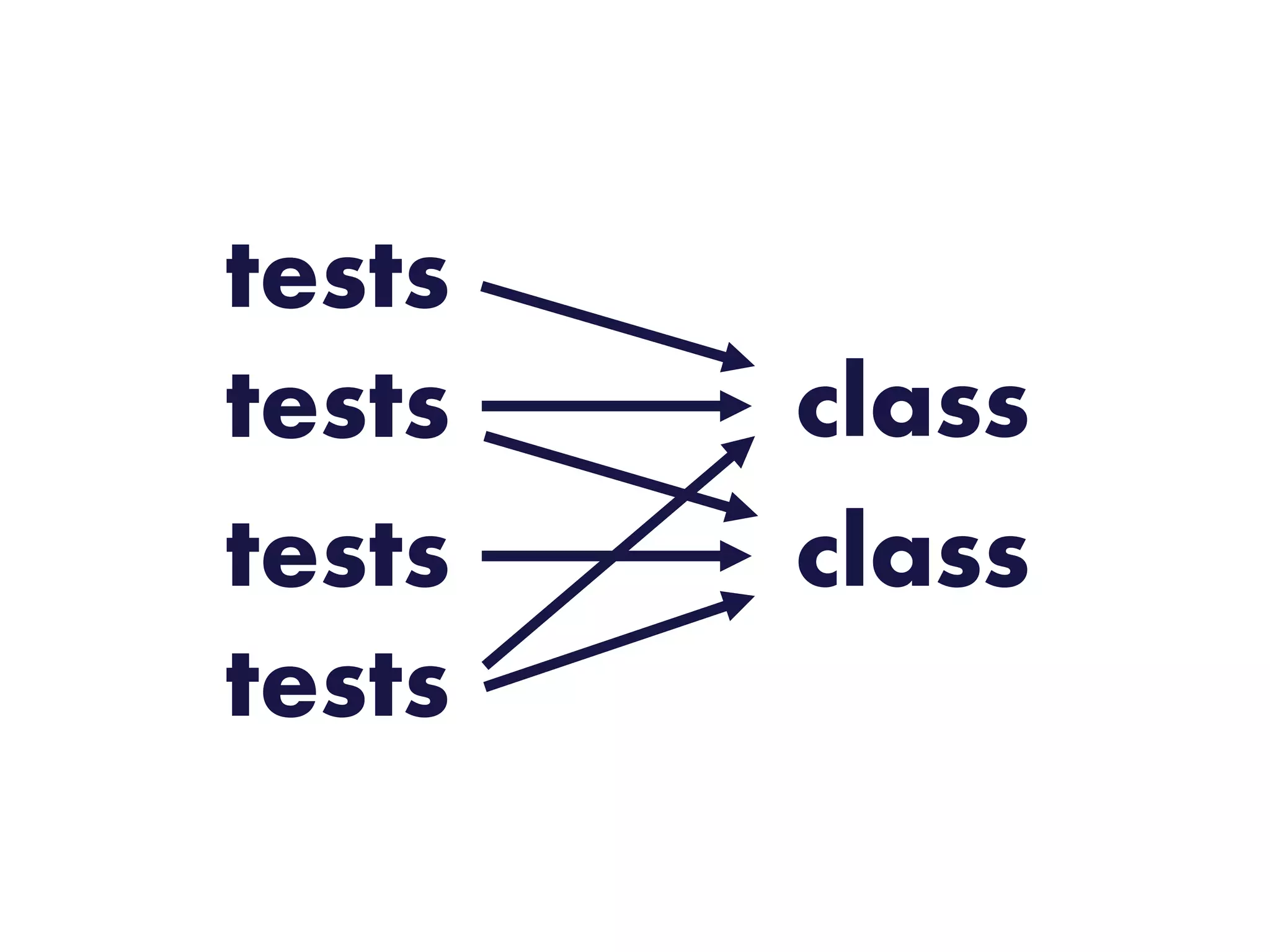
classtests
tests class
tests
tests
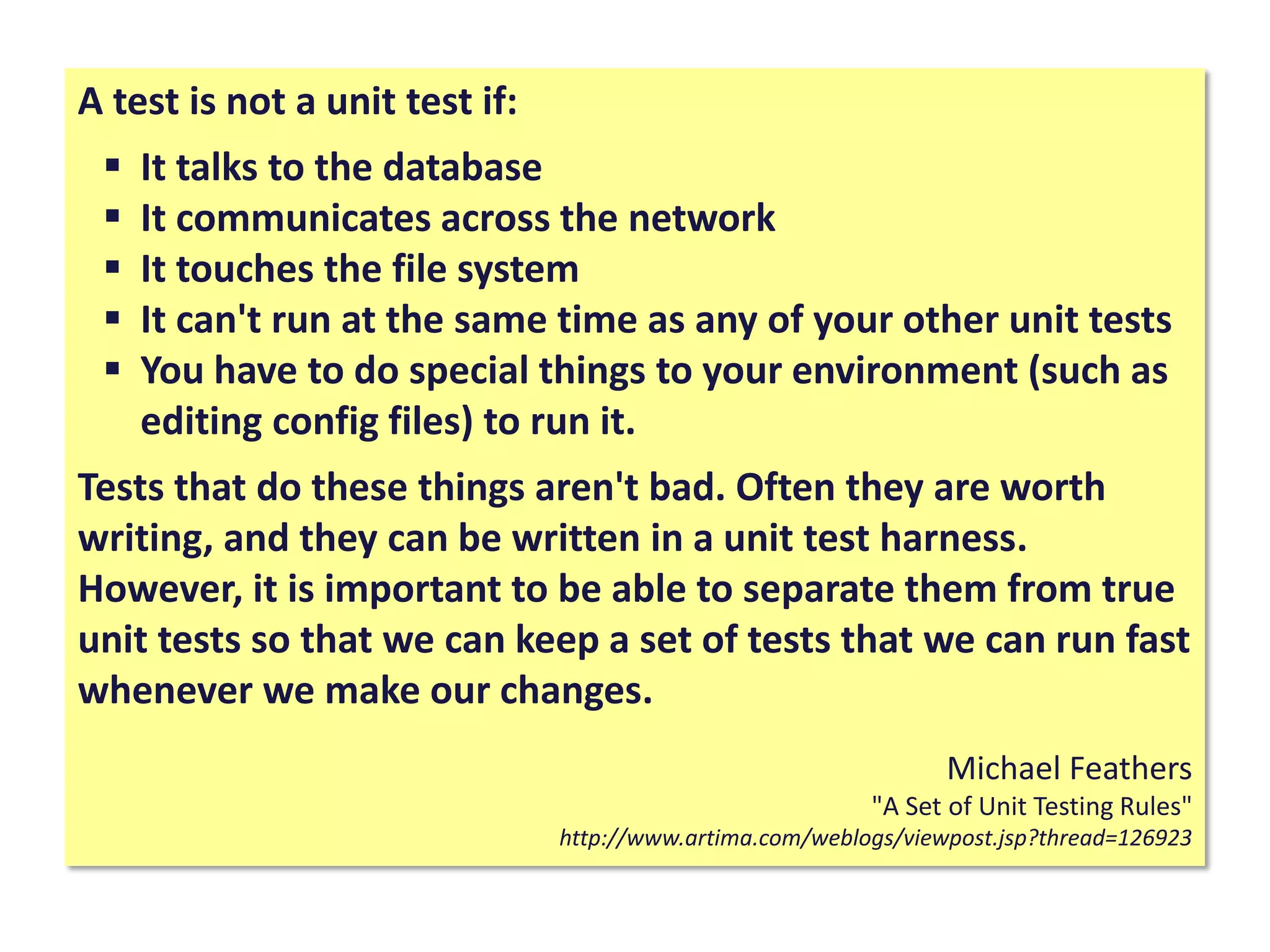
A test is not a unit test if:
 It talks to the database
 It communicates across the network
 It touches the file system
 It can't run at the same time as any of your other unit tests
 You have to do special things to your environment (such as
editing config files) to run it.
Tests that do these things aren't bad. Often they are worth
writing, and they can be written in a unit test harness.
However, it is important to be able to separate them from true
unit tests so that we can keep a set of tests that we can run fast
whenever we make our changes.
Michael Feathers
"A Set of Unit Testing Rules"
http://www.artima.com/weblogs/viewpost.jsp?thread=126923
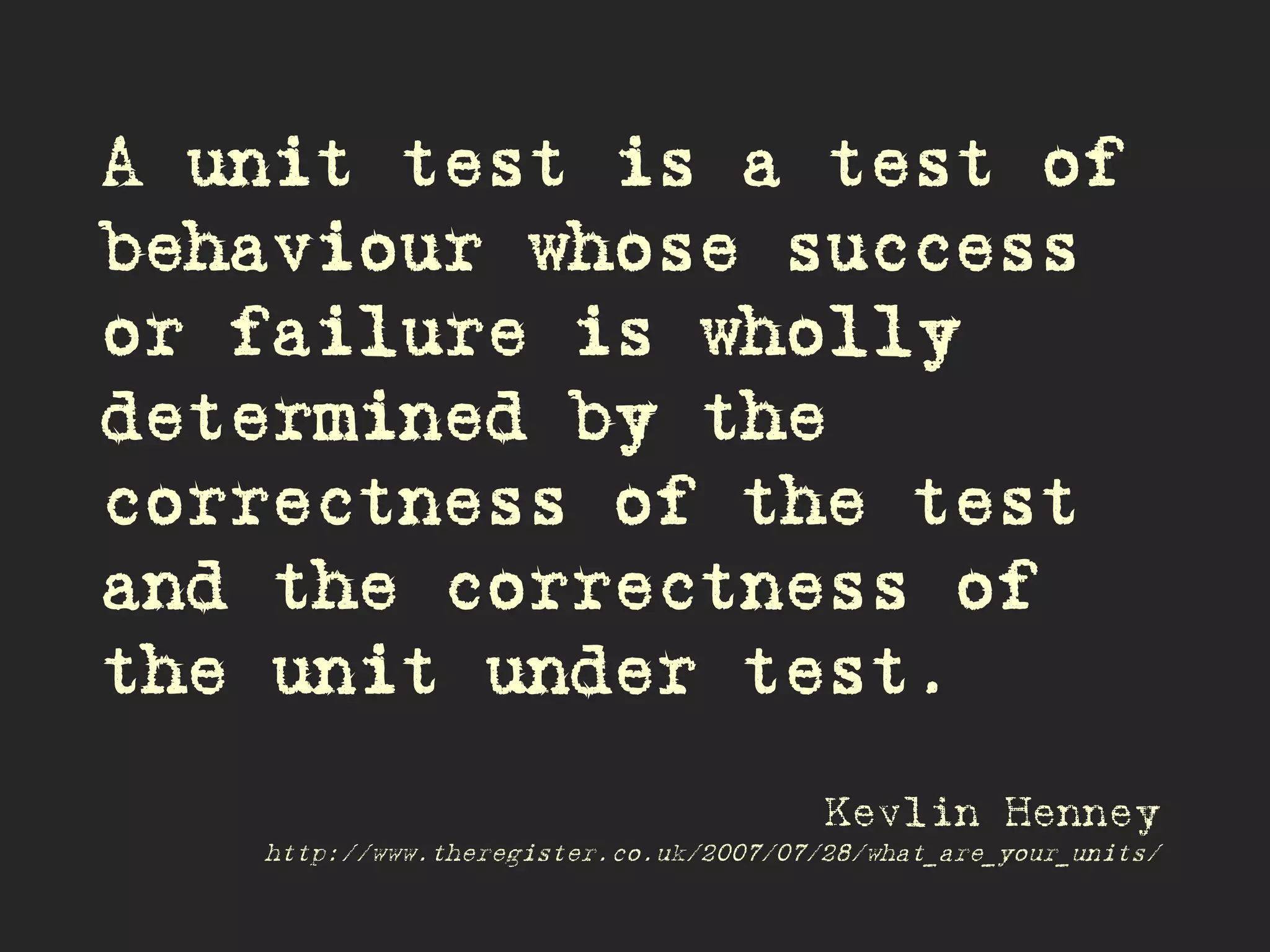
A unit test is a test of
behaviour whose success
or failure is wholly
determined by the
correctness of the test
and the correctness of
the unit under test.
Kevlin Henney
http://www.theregister.co.uk/2007/07/28/what_are_your_units/
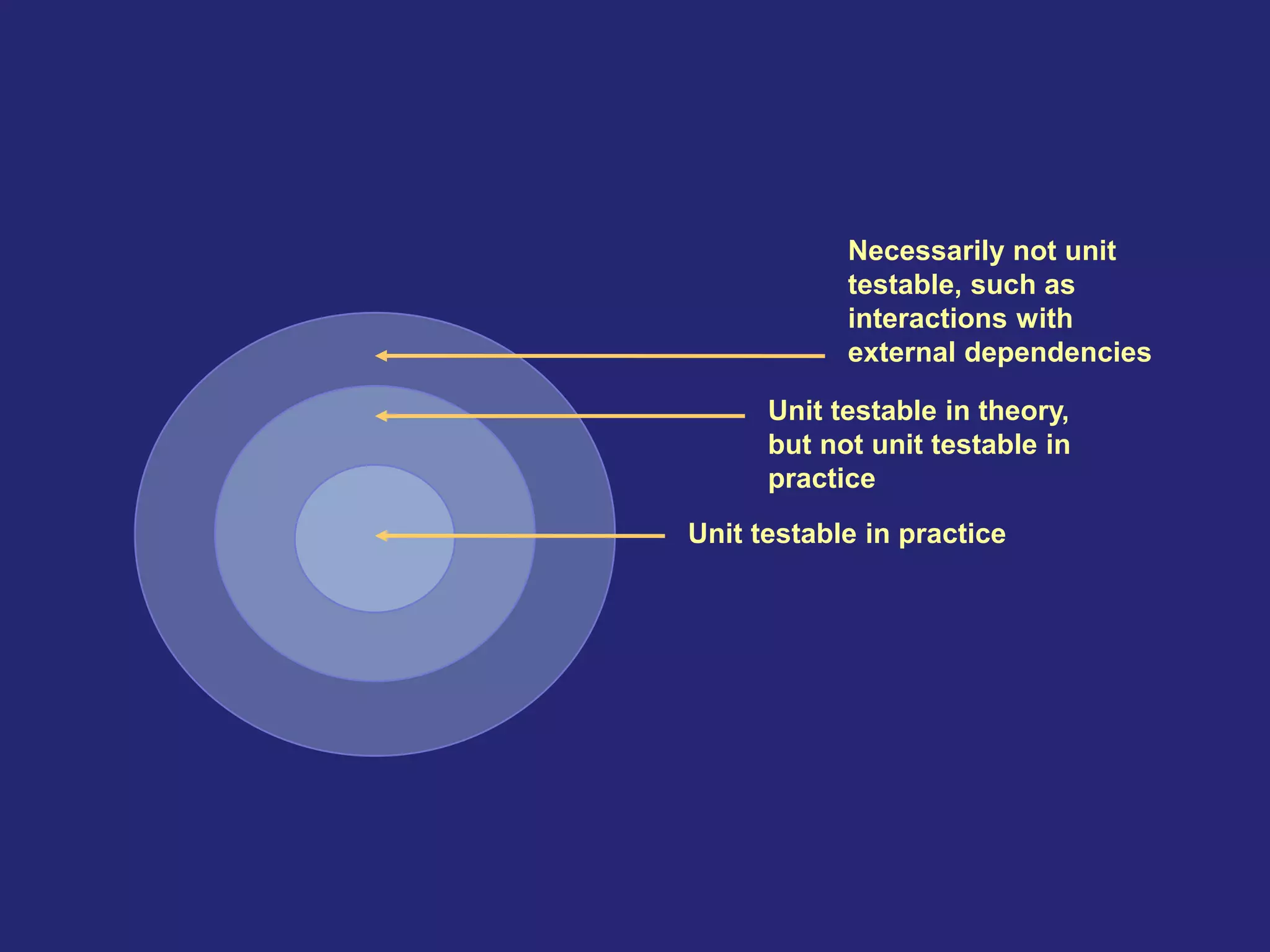
Necessarily not unit
testable, such as
interactions with
external dependencies
Unit testable in practice
Unit testable in theory,
but not unit testable in
practice
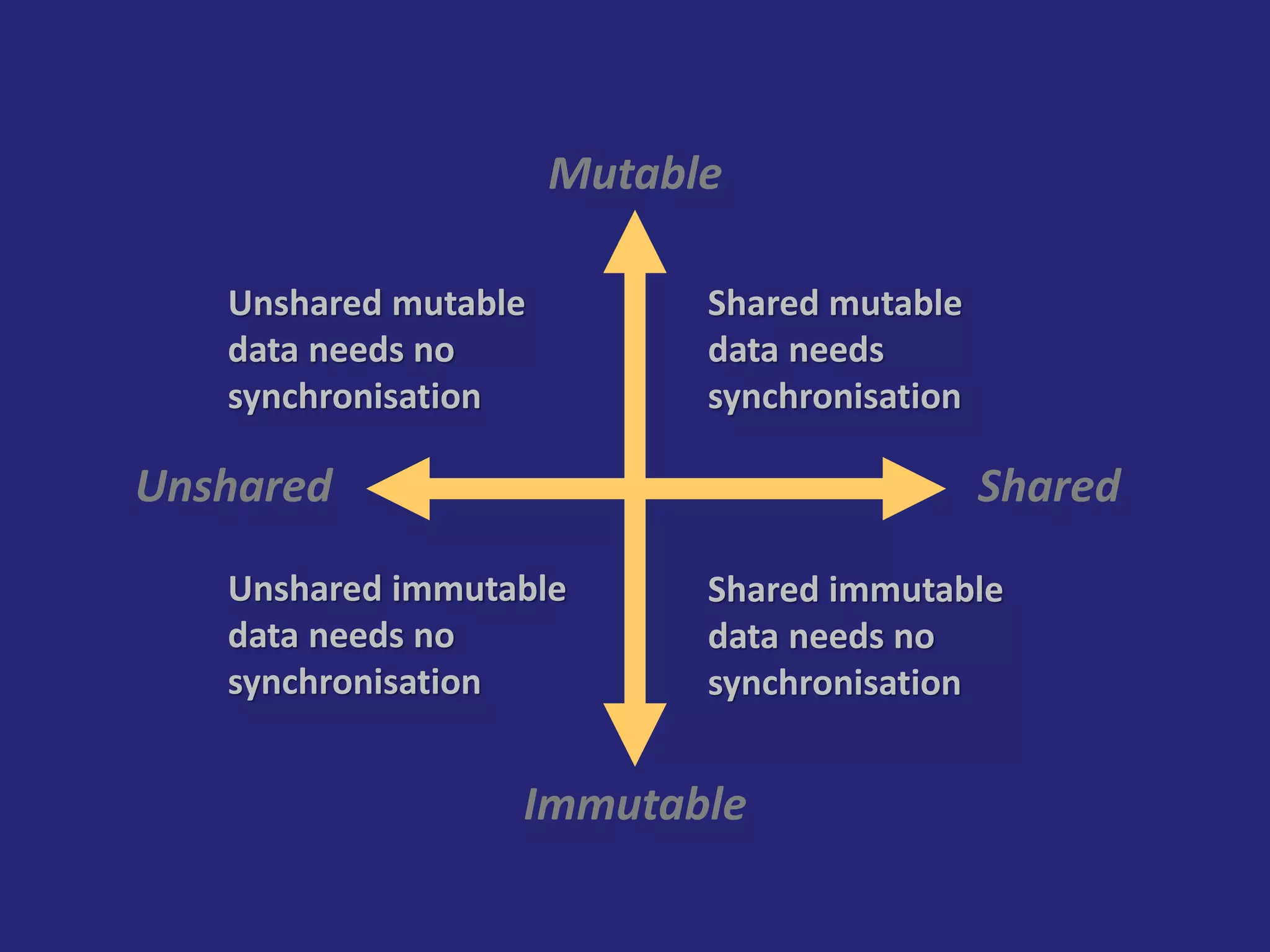
Mutable
Immutable
Unshared Shared
Unshared mutable
data needs no
synchronisation
Unshared immutable
data needs no
synchronisation
Shared mutable
data needs
synchronisation
Shared immutable
data needs no
synchronisation
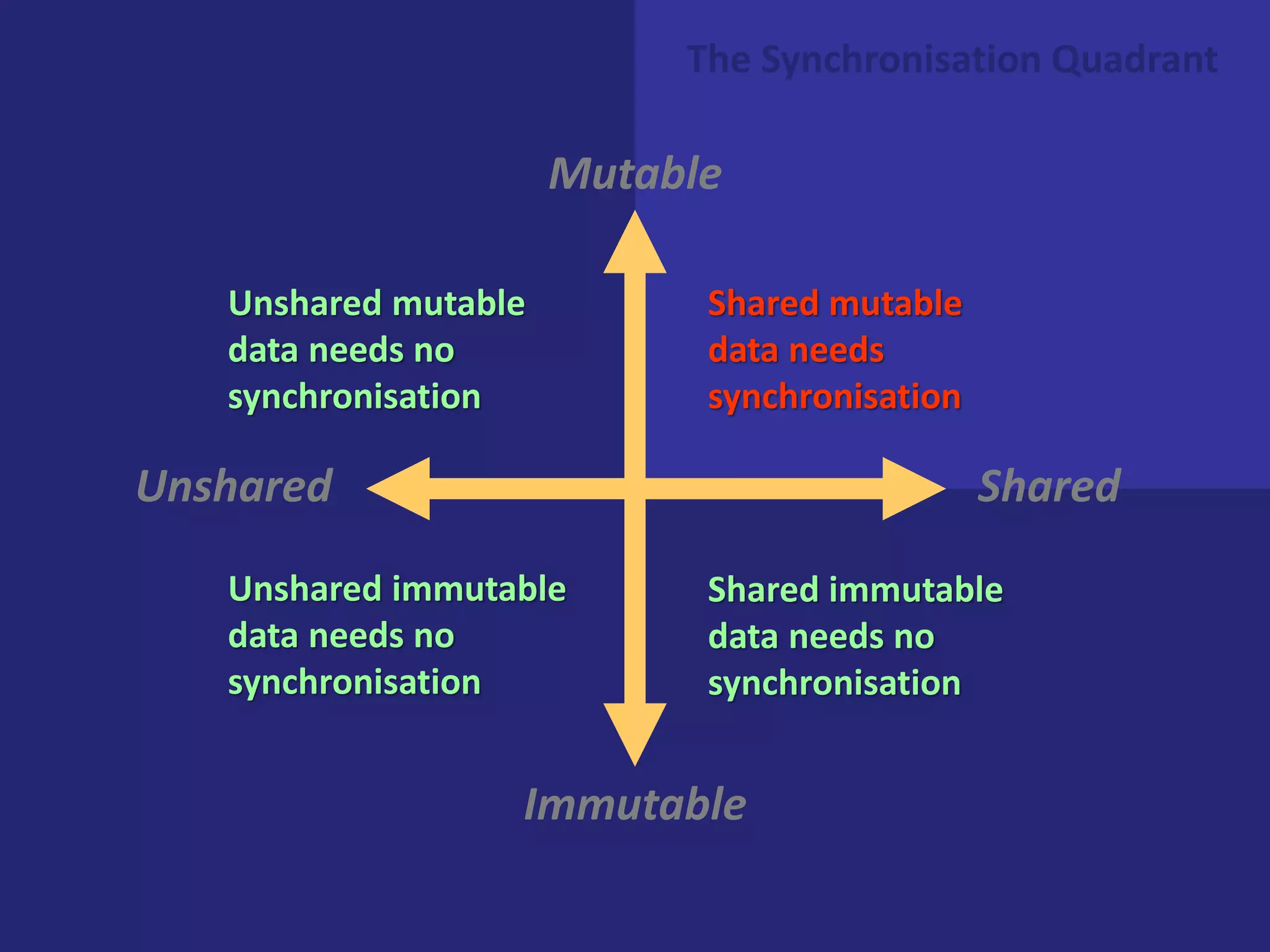
Mutable
Immutable
Unshared Shared
Unshared mutable
data needs no
synchronisation
Unshared immutable
data needs no
synchronisation
Shared mutable
data needs
synchronisation
Shared immutable
data needs no
synchronisation
The Synchronisation Quadrant
The real value of tests is
not that they detect bugs
in the code but that they
detect inadequacies in the
methods, concentration, and
skills of those who design
and produce the code.
C A R Hoare

What We Talk About When We Talk About Unit Testing

  • 1.
    What We TalkAbout When We Talk About Unit Testing @KevlinHenney kevlin@curbralan.com
  • 2.
    Write down theproblem. Think real hard. Write down the solution. The Feynman Problem-Solving Algorithm
  • 6.
    The update toSMARS was intended to replace old, unused code referred to as “Power Peg” — functionality that Knight hadn’t used in 8-years. Doug Seven http://dougseven.com/2014/04/17/knightmare-a-devops-cautionary-tale/
  • 7.
    Why code thathad been dead for 8 years was still present in the code base is a mystery, but that’s not the point. Doug Seven http://dougseven.com/2014/04/17/knightmare-a-devops-cautionary-tale/
  • 8.
    In the first45 minutes the market was open the Power Peg code received and processed 212 parent orders. As a result SMARS sent millions of child orders into the market resulting in 4 million transactions against 154 stocks for more than 397 million shares. Doug Seven http://dougseven.com/2014/04/17/knightmare-a-devops-cautionary-tale/
  • 9.
    Knight Capital Grouprealized a $460 million loss in 45 minutes. Doug Seven http://dougseven.com/2014/04/17/knightmare-a-devops-cautionary-tale/
  • 10.
    RUD, noun  RapidUnscheduled Disassembly  Rocket science and amateur rocketry jargon that's acronymous, euphemistic and explosively self-explanatory WordFriday
  • 12.
    The failure resultedin a loss of more than US$370 million. http://en.wikipedia.org/wiki/Cluster_(spacecraft)
  • 14.
    Um. What's thename of the word for things not being the same always. You know, I'm sure there is one. Isn't there? There's must be a word for it... the thing that lets you know time is happening. Is there a word? Change. Oh. I was afraid of that. Neil Gaiman The Sandman
  • 15.
    What experience and historyteach is that nations and governments have never learned anything from history. Georg Wilhelm Friedrich Hegel
  • 16.
    Write down theproblem. Think real hard. Write down the solution. Check it.
  • 17.
  • 18.
    void * bsearch( constvoid * key, const void * base, size_t element_count, size_t element_size, int compare(const void * lhs, const void * rhs));
  • 19.
    void * bsearch( constvoid * key, const void * base, size_t element_count, size_t element_size, int compare(const void * lhs, const void * rhs)) { ... void * result; ... assert(???); // What is the postcondition? return result; }
  • 20.
    void * bsearch( constvoid * key, const void * base, size_t element_count, size_t element_size, int compare(const void * lhs, const void * rhs)) { assert(???); // What is the precondition? void * result; ... assert(???); // What is the postcondition? return result; }
  • 22.
    Test early. Test often. Testautomatically. Andrew Hunt and David Thomas The Pragmatic Programmer
  • 23.
    From time totime I hear people asking what value of test coverage (also called code coverage) they should aim for, or stating their coverage levels with pride. Such statements miss the point. Martin Fowler http://martinfowler.com/bliki/TestCoverage.html
  • 24.
    I expect ahigh level of coverage. Sometimes managers require one. There's a subtle difference. Brian Marick http://martinfowler.com/bliki/TestCoverage.html
  • 25.
    Goodhart's law, noun Once a metric becomes a target, it loses its meaning as a measure.  Named after Charles Goodhart, professor of economics at the LSE and former advisor to the Bank of England, who in 1975 observed that "Any observed statistical regularity will tend to collapse once pressure is placed upon it for control purposes." https://www.facebook.com/WordFriday/posts/320731068014857
  • 27.
    Developer Controls Process Responsibilitiesof Developers include understanding requirements, reviewing the solution structure and algorithm with peers, building the implementation, and unit testing. A Generative Development-Process Pattern Language James O Coplien
  • 28.
    When you writeunit tests, TDD- style or after your development, you scrutinize, you think, and often you prevent problems without even encountering a test failure. Michael Feathers "The Flawed Theory Behind Unit Testing" http://michaelfeathers.typepad.com/michael_feathers_blog/2008/06/the-flawed-theo.html
  • 29.
    Very many peoplesay "TDD" when they really mean, "I have good unit tests" ("I have GUTs"?). Ron Jeffries tried for years to explain what this was, but we never got a catch-phrase for it, and now TDD is being watered down to mean GUTs. Alistair Cockburn "The modern programming professional has GUTs" http://alistair.cockburn.us/The+modern+programming+professional+has+GUTs
  • 30.
    size_t ints_to_csv( const int* to_write, size_t how_many, char * output, size_t length);
  • 31.
    size_t ints_to_csv( const int* to_write, size_t how_many, char * output, size_t length) { size_t result = 0; if(length != 0) { if(how_many == 0) { output[0] = '0'; } else { for(size_t which = 0; which != how_many && result != length; ++which) { result += snprintf( output + result, length - result, which == 0 ? "%i" : ",%i", to_write[which]); } result = result > length - 1 ? length - 1 : result; } } return result; }
  • 32.
    extern "C" size_tints_to_csv( const int * to_write, size_t how_many, char * output, size_t length) { size_t result = 0; if(length != 0) { output[length - 1] = '0'; std::ostrstream buffer(output, length - 1); for(size_t which = 0; which != how_many; ++which) buffer << (which == 0 ? "" : ",") << to_write[which]; buffer << std::ends; result = std::strlen(output); } return result; }
  • 33.
  • 34.
    void test_ints_to_csv() { size_t written= ints_to_csv(NULL, 0, NULL, 0); assert(written == 0); const int input[] = { 42 }; written = ints_to_csv(input, 1, NULL, 0); assert(written == 0); char output[3] = "+++"; written = ints_to_csv(NULL, 0, output, sizeof output); assert(written == 0); assert(output[0] == '0'); memcpy(output, "+++", sizeof output); written = ints_to_csv(input, 1, output, sizeof output); assert(written == 2); assert(strcmp(output, "42") == 0); ... }
  • 35.
    void test_ints_to_csv() { // Novalues from null to null output writes nothing size_t written = ints_to_csv(NULL, 0, NULL, 0); assert(written == 0); // Value to null output writes nothing const int input[] = { 42 }; written = ints_to_csv(input, 1, NULL, 0); assert(written == 0); // No values to sufficient output writes empty char output[3] = "+++"; written = ints_to_csv(NULL, 0, output, sizeof output); assert(written == 0); assert(output[0] == '0'); // Positive value to sufficient output writes value without sign memcpy(output, "+++", sizeof output); written = ints_to_csv(input, 1, output, sizeof output); assert(written == 2); assert(strcmp(output, "42") == 0); ... }
  • 36.
    void test_ints_to_csv() { // Novalues from null to null output writes nothing { size_t written = ints_to_csv(NULL, 0, NULL, 0); assert(written == 0); } // Value to null output writes nothing { const int input[] = { 42 }; size_t written = ints_to_csv(input, 1, NULL, 0); assert(written == 0); } // No values to sufficient output writes empty { char output[3] = "+++"; size_t written = ints_to_csv(NULL, 0, output, sizeof output); assert(written == 0); assert(output[0] == '0'); } // Positive value to sufficient output writes value without sign { const int input[] = { 42 }; char output[3] = "+++"; size_t written = ints_to_csv(input, 1, output, sizeof output); assert(written == 2); assert(strcmp(output, "42") == 0);
  • 37.
    void No_values_from_null_to_null_output_writes_nothing() { size_t written= ints_to_csv(NULL, 0, NULL, 0); assert(written == 0); } void Value_to_null_output_writes_nothing() { const int input[] = { 42 }; size_t written = ints_to_csv(input, 1, NULL, 0); assert(written == 0); } void No_values_to_sufficient_output_writes_empty() { char output[3] = "+++"; size_t written = ints_to_csv(NULL, 0, output, sizeof output); assert(written == 0); assert(output[0] == '0'); } void Positive_value_to_sufficient_output_writes_value_without_sign() { const int input[] = { 42 }; char output[3] = "+++"; size_t written = ints_to_csv(input, 1, output, sizeof output); assert(written == 2); assert(strcmp(output, "42") == 0); } void Negative_value_to_sufficient_output_writes_value_with_sign() { const int input[] = { -42 }; char output[4] = "++++"; size_t written = ints_to_csv(input, 1, output, sizeof output); assert(written == 3); assert(strcmp(output, "-42") == 0); } void Value_to_insufficient_output_writes_truncated_value() { const int input[] = { 42 }; char output[2] = "++"; size_t written = ints_to_csv(input, 1, output, sizeof output); assert(written == 1); assert(strcmp(output, "4") == 0); } void Multiple_values_to_sufficient_output_writes_comma_separated_values() { const int input[] = { 42, -273, 0, 7 }; char output[12] = "++++++++++++"; size_t written = ints_to_csv(input, 4, output, sizeof output); assert(written == 11); assert(strcmp(output, "42,-273,0,7") == 0); } void Multiple_values_to_insufficient_output_writes_truncated_value_sequence() { const int input[] = { 42, -273, 0, 7 }; char output[9] = "+++++++++"; size_t written = ints_to_csv(input, 4, output, sizeof output); assert(written == 8); assert(strcmp(output, "42,-273,") == 0); }
  • 38.
    void No_values_from_null_to_null_output_writes_nothing() { ... } void Value_to_null_output_writes_nothing() { ... } voidNo_values_to_sufficient_output_writes_empty() { ... } void Positive_value_to_sufficient_output_writes_value_without_sign() { ... } void Negative_value_to_sufficient_output_writes_value_with_sign() { ... } void Value_to_insufficient_output_writes_truncated_value() { ... } void Multiple_values_to_sufficient_output_writes_comma_separated_values() { ... } void Multiple_values_to_insufficient_output_writes_truncated_value_sequence() { ... }
  • 39.
  • 40.
    size_t ints_to_csv( const int* to_write, size_t how_many, char * output, size_t length);  No values from null to null output writes nothing  Value to null output writes nothing  No values to sufficient output writes empty  Positive value to sufficient output writes value without sign  Negative value to sufficient output writes value with sign  Value to insufficient output writes truncated value  Multiple values to sufficient output writes comma separated values  Multiple values to insufficient output writes truncated value sequence
  • 41.
    Tests that arenot written with their role as specifications in mind can be very confusing to read. The difficulty in understanding what they are testing can greatly reduce the velocity at which a codebase can be changed. Nat Pryce and Steve Freeman "Are Your Tests Really Driving Your Development?"
  • 43.
  • 44.
    Thus only indicative sentenceswhich it makes sense to think of as being true or as being false are capable of expressing propositions.
  • 45.
    public static boolIsLeapYear(int year) ...
  • 46.
  • 47.
  • 48.
  • 49.
    Make definite assertions.Avoid tame, colourless, hesitating, noncommittal language. Note [...] that when a sentence is made stronger, it usually becomes shorter. Thus brevity is a by-product of vigour. William Strunk and E B White The Elements of Style
  • 51.
  • 52.
  • 53.
  • 54.
    A test caseshould be just that: it should correspond to a single case.
  • 55.
    namespace Leap_year_spec { [TestFixture] public classA_year_is_a_leap_year { [Test] public void If_it_is_divisible_by_4_but_not_by_100()  [Test] public void If_it_is_divisible_by_400()  } [TestFixture] public class A_year_is_not_a_leap_year { [Test] public void If_it_is_not_divisible_by_4()  [Test] public void If_it_is_divisible_by_100_but_not_by_400()  } }
  • 56.
    namespace Leap_year_spec { [TestFixture] public classA_year_is_a_leap_year { [Test] public void If_it_is_divisible_by_4_but_not_by_100()  [Test] public void If_it_is_divisible_by_400()  } [TestFixture] public class A_year_is_not_a_leap_year { [Test] public void If_it_is_not_divisible_by_4()  [Test] public void If_it_is_divisible_by_100_but_not_by_400()  } }
  • 57.
    namespace Leap_year_spec { [TestFixture] public classA_year_is_a_leap_year { [Test] public void If_it_is_divisible_by_4_but_not_by_100()  [Test] public void If_it_is_divisible_by_400()  } [TestFixture] public class A_year_is_not_a_leap_year { [Test] public void If_it_is_not_divisible_by_4()  [Test] public void If_it_is_divisible_by_100_but_not_by_400()  } }
  • 58.
    namespace Leap_year_spec { [TestFixture] public classA_year_is_a_leap_year { [Test] public void If_it_is_divisible_by_4_but_not_by_100( [Values(2012, 1984, 4)] int year) { Assert.IsTrue(IsLeapYear(year)); } [Test] public void If_it_is_divisible_by_400( [Range(400, 2400, 400)] int year) { Assert.IsTrue(IsLeapYear(year)); } } [TestFixture] public class A_year_is_not_a_leap_year { [Test] public void If_it_is_not_divisible_by_4()  [Test] public void If_it_is_divisible_by_100_but_not_by_400()  } }
  • 59.
    namespace Leap_year_spec { [TestFixture] public classA_year_is_a_leap_year { [Test] public void If_it_is_divisible_by_4_but_not_by_100( [Values(2012, 1984, 4)] int year) { Assert.IsTrue(IsLeapYear(year)); } [Test] public void If_it_is_divisible_by_400( [Range(400, 2400, 400)] int year) { Assert.IsTrue(IsLeapYear(year)); } } [TestFixture] public class A_year_is_not_a_leap_year { [Test] public void If_it_is_not_divisible_by_4()  [Test] public void If_it_is_divisible_by_100_but_not_by_400()  } }
  • 60.
    namespace Leap_year_spec { [TestFixture] public classA_year_is_either_a_leap_year_or_not { [Test] public void IsLeapYear_is_correct([Range(1, 10000)] int year)  } }
  • 61.
    namespace Leap_year_spec { [TestFixture] public classA_year_is_either_a_leap_year_or_not { [Test] public void IsLeapYear_is_correct([Range(1, 10000)] int year) { Assert.AreEqual( year % 4 == 0 && year % 100 != 0 || year % 400 == 0, IsLeapYear(year)); } } }
  • 62.
    namespace Leap_year_spec { [TestFixture] public classA_year_is_either_a_leap_year_or_not { [Test] public void IsLeapYear_is_correct([Range(1, 10000)] int year) { Assert.AreEqual(LeapYearExpectation(year), IsLeapYear(year)); } public static bool LeapYearExpectation(int year) { return year % 4 == 0 && year % 100 != 0 || year % 400 == 0; } } }
  • 63.
    public static boolIsLeapYear(int year) { return year % 4 == 0 && year % 100 != 0 || year % 400 == 0; }
  • 64.
    All happy familiesare alike; each unhappy family is unhappy in its own way. Leo Tolstoy Anna Karenina
  • 65.
    proposition isbn_spec[] = { ... "Testvalidation", [] { CATCH(isbn("97805968094857"), isbn::malformed); CATCH(isbn("978059680948"), isbn::malformed); CATCH(isbn("978Q5968=9485"), isbn::malformed); CATCH(isbn("9780596809486"), isbn::malformed); }, ... };
  • 66.
    struct proposition { std::string name; std::function<void()>run; }; struct failure { const char * expression; int line; }; template<typename Propositions> void test(const Propositions & to_test) { for(auto & test : to_test) { try { std::cout << test.name << std::flush; test.run(); std::cout << "n"; } catch(failure & caught) { std::cout << " failed:n " << caught.expression << "n at line " << caught.line << "n"; } } } #define ASSERT(condition) void((condition) ? 0 : throw failure({ "ASSERT(" #condition ")", __LINE__ })) #define CATCH(expression, exception) try { (expression); throw failure({ "CATCH(" #expression ", " #exception ")", __LINE__ }); } catch (exception &) { } catch (...) { throw failure({ "CATCH(" #expression ", " #exception ")", __LINE__ }); }
  • 67.
    proposition isbn_spec[] = { ... "Testvalidation", [] { CATCH(isbn("97805968094857"), isbn::malformed); CATCH(isbn("978059680948"), isbn::malformed); CATCH(isbn("978Q5968=9485"), isbn::malformed); CATCH(isbn("9780596809486"), isbn::malformed); }, ... };
  • 68.
    proposition isbn_spec[] = { ... "Testvalidation", [] { CATCH(isbn("97805968094857"), isbn::malformed); CATCH(isbn("978059680948"), isbn::malformed); CATCH(isbn("978Q5968=9485"), isbn::malformed); CATCH(isbn("9780596809486"), isbn::malformed); }, ... };
  • 69.
    proposition isbn_spec[] = { ... "Testvalidation works", [] { CATCH(isbn("97805968094857"), isbn::malformed); CATCH(isbn("978059680948"), isbn::malformed); CATCH(isbn("978Q5968=9485"), isbn::malformed); CATCH(isbn("9780596809486"), isbn::malformed); }, ... };
  • 70.
    proposition isbn_spec[] = { ... "Testvalidation works", [] { CATCH(isbn("97805968094857"), isbn::malformed); CATCH(isbn("978059680948"), isbn::malformed); CATCH(isbn("978Q5968=9485"), isbn::malformed); CATCH(isbn("9780596809486"), isbn::malformed); }, ... };
  • 71.
    proposition isbn_spec[] = { ... "ISBNswith more than 13 digits are malformed", [] { CATCH(isbn("97805968094857"), isbn::malformed); }, "ISBNs with fewer than 13 digits are malformed", [] { CATCH(isbn("978059680948"), isbn::malformed); }, "ISBNs with non-digits are malformed", [] { CATCH(isbn("978Q5968=9485"), isbn::malformed); }, "ISBNs with an incorrect check digit are malformed", [] { CATCH(isbn("9780596809486"), isbn::malformed); }, ... };
  • 72.
    proposition isbn_spec[] = { ... "ISBNswith more than 13 digits are malformed", [] { CATCH(isbn("97805968094857"), isbn::malformed); }, "ISBNs with fewer than 13 digits are malformed", [] { CATCH(isbn("978059680948"), isbn::malformed); }, "ISBNs with non-digits are malformed", [] { CATCH(isbn("978Q5968=9485"), isbn::malformed); }, "ISBNs with an incorrect check digit are malformed", [] { CATCH(isbn("9780596809486"), isbn::malformed); }, ... };
  • 73.
    Validation is not abehaviour; the consequence of validation is.
  • 74.
  • 75.
    public class RecentlyUsedList { ... publicRecentlyUsedList() ... public int Count { get... } public string this[int index] { get... } public void Add(string newItem) ... ... }
  • 76.
    [TestFixture] public class RecentlyUsedListTests { [Test] publicvoid TestConstructor() ... [Test] public void TestCountGet() ... [Test] public void TestIndexerGet() ... [Test] public void TestAdd() ... ... }
  • 77.
  • 78.
    namespace RecentlyUsedList_spec { [TestFixture] public classA_new_list { [Test] public void Is_empty()  } [TestFixture] public class An_empty_list { [Test] public void Retains_a_single_addition()  [Test] public void Retains_unique_additions_in_stack_order()  } [TestFixture] public class A_non_empty_list { [Test] public void Is_unchanged_when_head_item_is_readded()  [Test] public void Moves_non_head_item_to_head_when_it_is_readded()  } [TestFixture] public class Any_list_rejects { [Test] public void Addition_of_null_items()  [Test] public void Indexing_past_its_end()  [Test] public void Negative_indexing()  } }
  • 79.
    namespace RecentlyUsedList_spec { [TestFixture] public classA_new_list { [Test] public void Is_empty()  } [TestFixture] public class An_empty_list { [Test] public void Retains_a_single_addition()  [Test] public void Retains_unique_additions_in_stack_order()  } [TestFixture] public class A_non_empty_list { [Test] public void Is_unchanged_when_head_item_is_readded()  [Test] public void Moves_non_head_item_to_head_when_it_is_readded()  } [TestFixture] public class Any_list_rejects { [Test] public void Addition_of_null_items()  [Test] public void Indexing_past_its_end()  [Test] public void Negative_indexing()  } }
  • 80.
    So who shouldyou be writing the tests for? For the person trying to understand your code. Good tests act as documentation for the code they are testing. They describe how the code works. For each usage scenario, the test(s):  Describe the context, starting point, or preconditions that must be satisfied  Illustrate how the software is invoked  Describe the expected results or postconditions to be verified Different usage scenarios will have slightly different versions of each of these. Gerard Meszaros "Write Tests for People"
  • 81.
    namespace RecentlyUsedList_spec { [TestFixture] public classA_new_list ... [TestFixture] public class An_empty_list { [Test] public void Retains_a_single_addition( [Values("Oxford", "Bristol", "London")] string addend) { var items = new RecentlyUsedList(); // Given... items.Add(addend); // When... Assert.AreEqual(1, items.Count); // Then... Assert.AreEqual(addend, list[0]); } [Test] public void Retains_unique_additions_in_stack_order()  } [TestFixture] public class A_non_empty_list ... [TestFixture] public class Any_list_rejects ... }
  • 82.
    One of thethings that Osherove warns against is multiple asserts in unit tests. Owen Pellegrin http://www.owenpellegrin.com/blog/testing/how-do-you-solve-multiple-asserts/
  • 83.
    Proper unit testsshould fail for exactly one reason, that’s why you should be using one assert per unit test. http://rauchy.net/oapt/
  • 84.
    string[] itinerary =...; string[] expected = { "London", "Bristol", "Oslo" }; Assert.AreEqual(expected, itinerary);
  • 85.
    Assert.IsNotNull(itinerary); Assert.AreEqual(3, itinerary.Length); Assert.AreEqual("London", itinerary[0]); Assert.AreEqual("Bristol",itinerary[1]); Assert.AreEqual("Oslo", itinerary[2]); Assert.DoesNotThrow(() => { string[] itinerary = ...; string[] expected = ...; });
  • 87.
  • 88.
  • 89.
  • 90.
    My guideline isusually that you test one logical concept per test. You can have multiple asserts on the same object. They will usually be the same concept being tested. Roy Osherove http://www.owenpellegrin.com/blog/testing/how-do-you-solve-multiple-asserts/
  • 91.
    One of themost foundational principles of good design is: Gather together those things that change for the same reason, and separate those things that change for different reasons. This principle is often known as the single responsibility principle, or SRP. In short, it says that a subsystem, module, class, or even a function, should not have more than one reason to change.
  • 92.
  • 96.
    A test isnot a unit test if:  It talks to the database  It communicates across the network  It touches the file system  It can't run at the same time as any of your other unit tests  You have to do special things to your environment (such as editing config files) to run it. Tests that do these things aren't bad. Often they are worth writing, and they can be written in a unit test harness. However, it is important to be able to separate them from true unit tests so that we can keep a set of tests that we can run fast whenever we make our changes. Michael Feathers "A Set of Unit Testing Rules" http://www.artima.com/weblogs/viewpost.jsp?thread=126923
  • 97.
    A unit testis a test of behaviour whose success or failure is wholly determined by the correctness of the test and the correctness of the unit under test. Kevlin Henney http://www.theregister.co.uk/2007/07/28/what_are_your_units/
  • 98.
    Necessarily not unit testable,such as interactions with external dependencies Unit testable in practice Unit testable in theory, but not unit testable in practice
  • 99.
    Mutable Immutable Unshared Shared Unshared mutable dataneeds no synchronisation Unshared immutable data needs no synchronisation Shared mutable data needs synchronisation Shared immutable data needs no synchronisation
  • 100.
    Mutable Immutable Unshared Shared Unshared mutable dataneeds no synchronisation Unshared immutable data needs no synchronisation Shared mutable data needs synchronisation Shared immutable data needs no synchronisation The Synchronisation Quadrant
  • 101.
    The real valueof tests is not that they detect bugs in the code but that they detect inadequacies in the methods, concentration, and skills of those who design and produce the code. C A R Hoare