Psychology
      Lesson 2:
What Psychologists Do
Three Categories

1. Teaching & doing research at
universities
2. Providing health or mental
services
3. Conducting research or applying
its finding in nonacademic settings
Psychological Research
• Basic Psychology: Study of
  psychological issues in order to seek
  knowledge for its own sake
• Applied Psychology: Study of
  psychological issues that have direct
  practical significance; also the
  application of psychological findings.
Psychological Practice
• Goal is to understand & improve
  physical & mental health
  –Work in mental hospitals, general
    hospitals, clinics, schools, counseling
    centers, the criminal justice system &
    private practice
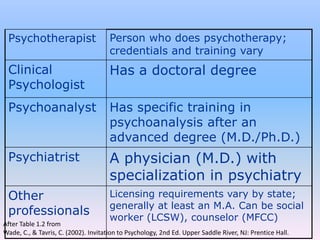
Psychotherapist                      Person who does psychotherapy;
                                      credentials and training vary
 Clinical                             Has a doctoral degree
 Psychologist
 Psychoanalyst                        Has specific training in
                                      psychoanalysis after an
                                      advanced degree (M.D./Ph.D.)
 Psychiatrist                         A physician (M.D.) with
                                      specialization in psychiatry
 Other                                Licensing requirements vary by state;
                                      generally at least an M.A. Can be social
 professionals                        worker (LCSW), counselor (MFCC)
After Table 1.2 from
Wade, C., & Tavris, C. (2002). Invitation to Psychology, 2nd Ed. Upper Saddle River, NJ: Prentice Hall.
Types of Private Practices
• Counseling Psychologists
  –Generally help people deal with
   problems of every day life
• School psychologists
  –Work with parents, teachers, &
   students to enhance students’
   performance & resolve emotional
   difficulties
• Clinical psychologists
  –Diagnose, treat, & study mental or
    emotional problems
• Psychotherapist
  –Anyone who does any kind of
    psychotherapy
  –Not legally regulated
• Psychoanalyst
  –Practices one particular form of
    therapy (psychoanalysis)
  –Must have an advanced degree,
    receive specialized training &
    undergo extensive
    psychoanalysis yourself
• Psychiatrists
  –MD who has done a 3 year residency
    in psychiatry under supervision to
    learn to diagnose & treat mental
    disorders
  –More likely to focus on possible
    biological causes of mental disorders
    & often treat these problems with
    medication
• Licensed Clinical Social Workers
• Licensing requirements vary by state
  but usually include a masters degree
  in psychology or social work & include
  1-2 years of supervised experience
Psychology in the Community
–Consult with companies to improve
 worker satisfaction & productivity
–Establish programs to improve race
 relations & reduce ethnic tensions
–Advise commissions on how pollution &
 noise affect mental health
• Do rehabilitation training for people who
  are physically or mentally disabled
• Educate judges & juries about eye
  witness testimony
• Assist the police in emergencies involving
  hostages or disturbed persons
• Conduct public opinion surveys
• Run suicide prevention hotlines
• Advise zoos on the care & training of
  animals
• Help coaches improve the athletic
  performance of their teams

What psychologists do

  • 1.
    Psychology Lesson 2: What Psychologists Do
  • 2.
    Three Categories 1. Teaching& doing research at universities 2. Providing health or mental services 3. Conducting research or applying its finding in nonacademic settings
  • 3.
    Psychological Research • BasicPsychology: Study of psychological issues in order to seek knowledge for its own sake • Applied Psychology: Study of psychological issues that have direct practical significance; also the application of psychological findings.
  • 4.
    Psychological Practice • Goalis to understand & improve physical & mental health –Work in mental hospitals, general hospitals, clinics, schools, counseling centers, the criminal justice system & private practice
  • 5.
    Psychotherapist Person who does psychotherapy; credentials and training vary Clinical Has a doctoral degree Psychologist Psychoanalyst Has specific training in psychoanalysis after an advanced degree (M.D./Ph.D.) Psychiatrist A physician (M.D.) with specialization in psychiatry Other Licensing requirements vary by state; generally at least an M.A. Can be social professionals worker (LCSW), counselor (MFCC) After Table 1.2 from Wade, C., & Tavris, C. (2002). Invitation to Psychology, 2nd Ed. Upper Saddle River, NJ: Prentice Hall.
  • 6.
    Types of PrivatePractices • Counseling Psychologists –Generally help people deal with problems of every day life
  • 7.
    • School psychologists –Work with parents, teachers, & students to enhance students’ performance & resolve emotional difficulties
  • 8.
    • Clinical psychologists –Diagnose, treat, & study mental or emotional problems • Psychotherapist –Anyone who does any kind of psychotherapy –Not legally regulated
  • 9.
    • Psychoanalyst –Practices one particular form of therapy (psychoanalysis) –Must have an advanced degree, receive specialized training & undergo extensive psychoanalysis yourself
  • 10.
    • Psychiatrists –MD who has done a 3 year residency in psychiatry under supervision to learn to diagnose & treat mental disorders –More likely to focus on possible biological causes of mental disorders & often treat these problems with medication
  • 11.
    • Licensed ClinicalSocial Workers • Licensing requirements vary by state but usually include a masters degree in psychology or social work & include 1-2 years of supervised experience
  • 12.
    Psychology in theCommunity –Consult with companies to improve worker satisfaction & productivity –Establish programs to improve race relations & reduce ethnic tensions –Advise commissions on how pollution & noise affect mental health
  • 13.
    • Do rehabilitationtraining for people who are physically or mentally disabled • Educate judges & juries about eye witness testimony • Assist the police in emergencies involving hostages or disturbed persons • Conduct public opinion surveys
  • 14.
    • Run suicideprevention hotlines • Advise zoos on the care & training of animals • Help coaches improve the athletic performance of their teams