What is Psychology
ChapterI
The American Psychological Association (APA) defines psychology as “the study of the mind and behavior.”
This concise definition reflects the discipline's emphasis on understanding both mental functions and
behavioral patterns.
3.
Clinical Psychology
The termclinical psychology was first used in print by Lightner Witmer in
1907. Witmer was also the first to operate a psychological clinic (L. T.
Benjamin, 1996, 2005).
The field of Clinical Psychology integrates science ,theory, and practice to
understand, predict, and alleviate maladjustment, disability, and discomfort
as well as to promote human adaptation, adjustment, and personal
development. Clinical Psychology focuses on the intellectual, emotional,
biological, psychological, social, and behavioral aspects of human
functioning across the life span, in varying cultures, and at all
socioeconomic levels. (APA, 2012a)
4.
Education and Trainingin Clinical Psychology
The aspiring clinical psychologist must obtain a doctoral degree in clinical psychology.
Most students enter a doctoral program with only a bachelor’s degree, but some enter with a master’s degree.
For those entering with a bachelor’s degree, training typically consists of at least 4 years of intensive, full-time
coursework, followed by a 1-year, full-time predoctoral internship.
Getting Licensed:
Once all the training requirements are met—graduate coursework, predoctoral internship, postdoctoral
internship—licensure appears on the horizon.
Becoming licensed also requires passing licensure exams—typically, the Examination for Professional Practice in
Psychology (EPPP) and a state-specific exam on laws and ethics.
The EPPP is a standardized multiple-choice exam on a broad range of psychology topics;
5.
Professional Activities andEmployment
Settings
Where do clinical psychologist work?
Private practice (Neuropsychological testing, Personality assessment, Diagnostic evaluation, Psychotherapy, etc.)
Psychiatric hospitals, General hospitals
Community mental health centers
Medical Schools
Government Agencies, substance abuse centers, university counseling centers, etc.
6.
The difference betweenClinical
psychologist and other adjacent specialists
Counseling Psychologists - Clinical psychologists were more likely to work with
seriously disturbed individuals, whereas counseling psychologists were more likely
to work with (“counsel”) less pathological clients.
Psychiatrist - Unlike clinical (or counseling) psychologists, psychiatrists go to
medical school and are licensed as physicians. (prescribe medication).
Social Workers- social workers have focused their work on the interaction between an individual
and the components of society that may contribute to or alleviate the individual’s problems. They
saw many of their clients’ problems as products of social ills—racism, oppressive gender roles,
poverty, abuse, and so on.
7.
The difference betweenClinical
psychologist and other adjacent specialists
School Psychologists - school psychologists usually work in schools, but some may work in other settings such as
day-care centers or correctional facilities. Their primary function is to enhance the intellectual, emotional, social,
and developmental lives of students.
Professional Counselors - Professional counselors’ work generally involves counseling of people with problems in
living or mild mental illness. Their training, compared with that of clinical psychologists, typically includes very little
emphasis on psychological testing or conducting research.
Marriage and Family Therapists - Their training focuses on working with couples and families, but sometimes they
also see individuals struggling with issues related to their partners or families.
8.
Evolution of ClinicalPsychology
William Tuke (1732–1822) - He raised funds to open the York Retreat, a residential
treatment center where the mentally ill would always be cared for with kindness,
dignity, and decency.
Philippe Pinel (1745–1826) - Pinel worked successfully to move mentally ill
individuals out of dungeons in Paris, where they were held as inmates rather than
treated as patients. He created new institutions in which patients were not kept in
chains or beaten but, rather, were given healthy food and benevolent treatment.
Eli Todd (1769–1833) - Eli Todd made sure that the chorus of voices for humane
treatment of the mentally ill was also heard on the other side of the Atlantic Ocean.
Dorothea Dix (1802–1887) -Dorothea Dix was working as a Sunday school teacher in a
jail in Boston, where she saw firsthand that many of the inmates were there as a result
of mental illness or retardation rather than crime.
9.
Evolution of ClinicalPsychology
Lightner Witmer (1867–1956) was born in Philadelphia
In 1896, he founded his first psychological clinic, where Witmer and his associates worked with children
whose problems arose in school settings and were related to learning or behavior.
In 1907, Witmer also founded the first scholarly journal in the field (called The Psychological Clinic).
10.
Evolution of ClinicalPsychology
Diagnostic Issues
Categorizing mental illness has been an issue central to clinical psychology since Witmer defined the field.
Emil Kraepelin (1855–1926), considered the “father of descriptive psychiatry”, offered a different two-category
system of mental illness:
1. exogenous disorders (caused by external factors)
2. endogenous disorders (caused by internal factors) and suggested that exogenous disorders were the far more
treatable type.
Diagnostic and Statistical Manual of Mental Disorders (DSM) was published by the American Psychiatric
Association in 1952.
11.
Evolution of ClinicalPsychology
Assessment of Intelligence
Assessment of intelligence – Intelligence tests arose in 1905 by Alfred Binet along with Theodore Simon.
The test called Binet-Simon scale.
In 1937, Binet’s test was revised by Lewis Terman. His revision called Stanford-Binet intelligence scale.
In 1939, David Wechsler filled the need for a test of intelligence designed specifically for adults with the
publication of his Wechsler Bellevue test. In, 1949 he created the test version for children (WiSC).
12.
Evolution of ClinicalPsychology
Assessment of Personality
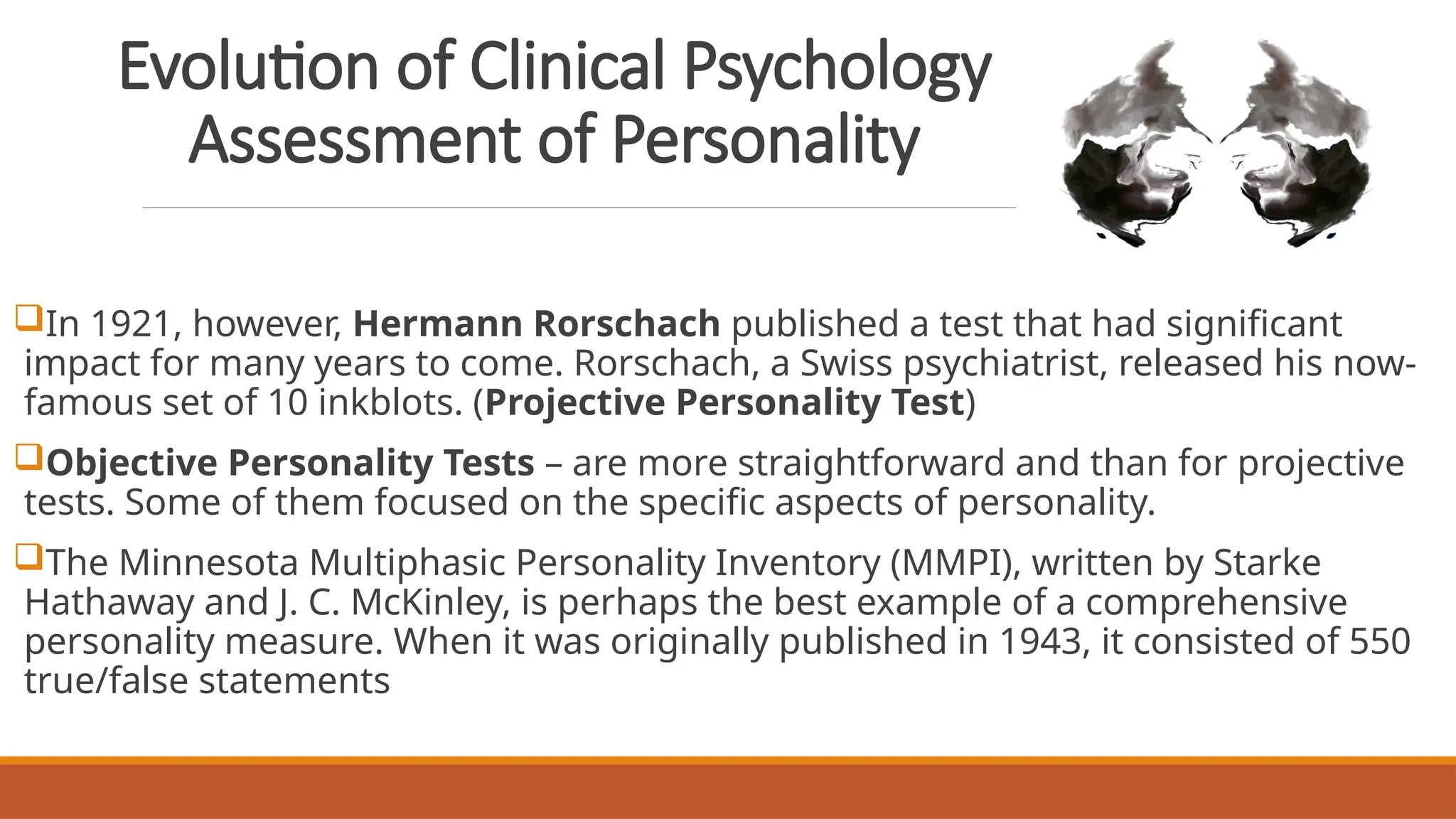
In 1921, however, Hermann Rorschach published a test that had significant
impact for many years to come. Rorschach, a Swiss psychiatrist, released his now-
famous set of 10 inkblots. (Projective Personality Test)
Objective Personality Tests – are more straightforward and than for projective
tests. Some of them focused on the specific aspects of personality.
The Minnesota Multiphasic Personality Inventory (MMPI), written by Starke
Hathaway and J. C. McKinley, is perhaps the best example of a comprehensive
personality measure. When it was originally published in 1943, it consisted of 550
true/false statements
13.
Evolution of ClinicalPsychology
Psychotherapy
Psychotherapy is the primary activity of clinical psychologists today, but that
hasn’t always been the case. In fact, in 1930—more than a quarter century
after Witmer founded the field—almost every clinical psychologist worked in
academia (rather than as a practitioner), and it wasn’t until the 1940s or 1950s
that psychotherapy played a significant role in the history of clinical
psychology.
As a result, different psychotherapeutic approaches have arisen.
14.
Current Controversies andDirections in Clinical Psychology
Why Clinical Psychologists Should Prescribe:
Shortage of psychiatrists.
Clinical psychologists are more expert than primary care physicians
Other nonphysician professionals already have prescription privileges (nurses etc).
Convenience for clients (need of two professional’s consultation).
Professional autonomy
Professional identification
Evolution of the profession
Revenue for the profession
15.
Current Controversies andDirections in
Clinical Psychology
Why Clinical Psychologists Should Not Prescribe:
Training issues
Threats to psychotherapy
Identity confusion
The potential influence of the pharmaceutical industry
16.
Current Controversies andDirections in
Clinical Psychology
EVIDENCE-BASED PRACTICE/ MANUALIZED THERAPY:
evidence-based practice, incorporates not only the particular treatment itself but also factors
related to the people providing and receiving it.
evidence-based practice is defined as “the integration of the best available research with clinical
expertise in the context of patient characteristics, culture, and preferences”(APA Presidential Task
Force on Evidence-Based Practice, 2006, p. 273).
17.
Current Controversies andDirections in
Clinical Psychology
Advantages of EVIDENCE-BASED PRACTICE/ MANUALIZED THERAPY:
Scientific legitimacy
Establishing minimal levels of competence
Training improvements
Decreased reliance on clinical judgment
Disadvantages:
Threats to the psychotherapy relationship
Diagnostic complications
Restrictions on practice
Debatable criteria for empirical evidence
18.
OVEREXPANSION OF MENTALDISORDERS AND NEW
DISORDERS AND NEW DEFINITIONS OF OLD
DISORDERS
There has been no real epidemic of mental illness, just a much looser definition of sickness, making it harder
for people to be considered well. The people remain the same; the diagnostic labels have changed and are too
elastic. Problems that used to be an expected and tolerated part of life are now diagnosed and treated as
mental disorder.” (Frances, 2013a, p. 82)
The danger of DSM-5 ideology is that it extends the scope of mental disorder to a point where almost anyone
can be diagnosed with one.”(Paris, 2013a, p. 41)
The more that psychiatric diagnoses appear to encroach on the boundaries of normal behavior, the more
psychiatry opens itself to criticisms that there is no validity to the concept of mental disorders (e.g., there’s no
such thing as mental illness—it’s a ‘myth’).” (Pierre, 2013, p. 109)
Lowering the bar – ADHD (symptoms must appear from 7 to 12 ages).
New disorders - Eating disorder (out of control overeating at least once per week); premenstrual
dysphoric disorder
19.
Applications of Technologyin Clinical Psychology
Today, technologically savvy clinical psychologists can use:
videoconferencing (similar to Skype or FaceTime) to interview or treat a client;
e-mail or text (in chat-room or one-on-one formats) to provide psychotherapy to a client;
interactive Internet sites to educate the public by responding to questions about mental health concerns;
online psychotherapy programs to diagnose and treat specific conditions;
virtual-reality techniques in which clients undergo therapeutic experiences, such as virtual exposure to feared objects;
computer-based self-instructional programs designed as specific components of a treatment that is otherwise provided
face to face;
apps and biofeedback sensors on handheld devices (e.g., smartphones, tablets) to monitor clients and interact with
them on a regular or random basis between meetings with the psychologist
20.
What should beaddressed when using
technology
Obtain informed consent from clients about the services they may receive, the technologies that may be used to provide them,
and the confidentiality of the communication.
Know and follow any applicable laws and guidelines on telehealth and telemedicine.
Know and follow the most recent version of the APA ethical code, especially the portions that address technological issues.
Similarly, be familiar with the APA Guidelines for the Practice of Telepsychology (APA, 2013).
Ensure client confidentiality as much as possible by using encryption or similar methods. Keep updated on ways clinical
information could be accessed by hackers and techniques for stopping them. Avoid public Wi-Fi hotspots, and consider using a
VPN.
Appreciate how issues of diversity and culture may be involved. As technological tools replace face-to-face meetings,
psychologists may need to make special efforts to assess the cultural backgrounds of the clients they serve.
Choose technologies carefully. For example, when choosing an app for clients to use on their smartphones, consider whether
the app was developed and tested by qualified mental health professionals, how widely available the app is (on different types of
operating systems), how long the app has been available (often a sign of its stability), and the extent to which you will be able to
troubleshoot if a client asks you questions about its use.
Be careful about how you dispose of data and technologies you use, including old phones, tablets, computers, and passwords.
Similarly, make sure all of your devices are password-protected and guard against their theft or loss.
21.
Factors that definethe effectiveness of
telepsychology
Which telepsychology is being used for which disorder?
On what device and via what means is the telepsychology delivered—computer, smartphone, e-mail, text,
videoconference, or something else?
In what setting is the telepsychology being delivered—home, clinic, school, public setting (library, café,
etc.), or somewhere else?
How did clients find the telepsychology? Did they receive a specific referral from a knowledgeable source
or stumble across it on the Internet?
Does the technology have live human support, and is that support monitored for quality?