Patterns for Cleaning Up Bug Data
Rodrigo Souza1,*
Christina Chavez1
Roberto Bittencourt2
1 Federal University of Bahia, Brazil
2 State University of Feira de Santana, Brazil
DAPSE’13: International Workshop on Data Analysis Patterns in Software Engineering
* speaker; email: rodrigo@dcc.ufba.br
May 21, 2013 San Francisco, USA
Bug reports 	
  
provide insight about…
- the quality of the software
- the quality of the process
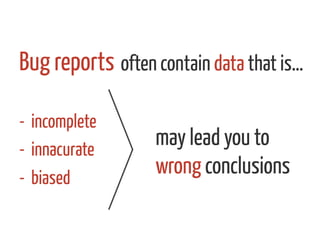
Bug reports 	
  
often contain data that is…
-  incomplete
-  innacurate
-  biased
Bug reports 	
  
may lead you to
wrong conclusions	
  
are
like vegetables…
You have to clean
them up before
using them
Bug reports 	
  
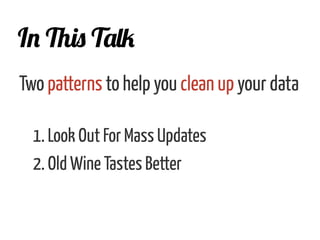
In This Talk
Two patterns to help you clean up your data
1. Look Out For Mass Updates
2. Old Wine Tastes Better
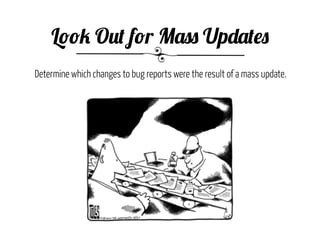
Look Out for Mass Updates
Determine which changes to bug reports were the result of a mass update.
1. Context
2. Problem
3. Solution
4. Discussion
Look Out for Mass Updates
tuesday
Worked	
  on	
  bug	
  #5	
  
Worked	
  on	
  bug	
  #12	
  
Updated	
  bug	
  report	
  #5	
  
Updated	
  bug	
  report	
  #12	
  
Joe’s worklog
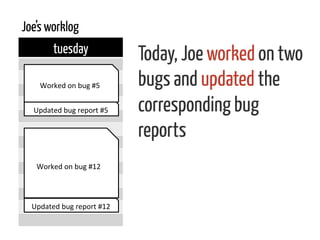
Today, Joe worked on two
bugs and updated the
corresponding bug
reports
tuesday
Updated	
  bug	
  report	
  #5	
  
Updated	
  bug	
  report	
  #12	
  
Joe’s worklog
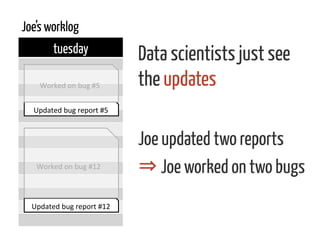
Data scientists just see
the updates
Joe updated two reports
⇒ Joe worked on two bugs
Worked	
  on	
  bug	
  #5	
  
Worked	
  on	
  bug	
  #12	
  
wednesday
Joe’s worklog
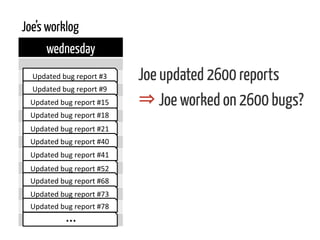
Joe updated 2600 reports
⇒ Joe worked on 2600 bugs?
Updated	
  bug	
  report	
  #3	
  
Updated	
  bug	
  report	
  #18	
  
Updated	
  bug	
  report	
  #9	
  
Updated	
  bug	
  report	
  #15	
  
Updated	
  bug	
  report	
  #21	
  
Updated	
  bug	
  report	
  #52	
  
Updated	
  bug	
  report	
  #40	
  
Updated	
  bug	
  report	
  #41	
  
Updated	
  bug	
  report	
  #68	
  
Updated	
  bug	
  report	
  #73	
  
Updated	
  bug	
  report	
  #78	
  
…	
  
Mass updates	
  	
  
do not represent actual work
Often, they are just cleanup
Mass updates	
  	
  
should be discarded
from your analyses
1. Context
2. Problem
3. Solution
4. Discussion
Look Out for Mass Updates
Determine which changes to bug reports
were the result of a mass update
1. Context
2. Problem
3. Solution
4. Discussion
Look Out for Mass Updates
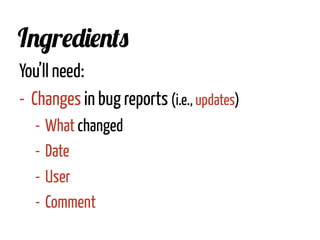
You’ll need:
-  Changes in bug reports (i.e., updates)
- What changed
- Date
- User
- Comment
Ingredients
Bug	
  #	
   What	
  changed	
   Date	
   User	
   Comment	
  
1	
   status	
  ⇒	
  
VERIFIED	
  
...	
   ...	
   ...	
  
2	
   status	
  ⇒	
  
VERIFIED	
  
...	
   ...	
   ...	
  
3	
   status	
  ⇒	
  
CLOSED	
  
...	
   ...	
   ...	
  
4	
   status	
  ⇒	
  
VERIFIED	
  
...	
   ...	
   ...	
  
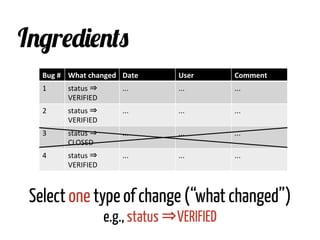
Ingredients
Select one type of change (“what changed”)
e.g., status ⇒VERIFIED
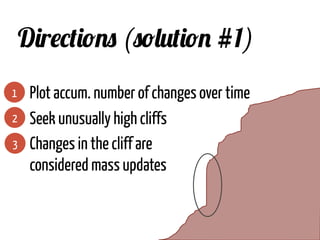
1
Directions (solution #1)
2 Seek unusually high cliffs
3 Changes in the cliff are
considered mass updates
Plot accum. number of changes over time
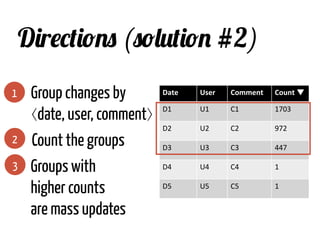
Directions (solution #2)
Date	
   User	
   Comment	
  
D1	
   U1	
   C1	
  
D2	
   U2	
   C2	
  
D3	
   U3	
   C3	
  
D4	
   U4	
   C4	
  
D5	
   U5	
   C5	
  
Count	
  ▼	
  
1703	
  
972	
  
447	
  
1	
  
1	
  
2 Count the groups
3 Groups with
higher counts
are mass updates
1 Group changes by
⟨date, user, comment⟩
1. Context
2. Problem
3. Solution
4. Discussion
Look Out for Mass Updates
The main challenge is
to find a suitable threshold
(i.e., how many updates characterize mass updates)
Old Wine Tastes Better
Determine bug reports that are too recent to be classified.
1. Context
2. Problem
3. Solution
4. Discussion
Old Wine Tastes Better
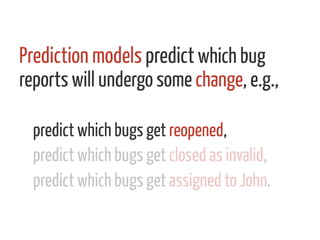
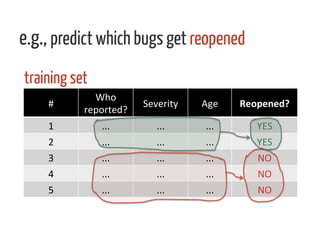
Prediction models predict which bug
reports will undergo some change, e.g.,
predict which bugs get reopened,
predict which bugs get closed as invalid,
predict which bugs get assigned to John.
e.g., predict which bugs get reopened
#	
  
Who	
  
reported?	
  
Severity	
   Age	
   Reopened?	
  
1	
   ...	
   ...	
   ...	
   YES	
  
2	
   ...	
   ...	
   ...	
   YES	
  
3	
   ...	
   ...	
   ...	
   NO	
  
4	
   ...	
   ...	
   ...	
   NO	
  
5	
   ...	
   ...	
   ...	
   NO	
  
training set
#	
  
Who	
  
reported?	
  
Severity	
   Age	
   Reopened?	
  
1	
   ...	
   ...	
   ...	
   YES	
  
2	
   ...	
   ...	
   ...	
   YES	
  
3	
   ...	
   ...	
   ...	
   NO	
  
4	
   ...	
   ...	
   ...	
   NO	
  
5	
   ...	
   ...	
   1	
  day	
   not	
  yet	
  
training set
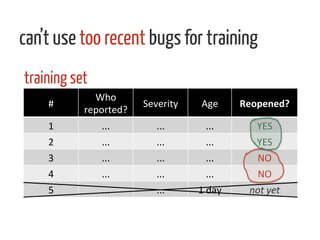
can’t use too recent bugs for training
1. Context
2. Problem
3. Solution
4. Discussion
Old Wine Tastes Better
Determine bug reports that are
too recent to be classified
1. Context
2. Problem
3. Solution
4. Discussion
Old Wine Tastes Better
You’ll need:
-  Date of last change in your data set
-  Bug reports
- Creation date
- Whether it has been reopened*
Ingredients
* or, in general, whether it has undergone a particular change
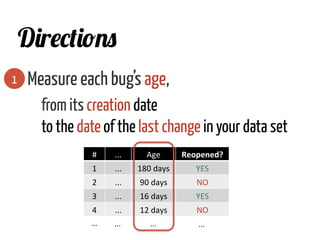
Measure each bug’s age,
from its creation date
to the date of the last change in your data set
1
Directions
#	
   ...	
   Age	
   Reopened?	
  
1	
   ...	
   180	
  days	
   YES	
  
2	
   ...	
   90	
  days	
   NO	
  
3	
   ...	
   16	
  days	
   YES	
  
4	
   ...	
   12	
  days	
   NO	
  
...	
   ...	
   ...	
   ...	
  
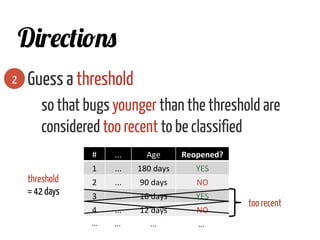
Guess a threshold
so that bugs younger than the threshold are
considered too recent to be classified
2
Directions
threshold
= 42 days
#	
   ...	
   Age	
   Reopened?	
  
1	
   ...	
   180	
  days	
   YES	
  
2	
   ...	
   90	
  days	
   NO	
  
3	
   ...	
   16	
  days	
   YES	
  
4	
   ...	
   12	
  days	
   NO	
  
...	
   ...	
   ...	
   ...	
  
too recent
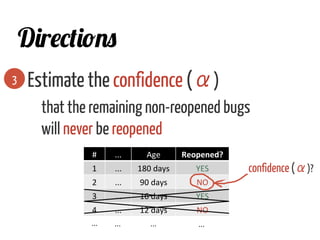
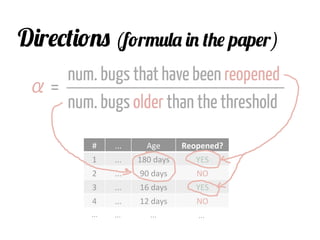
Estimate the confidence (α)
that the remaining non-reopened bugs
will never be reopened
3
Directions
#	
   ...	
   Age	
   Reopened?	
  
1	
   ...	
   180	
  days	
   YES	
  
2	
   ...	
   90	
  days	
   NO	
  
3	
   ...	
   16	
  days	
   YES	
  
4	
   ...	
   12	
  days	
   NO	
  
...	
   ...	
   ...	
   ...	
  
confidence (α)?
α =
Directions (formula in the paper)
#	
   ...	
   Age	
   Reopened?	
  
1	
   ...	
   180	
  days	
   YES	
  
2	
   ...	
   90	
  days	
   NO	
  
3	
   ...	
   16	
  days	
   YES	
  
4	
   ...	
   12	
  days	
   NO	
  
...	
   ...	
   ...	
   ...	
  
num. bugs that have been reopened
num. bugs older than the threshold
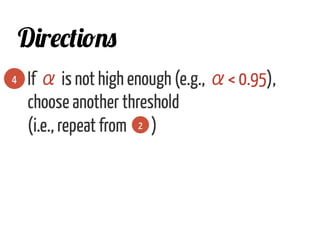
If α is not high enough (e.g., α< 0.95),
choose another threshold
(i.e., repeat from )
4
Directions
2
1. Context
2. Problem
3. Solution
4. Discussion
Old Wine Tastes Better
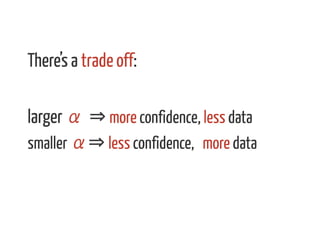
There’s a trade off:
larger α ⇒ more confidence, less data
smaller α⇒ less confidence, more data
For the project NetBeans/Platform:
removing bugs younger than 6 weeks (0.7%)
raises the confidence from 88% to 95%
Arrrr!*
It’s in the
paper!
*	
  
Do ye have
any source
code to show?
Thank you!
And clean up your bug
reports before using them!

Patterns for Cleaning Up Bug Data

  • 1.
    Patterns for CleaningUp Bug Data Rodrigo Souza1,* Christina Chavez1 Roberto Bittencourt2 1 Federal University of Bahia, Brazil 2 State University of Feira de Santana, Brazil DAPSE’13: International Workshop on Data Analysis Patterns in Software Engineering * speaker; email: rodrigo@dcc.ufba.br May 21, 2013 San Francisco, USA
  • 2.
  • 3.
    provide insight about… -the quality of the software - the quality of the process Bug reports  
  • 4.
    often contain datathat is… -  incomplete -  innacurate -  biased Bug reports   may lead you to wrong conclusions  
  • 5.
    are like vegetables… You haveto clean them up before using them Bug reports  
  • 6.
    In This Talk Twopatterns to help you clean up your data 1. Look Out For Mass Updates 2. Old Wine Tastes Better
  • 7.
    Look Out forMass Updates Determine which changes to bug reports were the result of a mass update.
  • 8.
    1. Context 2. Problem 3.Solution 4. Discussion Look Out for Mass Updates
  • 9.
    tuesday Worked  on  bug  #5   Worked  on  bug  #12   Updated  bug  report  #5   Updated  bug  report  #12   Joe’s worklog Today, Joe worked on two bugs and updated the corresponding bug reports
  • 10.
    tuesday Updated  bug  report  #5   Updated  bug  report  #12   Joe’s worklog Data scientists just see the updates Joe updated two reports ⇒ Joe worked on two bugs Worked  on  bug  #5   Worked  on  bug  #12  
  • 11.
    wednesday Joe’s worklog Joe updated2600 reports ⇒ Joe worked on 2600 bugs? Updated  bug  report  #3   Updated  bug  report  #18   Updated  bug  report  #9   Updated  bug  report  #15   Updated  bug  report  #21   Updated  bug  report  #52   Updated  bug  report  #40   Updated  bug  report  #41   Updated  bug  report  #68   Updated  bug  report  #73   Updated  bug  report  #78   …  
  • 13.
    Mass updates     do not represent actual work Often, they are just cleanup
  • 14.
    Mass updates     should be discarded from your analyses
  • 15.
    1. Context 2. Problem 3.Solution 4. Discussion Look Out for Mass Updates
  • 16.
    Determine which changesto bug reports were the result of a mass update
  • 17.
    1. Context 2. Problem 3.Solution 4. Discussion Look Out for Mass Updates
  • 18.
    You’ll need: -  Changesin bug reports (i.e., updates) - What changed - Date - User - Comment Ingredients
  • 19.
    Bug  #  What  changed   Date   User   Comment   1   status  ⇒   VERIFIED   ...   ...   ...   2   status  ⇒   VERIFIED   ...   ...   ...   3   status  ⇒   CLOSED   ...   ...   ...   4   status  ⇒   VERIFIED   ...   ...   ...   Ingredients Select one type of change (“what changed”) e.g., status ⇒VERIFIED
  • 20.
    1 Directions (solution #1) 2Seek unusually high cliffs 3 Changes in the cliff are considered mass updates Plot accum. number of changes over time
  • 21.
    Directions (solution #2) Date   User   Comment   D1   U1   C1   D2   U2   C2   D3   U3   C3   D4   U4   C4   D5   U5   C5   Count  ▼   1703   972   447   1   1   2 Count the groups 3 Groups with higher counts are mass updates 1 Group changes by ⟨date, user, comment⟩
  • 22.
    1. Context 2. Problem 3.Solution 4. Discussion Look Out for Mass Updates
  • 23.
    The main challengeis to find a suitable threshold (i.e., how many updates characterize mass updates)
  • 24.
    Old Wine TastesBetter Determine bug reports that are too recent to be classified.
  • 25.
    1. Context 2. Problem 3.Solution 4. Discussion Old Wine Tastes Better
  • 26.
    Prediction models predictwhich bug reports will undergo some change, e.g., predict which bugs get reopened, predict which bugs get closed as invalid, predict which bugs get assigned to John.
  • 27.
    e.g., predict whichbugs get reopened #   Who   reported?   Severity   Age   Reopened?   1   ...   ...   ...   YES   2   ...   ...   ...   YES   3   ...   ...   ...   NO   4   ...   ...   ...   NO   5   ...   ...   ...   NO   training set
  • 28.
    #   Who   reported?   Severity   Age   Reopened?   1   ...   ...   ...   YES   2   ...   ...   ...   YES   3   ...   ...   ...   NO   4   ...   ...   ...   NO   5   ...   ...   1  day   not  yet   training set can’t use too recent bugs for training
  • 29.
    1. Context 2. Problem 3.Solution 4. Discussion Old Wine Tastes Better
  • 30.
    Determine bug reportsthat are too recent to be classified
  • 31.
    1. Context 2. Problem 3.Solution 4. Discussion Old Wine Tastes Better
  • 32.
    You’ll need: -  Dateof last change in your data set -  Bug reports - Creation date - Whether it has been reopened* Ingredients * or, in general, whether it has undergone a particular change
  • 33.
    Measure each bug’sage, from its creation date to the date of the last change in your data set 1 Directions #   ...   Age   Reopened?   1   ...   180  days   YES   2   ...   90  days   NO   3   ...   16  days   YES   4   ...   12  days   NO   ...   ...   ...   ...  
  • 34.
    Guess a threshold sothat bugs younger than the threshold are considered too recent to be classified 2 Directions threshold = 42 days #   ...   Age   Reopened?   1   ...   180  days   YES   2   ...   90  days   NO   3   ...   16  days   YES   4   ...   12  days   NO   ...   ...   ...   ...   too recent
  • 35.
    Estimate the confidence(α) that the remaining non-reopened bugs will never be reopened 3 Directions #   ...   Age   Reopened?   1   ...   180  days   YES   2   ...   90  days   NO   3   ...   16  days   YES   4   ...   12  days   NO   ...   ...   ...   ...   confidence (α)?
  • 36.
    α = Directions (formulain the paper) #   ...   Age   Reopened?   1   ...   180  days   YES   2   ...   90  days   NO   3   ...   16  days   YES   4   ...   12  days   NO   ...   ...   ...   ...   num. bugs that have been reopened num. bugs older than the threshold
  • 37.
    If α isnot high enough (e.g., α< 0.95), choose another threshold (i.e., repeat from ) 4 Directions 2
  • 38.
    1. Context 2. Problem 3.Solution 4. Discussion Old Wine Tastes Better
  • 39.
    There’s a tradeoff: larger α ⇒ more confidence, less data smaller α⇒ less confidence, more data
  • 40.
    For the projectNetBeans/Platform: removing bugs younger than 6 weeks (0.7%) raises the confidence from 88% to 95%
  • 41.
    Arrrr!* It’s in the paper! *   Do ye have any source code to show?
  • 42.
    Thank you! And cleanup your bug reports before using them!