What Photosensitive Epilepsy?

          21/03/2013
What Photosensitive Epilepsy?
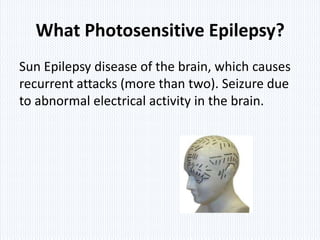
Sun Epilepsy disease of the brain, which causes
recurrent attacks (more than two). Seizure due
to abnormal electrical activity in the brain.
Epilepsy may be the result of:
• Irregularity in the wiring of the brain
• Umbalance of neurotransmitters (chemical
  messengers in the brain)
• Combination of these factors
• In photosensitive epilepsy, genetics also plays
  a role.
What Photosensitive Epilepsy?
About one in 100 people in the U.S. have
epilepsy. About 3% to 5% of those people have
photosensitive epilepsy.
What Photosensitive Epilepsy?
• Children and adolescents aged 7 to 19 are
  more likely to have photosensitive epilepsy.
• Girls are affected by the condition more often
  than boys.
• But boys tend to have more seizures.
• That's probably because they spend more
  time playing video games, a common seizure
  trigger.
Photosensitive Epilepsy Symptoms
• Television
  – Television programs
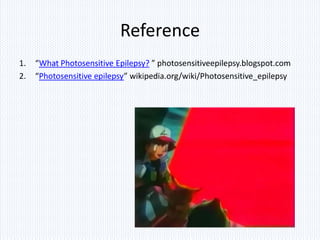
  – London Olympics promotional film incident
• Fluorescent lighting
• Video games
• Web design
Conclusion
•   The article I found goes into the general phenomenon of seizure self-
    induction, but does spend quite a bit of time on photosensitive epilepsy (PSE). It's
    a review, so there are plenty of references.
•   It first points out the prevalence of PSE, which occurs in between 2-5% of the
    population, and approximately 25% of those affected by the disorder are thought
    to self-stimulate.
•   The article supports the assertion on Wikipedia that developmentally challenged
    and "learning disabled" children are most prone to these self-inductive
    behaviors, but states that children of normal intelligence and higher may have
    developed strategies to avoid getting caught doing so during recorded sessions. It
    does not go into much depth regarding adults self-inducing, but tacitly assumes
    that adults of normal intelligence would be more likely to understand the harm
    that a seizure could bring them.
•   There is support for the notion that children with television induced seizures do
    try to seek out televisions for this self-stimulation behavior, but the article cautions
    that this compulsive behavior may be associated with the seizure activity
    itself, and not something the patients are consciously doing, many describe it as
    "irresistable."
The article lists a handful of reasons that are
 commonly thought to promote self-induction:
• Compulsion - whether for pleasure seeking or as a result of
  seizure activity
• Willful avoidance of stress or boredom
• Hedonistic motivation - to experience an "aura"/trance or
  other pleasurable feelings
• Sense of control - so they can have a "say" over when their
  seizures occur, and also so that they can reap the benefits
  of the refractory period
• Attention seeking - being the "sick patient" for sympathetic
  family members
• Self-treatment - the patient can give themselves a dose of
  "convulsive therapy" at will, if this gives them therapeutic
  relief of concomitant disorders
Reference
1.   “What Photosensitive Epilepsy? ” photosensitiveepilepsy.blogspot.com
2.   “Photosensitive epilepsy” wikipedia.org/wiki/Photosensitive_epilepsy

What photosensitive epilepsy

  • 1.
  • 2.
    What Photosensitive Epilepsy? SunEpilepsy disease of the brain, which causes recurrent attacks (more than two). Seizure due to abnormal electrical activity in the brain.
  • 3.
    Epilepsy may bethe result of: • Irregularity in the wiring of the brain • Umbalance of neurotransmitters (chemical messengers in the brain) • Combination of these factors • In photosensitive epilepsy, genetics also plays a role.
  • 4.
    What Photosensitive Epilepsy? Aboutone in 100 people in the U.S. have epilepsy. About 3% to 5% of those people have photosensitive epilepsy.
  • 5.
    What Photosensitive Epilepsy? •Children and adolescents aged 7 to 19 are more likely to have photosensitive epilepsy. • Girls are affected by the condition more often than boys. • But boys tend to have more seizures. • That's probably because they spend more time playing video games, a common seizure trigger.
  • 6.
    Photosensitive Epilepsy Symptoms •Television – Television programs – London Olympics promotional film incident • Fluorescent lighting • Video games • Web design
  • 7.
    Conclusion • The article I found goes into the general phenomenon of seizure self- induction, but does spend quite a bit of time on photosensitive epilepsy (PSE). It's a review, so there are plenty of references. • It first points out the prevalence of PSE, which occurs in between 2-5% of the population, and approximately 25% of those affected by the disorder are thought to self-stimulate. • The article supports the assertion on Wikipedia that developmentally challenged and "learning disabled" children are most prone to these self-inductive behaviors, but states that children of normal intelligence and higher may have developed strategies to avoid getting caught doing so during recorded sessions. It does not go into much depth regarding adults self-inducing, but tacitly assumes that adults of normal intelligence would be more likely to understand the harm that a seizure could bring them. • There is support for the notion that children with television induced seizures do try to seek out televisions for this self-stimulation behavior, but the article cautions that this compulsive behavior may be associated with the seizure activity itself, and not something the patients are consciously doing, many describe it as "irresistable."
  • 8.
    The article listsa handful of reasons that are commonly thought to promote self-induction: • Compulsion - whether for pleasure seeking or as a result of seizure activity • Willful avoidance of stress or boredom • Hedonistic motivation - to experience an "aura"/trance or other pleasurable feelings • Sense of control - so they can have a "say" over when their seizures occur, and also so that they can reap the benefits of the refractory period • Attention seeking - being the "sick patient" for sympathetic family members • Self-treatment - the patient can give themselves a dose of "convulsive therapy" at will, if this gives them therapeutic relief of concomitant disorders
  • 9.
    Reference 1. “What Photosensitive Epilepsy? ” photosensitiveepilepsy.blogspot.com 2. “Photosensitive epilepsy” wikipedia.org/wiki/Photosensitive_epilepsy