What Makes a
Good Research
Question?
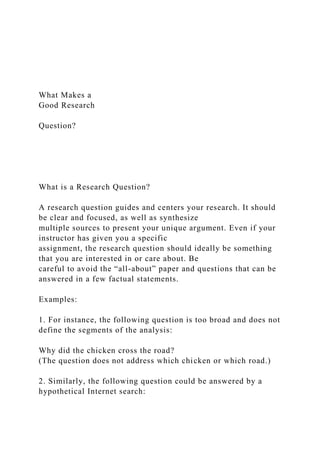
What is a Research Question?
A research question guides and centers your research. It should
be clear and focused, as well as synthesize
multiple sources to present your unique argument. Even if your
instructor has given you a specific
assignment, the research question should ideally be something
that you are interested in or care about. Be
careful to avoid the “all-about” paper and questions that can be
answered in a few factual statements.
Examples:
1. For instance, the following question is too broad and does not
define the segments of the analysis:
Why did the chicken cross the road?
(The question does not address which chicken or which road.)
2. Similarly, the following question could be answered by a
hypothetical Internet search:
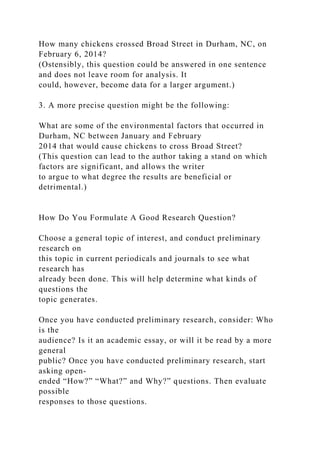
How many chickens crossed Broad Street in Durham, NC, on
February 6, 2014?
(Ostensibly, this question could be answered in one sentence
and does not leave room for analysis. It
could, however, become data for a larger argument.)
3. A more precise question might be the following:
What are some of the environmental factors that occurred in
Durham, NC between January and February
2014 that would cause chickens to cross Broad Street?
(This question can lead to the author taking a stand on which
factors are significant, and allows the writer
to argue to what degree the results are beneficial or
detrimental.)
How Do You Formulate A Good Research Question?
Choose a general topic of interest, and conduct preliminary
research on
this topic in current periodicals and journals to see what
research has
already been done. This will help determine what kinds of
questions the
topic generates.
Once you have conducted preliminary research, consider: Who
is the
audience? Is it an academic essay, or will it be read by a more
general
public? Once you have conducted preliminary research, start
asking open-
ended “How?” “What?” and Why?” questions. Then evaluate
possible
responses to those questions.
Duke Writing Studio 2
Examples:
Say, for instance, you want to focus on social networking sites.
After reading current research, you want
to examine to what degree social networking sites are harmful.
The Writing Center at George Mason
University provides the following examples and explanations:
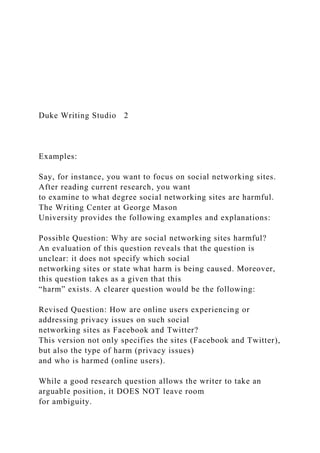
Possible Question: Why are social networking sites harmful?
An evaluation of this question reveals that the question is
unclear: it does not specify which social
networking sites or state what harm is being caused. Moreover,
this question takes as a given that this
“harm” exists. A clearer question would be the following:
Revised Question: How are online users experiencing or
addressing privacy issues on such social
networking sites as Facebook and Twitter?
This version not only specifies the sites (Facebook and Twitter),
but also the type of harm (privacy issues)
and who is harmed (online users).
While a good research question allows the writer to take an
arguable position, it DOES NOT leave room
for ambiguity.
Checklist of Potential Research Questions in the Humanities
(from the Vanderbilt University Writing
Center):
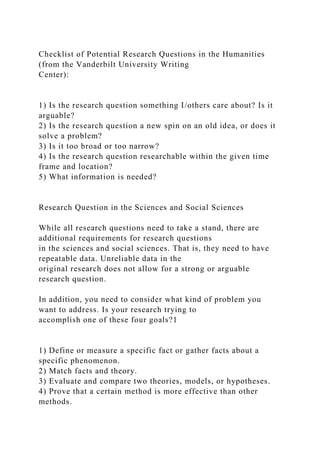
1) Is the research question something I/others care about? Is it
arguable?
2) Is the research question a new spin on an old idea, or does it
solve a problem?
3) Is it too broad or too narrow?
4) Is the research question researchable within the given time
frame and location?
5) What information is needed?
Research Question in the Sciences and Social Sciences
While all research questions need to take a stand, there are
additional requirements for research questions
in the sciences and social sciences. That is, they need to have
repeatable data. Unreliable data in the
original research does not allow for a strong or arguable
research question.
In addition, you need to consider what kind of problem you
want to address. Is your research trying to
accomplish one of these four goals?1
1) Define or measure a specific fact or gather facts about a
specific phenomenon.
2) Match facts and theory.
3) Evaluate and compare two theories, models, or hypotheses.
4) Prove that a certain method is more effective than other
methods.
Moreover, the research question should address what the
variables of the experiment are, their
relationship, and state something about the testing of those
relationships. The Psychology department at
California State University, Fresno, provides the following
examples and explanations:
1 David Porush, A Short Guide to Writing About Science. (New
York: Harper Collins, 1995), 92-93.
Duke Writing Studio 3
Examples:
Possible research question: Are females smarter than males?
This question delineates the variables to be measured: gender
and intelligence. Yet, it is unclear how they
will be evaluated: What method will be used to define and
measure intelligence?
Revised question: Do females age 18-35 score higher than adult
males age 18-35 on the WAIS-III? (The
WAIS-III is a standardized intelligence test.)
This research question produces data that can be replicated.
From there, the author can devise a question
that takes a stand.
In essence, the research question that guides the sciences and
social sciences should do the following
three things:2
1) Post a problem.
2) Shape the problem into a testable hypothesis.
3) Report the results of the tested hypothesis.
There are two types of data that can help shape research
questions in
the sciences and social sciences: quantitative and qualitative
data.
While quantitative data focuses on the numerical measurement
and
analysis between variables, qualitative data examines the social
processes that give rise to the relationships, interactions, and
constraints of the inquiry.
Writing After the Research Question
The answer to your research question should be your thesis
statement. Keep in mind that you will most
likely continue to refine your thesis statement as you conduct
and write about your research. A good
research question, however, puts you well on your way to
writing a strong research paper.
Helpful Links
• http://writingcenter.gmu.edu/?p=307
• http://vanderbilt.edu/writing/manage/wp-
content/uploads/2013/06/Formulating%20Your%20Research%20
Question.pdf
• http://www.esc.edu/online-writing-
center/resources/research/research-paper-
steps/developing-questions/
•
http://psych.csufresno.edu/psy144/Content/Science/researchques
tion.html
2 Lee Cuba, A Short Guide to Writing About Social Science,
third edition. (New York: Addison-Wesley Educational
Publishers, Inc., 1997), 70-71.
Review Material
https://www.youtube.com/watch?v=uvJD1sSt1PM
https://www.youtube.com/watch?v=56L_7QJZyRQ
Discussion
Why is conduit used or sometimes required?
What is determined by ratings on a receptacle?
Why are GFCI’s used and how do they work?
Why does voltage drop in a circuit?
Assignment
Determine the power factor when true power of an electrical
circuit is 1000W and apparent power is 1700 VA.
Also, for a heater rated at 3000 W, how much energy is used in
2 and 10 hours?
Review Material
https://www.youtube.com/watch?v=uvJD1sSt1PM
https://www.youtube.com/watch?v=56L_7QJZyRQ
Discussion
Why is conduit used or sometimes required?
What is determined by ratings on a receptacle?
Why are GFCI’s used and how
do they work?
Why does voltage drop in a circuit?
Assignment
Determine the power factor when true power of an electrical
circuit is 1000W and apparen
t power is
1700 VA.
Also, for a heater rated at 3000 W, how much energy is used in
2 and 10 hours?
Review Material
https://www.youtube.com/watch?v=uvJD1sSt1PM
https://www.youtube.com/watch?v=56L_7QJZyRQ
Discussion
Why is conduit used or sometimes required?
What is determined by ratings on a receptacle?
Why are GFCI’s used and how do they work?
Why does voltage drop in a circuit?
Assignment
Determine the power factor when true power of an electrical
circuit is 1000W and apparent power is
1700 VA.
Also, for a heater rated at 3000 W, how much energy is used in
2 and 10 hours?
Responses
I D
Why is conduit used or sometimes required?
Conduit is a rugged protective tube through which insulated
conductors are pulled. Metal conduit can be used to shield
sensitive circuits from electromagnetic interference, and also
can prevent emission of such interference from enclosed power
cables. Non-metallic conduits resist corrosion and are light
weight, reducing installation labor cost.
Respond:
What is determined by ratings on a receptacle?
A receptacle is a contact device installed for the connection of
plugs and flexible cords to supply current to portable electrical
equipment. Ratings on a receptacle determine the number of
contacts and the configuration in which the slots are positioned
in the receptacle. There are a large number of configurations
and diagrams for receptacles encountered in residential
construction work.
Respond:
Why are GFCI’s used and how do they work?
A ground fault circuit interpreter (GFCI) is a fast-acting
receptacle that detects low levels of leakage current to ground
and opens the circuit in response to the leakage. GFCI’s
provide greater protection than standard or isolated ground
receptacles. They provide protection for humans against electric
shock by providing the alternating current flow resistance path.
Respond:
DG
What is determined by ratings on a receptacle?
Rating determine the number of contacts and the configuration
in which slots are positioned in the receptacle. There are many
configurations and diagrams for receptacle encountered in
residential construction work. They are designed for straight
blade or locking type plugs. Locking type receptables are more
common in commercial and industrial applications than in
residential work.
Respond:
Why are GFCI’s used and how do they work?
A ground fault circuit interrupter is a fast-acting receptacle that
detects low levels of leakage current to ground and opens the
circuit in response to the leakage. GFCI’s do no protect against
line-to-line contact. GFCI protect the following areas such as
bathrooms, swimming pools, residential garages, or anywhere
electrical circuits can meet water.
Respond:
Why does voltage drop in a circuit?
Voltage drop occurs when there is a loss of voltage through the
circuit. When drops occur, lights can flicker, or bulbs can burn
out causing the load to work harder with less output.
Respond:
M U
What is determined by ratings on a receptacle?
The ratings of a receptacle help establish rules over how many
contact points and how these contact points are positioned
within the receptacle. These receptacles are created to accept
locking type or single blade plugs that can be unique to certain
countries as well. All of these details should be highlighted on
the electrical plans so that they are properly installed in a
residential or commercial property.
Respond:
Why are GFCI's used and how do they work?
A ground fault circuit interrupter is a receptacle that compares
the current on both sides of the circuit to ensure that they are
safe from any possible electric shocks. These are especially
important to use in areas where they can be exposed to
moisture, as water is a very good conductor of electric energy.
Respond:
Why does a voltage drop in a circuit?
The main reason that voltage usually drops in a circuit is that
the circuit becomes overloaded with extra connections or a
power source that takes the capacity of that series over the top.
When this happens there will usually be flickering or dimming
of lights which indicates that the capacity of the terminal has
been exceeded.
Respond:
Responses
I D
Why is conduit used or sometimes r
equired?
Conduit is a rugged protective tube through which insulated
conductors are pulled.
Metal conduit can
be used to shield sensitive circuits from electromagnetic
interference, and also can prevent emission of
such interference from enclosed power ca
bles. Non
-
metallic conduits resist corrosion and are light
weight, reducing installation labor cost.
Respon
d
:
What is determined by ratings on a receptacle?
A receptacle is a contact device installed for the connection of
plugs and flexible cords to supply current
to portable electrical equipment.
Ratings on a receptacle determine the number of contacts and
the
configuration in which the slots are positioned in the receptacle.
There are a large number of
configurations and diagrams for receptacles encountered in r
esidential construction work.
Respond
:
Why are GFCI’s used and how do they work?
A ground fault circuit interpreter (GFCI) is a fast
-
acting receptacle that detects low levels of leakage
current to ground and opens the circuit in response to the
leakage.
GFCI’s pro
vide greater protection
than standard or isolated ground receptacles. They provide
protection for humans against electric shock
by providing the alternating current flow resistance path.
Respond
:
DG
What is determined by ratings on a receptacle?
Rating determine the number of contacts and the configuration
in which slots are positioned in the
receptacle. There are
many
configurations and diagrams for recept
acle encountered in residential
construction work. They are designed for straight blade or
locking type plugs. Locking type receptables
are more common in commercial and industrial applications
than in residential work.
Respond
:
Why are GFCI’s used and ho
w do they work?
A ground fault circuit interrupter is a fast
-
acting receptacle that detects low levels of leakage current to
ground
and opens the circuit in response to the leakage. GFCI’s do no
protect against line
-
to
-
line
contact. GFCI protect the follo
wing areas such as bathrooms, swimming pools, residential
garages, or
anywhere electrical circuits can
meet
water.
Re
s
p
ond
:
Responses
I D
Why is conduit used or sometimes required?
Conduit is a rugged protective tube through which insulated
conductors are pulled. Metal conduit can
be used to shield sensitive circuits from electromagnetic
interference, and also can prevent emission of
such interference from enclosed power cables. Non-metallic
conduits resist corrosion and are light
weight, reducing installation labor cost.
Respond:
What is determined by ratings on a receptacle?
A receptacle is a contact device installed for the connection of
plugs and flexible cords to supply current
to portable electrical equipment. Ratings on a receptacle
determine the number of contacts and the
configuration in which the slots are positioned in the receptacle.
There are a large number of
configurations and diagrams for receptacles encountered in
residential construction work.
Respond:
Why are GFCI’s used and how do they work?
A ground fault circuit interpreter (GFCI) is a fast-acting
receptacle that detects low levels of leakage
current to ground and opens the circuit in response to the
leakage. GFCI’s provide greater protection
than standard or isolated ground receptacles. They provide
protection for humans against electric shock
by providing the alternating current flow resistance path.
Respond:
DG
What is determined by ratings on a receptacle?
Rating determine the number of contacts and the configuration
in which slots are positioned in the
receptacle. There are many configurations and diagrams for
receptacle encountered in residential
construction work. They are designed for straight blade or
locking type plugs. Locking type receptables
are more common in commercial and industrial applications
than in residential work.
Respond:
Why are GFCI’s used and how do they work?
A ground fault circuit interrupter is a fast-acting receptacle that
detects low levels of leakage current to
ground and opens the circuit in response to the leakage. GFCI’s
do no protect against line-to-line
contact. GFCI protect the following areas such as bathrooms,
swimming pools, residential garages, or
anywhere electrical circuits can meet water.
Respond:
www.vanderbilt.edu/writing Revised 08/08/2007
Formulating Your Research Question (RQ)
In a research paper, the emphasis is on generating a unique
question and then synthesizing diverse sources into a
coherent essay that supports your argument about the topic. In
other words, you integrate information from
publications with your own thoughts in order to formulate an
argument. Your topic is your starting place: from here,
you will develop an engaging research question. Merely
presenting a topic in the form of a question does not
transform it into a good research question. For example:
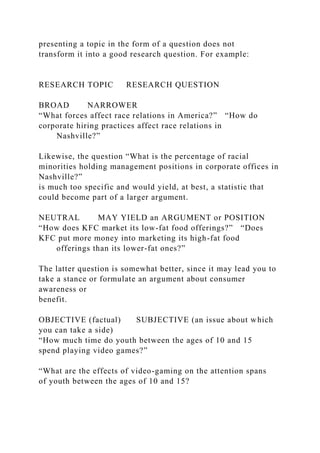
RESEARCH TOPIC RESEARCH QUESTION
BROAD NARROWER
“What forces affect race relations in America?” “How do
corporate hiring practices affect race relations in
Nashville?”
Likewise, the question “What is the percentage of racial
minorities holding management positions in corporate offices in
Nashville?”
is much too specific and would yield, at best, a statistic that
could become part of a larger argument.
NEUTRAL MAY YIELD an ARGUMENT or POSITION
“How does KFC market its low-fat food offerings?” “Does
KFC put more money into marketing its high-fat food
offerings than its lower-fat ones?”
The latter question is somewhat better, since it may lead you to
take a stance or formulate an argument about consumer
awareness or
benefit.
OBJECTIVE (factual) SUBJECTIVE (an issue about which
you can take a side)
“How much time do youth between the ages of 10 and 15
spend playing video games?”
“What are the effects of video-gaming on the attention spans
of youth between the ages of 10 and 15?
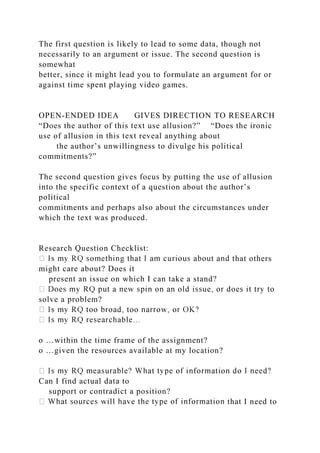
The first question is likely to lead to some data, though not
necessarily to an argument or issue. The second question is
somewhat
better, since it might lead you to formulate an argument for or
against time spent playing video games.
OPEN-ENDED IDEA GIVES DIRECTION TO RESEARCH
“Does the author of this text use allusion?” “Does the ironic
use of allusion in this text reveal anything about
the author’s unwillingness to divulge his political
commitments?”
The second question gives focus by putting the use of allusion
into the specific context of a question about the author’s
political
commitments and perhaps also about the circumstances under
which the text was produced.
Research Question Checklist:
hat others
might care about? Does it
present an issue on which I can take a stand?
solve a problem?
o …within the time frame of the assignment?
o …given the resources available at my location?
Can I find actual data to
support or contradict a position?
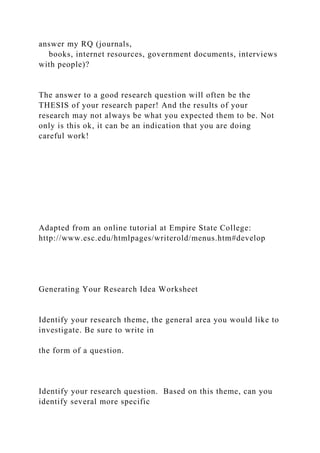
that I need to
answer my RQ (journals,
books, internet resources, government documents, interviews
with people)?
The answer to a good research question will often be the
THESIS of your research paper! And the results of your
research may not always be what you expected them to be. Not
only is this ok, it can be an indication that you are doing
careful work!
Adapted from an online tutorial at Empire State College:
http://www.esc.edu/htmlpages/writerold/menus.htm#develop
Generating Your Research Idea Worksheet
Identify your research theme, the general area you would like to
investigate. Be sure to write in
the form of a question.
Identify your research question. Based on this theme, can you
identify several more specific
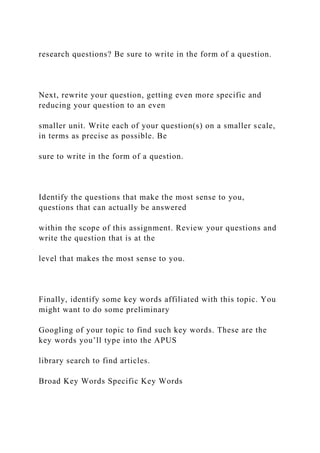
research questions? Be sure to write in the form of a question.
Next, rewrite your question, getting even more specific and
reducing your question to an even
smaller unit. Write each of your question(s) on a smaller scale,
in terms as precise as possible. Be
sure to write in the form of a question.
Identify the questions that make the most sense to you,
questions that can actually be answered
within the scope of this assignment. Review your questions and
write the question that is at the
level that makes the most sense to you.
Finally, identify some key words affiliated with this topic. You
might want to do some preliminary
Googling of your topic to find such key words. These are the
key words you’ll type into the APUS
library search to find articles.
Broad Key Words Specific Key Words
ENGL110
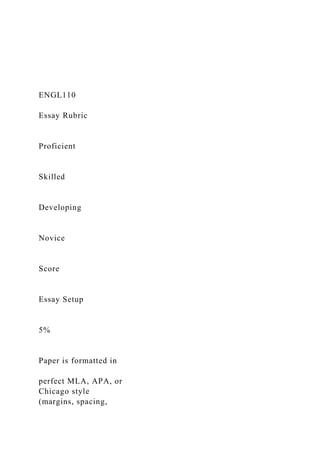
Essay Rubric
Proficient
Skilled
Developing
Novice
Score
Essay Setup
5%
Paper is formatted in
perfect MLA, APA, or
Chicago style
(margins, spacing,
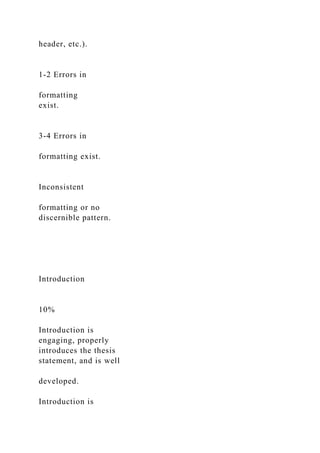
header, etc.).
1-2 Errors in
formatting
exist.
3-4 Errors in
formatting exist.
Inconsistent
formatting or no
discernible pattern.
Introduction
10%
Introduction is
engaging, properly
introduces the thesis
statement, and is well
developed.
Introduction is
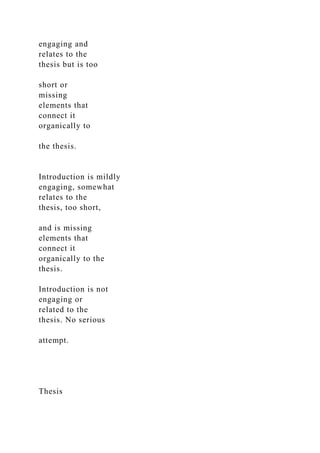
engaging and
relates to the
thesis but is too
short or
missing
elements that
connect it
organically to
the thesis.
Introduction is mildly
engaging, somewhat
relates to the
thesis, too short,
and is missing
elements that
connect it
organically to the
thesis.
Introduction is not
engaging or
related to the
thesis. No serious
attempt.
Thesis
10%
Thesis clearly
articulates the
position, scope, and
specific elements that
will be covered in the
essay.
Thesis
articulates the
position, scope,
and specific
elements that
will be covered
in the essay
with some
challenges in
wording/focus.
Thesis is attempted
but has issues with
clarity.
Thesis is
irrelevant, unclear,
too narrow, or too
broad. No serious
attempt.
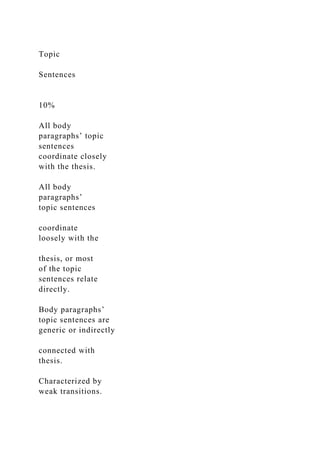
Topic
Sentences
10%
All body
paragraphs’ topic
sentences
coordinate closely
with the thesis.
All body
paragraphs’
topic sentences
coordinate
loosely with the
thesis, or most
of the topic
sentences relate
directly.
Body paragraphs’
topic sentences are
generic or indirectly
connected with
thesis.
Characterized by
weak transitions.
Weak transitions
and indirect
connections
characterize
poorly-constructed
topic sentences.
Body
Paragraphs
15%
All body paragraphs
are well developed.
All sentences support
their respective topic
sentences.
Body
paragraphs are
fairly
developed. Most
sentences
support their
respective topic
sentences.
Only one body
paragraph is
developed. Some
sentences support
their respective topic
sentences.
Body paragraphs
are present but
are too short and
do not support
their respective
topic sentences.
Grammar
20%
There are no
grammatical errors.
1-2
grammatical
errors/patterns
present, but
they do not
hinder
readability of
text.
3-5 grammatical
errors/patterns
present; mild
disruption of
readability of text.
6 or more
grammatical errors
present that
disrupt
understanding of
text.
Conclusion
10%
Conclusion is
effective, paraphrases
the thesis, and is
well developed.
Conclusion is
effective and
paraphrases the
thesis but is too
short.
Conclusion is mildly
effective, somewhat
paraphrases the
thesis, and is too
short.
Conclusion is not
effective, does
not paraphrase the
thesis, and is too
short.
In-text
Citations
10%
Signal phrases and
parenthetical
references (when
required) indicate
clearly when the
ideas, constructions,
methods, or “exact”
words of others are
used. All are
formatted according
to citation style.
Signal phrases
and
parenthetical
references are
generally, but
not perfectly,
used according
to appropriate
citation style.
Signal phrases or
parenthetical
references are
attempted but
inconsistent; may
not be formatted to
align with citation
style.
Signal phrases and
parenthetical
references are
lacking and don’t
align with citation
style.
References or
Works Cited
10%
Students correctly
and appropriately
used requisite number
of resources from
APUS library and
professional
organizations.
1-3 Errors are
present, but
student used
requisite
number of
resources from
APUS library
and professional
organizations.
4 or more errors
are present, or
student did not use
requisite number of
resources from
APUS library and
professional
organizations.
Excessive
formatting errors,
and student did
not use requisite
number of
resources from
APUS library and
professional
organizations.
Total

What Makes a Good Research Question .docx

  • 1.
    What Makes a GoodResearch Question? What is a Research Question? A research question guides and centers your research. It should be clear and focused, as well as synthesize multiple sources to present your unique argument. Even if your instructor has given you a specific assignment, the research question should ideally be something that you are interested in or care about. Be careful to avoid the “all-about” paper and questions that can be answered in a few factual statements. Examples: 1. For instance, the following question is too broad and does not define the segments of the analysis: Why did the chicken cross the road? (The question does not address which chicken or which road.) 2. Similarly, the following question could be answered by a hypothetical Internet search:
  • 2.
    How many chickenscrossed Broad Street in Durham, NC, on February 6, 2014? (Ostensibly, this question could be answered in one sentence and does not leave room for analysis. It could, however, become data for a larger argument.) 3. A more precise question might be the following: What are some of the environmental factors that occurred in Durham, NC between January and February 2014 that would cause chickens to cross Broad Street? (This question can lead to the author taking a stand on which factors are significant, and allows the writer to argue to what degree the results are beneficial or detrimental.) How Do You Formulate A Good Research Question? Choose a general topic of interest, and conduct preliminary research on this topic in current periodicals and journals to see what research has already been done. This will help determine what kinds of questions the topic generates. Once you have conducted preliminary research, consider: Who is the audience? Is it an academic essay, or will it be read by a more general public? Once you have conducted preliminary research, start asking open- ended “How?” “What?” and Why?” questions. Then evaluate possible responses to those questions.
  • 3.
    Duke Writing Studio2 Examples: Say, for instance, you want to focus on social networking sites. After reading current research, you want to examine to what degree social networking sites are harmful. The Writing Center at George Mason University provides the following examples and explanations: Possible Question: Why are social networking sites harmful? An evaluation of this question reveals that the question is unclear: it does not specify which social networking sites or state what harm is being caused. Moreover, this question takes as a given that this “harm” exists. A clearer question would be the following: Revised Question: How are online users experiencing or addressing privacy issues on such social networking sites as Facebook and Twitter? This version not only specifies the sites (Facebook and Twitter), but also the type of harm (privacy issues) and who is harmed (online users). While a good research question allows the writer to take an arguable position, it DOES NOT leave room for ambiguity.
  • 4.
    Checklist of PotentialResearch Questions in the Humanities (from the Vanderbilt University Writing Center): 1) Is the research question something I/others care about? Is it arguable? 2) Is the research question a new spin on an old idea, or does it solve a problem? 3) Is it too broad or too narrow? 4) Is the research question researchable within the given time frame and location? 5) What information is needed? Research Question in the Sciences and Social Sciences While all research questions need to take a stand, there are additional requirements for research questions in the sciences and social sciences. That is, they need to have repeatable data. Unreliable data in the original research does not allow for a strong or arguable research question. In addition, you need to consider what kind of problem you want to address. Is your research trying to accomplish one of these four goals?1 1) Define or measure a specific fact or gather facts about a specific phenomenon. 2) Match facts and theory. 3) Evaluate and compare two theories, models, or hypotheses. 4) Prove that a certain method is more effective than other methods.
  • 5.
    Moreover, the researchquestion should address what the variables of the experiment are, their relationship, and state something about the testing of those relationships. The Psychology department at California State University, Fresno, provides the following examples and explanations: 1 David Porush, A Short Guide to Writing About Science. (New York: Harper Collins, 1995), 92-93. Duke Writing Studio 3 Examples: Possible research question: Are females smarter than males? This question delineates the variables to be measured: gender and intelligence. Yet, it is unclear how they will be evaluated: What method will be used to define and measure intelligence? Revised question: Do females age 18-35 score higher than adult males age 18-35 on the WAIS-III? (The WAIS-III is a standardized intelligence test.) This research question produces data that can be replicated. From there, the author can devise a question that takes a stand.
  • 6.
    In essence, theresearch question that guides the sciences and social sciences should do the following three things:2 1) Post a problem. 2) Shape the problem into a testable hypothesis. 3) Report the results of the tested hypothesis. There are two types of data that can help shape research questions in the sciences and social sciences: quantitative and qualitative data. While quantitative data focuses on the numerical measurement and analysis between variables, qualitative data examines the social processes that give rise to the relationships, interactions, and constraints of the inquiry. Writing After the Research Question The answer to your research question should be your thesis statement. Keep in mind that you will most likely continue to refine your thesis statement as you conduct and write about your research. A good research question, however, puts you well on your way to writing a strong research paper. Helpful Links • http://writingcenter.gmu.edu/?p=307
  • 7.
    • http://vanderbilt.edu/writing/manage/wp- content/uploads/2013/06/Formulating%20Your%20Research%20 Question.pdf • http://www.esc.edu/online-writing- center/resources/research/research-paper- steps/developing-questions/ • http://psych.csufresno.edu/psy144/Content/Science/researchques tion.html 2Lee Cuba, A Short Guide to Writing About Social Science, third edition. (New York: Addison-Wesley Educational Publishers, Inc., 1997), 70-71. Review Material https://www.youtube.com/watch?v=uvJD1sSt1PM https://www.youtube.com/watch?v=56L_7QJZyRQ Discussion Why is conduit used or sometimes required? What is determined by ratings on a receptacle? Why are GFCI’s used and how do they work? Why does voltage drop in a circuit? Assignment Determine the power factor when true power of an electrical circuit is 1000W and apparent power is 1700 VA. Also, for a heater rated at 3000 W, how much energy is used in
  • 8.
    2 and 10hours? Review Material https://www.youtube.com/watch?v=uvJD1sSt1PM https://www.youtube.com/watch?v=56L_7QJZyRQ Discussion Why is conduit used or sometimes required? What is determined by ratings on a receptacle? Why are GFCI’s used and how do they work? Why does voltage drop in a circuit? Assignment Determine the power factor when true power of an electrical circuit is 1000W and apparen t power is 1700 VA. Also, for a heater rated at 3000 W, how much energy is used in 2 and 10 hours?
  • 9.
    Review Material https://www.youtube.com/watch?v=uvJD1sSt1PM https://www.youtube.com/watch?v=56L_7QJZyRQ Discussion Why isconduit used or sometimes required? What is determined by ratings on a receptacle? Why are GFCI’s used and how do they work? Why does voltage drop in a circuit? Assignment Determine the power factor when true power of an electrical circuit is 1000W and apparent power is 1700 VA. Also, for a heater rated at 3000 W, how much energy is used in 2 and 10 hours? Responses I D Why is conduit used or sometimes required? Conduit is a rugged protective tube through which insulated conductors are pulled. Metal conduit can be used to shield sensitive circuits from electromagnetic interference, and also can prevent emission of such interference from enclosed power cables. Non-metallic conduits resist corrosion and are light weight, reducing installation labor cost. Respond: What is determined by ratings on a receptacle? A receptacle is a contact device installed for the connection of plugs and flexible cords to supply current to portable electrical equipment. Ratings on a receptacle determine the number of contacts and the configuration in which the slots are positioned in the receptacle. There are a large number of configurations
  • 10.
    and diagrams forreceptacles encountered in residential construction work. Respond: Why are GFCI’s used and how do they work? A ground fault circuit interpreter (GFCI) is a fast-acting receptacle that detects low levels of leakage current to ground and opens the circuit in response to the leakage. GFCI’s provide greater protection than standard or isolated ground receptacles. They provide protection for humans against electric shock by providing the alternating current flow resistance path. Respond: DG What is determined by ratings on a receptacle? Rating determine the number of contacts and the configuration in which slots are positioned in the receptacle. There are many configurations and diagrams for receptacle encountered in residential construction work. They are designed for straight blade or locking type plugs. Locking type receptables are more common in commercial and industrial applications than in residential work. Respond: Why are GFCI’s used and how do they work? A ground fault circuit interrupter is a fast-acting receptacle that detects low levels of leakage current to ground and opens the circuit in response to the leakage. GFCI’s do no protect against line-to-line contact. GFCI protect the following areas such as bathrooms, swimming pools, residential garages, or anywhere electrical circuits can meet water. Respond: Why does voltage drop in a circuit? Voltage drop occurs when there is a loss of voltage through the circuit. When drops occur, lights can flicker, or bulbs can burn out causing the load to work harder with less output.
  • 11.
    Respond: M U What isdetermined by ratings on a receptacle? The ratings of a receptacle help establish rules over how many contact points and how these contact points are positioned within the receptacle. These receptacles are created to accept locking type or single blade plugs that can be unique to certain countries as well. All of these details should be highlighted on the electrical plans so that they are properly installed in a residential or commercial property. Respond: Why are GFCI's used and how do they work? A ground fault circuit interrupter is a receptacle that compares the current on both sides of the circuit to ensure that they are safe from any possible electric shocks. These are especially important to use in areas where they can be exposed to moisture, as water is a very good conductor of electric energy. Respond: Why does a voltage drop in a circuit? The main reason that voltage usually drops in a circuit is that the circuit becomes overloaded with extra connections or a power source that takes the capacity of that series over the top. When this happens there will usually be flickering or dimming of lights which indicates that the capacity of the terminal has been exceeded. Respond: Responses
  • 12.
    I D Why isconduit used or sometimes r equired? Conduit is a rugged protective tube through which insulated conductors are pulled. Metal conduit can be used to shield sensitive circuits from electromagnetic interference, and also can prevent emission of such interference from enclosed power ca bles. Non - metallic conduits resist corrosion and are light weight, reducing installation labor cost. Respon d : What is determined by ratings on a receptacle? A receptacle is a contact device installed for the connection of plugs and flexible cords to supply current to portable electrical equipment. Ratings on a receptacle determine the number of contacts and the configuration in which the slots are positioned in the receptacle. There are a large number of configurations and diagrams for receptacles encountered in r
  • 13.
    esidential construction work. Respond : Whyare GFCI’s used and how do they work? A ground fault circuit interpreter (GFCI) is a fast - acting receptacle that detects low levels of leakage current to ground and opens the circuit in response to the leakage. GFCI’s pro vide greater protection than standard or isolated ground receptacles. They provide protection for humans against electric shock by providing the alternating current flow resistance path. Respond : DG What is determined by ratings on a receptacle? Rating determine the number of contacts and the configuration in which slots are positioned in the receptacle. There are many configurations and diagrams for recept acle encountered in residential construction work. They are designed for straight blade or
  • 14.
    locking type plugs.Locking type receptables are more common in commercial and industrial applications than in residential work. Respond : Why are GFCI’s used and ho w do they work? A ground fault circuit interrupter is a fast - acting receptacle that detects low levels of leakage current to ground and opens the circuit in response to the leakage. GFCI’s do no protect against line - to - line contact. GFCI protect the follo wing areas such as bathrooms, swimming pools, residential garages, or anywhere electrical circuits can meet water. Re s p
  • 15.
    ond : Responses I D Why isconduit used or sometimes required? Conduit is a rugged protective tube through which insulated conductors are pulled. Metal conduit can be used to shield sensitive circuits from electromagnetic interference, and also can prevent emission of such interference from enclosed power cables. Non-metallic conduits resist corrosion and are light weight, reducing installation labor cost. Respond: What is determined by ratings on a receptacle? A receptacle is a contact device installed for the connection of plugs and flexible cords to supply current to portable electrical equipment. Ratings on a receptacle determine the number of contacts and the configuration in which the slots are positioned in the receptacle. There are a large number of configurations and diagrams for receptacles encountered in residential construction work. Respond: Why are GFCI’s used and how do they work? A ground fault circuit interpreter (GFCI) is a fast-acting receptacle that detects low levels of leakage current to ground and opens the circuit in response to the leakage. GFCI’s provide greater protection than standard or isolated ground receptacles. They provide protection for humans against electric shock by providing the alternating current flow resistance path. Respond: DG What is determined by ratings on a receptacle?
  • 16.
    Rating determine thenumber of contacts and the configuration in which slots are positioned in the receptacle. There are many configurations and diagrams for receptacle encountered in residential construction work. They are designed for straight blade or locking type plugs. Locking type receptables are more common in commercial and industrial applications than in residential work. Respond: Why are GFCI’s used and how do they work? A ground fault circuit interrupter is a fast-acting receptacle that detects low levels of leakage current to ground and opens the circuit in response to the leakage. GFCI’s do no protect against line-to-line contact. GFCI protect the following areas such as bathrooms, swimming pools, residential garages, or anywhere electrical circuits can meet water. Respond: www.vanderbilt.edu/writing Revised 08/08/2007 Formulating Your Research Question (RQ) In a research paper, the emphasis is on generating a unique question and then synthesizing diverse sources into a coherent essay that supports your argument about the topic. In other words, you integrate information from publications with your own thoughts in order to formulate an argument. Your topic is your starting place: from here, you will develop an engaging research question. Merely
  • 17.
    presenting a topicin the form of a question does not transform it into a good research question. For example: RESEARCH TOPIC RESEARCH QUESTION BROAD NARROWER “What forces affect race relations in America?” “How do corporate hiring practices affect race relations in Nashville?” Likewise, the question “What is the percentage of racial minorities holding management positions in corporate offices in Nashville?” is much too specific and would yield, at best, a statistic that could become part of a larger argument. NEUTRAL MAY YIELD an ARGUMENT or POSITION “How does KFC market its low-fat food offerings?” “Does KFC put more money into marketing its high-fat food offerings than its lower-fat ones?” The latter question is somewhat better, since it may lead you to take a stance or formulate an argument about consumer awareness or benefit. OBJECTIVE (factual) SUBJECTIVE (an issue about which you can take a side) “How much time do youth between the ages of 10 and 15 spend playing video games?” “What are the effects of video-gaming on the attention spans of youth between the ages of 10 and 15?
  • 18.
    The first questionis likely to lead to some data, though not necessarily to an argument or issue. The second question is somewhat better, since it might lead you to formulate an argument for or against time spent playing video games. OPEN-ENDED IDEA GIVES DIRECTION TO RESEARCH “Does the author of this text use allusion?” “Does the ironic use of allusion in this text reveal anything about the author’s unwillingness to divulge his political commitments?” The second question gives focus by putting the use of allusion into the specific context of a question about the author’s political commitments and perhaps also about the circumstances under which the text was produced. Research Question Checklist: hat others might care about? Does it present an issue on which I can take a stand? solve a problem? o …within the time frame of the assignment? o …given the resources available at my location? Can I find actual data to support or contradict a position? that I need to
  • 19.
    answer my RQ(journals, books, internet resources, government documents, interviews with people)? The answer to a good research question will often be the THESIS of your research paper! And the results of your research may not always be what you expected them to be. Not only is this ok, it can be an indication that you are doing careful work! Adapted from an online tutorial at Empire State College: http://www.esc.edu/htmlpages/writerold/menus.htm#develop Generating Your Research Idea Worksheet Identify your research theme, the general area you would like to investigate. Be sure to write in the form of a question. Identify your research question. Based on this theme, can you identify several more specific
  • 20.
    research questions? Besure to write in the form of a question. Next, rewrite your question, getting even more specific and reducing your question to an even smaller unit. Write each of your question(s) on a smaller scale, in terms as precise as possible. Be sure to write in the form of a question. Identify the questions that make the most sense to you, questions that can actually be answered within the scope of this assignment. Review your questions and write the question that is at the level that makes the most sense to you. Finally, identify some key words affiliated with this topic. You might want to do some preliminary Googling of your topic to find such key words. These are the key words you’ll type into the APUS library search to find articles. Broad Key Words Specific Key Words
  • 21.
    ENGL110 Essay Rubric Proficient Skilled Developing Novice Score Essay Setup 5% Paperis formatted in perfect MLA, APA, or Chicago style (margins, spacing,
  • 22.
    header, etc.). 1-2 Errorsin formatting exist. 3-4 Errors in formatting exist. Inconsistent formatting or no discernible pattern. Introduction 10% Introduction is engaging, properly introduces the thesis statement, and is well developed. Introduction is
  • 23.
    engaging and relates tothe thesis but is too short or missing elements that connect it organically to the thesis. Introduction is mildly engaging, somewhat relates to the thesis, too short, and is missing elements that connect it organically to the thesis. Introduction is not engaging or related to the thesis. No serious attempt. Thesis
  • 24.
    10% Thesis clearly articulates the position,scope, and specific elements that will be covered in the essay. Thesis articulates the position, scope, and specific elements that will be covered in the essay with some challenges in wording/focus. Thesis is attempted but has issues with clarity. Thesis is irrelevant, unclear, too narrow, or too broad. No serious attempt.
  • 25.
    Topic Sentences 10% All body paragraphs’ topic sentences coordinateclosely with the thesis. All body paragraphs’ topic sentences coordinate loosely with the thesis, or most of the topic sentences relate directly. Body paragraphs’ topic sentences are generic or indirectly connected with thesis. Characterized by weak transitions.
  • 26.
    Weak transitions and indirect connections characterize poorly-constructed topicsentences. Body Paragraphs 15% All body paragraphs are well developed. All sentences support their respective topic sentences. Body paragraphs are fairly developed. Most sentences support their respective topic
  • 27.
    sentences. Only one body paragraphis developed. Some sentences support their respective topic sentences. Body paragraphs are present but are too short and do not support their respective topic sentences. Grammar 20% There are no grammatical errors. 1-2 grammatical errors/patterns present, but
  • 28.
    they do not hinder readabilityof text. 3-5 grammatical errors/patterns present; mild disruption of readability of text. 6 or more grammatical errors present that disrupt understanding of text. Conclusion 10% Conclusion is effective, paraphrases the thesis, and is well developed.
  • 29.
    Conclusion is effective and paraphrasesthe thesis but is too short. Conclusion is mildly effective, somewhat paraphrases the thesis, and is too short. Conclusion is not effective, does not paraphrase the thesis, and is too short. In-text Citations
  • 30.
    10% Signal phrases and parenthetical references(when required) indicate clearly when the ideas, constructions, methods, or “exact” words of others are used. All are formatted according to citation style. Signal phrases and parenthetical references are generally, but not perfectly, used according to appropriate citation style. Signal phrases or parenthetical references are
  • 31.
    attempted but inconsistent; may notbe formatted to align with citation style. Signal phrases and parenthetical references are lacking and don’t align with citation style. References or Works Cited 10% Students correctly and appropriately used requisite number of resources from APUS library and professional organizations. 1-3 Errors are present, but
  • 32.
    student used requisite number of resourcesfrom APUS library and professional organizations. 4 or more errors are present, or student did not use requisite number of resources from APUS library and professional organizations. Excessive formatting errors, and student did not use requisite number of resources from APUS library and professional organizations.
  • 33.