Guide on Conceptualizing
and Preparing
IT Capstone Research Proposal
Introduction to IT Capstone
What is a Capstone project?
The capstone project has become an integral part of the university
degree curriculum. It can take many various forms, but its purpose
remains the same. The capstone project is a unique opportunity to
carry out independent group research in order to devise an innovative
solution for a real-world problem.
The capstone project is usually the final assignment and plays a vital
role in preparing students for the world of work thanks to its practical
applications and ability to help hone students’ professional knowledge
and skills.
Scope of Research in DLL
Basic research is an experimental or theoretical analysis carried out solely for the purpose of gaining new
knowledge of the fundamental basis of phenomena and observable data, with no specific or complex
application or use in mind.
Applied research is an original investigation carried out with the intention of developing new knowledge
and aimed pri- marily at achieving a specific goal or objective.
Development Research is a systematic work that builds on established expertise gained through research
and/or practi- cal experience, with the goal of developing new materials, goods, or devices, implementing
new methods, systems, and ser- vices, and significantly improving those that have already been developed
or installed.
Participatory / Intervention Research focuses on social change that promotes democracy and challenges
inequality; it is context-relevant, often targeting the needs of a specific group; it is an iterative cycle of
research, action, and reflection; and it often aims to ‘liberate' participants by increasing their understanding
of their condition so that they can take action.
The DLL-BSIT Research Thrust
1. ICT in Learning and Teaching
2. Technology and Policy
3. Computers, New Normal Learning/Teaching Environments and Technological
Literacy/Competency.
4. Technology in Educational Management Innovations in Health Care
5. Artificial Intelligence
6. ICT infused Education & E- Learning
7. Web-Based Application on Innovation and Development
8. ICT for Development ( usage and application in Government)
9. Sensors for Environment (Rain & flood monitoring and Alarm System)
10. Big Data Management and Analytics
11. Embedded Systems
12. Systems for rural and urban planning and management
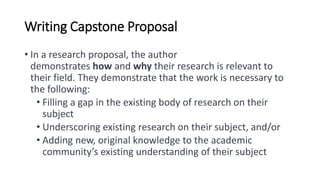
Writing Capstone Proposal
• In a research proposal, the author
demonstrates how and why their research is relevant to
their field. They demonstrate that the work is necessary to
the following:
• Filling a gap in the existing body of research on their
subject
• Underscoring existing research on their subject, and/or
• Adding new, original knowledge to the academic
community’s existing understanding of their subject
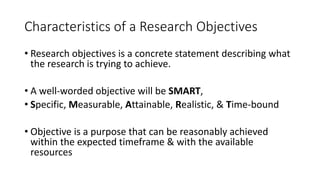
Characteristics of a Research Objectives
• Research objectives is a concrete statement describing what
the research is trying to achieve.
• A well-worded objective will be SMART,
• Specific, Measurable, Attainable, Realistic, & Time-bound
• Objective is a purpose that can be reasonably achieved
within the expected timeframe & with the available
resources
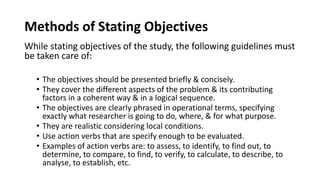
Methods of Stating Objectives
While stating objectives of the study, the following guidelines must
be taken care of:
• The objectives should be presented briefly & concisely.
• They cover the different aspects of the problem & its contributing
factors in a coherent way & in a logical sequence.
• The objectives are clearly phrased in operational terms, specifying
exactly what researcher is going to do, where, & for what purpose.
• They are realistic considering local conditions.
• Use action verbs that are specify enough to be evaluated.
• Examples of action verbs are: to assess, to identify, to find out, to
determine, to compare, to find, to verify, to calculate, to describe, to
analyse, to establish, etc.
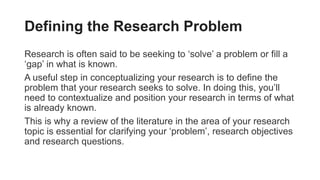
Defining the Research Problem
Research is often said to be seeking to ‘solve’ a problem or fill a
‘gap’ in what is known.
A useful step in conceptualizing your research is to define the
problem that your research seeks to solve. In doing this, you’ll
need to contextualize and position your research in terms of what
is already known.
This is why a review of the literature in the area of your research
topic is essential for clarifying your ‘problem’, research objectives
and research questions.
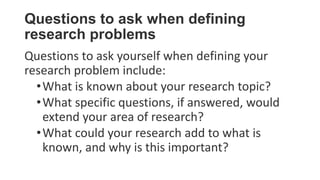
Questions to ask when defining
research problems
Questions to ask yourself when defining your
research problem include:
•What is known about your research topic?
•What specific questions, if answered, would
extend your area of research?
•What could your research add to what is
known, and why is this important?
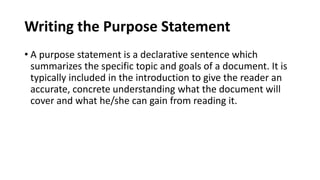
Writing the Purpose Statement
• A purpose statement is a declarative sentence which
summarizes the specific topic and goals of a document. It is
typically included in the introduction to give the reader an
accurate, concrete understanding what the document will
cover and what he/she can gain from reading it.
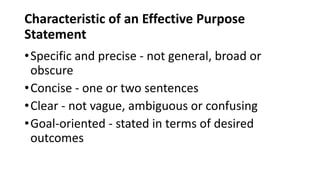
Characteristic of an Effective Purpose
Statement
•Specific and precise - not general, broad or
obscure
•Concise - one or two sentences
•Clear - not vague, ambiguous or confusing
•Goal-oriented - stated in terms of desired
outcomes
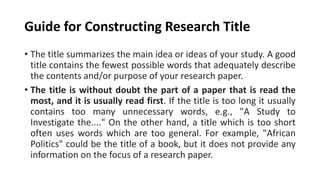
Guide for Constructing Research Title
• The title summarizes the main idea or ideas of your study. A good
title contains the fewest possible words that adequately describe
the contents and/or purpose of your research paper.
• The title is without doubt the part of a paper that is read the
most, and it is usually read first. If the title is too long it usually
contains too many unnecessary words, e.g., "A Study to
Investigate the...." On the other hand, a title which is too short
often uses words which are too general. For example, "African
Politics" could be the title of a book, but it does not provide any
information on the focus of a research paper.
Structure and Writing Style
The following parameters can be used to help you formulate a
suitable research paper title:
1.The purpose of the research
2.The narrative tone of the paper [typically defined by the type of
the research]
3.The methods used
The initial aim of a title is to capture the reader’s attention and to
draw his or her attention to the research problem being
investigated.
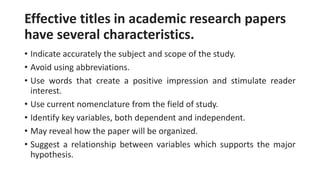
Effective titles in academic research papers
have several characteristics.
• Indicate accurately the subject and scope of the study.
• Avoid using abbreviations.
• Use words that create a positive impression and stimulate reader
interest.
• Use current nomenclature from the field of study.
• Identify key variables, both dependent and independent.
• May reveal how the paper will be organized.
• Suggest a relationship between variables which supports the major
hypothesis.
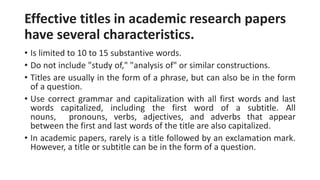
Effective titles in academic research papers
have several characteristics.
• Is limited to 10 to 15 substantive words.
• Do not include "study of," "analysis of" or similar constructions.
• Titles are usually in the form of a phrase, but can also be in the form
of a question.
• Use correct grammar and capitalization with all first words and last
words capitalized, including the first word of a subtitle. All
nouns, pronouns, verbs, adjectives, and adverbs that appear
between the first and last words of the title are also capitalized.
• In academic papers, rarely is a title followed by an exclamation mark.
However, a title or subtitle can be in the form of a question.

Guide on IT Capstone Research Proposal.pptx

  • 1.
    Guide on Conceptualizing andPreparing IT Capstone Research Proposal Introduction to IT Capstone
  • 2.
    What is aCapstone project? The capstone project has become an integral part of the university degree curriculum. It can take many various forms, but its purpose remains the same. The capstone project is a unique opportunity to carry out independent group research in order to devise an innovative solution for a real-world problem. The capstone project is usually the final assignment and plays a vital role in preparing students for the world of work thanks to its practical applications and ability to help hone students’ professional knowledge and skills.
  • 3.
    Scope of Researchin DLL Basic research is an experimental or theoretical analysis carried out solely for the purpose of gaining new knowledge of the fundamental basis of phenomena and observable data, with no specific or complex application or use in mind. Applied research is an original investigation carried out with the intention of developing new knowledge and aimed pri- marily at achieving a specific goal or objective. Development Research is a systematic work that builds on established expertise gained through research and/or practi- cal experience, with the goal of developing new materials, goods, or devices, implementing new methods, systems, and ser- vices, and significantly improving those that have already been developed or installed. Participatory / Intervention Research focuses on social change that promotes democracy and challenges inequality; it is context-relevant, often targeting the needs of a specific group; it is an iterative cycle of research, action, and reflection; and it often aims to ‘liberate' participants by increasing their understanding of their condition so that they can take action.
  • 4.
    The DLL-BSIT ResearchThrust 1. ICT in Learning and Teaching 2. Technology and Policy 3. Computers, New Normal Learning/Teaching Environments and Technological Literacy/Competency. 4. Technology in Educational Management Innovations in Health Care 5. Artificial Intelligence 6. ICT infused Education & E- Learning 7. Web-Based Application on Innovation and Development 8. ICT for Development ( usage and application in Government) 9. Sensors for Environment (Rain & flood monitoring and Alarm System) 10. Big Data Management and Analytics 11. Embedded Systems 12. Systems for rural and urban planning and management
  • 5.
    Writing Capstone Proposal •In a research proposal, the author demonstrates how and why their research is relevant to their field. They demonstrate that the work is necessary to the following: • Filling a gap in the existing body of research on their subject • Underscoring existing research on their subject, and/or • Adding new, original knowledge to the academic community’s existing understanding of their subject
  • 6.
    Characteristics of aResearch Objectives • Research objectives is a concrete statement describing what the research is trying to achieve. • A well-worded objective will be SMART, • Specific, Measurable, Attainable, Realistic, & Time-bound • Objective is a purpose that can be reasonably achieved within the expected timeframe & with the available resources
  • 7.
    Methods of StatingObjectives While stating objectives of the study, the following guidelines must be taken care of: • The objectives should be presented briefly & concisely. • They cover the different aspects of the problem & its contributing factors in a coherent way & in a logical sequence. • The objectives are clearly phrased in operational terms, specifying exactly what researcher is going to do, where, & for what purpose. • They are realistic considering local conditions. • Use action verbs that are specify enough to be evaluated. • Examples of action verbs are: to assess, to identify, to find out, to determine, to compare, to find, to verify, to calculate, to describe, to analyse, to establish, etc.
  • 8.
    Defining the ResearchProblem Research is often said to be seeking to ‘solve’ a problem or fill a ‘gap’ in what is known. A useful step in conceptualizing your research is to define the problem that your research seeks to solve. In doing this, you’ll need to contextualize and position your research in terms of what is already known. This is why a review of the literature in the area of your research topic is essential for clarifying your ‘problem’, research objectives and research questions.
  • 9.
    Questions to askwhen defining research problems Questions to ask yourself when defining your research problem include: •What is known about your research topic? •What specific questions, if answered, would extend your area of research? •What could your research add to what is known, and why is this important?
  • 10.
    Writing the PurposeStatement • A purpose statement is a declarative sentence which summarizes the specific topic and goals of a document. It is typically included in the introduction to give the reader an accurate, concrete understanding what the document will cover and what he/she can gain from reading it.
  • 11.
    Characteristic of anEffective Purpose Statement •Specific and precise - not general, broad or obscure •Concise - one or two sentences •Clear - not vague, ambiguous or confusing •Goal-oriented - stated in terms of desired outcomes
  • 12.
    Guide for ConstructingResearch Title • The title summarizes the main idea or ideas of your study. A good title contains the fewest possible words that adequately describe the contents and/or purpose of your research paper. • The title is without doubt the part of a paper that is read the most, and it is usually read first. If the title is too long it usually contains too many unnecessary words, e.g., "A Study to Investigate the...." On the other hand, a title which is too short often uses words which are too general. For example, "African Politics" could be the title of a book, but it does not provide any information on the focus of a research paper.
  • 13.
    Structure and WritingStyle The following parameters can be used to help you formulate a suitable research paper title: 1.The purpose of the research 2.The narrative tone of the paper [typically defined by the type of the research] 3.The methods used The initial aim of a title is to capture the reader’s attention and to draw his or her attention to the research problem being investigated.
  • 14.
    Effective titles inacademic research papers have several characteristics. • Indicate accurately the subject and scope of the study. • Avoid using abbreviations. • Use words that create a positive impression and stimulate reader interest. • Use current nomenclature from the field of study. • Identify key variables, both dependent and independent. • May reveal how the paper will be organized. • Suggest a relationship between variables which supports the major hypothesis.
  • 15.
    Effective titles inacademic research papers have several characteristics. • Is limited to 10 to 15 substantive words. • Do not include "study of," "analysis of" or similar constructions. • Titles are usually in the form of a phrase, but can also be in the form of a question. • Use correct grammar and capitalization with all first words and last words capitalized, including the first word of a subtitle. All nouns, pronouns, verbs, adjectives, and adverbs that appear between the first and last words of the title are also capitalized. • In academic papers, rarely is a title followed by an exclamation mark. However, a title or subtitle can be in the form of a question.