Research Topics and
Questions
Adapted from material published by the George Mason Writing Center
and materials developed by Shona McCombes, 2019.
What makes a good topic?
• Is it debatable?
• Is it researchable?
• Is it interesting, original, different?
• Is there a question to ask about the topic?
A strong topic...
• Is limited in scope, rather than broad and encyclopedic
• Will appeal to and interest a knowledgable audience
• Will require that you stretch yourself intellectually
• Seems practical (within your means) to research
• Sincerely interests you
A research question is the
foundation of your research
project.
It is the question your research
is intended to answer.
Your research question should be:
1.Clear – it is specific with all the information the audience
needs
2.Focused – it can be fully addressed in the limits of the
paper
3.Concise – it is written with the fewest possible words
4.Complex – it is not a yes or no question
5.Arguable – it’s open to debate
How to develop a research question
Choose an interesting general topic.
How to develop a research question
Do preliminary research on your general
topic.
How to develop a research question
Consider your audience.
How to develop a research question
Start asking questions.
How to develop a research question
Evaluate your questions.
How to develop a research question
Focus and continue your research.
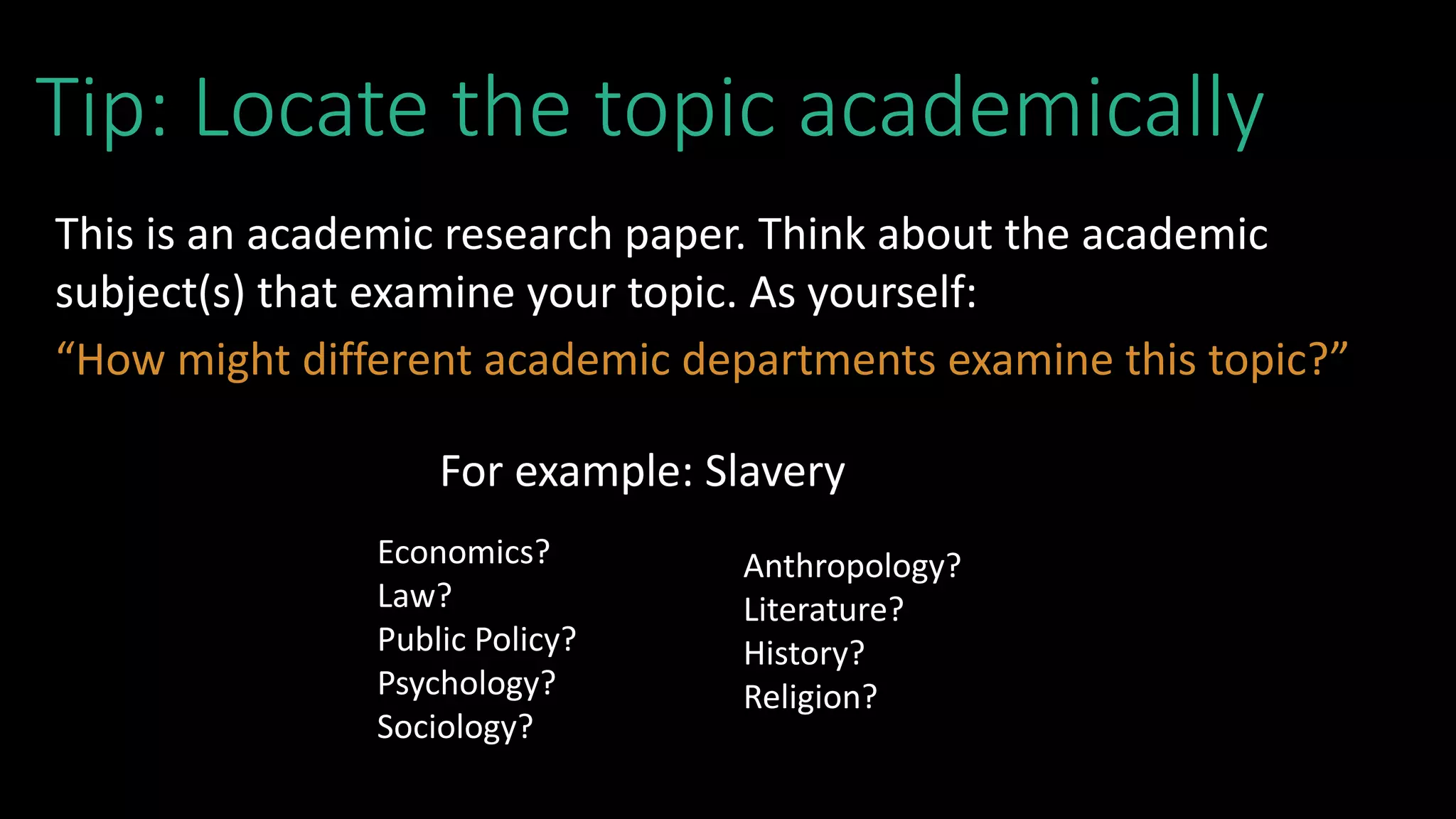
Tip: Locate the topic academically
This is an academic research paper. Think about the academic
subject(s) that examine your topic. As yourself:
“How might different academic departments examine this topic?”
For example: Slavery
Economics?
Law?
Public Policy?
Psychology?
Sociology?
Anthropology?
Literature?
History?
Religion?
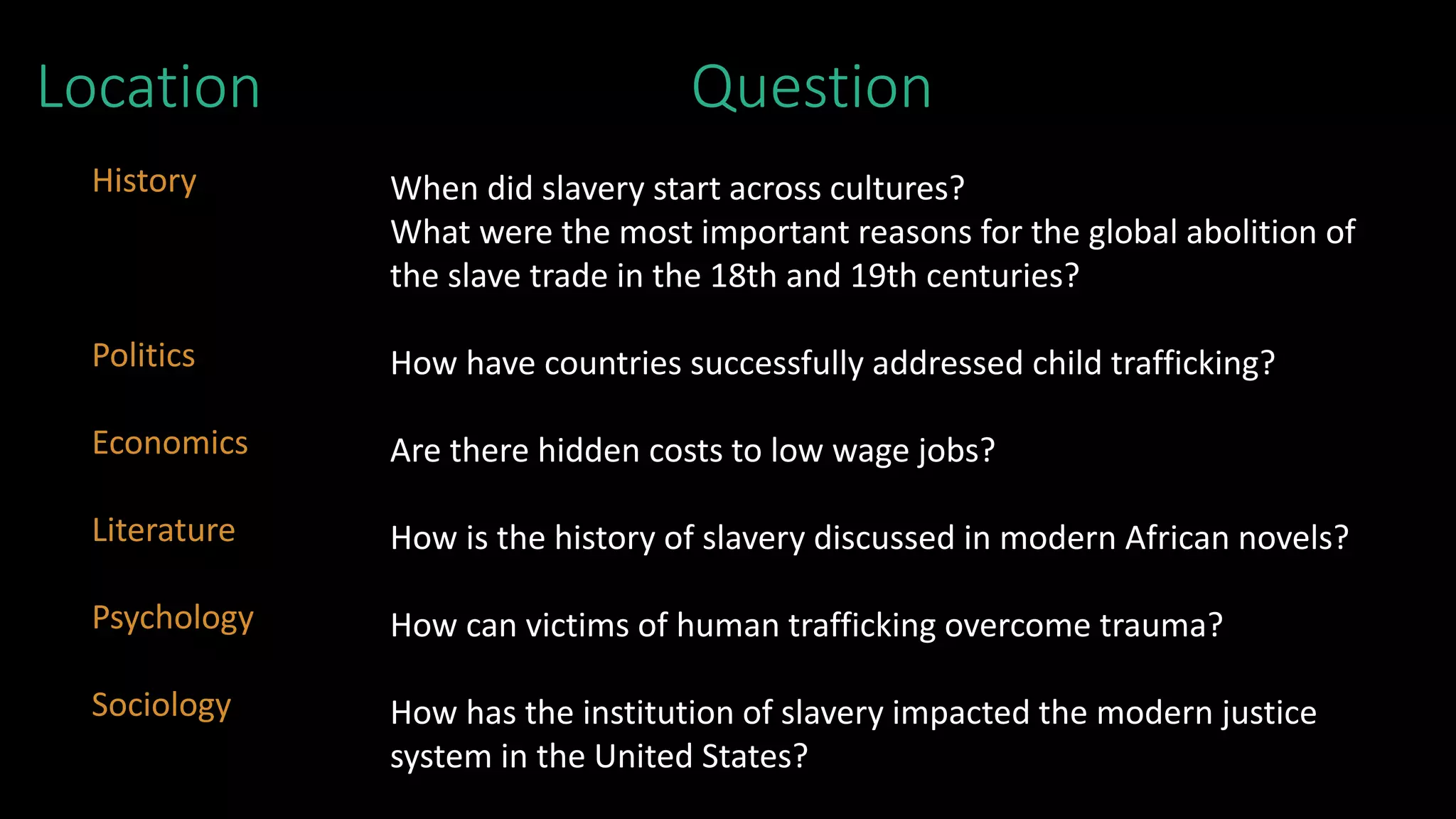
Location Question
History
Politics
Economics
Literature
Psychology
Sociology
When did slavery start across cultures?
What were the most important reasons for the global abolition of
the slave trade in the 18th and 19th centuries?
How have countries successfully addressed child trafficking?
Are there hidden costs to low wage jobs?
How is the history of slavery discussed in modern African novels?
How can victims of human trafficking overcome trauma?
How has the institution of slavery impacted the modern justice
system in the United States?
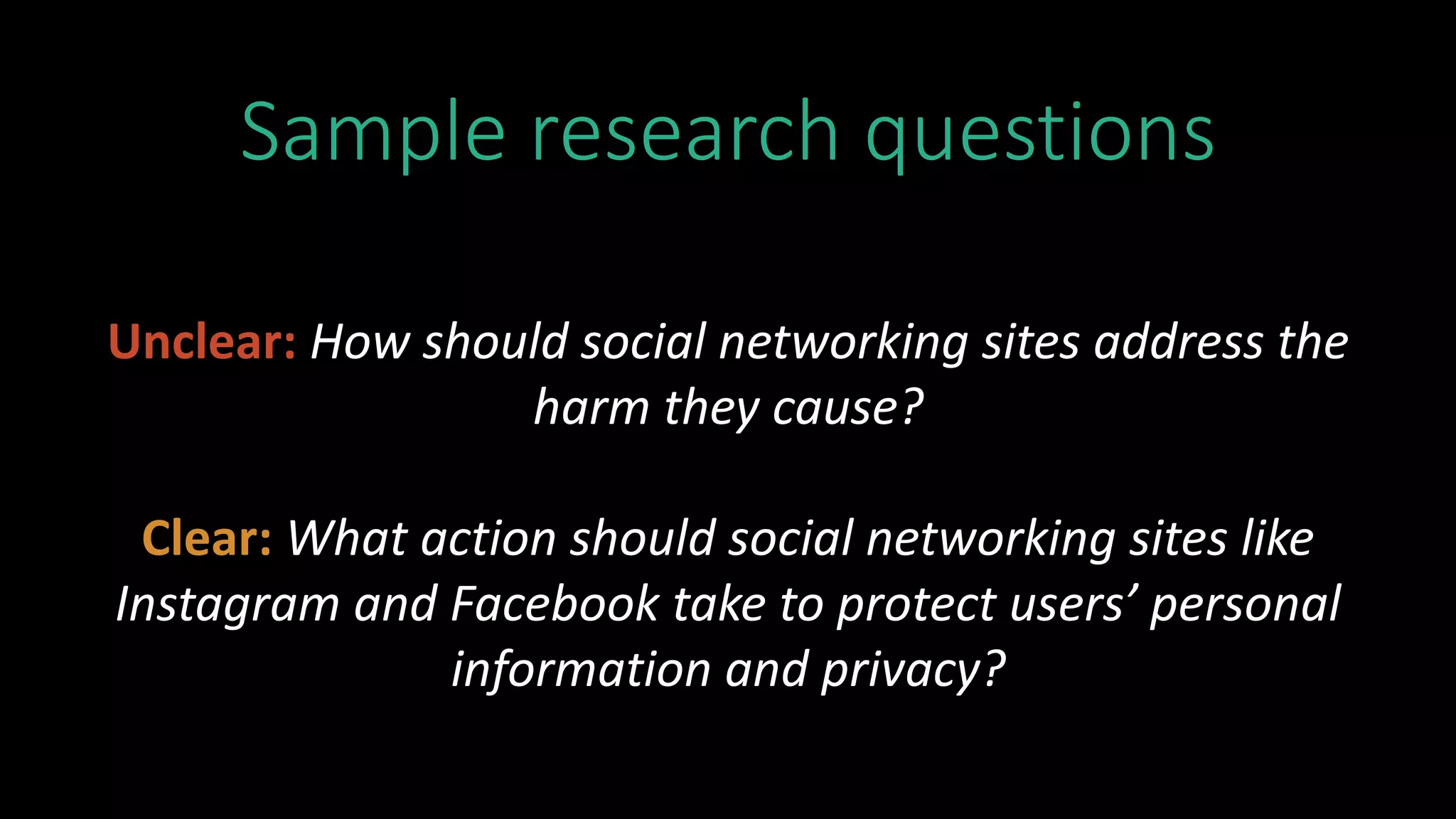
Sample research questions
Unclear: How should social networking sites address the
harm they cause?
Clear: What action should social networking sites like
Instagram and Facebook take to protect users’ personal
information and privacy?
Sample research questions
Unfocused: What is the effect on the environment from
global warming?
Focused: What is the most significant effect of glacial
melting on the ecosystem of Greenland?
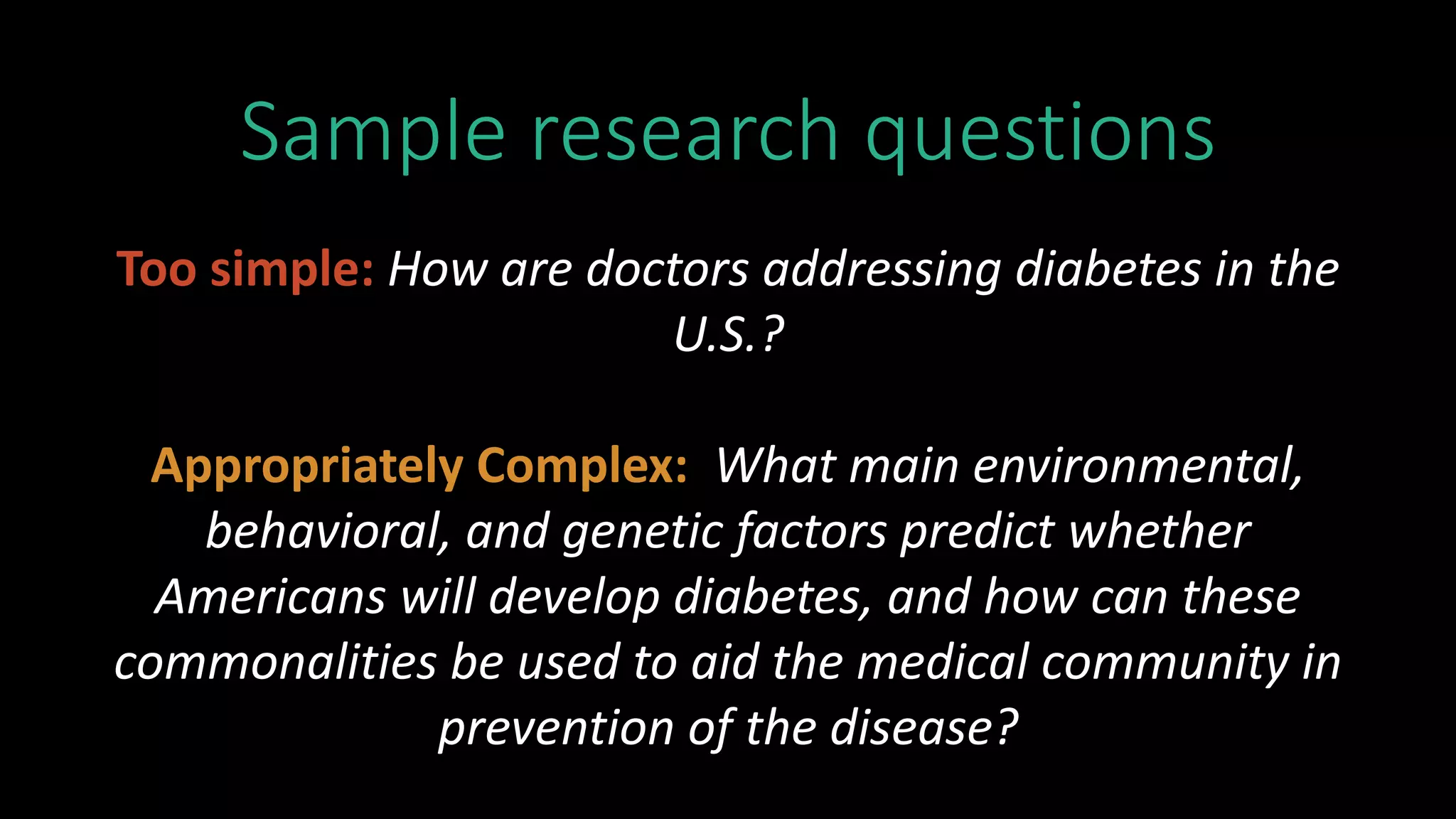
Sample research questions
Too simple: How are doctors addressing diabetes in the
U.S.?
Appropriately Complex: What main environmental,
behavioral, and genetic factors predict whether
Americans will develop diabetes, and how can these
commonalities be used to aid the medical community in
prevention of the disease?
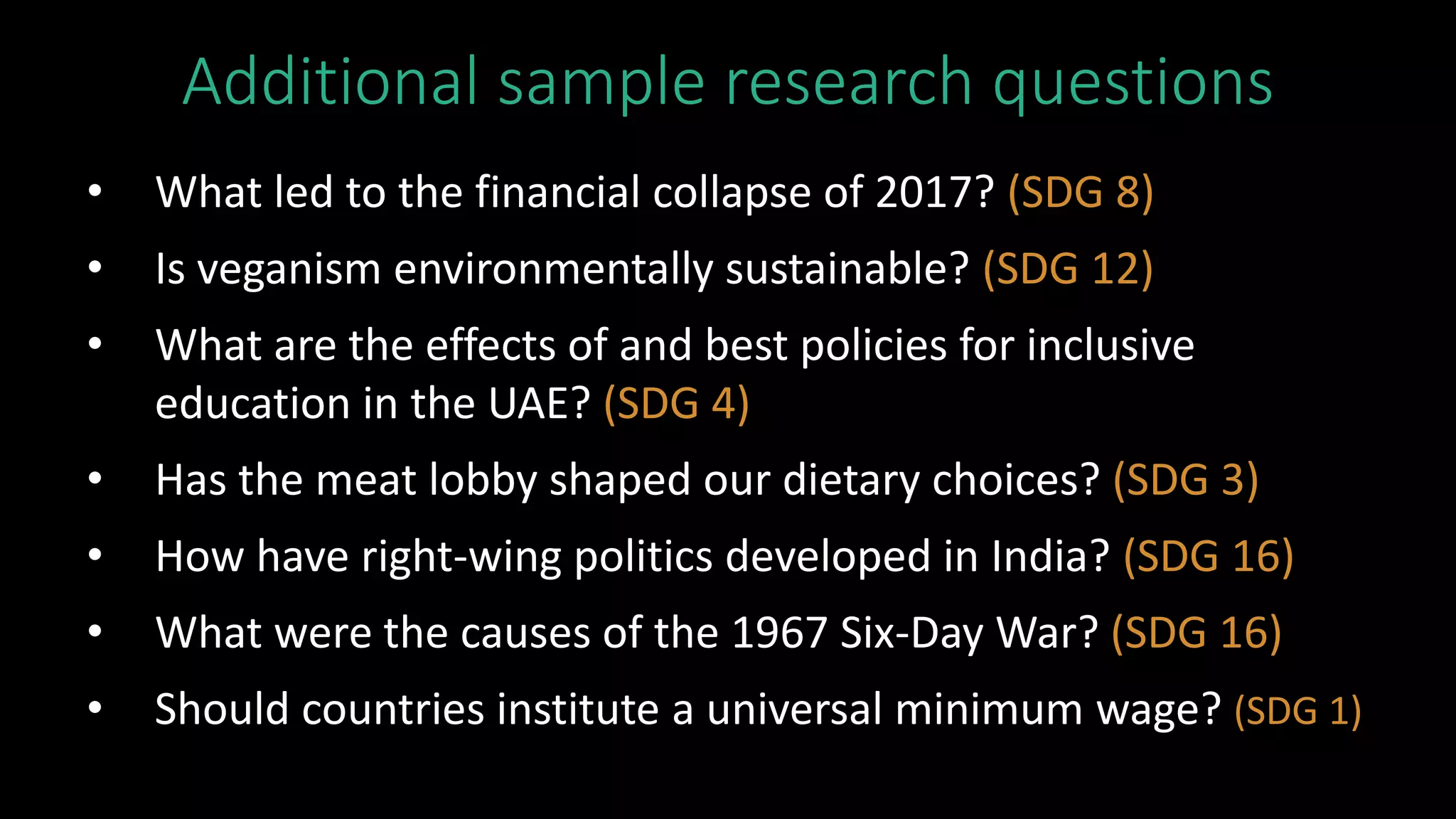
Additional sample research questions
• What led to the financial collapse of 2017? (SDG 8)
• Is veganism environmentally sustainable? (SDG 12)
• What are the effects of and best policies for inclusive
education in the UAE? (SDG 4)
• Has the meat lobby shaped our dietary choices? (SDG 3)
• How have right-wing politics developed in India? (SDG 16)
• What were the causes of the 1967 Six-Day War? (SDG 16)
• Should countries institute a universal minimum wage? (SDG 1)
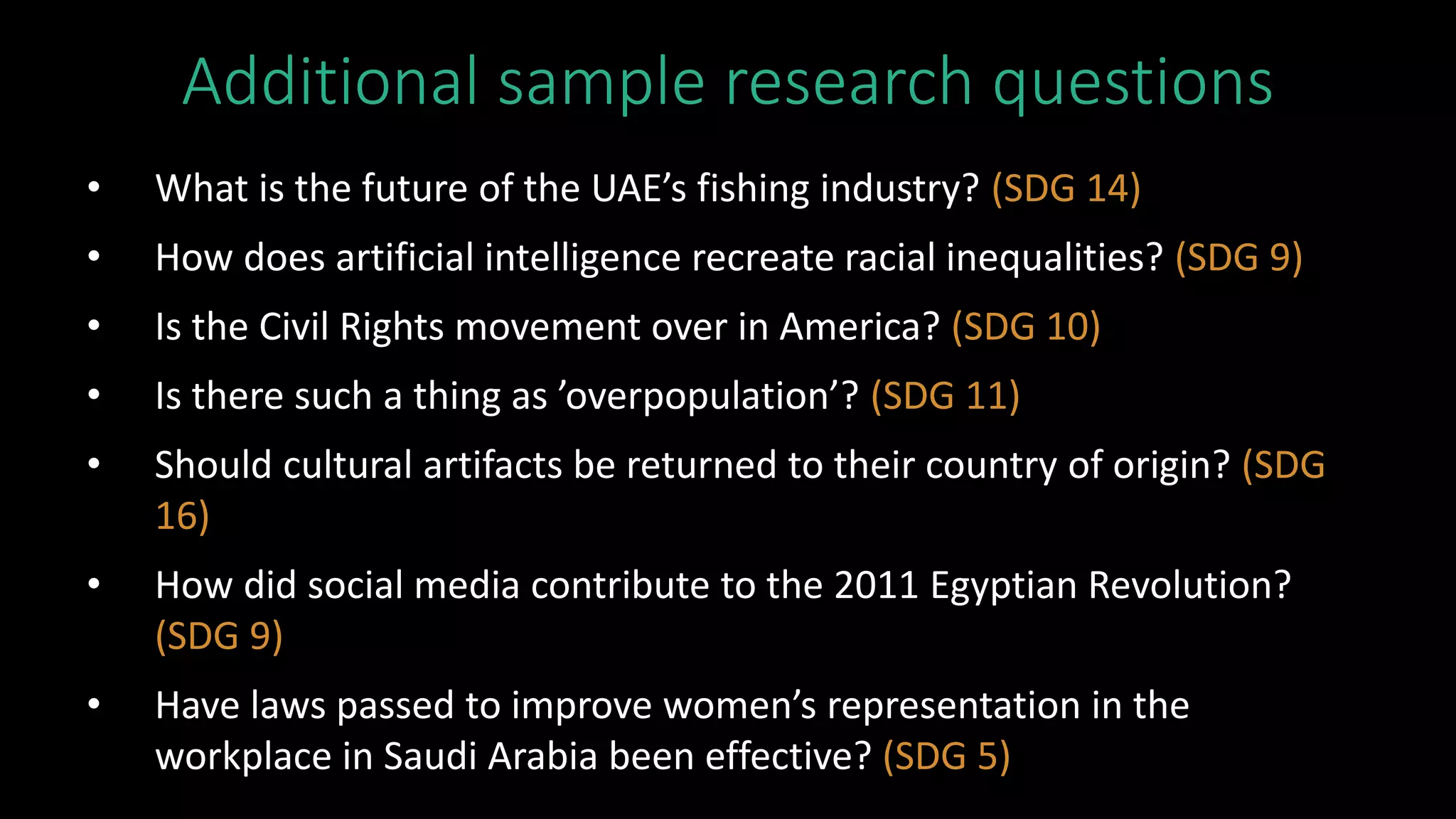
Additional sample research questions
• What is the future of the UAE’s fishing industry? (SDG 14)
• How does artificial intelligence recreate racial inequalities? (SDG 9)
• Is the Civil Rights movement over in America? (SDG 10)
• Is there such a thing as ’overpopulation’? (SDG 11)
• Should cultural artifacts be returned to their country of origin? (SDG
16)
• How did social media contribute to the 2011 Egyptian Revolution?
(SDG 9)
• Have laws passed to improve women’s representation in the
workplace in Saudi Arabia been effective? (SDG 5)

Research Topics and Questions

  • 1.
    Research Topics and Questions Adaptedfrom material published by the George Mason Writing Center and materials developed by Shona McCombes, 2019.
  • 2.
    What makes agood topic? • Is it debatable? • Is it researchable? • Is it interesting, original, different? • Is there a question to ask about the topic?
  • 3.
    A strong topic... •Is limited in scope, rather than broad and encyclopedic • Will appeal to and interest a knowledgable audience • Will require that you stretch yourself intellectually • Seems practical (within your means) to research • Sincerely interests you
  • 4.
    A research questionis the foundation of your research project. It is the question your research is intended to answer.
  • 5.
    Your research questionshould be: 1.Clear – it is specific with all the information the audience needs 2.Focused – it can be fully addressed in the limits of the paper 3.Concise – it is written with the fewest possible words 4.Complex – it is not a yes or no question 5.Arguable – it’s open to debate
  • 6.
    How to developa research question Choose an interesting general topic.
  • 7.
    How to developa research question Do preliminary research on your general topic.
  • 8.
    How to developa research question Consider your audience.
  • 9.
    How to developa research question Start asking questions.
  • 10.
    How to developa research question Evaluate your questions.
  • 11.
    How to developa research question Focus and continue your research.
  • 12.
    Tip: Locate thetopic academically This is an academic research paper. Think about the academic subject(s) that examine your topic. As yourself: “How might different academic departments examine this topic?” For example: Slavery Economics? Law? Public Policy? Psychology? Sociology? Anthropology? Literature? History? Religion?
  • 13.
    Location Question History Politics Economics Literature Psychology Sociology When didslavery start across cultures? What were the most important reasons for the global abolition of the slave trade in the 18th and 19th centuries? How have countries successfully addressed child trafficking? Are there hidden costs to low wage jobs? How is the history of slavery discussed in modern African novels? How can victims of human trafficking overcome trauma? How has the institution of slavery impacted the modern justice system in the United States?
  • 14.
    Sample research questions Unclear:How should social networking sites address the harm they cause? Clear: What action should social networking sites like Instagram and Facebook take to protect users’ personal information and privacy?
  • 15.
    Sample research questions Unfocused:What is the effect on the environment from global warming? Focused: What is the most significant effect of glacial melting on the ecosystem of Greenland?
  • 16.
    Sample research questions Toosimple: How are doctors addressing diabetes in the U.S.? Appropriately Complex: What main environmental, behavioral, and genetic factors predict whether Americans will develop diabetes, and how can these commonalities be used to aid the medical community in prevention of the disease?
  • 17.
    Additional sample researchquestions • What led to the financial collapse of 2017? (SDG 8) • Is veganism environmentally sustainable? (SDG 12) • What are the effects of and best policies for inclusive education in the UAE? (SDG 4) • Has the meat lobby shaped our dietary choices? (SDG 3) • How have right-wing politics developed in India? (SDG 16) • What were the causes of the 1967 Six-Day War? (SDG 16) • Should countries institute a universal minimum wage? (SDG 1)
  • 18.
    Additional sample researchquestions • What is the future of the UAE’s fishing industry? (SDG 14) • How does artificial intelligence recreate racial inequalities? (SDG 9) • Is the Civil Rights movement over in America? (SDG 10) • Is there such a thing as ’overpopulation’? (SDG 11) • Should cultural artifacts be returned to their country of origin? (SDG 16) • How did social media contribute to the 2011 Egyptian Revolution? (SDG 9) • Have laws passed to improve women’s representation in the workplace in Saudi Arabia been effective? (SDG 5)

Editor's Notes

  • #7 Most professional researchers focus on topics they are genuinely interested in studying. Writers should choose a broad topic about which they genuinely would like to know more. An example of a general topic might be “Slavery in the American South” or “Films of the 1930s.”
  • #8 Do a few quick searches in current periodicals and journals on your topic to see what’s already been done and to help you narrow your focus. What issues are scholars and researchers discussing, when it comes to your topic? What questions occur to you as you read these articles?
  • #9 For most college papers, your audience will be academic, but always keep your audience in mind when narrowing your topic and developing your question. Would that particular audience be interested in the question you are developing?
  • #10 Taking into consideration all of the above, start asking yourself open-ended “how” and “why” questions about your general topic. What do you want to know more about? For example, “Why were slave narratives effective tools in working toward the abolishment of slavery?” or “How did the films of the 1930s reflect or respond to the conditions of the Great Depression?”
  • #11 After you’ve put a question or even a couple of questions down on paper, evaluate these questions to determine whether they would be effective research questions or whether they need more revising and refining. Is your research question clear? With so much research available on any given topic, research questions must be as clear as possible in order to be effective in helping the writer direct his or her research. Is your research question focused? Research questions must be specific enough to be well covered in the space available. Is your research question complex? Research questions should not be answerable with a simple “yes” or “no” or by easily-found facts.  They should, instead, require both research and analysis on the part of the writer. They often begin with “How” or “Why.”
  • #12 After you’ve come up with a question, think about the possible paths your research could take. What sources should you consult as you seek answers to your question? What research process will ensure that you find a variety of perspectives and responses to your question?
  • #15 The unclear version of this question doesn’t specify which social networking sites or suggest what kind of harm the sites might be causing. It also assumes that this “harm” is proven and/or accepted. The clearer version specifies sites (Instagram and Facebook), the type of potential harm (privacy issues), and who may be experiencing that harm (users). A strong research question should never leave room for ambiguity or interpretation.
  • #16 The unfocused research question is so broad that it couldn’t be adequately answered in a book-length piece, let alone a standard college-level paper. The focused version narrows down to a specific effect of global warming (glacial melting), a specific place (Greenland), and a specific thing that is affected (ecosystem). It also requires the writer to take a stance on which effect has the greatest impact on the countries’ ecosystem. When in doubt, make a research question as narrow and focused as possible.
  • #17 The simple version of this question can be looked up online and answered in a few factual sentences; it leaves no room for analysis. The more complex version is written in two parts; it is thought provoking and requires both significant investigation and evaluation from the writer. As a general rule of thumb, if a quick Google search can answer a research question, it’s likely not very effective.