Nursing as a Profession
The Significance of Nursing Education
Nicole Sharrow, RN
November 19, 2017
This presentation will discuss:
▪ Characteristics of a profession.
▪ Nursing’s place on the professionalism continuum.
▪ Barriers to professionalism in nursing
▪ History of nursing education
▪ Significance of baccalaureate education in nursing professionalism.
▪ The importance of RN to BSN education and the growth of baccalaureate
preparation.
▪ Facilitators and barriers for RN to BSN students.
▪ How media images of nursing are transformed through professional
education.
What is a profession?
▪ Scholars have debated the meaning of profession since the 1900s.
▪ Three criteria consistently appear in most discussions
▪ Service/altruism
▪ Specialized knowledge
▪ Autonomy/ethics
(Black, 2017, p 53)
Characteristics of a Profession (Houle)
▪ Formal training
▪ Definition of mission and foundation of practice
▪ Continued learning and development
▪ Mastery of theoretical knowledge
▪ Legal right to practice
▪ Public acceptance
▪ Ethical practice
(Black, 2017, p 54)
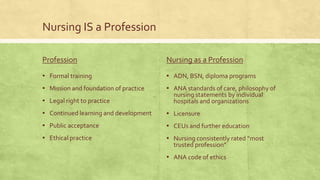
Nursing IS a Profession
Profession
▪ Formal training
▪ Mission and foundation of practice
▪ Legal right to practice
▪ Continued learning and development
▪ Public acceptance
▪ Ethical practice
Nursing as a Profession
▪ ADN, BSN, diploma programs
▪ ANA standards of care, philosophy of
nursing statements by individual
hospitals and organizations
▪ Licensure
▪ CEUs and further education
▪ Nursing consistently rated “most
trusted profession”
▪ ANA code of ethics
ANA (American Nurses Association) and
Professionalism
▪ Fosters high standards of nursing practice
▪ Standards of Practice and Code of Ethics adopted by health
organizations nationwide (including Rutland Regional Medical
Center)
▪ Promotes safe and ethical work environment
▪ Advocates on health care issues affecting nurses and the public at a
state and national level
(http://www.nursingworld.org/FunctionalMenuCategories/AboutANA)
Barriers to Professionalism in Nursing
▪ Lack of uniformity in nursing education.
▪ Gender issues
▪ Historical influences
(Black, 2017)
Barriers – Lack of Uniformity in Education
▪ Three levels of entry level nursing: diploma, ADN, and BSN.
▪ Varying levels of entry level education unique to nursing.
▪ All three levels of nursing are eligible for licensure (N-CLEX).
▪ RNs must collaborate as equals with other professionals who have much
greater requirements for practice.
▪ With such a variety of preparation, nursing has been unable to develop a
common identity which sabotages our ability to develop as a profession.
(Black, 2017)
Barriers – Gender Issues
▪ Nursing has traditionally been dominated by women.
▪ “Women’s work” (teaching, nursing, social work) typically undervalued in modern
society.
▪ Gender politics and stereotypes are reinforced in hierarchical organizations such as
hospitals.
▪ Nurses seen as doctor’s assistants or mother figures to patients.
▪ This undermines the professional values of autonomy and self-determination.
(David, 2000)
Barriers – Historical Influences
▪ Nursing historically developed in religious orders and adjunct to the
military.
▪ Expectation of unquestioning obedience to “superiors”.
▪ Connection to religion implies that nursing is inherently altruistic: the
common representation of nurses as “angels”.
▪ This hinders nurses from demanding fair compensation and adequate work
conditions.
▪ Nurses can be made to feel guilty or greedy for advocating for their
profession.
(Black, 2017)
History of Nursing Education
▪ Florence Nightingale is the founder of modern nursing
▪ Began the professionalism of nurses by insisting nursing was not a
“charitable service” but rather a “respected occupation requiring advanced
education”.
▪ First training schools for nurses in United States were hospital based
diploma programs.
▪ Each school had its own standards and requirements, no national
certification
▪ Purpose of diploma programs was to staff the hospitals that provided them
(Black, 2017, p68)
History of Nursing Education, cont’d
▪ Associate Degree Programs (ADN) began in 1952 in response to postWWII
nursing shortage and rise in community college education.
▪ Accessibility of community colleges, low tuition, and shorter duration of
programs make ADN programs popular.
▪ Most importantly, ADN graduates are eligible to take the licensure
examination for RNs.
▪ Majority of practicing RNs in the United States hold an associate degree.
(Black, 2017)
History of Nursing Education, cont’d
▪ The Brown Report (1948): Nursing schools should be placed in universities
and colleges.
▪ In 1965 the ANA concluded that baccalaureate education should be the
minimum preparation for professional practice.
▪ National League of Nursing (NLN) in 1982 affirmed that BSN should be the
minimum education for professional nursing practice, while diploma or
ADN of nursing prepared for technical practice.
▪ Practicing nurses with diplomas or ADNs vigorously protested the
recommendations.
(Black, 2017, pp. 70-71)
Significance of Baccalaureate Education in
Nursing Professionalism
▪ Faculty qualifications in BSN programs often higher than basic nursing programs.
▪ Magnet hospitals typically employ greater numbers of BSN prepared nurses.
▪ Complexities of health care support concept of additional education.
▪ Broader knowledge base from wider range of general education courses. Important as role of
nurses in the community continue to expand.
▪ BSN programs offer training in research, theory, leadership and community health.
▪ Courses in research are important to enable nurses to use evidence based practice.
▪ Courses in theory-based practice establish a foundation for problem solving and critical thinking.
(Spencer, 2008)
The Importance of RN to BSN Education and
the Growth of Baccalaureate Preparation
▪ Hospitals with higher proportions of nurses educated at the baccalaureate level saw lower
mortality and failure-to-rescue rates among surgical patients (Aiken, Clarke, Cheung, Sloan, &
Silber, 2003).
▪ Chronic problems with nurse retention requires nurses with academic preparation in leadership.
▪ Complexities of issues such as Medicaid and reimbursement call for nurses to have a basic
understanding of the economics of health care and how it affects nursing practice.
▪ Despite consensus of benefits of baccalaureate preparation, majority of nurses are associate
trained.
▪ The nursing shortage that spurred the development of theADN program has continued to this
day.
▪ Therefore, it is vital for the profession of nursing thatADN trained nurses are encourages to
pursue a BSN degree.
(Spencer, 2008)
Barriers for RN to BSN students
▪ Time constraints
▪ Cost
▪ Lack of monetary incentive or recognition from employers (Spencer,
2008).
▪ No difference in percentage of complex nursing tasks performed by
BSN or ADN nurses (Smith, 2002).
Facilitators for RN to BSN students
▪ Expanding opportunities
▪ Desire to fulfill personal goal
▪ Potential for promotion
▪ Stepping stone for pursuing an advanced degree
▪ Most BSN programs accept the transfer of general education and nursing
courses from ADN programs, reducing the need to repeat prerequisites.
▪ Many programs are offered online, allowing flexibility for working RNs.
(Sarver, Cichra, & Kline, 2015)
Media Images of Nursing :Transforming
Through Professional Education
▪ Portrayal of nursing in the media has a direct influence on the public’s
perception of the profession.
▪ Stereotypes of nurses: naughty nurse, battle-axe, angel, handmaiden.
▪ Health care reform and policy is changing more that ever, and it is vital that
nurses have a place in these debates.
▪ These stereotypes make the public less responsive to nurses as
professionals and devalues our input.
(Brown, 2009)
Media Images of Nursing, cont’d
▪ “TheTruth About Nursing” is an organization using advocacy and education
to improve the image of nursing in popular media.
▪ Example: Currently has a petition to protest the development of a “Young
Nurse Rachet” horror television series in development by Netflix
(Truthaboutnursing.org, 2017).
▪ It is important that nurses look and act professional in public and online.
▪ Keep work and personal life separate on social media.
▪ Support professional nursing organizations efforts to work with the media
on accurate portrayals.
▪ Follow organizational policy regarding confidentiality and appropriate
online behavior.
References
American Nurses Association. (2017). About ANA. Retrieved November 19, 2017 from
http://www.nursingworld.org/FunctionalMenuCategories/AboutANA
Black, B.P. (2017). Professional nursing: Concepts and challenges (8th ed.). St. Louis, MO: Elsevier.
Brown, P. (2009). Saving lives [Review of the book Saving lives:Why the media’s portrayal of nurses puts us all at
risk, by S. Summers & H.J. Summers]. Kansas Nurse, 84(7), 10-10.
David, B.A. (2000). Nursing’s gender politics: Reformulating the footnotes. Advances in Nursing Science, 23(1), 83-
93.
Sarver,W., Cichra, N., & Kline, M. (2015). Perceived benefits, motivators, and barriers to advancing nurse
education: Removing barriers to improve success. Nursing Education Perspectives, 36(3), 153-156.
Smith, J.E. (2002). Analysis of differences in entry-level practice by educational preparation. Journal of Nursing
Education, 41(11), 491-494.
Spencer, J. (2008). Increasing RN-BSN enrollments: Facilitating articulation through curriculum reform. The
Journal of Continuing Education in Nursing, 39(7), 307-313.
TheTruth About Nursing.org (n.d.). Retrieved November 19, 2017 from
http://www.truthaboutnursing.org/about_us/index.html

Nursing education

  • 1.
    Nursing as aProfession The Significance of Nursing Education Nicole Sharrow, RN November 19, 2017
  • 2.
    This presentation willdiscuss: ▪ Characteristics of a profession. ▪ Nursing’s place on the professionalism continuum. ▪ Barriers to professionalism in nursing ▪ History of nursing education ▪ Significance of baccalaureate education in nursing professionalism. ▪ The importance of RN to BSN education and the growth of baccalaureate preparation. ▪ Facilitators and barriers for RN to BSN students. ▪ How media images of nursing are transformed through professional education.
  • 3.
    What is aprofession? ▪ Scholars have debated the meaning of profession since the 1900s. ▪ Three criteria consistently appear in most discussions ▪ Service/altruism ▪ Specialized knowledge ▪ Autonomy/ethics (Black, 2017, p 53)
  • 4.
    Characteristics of aProfession (Houle) ▪ Formal training ▪ Definition of mission and foundation of practice ▪ Continued learning and development ▪ Mastery of theoretical knowledge ▪ Legal right to practice ▪ Public acceptance ▪ Ethical practice (Black, 2017, p 54)
  • 5.
    Nursing IS aProfession Profession ▪ Formal training ▪ Mission and foundation of practice ▪ Legal right to practice ▪ Continued learning and development ▪ Public acceptance ▪ Ethical practice Nursing as a Profession ▪ ADN, BSN, diploma programs ▪ ANA standards of care, philosophy of nursing statements by individual hospitals and organizations ▪ Licensure ▪ CEUs and further education ▪ Nursing consistently rated “most trusted profession” ▪ ANA code of ethics
  • 6.
    ANA (American NursesAssociation) and Professionalism ▪ Fosters high standards of nursing practice ▪ Standards of Practice and Code of Ethics adopted by health organizations nationwide (including Rutland Regional Medical Center) ▪ Promotes safe and ethical work environment ▪ Advocates on health care issues affecting nurses and the public at a state and national level (http://www.nursingworld.org/FunctionalMenuCategories/AboutANA)
  • 7.
    Barriers to Professionalismin Nursing ▪ Lack of uniformity in nursing education. ▪ Gender issues ▪ Historical influences (Black, 2017)
  • 8.
    Barriers – Lackof Uniformity in Education ▪ Three levels of entry level nursing: diploma, ADN, and BSN. ▪ Varying levels of entry level education unique to nursing. ▪ All three levels of nursing are eligible for licensure (N-CLEX). ▪ RNs must collaborate as equals with other professionals who have much greater requirements for practice. ▪ With such a variety of preparation, nursing has been unable to develop a common identity which sabotages our ability to develop as a profession. (Black, 2017)
  • 9.
    Barriers – GenderIssues ▪ Nursing has traditionally been dominated by women. ▪ “Women’s work” (teaching, nursing, social work) typically undervalued in modern society. ▪ Gender politics and stereotypes are reinforced in hierarchical organizations such as hospitals. ▪ Nurses seen as doctor’s assistants or mother figures to patients. ▪ This undermines the professional values of autonomy and self-determination. (David, 2000)
  • 10.
    Barriers – HistoricalInfluences ▪ Nursing historically developed in religious orders and adjunct to the military. ▪ Expectation of unquestioning obedience to “superiors”. ▪ Connection to religion implies that nursing is inherently altruistic: the common representation of nurses as “angels”. ▪ This hinders nurses from demanding fair compensation and adequate work conditions. ▪ Nurses can be made to feel guilty or greedy for advocating for their profession. (Black, 2017)
  • 11.
    History of NursingEducation ▪ Florence Nightingale is the founder of modern nursing ▪ Began the professionalism of nurses by insisting nursing was not a “charitable service” but rather a “respected occupation requiring advanced education”. ▪ First training schools for nurses in United States were hospital based diploma programs. ▪ Each school had its own standards and requirements, no national certification ▪ Purpose of diploma programs was to staff the hospitals that provided them (Black, 2017, p68)
  • 12.
    History of NursingEducation, cont’d ▪ Associate Degree Programs (ADN) began in 1952 in response to postWWII nursing shortage and rise in community college education. ▪ Accessibility of community colleges, low tuition, and shorter duration of programs make ADN programs popular. ▪ Most importantly, ADN graduates are eligible to take the licensure examination for RNs. ▪ Majority of practicing RNs in the United States hold an associate degree. (Black, 2017)
  • 13.
    History of NursingEducation, cont’d ▪ The Brown Report (1948): Nursing schools should be placed in universities and colleges. ▪ In 1965 the ANA concluded that baccalaureate education should be the minimum preparation for professional practice. ▪ National League of Nursing (NLN) in 1982 affirmed that BSN should be the minimum education for professional nursing practice, while diploma or ADN of nursing prepared for technical practice. ▪ Practicing nurses with diplomas or ADNs vigorously protested the recommendations. (Black, 2017, pp. 70-71)
  • 14.
    Significance of BaccalaureateEducation in Nursing Professionalism ▪ Faculty qualifications in BSN programs often higher than basic nursing programs. ▪ Magnet hospitals typically employ greater numbers of BSN prepared nurses. ▪ Complexities of health care support concept of additional education. ▪ Broader knowledge base from wider range of general education courses. Important as role of nurses in the community continue to expand. ▪ BSN programs offer training in research, theory, leadership and community health. ▪ Courses in research are important to enable nurses to use evidence based practice. ▪ Courses in theory-based practice establish a foundation for problem solving and critical thinking. (Spencer, 2008)
  • 15.
    The Importance ofRN to BSN Education and the Growth of Baccalaureate Preparation ▪ Hospitals with higher proportions of nurses educated at the baccalaureate level saw lower mortality and failure-to-rescue rates among surgical patients (Aiken, Clarke, Cheung, Sloan, & Silber, 2003). ▪ Chronic problems with nurse retention requires nurses with academic preparation in leadership. ▪ Complexities of issues such as Medicaid and reimbursement call for nurses to have a basic understanding of the economics of health care and how it affects nursing practice. ▪ Despite consensus of benefits of baccalaureate preparation, majority of nurses are associate trained. ▪ The nursing shortage that spurred the development of theADN program has continued to this day. ▪ Therefore, it is vital for the profession of nursing thatADN trained nurses are encourages to pursue a BSN degree. (Spencer, 2008)
  • 16.
    Barriers for RNto BSN students ▪ Time constraints ▪ Cost ▪ Lack of monetary incentive or recognition from employers (Spencer, 2008). ▪ No difference in percentage of complex nursing tasks performed by BSN or ADN nurses (Smith, 2002).
  • 17.
    Facilitators for RNto BSN students ▪ Expanding opportunities ▪ Desire to fulfill personal goal ▪ Potential for promotion ▪ Stepping stone for pursuing an advanced degree ▪ Most BSN programs accept the transfer of general education and nursing courses from ADN programs, reducing the need to repeat prerequisites. ▪ Many programs are offered online, allowing flexibility for working RNs. (Sarver, Cichra, & Kline, 2015)
  • 18.
    Media Images ofNursing :Transforming Through Professional Education ▪ Portrayal of nursing in the media has a direct influence on the public’s perception of the profession. ▪ Stereotypes of nurses: naughty nurse, battle-axe, angel, handmaiden. ▪ Health care reform and policy is changing more that ever, and it is vital that nurses have a place in these debates. ▪ These stereotypes make the public less responsive to nurses as professionals and devalues our input. (Brown, 2009)
  • 19.
    Media Images ofNursing, cont’d ▪ “TheTruth About Nursing” is an organization using advocacy and education to improve the image of nursing in popular media. ▪ Example: Currently has a petition to protest the development of a “Young Nurse Rachet” horror television series in development by Netflix (Truthaboutnursing.org, 2017). ▪ It is important that nurses look and act professional in public and online. ▪ Keep work and personal life separate on social media. ▪ Support professional nursing organizations efforts to work with the media on accurate portrayals. ▪ Follow organizational policy regarding confidentiality and appropriate online behavior.
  • 20.
    References American Nurses Association.(2017). About ANA. Retrieved November 19, 2017 from http://www.nursingworld.org/FunctionalMenuCategories/AboutANA Black, B.P. (2017). Professional nursing: Concepts and challenges (8th ed.). St. Louis, MO: Elsevier. Brown, P. (2009). Saving lives [Review of the book Saving lives:Why the media’s portrayal of nurses puts us all at risk, by S. Summers & H.J. Summers]. Kansas Nurse, 84(7), 10-10. David, B.A. (2000). Nursing’s gender politics: Reformulating the footnotes. Advances in Nursing Science, 23(1), 83- 93. Sarver,W., Cichra, N., & Kline, M. (2015). Perceived benefits, motivators, and barriers to advancing nurse education: Removing barriers to improve success. Nursing Education Perspectives, 36(3), 153-156. Smith, J.E. (2002). Analysis of differences in entry-level practice by educational preparation. Journal of Nursing Education, 41(11), 491-494. Spencer, J. (2008). Increasing RN-BSN enrollments: Facilitating articulation through curriculum reform. The Journal of Continuing Education in Nursing, 39(7), 307-313. TheTruth About Nursing.org (n.d.). Retrieved November 19, 2017 from http://www.truthaboutnursing.org/about_us/index.html