THE PRAYER
OPENING PRAYER: AS THE DEER
Psalm 42
As the deer panteth for the
water
So my soul longeth after Thee
You alone are my heart's desire
And I long to worship Thee

You're my friend and You are
my brother
Even though You are a king
I love You more than any
other
So much more than anything

You alone are my strength, my
shield
To You alone may my spirit yield
You alone are my heart's desire
And I long to worship Thee

I want You more than gold or
silver
Only You can satisfy You
alone are the real joy giver
And the apple of my eye
CHAOS

GOD

REVIEW on salvation history:
Restoration of
broken relationship

Pray…
not be put to the test
Mt.26:41

JESUS CHRIST
Savior

-is a man of PRAYER

FALL OF MAN
Disobedience
-independence

Sin:
•Alienation
•Death
•Sufferings,
•Chaos

•Created in His image
and likeness
•Dependence
•Harmony
•Immortality

BaptismAdopted
children

Concupiscence
-tendency to
commit sin

Prayer is our
weapon to
combat evil
Questions to ponder:
1. What is prayer?
2.Why do we need to pray?
3.Where to pray?
4.When to pray?
5.How to pray?
6.Did God answer our prayers?
WHAT IS PRAYER?
Prayer is basically a RELATIONSHIP and COMMUNICATION with God:

GOD

OTHERS

• is God’s initiative, not our
achievement.
• is an encounter with God in
love.
• God constantly seeks to
make his presence
known and felt.

OTHERS

Consider a close human
relationship (with a spouse or best
friend):

• We not only speak with one another, but
also listen to each other (one
mouth, two ears!).
• We not only communicate verbally, but
also spend time together in
many other ways.
• We focus not just on ourselves, our
needs & desires, but even more
on the other person.
“Holy Father, keep those you have given me
true to your name, so that they may be one
like us.” (Jn. 17: 11 )
“Our prayer should be an
expression of a desire for
what God tells us in our heart
and conscience to do or to
wish for and not to desire what
we selfishly and personally
like to do or possess”.

St. Augustine (Conf.X, 26,37)
2. Why do we need to pray?
•We need to pray because we have a basic
need and duty to recognize God in the midst
of life and to respond to God’s gift of
himself.
•We are in love with God.
• We want to communicate with God and
respond to His love for us.
•To know the will of God
The choices we made is the product of
our prayer.
Reasons for Prayer
Types of prayer

•
•
•
•

Adoration
Contrition
Thanksgiving
Supplications
Adoration:
- Means recognizing and
accepting
the infinite difference between
God and every creature.
-True “worship or pagsamba”
of God.

“ Yahweh, our Lord, how great
your name throughout the
earth!”
Ps. 8:1

(Ito ay ang pagkilala ng tao sa
kanyang Tagapaglikha (Creator)
at pagbibigay halaga sa kanyang
sarili bilang nilika (creature).
Contrition:
- to ask pardon for
our sins and for many
times we have not
loved God as we
should.

Have mercy on me, O God in your
goodness, in your great tenderness
wipe away my faults; wash me clean
of my guilt, purify me from my sin. (
Ps. 51: 1-2)
Thanksgiving:
- We thank God for all His
goodness to us.

- For the many benefits we
receive from God including
those which we are not
aware of.
Rejoice always, pray without ceasing,
give thanks in all circumstances; for this is
the will of God in Christ Jesus for you.
(1 Thessalonians 5:16–18)
Supplications:
Do not worry about anything, but in everything
by prayer and supplication with thanksgiving
let your requests be made known to God.
(Philippians 4:6)

- to ask for the many
things, spiritual and
material, which we need.
“Ask and it will be given to you; search, and you
will find; knock, and the door will be opened to
you.” Mt. 7:7
3. Where to pray?
1. Find a suitable place.

God is everywhere
“When you pray, go into your inner room and
shut the door and pray to your Father in secret.”
(Matthew 6:6)
4. When to pray?
Set times for prayer:
– morning , evening, or any
hour of the day.

When do you pray?
“Prayer is the key of the morning and the bolt of
the evening”
Mahatma Gandhi
• “Longing is always a prayer, even though the tongue is silent.
If your yearning is constant, then you are always praying”
•
St. Augustine (Sermon 80,7)
5. How to pray?
“Likewise the Spirit helps us in our weakness; for we do not know
how to pray as we ought,
but that very Spirit intercedes with sighs too deep for words”.
Romans 8:26

Forms of prayer:
A. Private prayer
B. Public or common prayer
What is lectio divina?
Lectio Divina: (individual or group)
• literally this means ‘spiritual reading’.
• is a "Vital Encounter with the Lord"
• is being promoted today as a very helpful way of
praying with the Bible, combining several of the other
methods of biblical prayer :
– This Bible reading, accompanied by prayer, is
known in the tradition of the Church by the
name Lectio Divina, a practice that should be
encouraged among all Christians.” (John Paul
II, Ecclesia in America, 1999, p. 31)
Methods of Praying with the
Scriptures
• Reading (lectio)
• Meditation (meditatio)
• Prayer (oratio)
• Contemplation (contemplatio)
• Action (actio)
•Reading (lectio) – hearing God’s Word in the
Bible as I/we read it aloud

What does the biblical text say?
Meditation (meditatio) – reflecting on the
meaning of the text that I/we have read

What is God saying to me/us through this text?
Prayer (oratio) –

speaking with God in praise,
thanksgiving, contrition, and
petition

What do I/we say to God in
response to this text?
Contemplation (contemplatio) – listening to
God more quietly in
the silence of our hearts

How does this text make me/us feel in
my/our relationship with God?
Action (actio) – letting the encounter concretely
affect our daily life and work in the
world

How will I/we change what I/we do today
in response to hearing this text?
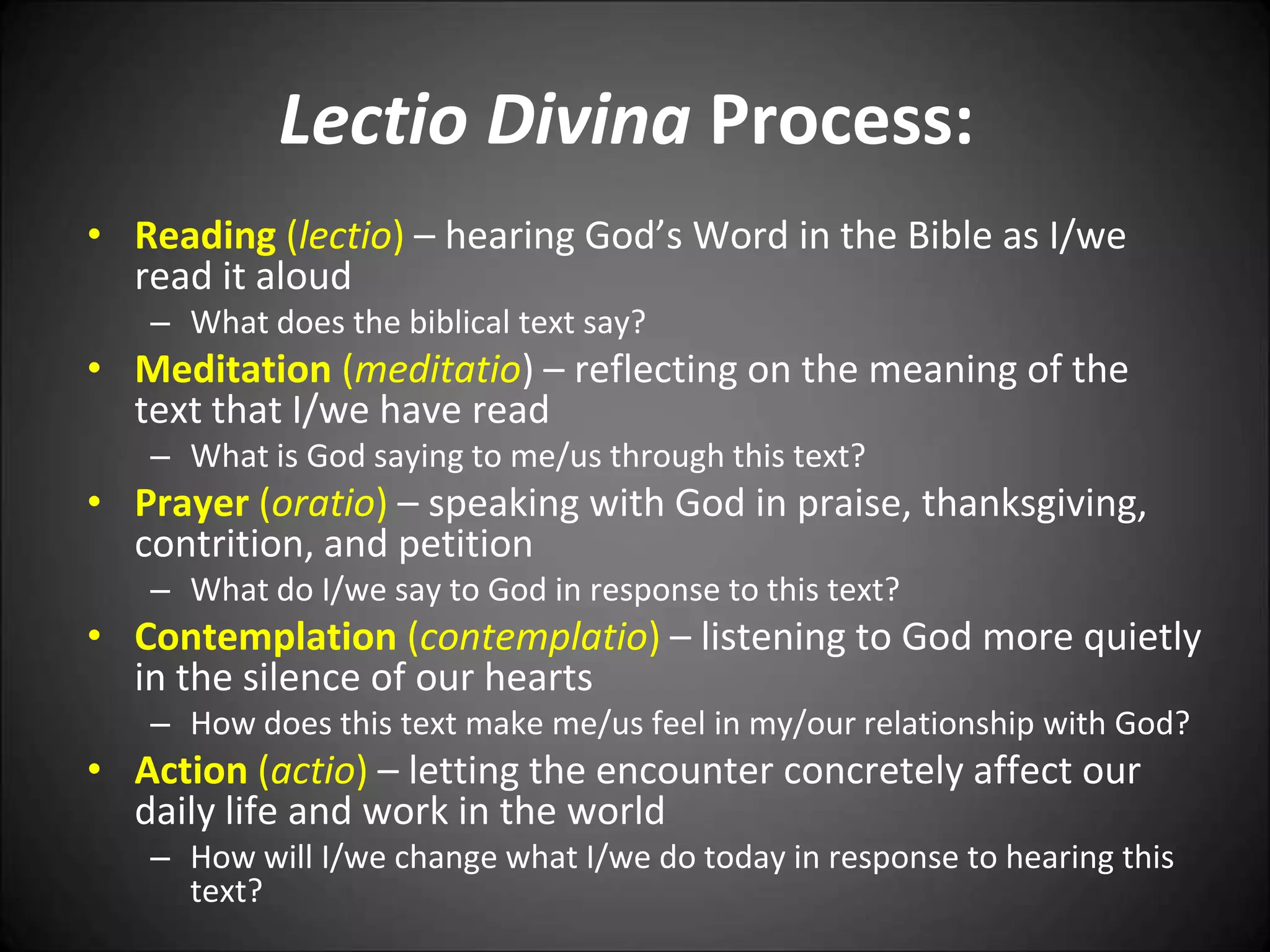
Lectio Divina Process:
• Reading (lectio) – hearing God’s Word in the Bible as I/we
read it aloud
– What does the biblical text say?

• Meditation (meditatio) – reflecting on the meaning of the
text that I/we have read
– What is God saying to me/us through this text?

• Prayer (oratio) – speaking with God in praise, thanksgiving,
contrition, and petition
– What do I/we say to God in response to this text?

• Contemplation (contemplatio) – listening to God more quietly
in the silence of our hearts
– How does this text make me/us feel in my/our relationship with God?

• Action (actio) – letting the encounter concretely affect our
daily life and work in the world
– How will I/we change what I/we do today in response to hearing this
text?
B. Public or Common prayer
When two or three are gathered in my name I am
in the midst of them.” Mt. 18:20

• It is not enough to pray in
private.
• We are also a Church- Mystical
Body of Christ.
• Holy Eucharist- the highest
form of worship/ prayer.
• Liturgy of the Hours
6. Did God answer our
prayers?
If God did not answer our prayers…
• He is teaching us to be patient.
• Maybe what we asked for is not good
for us – it is contrary to our sanctification
and will lead us into damnation.
•Let us pray what is the will of God
for us. May our desire will
be the desire of God for us.
• Willing to do His will not our will.
Synthesis:
•Prayer is an encounter with
God in love. A God who
constantly seeks to make
His presence known and felt
by us.
•We do not know how to
pray as we should, but that
very Spirit that is in us who
teaches us what to pray.
Synthesis:
•He calls us to respond his loving
invitation as he continuously reveals
himself to us in our history and in our
daily undertakings. He calls us to establish
an intimate relationship with Him who
created, redeemed and sanctified us.
•God nourish our body and soul through
the Body and Blood of Christ that we
partake in the Holy Eucharist. The
Eucharist is the source and summit of all
Christian worship. We become what we
eat– we become like Christ in thought, in
word, and in deed.
CLOSING PRAYER:
Great art thou, O Lord, and greatly to be praised;
great is thy power, and infinite is thy wisdom." And man
desires to praise thee, for he is a part of thy creation; he
bears his mortality about with him and carries the evidence of
his sin and the proof that thou dost resist the proud. Still he
desires to praise thee, this man who is only a small part of
thy creation. Thou hast prompted him, that he should delight
to praise thee, for thou hast made us for thyself and restless
is our heart until it comes to rest in thee. Grant me, O Lord, to
know and understand whether first to invoke thee or to praise
thee; whether first to know thee or call upon thee. But who
can invoke thee, knowing thee not? For he who knows thee
not may invoke thee as another than thou art. It may be that
we should invoke thee in order that we may come to know
thee. But "how shall they call on him in whom they have not
believed? Or how shall they believe without a preacher?"
Now, "they shall praise the Lord who seek him," for "those
who seek shall find him," and, finding him, shall praise him. I
will seek thee, O Lord, and call upon thee. I call upon thee, O
Lord, in my faith which thou hast given me, which thou hast
inspired in me through the humanity of thy Son, and through
the ministry of thy preacher.
Glory be…..
Excerpt from Confessions, Book I, Chapter I
HAVE A NICE DAY!

GOD BLESS!

What is prayer

  • 1.
  • 2.
    OPENING PRAYER: ASTHE DEER Psalm 42 As the deer panteth for the water So my soul longeth after Thee You alone are my heart's desire And I long to worship Thee You're my friend and You are my brother Even though You are a king I love You more than any other So much more than anything You alone are my strength, my shield To You alone may my spirit yield You alone are my heart's desire And I long to worship Thee I want You more than gold or silver Only You can satisfy You alone are the real joy giver And the apple of my eye
  • 3.
    CHAOS GOD REVIEW on salvationhistory: Restoration of broken relationship Pray… not be put to the test Mt.26:41 JESUS CHRIST Savior -is a man of PRAYER FALL OF MAN Disobedience -independence Sin: •Alienation •Death •Sufferings, •Chaos •Created in His image and likeness •Dependence •Harmony •Immortality BaptismAdopted children Concupiscence -tendency to commit sin Prayer is our weapon to combat evil
  • 4.
    Questions to ponder: 1.What is prayer? 2.Why do we need to pray? 3.Where to pray? 4.When to pray? 5.How to pray? 6.Did God answer our prayers?
  • 5.
    WHAT IS PRAYER? Prayeris basically a RELATIONSHIP and COMMUNICATION with God: GOD OTHERS • is God’s initiative, not our achievement. • is an encounter with God in love. • God constantly seeks to make his presence known and felt. OTHERS Consider a close human relationship (with a spouse or best friend): • We not only speak with one another, but also listen to each other (one mouth, two ears!). • We not only communicate verbally, but also spend time together in many other ways. • We focus not just on ourselves, our needs & desires, but even more on the other person.
  • 6.
    “Holy Father, keepthose you have given me true to your name, so that they may be one like us.” (Jn. 17: 11 )
  • 7.
    “Our prayer shouldbe an expression of a desire for what God tells us in our heart and conscience to do or to wish for and not to desire what we selfishly and personally like to do or possess”. St. Augustine (Conf.X, 26,37)
  • 8.
    2. Why dowe need to pray? •We need to pray because we have a basic need and duty to recognize God in the midst of life and to respond to God’s gift of himself. •We are in love with God. • We want to communicate with God and respond to His love for us. •To know the will of God The choices we made is the product of our prayer.
  • 9.
    Reasons for Prayer Typesof prayer • • • • Adoration Contrition Thanksgiving Supplications
  • 10.
    Adoration: - Means recognizingand accepting the infinite difference between God and every creature. -True “worship or pagsamba” of God. “ Yahweh, our Lord, how great your name throughout the earth!” Ps. 8:1 (Ito ay ang pagkilala ng tao sa kanyang Tagapaglikha (Creator) at pagbibigay halaga sa kanyang sarili bilang nilika (creature).
  • 11.
    Contrition: - to askpardon for our sins and for many times we have not loved God as we should. Have mercy on me, O God in your goodness, in your great tenderness wipe away my faults; wash me clean of my guilt, purify me from my sin. ( Ps. 51: 1-2)
  • 12.
    Thanksgiving: - We thankGod for all His goodness to us. - For the many benefits we receive from God including those which we are not aware of. Rejoice always, pray without ceasing, give thanks in all circumstances; for this is the will of God in Christ Jesus for you. (1 Thessalonians 5:16–18)
  • 13.
    Supplications: Do not worryabout anything, but in everything by prayer and supplication with thanksgiving let your requests be made known to God. (Philippians 4:6) - to ask for the many things, spiritual and material, which we need. “Ask and it will be given to you; search, and you will find; knock, and the door will be opened to you.” Mt. 7:7
  • 14.
    3. Where topray? 1. Find a suitable place. God is everywhere “When you pray, go into your inner room and shut the door and pray to your Father in secret.” (Matthew 6:6)
  • 15.
    4. When topray? Set times for prayer: – morning , evening, or any hour of the day. When do you pray?
  • 16.
    “Prayer is thekey of the morning and the bolt of the evening” Mahatma Gandhi
  • 17.
    • “Longing isalways a prayer, even though the tongue is silent. If your yearning is constant, then you are always praying” • St. Augustine (Sermon 80,7)
  • 18.
    5. How topray? “Likewise the Spirit helps us in our weakness; for we do not know how to pray as we ought, but that very Spirit intercedes with sighs too deep for words”. Romans 8:26 Forms of prayer: A. Private prayer B. Public or common prayer
  • 19.
    What is lectiodivina? Lectio Divina: (individual or group) • literally this means ‘spiritual reading’. • is a "Vital Encounter with the Lord" • is being promoted today as a very helpful way of praying with the Bible, combining several of the other methods of biblical prayer : – This Bible reading, accompanied by prayer, is known in the tradition of the Church by the name Lectio Divina, a practice that should be encouraged among all Christians.” (John Paul II, Ecclesia in America, 1999, p. 31)
  • 20.
    Methods of Prayingwith the Scriptures • Reading (lectio) • Meditation (meditatio) • Prayer (oratio) • Contemplation (contemplatio) • Action (actio)
  • 21.
    •Reading (lectio) –hearing God’s Word in the Bible as I/we read it aloud What does the biblical text say?
  • 22.
    Meditation (meditatio) –reflecting on the meaning of the text that I/we have read What is God saying to me/us through this text?
  • 23.
    Prayer (oratio) – speakingwith God in praise, thanksgiving, contrition, and petition What do I/we say to God in response to this text?
  • 24.
    Contemplation (contemplatio) –listening to God more quietly in the silence of our hearts How does this text make me/us feel in my/our relationship with God?
  • 25.
    Action (actio) –letting the encounter concretely affect our daily life and work in the world How will I/we change what I/we do today in response to hearing this text?
  • 26.
    Lectio Divina Process: •Reading (lectio) – hearing God’s Word in the Bible as I/we read it aloud – What does the biblical text say? • Meditation (meditatio) – reflecting on the meaning of the text that I/we have read – What is God saying to me/us through this text? • Prayer (oratio) – speaking with God in praise, thanksgiving, contrition, and petition – What do I/we say to God in response to this text? • Contemplation (contemplatio) – listening to God more quietly in the silence of our hearts – How does this text make me/us feel in my/our relationship with God? • Action (actio) – letting the encounter concretely affect our daily life and work in the world – How will I/we change what I/we do today in response to hearing this text?
  • 27.
    B. Public orCommon prayer When two or three are gathered in my name I am in the midst of them.” Mt. 18:20 • It is not enough to pray in private. • We are also a Church- Mystical Body of Christ. • Holy Eucharist- the highest form of worship/ prayer. • Liturgy of the Hours
  • 28.
    6. Did Godanswer our prayers? If God did not answer our prayers… • He is teaching us to be patient. • Maybe what we asked for is not good for us – it is contrary to our sanctification and will lead us into damnation. •Let us pray what is the will of God for us. May our desire will be the desire of God for us. • Willing to do His will not our will.
  • 29.
    Synthesis: •Prayer is anencounter with God in love. A God who constantly seeks to make His presence known and felt by us. •We do not know how to pray as we should, but that very Spirit that is in us who teaches us what to pray.
  • 30.
    Synthesis: •He calls usto respond his loving invitation as he continuously reveals himself to us in our history and in our daily undertakings. He calls us to establish an intimate relationship with Him who created, redeemed and sanctified us. •God nourish our body and soul through the Body and Blood of Christ that we partake in the Holy Eucharist. The Eucharist is the source and summit of all Christian worship. We become what we eat– we become like Christ in thought, in word, and in deed.
  • 31.
    CLOSING PRAYER: Great artthou, O Lord, and greatly to be praised; great is thy power, and infinite is thy wisdom." And man desires to praise thee, for he is a part of thy creation; he bears his mortality about with him and carries the evidence of his sin and the proof that thou dost resist the proud. Still he desires to praise thee, this man who is only a small part of thy creation. Thou hast prompted him, that he should delight to praise thee, for thou hast made us for thyself and restless is our heart until it comes to rest in thee. Grant me, O Lord, to know and understand whether first to invoke thee or to praise thee; whether first to know thee or call upon thee. But who can invoke thee, knowing thee not? For he who knows thee not may invoke thee as another than thou art. It may be that we should invoke thee in order that we may come to know thee. But "how shall they call on him in whom they have not believed? Or how shall they believe without a preacher?" Now, "they shall praise the Lord who seek him," for "those who seek shall find him," and, finding him, shall praise him. I will seek thee, O Lord, and call upon thee. I call upon thee, O Lord, in my faith which thou hast given me, which thou hast inspired in me through the humanity of thy Son, and through the ministry of thy preacher. Glory be….. Excerpt from Confessions, Book I, Chapter I
  • 32.
    HAVE A NICEDAY! GOD BLESS!