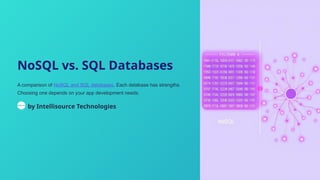
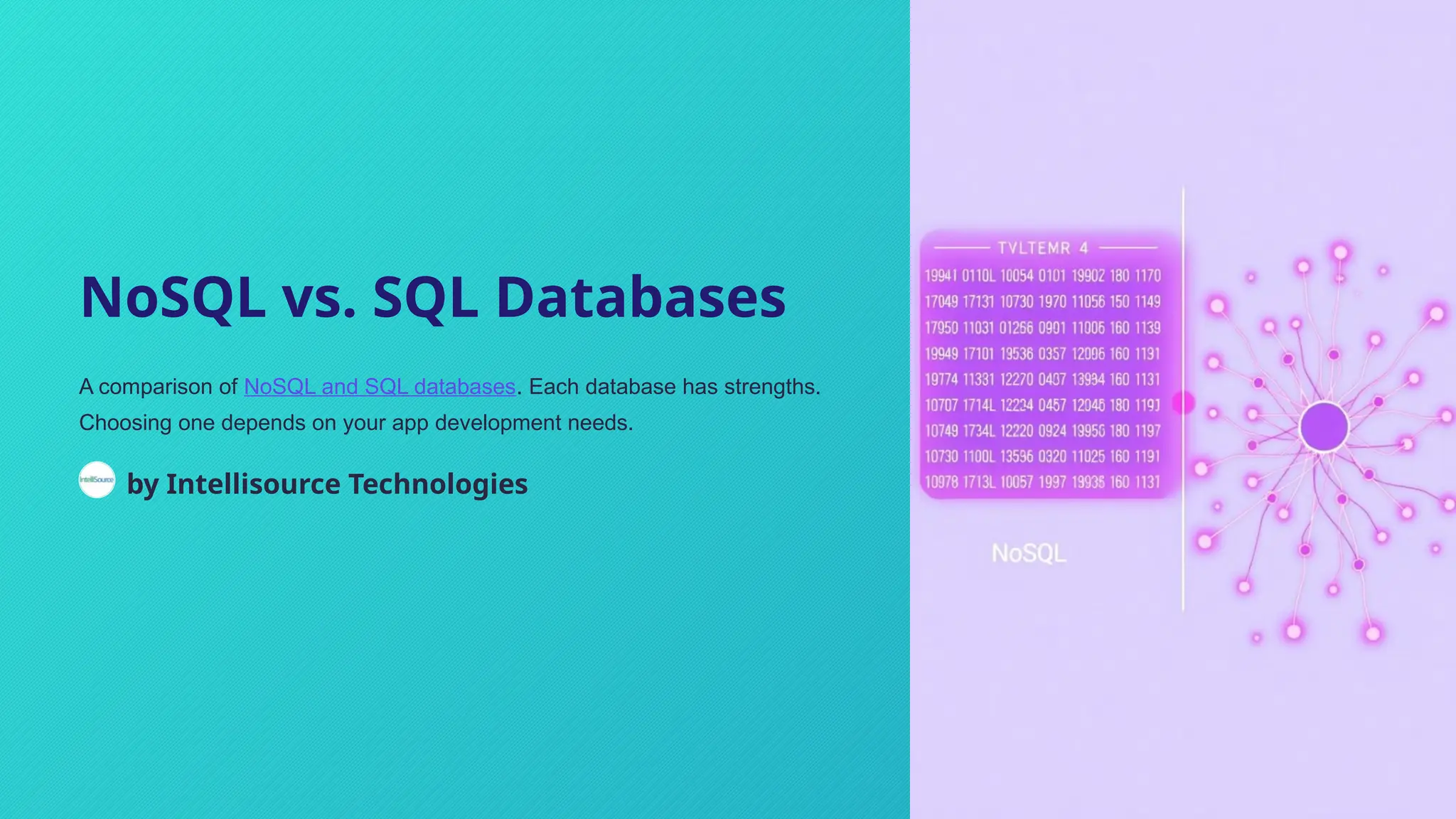
NoSQL vs. SQL Databases
A comparison of NoSQL and SQL databases. Each database has strengths.
Choosing one depends on your app development needs.
by Intellisource Technologies
SQL Databases: Overview
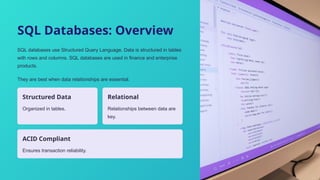
SQL databases use Structured Query Language. Data is structured in tables
with rows and columns. SQL databases are used in finance and enterprise
products.
They are best when data relationships are essential.
Structured Data
Organized in tables.
Relational
Relationships between data are
key.
ACID Compliant
Ensures transaction reliability.
Popular SQL Databases
• MySQL: Fast and stable.
• PostgreSQL: High-performance RDBMS.
• Microsoft SQL Server: Strong connectivity.
• Oracle Database: For large-scale apps.
• SQLite: Lightweight, for mobile use.
MySQL PostgreSQL SQL Server
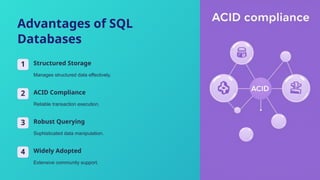
Advantages of SQL
Databases
1 Structured Storage
Manages structured data effectively.
2 ACID Compliance
Reliable transaction execution.
3 Robust Querying
Sophisticated data manipulation.
4 Widely Adopted
Extensive community support.
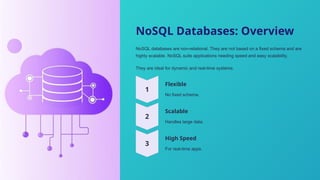
NoSQL Databases: Overview
NoSQL databases are non-relational. They are not based on a fixed schema and are
highly scalable. NoSQL suits applications needing speed and easy scalability.
They are ideal for dynamic and real-time systems.
Flexible
No fixed schema.
Scalable
Handles large data.
High Speed
For real-time apps.
Popular NoSQL Databases
• MongoDB: Document-based, JSON-like.
• Cassandra: High availability, scale-out.
• Couchbase: Document-oriented, key-value.
• DynamoDB: Managed NoSQL by AWS.
• Redis: Fast, in-memory key-value store.
MongoDB Cassandra Couchbase
Advantages of NoSQL Databases
1 Scalability
Manages vast datasets.
2 Flexibility
Supports various data models.
3 High Performance
Real-time analytics.
4 Dynamic Schemas
Adapts to evolving data.
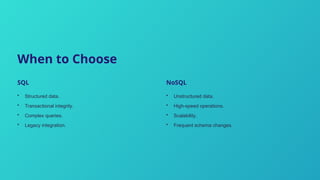
When to Choose
SQL
• Structured data.
• Transactional integrity.
• Complex queries.
• Legacy integration.
NoSQL
• Unstructured data.
• High-speed operations.
• Scalability.
• Frequent schema changes.

what is NoSQL-vs-SQL-Databases Diffrance.pptx

  • 1.
    NoSQL vs. SQLDatabases A comparison of NoSQL and SQL databases. Each database has strengths. Choosing one depends on your app development needs. by Intellisource Technologies
  • 2.
    SQL Databases: Overview SQLdatabases use Structured Query Language. Data is structured in tables with rows and columns. SQL databases are used in finance and enterprise products. They are best when data relationships are essential. Structured Data Organized in tables. Relational Relationships between data are key. ACID Compliant Ensures transaction reliability.
  • 3.
    Popular SQL Databases •MySQL: Fast and stable. • PostgreSQL: High-performance RDBMS. • Microsoft SQL Server: Strong connectivity. • Oracle Database: For large-scale apps. • SQLite: Lightweight, for mobile use. MySQL PostgreSQL SQL Server
  • 4.
    Advantages of SQL Databases 1Structured Storage Manages structured data effectively. 2 ACID Compliance Reliable transaction execution. 3 Robust Querying Sophisticated data manipulation. 4 Widely Adopted Extensive community support.
  • 5.
    NoSQL Databases: Overview NoSQLdatabases are non-relational. They are not based on a fixed schema and are highly scalable. NoSQL suits applications needing speed and easy scalability. They are ideal for dynamic and real-time systems. Flexible No fixed schema. Scalable Handles large data. High Speed For real-time apps.
  • 6.
    Popular NoSQL Databases •MongoDB: Document-based, JSON-like. • Cassandra: High availability, scale-out. • Couchbase: Document-oriented, key-value. • DynamoDB: Managed NoSQL by AWS. • Redis: Fast, in-memory key-value store. MongoDB Cassandra Couchbase
  • 7.
    Advantages of NoSQLDatabases 1 Scalability Manages vast datasets. 2 Flexibility Supports various data models. 3 High Performance Real-time analytics. 4 Dynamic Schemas Adapts to evolving data.
  • 8.
    When to Choose SQL •Structured data. • Transactional integrity. • Complex queries. • Legacy integration. NoSQL • Unstructured data. • High-speed operations. • Scalability. • Frequent schema changes.