Low-Code Platforms:
Revolutionizing App
Development
Discover how low-code platforms are transforming custom app
development for enterprises, enabling faster innovation and cost-
effectiveness in a rapidly evolving digital landscape.
Chapter 1
The Low-Code Revolution
In today's fast-paced business environment, digital transformation is crucial. Traditional software development is often slow
and expensive, struggling to meet evolving organizational demands. Low-code custom app development offers a paradigm
shift, enabling businesses to create powerful applications with minimal coding, fostering faster innovation and cost-
effectiveness.
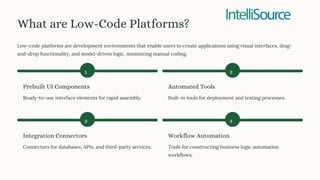
What are Low-Code Platforms?
Low-code platforms are development environments that enable users to create applications using visual interfaces, drag-
and-drop functionality, and model-driven logic, minimizing manual coding.
1
Prebuilt UI Components
Ready-to-use interface elements for rapid assembly.
2
Automated Tools
Built-in tools for deployment and testing processes.
3
Integration Connectors
Connectors for databases, APIs, and third-party services.
4
Workflow Automation
Tools for constructing business logic automation
workflows.
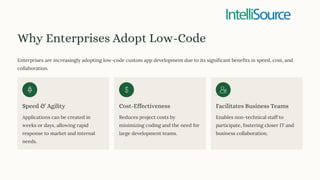
Why Enterprises Adopt Low-Code
Enterprises are increasingly adopting low-code custom app development due to its significant benefits in speed, cost, and
collaboration.
Speed & Agility
Applications can be created in
weeks or days, allowing rapid
response to market and internal
needs.
Cost-Effectiveness
Reduces project costs by
minimizing coding and the need for
large development teams.
Facilitates Business Teams
Enables non-technical staff to
participate, fostering closer IT and
business collaboration.
Chapter 2
Impact & Considerations
Low-code platforms are transforming custom app development by accelerating prototyping and fostering hybrid teams, but
they also present challenges that enterprises must consider.
Impact on Custom App Development
Low-code platforms complement traditional development, transforming the landscape by enabling quicker prototyping and fostering hybrid teams.
Quicker Prototypes & MVPs
Businesses can rapidly prototype and test ideas without lengthy development cycles.
Hybrid Teams
Collaboration between non-technical and technical members enhances digital project throughput.
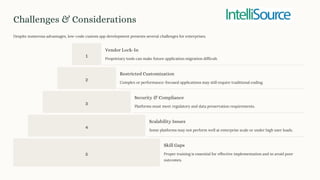
Challenges & Considerations
Despite numerous advantages, low-code custom app development presents several challenges for enterprises.
1
Vendor Lock-In
Proprietary tools can make future application migration difficult.
2
Restricted Customization
Complex or performance-focused applications may still require traditional coding.
3
Security & Compliance
Platforms must meet regulatory and data preservation requirements.
4
Scalability Issues
Some platforms may not perform well at enterprise scale or under high user loads.
5
Skill Gaps
Proper training is essential for effective implementation and to avoid poor
outcomes.
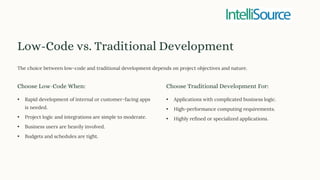
Low-Code vs. Traditional Development
The choice between low-code and traditional development depends on project objectives and nature.
Choose Low-Code When:
• Rapid development of internal or customer-facing apps
is needed.
• Project logic and integrations are simple to moderate.
• Business users are heavily involved.
• Budgets and schedules are tight.
Choose Traditional Development For:
• Applications with complicated business logic.
• High-performance computing requirements.
• Highly refined or specialized applications.
Chapter 3
The Future of Low-Code
Gartner predicts that by 2026, over 65% of all app development will utilize low-code platforms, signaling a transformative
future for enterprise tech stacks.
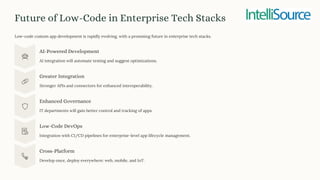
Future of Low-Code in Enterprise Tech Stacks
Low-code custom app development is rapidly evolving, with a promising future in enterprise tech stacks.
AI-Powered Development
AI integration will automate testing and suggest optimizations.
Greater Integration
Stronger APIs and connectors for enhanced interoperability.
Enhanced Governance
IT departments will gain better control and tracking of apps.
Low-Code DevOps
Integration with CI/CD pipelines for enterprise-level app lifecycle management.
Cross-Platform
Develop once, deploy everywhere: web, mobile, and IoT.

Low-Code-Platforms-Revolutionizing-App-Development

  • 1.
    Low-Code Platforms: Revolutionizing App Development Discoverhow low-code platforms are transforming custom app development for enterprises, enabling faster innovation and cost- effectiveness in a rapidly evolving digital landscape.
  • 2.
    Chapter 1 The Low-CodeRevolution In today's fast-paced business environment, digital transformation is crucial. Traditional software development is often slow and expensive, struggling to meet evolving organizational demands. Low-code custom app development offers a paradigm shift, enabling businesses to create powerful applications with minimal coding, fostering faster innovation and cost- effectiveness.
  • 3.
    What are Low-CodePlatforms? Low-code platforms are development environments that enable users to create applications using visual interfaces, drag- and-drop functionality, and model-driven logic, minimizing manual coding. 1 Prebuilt UI Components Ready-to-use interface elements for rapid assembly. 2 Automated Tools Built-in tools for deployment and testing processes. 3 Integration Connectors Connectors for databases, APIs, and third-party services. 4 Workflow Automation Tools for constructing business logic automation workflows.
  • 4.
    Why Enterprises AdoptLow-Code Enterprises are increasingly adopting low-code custom app development due to its significant benefits in speed, cost, and collaboration. Speed & Agility Applications can be created in weeks or days, allowing rapid response to market and internal needs. Cost-Effectiveness Reduces project costs by minimizing coding and the need for large development teams. Facilitates Business Teams Enables non-technical staff to participate, fostering closer IT and business collaboration.
  • 5.
    Chapter 2 Impact &Considerations Low-code platforms are transforming custom app development by accelerating prototyping and fostering hybrid teams, but they also present challenges that enterprises must consider.
  • 6.
    Impact on CustomApp Development Low-code platforms complement traditional development, transforming the landscape by enabling quicker prototyping and fostering hybrid teams. Quicker Prototypes & MVPs Businesses can rapidly prototype and test ideas without lengthy development cycles. Hybrid Teams Collaboration between non-technical and technical members enhances digital project throughput.
  • 7.
    Challenges & Considerations Despitenumerous advantages, low-code custom app development presents several challenges for enterprises. 1 Vendor Lock-In Proprietary tools can make future application migration difficult. 2 Restricted Customization Complex or performance-focused applications may still require traditional coding. 3 Security & Compliance Platforms must meet regulatory and data preservation requirements. 4 Scalability Issues Some platforms may not perform well at enterprise scale or under high user loads. 5 Skill Gaps Proper training is essential for effective implementation and to avoid poor outcomes.
  • 8.
    Low-Code vs. TraditionalDevelopment The choice between low-code and traditional development depends on project objectives and nature. Choose Low-Code When: • Rapid development of internal or customer-facing apps is needed. • Project logic and integrations are simple to moderate. • Business users are heavily involved. • Budgets and schedules are tight. Choose Traditional Development For: • Applications with complicated business logic. • High-performance computing requirements. • Highly refined or specialized applications.
  • 9.
    Chapter 3 The Futureof Low-Code Gartner predicts that by 2026, over 65% of all app development will utilize low-code platforms, signaling a transformative future for enterprise tech stacks.
  • 10.
    Future of Low-Codein Enterprise Tech Stacks Low-code custom app development is rapidly evolving, with a promising future in enterprise tech stacks. AI-Powered Development AI integration will automate testing and suggest optimizations. Greater Integration Stronger APIs and connectors for enhanced interoperability. Enhanced Governance IT departments will gain better control and tracking of apps. Low-Code DevOps Integration with CI/CD pipelines for enterprise-level app lifecycle management. Cross-Platform Develop once, deploy everywhere: web, mobile, and IoT.