SQL vs NoSQL
Gabriel Garcia
SQL (Structured Query
Language) Databases
Characteristics
Structure
• SQL databases are relational,
meaning data is organized into
tables with rows and columns. Each
row represents a unique record,
and each column represents an
attribute of that record
Query Language
• They use SQL as the standard
language for querying and
manipulating data. SQL is a
declarative language, meaning it
describes what data to retrieve, not
how to retrieve it.
Fixed Schema
• SQL databases have a rigid,
predefined schema. You need to
define the table structure (schema)
before inserting data, specifying
the data types for each column.
Transactions
• They support ACID (Atomicity,
Consistency, Isolation, Durability)
transactions, ensuring data
integrity and reliability.
Advantages
Consistency
• The rigid schema ensures data
consistency and maintains
referential integrity.
Support and
Maturity
• SQL databases have been around
for a long time, providing broad
support and extensive
documentation.
Disadvantages
Vertical Scalability
• Typically, SQL databases scale
vertically (by improving hardware),
which can be costly.
Limited Flexibility
• Changing the schema of an SQL
database can be challenging and
time-consuming.
Examples of SQL Databases
MySQL PostgreSQL Microsoft SQL
Server
Oracle
Database
NoSQL (Not Only SQL)
Databases
Characteristics
Structure
• NoSQL databases are non-
relational and can store data in
various formats, such as
documents (JSON), graphs, key-
value pairs, and columns. They do
not require a fixed schema,
allowing for more flexible data
storage.
Flexibility
• They can handle unstructured or
semi-structured data, allowing
diverse information to be stored
without a predefined structure.
Horizontal
Scalability
• NoSQL databases typically scale
horizontally, meaning you can add
more servers to handle more data
and traffic, which is ideal for large
volumes of data and cloud-based
applications.
Advantages
Scalability
• They can handle large volumes of
data and are easily scalable
horizontally.
Flexibility
• They adapt better to changing data
requirements since they do not
require a fixed schema.
Disadvantage
s
Eventual
Consistency
• Instead of providing immediate
consistency, many NoSQL
databases offer "eventual
consistency," which might be less
suitable for applications requiring
real-time precision.
Lack of Standard
• There is no standard query
language like SQL for NoSQL
databases, which can make
transitioning between different
systems more complex.
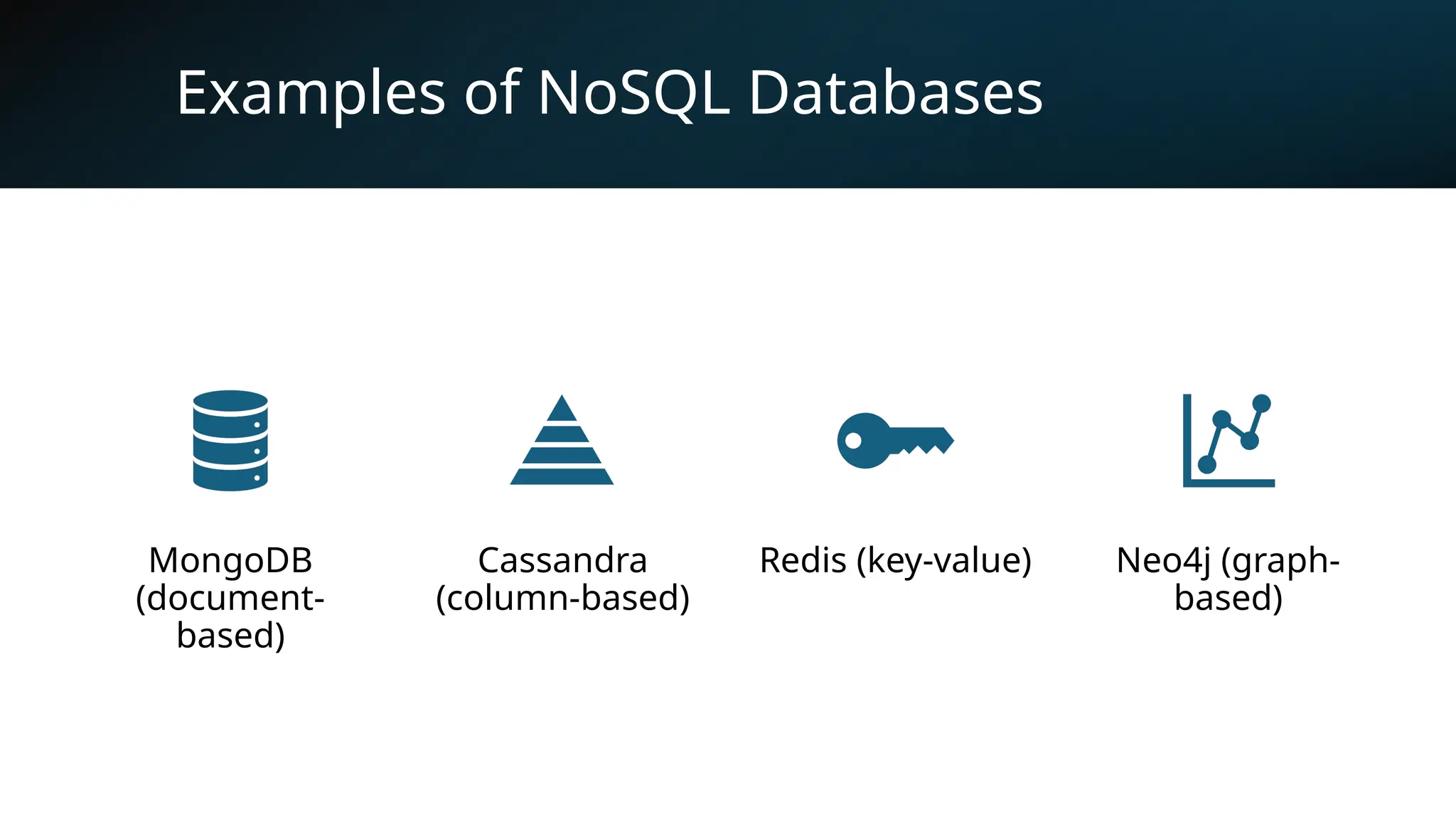
Examples of NoSQL Databases
MongoDB
(document-
based)
Cassandra
(column-based)
Redis (key-value) Neo4j (graph-
based)

SQL vs NoSQL presentacion informativa.pptx