SQL VS NoSQL:
Top 10 Head-to-
Head
Comparisons
Are you confused while choosing the modern
database? Or don't know whether SQL or
NoSQL; which one to choose? SQL refers to a
decades-old database but is still ubiquitous
and effectively being used by Analysts,
Engineers, data scientists, and IT decision-
makers. However, the increasing volumes of
unstructured data, process chunks of data,
and the need for storage availability spark
interest in different technologies such as
NoSQL.
What is
Structured
Query language
(SQL)?
SQL is a programming language that differs from a general-purpose
programming language such as Python, Java, and JavaScript. It has a specific
purpose: to access and manage data in relational databases. It uses relations
(referred to as tables) with a schema to manage and store data.
Some of the relational database examples which use SQL are:
• Oracle
• Microsoft SQL server
• Ingres
• Microsoft office
Access
• IBM DB2
• Sybase
• Google Cloud SQL
• Amazon RDS
• PostgreSQL
What is Non- SQL or
Not only SQL
(NoSQL)?
It is a non-tabular and non-
relational database with specific
data models such as document,
key-value, and graph formats to
create modern applications. It is
used for distributed data that
requires a large stack of storage
needs and can effectively store
structured, unstructured, semi-
structured, and polymorphic data.
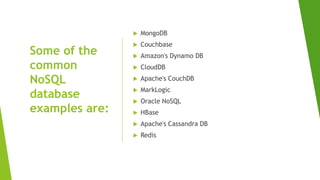
Some of the
common
NoSQL
database
examples are:
 MongoDB
 Couchbase
 Amazon's Dynamo DB
 CloudDB
 Apache's CouchDB
 MarkLogic
 Oracle NoSQL
 HBase
 Apache's Cassandra DB
 Redis
Comparison SQL NoSQL
Key Purpose
It can be used for data
1.Storage
2.Deletion
3.Updation
4.Insertion
5.Retrieval of data
It can be used for the
maintenance and retrieval of
different types of data
1.Structured
2.Unstructured
3.Semi-structured
4.Polymorphic
Schema
Rigid Schema (structured
data)
Flexible Schema
(unstructured data)
Data Structure
SQL Data structures
Table-based
1.NoSQL Data
structures Document-based
2.Key-value
3.Graph-based
4.Wide Column
Scalability
Vertically scaled( add big
servers)
Horizontally scaled(add more
servers)
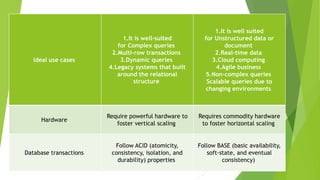
Ideal use cases
1.It is well-suited
for Complex queries
2.Multi-row transactions
3.Dynamic queries
4.Legacy systems that built
around the relational
structure
1.It is well suited
for Unstructured data or
document
2.Real-time data
3.Cloud computing
4.Agile business
5.Non-complex queries
Scalable queries due to
changing environments
Hardware
Require powerful hardware to
foster vertical scaling
Requires commodity hardware
to foster horizontal scaling
Database transactions
Follow ACID (atomicity,
consistency, isolation, and
durability) properties
Follow BASE (basic availability,
soft-state, and eventual
consistency)
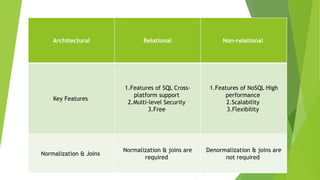
Architectural Relational Non-relational
Key Features
1.Features of SQL Cross-
platform support
2.Multi-level Security
3.Free
1.Features of NoSQL High
performance
2.Scalability
3.Flexibility
Normalization & Joins
Normalization & joins are
required
Denormalization & joins are
not required
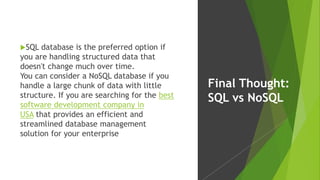
SQL database is the preferred option if
you are handling structured data that
doesn't change much over time.
You can consider a NoSQL database if you
handle a large chunk of data with little
structure. If you are searching for the best
software development company in
USA that provides an efficient and
streamlined database management
solution for your enterprise
Final Thought:
SQL vs NoSQL
Contact US
Web: www.zenesys.com
Address: 2591 Dallas Parkway, Suite
300 Frisco, Texas, United States
Email: info@zenesys.com
Phone: +1 (323) 565-1141

SQL VS NoSQL

  • 2.
    SQL VS NoSQL: Top10 Head-to- Head Comparisons Are you confused while choosing the modern database? Or don't know whether SQL or NoSQL; which one to choose? SQL refers to a decades-old database but is still ubiquitous and effectively being used by Analysts, Engineers, data scientists, and IT decision- makers. However, the increasing volumes of unstructured data, process chunks of data, and the need for storage availability spark interest in different technologies such as NoSQL.
  • 3.
  • 4.
    SQL is aprogramming language that differs from a general-purpose programming language such as Python, Java, and JavaScript. It has a specific purpose: to access and manage data in relational databases. It uses relations (referred to as tables) with a schema to manage and store data. Some of the relational database examples which use SQL are: • Oracle • Microsoft SQL server • Ingres • Microsoft office Access • IBM DB2 • Sybase • Google Cloud SQL • Amazon RDS • PostgreSQL
  • 5.
    What is Non-SQL or Not only SQL (NoSQL)? It is a non-tabular and non- relational database with specific data models such as document, key-value, and graph formats to create modern applications. It is used for distributed data that requires a large stack of storage needs and can effectively store structured, unstructured, semi- structured, and polymorphic data.
  • 6.
    Some of the common NoSQL database examplesare:  MongoDB  Couchbase  Amazon's Dynamo DB  CloudDB  Apache's CouchDB  MarkLogic  Oracle NoSQL  HBase  Apache's Cassandra DB  Redis
  • 7.
    Comparison SQL NoSQL KeyPurpose It can be used for data 1.Storage 2.Deletion 3.Updation 4.Insertion 5.Retrieval of data It can be used for the maintenance and retrieval of different types of data 1.Structured 2.Unstructured 3.Semi-structured 4.Polymorphic Schema Rigid Schema (structured data) Flexible Schema (unstructured data) Data Structure SQL Data structures Table-based 1.NoSQL Data structures Document-based 2.Key-value 3.Graph-based 4.Wide Column Scalability Vertically scaled( add big servers) Horizontally scaled(add more servers)
  • 8.
    Ideal use cases 1.Itis well-suited for Complex queries 2.Multi-row transactions 3.Dynamic queries 4.Legacy systems that built around the relational structure 1.It is well suited for Unstructured data or document 2.Real-time data 3.Cloud computing 4.Agile business 5.Non-complex queries Scalable queries due to changing environments Hardware Require powerful hardware to foster vertical scaling Requires commodity hardware to foster horizontal scaling Database transactions Follow ACID (atomicity, consistency, isolation, and durability) properties Follow BASE (basic availability, soft-state, and eventual consistency)
  • 9.
    Architectural Relational Non-relational KeyFeatures 1.Features of SQL Cross- platform support 2.Multi-level Security 3.Free 1.Features of NoSQL High performance 2.Scalability 3.Flexibility Normalization & Joins Normalization & joins are required Denormalization & joins are not required
  • 10.
    SQL database isthe preferred option if you are handling structured data that doesn't change much over time. You can consider a NoSQL database if you handle a large chunk of data with little structure. If you are searching for the best software development company in USA that provides an efficient and streamlined database management solution for your enterprise Final Thought: SQL vs NoSQL
  • 11.
    Contact US Web: www.zenesys.com Address:2591 Dallas Parkway, Suite 300 Frisco, Texas, United States Email: info@zenesys.com Phone: +1 (323) 565-1141