LIB 640 Information Sources and Services
                Summer 2012


What is Information?
And what do we do about it?
2
     What is Information?


http://www.youtube.com/watch?v=2U84RbG0iBk&feature=channel&list=UL
3
    3
Information is all-pervading!                                                   4


    James Gleick:
      •   For the purposes of science,
          information had to mean
          something special. . . . A rite
          of purification became
          necessary.
      •   And then, when it was made
          simple, distilled, counted in bits,
          information was found to be
          everywhere. [Claude] Shannon’s [information] theory
          [1948] made a bridge between information and
          uncertainty; between information and entropy; and
          between information and chaos. It led to compact discs
          and fax machines, computers and cyberspace, Moore’s
          law and all the world’s Silicon Alleys. Information
          processing was born, along with information storage and
          information retrieval. People began to name a successor
          to the Iron Age and the Steam Age.
                •   Gleick, James (2011). The Information: A History, a Theory, a
                    Flood (Kindle Locations 134-138). Pantheon. Kindle Edition.
4
5
            Why Shannon?

    Gleick:
                      •   We can see now that
                          information is what our world
                          runs on: the blood and the fuel,
                          the vital principle. It pervades
                          the sciences from top to bottom,
                          transforming every branch of
                          knowledge. [Shannon’s]
                          Information theory began as a
                          bridge from mathematics to
                          electrical engineering and from
                          there to computing.
      •   Gleick, James (2011). The Information: A History, a
          Theory, a Flood (Kindle Locations 141-143). Pantheon.
          Kindle Edition.


5
6
      Information, more precisely
      defined?
Information
  • Data presented in readily comprehensible form to
    which meaning has been attributed within the
    context of its use. In a more dynamic sense, the
    message conveyed by the use of a medium of
    communication or expression.
  • Whether a specific message is informative or not
    depends in part on the subjective perception of
    the person receiving it. . . . Compare with
    knowledge.
      • ODLIS:   Online Dictionary for Library and Information Science
Another view of “information”
                                                                 7


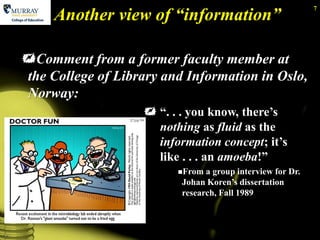
    Comment from a former faculty member at
    the College of Library and Information in Oslo,
    Norway:
                         ―. . . you know, there’s
                          nothing as fluid as the
                          information concept; it’s
                          like . . . an amoeba!‖
                              From  a group interview for Dr.
                               Johan Koren’s dissertation
                               research, Fall 1989


7
8
Do you know what information is?


                  http://vimeo.com/3248432
9


What is information?
   According to the International Encyclopedia of Information
    and Library Science, information is ―best seen as holding
    the place in the spectrum between raw data and
    knowledge. Seen in this way, information is an assemblage
    of data in a comprehensible form capable of
    communication and use: facts to which meaning has been
    attached.‖
   In this sense, almost everything could be information -
    facts (events, concepts, objects, etc.) that carry meaning
    and can be communicated.
10
      Characteristics of information
 Knowing the character or type of information can
  help you to identify its origin and use. There are
  several kinds of information that can be useful for
  different reasons.
         •   Factual Information
         •   Analytical Information
         •   Subjective Information
         •   Objective Information


         SEE ALSO
Understanding the information                         11


           universe
     Information formats
       •   When information is recorded and stored, it
           exists in a physical form called a format.
           There are three broad categories of format:
            • Print  – paper
            • Audio-visual - film, audiotape, videocassette,
              slides, microfilm, vinyl records, etc.
            • Electronic – information that’s recorded, stored
              and retrieved using computer technology.
              Examples include CD’s, DVD’s, and all online
              sources.
                •


11
12
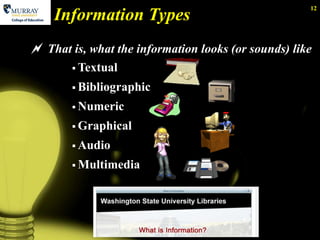
    Information Types
 That is, what the information looks (or sounds) like
         Textual

         Bibliographic

         Numeric

         Graphical

         Audio

         Multimedia
13

     The result?
        Gleick again:
          •   After ―information theory‖ came to be, so did
              ―information overload,‖ ―information glut,‖
              ―information anxiety,‖ and ―information
              fatigue,‖ the last recognized by the OED in
              2009 as a timely syndrome: ―Apathy,
              indifference, or mental exhaustion arising
              from exposure to too much information, esp.
              (in later use) stress induced by the attempt to
              assimilate excessive amounts of information
              from the media, the Internet, or at work.‖
                    •   Gleick, James (2011). The Information: A
                        History, a Theory, a Flood (Kindle Locations
                        7201-7205). Pantheon. Kindle Edition.


13
14
           The solution?
     Gleick has none but hard work:
       •   No deus ex machina waits in the wings; no man behind
           the curtain.
       •   As ever, it is the choice that informs us (in the original
           sense of that word). Selecting the genuine takes work;
           then forgetting takes even more work. This is the curse of
           omniscience: the answer to any question may arrive at the
           fingertips—via Google or Wikipedia or IMDb or YouTube
           or Epicurious or the National DNA Database or any of
           their natural heirs and successors—and still we wonder
           what we know.
                •   Gleick, James (2011). The Information: A History, a Theory, a Flood
                    (Kindle Locations 7587-7588; 7592-7595). Pantheon. Kindle Edition.


14
15
       Can we help?
Is there help to be found from librarians?


                            •   If so, how should it work?

What is information?

  • 1.
    LIB 640 InformationSources and Services Summer 2012 What is Information? And what do we do about it?
  • 2.
    2 What is Information? http://www.youtube.com/watch?v=2U84RbG0iBk&feature=channel&list=UL
  • 3.
    3 3
  • 4.
    Information is all-pervading! 4 James Gleick: • For the purposes of science, information had to mean something special. . . . A rite of purification became necessary. • And then, when it was made simple, distilled, counted in bits, information was found to be everywhere. [Claude] Shannon’s [information] theory [1948] made a bridge between information and uncertainty; between information and entropy; and between information and chaos. It led to compact discs and fax machines, computers and cyberspace, Moore’s law and all the world’s Silicon Alleys. Information processing was born, along with information storage and information retrieval. People began to name a successor to the Iron Age and the Steam Age. • Gleick, James (2011). The Information: A History, a Theory, a Flood (Kindle Locations 134-138). Pantheon. Kindle Edition. 4
  • 5.
    5 Why Shannon? Gleick: • We can see now that information is what our world runs on: the blood and the fuel, the vital principle. It pervades the sciences from top to bottom, transforming every branch of knowledge. [Shannon’s] Information theory began as a bridge from mathematics to electrical engineering and from there to computing. • Gleick, James (2011). The Information: A History, a Theory, a Flood (Kindle Locations 141-143). Pantheon. Kindle Edition. 5
  • 6.
    6 Information, more precisely defined? Information • Data presented in readily comprehensible form to which meaning has been attributed within the context of its use. In a more dynamic sense, the message conveyed by the use of a medium of communication or expression. • Whether a specific message is informative or not depends in part on the subjective perception of the person receiving it. . . . Compare with knowledge. • ODLIS: Online Dictionary for Library and Information Science
  • 7.
    Another view of“information” 7 Comment from a former faculty member at the College of Library and Information in Oslo, Norway:  ―. . . you know, there’s nothing as fluid as the information concept; it’s like . . . an amoeba!‖ From a group interview for Dr. Johan Koren’s dissertation research, Fall 1989 7
  • 8.
    8 Do you knowwhat information is? http://vimeo.com/3248432
  • 9.
    9 What is information?  According to the International Encyclopedia of Information and Library Science, information is ―best seen as holding the place in the spectrum between raw data and knowledge. Seen in this way, information is an assemblage of data in a comprehensible form capable of communication and use: facts to which meaning has been attached.‖  In this sense, almost everything could be information - facts (events, concepts, objects, etc.) that carry meaning and can be communicated.
  • 10.
    10 Characteristics of information  Knowing the character or type of information can help you to identify its origin and use. There are several kinds of information that can be useful for different reasons. • Factual Information • Analytical Information • Subjective Information • Objective Information SEE ALSO
  • 11.
    Understanding the information 11 universe Information formats • When information is recorded and stored, it exists in a physical form called a format. There are three broad categories of format: • Print – paper • Audio-visual - film, audiotape, videocassette, slides, microfilm, vinyl records, etc. • Electronic – information that’s recorded, stored and retrieved using computer technology. Examples include CD’s, DVD’s, and all online sources. • 11
  • 12.
    12 Information Types  That is, what the information looks (or sounds) like  Textual  Bibliographic  Numeric  Graphical  Audio  Multimedia
  • 13.
    13 The result? Gleick again: • After ―information theory‖ came to be, so did ―information overload,‖ ―information glut,‖ ―information anxiety,‖ and ―information fatigue,‖ the last recognized by the OED in 2009 as a timely syndrome: ―Apathy, indifference, or mental exhaustion arising from exposure to too much information, esp. (in later use) stress induced by the attempt to assimilate excessive amounts of information from the media, the Internet, or at work.‖ • Gleick, James (2011). The Information: A History, a Theory, a Flood (Kindle Locations 7201-7205). Pantheon. Kindle Edition. 13
  • 14.
    14 The solution? Gleick has none but hard work: • No deus ex machina waits in the wings; no man behind the curtain. • As ever, it is the choice that informs us (in the original sense of that word). Selecting the genuine takes work; then forgetting takes even more work. This is the curse of omniscience: the answer to any question may arrive at the fingertips—via Google or Wikipedia or IMDb or YouTube or Epicurious or the National DNA Database or any of their natural heirs and successors—and still we wonder what we know. • Gleick, James (2011). The Information: A History, a Theory, a Flood (Kindle Locations 7587-7588; 7592-7595). Pantheon. Kindle Edition. 14
  • 15.
    15 Can we help? Is there help to be found from librarians? • If so, how should it work?