THEORETICAL FRAMEWORK INFORMATION   AS…
or, Something WIKID This Way Comes…. Betsy Van der Veer Martens   School of Library and   Information Studies University of Oklahoma
FISH IN AN OCEAN OF INFORMATION?
INFORMATION, PLEASE ! Enquiring Martians Want to Know: Does “information” exist outside the minds of these humans? What are the connections between “information” and the reality it may represent? How can humans (as “fish” in these deep waters) possibly expect to determine any of this themselves?
INFORMATION AS? “ Information 1: The pattern of organization of matter and   energy.” “ Information 2: Some pattern of organization of matter and energy given meaning by a living being.” (Marcia Bates, 2005)
INFORMATION AS? “ What we mean by information — the elementary unit of information — is a difference  which makes a difference.”     (Gregory Bateson, 1971)
INFORMATION AS? “ Any stimulus that alters  cognitive structure in the  receiver.”  (Bill Paisley, 1969)
INFORMATION AS? The general definition of information (GDI): σ is an instance of information,   understood as semantic content,    if and only if: (GDI.1) σ consists of one or more  data (GDI.2) the data in σ are  well-formed (GDI.3) the well-formed data in σ are   meaningful .
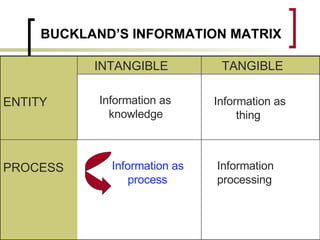
DO FISH NEED A NET? Information theorist Michael Buckland’s matrix from page 3 of his “Information as Thing” (1991) as our organizing framework: Information-as-process Information-as-thing  Information-as-knowledge
BUCKLAND’S INFORMATION MATRIX TANGIBLE INTANGIBLE  Information   processing Information as   process PROCESS Information as   thing Information as   knowledge ENTITY
BUCKLAND’S INFORMATION MATRIX TANGIBLE INTANGIBLE  Information   Processing Information as   Process PROCESS Information as   thing Information as   knowledge ENTITY
INFORMATION AS THING (1) the virtue (and vice!) of being information-as-thing is situational (anything can be seen as evidence of something) (2) determining that anything is likely to be useful information depends on a compounding of subjective judgments (Buckland, 1991)
INFORMATION AS THING “ Information appears to us in a material form … and can be described in a language of physical things. As material objects, [information] can then be collected, organized, and retrieved for use.” (Raber, 2003)
INFORMATION AS THING: THE RAW or THE COOKED? All organized representation and  retrieval of “information as thing”  also involves some kind of processing (cooking, in Claude L évi-Strauss’s  terms),  which leads to the next  cell of Buckland’s matrix (“information processing”) which is what we do professionally.
AND NOW WE’RE COOKING WITH MARCIA BATES! “ Information is given meaning    and integrated with other    contents of understanding.”  (Bates, 2005)
BUCKLAND’S INFORMATION MATRIX TANGIBLE INTANGIBLE  Information   Processing Information as   Process PROCESS Information as   thing Information as   knowledge ENTITY
INFORMATION PROCESSING “ A datum is a string of elementary symbols such as integers or letters.  It is the value of an attribute. It need not have meaning to everyone.” (Meadow, 1992)
INFORMATION PROCESSING Representing and retrieving information can be facilitated by thinking of the information as data “ types,” such as: Primary data Secondary data Metadata Operational data Derivative data
INFORMATION PROCESSING The term, “information processing” also  facilitates thinking about the activities involved in representing and retrieving information: Information classification (catalogs, indices,    ontologies, folksonomies) Information retrieval (recall, precision, relevance,  pertinence) Informetrics (citation analysis, bibliometrics) Intellectual property (patent analysis, open  sourcing)
INFORMATION PROCESSING So, one way we might make an easy transition from “information processing” in this cell to the next cell (“information as process”) is to realize that in this cell people are generally processing information for other people (cooking and serving up “information as thing”), while in the adjoining cell, it’s generally about people processing information for themselves (in the qualitative approach) or about attempting to capture the transmission process itself (in the quantitative approach).
BUCKLAND’S INFORMATION MATRIX TANGIBLE INTANGIBLE  Information   processing Information as   process PROCESS Information as   thing Information as   knowledge ENTITY
INFORMATION AS PROCESS Information as process has  two major approaches:  Focus on the message process (these are mostly quantitative models) Focus on the meaning process (these are mostly qualitative models)
INFORMATION AS PROCESS Some well-known quantitative models of  “information as process”: Shannon and Weaver Fred Dretske Brian Vickery
INFORMATION AS PROCESS Shannon and Weaver’s Probabilistic model of    information transmission Transmitter NOISE   CHANNEL Receiver Destination Message sent
INFORMATION AS PROCESS Fred Dretske’s   Semantic model of    information transmission Transmitter LOGIC CHANNEL Receiver decodes meaning Destination Meaningful  message
INFORMATION AS PROCESS S  M(S)  M(R)  I+K(1)  K(2) Brian Vickery’s Information Transfer model
INFORMATION AS PROCESS Models using a qualitative approach: Taylor’s model of question negotiation Dervin’s sense-making Holsapple’s KVI
INFORMATION AS PROCESS Robert Taylor’s question-formation model: Q 1  visceral need Q 2  conscious need Q 3  formalized need Q 4  compromised need
INFORMATION AS PROCESS Communication theorist Brenda Dervin: Information One (the world) Information Two (ideas people have about the world) Information Three (how people make sense of things when they encounter the differences between One and Two)
INFORMATION AS PROCESS More on Dervin’s Sensemaking : (How people see gaps in the road ahead): Decision stop Barrier stop Spin-out stop Wash-out stop Problematic stop Perceptual embeddedness  Situational embeddedness Social embeddedness
INFORMATION AS PROCESS The KVI Perspective  from Clyde Holsapple
INFORMATION AS PROCESS “ The cognitive state of awareness (as being informed) given representation in physical form (data). This physical representation facilitates the process of knowing.” (Debons  et al ., 1988)
BUCKLAND’S INFORMATION MATRIX TANGIBLE INTANGIBLE  Information   processing Information as   process PROCESS Information as   thing Information as   knowledge ENTITY
INFORMATION AS KNOWLEDGE Karl Popper: The Three Worlds World 1 (world of physical reality) World 2 (world as we perceive it) World 3 (world of ideas)
INFORMATION AS KNOWLEDGE Fritz Machlup:  The Economics of Information
DIKW Hierarchy Wisdom Intelligence Knowledge Information Data
DIKW Hierarchy?
Or is it WIKID? “ Where is the life we have lost in   living?  Where is the wisdom we have lost    in knowledge? Where is the knowledge we have    lost in information?” — T.S. Eliot,  chorus from “The Rock”
Or is it WIKID?
KM/LIS 5033 Students Respond….

Information As...

  • 1.
  • 2.
    or, Something WIKIDThis Way Comes…. Betsy Van der Veer Martens School of Library and Information Studies University of Oklahoma
  • 3.
    FISH IN ANOCEAN OF INFORMATION?
  • 4.
    INFORMATION, PLEASE !Enquiring Martians Want to Know: Does “information” exist outside the minds of these humans? What are the connections between “information” and the reality it may represent? How can humans (as “fish” in these deep waters) possibly expect to determine any of this themselves?
  • 5.
    INFORMATION AS? “Information 1: The pattern of organization of matter and energy.” “ Information 2: Some pattern of organization of matter and energy given meaning by a living being.” (Marcia Bates, 2005)
  • 6.
    INFORMATION AS? “What we mean by information — the elementary unit of information — is a difference which makes a difference.” (Gregory Bateson, 1971)
  • 7.
    INFORMATION AS? “Any stimulus that alters cognitive structure in the receiver.” (Bill Paisley, 1969)
  • 8.
    INFORMATION AS? Thegeneral definition of information (GDI): σ is an instance of information, understood as semantic content, if and only if: (GDI.1) σ consists of one or more data (GDI.2) the data in σ are well-formed (GDI.3) the well-formed data in σ are meaningful .
  • 9.
    DO FISH NEEDA NET? Information theorist Michael Buckland’s matrix from page 3 of his “Information as Thing” (1991) as our organizing framework: Information-as-process Information-as-thing Information-as-knowledge
  • 10.
    BUCKLAND’S INFORMATION MATRIXTANGIBLE INTANGIBLE Information processing Information as process PROCESS Information as thing Information as knowledge ENTITY
  • 11.
    BUCKLAND’S INFORMATION MATRIXTANGIBLE INTANGIBLE Information Processing Information as Process PROCESS Information as thing Information as knowledge ENTITY
  • 12.
    INFORMATION AS THING(1) the virtue (and vice!) of being information-as-thing is situational (anything can be seen as evidence of something) (2) determining that anything is likely to be useful information depends on a compounding of subjective judgments (Buckland, 1991)
  • 13.
    INFORMATION AS THING“ Information appears to us in a material form … and can be described in a language of physical things. As material objects, [information] can then be collected, organized, and retrieved for use.” (Raber, 2003)
  • 14.
    INFORMATION AS THING:THE RAW or THE COOKED? All organized representation and retrieval of “information as thing” also involves some kind of processing (cooking, in Claude L évi-Strauss’s terms), which leads to the next cell of Buckland’s matrix (“information processing”) which is what we do professionally.
  • 15.
    AND NOW WE’RECOOKING WITH MARCIA BATES! “ Information is given meaning and integrated with other contents of understanding.” (Bates, 2005)
  • 16.
    BUCKLAND’S INFORMATION MATRIXTANGIBLE INTANGIBLE Information Processing Information as Process PROCESS Information as thing Information as knowledge ENTITY
  • 17.
    INFORMATION PROCESSING “A datum is a string of elementary symbols such as integers or letters. It is the value of an attribute. It need not have meaning to everyone.” (Meadow, 1992)
  • 18.
    INFORMATION PROCESSING Representingand retrieving information can be facilitated by thinking of the information as data “ types,” such as: Primary data Secondary data Metadata Operational data Derivative data
  • 19.
    INFORMATION PROCESSING Theterm, “information processing” also facilitates thinking about the activities involved in representing and retrieving information: Information classification (catalogs, indices, ontologies, folksonomies) Information retrieval (recall, precision, relevance, pertinence) Informetrics (citation analysis, bibliometrics) Intellectual property (patent analysis, open sourcing)
  • 20.
    INFORMATION PROCESSING So,one way we might make an easy transition from “information processing” in this cell to the next cell (“information as process”) is to realize that in this cell people are generally processing information for other people (cooking and serving up “information as thing”), while in the adjoining cell, it’s generally about people processing information for themselves (in the qualitative approach) or about attempting to capture the transmission process itself (in the quantitative approach).
  • 21.
    BUCKLAND’S INFORMATION MATRIXTANGIBLE INTANGIBLE Information processing Information as process PROCESS Information as thing Information as knowledge ENTITY
  • 22.
    INFORMATION AS PROCESSInformation as process has two major approaches: Focus on the message process (these are mostly quantitative models) Focus on the meaning process (these are mostly qualitative models)
  • 23.
    INFORMATION AS PROCESSSome well-known quantitative models of “information as process”: Shannon and Weaver Fred Dretske Brian Vickery
  • 24.
    INFORMATION AS PROCESSShannon and Weaver’s Probabilistic model of information transmission Transmitter NOISE CHANNEL Receiver Destination Message sent
  • 25.
    INFORMATION AS PROCESSFred Dretske’s Semantic model of information transmission Transmitter LOGIC CHANNEL Receiver decodes meaning Destination Meaningful message
  • 26.
    INFORMATION AS PROCESSS M(S) M(R) I+K(1) K(2) Brian Vickery’s Information Transfer model
  • 27.
    INFORMATION AS PROCESSModels using a qualitative approach: Taylor’s model of question negotiation Dervin’s sense-making Holsapple’s KVI
  • 28.
    INFORMATION AS PROCESSRobert Taylor’s question-formation model: Q 1 visceral need Q 2 conscious need Q 3 formalized need Q 4 compromised need
  • 29.
    INFORMATION AS PROCESSCommunication theorist Brenda Dervin: Information One (the world) Information Two (ideas people have about the world) Information Three (how people make sense of things when they encounter the differences between One and Two)
  • 30.
    INFORMATION AS PROCESSMore on Dervin’s Sensemaking : (How people see gaps in the road ahead): Decision stop Barrier stop Spin-out stop Wash-out stop Problematic stop Perceptual embeddedness Situational embeddedness Social embeddedness
  • 31.
    INFORMATION AS PROCESSThe KVI Perspective from Clyde Holsapple
  • 32.
    INFORMATION AS PROCESS“ The cognitive state of awareness (as being informed) given representation in physical form (data). This physical representation facilitates the process of knowing.” (Debons et al ., 1988)
  • 33.
    BUCKLAND’S INFORMATION MATRIXTANGIBLE INTANGIBLE Information processing Information as process PROCESS Information as thing Information as knowledge ENTITY
  • 34.
    INFORMATION AS KNOWLEDGEKarl Popper: The Three Worlds World 1 (world of physical reality) World 2 (world as we perceive it) World 3 (world of ideas)
  • 35.
    INFORMATION AS KNOWLEDGEFritz Machlup: The Economics of Information
  • 36.
    DIKW Hierarchy WisdomIntelligence Knowledge Information Data
  • 37.
  • 38.
    Or is itWIKID? “ Where is the life we have lost in living? Where is the wisdom we have lost in knowledge? Where is the knowledge we have lost in information?” — T.S. Eliot, chorus from “The Rock”
  • 39.
    Or is itWIKID?
  • 40.