A resource for grassroots soil remediation products, education, and community
Remove toxins from the soil in small residential lots using passive, non-invasive, soil-building natural
processes
What is:
Grassroots Soil Remediation?
What is Soil Remediation?
Remedying Soil
Taking Bad/Unhealthy Things
Out of Soil
What are
Bad/Unhealthy
Things in Soil?
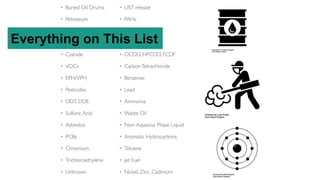
Everything on This List
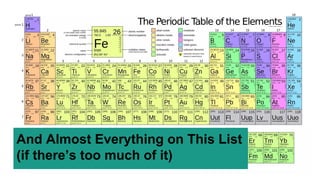
And Almost Everything on This List
(if there’s too much of it)
How Do These Unhealthy
Things Get in Soil?
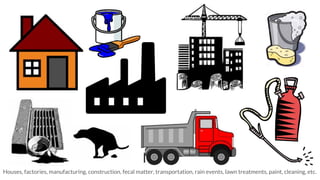
Houses, factories, manufacturing, construction, fecal matter, transportation, rain events, lawn treatments, paint, cleaning, etc.
How are these things removed?
How does remediation work?
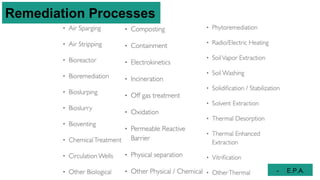
- E.P.A.
Remediation Processes
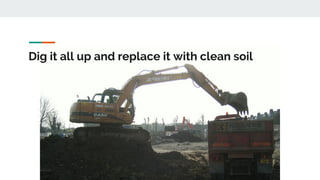
Dig it all up and replace it with clean soil
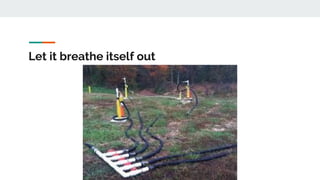
Let it breathe itself out
Wash it and throw out the bad stuff
Set it on Fire!
None of these are something
someone can do on their own
Plus other issues like being prohibitively expensive, looking ugly, being loud and disruptive,
and destroying all life in the soil and all the wildlife habitats on the site
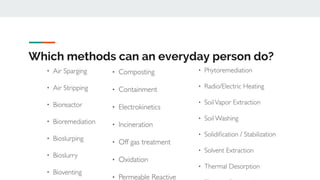
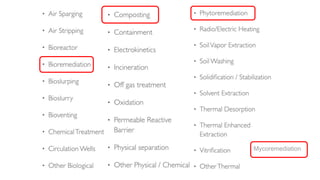
Which methods can an everyday person do?
Mycoremediation
Grassroots Soil Remediation is
remediation that is safe and
plausible for an ordinary* person
to do.
*ordinary, in this case, meaning people without specific soil science and remediation education and
training that do not have the funds/access/support of remediation companies.
People without soil remediation day jobs.
All Natural Soil Remediation
Plus it develops the soil, is much prettier, improves the soil so that it can hold water better and capture
carbon, improves and creates habitat for local wildlife and bees, and reduces erosion.
It’s typically much cheaper. The trade off is that it’s slower. It runs at nature’s speed.
Bioremediation*
Phytoremediation
Mycoremediation
*Bioremediation has 2 meanings, depending on who you ask:
- Using special microbes (usually bred in a lab) to eat specific toxins
(microbial remediation)
or
- Using all-natural remediation processes / using nature to fix nature
One of these the is accessible to the layperson, one of these isn’t.
I’m mostly just going to say ‘Compost’, because compost is the layperson’s way to
breed helpful microbes that eat toxins.
Compost
Phytoremediation
Mycoremediation
What are these natural grassroot methods?
How can we use them?
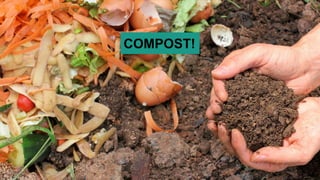
COMPOST!
COMPOST!
Bioremediation / Microbial Remediation
COMPOST! VERMICULTURE! MICROBES! BENEFICIAL BACTERIA!
First up -
Microbial Remediation
“Microbial Remediation uses microorganism to either degrade organic contaminants or to bind heavy
metals into more inert and less biological available forms.
“Microorganisms break down contaminants by using them as a food source or metabolizing them with a
food source.”
-Leila Darwish
“If you are doing any restoration project,
healthy soil is the foundation.”
- Marika Smith, Victoria Compost Education Center
Compost
decayed organic material (as of leaves and grass) used to improve soil especially for growing crops.
- Merriam - Webster Dictionary
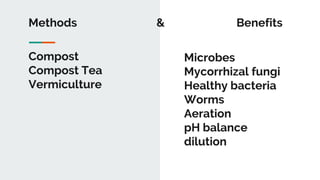
Compost
Compost Tea
Vermiculture
Microbes
Mycorrhizal fungi
Healthy bacteria
Worms
Aeration
pH balance
dilution
Methods & Benefits
Healthy Compost
Nitrogen (green) + Carbon (brown) + Moisture + Oxygen
Top Dressing
Get composting instructions at:
https://www.boston.gov/departments/public-works/composting-boston
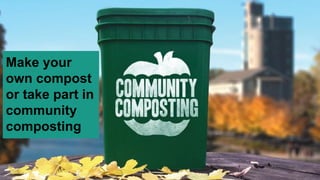
Make your
own compost
or take part in
community
composting
PHYTOREMEDIATION!
Phytotechnology
“Phytotechnology is the use of vegetation to remediation, contain, or prevent contaminants in soils,
sediments and groundwater, and/or nutrients, porosity and organic matter.
It is also a set of planning, engineering and design tools and cultural practices that can assist landscape
architects, site designers, engineers and environmental planners in working on current and future
individual sites, the urban fabric and regional landscape.”
- Kirkwood and Kennen
Second up -
Types of Phytotechnologies
Phytodegradation - plant destroys it
Rhizodegradation - microbes in soil destroy it
Phytovolatilization - plant releases it as a gas
Phytometabolism - plant uses it for growth, incorporates it into biomass
Phytoextraction - plant extracts and stores it, must be harvest and removed for treatment
Phytohydraulics - plant pulls up water, contaminants may come with it
Phytostabilization - plant holds it in place
Phytoaccumulation - plant collects contaminants from air and stores it
Rhizofiltration - roots and soil filter water
Phytobuffering - proactive plant choice prevents future contamination
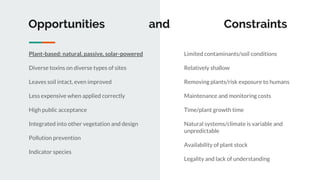
Limited contaminants/soil conditions
Relatively shallow
Removing plants/risk exposure to humans
Maintenance and monitoring costs
Time/plant growth time
Natural systems/climate is variable and
unpredictable
Availability of plant stock
Legality and lack of understanding
Opportunities and Constraints
Plant-based: natural, passive, solar-powered
Diverse toxins on diverse types of sites
Leaves soil intact, even improved
Less expensive when applied correctly
High public acceptance
Integrated into other vegetation and design
Pollution prevention
Indicator species
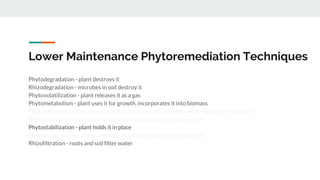
Lower Maintenance Phytoremediation Techniques
Phytodegradation - plant destroys it
Rhizodegradation - microbes in soil destroy it
Phytovolatilization - plant releases it as a gas
Phytometabolism - plant uses it for growth, incorporates it into biomass
Phytoextraction - plant extracts and stores it, must be harvest and removed for treatment
Phytohydraulics - plant pulls up water, contaminants may come with it
Phytostabilization - plant holds it in place
Phytoaccumulation - plant collects contaminants from air and stores it
Rhizofiltration - roots and soil filter water
*The list excluded techniques that involve planting species that accumulate metal and
then having to extract the toxin plants and safely dispose of them
The remaining techniques involve the plant doing all the work with no extraction
necessary
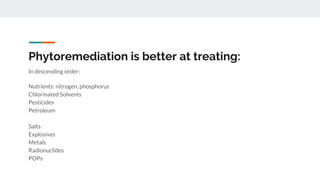
Phytoremediation is better at treating:
In descending order:
Nutrients: nitrogen, phosphorus
Chlorinated Solvents
Pesticides
Petroleum
Salts
Explosives
Metals
Radionuclides
POPs
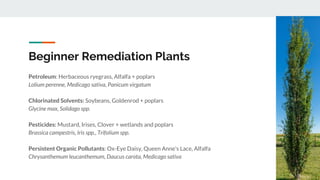
Beginner Remediation Plants
Petroleum: Herbaceous ryegrass, Alfalfa + poplars
Lolium perenne, Medicago sativa, Panicum virgatum
Chlorinated Solvents: Soybeans, Goldenrod + poplars
Glycine max, Solidago spp.
Pesticides: Mustard, Irises, Clover + wetlands and poplars
Brassica campestris, Iris spp., Trifolium spp.
Persistent Organic Pollutants: Ox-Eye Daisy, Queen Anne’s Lace, Alfalfa
Chrysanthemum leucanthemum, Daucus carota, Medicago sativa
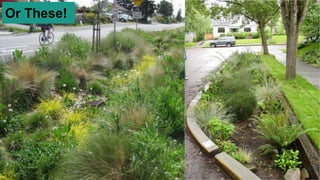
Make This!
Or These!
Toxic Soil Busters
Worchester, MA
Example of a
group doing this
for themselves…
Fighting lead
contamination
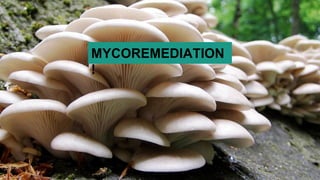
MYCOREMEDIATION
!
Mycoremediation
“...the use of fungi, specifically mushrooms, for creating simple yet effective biomass capable of breaking
down environmental and industrial pollutants.”
“Research has proven the efficacy of using fungi to degrade contamination such as PCBs, aromatic
hydrocarbons, and oil spills.”
- Tradd Cotter
Third up -
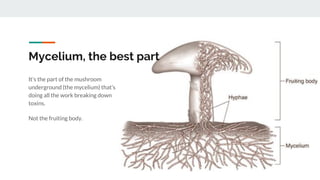
It’s the part of the mushroom
underground (the mycelium) that’s
doing all the work breaking down
toxins.
Not the fruiting body.
Mycelium, the best part
Beginner Remediation Mushrooms
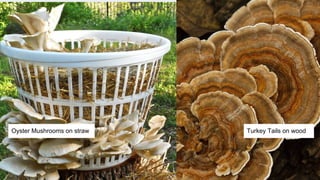
Oysters: King Oyster, Pearl Oyster Phoenix Oyster
Pleurotus eryngii, Pleurotus ostreatus, Pleurotus pulmonarius
Turkey Tail
Trametes versicolor
Oyster Mushrooms on straw Turkey Tails on wood
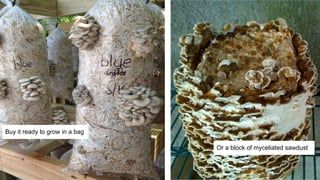
Buy it ready to grow in a bag
Or a block of myceliated sawdust
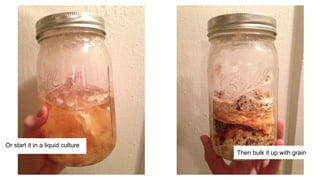
Or start it in a liquid culture
Then bulk it up with grain
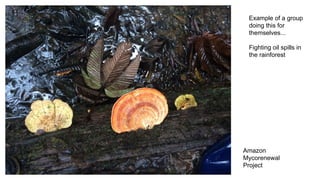
Amazon
Mycorenewal
Project
Example of a group
doing this for
themselves...
Fighting oil spills in
the rainforest
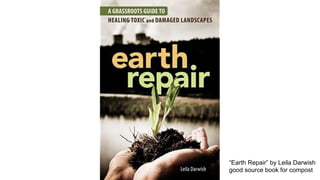
“Earth Repair” by Leila Darwish
good source book for compost
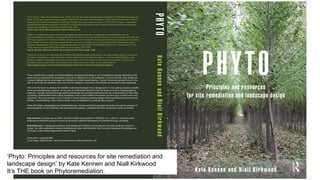
‘Phyto: Principles and resources for site remediation and
landscape design’ by Kate Kennen and Niall Kirkwood
It’s THE book on Phytoremediation.
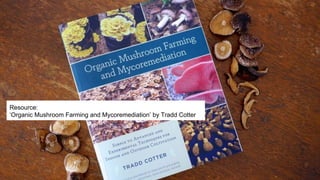
Resource:
‘Organic Mushroom Farming and Mycoremediation’ by Tradd Cotter
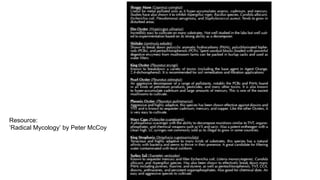
Resource:
‘Radical Mycology’ by Peter McCoy
Everything by Paul Stamets
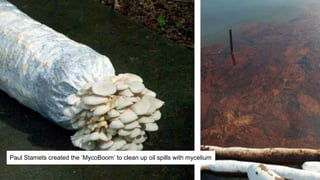
Paul Stamets created the ‘MycoBoom’ to clean up oil spills with mycelium
Compost
Phytoremediation
Mycoremediation
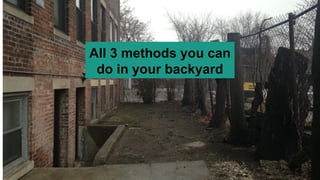
All 3 methods you can
do in your backyard
Make it more
Beautiful AND Healthy
THANK YOU!
If you’d like to learn more, please visit our website!
www.equiterraco.com

What is 'Grassroots' Soil Remediation

  • 1.
    A resource forgrassroots soil remediation products, education, and community Remove toxins from the soil in small residential lots using passive, non-invasive, soil-building natural processes
  • 2.
  • 3.
    What is SoilRemediation?
  • 4.
  • 5.
  • 6.
  • 7.
    And Almost Everythingon This List (if there’s too much of it)
  • 8.
    How Do TheseUnhealthy Things Get in Soil?
  • 9.
    Houses, factories, manufacturing,construction, fecal matter, transportation, rain events, lawn treatments, paint, cleaning, etc.
  • 10.
    How are thesethings removed? How does remediation work?
  • 11.
  • 12.
    Dig it allup and replace it with clean soil
  • 13.
    Let it breatheitself out
  • 14.
    Wash it andthrow out the bad stuff
  • 15.
    Set it onFire!
  • 16.
    None of theseare something someone can do on their own Plus other issues like being prohibitively expensive, looking ugly, being loud and disruptive, and destroying all life in the soil and all the wildlife habitats on the site
  • 17.
    Which methods canan everyday person do?
  • 18.
  • 19.
    Grassroots Soil Remediationis remediation that is safe and plausible for an ordinary* person to do. *ordinary, in this case, meaning people without specific soil science and remediation education and training that do not have the funds/access/support of remediation companies. People without soil remediation day jobs.
  • 20.
    All Natural SoilRemediation Plus it develops the soil, is much prettier, improves the soil so that it can hold water better and capture carbon, improves and creates habitat for local wildlife and bees, and reduces erosion. It’s typically much cheaper. The trade off is that it’s slower. It runs at nature’s speed.
  • 21.
  • 22.
    *Bioremediation has 2meanings, depending on who you ask: - Using special microbes (usually bred in a lab) to eat specific toxins (microbial remediation) or - Using all-natural remediation processes / using nature to fix nature One of these the is accessible to the layperson, one of these isn’t. I’m mostly just going to say ‘Compost’, because compost is the layperson’s way to breed helpful microbes that eat toxins.
  • 23.
  • 24.
    What are thesenatural grassroot methods? How can we use them?
  • 25.
  • 26.
    COMPOST! Bioremediation / MicrobialRemediation COMPOST! VERMICULTURE! MICROBES! BENEFICIAL BACTERIA! First up -
  • 27.
    Microbial Remediation “Microbial Remediationuses microorganism to either degrade organic contaminants or to bind heavy metals into more inert and less biological available forms. “Microorganisms break down contaminants by using them as a food source or metabolizing them with a food source.” -Leila Darwish
  • 28.
    “If you aredoing any restoration project, healthy soil is the foundation.” - Marika Smith, Victoria Compost Education Center
  • 29.
    Compost decayed organic material(as of leaves and grass) used to improve soil especially for growing crops. - Merriam - Webster Dictionary
  • 30.
    Compost Compost Tea Vermiculture Microbes Mycorrhizal fungi Healthybacteria Worms Aeration pH balance dilution Methods & Benefits
  • 31.
    Healthy Compost Nitrogen (green)+ Carbon (brown) + Moisture + Oxygen Top Dressing
  • 32.
    Get composting instructionsat: https://www.boston.gov/departments/public-works/composting-boston
  • 33.
    Make your own compost ortake part in community composting
  • 34.
  • 35.
    Phytotechnology “Phytotechnology is theuse of vegetation to remediation, contain, or prevent contaminants in soils, sediments and groundwater, and/or nutrients, porosity and organic matter. It is also a set of planning, engineering and design tools and cultural practices that can assist landscape architects, site designers, engineers and environmental planners in working on current and future individual sites, the urban fabric and regional landscape.” - Kirkwood and Kennen Second up -
  • 36.
    Types of Phytotechnologies Phytodegradation- plant destroys it Rhizodegradation - microbes in soil destroy it Phytovolatilization - plant releases it as a gas Phytometabolism - plant uses it for growth, incorporates it into biomass Phytoextraction - plant extracts and stores it, must be harvest and removed for treatment Phytohydraulics - plant pulls up water, contaminants may come with it Phytostabilization - plant holds it in place Phytoaccumulation - plant collects contaminants from air and stores it Rhizofiltration - roots and soil filter water Phytobuffering - proactive plant choice prevents future contamination
  • 37.
    Limited contaminants/soil conditions Relativelyshallow Removing plants/risk exposure to humans Maintenance and monitoring costs Time/plant growth time Natural systems/climate is variable and unpredictable Availability of plant stock Legality and lack of understanding Opportunities and Constraints Plant-based: natural, passive, solar-powered Diverse toxins on diverse types of sites Leaves soil intact, even improved Less expensive when applied correctly High public acceptance Integrated into other vegetation and design Pollution prevention Indicator species
  • 38.
    Lower Maintenance PhytoremediationTechniques Phytodegradation - plant destroys it Rhizodegradation - microbes in soil destroy it Phytovolatilization - plant releases it as a gas Phytometabolism - plant uses it for growth, incorporates it into biomass Phytoextraction - plant extracts and stores it, must be harvest and removed for treatment Phytohydraulics - plant pulls up water, contaminants may come with it Phytostabilization - plant holds it in place Phytoaccumulation - plant collects contaminants from air and stores it Rhizofiltration - roots and soil filter water
  • 39.
    *The list excludedtechniques that involve planting species that accumulate metal and then having to extract the toxin plants and safely dispose of them The remaining techniques involve the plant doing all the work with no extraction necessary
  • 40.
    Phytoremediation is betterat treating: In descending order: Nutrients: nitrogen, phosphorus Chlorinated Solvents Pesticides Petroleum Salts Explosives Metals Radionuclides POPs
  • 41.
    Beginner Remediation Plants Petroleum:Herbaceous ryegrass, Alfalfa + poplars Lolium perenne, Medicago sativa, Panicum virgatum Chlorinated Solvents: Soybeans, Goldenrod + poplars Glycine max, Solidago spp. Pesticides: Mustard, Irises, Clover + wetlands and poplars Brassica campestris, Iris spp., Trifolium spp. Persistent Organic Pollutants: Ox-Eye Daisy, Queen Anne’s Lace, Alfalfa Chrysanthemum leucanthemum, Daucus carota, Medicago sativa
  • 42.
  • 43.
  • 44.
    Toxic Soil Busters Worchester,MA Example of a group doing this for themselves… Fighting lead contamination
  • 45.
  • 46.
    Mycoremediation “...the use offungi, specifically mushrooms, for creating simple yet effective biomass capable of breaking down environmental and industrial pollutants.” “Research has proven the efficacy of using fungi to degrade contamination such as PCBs, aromatic hydrocarbons, and oil spills.” - Tradd Cotter Third up -
  • 47.
    It’s the partof the mushroom underground (the mycelium) that’s doing all the work breaking down toxins. Not the fruiting body. Mycelium, the best part
  • 48.
    Beginner Remediation Mushrooms Oysters:King Oyster, Pearl Oyster Phoenix Oyster Pleurotus eryngii, Pleurotus ostreatus, Pleurotus pulmonarius Turkey Tail Trametes versicolor
  • 49.
    Oyster Mushrooms onstraw Turkey Tails on wood
  • 50.
    Buy it readyto grow in a bag Or a block of myceliated sawdust
  • 51.
    Or start itin a liquid culture Then bulk it up with grain
  • 52.
    Amazon Mycorenewal Project Example of agroup doing this for themselves... Fighting oil spills in the rainforest
  • 53.
    “Earth Repair” byLeila Darwish good source book for compost
  • 54.
    ‘Phyto: Principles andresources for site remediation and landscape design’ by Kate Kennen and Niall Kirkwood It’s THE book on Phytoremediation.
  • 55.
    Resource: ‘Organic Mushroom Farmingand Mycoremediation’ by Tradd Cotter
  • 56.
  • 57.
  • 58.
    Paul Stamets createdthe ‘MycoBoom’ to clean up oil spills with mycelium
  • 59.
  • 60.
    All 3 methodsyou can do in your backyard
  • 61.
  • 62.
    THANK YOU! If you’dlike to learn more, please visit our website! www.equiterraco.com