© 2022. UNCAL Digital Technology
Your Platform in Digital Transformation
© 2022. UNCAL Digital Technology
CONTENTS OF THIS TEMPLATE
1. Understanding ESB
2. Why UNCAL ESB
© 2022. UNCAL Digital Technology
Understanding ESB
Enterprise Service Bus introduction
© 2022. UNCAL Digital Technology
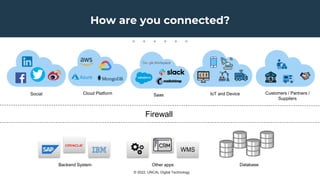
Other apps
Backend System Database
Cloud Platform Saas
Social IoT and Device Customers / Partners /
Suppliers
How are you connected?
Firewall
© 2022. UNCAL Digital Technology
Cloud Platform Saas
Social IoT and Device Customers / Partners /
Suppliers
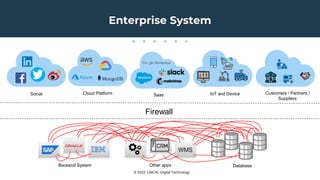
Enterprise System
Other apps
Backend System Database
Firewall
© 2022. UNCAL Digital Technology
Other apps Database
Cloud Platform Saas
Social IoT and Device Customers / Partners /
Suppliers
Enterprise System
Backend System
© 2022. UNCAL Digital Technology
Other apps Database
Cloud Platform Saas
Social IoT and Device Customers / Partners /
Suppliers
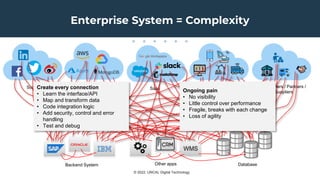
Create every connection
• Learn the interface/API
• Map and transform data
• Code integration logic
• Add security, control and error
handling
• Test and debug
Ongoing pain
• No visibility
• Little control over performance
• Fragile, breaks with each change
• Loss of agility
Enterprise System = Complexity
Backend System
© 2022. UNCAL Digital Technology
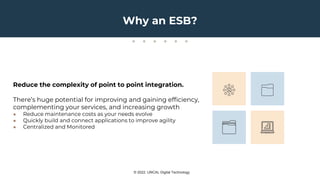
Reduce the complexity of point to point integration.
There’s huge potential for improving and gaining efficiency,
complementing your services, and increasing growth
● Reduce maintenance costs as your needs evolve
● Quickly build and connect applications to improve agility
● Centralized and Monitored
Why an ESB?
© 2022. UNCAL Digital Technology
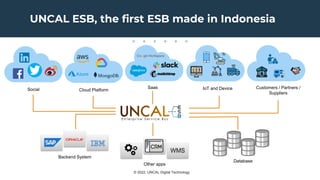
UNCAL ESB, the first ESB made in Indonesia
Other apps
Database
Cloud Platform
Saas
Social IoT and Device Customers / Partners /
Suppliers
Backend System
© 2022. UNCAL Digital Technology
Why UNCAL ESB
Enterprise Service Bus introduction
© 2022. UNCAL Digital Technology
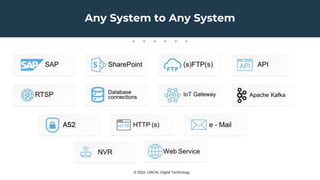
Any System to Any System
© 2022. UNCAL Digital Technology
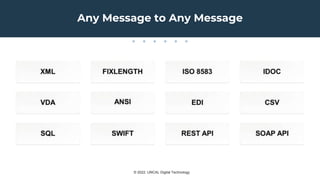
Any Message to Any Message
© 2022. UNCAL Digital Technology
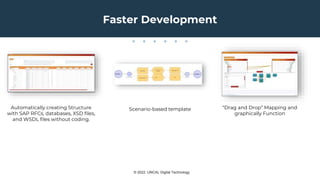
Faster Development
Automatically creating Structure
with SAP RFCs, databases, XSD files,
and WSDL files without coding.
“Drag and Drop” Mapping and
graphically Function
Scenario-based template
© 2022. UNCAL Digital Technology
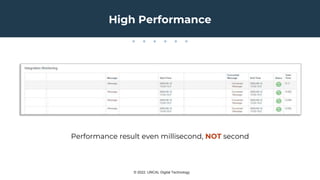
High Performance
Performance result even millisecond, NOT second
© 2022. UNCAL Digital Technology
OUR VALUABLE CUSTOMERS
© 2022. UNCAL Digital Technology
Let's Start a Digital Transformation
Journey With Us!
@UNCALDT www.uncal-dt.com

What is ESB (v2).pptx

  • 1.
    © 2022. UNCALDigital Technology © 2022. UNCAL Digital Technology Your Platform in Digital Transformation
  • 2.
    © 2022. UNCALDigital Technology CONTENTS OF THIS TEMPLATE 1. Understanding ESB 2. Why UNCAL ESB
  • 3.
    © 2022. UNCALDigital Technology © 2022. UNCAL Digital Technology Understanding ESB Enterprise Service Bus introduction
  • 4.
    © 2022. UNCALDigital Technology Other apps Backend System Database Cloud Platform Saas Social IoT and Device Customers / Partners / Suppliers How are you connected? Firewall
  • 5.
    © 2022. UNCALDigital Technology Cloud Platform Saas Social IoT and Device Customers / Partners / Suppliers Enterprise System Other apps Backend System Database Firewall
  • 6.
    © 2022. UNCALDigital Technology Other apps Database Cloud Platform Saas Social IoT and Device Customers / Partners / Suppliers Enterprise System Backend System
  • 7.
    © 2022. UNCALDigital Technology Other apps Database Cloud Platform Saas Social IoT and Device Customers / Partners / Suppliers Create every connection • Learn the interface/API • Map and transform data • Code integration logic • Add security, control and error handling • Test and debug Ongoing pain • No visibility • Little control over performance • Fragile, breaks with each change • Loss of agility Enterprise System = Complexity Backend System
  • 8.
    © 2022. UNCALDigital Technology Reduce the complexity of point to point integration. There’s huge potential for improving and gaining efficiency, complementing your services, and increasing growth ● Reduce maintenance costs as your needs evolve ● Quickly build and connect applications to improve agility ● Centralized and Monitored Why an ESB?
  • 9.
    © 2022. UNCALDigital Technology UNCAL ESB, the first ESB made in Indonesia Other apps Database Cloud Platform Saas Social IoT and Device Customers / Partners / Suppliers Backend System
  • 10.
    © 2022. UNCALDigital Technology © 2022. UNCAL Digital Technology Why UNCAL ESB Enterprise Service Bus introduction
  • 11.
    © 2022. UNCALDigital Technology Any System to Any System
  • 12.
    © 2022. UNCALDigital Technology Any Message to Any Message
  • 13.
    © 2022. UNCALDigital Technology Faster Development Automatically creating Structure with SAP RFCs, databases, XSD files, and WSDL files without coding. “Drag and Drop” Mapping and graphically Function Scenario-based template
  • 14.
    © 2022. UNCALDigital Technology High Performance Performance result even millisecond, NOT second
  • 15.
    © 2022. UNCALDigital Technology OUR VALUABLE CUSTOMERS
  • 16.
    © 2022. UNCALDigital Technology © 2022. UNCAL Digital Technology Let's Start a Digital Transformation Journey With Us! @UNCALDT www.uncal-dt.com

Editor's Notes

  • #5 If you know what this prospect’s IT environment looks like, try to represent it here. For example, change the icons of the SaaS apps, cloud platforms, social apps to include the things you know they’re using. We want to make sure they recognize themselves in this picture. Talk track This is what most businesses look like today. They still have a number of on-premise systems and databases that reside comfortably behind the firewall. These systems have been built up over time, often decades, and they’re unlikely to go away anytime soon. You have too much invested in them and they’re performing mission-critical work for your business. However, in addition to these systems, you also rely on a host of other systems and services that reside outside you business, in the cloud. You’re connecting with partner systems like [Mitchell estimating, DMV] and engaging with customers in new places like [aggregators]. You may have some cloud platforms like AWS or NetSuite You’re using SaaS applications, probably more of them than you even know about and the number is growing rapidly Engaging with customers through social media is no longer a nice to have. More than likely your marketing team is actively using facebook and twitter to engage with customers and build awareness And you’re supporting mobile devices and well as a growing number of devices (ex: telematic device to support pay-as-you go insurance) The problem is that you need to get all of these systems connected. And many companies still take a point-to-point approach to integration. You have to build all of the connections between your back-end systems [CLICK]
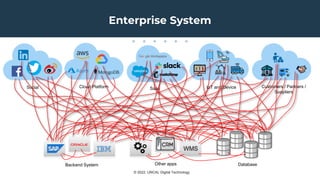
  • #6 Talk track And you have to build all of the connections between those back-end systems and all of the SaaS apps you’re using [CLICK]
  • #7 Talk track And repeat the process for everything else you need to connect to – partners, devices, social apps, and cloud platforms. And this is what you end up – integration spaghetti.
  • #8 Note on presenting this if customer already has ESB You might think you've solved this b/c you have IBM or Oracle but here's what you haven't solved – connecting SaaS. Legacy ESBs were not designed to connect to SaaS applications – they’re only designed to address the behind the firewall problem. Talk track: It’s not pretty, and it’s not easy. Think about it. For every one of these connections you have to learn the interfaces of the two endpoints you’re connecting, which can be hard because the chances of those being well-documented in pretty slim. Then you have to build all the transformations and code the business logic for the processes you’re integrating. You’ll need to build a security layer so your data isn’t exposed in-flight. You’ll have to write some code to manage exceptions and handle errors. And you’ll have to test and debug it all. [CLICK] And the situation grows even uglier when you roll this into production because now you have to manage and maintain it. You have no visibility into what’s happening so when something goes wrong it’s difficult to identify and fix. It’s difficult to performance tune this. Every time one of these application APIs changes, all of the integrations to that app break and you have go and manually update each one. And ultimately, it slows you down and makes it really difficult to adapt to change. Adding or changing an endpoint means creating all of these connections over again.