PRESENTER

                USC Lancaster
                Kenneth T. Cole
  USC
            Director of Financial Aid
LANCASTER
   Education as an Investment

   Calculating College Costs

   Reading an Award Letter

   Comparing Colleges by Costs and Awards

   Determining How Much You Should Borrow
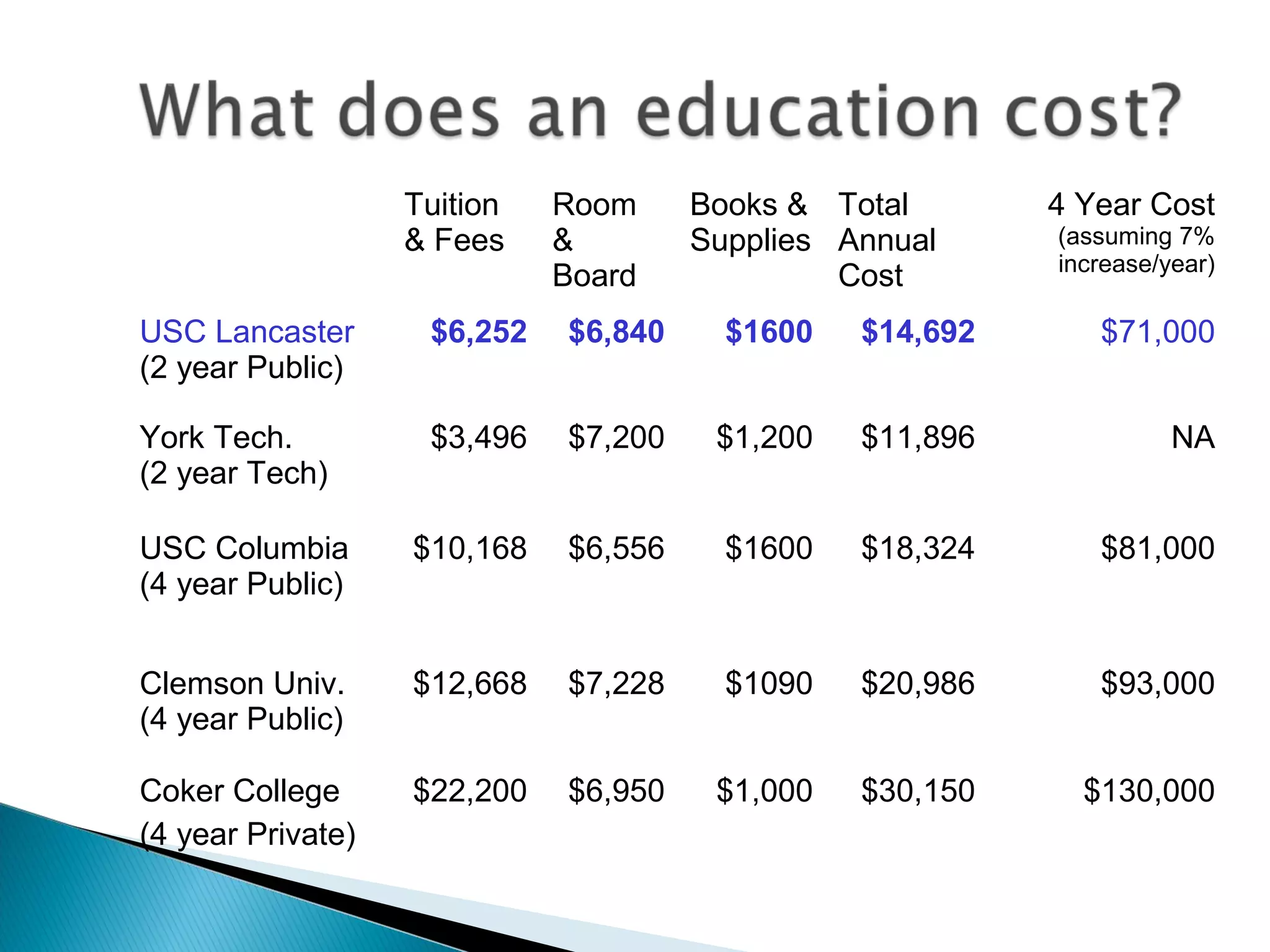
Tuition   Room     Books & Total       4 Year Cost
                   & Fees    &        Supplies Annual     (assuming 7%
                                                          increase/year)
                             Board             Cost
USC Lancaster       $6,252   $6,840     $1600   $14,692      $71,000
(2 year Public)

York Tech.          $3,496   $7,200    $1,200   $11,896             NA
(2 year Tech)

USC Columbia       $10,168   $6,556     $1600   $18,324      $81,000
(4 year Public)


Clemson Univ.      $12,668   $7,228     $1090   $20,986      $93,000
(4 year Public)

Coker College      $22,200   $6,950    $1,000   $30,150     $130,000
(4 year Private)
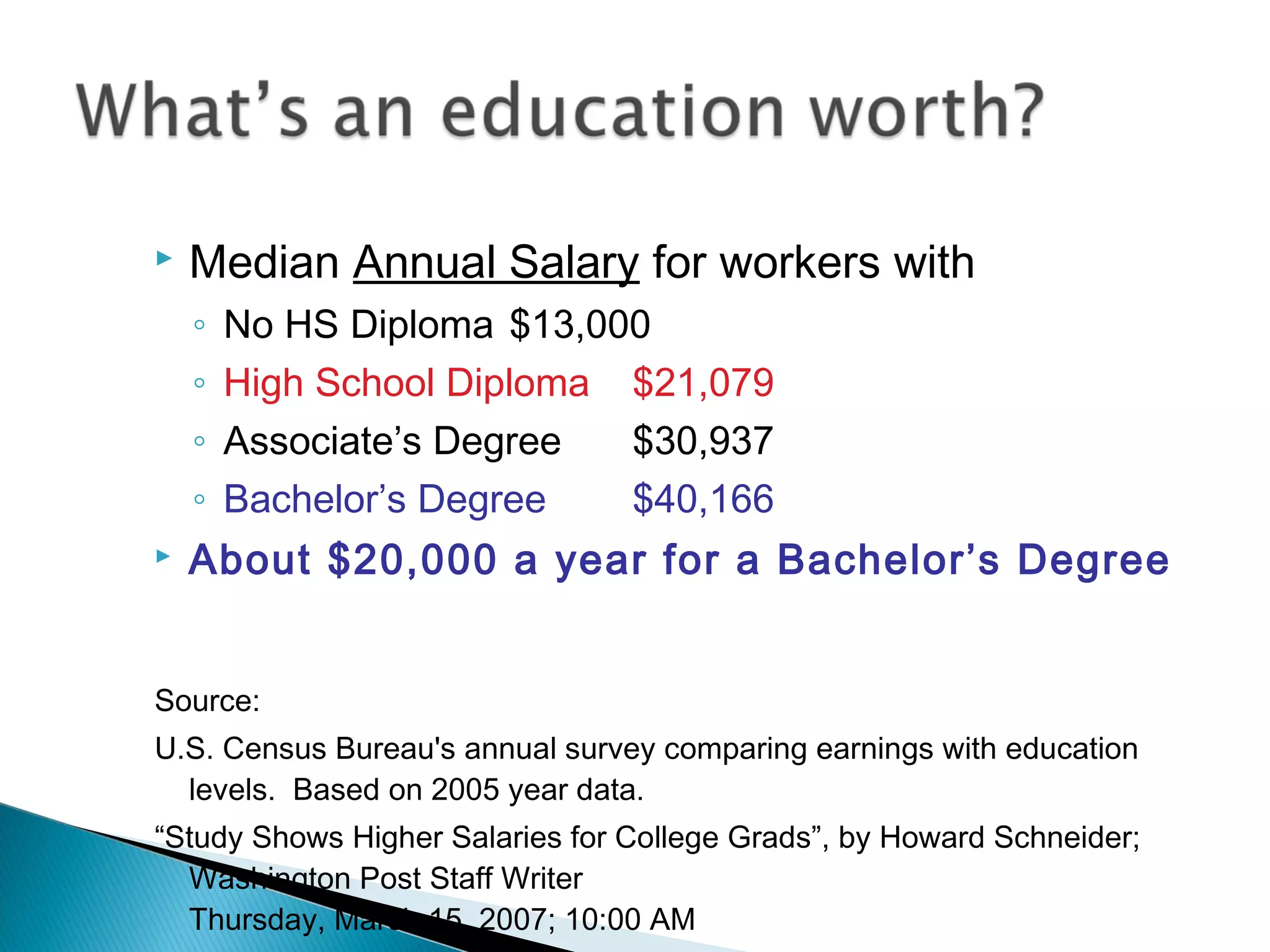
   Median Annual Salary for workers with
    ◦   No HS Diploma $13,000
    ◦   High School Diploma $21,079
    ◦   Associate’s Degree  $30,937
    ◦   Bachelor’s Degree   $40,166
   About $20,000 a year for a Bachelor’s Degree


Source:
U.S. Census Bureau's annual survey comparing earnings with education
  levels. Based on 2005 year data.
“Study Shows Higher Salaries for College Grads”, by Howard Schneider;
  Washington Post Staff Writer
  Thursday, March 15, 2007; 10:00 AM
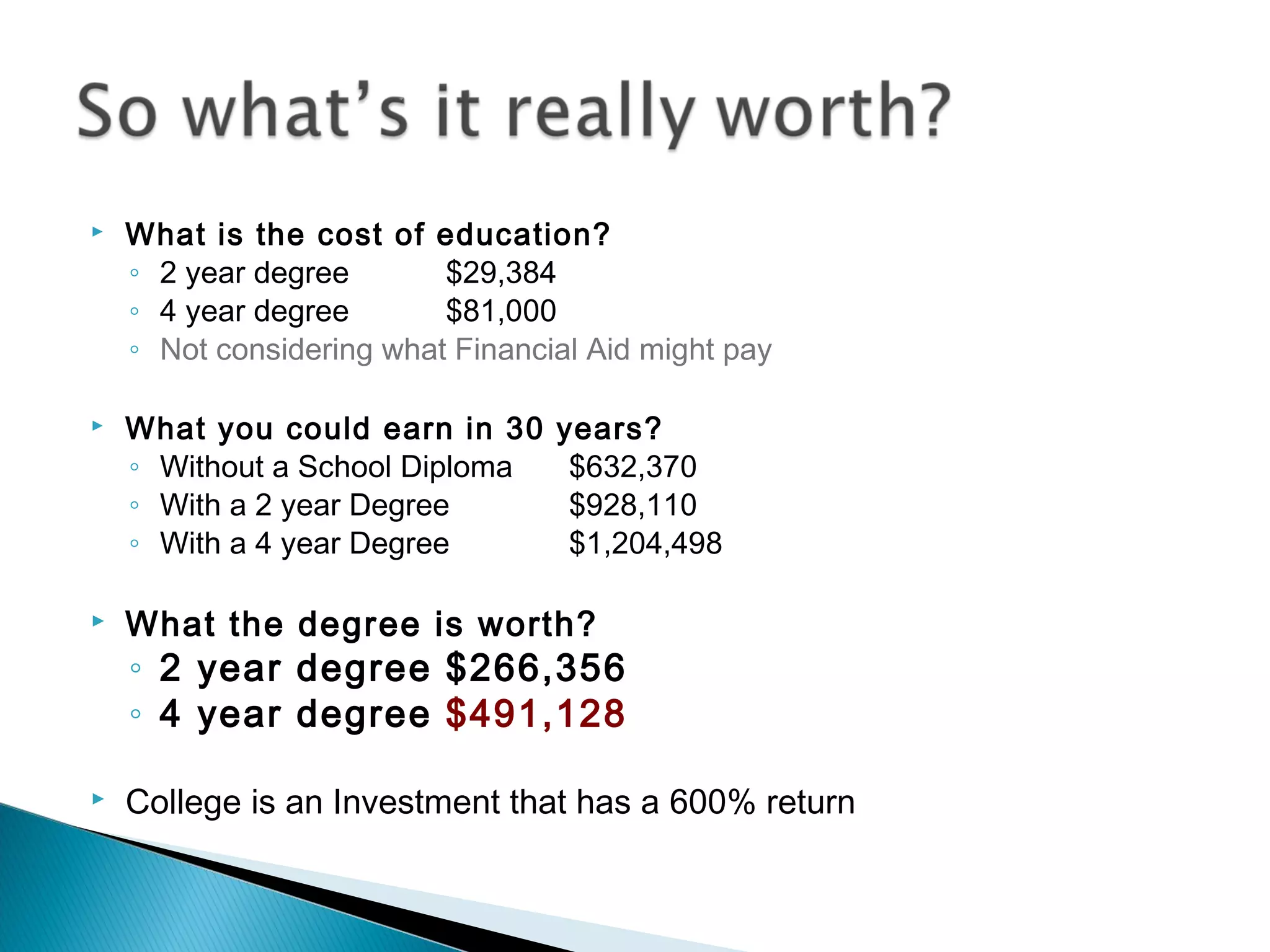
   What is the cost of education?
    ◦ 2 year degree       $29,384
    ◦ 4 year degree       $81,000
    ◦ Not considering what Financial Aid might pay

   What you could earn in 30     years?
    ◦ Without a School Diploma     $632,370
    ◦ With a 2 year Degree         $928,110
    ◦ With a 4 year Degree         $1,204,498

   What the degree is worth?
    ◦ 2 year degree $266,356
    ◦ 4 year degree $491,128

   College is an Investment that has a 600% return
Is 4 years of hard work worth


      $500,000
          to you?
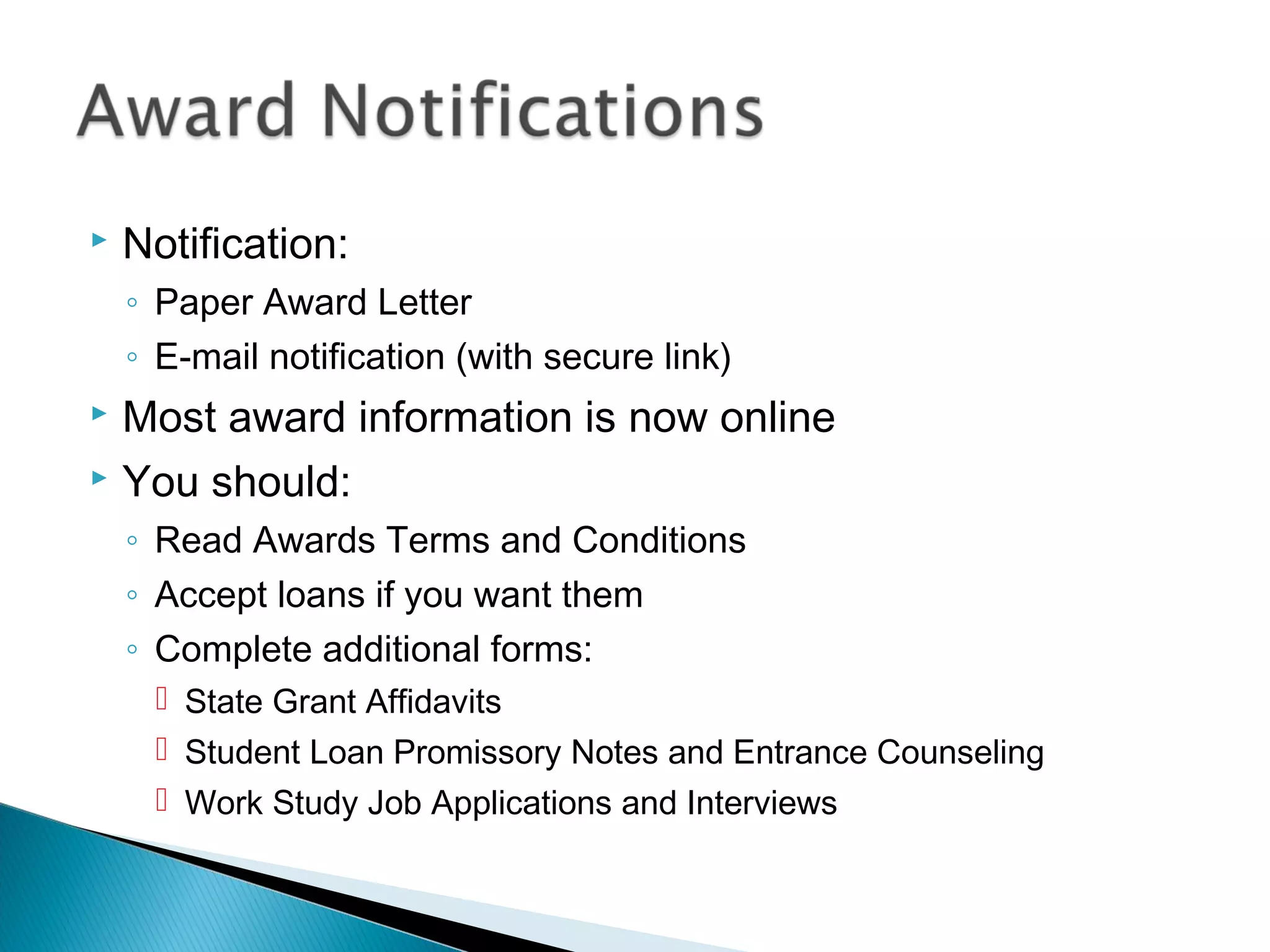
   Notification:
    ◦ Paper Award Letter
    ◦ E-mail notification (with secure link)
   Most award information is now online
   You should:
    ◦ Read Awards Terms and Conditions
    ◦ Accept loans if you want them
    ◦ Complete additional forms:
      State Grant Affidavits
      Student Loan Promissory Notes and Entrance Counseling
      Work Study Job Applications and Interviews
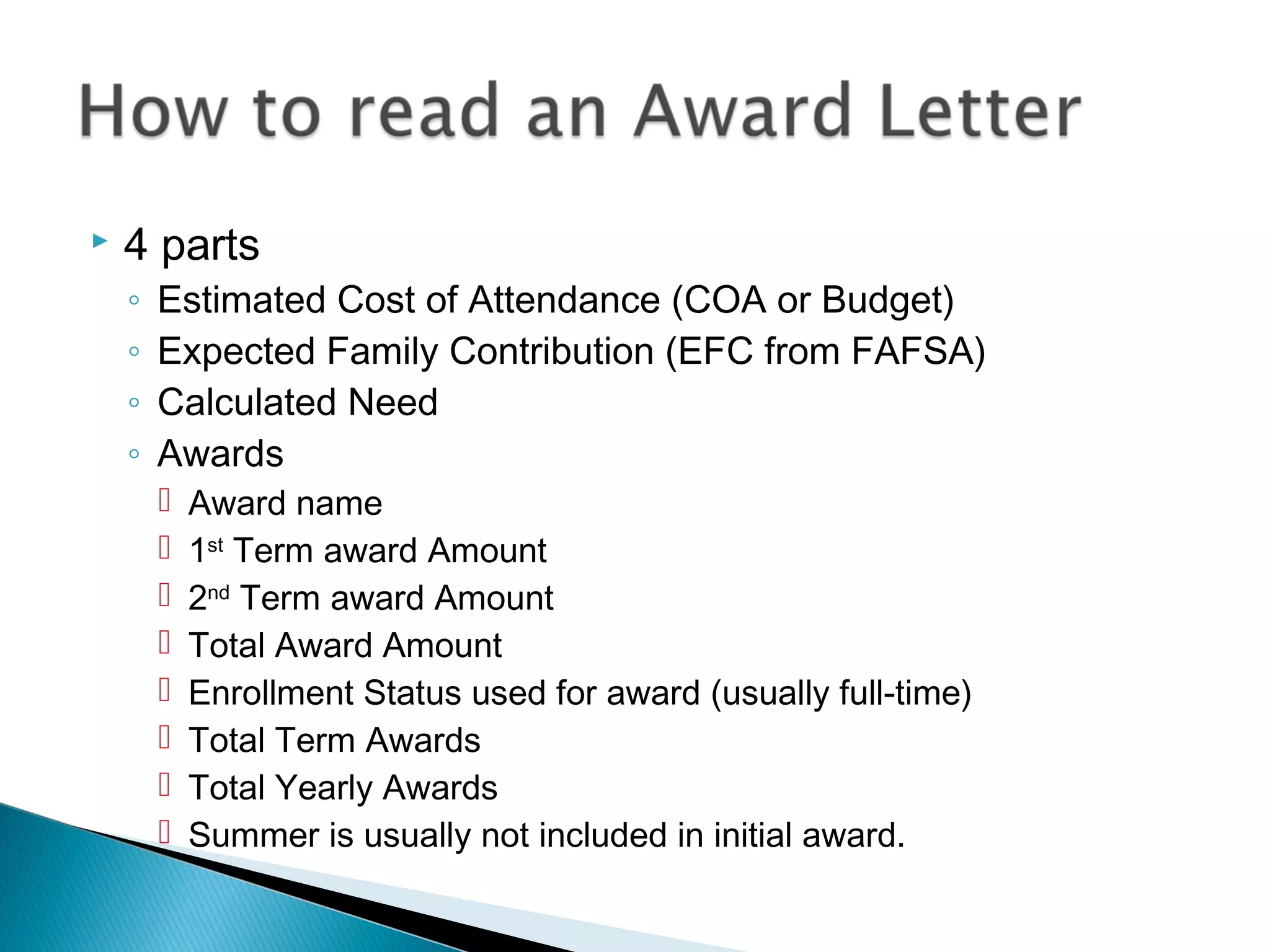
   4 parts
    ◦   Estimated Cost of Attendance (COA or Budget)
    ◦   Expected Family Contribution (EFC from FAFSA)
    ◦   Calculated Need
    ◦   Awards
           Award name
           1st Term award Amount
           2nd Term award Amount
           Total Award Amount
           Enrollment Status used for award (usually full-time)
           Total Term Awards
           Total Yearly Awards
           Summer is usually not included in initial award.
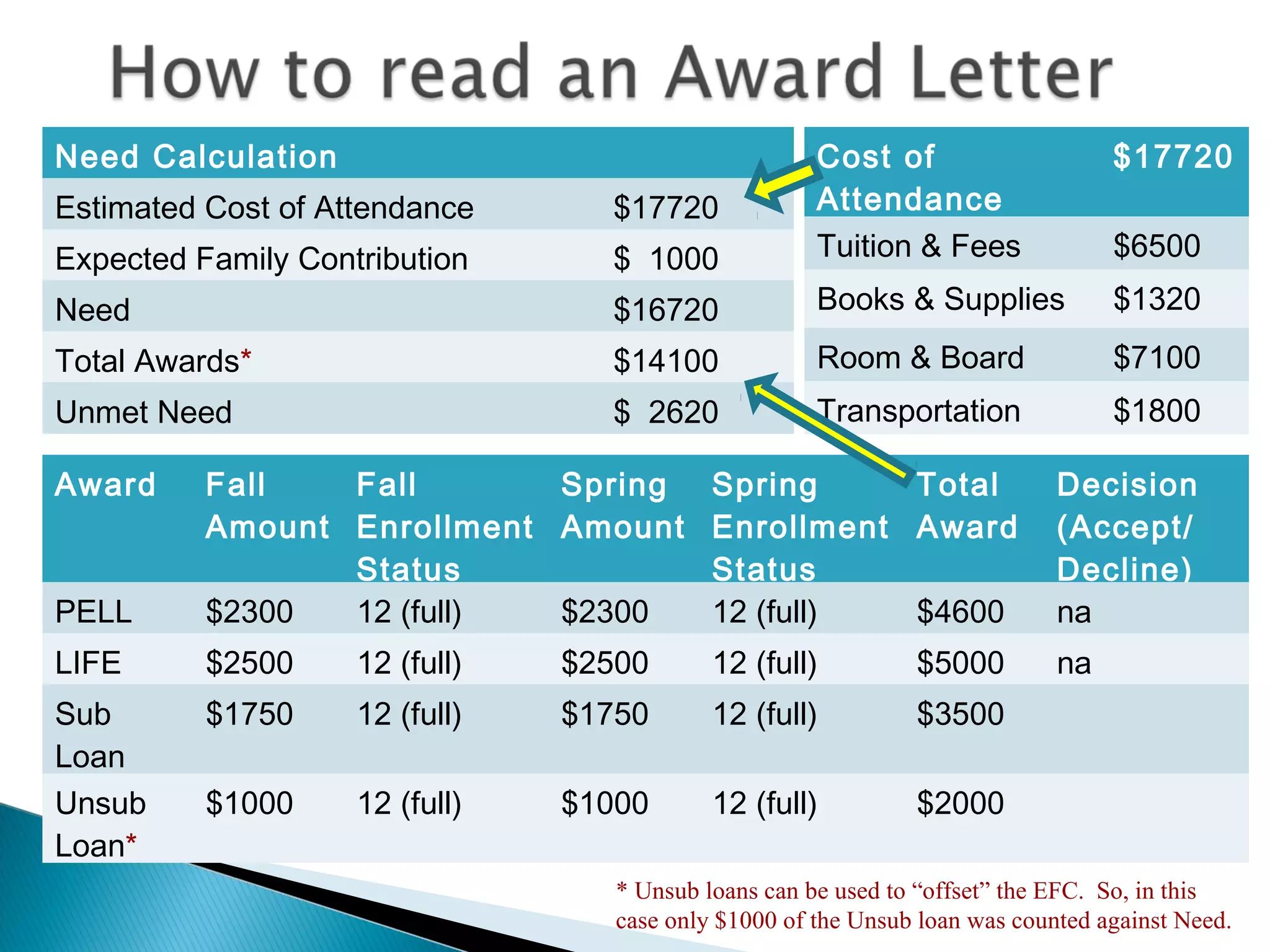
Need Calculation                                      Cost of                     $17720
Estimated Cost of Attendance      $17720              Attendance
Expected Family Contribution      $ 1000              Tuition & Fees              $6500

Need                              $16720              Books & Supplies            $1320
Total Awards*                     $14100              Room & Board                $7100
Unmet Need                        $ 2620              Transportation              $1800

Award     Fall   Fall       Spring          Spring     Total                 Decision
          Amount Enrollment Amount          Enrollment Award                 (Accept/
                 Status                     Status                           Decline)
PELL      $2300  12 (full)  $2300           12 (full)  $4600                 na
LIFE      $2500     12 (full)   $2500       12 (full)          $5000         na
Sub       $1750     12 (full)   $1750       12 (full)          $3500
Loan
Unsub     $1000     12 (full)   $1000       12 (full)          $2000
Loan*
                                   * Unsub loans can be used to “offset” the EFC. So, in this
                                   case only $1000 of the Unsub loan was counted against Need.
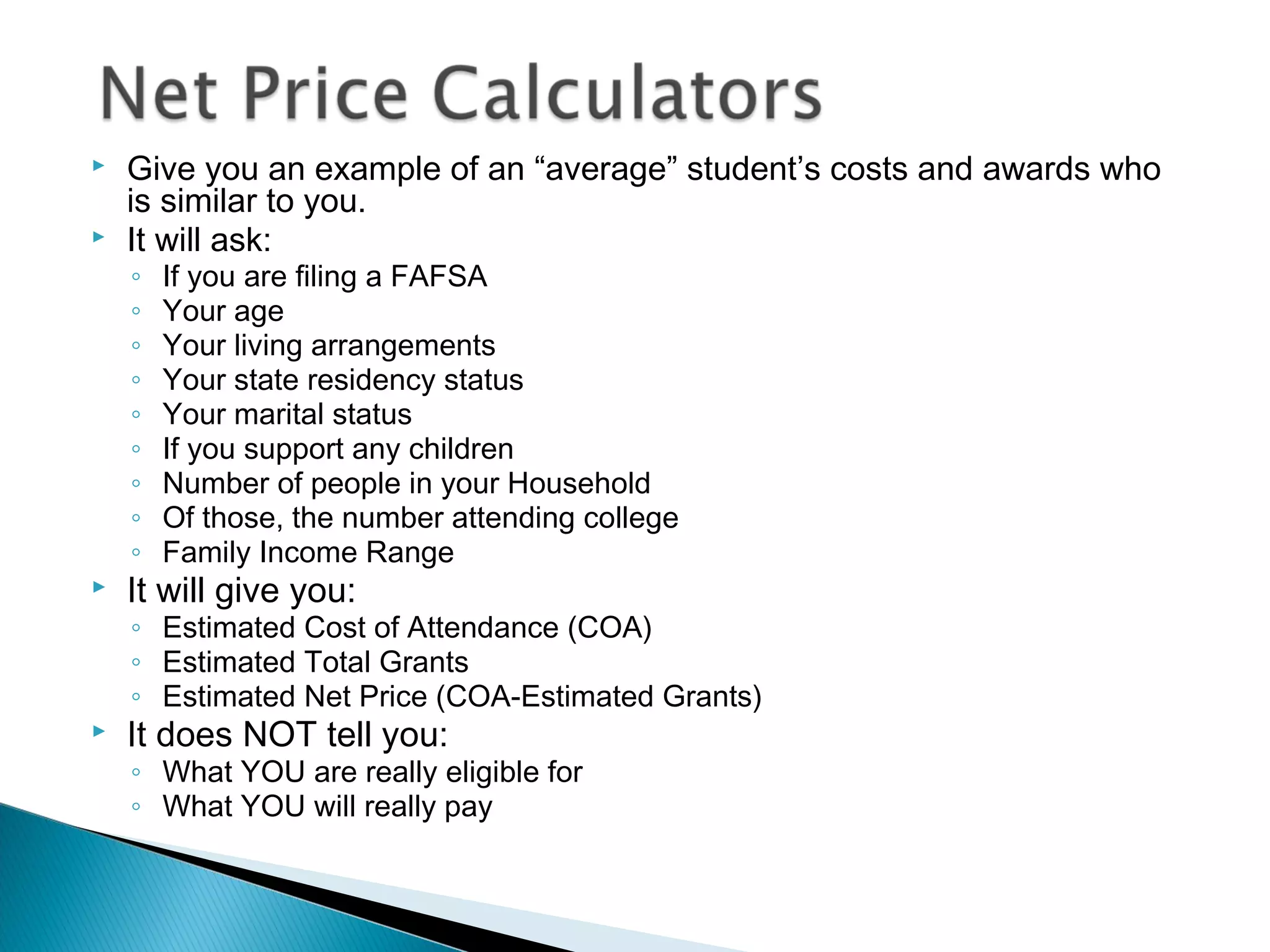
   Give you an example of an “average” student’s costs and awards who
    is similar to you.
   It will ask:
    ◦   If you are filing a FAFSA
    ◦   Your age
    ◦   Your living arrangements
    ◦   Your state residency status
    ◦   Your marital status
    ◦   If you support any children
    ◦   Number of people in your Household
    ◦   Of those, the number attending college
    ◦   Family Income Range
   It will give you:
    ◦ Estimated Cost of Attendance (COA)
    ◦ Estimated Total Grants
    ◦ Estimated Net Price (COA-Estimated Grants)
   It does NOT tell you:
    ◦ What YOU are really eligible for
    ◦ What YOU will really pay
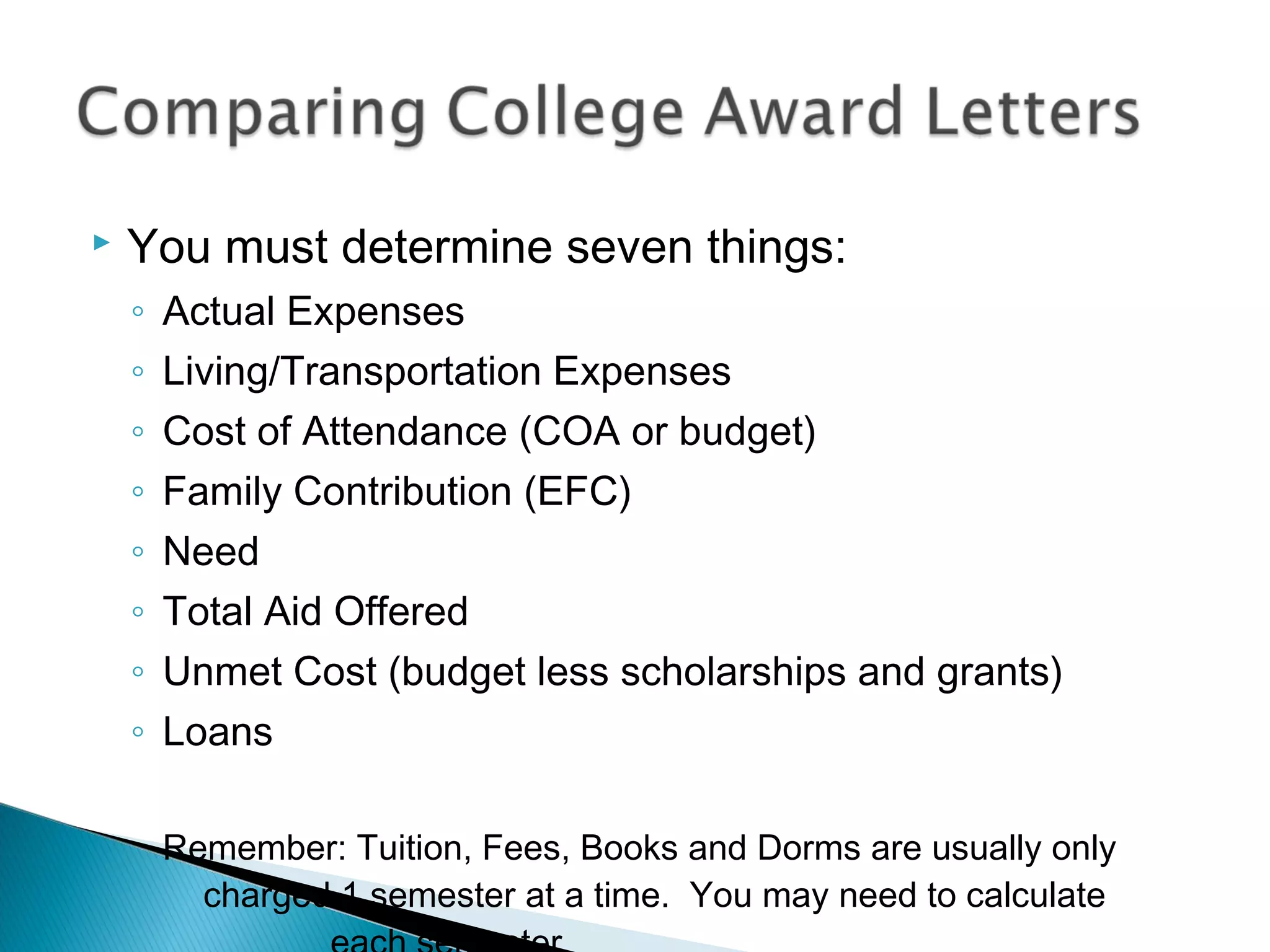
   You must determine seven things:
    ◦   Actual Expenses
    ◦   Living/Transportation Expenses
    ◦   Cost of Attendance (COA or budget)
    ◦   Family Contribution (EFC)
    ◦   Need
    ◦   Total Aid Offered
    ◦   Unmet Cost (budget less scholarships and grants)
    ◦   Loans

        Remember: Tuition, Fees, Books and Dorms are usually only
          charged 1 semester at a time. You may need to calculate
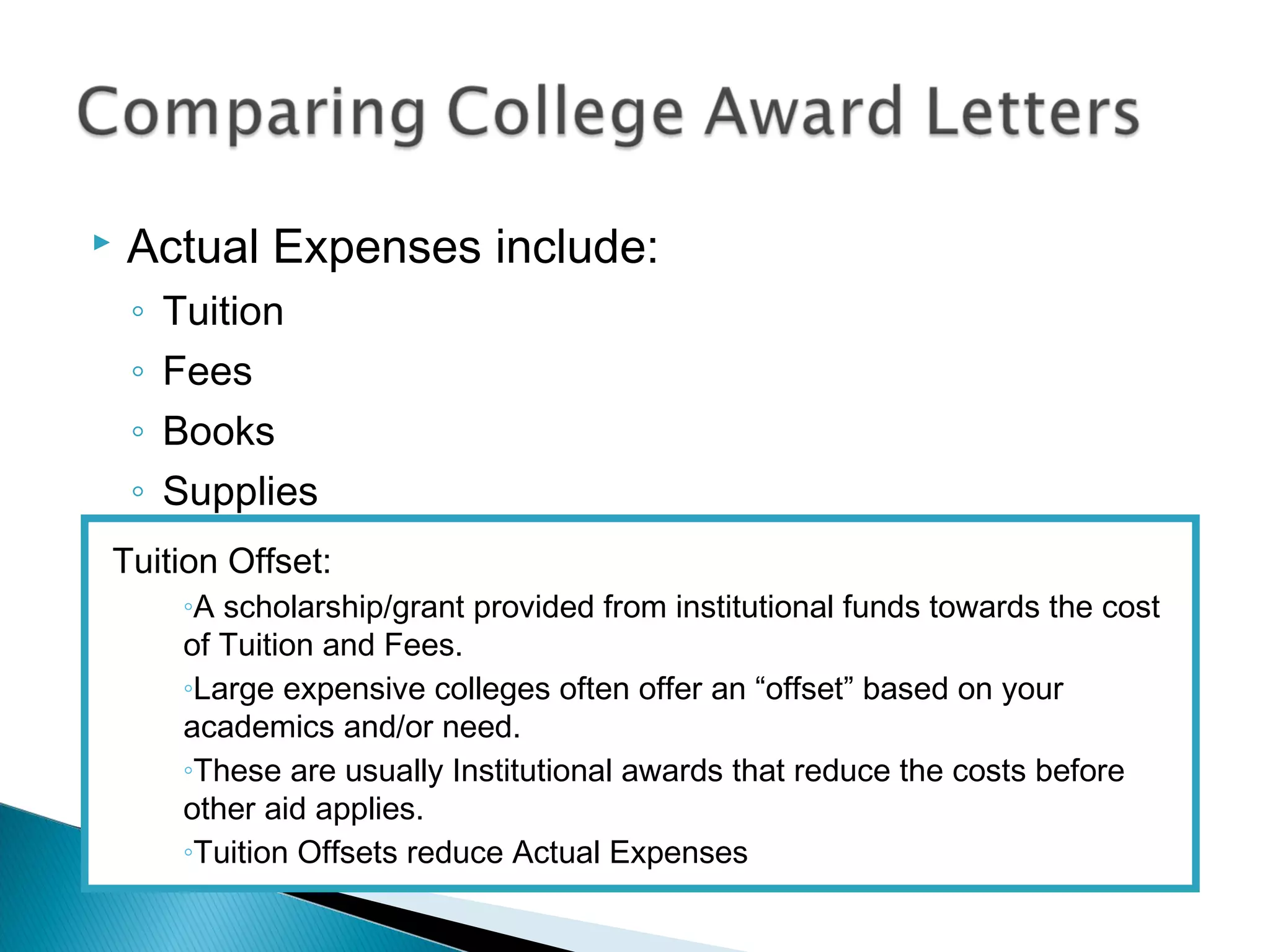
   Actual Expenses include:
    ◦   Tuition
    ◦   Fees
    ◦   Books
    ◦   Supplies
Tuition Offset:
         ◦A scholarship/grant provided from institutional funds towards the cost
         of Tuition and Fees.
         ◦Large expensive colleges often offer an “offset” based on your
         academics and/or need.
         ◦These are usually Institutional awards that reduce the costs before
         other aid applies.
         ◦Tuition Offsets reduce Actual Expenses
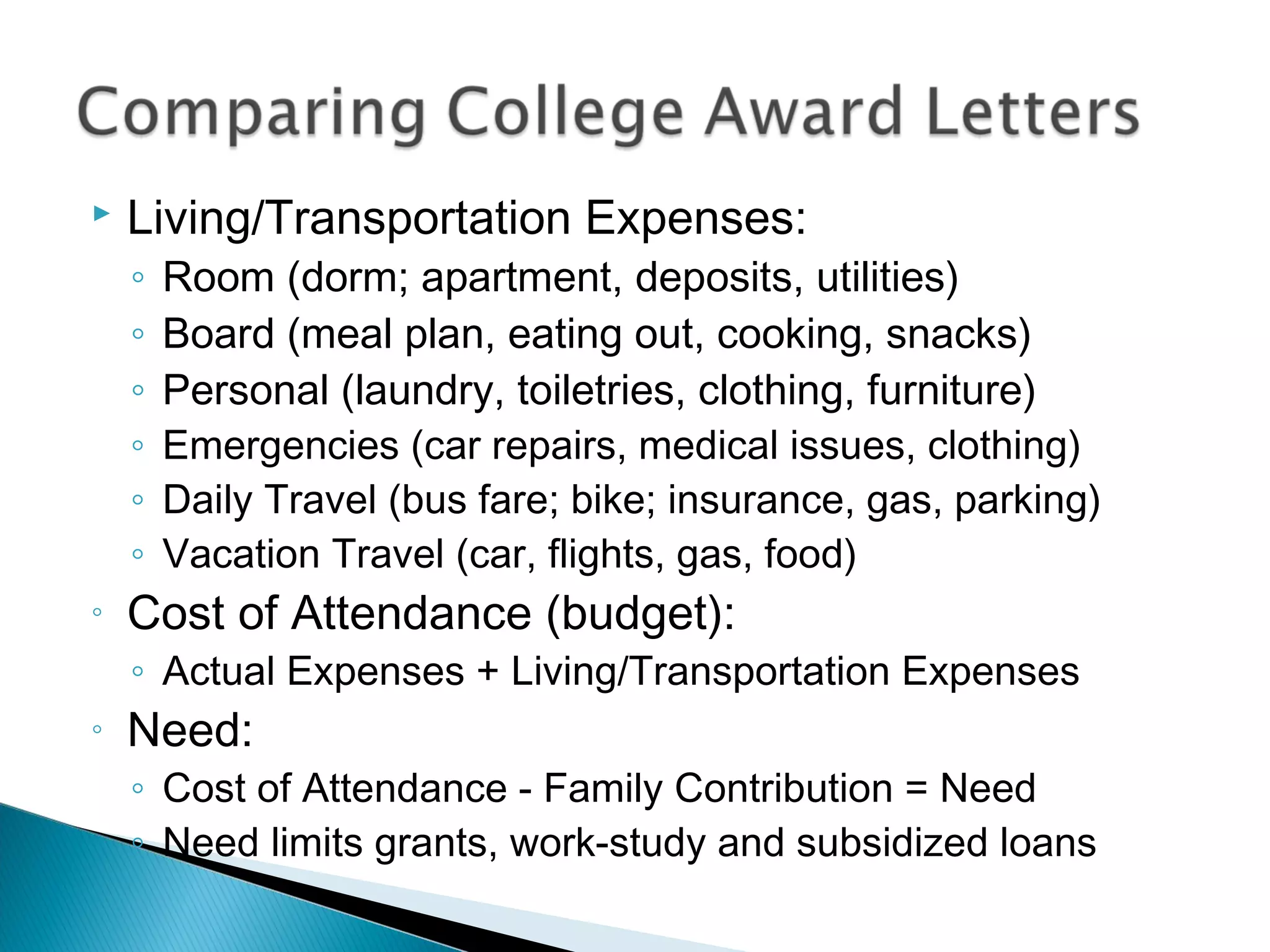
   Living/Transportation Expenses:
    ◦   Room (dorm; apartment, deposits, utilities)
    ◦   Board (meal plan, eating out, cooking, snacks)
    ◦   Personal (laundry, toiletries, clothing, furniture)
    ◦   Emergencies (car repairs, medical issues, clothing)
    ◦   Daily Travel (bus fare; bike; insurance, gas, parking)
    ◦   Vacation Travel (car, flights, gas, food)
◦   Cost of Attendance (budget):
    ◦ Actual Expenses + Living/Transportation Expenses
◦   Need:
    ◦ Cost of Attendance - Family Contribution = Need
    ◦ Need limits grants, work-study and subsidized loans
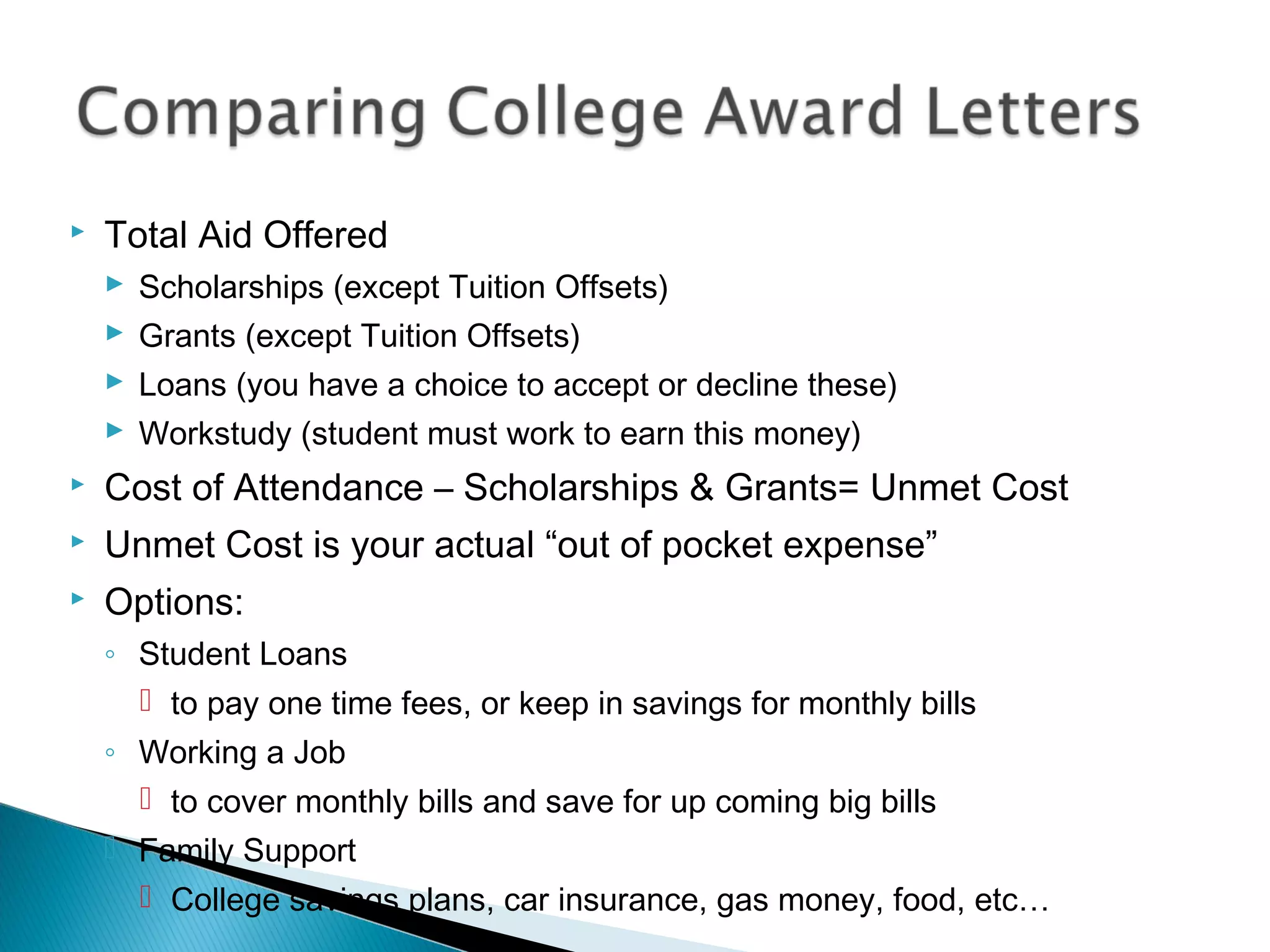
   Total Aid Offered
     Scholarships (except Tuition Offsets)
     Grants (except Tuition Offsets)
     Loans (you have a choice to accept or decline these)
     Workstudy (student must work to earn this money)
   Cost of Attendance – Scholarships & Grants= Unmet Cost
   Unmet Cost is your actual “out of pocket expense”
   Options:
    ◦ Student Loans
       to pay one time fees, or keep in savings for monthly bills
    ◦ Working a Job
       to cover monthly bills and save for up coming big bills
     Family Support
       College savings plans, car insurance, gas money, food, etc…
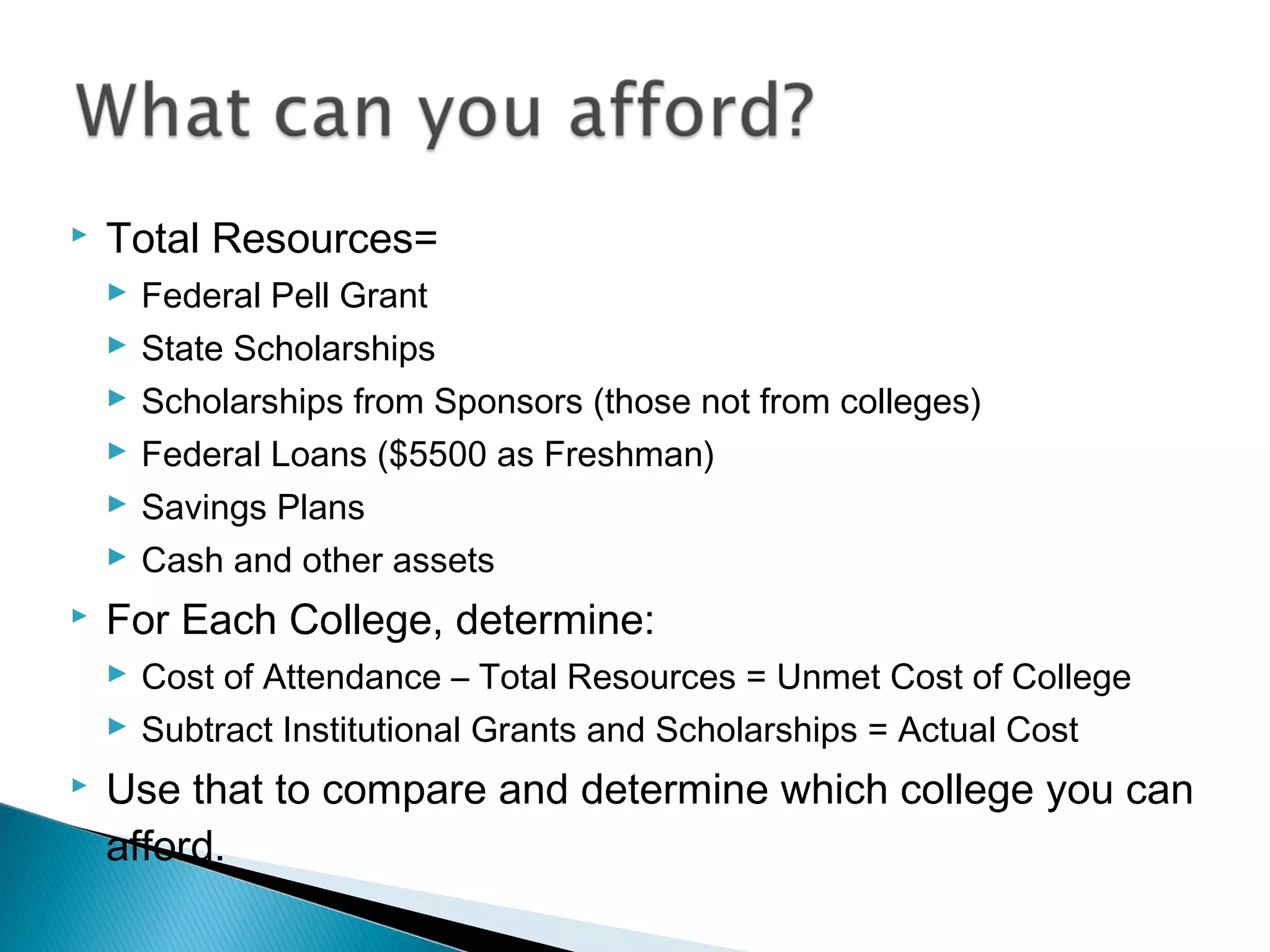
   Total Resources=
     Federal Pell Grant
     State Scholarships
     Scholarships from Sponsors (those not from colleges)
     Federal Loans ($5500 as Freshman)
     Savings Plans
     Cash and other assets
   For Each College, determine:
     Cost of Attendance – Total Resources = Unmet Cost of College
     Subtract Institutional Grants and Scholarships = Actual Cost
   Use that to compare and determine which college you can
    afford.
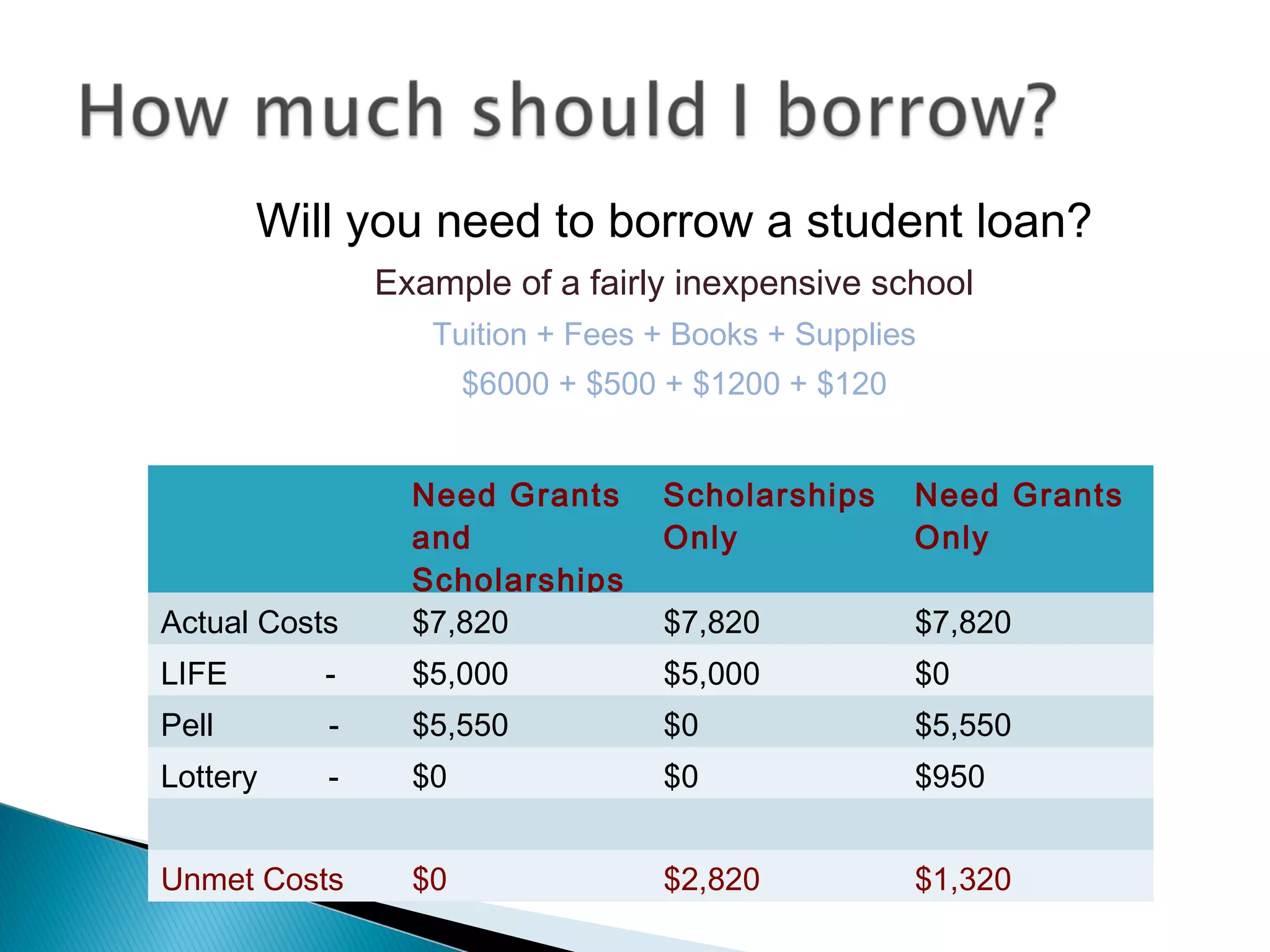
Will you need to borrow a student loan?
               Example of a fairly inexpensive school
                  Tuition + Fees + Books + Supplies
                      $6000 + $500 + $1200 + $120


                 Need Grants      Scholarships      Need Grants
                 and              Only              Only
                 Scholarships
Actual Costs     $7,820           $7,820            $7,820
LIFE       -     $5,000           $5,000            $0
Pell       -     $5,550           $0                $5,550
Lottery    -     $0               $0                $950


Unmet Costs      $0               $2,820            $1,320
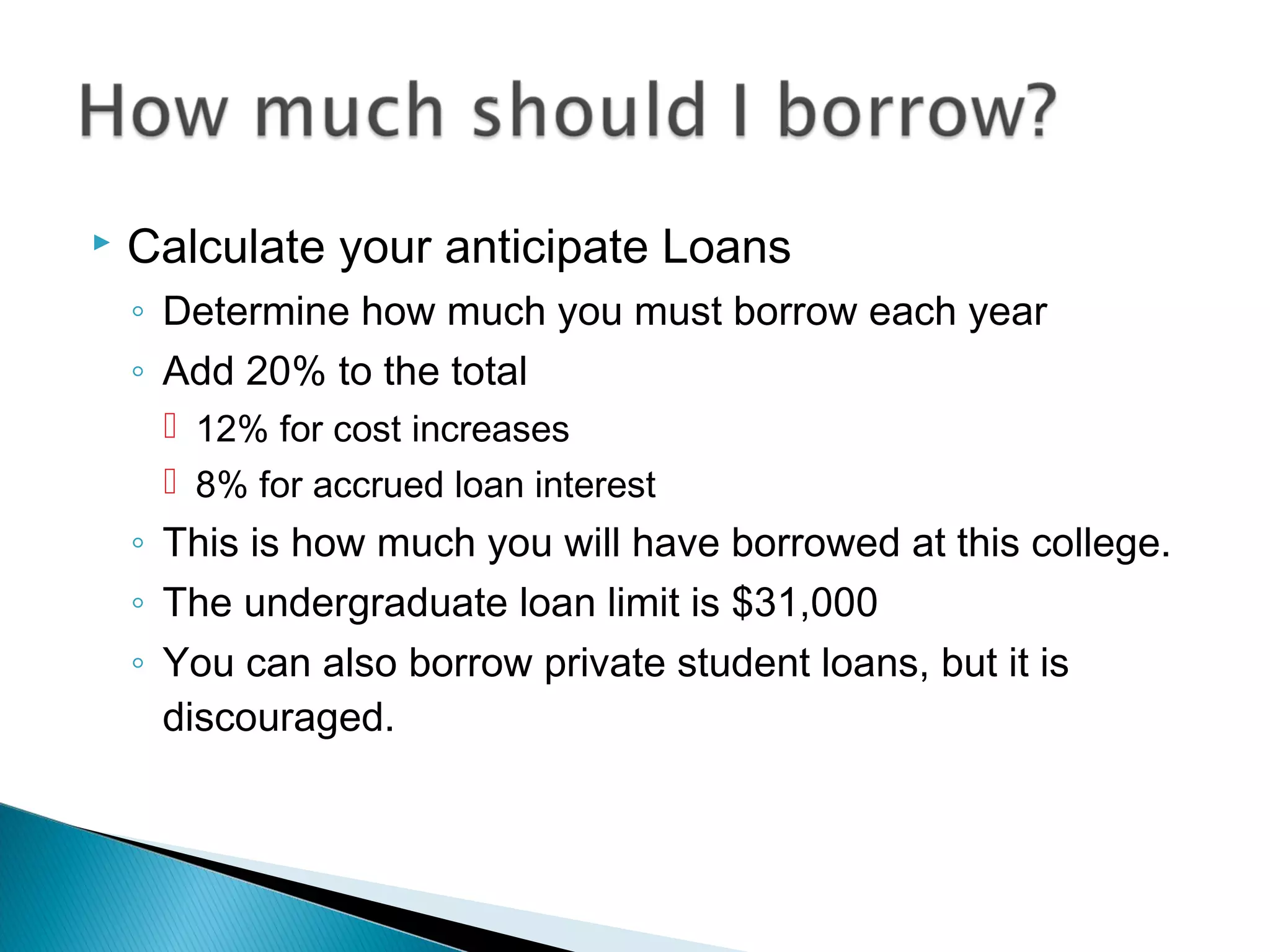
   Calculate your anticipate Loans
    ◦ Determine how much you must borrow each year
    ◦ Add 20% to the total
      12% for cost increases
      8% for accrued loan interest
    ◦ This is how much you will have borrowed at this college.
    ◦ The undergraduate loan limit is $31,000
    ◦ You can also borrow private student loans, but it is
      discouraged.
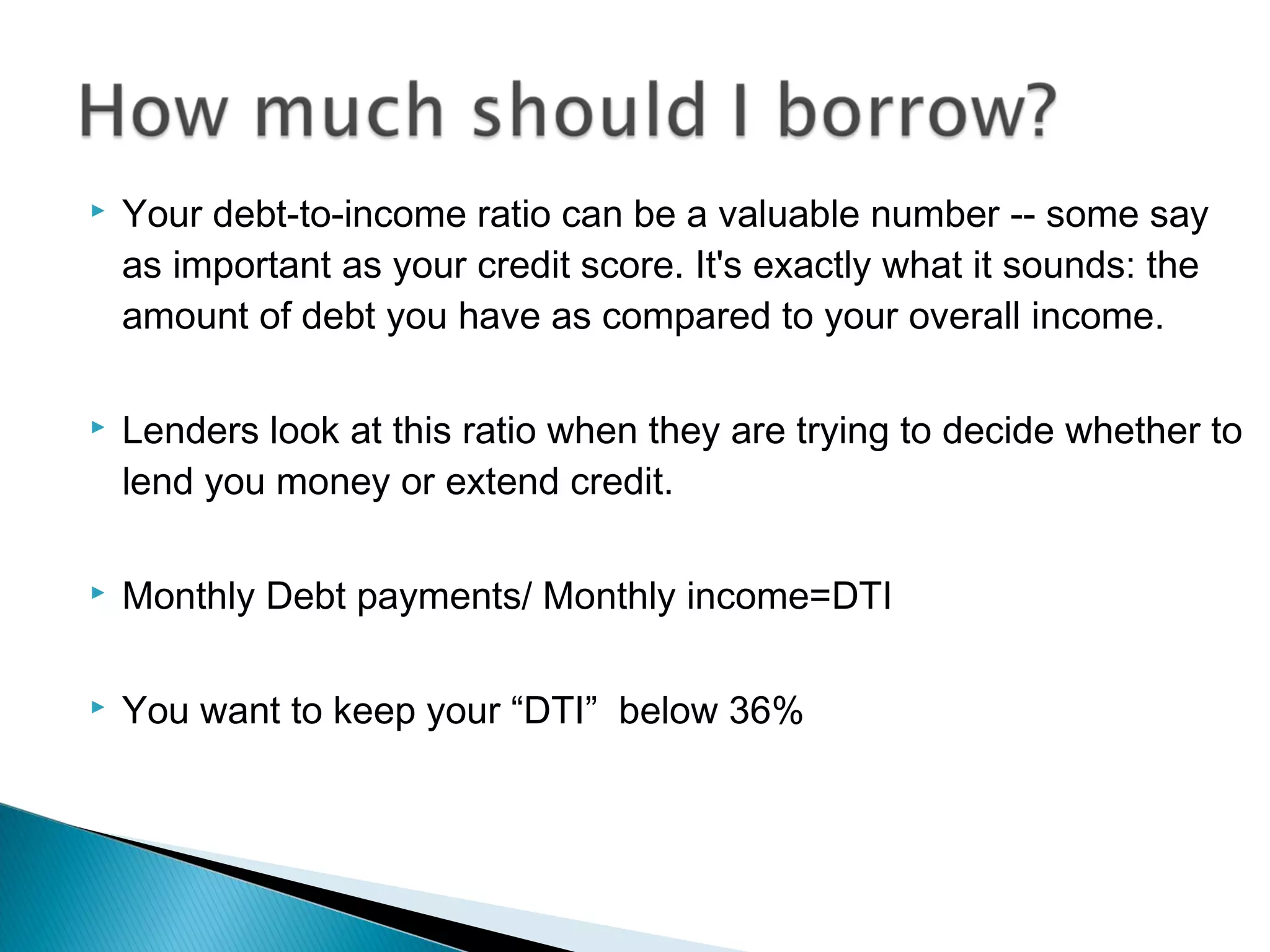
   Your debt-to-income ratio can be a valuable number -- some say
    as important as your credit score. It's exactly what it sounds: the
    amount of debt you have as compared to your overall income.

   Lenders look at this ratio when they are trying to decide whether to
    lend you money or extend credit.

   Monthly Debt payments/ Monthly income=DTI

   You want to keep your “DTI” below 36%
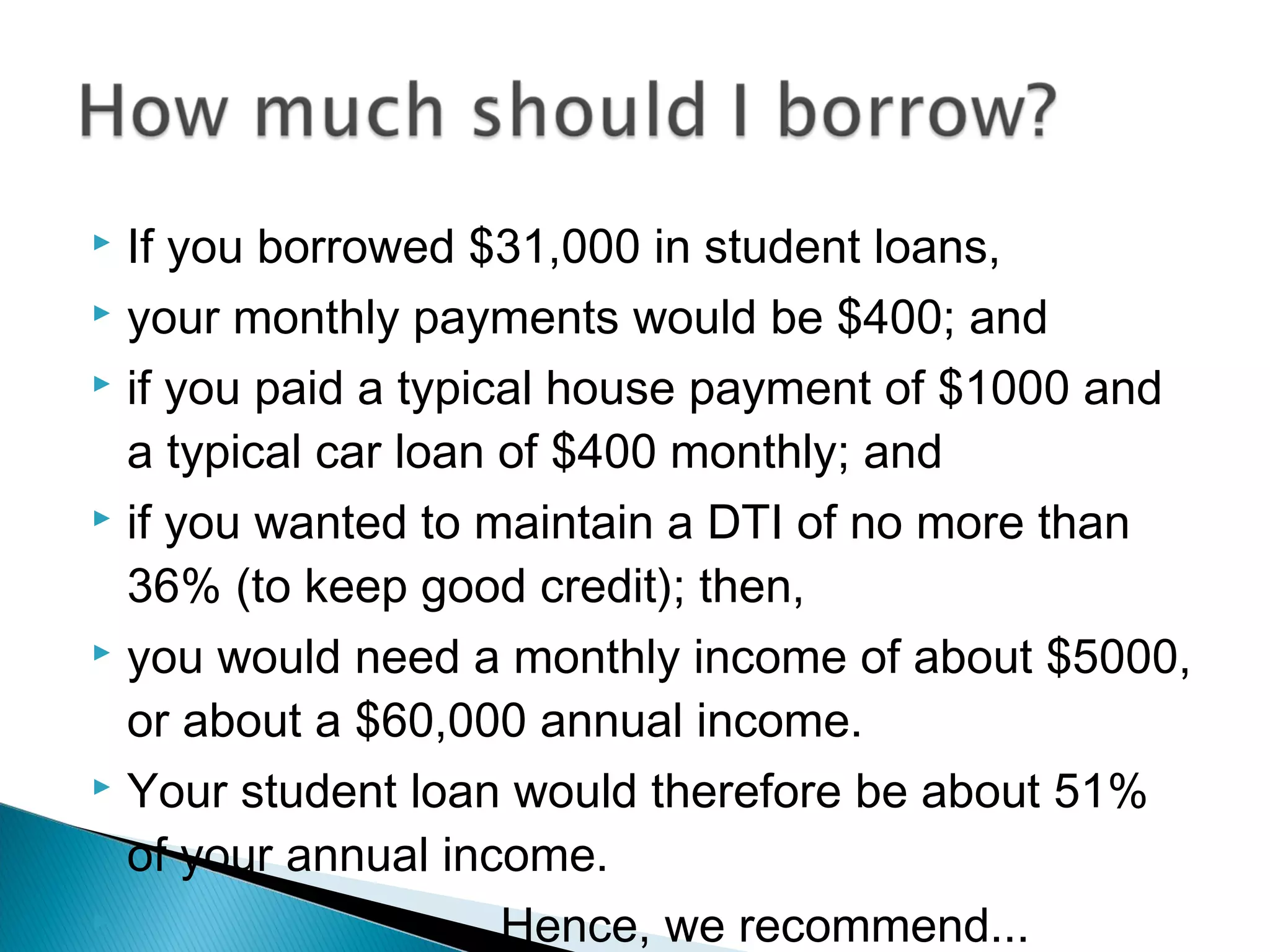
 If you borrowed $31,000 in student loans,
 your monthly payments would be $400; and

 if you paid a typical house payment of $1000 and

  a typical car loan of $400 monthly; and
 if you wanted to maintain a DTI of no more than

  36% (to keep good credit); then,
 you would need a monthly income of about $5000,

  or about a $60,000 annual income.
 Your student loan would therefore be about 51%

  of your annual income.
                    Hence, we recommend...
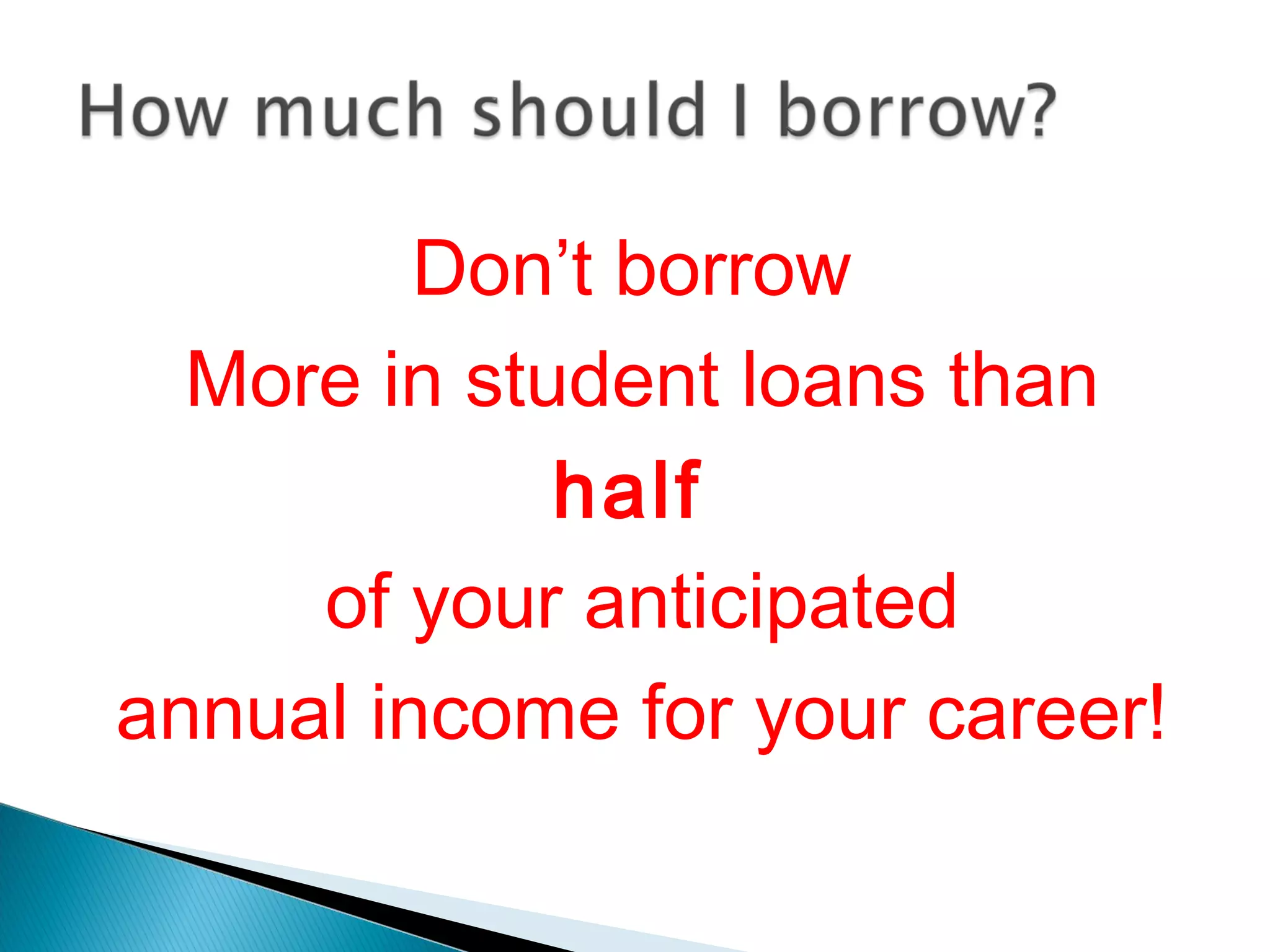
Don’t borrow
  More in student loans than
             half
     of your anticipated
annual income for your career!
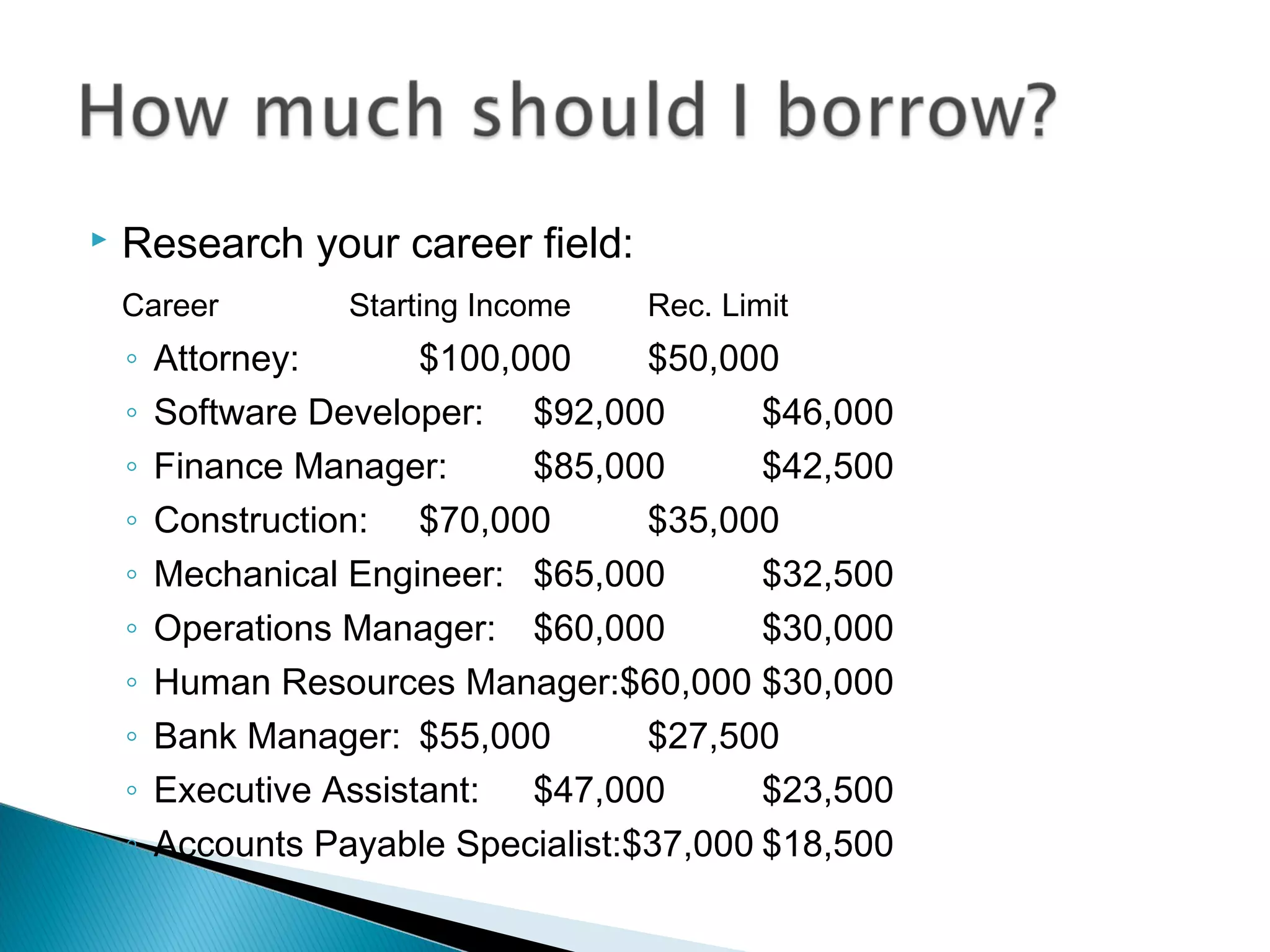
   Research your career field:
    Career         Starting Income   Rec. Limit
    ◦   Attorney:       $100,000     $50,000
    ◦   Software Developer: $92,000         $46,000
    ◦   Finance Manager:      $85,000       $42,500
    ◦   Construction: $70,000        $35,000
    ◦   Mechanical Engineer: $65,000        $32,500
    ◦   Operations Manager: $60,000         $30,000
    ◦   Human Resources Manager:$60,000 $30,000
    ◦   Bank Manager: $55,000        $27,500
    ◦   Executive Assistant: $47,000        $23,500
    ◦   Accounts Payable Specialist:$37,000 $18,500
Thank you for your
                 attention!


                                   Contact Us!
USC Lancaster
Kenneth Cole
 BY MAIL:    PO Box 889
            Lancaster, SC 29721
 BY PHONE: (803) 313-7068
 Visit Us: 127 Starr Hall, Hubbard Drive
 BY WEB: http://usclancaster.sc.edu/


A presentation like this is available at the USC Lancaster Financial Aid Office
  Website

What is college worth

  • 1.
    PRESENTER USC Lancaster Kenneth T. Cole USC Director of Financial Aid LANCASTER
  • 2.
    Education as an Investment  Calculating College Costs  Reading an Award Letter  Comparing Colleges by Costs and Awards  Determining How Much You Should Borrow
  • 4.
    Tuition Room Books & Total 4 Year Cost & Fees & Supplies Annual (assuming 7% increase/year) Board Cost USC Lancaster $6,252 $6,840 $1600 $14,692 $71,000 (2 year Public) York Tech. $3,496 $7,200 $1,200 $11,896 NA (2 year Tech) USC Columbia $10,168 $6,556 $1600 $18,324 $81,000 (4 year Public) Clemson Univ. $12,668 $7,228 $1090 $20,986 $93,000 (4 year Public) Coker College $22,200 $6,950 $1,000 $30,150 $130,000 (4 year Private)
  • 5.
    Median Annual Salary for workers with ◦ No HS Diploma $13,000 ◦ High School Diploma $21,079 ◦ Associate’s Degree $30,937 ◦ Bachelor’s Degree $40,166  About $20,000 a year for a Bachelor’s Degree Source: U.S. Census Bureau's annual survey comparing earnings with education levels. Based on 2005 year data. “Study Shows Higher Salaries for College Grads”, by Howard Schneider; Washington Post Staff Writer Thursday, March 15, 2007; 10:00 AM
  • 6.
    What is the cost of education? ◦ 2 year degree $29,384 ◦ 4 year degree $81,000 ◦ Not considering what Financial Aid might pay  What you could earn in 30 years? ◦ Without a School Diploma $632,370 ◦ With a 2 year Degree $928,110 ◦ With a 4 year Degree $1,204,498  What the degree is worth? ◦ 2 year degree $266,356 ◦ 4 year degree $491,128  College is an Investment that has a 600% return
  • 7.
    Is 4 yearsof hard work worth $500,000 to you?
  • 8.
    Notification: ◦ Paper Award Letter ◦ E-mail notification (with secure link)  Most award information is now online  You should: ◦ Read Awards Terms and Conditions ◦ Accept loans if you want them ◦ Complete additional forms:  State Grant Affidavits  Student Loan Promissory Notes and Entrance Counseling  Work Study Job Applications and Interviews
  • 9.
    4 parts ◦ Estimated Cost of Attendance (COA or Budget) ◦ Expected Family Contribution (EFC from FAFSA) ◦ Calculated Need ◦ Awards  Award name  1st Term award Amount  2nd Term award Amount  Total Award Amount  Enrollment Status used for award (usually full-time)  Total Term Awards  Total Yearly Awards  Summer is usually not included in initial award.
  • 10.
    Need Calculation Cost of $17720 Estimated Cost of Attendance $17720 Attendance Expected Family Contribution $ 1000 Tuition & Fees $6500 Need $16720 Books & Supplies $1320 Total Awards* $14100 Room & Board $7100 Unmet Need $ 2620 Transportation $1800 Award Fall Fall Spring Spring Total Decision Amount Enrollment Amount Enrollment Award (Accept/ Status Status Decline) PELL $2300 12 (full) $2300 12 (full) $4600 na LIFE $2500 12 (full) $2500 12 (full) $5000 na Sub $1750 12 (full) $1750 12 (full) $3500 Loan Unsub $1000 12 (full) $1000 12 (full) $2000 Loan* * Unsub loans can be used to “offset” the EFC. So, in this case only $1000 of the Unsub loan was counted against Need.
  • 11.
    Give you an example of an “average” student’s costs and awards who is similar to you.  It will ask: ◦ If you are filing a FAFSA ◦ Your age ◦ Your living arrangements ◦ Your state residency status ◦ Your marital status ◦ If you support any children ◦ Number of people in your Household ◦ Of those, the number attending college ◦ Family Income Range  It will give you: ◦ Estimated Cost of Attendance (COA) ◦ Estimated Total Grants ◦ Estimated Net Price (COA-Estimated Grants)  It does NOT tell you: ◦ What YOU are really eligible for ◦ What YOU will really pay
  • 12.
    You must determine seven things: ◦ Actual Expenses ◦ Living/Transportation Expenses ◦ Cost of Attendance (COA or budget) ◦ Family Contribution (EFC) ◦ Need ◦ Total Aid Offered ◦ Unmet Cost (budget less scholarships and grants) ◦ Loans Remember: Tuition, Fees, Books and Dorms are usually only charged 1 semester at a time. You may need to calculate
  • 13.
    Actual Expenses include: ◦ Tuition ◦ Fees ◦ Books ◦ Supplies Tuition Offset: ◦A scholarship/grant provided from institutional funds towards the cost of Tuition and Fees. ◦Large expensive colleges often offer an “offset” based on your academics and/or need. ◦These are usually Institutional awards that reduce the costs before other aid applies. ◦Tuition Offsets reduce Actual Expenses
  • 14.
    Living/Transportation Expenses: ◦ Room (dorm; apartment, deposits, utilities) ◦ Board (meal plan, eating out, cooking, snacks) ◦ Personal (laundry, toiletries, clothing, furniture) ◦ Emergencies (car repairs, medical issues, clothing) ◦ Daily Travel (bus fare; bike; insurance, gas, parking) ◦ Vacation Travel (car, flights, gas, food) ◦ Cost of Attendance (budget): ◦ Actual Expenses + Living/Transportation Expenses ◦ Need: ◦ Cost of Attendance - Family Contribution = Need ◦ Need limits grants, work-study and subsidized loans
  • 15.
    Total Aid Offered  Scholarships (except Tuition Offsets)  Grants (except Tuition Offsets)  Loans (you have a choice to accept or decline these)  Workstudy (student must work to earn this money)  Cost of Attendance – Scholarships & Grants= Unmet Cost  Unmet Cost is your actual “out of pocket expense”  Options: ◦ Student Loans  to pay one time fees, or keep in savings for monthly bills ◦ Working a Job  to cover monthly bills and save for up coming big bills  Family Support  College savings plans, car insurance, gas money, food, etc…
  • 16.
    Total Resources=  Federal Pell Grant  State Scholarships  Scholarships from Sponsors (those not from colleges)  Federal Loans ($5500 as Freshman)  Savings Plans  Cash and other assets  For Each College, determine:  Cost of Attendance – Total Resources = Unmet Cost of College  Subtract Institutional Grants and Scholarships = Actual Cost  Use that to compare and determine which college you can afford.
  • 17.
    Will you needto borrow a student loan? Example of a fairly inexpensive school Tuition + Fees + Books + Supplies $6000 + $500 + $1200 + $120 Need Grants Scholarships Need Grants and Only Only Scholarships Actual Costs $7,820 $7,820 $7,820 LIFE - $5,000 $5,000 $0 Pell - $5,550 $0 $5,550 Lottery - $0 $0 $950 Unmet Costs $0 $2,820 $1,320
  • 18.
    Calculate your anticipate Loans ◦ Determine how much you must borrow each year ◦ Add 20% to the total  12% for cost increases  8% for accrued loan interest ◦ This is how much you will have borrowed at this college. ◦ The undergraduate loan limit is $31,000 ◦ You can also borrow private student loans, but it is discouraged.
  • 19.
    Your debt-to-income ratio can be a valuable number -- some say as important as your credit score. It's exactly what it sounds: the amount of debt you have as compared to your overall income.  Lenders look at this ratio when they are trying to decide whether to lend you money or extend credit.  Monthly Debt payments/ Monthly income=DTI  You want to keep your “DTI” below 36%
  • 20.
     If youborrowed $31,000 in student loans,  your monthly payments would be $400; and  if you paid a typical house payment of $1000 and a typical car loan of $400 monthly; and  if you wanted to maintain a DTI of no more than 36% (to keep good credit); then,  you would need a monthly income of about $5000, or about a $60,000 annual income.  Your student loan would therefore be about 51% of your annual income.  Hence, we recommend...
  • 21.
    Don’t borrow More in student loans than half of your anticipated annual income for your career!
  • 22.
    Research your career field: Career Starting Income Rec. Limit ◦ Attorney: $100,000 $50,000 ◦ Software Developer: $92,000 $46,000 ◦ Finance Manager: $85,000 $42,500 ◦ Construction: $70,000 $35,000 ◦ Mechanical Engineer: $65,000 $32,500 ◦ Operations Manager: $60,000 $30,000 ◦ Human Resources Manager:$60,000 $30,000 ◦ Bank Manager: $55,000 $27,500 ◦ Executive Assistant: $47,000 $23,500 ◦ Accounts Payable Specialist:$37,000 $18,500
  • 23.
    Thank you foryour attention! Contact Us! USC Lancaster Kenneth Cole  BY MAIL: PO Box 889 Lancaster, SC 29721  BY PHONE: (803) 313-7068  Visit Us: 127 Starr Hall, Hubbard Drive  BY WEB: http://usclancaster.sc.edu/ A presentation like this is available at the USC Lancaster Financial Aid Office Website