

Governor’s Budget Update


February 8, 2012

Devin Vodicka, EdD
Assistant Superintendent, Business
Services
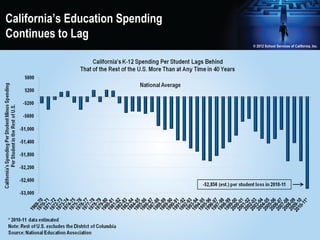
California’s Education Spending
Continues to Lag
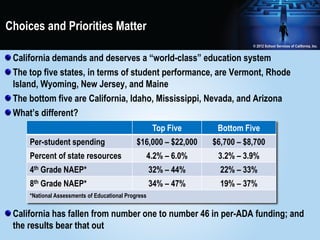
Choices and Priorities Matter

 California demands and deserves a “world-class” education system
 The top five states, in terms of student performance, are Vermont, Rhode
 Island, Wyoming, New Jersey, and Maine
 The bottom five are California, Idaho, Mississippi, Nevada, and Arizona
 What’s different?
                                                     Top Five      Bottom Five
     Per-student spending                     $16,000 – $22,000   $6,700 – $8,700
     Percent of state resources                  4.2% – 6.0%       3.2% – 3.9%
     4th Grade NAEP*                                 32% – 44%      22% – 33%
     8th Grade NAEP*                                 34% – 47%      19% – 37%
     *National Assessments of Educational Progress


 California has fallen from number one to number 46 in per-ADA funding; and
 the results bear that out
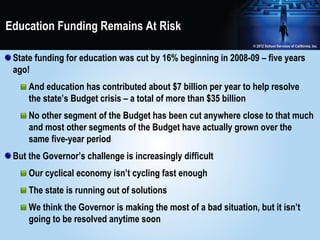
Education Funding Remains At Risk

 State funding for education was cut by 16% beginning in 2008-09 – five years
 ago!
     And education has contributed about $7 billion per year to help resolve
     the state’s Budget crisis – a total of more than $35 billion
     No other segment of the Budget has been cut anywhere close to that much
     and most other segments of the Budget have actually grown over the
     same five-year period
 But the Governor’s challenge is increasingly difficult
     Our cyclical economy isn’t cycling fast enough
     The state is running out of solutions
     We think the Governor is making the most of a bad situation, but it isn’t
     going to be resolved anytime soon
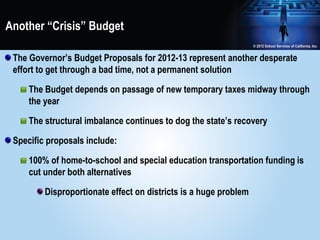
Another “Crisis” Budget

 The Governor’s Budget Proposals for 2012-13 represent another desperate
 effort to get through a bad time, not a permanent solution

     The Budget depends on passage of new temporary taxes midway through
     the year

     The structural imbalance continues to dog the state’s recovery

 Specific proposals include:

     100% of home-to-school and special education transportation funding is
     cut under both alternatives

         Disproportionate effect on districts is a huge problem
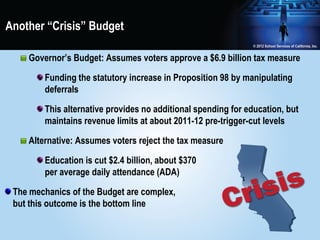
Another “Crisis” Budget

    Governor’s Budget: Assumes voters approve a $6.9 billion tax measure

        Funding the statutory increase in Proposition 98 by manipulating
        deferrals

        This alternative provides no additional spending for education, but
        maintains revenue limits at about 2011-12 pre-trigger-cut levels

    Alternative: Assumes voters reject the tax measure

        Education is cut $2.4 billion, about $370
        per average daily attendance (ADA)

 The mechanics of the Budget are complex,
 but this outcome is the bottom line
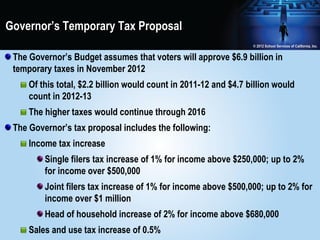
Governor’s Temporary Tax Proposal

 The Governor’s Budget assumes that voters will approve $6.9 billion in
 temporary taxes in November 2012
     Of this total, $2.2 billion would count in 2011-12 and $4.7 billion would
     count in 2012-13
     The higher taxes would continue through 2016
 The Governor’s tax proposal includes the following:
     Income tax increase
         Single filers tax increase of 1% for income above $250,000; up to 2%
         for income over $500,000
         Joint filers tax increase of 1% for income above $500,000; up to 2% for
         income over $1 million
         Head of household increase of 2% for income above $680,000
     Sales and use tax increase of 0.5%
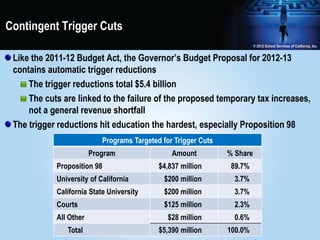
Contingent Trigger Cuts

 Like the 2011-12 Budget Act, the Governor’s Budget Proposal for 2012-13
 contains automatic trigger reductions
     The trigger reductions total $5.4 billion
     The cuts are linked to the failure of the proposed temporary tax increases,
     not a general revenue shortfall
 The trigger reductions hit education the hardest, especially Proposition 98
                           Programs Targeted for Trigger Cuts
                        Program                 Amount          % Share
            Proposition 98                  $4,837 million       89.7%
            University of California          $200 million        3.7%
            California State University       $200 million        3.7%
            Courts                            $125 million        2.3%
            All Other                          $28 million        0.6%
               Total                        $5,390 million      100.0%
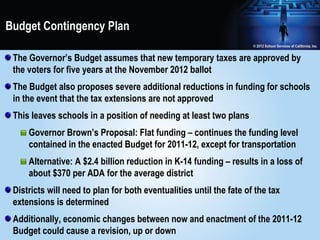
Budget Contingency Plan

 The Governor’s Budget assumes that new temporary taxes are approved by
 the voters for five years at the November 2012 ballot
 The Budget also proposes severe additional reductions in funding for schools
 in the event that the tax extensions are not approved
 This leaves schools in a position of needing at least two plans
     Governor Brown’s Proposal: Flat funding – continues the funding level
     contained in the enacted Budget for 2011-12, except for transportation
     Alternative: A $2.4 billion reduction in K-14 funding – results in a loss of
     about $370 per ADA for the average district
 Districts will need to plan for both eventualities until the fate of the tax
 extensions is determined
 Additionally, economic changes between now and enactment of the 2011-12
 Budget could cause a revision, up or down
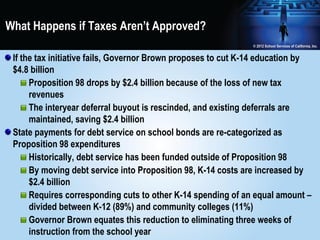
What Happens if Taxes Aren’t Approved?

 If the tax initiative fails, Governor Brown proposes to cut K-14 education by
 $4.8 billion
      Proposition 98 drops by $2.4 billion because of the loss of new tax
      revenues
      The interyear deferral buyout is rescinded, and existing deferrals are
      maintained, saving $2.4 billion
 State payments for debt service on school bonds are re-categorized as
 Proposition 98 expenditures
      Historically, debt service has been funded outside of Proposition 98
      By moving debt service into Proposition 98, K-14 costs are increased by
      $2.4 billion
      Requires corresponding cuts to other K-14 spending of an equal amount –
      divided between K-12 (89%) and community colleges (11%)
      Governor Brown equates this reduction to eliminating three weeks of
      instruction from the school year
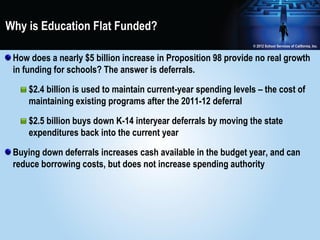
Why is Education Flat Funded?

 How does a nearly $5 billion increase in Proposition 98 provide no real growth
 in funding for schools? The answer is deferrals.

     $2.4 billion is used to maintain current-year spending levels – the cost of
     maintaining existing programs after the 2011-12 deferral

     $2.5 billion buys down K-14 interyear deferrals by moving the state
     expenditures back into the current year

 Buying down deferrals increases cash available in the budget year, and can
 reduce borrowing costs, but does not increase spending authority
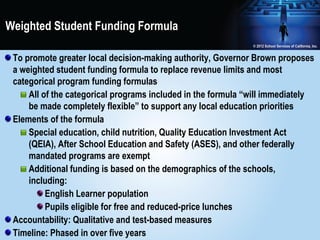
Weighted Student Funding Formula

 To promote greater local decision-making authority, Governor Brown proposes
 a weighted student funding formula to replace revenue limits and most
 categorical program funding formulas
     All of the categorical programs included in the formula “will immediately
     be made completely flexible” to support any local education priorities
 Elements of the formula
     Special education, child nutrition, Quality Education Investment Act
     (QEIA), After School Education and Safety (ASES), and other federally
     mandated programs are exempt
     Additional funding is based on the demographics of the schools,
     including:
          English Learner population
          Pupils eligible for free and reduced-price lunches
 Accountability: Qualitative and test-based measures
 Timeline: Phased in over five years
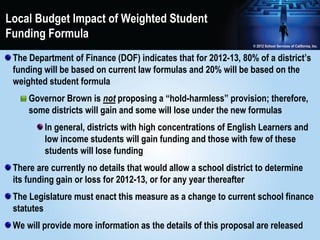
Local Budget Impact of Weighted Student
Funding Formula
 The Department of Finance (DOF) indicates that for 2012-13, 80% of a district’s
 funding will be based on current law formulas and 20% will be based on the
 weighted student formula
     Governor Brown is not proposing a “hold-harmless” provision; therefore,
     some districts will gain and some will lose under the new formulas
         In general, districts with high concentrations of English Learners and
         low income students will gain funding and those with few of these
         students will lose funding
 There are currently no details that would allow a school district to determine
 its funding gain or loss for 2012-13, or for any year thereafter
 The Legislature must enact this measure as a change to current school finance
 statutes
 We will provide more information as the details of this proposal are released
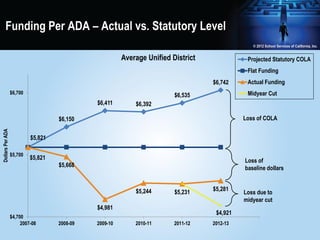
Funding Per ADA – Actual vs. Statutory Level

                                                        Average Unified District              Projected Statutory COLA
                                                                                              Flat Funding
                                                                                   $6,742     Actual Funding
                  $6,700                                                                      Midyear Cut
                                                                         $6,535
                                              $6,411        $6,392

                                    $6,150                                                   Loss of COLA
Dollars Per ADA


                           $5,821

                  $5,700
                           $5,821                                                            Loss of
                                    $5,668                                                   baseline dollars


                                                            $5,244       $5,231    $5,281
                                                                                             Loss due to
                                                                                             midyear cut
                                              $4,981
                                                                                    $4,921
                  $4,700
                       2007-08      2008-09   2009-10       2010-11      2011-12   2012-13
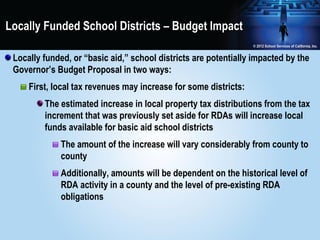
Locally Funded School Districts – Budget Impact

 Locally funded, or “basic aid,” school districts are potentially impacted by the
 Governor’s Budget Proposal in two ways:
     First, local tax revenues may increase for some districts:
         The estimated increase in local property tax distributions from the tax
         increment that was previously set aside for RDAs will increase local
         funds available for basic aid school districts
             The amount of the increase will vary considerably from county to
             county
             Additionally, amounts will be dependent on the historical level of
             RDA activity in a county and the level of pre-existing RDA
             obligations
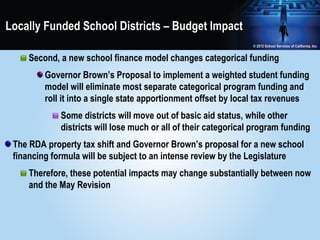
Locally Funded School Districts – Budget Impact

    Second, a new school finance model changes categorical funding
         Governor Brown’s Proposal to implement a weighted student funding
         model will eliminate most separate categorical program funding and
         roll it into a single state apportionment offset by local tax revenues
             Some districts will move out of basic aid status, while other
             districts will lose much or all of their categorical program funding
 The RDA property tax shift and Governor Brown’s proposal for a new school
 financing formula will be subject to an intense review by the Legislature
    Therefore, these potential impacts may change substantially between now
    and the May Revision
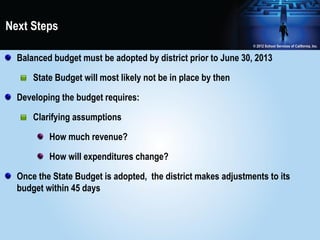
Next Steps

  Balanced budget must be adopted by district prior to June 30, 2013

      State Budget will most likely not be in place by then

  Developing the budget requires:

      Clarifying assumptions

          How much revenue?

          How will expenditures change?

  Once the State Budget is adopted, the district makes adjustments to its
  budget within 45 days
Questions?

Governor's Budget Update

  • 1.
    Governor’s Budget Update February8, 2012 Devin Vodicka, EdD Assistant Superintendent, Business Services
  • 2.
  • 3.
    Choices and PrioritiesMatter California demands and deserves a “world-class” education system The top five states, in terms of student performance, are Vermont, Rhode Island, Wyoming, New Jersey, and Maine The bottom five are California, Idaho, Mississippi, Nevada, and Arizona What’s different? Top Five Bottom Five Per-student spending $16,000 – $22,000 $6,700 – $8,700 Percent of state resources 4.2% – 6.0% 3.2% – 3.9% 4th Grade NAEP* 32% – 44% 22% – 33% 8th Grade NAEP* 34% – 47% 19% – 37% *National Assessments of Educational Progress California has fallen from number one to number 46 in per-ADA funding; and the results bear that out
  • 4.
    Education Funding RemainsAt Risk State funding for education was cut by 16% beginning in 2008-09 – five years ago! And education has contributed about $7 billion per year to help resolve the state’s Budget crisis – a total of more than $35 billion No other segment of the Budget has been cut anywhere close to that much and most other segments of the Budget have actually grown over the same five-year period But the Governor’s challenge is increasingly difficult Our cyclical economy isn’t cycling fast enough The state is running out of solutions We think the Governor is making the most of a bad situation, but it isn’t going to be resolved anytime soon
  • 5.
    Another “Crisis” Budget The Governor’s Budget Proposals for 2012-13 represent another desperate effort to get through a bad time, not a permanent solution The Budget depends on passage of new temporary taxes midway through the year The structural imbalance continues to dog the state’s recovery Specific proposals include: 100% of home-to-school and special education transportation funding is cut under both alternatives Disproportionate effect on districts is a huge problem
  • 6.
    Another “Crisis” Budget Governor’s Budget: Assumes voters approve a $6.9 billion tax measure Funding the statutory increase in Proposition 98 by manipulating deferrals This alternative provides no additional spending for education, but maintains revenue limits at about 2011-12 pre-trigger-cut levels Alternative: Assumes voters reject the tax measure Education is cut $2.4 billion, about $370 per average daily attendance (ADA) The mechanics of the Budget are complex, but this outcome is the bottom line
  • 7.
    Governor’s Temporary TaxProposal The Governor’s Budget assumes that voters will approve $6.9 billion in temporary taxes in November 2012 Of this total, $2.2 billion would count in 2011-12 and $4.7 billion would count in 2012-13 The higher taxes would continue through 2016 The Governor’s tax proposal includes the following: Income tax increase Single filers tax increase of 1% for income above $250,000; up to 2% for income over $500,000 Joint filers tax increase of 1% for income above $500,000; up to 2% for income over $1 million Head of household increase of 2% for income above $680,000 Sales and use tax increase of 0.5%
  • 8.
    Contingent Trigger Cuts Like the 2011-12 Budget Act, the Governor’s Budget Proposal for 2012-13 contains automatic trigger reductions The trigger reductions total $5.4 billion The cuts are linked to the failure of the proposed temporary tax increases, not a general revenue shortfall The trigger reductions hit education the hardest, especially Proposition 98 Programs Targeted for Trigger Cuts Program Amount % Share Proposition 98 $4,837 million 89.7% University of California $200 million 3.7% California State University $200 million 3.7% Courts $125 million 2.3% All Other $28 million 0.6% Total $5,390 million 100.0%
  • 9.
    Budget Contingency Plan The Governor’s Budget assumes that new temporary taxes are approved by the voters for five years at the November 2012 ballot The Budget also proposes severe additional reductions in funding for schools in the event that the tax extensions are not approved This leaves schools in a position of needing at least two plans Governor Brown’s Proposal: Flat funding – continues the funding level contained in the enacted Budget for 2011-12, except for transportation Alternative: A $2.4 billion reduction in K-14 funding – results in a loss of about $370 per ADA for the average district Districts will need to plan for both eventualities until the fate of the tax extensions is determined Additionally, economic changes between now and enactment of the 2011-12 Budget could cause a revision, up or down
  • 10.
    What Happens ifTaxes Aren’t Approved? If the tax initiative fails, Governor Brown proposes to cut K-14 education by $4.8 billion Proposition 98 drops by $2.4 billion because of the loss of new tax revenues The interyear deferral buyout is rescinded, and existing deferrals are maintained, saving $2.4 billion State payments for debt service on school bonds are re-categorized as Proposition 98 expenditures Historically, debt service has been funded outside of Proposition 98 By moving debt service into Proposition 98, K-14 costs are increased by $2.4 billion Requires corresponding cuts to other K-14 spending of an equal amount – divided between K-12 (89%) and community colleges (11%) Governor Brown equates this reduction to eliminating three weeks of instruction from the school year
  • 11.
    Why is EducationFlat Funded? How does a nearly $5 billion increase in Proposition 98 provide no real growth in funding for schools? The answer is deferrals. $2.4 billion is used to maintain current-year spending levels – the cost of maintaining existing programs after the 2011-12 deferral $2.5 billion buys down K-14 interyear deferrals by moving the state expenditures back into the current year Buying down deferrals increases cash available in the budget year, and can reduce borrowing costs, but does not increase spending authority
  • 12.
    Weighted Student FundingFormula To promote greater local decision-making authority, Governor Brown proposes a weighted student funding formula to replace revenue limits and most categorical program funding formulas All of the categorical programs included in the formula “will immediately be made completely flexible” to support any local education priorities Elements of the formula Special education, child nutrition, Quality Education Investment Act (QEIA), After School Education and Safety (ASES), and other federally mandated programs are exempt Additional funding is based on the demographics of the schools, including: English Learner population Pupils eligible for free and reduced-price lunches Accountability: Qualitative and test-based measures Timeline: Phased in over five years
  • 13.
    Local Budget Impactof Weighted Student Funding Formula The Department of Finance (DOF) indicates that for 2012-13, 80% of a district’s funding will be based on current law formulas and 20% will be based on the weighted student formula Governor Brown is not proposing a “hold-harmless” provision; therefore, some districts will gain and some will lose under the new formulas In general, districts with high concentrations of English Learners and low income students will gain funding and those with few of these students will lose funding There are currently no details that would allow a school district to determine its funding gain or loss for 2012-13, or for any year thereafter The Legislature must enact this measure as a change to current school finance statutes We will provide more information as the details of this proposal are released
  • 14.
    Funding Per ADA– Actual vs. Statutory Level Average Unified District Projected Statutory COLA Flat Funding $6,742 Actual Funding $6,700 Midyear Cut $6,535 $6,411 $6,392 $6,150 Loss of COLA Dollars Per ADA $5,821 $5,700 $5,821 Loss of $5,668 baseline dollars $5,244 $5,231 $5,281 Loss due to midyear cut $4,981 $4,921 $4,700 2007-08 2008-09 2009-10 2010-11 2011-12 2012-13
  • 15.
    Locally Funded SchoolDistricts – Budget Impact Locally funded, or “basic aid,” school districts are potentially impacted by the Governor’s Budget Proposal in two ways: First, local tax revenues may increase for some districts: The estimated increase in local property tax distributions from the tax increment that was previously set aside for RDAs will increase local funds available for basic aid school districts The amount of the increase will vary considerably from county to county Additionally, amounts will be dependent on the historical level of RDA activity in a county and the level of pre-existing RDA obligations
  • 16.
    Locally Funded SchoolDistricts – Budget Impact Second, a new school finance model changes categorical funding Governor Brown’s Proposal to implement a weighted student funding model will eliminate most separate categorical program funding and roll it into a single state apportionment offset by local tax revenues Some districts will move out of basic aid status, while other districts will lose much or all of their categorical program funding The RDA property tax shift and Governor Brown’s proposal for a new school financing formula will be subject to an intense review by the Legislature Therefore, these potential impacts may change substantially between now and the May Revision
  • 17.
    Next Steps Balanced budget must be adopted by district prior to June 30, 2013 State Budget will most likely not be in place by then Developing the budget requires: Clarifying assumptions How much revenue? How will expenditures change? Once the State Budget is adopted, the district makes adjustments to its budget within 45 days
  • 18.