
What is Certification?
STC Summit, Rosemont, IL

May 2012


                           1
Session Agenda
✤   Who is eligible for CPTC™
    certification—and who should apply?

✤   Why is certification right for you?

✤   What is the process?

✤   When will you get your results?

✤   How will it matter—to you, to
    employers, and to the profession?

✤   Where do you get more information
    and get started?

                                         2

                                             2
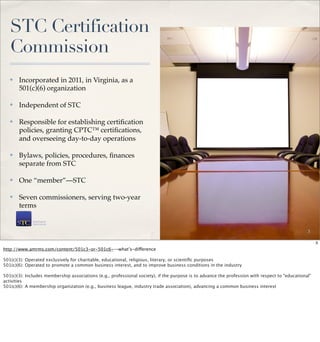
STC Certification
   Commission
   ✤   Incorporated in 2011, in Virginia, as a
       501(c)(6) organization

   ✤   Independent of STC

   ✤   Responsible for establishing certification
       policies, granting CPTC™ certifications,
       and overseeing day-to-day operations

   ✤   Bylaws, policies, procedures, finances
       separate from STC

   ✤   One “member”—STC

   ✤   Seven commissioners, serving two-year
       terms


                                                                                                                                                   3

                                                                                                                                                        3
http://www.amrms.com/content/501c3-or-501c6-–-what’s-difference

501(c)(3):   Operated exclusively for charitable, educational, religious, literary, or scientific purposes
501(c)(6):   Operated to promote a common business interest, and to improve business conditions in the industry
 
501(c)(3):   Includes membership associations (e.g., professional society), if the purpose is to advance the profession with respect to "educational"
activities
501(c)(6):   A membership organization (e.g., business league, industry trade association), advancing a common business interest
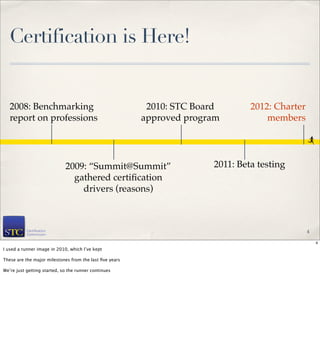
Certification is Here!


   2008: Benchmarking                                     2010: STC Board       2012: Charter
   report on professions                                 approved program           members


                             2009: “Summit@Summit”                     2011: Beta testing
                               gathered certification
                                 drivers (reasons)


                                                                                                4

                                                                                                    4
I used a runner image in 2010, which I’ve kept

These are the major milestones from the last five years

We’re just getting started, so the runner continues
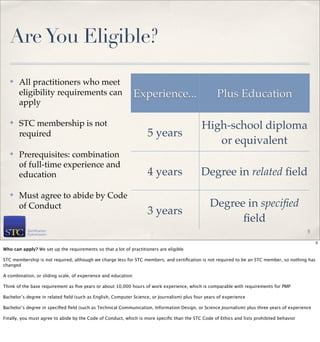
Are You Eligible?

   ✤   All practitioners who meet
       eligibility requirements can                          Experience...                          Plus Education
       apply

   ✤   STC membership is not                                                                 High-school diploma
       required                                                     5 years
                                                                                                or equivalent
   ✤   Prerequisites: combination
       of full-time experience and
       education                                                    4 years                  Degree in related field
   ✤   Must agree to abide by Code
       of Conduct                                                                                Degree in specified
                                                                    3 years
                                                                                                       field
                                                                                                                                            5

                                                                                                                                                 5
Who can apply? We set up the requirements so that a lot of practitioners are eligible

STC membership is not required, although we charge less for STC members; and certification is not required to be an STC member, so nothing has
changed

A combination, or sliding scale, of experience and education:

Think of the base requirement as five years or about 10,000 hours of work experience, which is comparable with requirements for PMP

Bachelor’s degree in related field (such as English, Computer Science, or Journalism) plus four years of experience

Bachelor’s degree in specified field (such as Technical Communication, Information Design, or Science Journalism) plus three years of experience

Finally, you must agree to abide by the Code of Conduct, which is more specific than the STC Code of Ethics and lists prohibited behavior
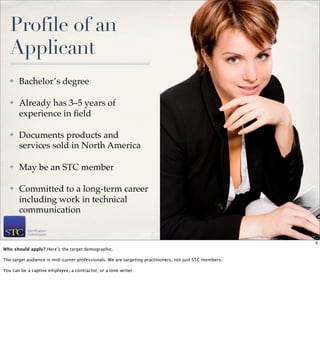
Profile of an
   Applicant
   ✤   Bachelor’s degree

   ✤   Already has 3–5 years of
       experience in field

   ✤   Documents products and
       services sold in North America

   ✤   May be an STC member

   ✤   Committed to a long-term career
       including work in technical
       communication

                                                                                                         6

                                                                                                             6
Who should apply? Here’s the target demographic.

The target audience is mid-career professionals. We are targeting practitioners, not just STC members.

You can be a captive employee, a contractor, or a lone writer.
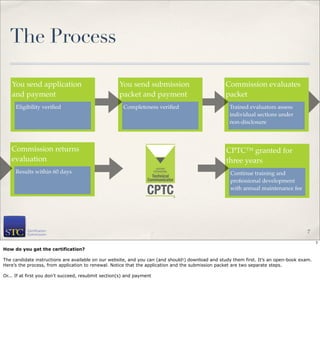
The Process

    You send application                             You send submission                          Commission evaluates
    and payment                                      packet and payment                           packet
     Eligibility verified                               Completeness verified                         Trained evaluators assess
                                                                                                    individual sections under
                                                                                                    non-disclosure


   Commission returns                                                                              CPTC™ granted for
   evaluation                                                                                      three years
     Results within 60 days                                                                         Continue training and
                                                                                                    professional development
                                                                                                    with annual maintenance fee


                                                                                                                                       7

                                                                                                                                            7
How do you get the certification?

The candidate instructions are available on our website, and you can (and should!) download and study them first. It’s an open-book exam.
Here’s the process, from application to renewal. Notice that the application and the submission packet are two separate steps.

Or... If at first you don’t succeed, resubmit section(s) and payment
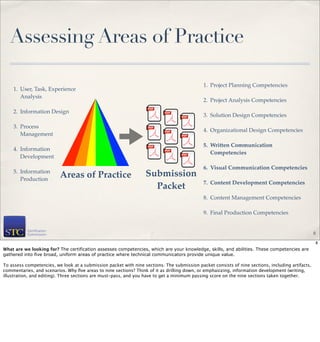
Assessing Areas of Practice

                                                                                             1. Project Planning Competencies
    1. User, Task, Experience
       Analysis
                                                                                             2. Project Analysis Competencies

    2. Information Design
                                                                                             3. Solution Design Competencies

    3. Process
                                                                                             4. Organizational Design Competencies
       Management
                                                                                             5. Written Communication
    4. Information
                                                                                                Competencies
       Development
                                                                                             6. Visual Communication Competencies
    5. Information
       Production
                          Areas of Practice                       Submission
                                                                                             7. Content Development Competencies
                                                                    Packet
                                                                                             8. Content Management Competencies

                                                                                             9. Final Production Competencies


                                                                                                                                                   8
                                                                                                                                                   8
What are we looking for? The certification assesses competencies, which are your knowledge, skills, and abilities. These competencies are
gathered into five broad, uniform areas of practice where technical communicators provide unique value.

To assess competencies, we look at a submission packet with nine sections. The submission packet consists of nine sections, including artifacts,
commentaries, and scenarios. Why five areas to nine sections? Think of it as drilling down, or emphasizing, information development (writing,
illustration, and editing). Three sections are must-pass, and you have to get a minimum passing score on the nine sections taken together.
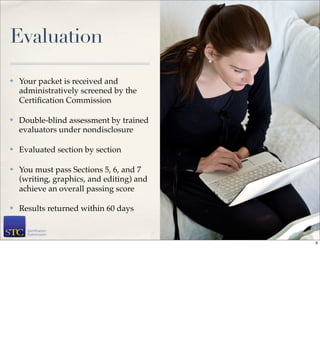
Evaluation
✤   Your packet is received and
    administratively screened by the
    Certification Commission

✤   Double-blind assessment by trained
    evaluators under nondisclosure

✤   Evaluated section by section

✤   You must pass Sections 5, 6, and 7
    (writing, graphics, and editing) and
    achieve an overall passing score

✤   Results returned within 60 days

                                           9

                                               9
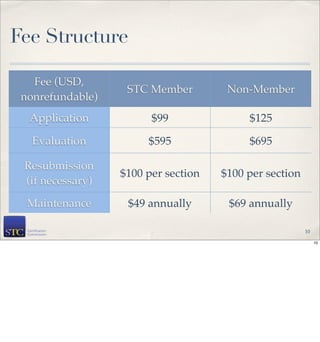
Fee Structure

   Fee (USD,
                   STC Member         Non-Member
 nonrefundable)
  Application           $99               $125

   Evaluation          $595               $695

 Resubmission
                  $100 per section   $100 per section
 (if necessary)

  Maintenance      $49 annually       $69 annually

                                                        10

                                                             10
Preparing Your
   Packet
   ✤   Read and follow all the directions on
       the candidate instructions

   ✤   Treat each section separately

   ✤   Don’t skip anything

   ✤   Choose your sample(s) wisely

   ✤   Observe all page lengths

   ✤   Proofread carefully

   ✤   Submit only PDF files (we do not
       accept other formats)

                                                                                                                                  11

                                                                                                                                       11
Here I insult your intelligence, but I have a reason to list each of these

V1.0 of the Candidate Instructions list page limits as suggestions; they will soon become requirements

V1.0 of the Candidate Instructions imply formats other than PDF are acceptable; PDF will soon become the only acceptable format

For more details, go to Rob’s session on Wednesday
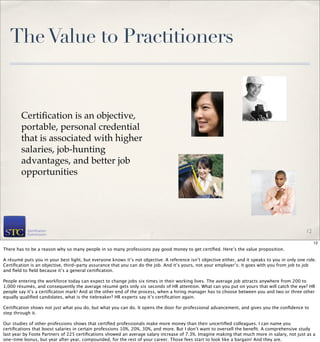
The Value to Practitioners


        Certification is an objective,                                                                                                    !
        portable, personal credential
                                                                                                          !
        that is associated with higher
        salaries, job-hunting
        advantages, and better job
        opportunities

                                                                                                          !


                                                                                                                                             !


                                                                                                                                                  12
                                                                                                                                                       12
There has to be a reason why so many people in so many professions pay good money to get certified. Here’s the value proposition.

A résumé puts you in your best light, but everyone knows it’s not objective. A reference isn’t objective either, and it speaks to you in only one role.
Certification is an objective, third-party assurance that you can do the job. And it’s yours, not your employer’s; it goes with you from job to job
and field to field because it’s a general certification.

People entering the workforce today can expect to change jobs six times in their working lives. The average job attracts anywhere from 200 to
1,000 résumés, and consequently the average résumé gets only six seconds of HR attention. What can you put on yours that will catch the eye? HR
people say it’s a certification mark! And at the other end of the process, when a hiring manager has to choose between you and two or three other
equally qualified candidates, what is the tiebreaker? HR experts say it’s certification again.

Certification shows not just what you do, but what you can do. It opens the door for professional advancement, and gives you the confidence to
step through it.

Our studies of other professions shows that certified professionals make more money than their uncertified colleagues. I can name you
certifications that boost salaries in certain professions 10%, 20%, 30%, and more. But I don’t want to oversell the benefit. A comprehensive study
last year by Foote Partners of 225 certifications showed an average salary increase of 7.3%. Imagine making that much more in salary, not just as a
one-time bonus, but year after year, compounded, for the rest of your career. Those fees start to look like a bargain! And they are.
The Value to
   Employers
   ✤   Certificants are more cost-effective
       to find, train, and keep—and so
       are worth paying a premium for

   ✤   Certification objectively assures
       that certificants can handle
       complex projects from planning
       through completion—so they
       reduce the risk of problems

   ✤   Certificants voluntarily dedicate
       and commit to their profession—
       something employers like

                                                                                                                             13

                                                                                                                                  13
There also has to be a reason why employers would pay more for a certified professional. How is that possible? This is how.

In general, employers find that certified professionals are more likely to be successful, valued employees.
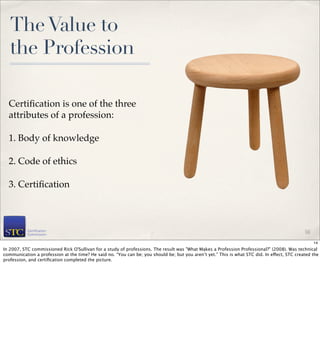
The Value to
   the Profession

  Certification is one of the three
  attributes of a profession:

  1. Body of knowledge

  2. Code of ethics

  3. Certification


                                                                                                                                              14

                                                                                                                                                   14
In 2007, STC commissioned Rick O'Sullivan for a study of professions. The result was "What Makes a Profession Professional?" (2008). Was technical
communication a profession at the time? He said no. “You can be; you should be; but you aren’t yet.” This is what STC did. In effect, STC created the
profession, and certification completed the picture.
Maintaining Your
   Certification
   ✤   Your CPTC™ certification is valid for
       three years

   ✤   To maintain your certification:

        ✤    Annual maintenance fee

        ✤    Ongoing professional development

        ✤    Stay active in the field

        ✤    Renewable without retest,
             resubmission packet, or
             recertification fee


                                                                                                                                               15

                                                                                                                                                      15
The certification isn’t a lifetime grant; it would be worthless if it were. We chose a typical period of three years.

Continuing education is important, and the certification maintenance process encourages it.

You don’t have to attend STC events—any professional society (such as IEEE or ASI) will do.

Remaining active in your chapter or SIG counts as professional activity. Chapter leaders: the more certified practitioners in your chapter, the more
they’ll have reason to attend your chapter events and workshops.
Certification
   and Your Career
   ✤   Certification is an important milestone in your
       career journey

   ✤   Like career paths, the path to certification varies
       among individuals

   ✤   Most practitioners are qualified to apply for
       CPTC™ certification

   ✤   Some employers will pay; some practitioners
       will invest in themselves

   ✤   Initially, certification is for generalists

   ✤   Initially, certification is in English and based on
       US market standards

   ✤   CPTC™ certification will take time to take root


                                                                                                                  16

                                                                                                                       16
Not everyone qualifies, and not everyone will pass. This is a feature, not a bug.

Certification is not a guarantee of personal success.

It’s been suggested that this is a money-making scheme, and that everyone who applies passes. That is not true.
Certification is
   Transformational
   ✤   For practitioners: More money,
       respect, recognition, and
       opportunity; breaks the
       downward rate spiral

   ✤   For employers: An objective way
       to discern value; less risk

   ✤   For the profession: Makes the
       profession professional; raises
       the bar of practice

                                                                                                            17

                                                                                                                 17
How does certification matter? I truly believe certification is transformational

Project managers were in a commodity spiral 25 years ago, and began certification to break it

Maintenance raises the bar of practice; we can refurbish or add new requirements as circumstances warrant
Where Do I
   Sign Up—?
   ✤   To get started on your CPTC™
       certification: www.stccert.org

   ✤   Information at the Summit:
       “How do I Become Certified?”
       Rob Hanna, Wednesday 11:30–
       12:30 pm

   ✤   More questions? Email
       cert@stc.org (or me at
       stevefjong@comcast.net)


                                                                       18

                                                                            18
Today is just an overview; for more information, go to Rob’s session

What is Certification? STC Summit 2012

  • 1.
    What is Certification? STCSummit, Rosemont, IL May 2012 1
  • 2.
    Session Agenda ✤ Who is eligible for CPTC™ certification—and who should apply? ✤ Why is certification right for you? ✤ What is the process? ✤ When will you get your results? ✤ How will it matter—to you, to employers, and to the profession? ✤ Where do you get more information and get started? 2 2
  • 3.
    STC Certification Commission ✤ Incorporated in 2011, in Virginia, as a 501(c)(6) organization ✤ Independent of STC ✤ Responsible for establishing certification policies, granting CPTC™ certifications, and overseeing day-to-day operations ✤ Bylaws, policies, procedures, finances separate from STC ✤ One “member”—STC ✤ Seven commissioners, serving two-year terms 3 3 http://www.amrms.com/content/501c3-or-501c6-–-what’s-difference 501(c)(3): Operated exclusively for charitable, educational, religious, literary, or scientific purposes 501(c)(6): Operated to promote a common business interest, and to improve business conditions in the industry   501(c)(3): Includes membership associations (e.g., professional society), if the purpose is to advance the profession with respect to "educational" activities 501(c)(6): A membership organization (e.g., business league, industry trade association), advancing a common business interest
  • 4.
    Certification is Here! 2008: Benchmarking 2010: STC Board 2012: Charter report on professions approved program members 2009: “Summit@Summit” 2011: Beta testing gathered certification drivers (reasons) 4 4 I used a runner image in 2010, which I’ve kept These are the major milestones from the last five years We’re just getting started, so the runner continues
  • 5.
    Are You Eligible? ✤ All practitioners who meet eligibility requirements can Experience... Plus Education apply ✤ STC membership is not High-school diploma required 5 years or equivalent ✤ Prerequisites: combination of full-time experience and education 4 years Degree in related field ✤ Must agree to abide by Code of Conduct Degree in specified 3 years field 5 5 Who can apply? We set up the requirements so that a lot of practitioners are eligible STC membership is not required, although we charge less for STC members; and certification is not required to be an STC member, so nothing has changed A combination, or sliding scale, of experience and education: Think of the base requirement as five years or about 10,000 hours of work experience, which is comparable with requirements for PMP Bachelor’s degree in related field (such as English, Computer Science, or Journalism) plus four years of experience Bachelor’s degree in specified field (such as Technical Communication, Information Design, or Science Journalism) plus three years of experience Finally, you must agree to abide by the Code of Conduct, which is more specific than the STC Code of Ethics and lists prohibited behavior
  • 6.
    Profile of an Applicant ✤ Bachelor’s degree ✤ Already has 3–5 years of experience in field ✤ Documents products and services sold in North America ✤ May be an STC member ✤ Committed to a long-term career including work in technical communication 6 6 Who should apply? Here’s the target demographic. The target audience is mid-career professionals. We are targeting practitioners, not just STC members. You can be a captive employee, a contractor, or a lone writer.
  • 7.
    The Process You send application You send submission Commission evaluates and payment packet and payment packet Eligibility verified Completeness verified Trained evaluators assess individual sections under non-disclosure Commission returns CPTC™ granted for evaluation three years Results within 60 days Continue training and professional development with annual maintenance fee 7 7 How do you get the certification? The candidate instructions are available on our website, and you can (and should!) download and study them first. It’s an open-book exam. Here’s the process, from application to renewal. Notice that the application and the submission packet are two separate steps. Or... If at first you don’t succeed, resubmit section(s) and payment
  • 8.
    Assessing Areas ofPractice 1. Project Planning Competencies 1. User, Task, Experience Analysis 2. Project Analysis Competencies 2. Information Design 3. Solution Design Competencies 3. Process 4. Organizational Design Competencies Management 5. Written Communication 4. Information Competencies Development 6. Visual Communication Competencies 5. Information Production Areas of Practice Submission 7. Content Development Competencies Packet 8. Content Management Competencies 9. Final Production Competencies 8 8 What are we looking for? The certification assesses competencies, which are your knowledge, skills, and abilities. These competencies are gathered into five broad, uniform areas of practice where technical communicators provide unique value. To assess competencies, we look at a submission packet with nine sections. The submission packet consists of nine sections, including artifacts, commentaries, and scenarios. Why five areas to nine sections? Think of it as drilling down, or emphasizing, information development (writing, illustration, and editing). Three sections are must-pass, and you have to get a minimum passing score on the nine sections taken together.
  • 9.
    Evaluation ✤ Your packet is received and administratively screened by the Certification Commission ✤ Double-blind assessment by trained evaluators under nondisclosure ✤ Evaluated section by section ✤ You must pass Sections 5, 6, and 7 (writing, graphics, and editing) and achieve an overall passing score ✤ Results returned within 60 days 9 9
  • 10.
    Fee Structure Fee (USD, STC Member Non-Member nonrefundable) Application $99 $125 Evaluation $595 $695 Resubmission $100 per section $100 per section (if necessary) Maintenance $49 annually $69 annually 10 10
  • 11.
    Preparing Your Packet ✤ Read and follow all the directions on the candidate instructions ✤ Treat each section separately ✤ Don’t skip anything ✤ Choose your sample(s) wisely ✤ Observe all page lengths ✤ Proofread carefully ✤ Submit only PDF files (we do not accept other formats) 11 11 Here I insult your intelligence, but I have a reason to list each of these V1.0 of the Candidate Instructions list page limits as suggestions; they will soon become requirements V1.0 of the Candidate Instructions imply formats other than PDF are acceptable; PDF will soon become the only acceptable format For more details, go to Rob’s session on Wednesday
  • 12.
    The Value toPractitioners Certification is an objective, ! portable, personal credential ! that is associated with higher salaries, job-hunting advantages, and better job opportunities ! ! 12 12 There has to be a reason why so many people in so many professions pay good money to get certified. Here’s the value proposition. A résumé puts you in your best light, but everyone knows it’s not objective. A reference isn’t objective either, and it speaks to you in only one role. Certification is an objective, third-party assurance that you can do the job. And it’s yours, not your employer’s; it goes with you from job to job and field to field because it’s a general certification. People entering the workforce today can expect to change jobs six times in their working lives. The average job attracts anywhere from 200 to 1,000 résumés, and consequently the average résumé gets only six seconds of HR attention. What can you put on yours that will catch the eye? HR people say it’s a certification mark! And at the other end of the process, when a hiring manager has to choose between you and two or three other equally qualified candidates, what is the tiebreaker? HR experts say it’s certification again. Certification shows not just what you do, but what you can do. It opens the door for professional advancement, and gives you the confidence to step through it. Our studies of other professions shows that certified professionals make more money than their uncertified colleagues. I can name you certifications that boost salaries in certain professions 10%, 20%, 30%, and more. But I don’t want to oversell the benefit. A comprehensive study last year by Foote Partners of 225 certifications showed an average salary increase of 7.3%. Imagine making that much more in salary, not just as a one-time bonus, but year after year, compounded, for the rest of your career. Those fees start to look like a bargain! And they are.
  • 13.
    The Value to Employers ✤ Certificants are more cost-effective to find, train, and keep—and so are worth paying a premium for ✤ Certification objectively assures that certificants can handle complex projects from planning through completion—so they reduce the risk of problems ✤ Certificants voluntarily dedicate and commit to their profession— something employers like 13 13 There also has to be a reason why employers would pay more for a certified professional. How is that possible? This is how. In general, employers find that certified professionals are more likely to be successful, valued employees.
  • 14.
    The Value to the Profession Certification is one of the three attributes of a profession: 1. Body of knowledge 2. Code of ethics 3. Certification 14 14 In 2007, STC commissioned Rick O'Sullivan for a study of professions. The result was "What Makes a Profession Professional?" (2008). Was technical communication a profession at the time? He said no. “You can be; you should be; but you aren’t yet.” This is what STC did. In effect, STC created the profession, and certification completed the picture.
  • 15.
    Maintaining Your Certification ✤ Your CPTC™ certification is valid for three years ✤ To maintain your certification: ✤ Annual maintenance fee ✤ Ongoing professional development ✤ Stay active in the field ✤ Renewable without retest, resubmission packet, or recertification fee 15 15 The certification isn’t a lifetime grant; it would be worthless if it were. We chose a typical period of three years. Continuing education is important, and the certification maintenance process encourages it. You don’t have to attend STC events—any professional society (such as IEEE or ASI) will do. Remaining active in your chapter or SIG counts as professional activity. Chapter leaders: the more certified practitioners in your chapter, the more they’ll have reason to attend your chapter events and workshops.
  • 16.
    Certification and Your Career ✤ Certification is an important milestone in your career journey ✤ Like career paths, the path to certification varies among individuals ✤ Most practitioners are qualified to apply for CPTC™ certification ✤ Some employers will pay; some practitioners will invest in themselves ✤ Initially, certification is for generalists ✤ Initially, certification is in English and based on US market standards ✤ CPTC™ certification will take time to take root 16 16 Not everyone qualifies, and not everyone will pass. This is a feature, not a bug. Certification is not a guarantee of personal success. It’s been suggested that this is a money-making scheme, and that everyone who applies passes. That is not true.
  • 17.
    Certification is Transformational ✤ For practitioners: More money, respect, recognition, and opportunity; breaks the downward rate spiral ✤ For employers: An objective way to discern value; less risk ✤ For the profession: Makes the profession professional; raises the bar of practice 17 17 How does certification matter? I truly believe certification is transformational Project managers were in a commodity spiral 25 years ago, and began certification to break it Maintenance raises the bar of practice; we can refurbish or add new requirements as circumstances warrant
  • 18.
    Where Do I Sign Up—? ✤ To get started on your CPTC™ certification: www.stccert.org ✤ Information at the Summit: “How do I Become Certified?” Rob Hanna, Wednesday 11:30– 12:30 pm ✤ More questions? Email cert@stc.org (or me at stevefjong@comcast.net) 18 18 Today is just an overview; for more information, go to Rob’s session