Whatis
Atheism?
Examining the Truth Claims of Atheism
www.confidentchristians.org
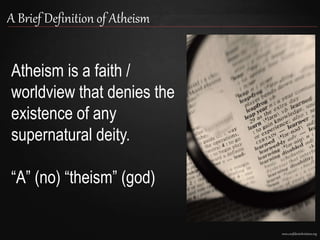
A Brief Definition of Atheism
Atheism is a faith /
worldview that denies the
existence of any
supernatural deity.
“A” (no) “theism” (god)
www.confidentchristians.org
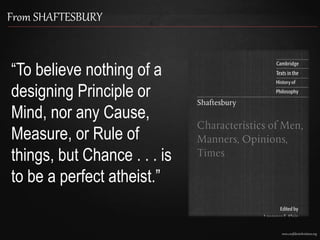
From SHAFTESBURY
“To believe nothing of a
designing Principle or
Mind, nor any Cause,
Measure, or Rule of
things, but Chance . . . is
to be a perfect atheist.”
www.confidentchristians.org
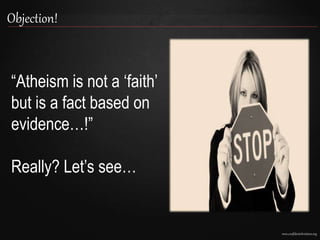
Objection!
“Atheism is not a ‘faith’
but is a fact based on
evidence…!”
Really? Let’s see…
www.confidentchristians.org
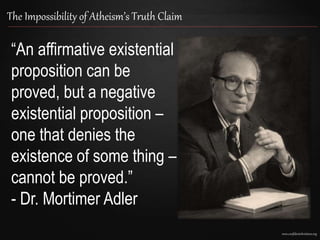
The Impossibility of Atheism’s Truth Claim
“An affirmative existential
proposition can be
proved, but a negative
existential proposition –
one that denies the
existence of some thing –
cannot be proved.”
- Dr. Mortimer Adler
www.confidentchristians.org
The First / Foremost Problem of Atheism
When a negative existential truth claim is put forward, the one
making the claim has shot themselves not in the foot, but in the
head. Unless the person can be in all places of the entire
universe at the same time, they have no way of confirming that
whatever they claim does not exist, in fact, does not exist. This is
conundrum the atheist finds him/herself in.
www.confidentchristians.org
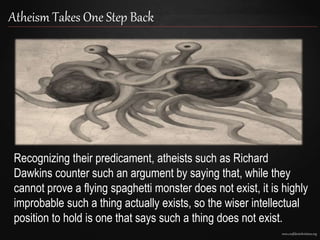
Atheism Takes One Step Back
Recognizing their predicament, atheists such as Richard
Dawkins counter such an argument by saying that, while they
cannot prove a flying spaghetti monster does not exist, it is highly
improbable such a thing actually exists, so the wiser intellectual
position to hold is one that says such a thing does not exist.
www.confidentchristians.org
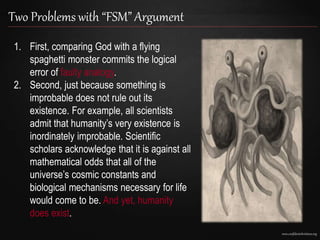
Two Problems with “FSM” Argument
1. First, comparing God with a flying
spaghetti monster commits the logical
error of faulty analogy.
2. Second, just because something is
improbable does not rule out its
existence. For example, all scientists
admit that humanity’s very existence is
inordinately improbable. Scientific
scholars acknowledge that it is against all
mathematical odds that all of the
universe’s cosmic constants and
biological mechanisms necessary for life
would come to be. And yet, humanity
does exist.
www.confidentchristians.org
The Real Question…
The question is not whether the existence of God is improbable,
but rather is there logical, reasonable evidence that moves one
toward a conclusion that God exists.
www.confidentchristians.org
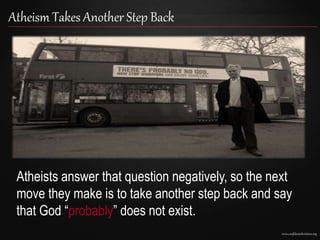
Atheism Takes Another Step Back
Atheists answer that question negatively, so the next
move they make is to take another step back and say
that God “probably” does not exist.
www.confidentchristians.org
Problem Number One
This is not the way human beings live most every other
area of their life they consider important.
Probably safe to fly
All Aboard…?
www.confidentchristians.org
Problem Number Two
The seriousness of a truth claim dictates
the amount of evidence necessary to
support it. The atheist truth claim carries
with it enormous, irreparable and eternal
consequences if it is wrong. That being the
case, it is intellectually and morally
incumbent upon the atheist to produce
weighty and overriding evidence to
support his/her position, but they provide
nothing to substantiate their limp assertion
that God “probably” does not exist.
www.confidentchristians.org
Problem Number Two
Atheism simply cannot meet the test for evidence for the seriousness of the
truth claim it makes. Instead, using a supposed argument from silence, the
atheist and those whom he/she convinces of their position slide into death
with their fingers crossed hoping they do not face the unpleasant reality that
eternity is an awfully long time to be wrong.
www.confidentchristians.org
Atheism’s ‘Evidence’? Science!
Some atheists recognize the
gravity of their situation, and
therefore when pressed for
evidence, they take a stand that
can be boiled down to “Science
has disproven God”.
Really? Let’s see…
www.confidentchristians.org
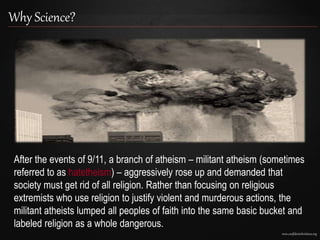
Why Science?
After the events of 9/11, a branch of atheism – militant atheism (sometimes
referred to as hatetheism) – aggressively rose up and demanded that
society must get rid of all religion. Rather than focusing on religious
extremists who use religion to justify violent and murderous actions, the
militant atheists lumped all peoples of faith into the same basic bucket and
labeled religion as a whole dangerous.
www.confidentchristians.org
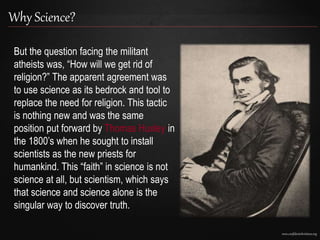
Why Science?
But the question facing the militant
atheists was, “How will we get rid of
religion?” The apparent agreement was
to use science as its bedrock and tool to
replace the need for religion. This tactic
is nothing new and was the same
position put forward by Thomas Huxley in
the 1800’s when he sought to install
scientists as the new priests for
humankind. This “faith” in science is not
science at all, but scientism, which says
that science and science alone is the
singular way to discover truth.
www.confidentchristians.org
Science vs. Scientism
While science has indeed delivered many great gifts to
humankind, the hopes atheism has that scientism will replace
religion are ill founded. Why? Let see…
www.confidentchristians.org
Scientism is self-refuting
The statement “We should only believe what can be scientifically
proven” itself cannot be scientifically proven (because it is a
philosophical statement), and so based on its own criteria, it
should be rejected.
www.confidentchristians.org
Scientism Ignores Valid Epistemology
Scientism ignores other much-respected
and used methods for obtaining knowledge.
For example, the legal/forensic/historical
method of discovering truth is used every
day and is very well respected. The legal
method does not ignore testimony or facts
because they are not empirically
reproducible or testable. By a process of
elimination and corroboration, the legal
method allows history and testimony to
speak for itself until a verdict is reached
beyond a reasonable doubt and the balance
of probability is achieved.
www.confidentchristians.org
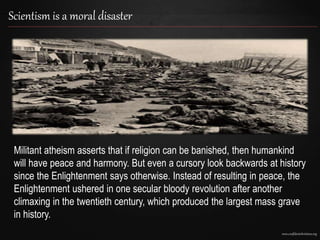
Scientism is a moral disaster
Militant atheism asserts that if religion can be banished, then humankind
will have peace and harmony. But even a cursory look backwards at history
since the Enlightenment says otherwise. Instead of resulting in peace, the
Enlightenment ushered in one secular bloody revolution after another
climaxing in the twentieth century, which produced the largest mass grave
in history.
www.confidentchristians.org
Scientism is a moral disaster
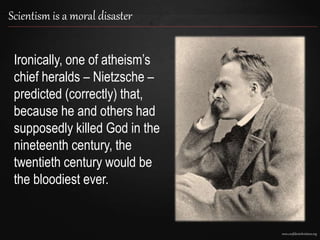
Ironically, one of atheism’s
chief heralds – Nietzsche –
predicted (correctly) that,
because he and others had
supposedly killed God in the
nineteenth century, the
twentieth century would be
the bloodiest ever.
www.confidentchristians.org
Real Science Points Toward a Creator
The death of the steady state theory and the near
universal acceptance that the universe as we know it
exploded out of nothing into existence (cf. Genesis 1:1)
points to a transcendent cause.
www.confidentchristians.org
Real Science Points Toward a Creator
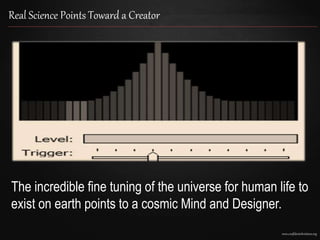
The incredible fine tuning of the universe for human life to
exist on earth points to a cosmic Mind and Designer.
www.confidentchristians.org
Real Science Points Toward a Creator
The confirmation of specified complexity like DNA that in
a single strand contains digital information equivalent to
600,000 pages of intelligence and is mathematically
identical to a language points to an intelligent source.
www.confidentchristians.org
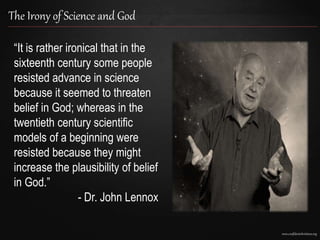
The Irony of Science and God
“It is rather ironical that in the
sixteenth century some people
resisted advance in science
because it seemed to threaten
belief in God; whereas in the
twentieth century scientific
models of a beginning were
resisted because they might
increase the plausibility of belief
in God.”
- Dr. John Lennox
www.confidentchristians.org
Atheism’s False Dilemma
Atheism’s position on science commits the
logical fallacy of the false dilemma.
Atheism demands that a person choose
between science and God, where in fact,
no such division need occur. Such a
requirement can be likened to a person
being forced to choose between:
1. The laws of internal combustion
2. Henry Ford,
as to why a car exists. The fact is the two
choices are not contradictory, but
complementary.
www.confidentchristians.org
Atheism’s False Dilemma
The atheist misses the important
difference between agency
(Henry Ford) and mechanism
(internal combustion).
In the same way, God is the
intelligent agency and efficient
cause behind everything, with his
natural laws and mechanisms
carrying out His intentions to
produce His desired end result.
www.confidentchristians.org
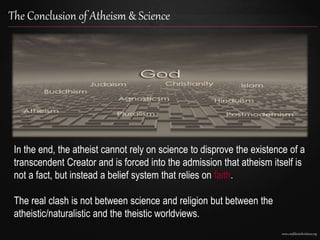
The Conclusion of Atheism & Science
In the end, the atheist cannot rely on science to disprove the existence of a
transcendent Creator and is forced into the admission that atheism itself is
not a fact, but instead a belief system that relies on faith.
The real clash is not between science and religion but between the
atheistic/naturalistic and the theistic worldviews.
www.confidentchristians.org
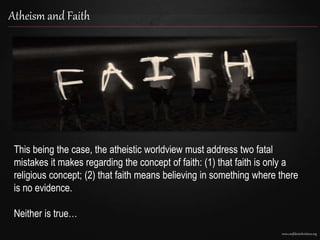
Atheism and Faith
This being the case, the atheistic worldview must address two fatal
mistakes it makes regarding the concept of faith: (1) that faith is only a
religious concept; (2) that faith means believing in something where there
is no evidence.
Neither is true…
www.confidentchristians.org
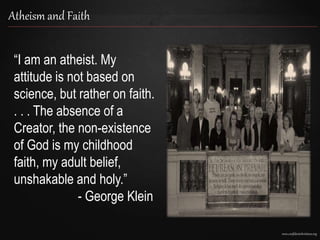
Atheism and Faith
“I am an atheist. My
attitude is not based on
science, but rather on faith.
. . . The absence of a
Creator, the non-existence
of God is my childhood
faith, my adult belief,
unshakable and holy.”
- George Klein
www.confidentchristians.org
Faith in Everyday Life
As to faith being defined as a belief that lacks evidence, nothing could be
further from the truth. Science has faith in logic, mathematics, natural laws,
and the intelligibility of the universe and believes all such things are firm
and will never change. People also act on faith every day from meals they
eat in restaurants, medicine they take from doctors, and marriages they
participate in with their spouse.
www.confidentchristians.org
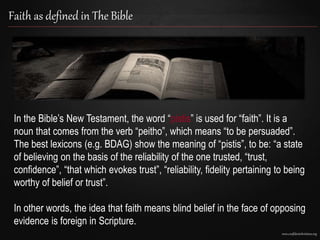
Faith as defined in The Bible
In the Bible’s New Testament, the word “pistis” is used for “faith”. It is a
noun that comes from the verb “peitho”, which means “to be persuaded”.
The best lexicons (e.g. BDAG) show the meaning of “pistis”, to be: “a state
of believing on the basis of the reliability of the one trusted, “trust,
confidence”, “that which evokes trust”, “reliability, fidelity pertaining to being
worthy of belief or trust”.
In other words, the idea that faith means blind belief in the face of opposing
evidence is foreign in Scripture.
www.confidentchristians.org
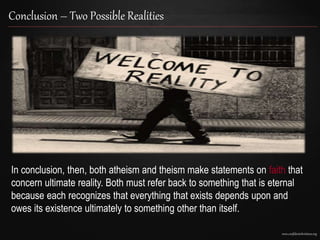
Conclusion – Two Possible Realities
In conclusion, then, both atheism and theism make statements on faith that
concern ultimate reality. Both must refer back to something that is eternal
because each recognizes that everything that exists depends upon and
owes its existence ultimately to something other than itself.
www.confidentchristians.org
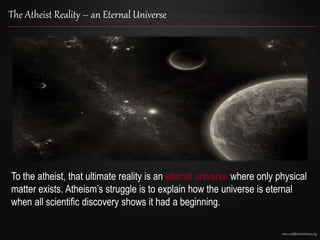
The Atheist Reality – an Eternal Universe
To the atheist, that ultimate reality is an eternal universe where only physical
matter exists. Atheism’s struggle is to explain how the universe is eternal
when all scientific discovery shows it had a beginning.
www.confidentchristians.org
The Atheist Reality Check
Atheism must confront a key issue
with their ultimate reality. Science says
that an effect always represents it
cause in essence. Therefore, atheism
must answer how an impersonal, non-
conscious, meaningless, purposeless,
and amoral universe accidentally
created personal, conscious, moral
beings who are obsessed with
meaning and purpose.
www.confidentchristians.org
The Theist Reality – A Better Answer
The theist has no such problem because it holds that a personal,
conscious, purposeful, intelligent, moral, eternal God created beings in His
likeness and established the universe and its laws to govern their
existence.
www.confidentchristians.org
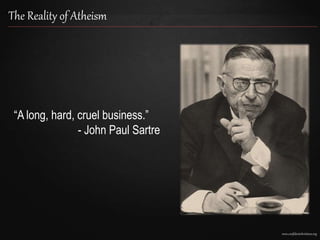
The Reality of Atheism
“A long, hard, cruel business.”
- John Paul Sartre
www.confidentchristians.org
The Reality of God
“The heavens are telling of the
glory of God; and their expanse
is declaring the work of His
hands. Day to day pours forth
speech, and night to night
reveals knowledge. There is no
speech, nor are there words;
their voice is not heard”
(Psalm 19:1–3)
www.confidentchristians.org
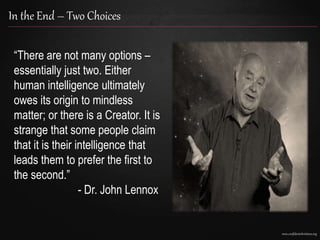
In the End – Two Choices
“There are not many options –
essentially just two. Either
human intelligence ultimately
owes its origin to mindless
matter; or there is a Creator. It is
strange that some people claim
that it is their intelligence that
leads them to prefer the first to
the second.”
- Dr. John Lennox
www.confidentchristians.org
For More Information
www.confidentchristians.org
Whatis
Atheism?
Examining the Truth Claims of Atheism

What is Atheism?

  • 1.
  • 2.
    www.confidentchristians.org A Brief Definitionof Atheism Atheism is a faith / worldview that denies the existence of any supernatural deity. “A” (no) “theism” (god)
  • 3.
    www.confidentchristians.org From SHAFTESBURY “To believenothing of a designing Principle or Mind, nor any Cause, Measure, or Rule of things, but Chance . . . is to be a perfect atheist.”
  • 4.
    www.confidentchristians.org Objection! “Atheism is nota ‘faith’ but is a fact based on evidence…!” Really? Let’s see…
  • 5.
    www.confidentchristians.org The Impossibility ofAtheism’s Truth Claim “An affirmative existential proposition can be proved, but a negative existential proposition – one that denies the existence of some thing – cannot be proved.” - Dr. Mortimer Adler
  • 6.
    www.confidentchristians.org The First /Foremost Problem of Atheism When a negative existential truth claim is put forward, the one making the claim has shot themselves not in the foot, but in the head. Unless the person can be in all places of the entire universe at the same time, they have no way of confirming that whatever they claim does not exist, in fact, does not exist. This is conundrum the atheist finds him/herself in.
  • 7.
    www.confidentchristians.org Atheism Takes OneStep Back Recognizing their predicament, atheists such as Richard Dawkins counter such an argument by saying that, while they cannot prove a flying spaghetti monster does not exist, it is highly improbable such a thing actually exists, so the wiser intellectual position to hold is one that says such a thing does not exist.
  • 8.
    www.confidentchristians.org Two Problems with“FSM” Argument 1. First, comparing God with a flying spaghetti monster commits the logical error of faulty analogy. 2. Second, just because something is improbable does not rule out its existence. For example, all scientists admit that humanity’s very existence is inordinately improbable. Scientific scholars acknowledge that it is against all mathematical odds that all of the universe’s cosmic constants and biological mechanisms necessary for life would come to be. And yet, humanity does exist.
  • 9.
    www.confidentchristians.org The Real Question… Thequestion is not whether the existence of God is improbable, but rather is there logical, reasonable evidence that moves one toward a conclusion that God exists.
  • 10.
    www.confidentchristians.org Atheism Takes AnotherStep Back Atheists answer that question negatively, so the next move they make is to take another step back and say that God “probably” does not exist.
  • 11.
    www.confidentchristians.org Problem Number One Thisis not the way human beings live most every other area of their life they consider important. Probably safe to fly All Aboard…?
  • 12.
    www.confidentchristians.org Problem Number Two Theseriousness of a truth claim dictates the amount of evidence necessary to support it. The atheist truth claim carries with it enormous, irreparable and eternal consequences if it is wrong. That being the case, it is intellectually and morally incumbent upon the atheist to produce weighty and overriding evidence to support his/her position, but they provide nothing to substantiate their limp assertion that God “probably” does not exist.
  • 13.
    www.confidentchristians.org Problem Number Two Atheismsimply cannot meet the test for evidence for the seriousness of the truth claim it makes. Instead, using a supposed argument from silence, the atheist and those whom he/she convinces of their position slide into death with their fingers crossed hoping they do not face the unpleasant reality that eternity is an awfully long time to be wrong.
  • 14.
    www.confidentchristians.org Atheism’s ‘Evidence’? Science! Someatheists recognize the gravity of their situation, and therefore when pressed for evidence, they take a stand that can be boiled down to “Science has disproven God”. Really? Let’s see…
  • 15.
    www.confidentchristians.org Why Science? After theevents of 9/11, a branch of atheism – militant atheism (sometimes referred to as hatetheism) – aggressively rose up and demanded that society must get rid of all religion. Rather than focusing on religious extremists who use religion to justify violent and murderous actions, the militant atheists lumped all peoples of faith into the same basic bucket and labeled religion as a whole dangerous.
  • 16.
    www.confidentchristians.org Why Science? But thequestion facing the militant atheists was, “How will we get rid of religion?” The apparent agreement was to use science as its bedrock and tool to replace the need for religion. This tactic is nothing new and was the same position put forward by Thomas Huxley in the 1800’s when he sought to install scientists as the new priests for humankind. This “faith” in science is not science at all, but scientism, which says that science and science alone is the singular way to discover truth.
  • 17.
    www.confidentchristians.org Science vs. Scientism Whilescience has indeed delivered many great gifts to humankind, the hopes atheism has that scientism will replace religion are ill founded. Why? Let see…
  • 18.
    www.confidentchristians.org Scientism is self-refuting Thestatement “We should only believe what can be scientifically proven” itself cannot be scientifically proven (because it is a philosophical statement), and so based on its own criteria, it should be rejected.
  • 19.
    www.confidentchristians.org Scientism Ignores ValidEpistemology Scientism ignores other much-respected and used methods for obtaining knowledge. For example, the legal/forensic/historical method of discovering truth is used every day and is very well respected. The legal method does not ignore testimony or facts because they are not empirically reproducible or testable. By a process of elimination and corroboration, the legal method allows history and testimony to speak for itself until a verdict is reached beyond a reasonable doubt and the balance of probability is achieved.
  • 20.
    www.confidentchristians.org Scientism is amoral disaster Militant atheism asserts that if religion can be banished, then humankind will have peace and harmony. But even a cursory look backwards at history since the Enlightenment says otherwise. Instead of resulting in peace, the Enlightenment ushered in one secular bloody revolution after another climaxing in the twentieth century, which produced the largest mass grave in history.
  • 21.
    www.confidentchristians.org Scientism is amoral disaster Ironically, one of atheism’s chief heralds – Nietzsche – predicted (correctly) that, because he and others had supposedly killed God in the nineteenth century, the twentieth century would be the bloodiest ever.
  • 22.
    www.confidentchristians.org Real Science PointsToward a Creator The death of the steady state theory and the near universal acceptance that the universe as we know it exploded out of nothing into existence (cf. Genesis 1:1) points to a transcendent cause.
  • 23.
    www.confidentchristians.org Real Science PointsToward a Creator The incredible fine tuning of the universe for human life to exist on earth points to a cosmic Mind and Designer.
  • 24.
    www.confidentchristians.org Real Science PointsToward a Creator The confirmation of specified complexity like DNA that in a single strand contains digital information equivalent to 600,000 pages of intelligence and is mathematically identical to a language points to an intelligent source.
  • 25.
    www.confidentchristians.org The Irony ofScience and God “It is rather ironical that in the sixteenth century some people resisted advance in science because it seemed to threaten belief in God; whereas in the twentieth century scientific models of a beginning were resisted because they might increase the plausibility of belief in God.” - Dr. John Lennox
  • 26.
    www.confidentchristians.org Atheism’s False Dilemma Atheism’sposition on science commits the logical fallacy of the false dilemma. Atheism demands that a person choose between science and God, where in fact, no such division need occur. Such a requirement can be likened to a person being forced to choose between: 1. The laws of internal combustion 2. Henry Ford, as to why a car exists. The fact is the two choices are not contradictory, but complementary.
  • 27.
    www.confidentchristians.org Atheism’s False Dilemma Theatheist misses the important difference between agency (Henry Ford) and mechanism (internal combustion). In the same way, God is the intelligent agency and efficient cause behind everything, with his natural laws and mechanisms carrying out His intentions to produce His desired end result.
  • 28.
    www.confidentchristians.org The Conclusion ofAtheism & Science In the end, the atheist cannot rely on science to disprove the existence of a transcendent Creator and is forced into the admission that atheism itself is not a fact, but instead a belief system that relies on faith. The real clash is not between science and religion but between the atheistic/naturalistic and the theistic worldviews.
  • 29.
    www.confidentchristians.org Atheism and Faith Thisbeing the case, the atheistic worldview must address two fatal mistakes it makes regarding the concept of faith: (1) that faith is only a religious concept; (2) that faith means believing in something where there is no evidence. Neither is true…
  • 30.
    www.confidentchristians.org Atheism and Faith “Iam an atheist. My attitude is not based on science, but rather on faith. . . . The absence of a Creator, the non-existence of God is my childhood faith, my adult belief, unshakable and holy.” - George Klein
  • 31.
    www.confidentchristians.org Faith in EverydayLife As to faith being defined as a belief that lacks evidence, nothing could be further from the truth. Science has faith in logic, mathematics, natural laws, and the intelligibility of the universe and believes all such things are firm and will never change. People also act on faith every day from meals they eat in restaurants, medicine they take from doctors, and marriages they participate in with their spouse.
  • 32.
    www.confidentchristians.org Faith as definedin The Bible In the Bible’s New Testament, the word “pistis” is used for “faith”. It is a noun that comes from the verb “peitho”, which means “to be persuaded”. The best lexicons (e.g. BDAG) show the meaning of “pistis”, to be: “a state of believing on the basis of the reliability of the one trusted, “trust, confidence”, “that which evokes trust”, “reliability, fidelity pertaining to being worthy of belief or trust”. In other words, the idea that faith means blind belief in the face of opposing evidence is foreign in Scripture.
  • 33.
    www.confidentchristians.org Conclusion – TwoPossible Realities In conclusion, then, both atheism and theism make statements on faith that concern ultimate reality. Both must refer back to something that is eternal because each recognizes that everything that exists depends upon and owes its existence ultimately to something other than itself.
  • 34.
    www.confidentchristians.org The Atheist Reality– an Eternal Universe To the atheist, that ultimate reality is an eternal universe where only physical matter exists. Atheism’s struggle is to explain how the universe is eternal when all scientific discovery shows it had a beginning.
  • 35.
    www.confidentchristians.org The Atheist RealityCheck Atheism must confront a key issue with their ultimate reality. Science says that an effect always represents it cause in essence. Therefore, atheism must answer how an impersonal, non- conscious, meaningless, purposeless, and amoral universe accidentally created personal, conscious, moral beings who are obsessed with meaning and purpose.
  • 36.
    www.confidentchristians.org The Theist Reality– A Better Answer The theist has no such problem because it holds that a personal, conscious, purposeful, intelligent, moral, eternal God created beings in His likeness and established the universe and its laws to govern their existence.
  • 37.
    www.confidentchristians.org The Reality ofAtheism “A long, hard, cruel business.” - John Paul Sartre
  • 38.
    www.confidentchristians.org The Reality ofGod “The heavens are telling of the glory of God; and their expanse is declaring the work of His hands. Day to day pours forth speech, and night to night reveals knowledge. There is no speech, nor are there words; their voice is not heard” (Psalm 19:1–3)
  • 39.
    www.confidentchristians.org In the End– Two Choices “There are not many options – essentially just two. Either human intelligence ultimately owes its origin to mindless matter; or there is a Creator. It is strange that some people claim that it is their intelligence that leads them to prefer the first to the second.” - Dr. John Lennox
  • 40.
  • 41.

Editor's Notes

  • #4 Lennox, Gunning for God, Pg. 22, also: https://goo.gl/dpbJpb
  • #26 Lennox, gunning, pg 30
  • #27 Lennox, gunning, pg 30
  • #28 Lennox, gunning, pg 30
  • #29 Lennox, gunning, pg 30
  • #30 Lennox, gunning, pg 30
  • #31 Lennox, gunning, pg 30
  • #38 Lennox, gunning, pg 30
  • #39 Lennox, gunning, pg 30
  • #40 Lennox, gunning, pg 30