1
APNIC –
Registry & Development
Che-Hoo Cheng
Infrastructure & Development Director
APNIC
2
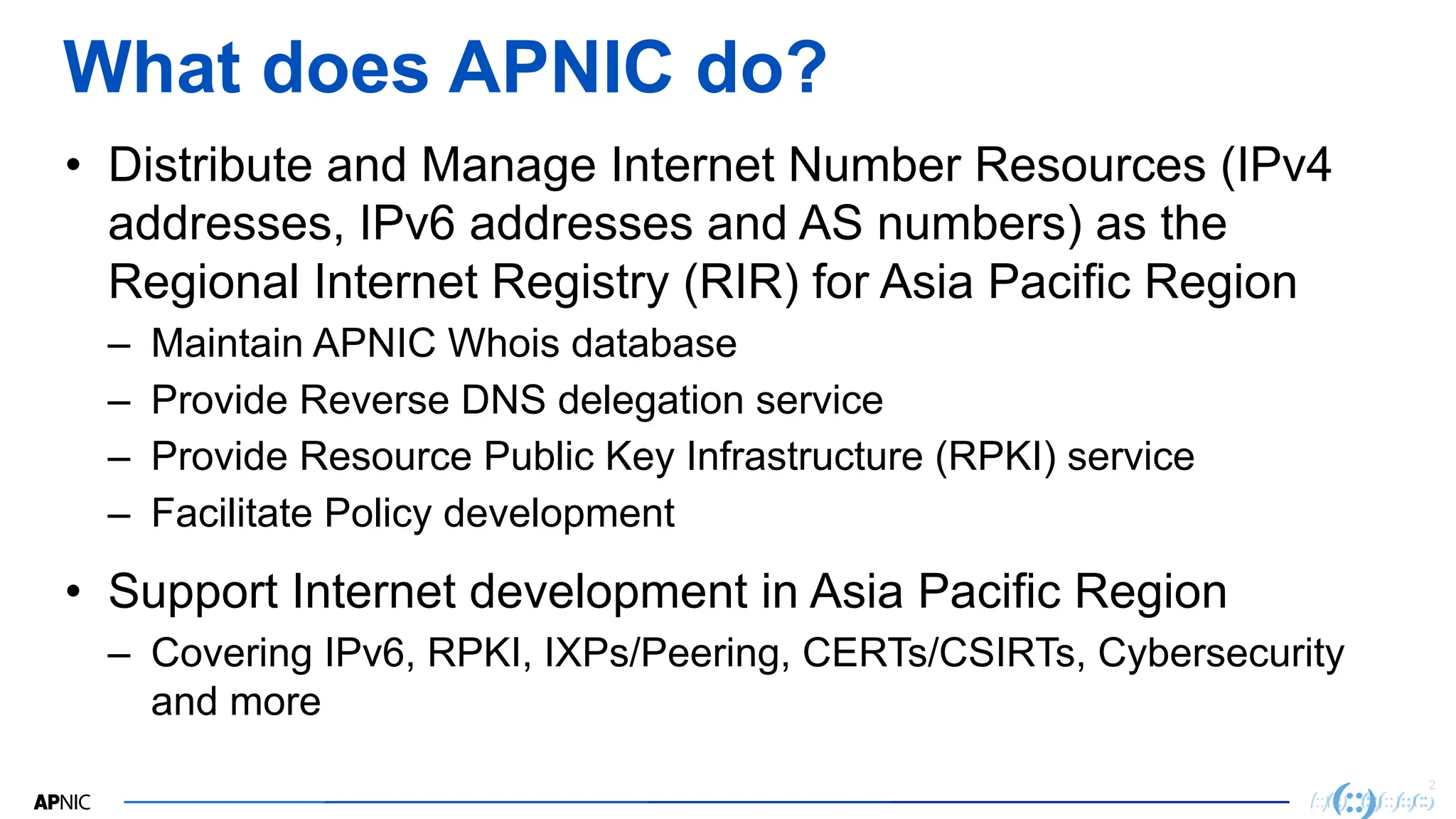
What does APNIC do?
• Distribute and Manage Internet Number Resources (IPv4
addresses, IPv6 addresses and AS numbers) as the
Regional Internet Registry (RIR) for Asia Pacific Region
– Maintain APNIC Whois database
– Provide Reverse DNS delegation service
– Provide Resource Public Key Infrastructure (RPKI) service
– Facilitate Policy development
• Support Internet development in Asia Pacific Region
– Covering IPv6, RPKI, IXPs/Peering, CERTs/CSIRTs, Cybersecurity
and more
3
3
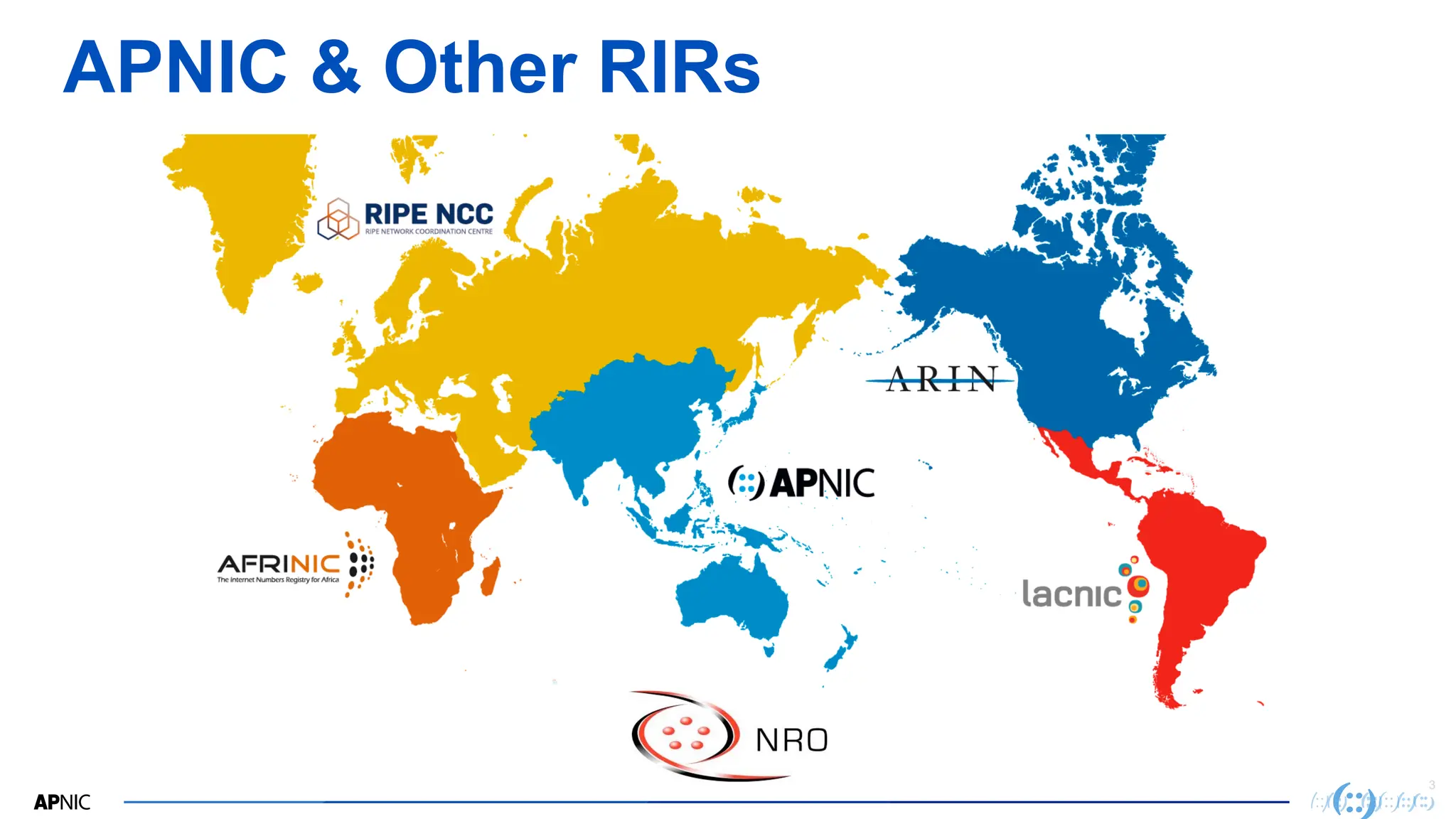
APNIC & Other RIRs
4
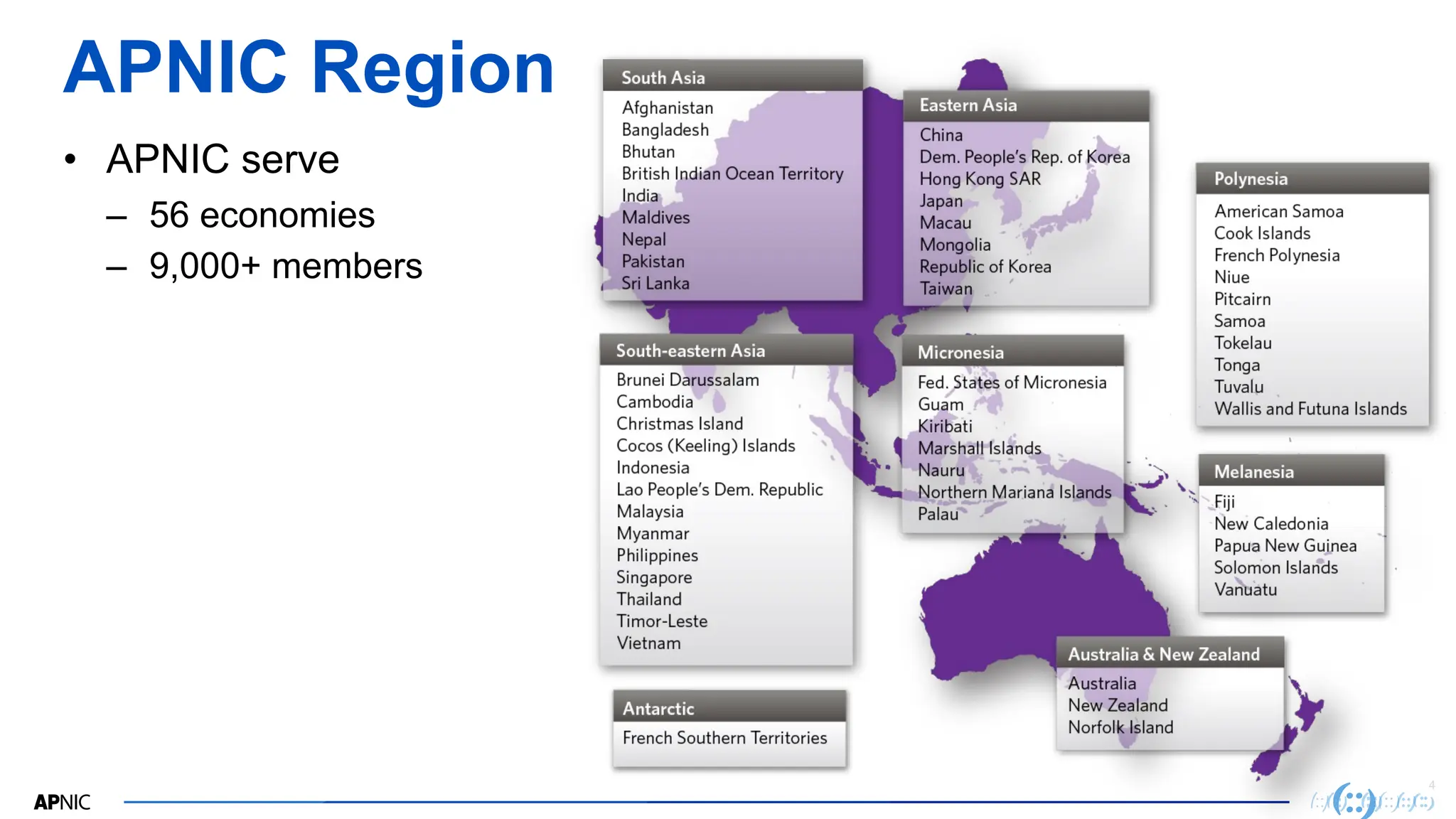
APNIC Region
• APNIC serve
– 56 economies
– 9,000+ members
5
APNIC’s Vision & Mission
• Vision:
– “A global, open, stable, and secure Internet”
• Mission:
– To provide essential services as a Regional Internet Registry, and to
support Internet development in the Asia Pacific region
6
6
APNIC’s Objects in By-laws
• to provide the service of allocating and registering Internet resources for the
purpose of enabling communications via open system network protocols and to
assist in the development and growth of the Internet in the Asia and Pacific Rim
region;
• to assist the Asia and Pacific Rim Internet community in the development of
procedures, mechanisms, and standards to efficiently allocate Internet resources as
a service to the community as a whole;
• to provide educational opportunities to further Members’ technical and policy
understanding of the industry;
• to develop public policies and public positions in the best interest of the Members
and to seek legislative and regulatory consideration of issues of general benefit to
the Members, where and when appropriate;
• to serve as the administrative, managerial and operations arm of APNIC Pty Ltd,
and to transact all activities, functions and affairs on behalf, and in the name, of the
corporation.
7
Internet Development Work of APNIC
• Human Resource Development / Capacity Building
– Training & Technical Assistance on Internet infrastructure topics
• Technical/Security Community Support
– NOGs, Peering Forums, NRENs/RENs & CERTs/CSIRTs
• Internet Infrastructure Support
– IXPs, Root Servers, Honeynet & RIPE Atlas
8
Positioning of Training
• Internet infrastructure focused
– Targeting current and future Internet engineers
– Covering deployment and operations
– Emphasising best practices – RFCs and other industry best practices
– Vendor neutral
• Standardized, well-structured training content and curriculum as solid foundation
– CC BY-NC-SA 4.0 used for training content for maximum benefit to community
• Inputs & feedbacks received guiding the development
9
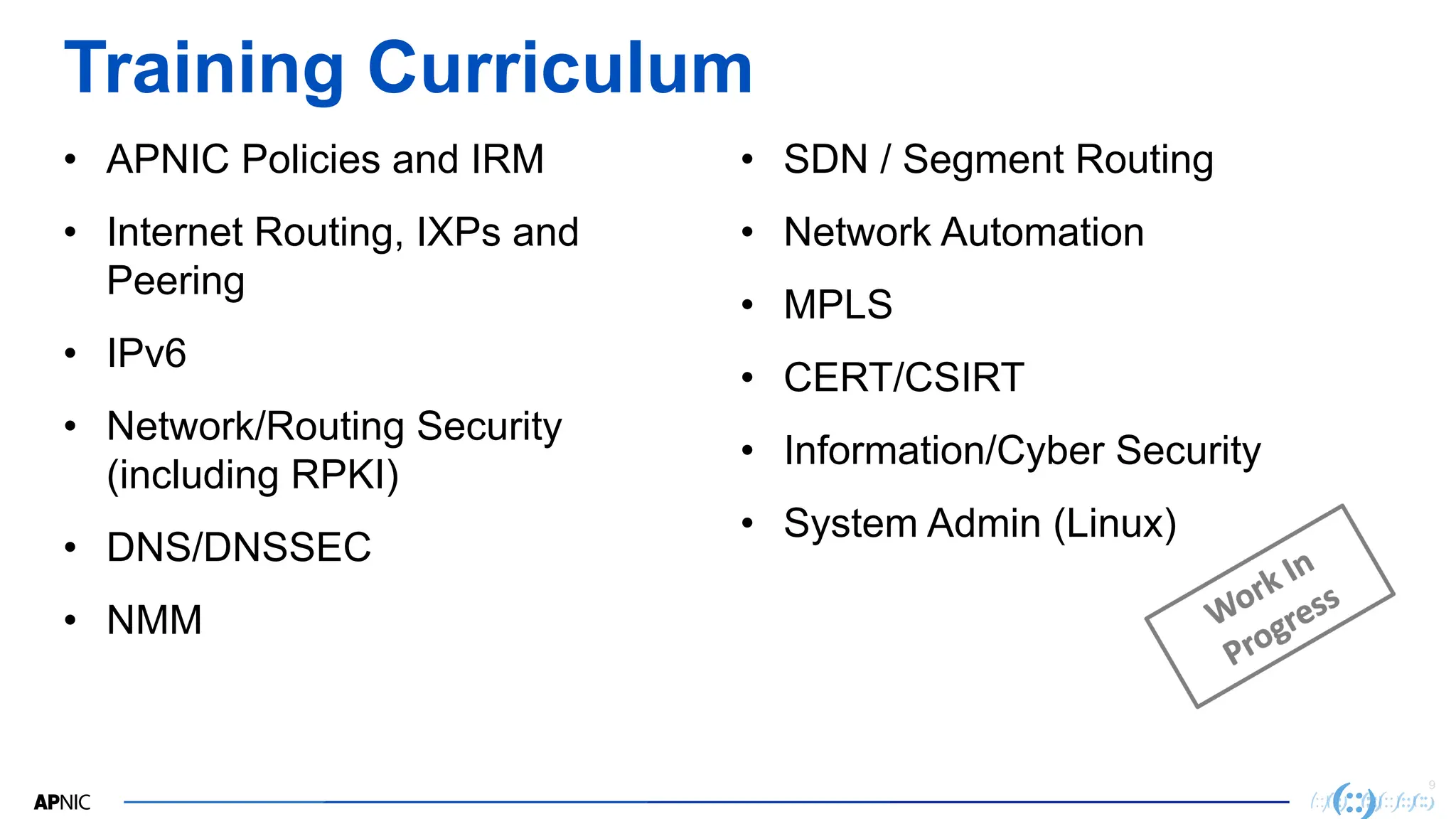
Training Curriculum
• APNIC Policies and IRM
• Internet Routing, IXPs and
Peering
• IPv6
• Network/Routing Security
(including RPKI)
• DNS/DNSSEC
• NMM
• SDN / Segment Routing
• Network Automation
• MPLS
• CERT/CSIRT
• Information/Cyber Security
• System Admin (Linux)
10
APNIC Academy
• APNIC Academy as the branding to use for all APNIC
training and technical assistance (TA) activities
gradually starting 2020
• Blending Learning / Flipped Classroom / HyFlex
– Face-to-Face + Online / Instructor-Led + Self-Paced
• As complement, with good balance
– Theories and practical exercises
– Basic to advanced level
– Depth and breadth
11
APNIC Academy Platform
• One single online platform for all users to go to for all
training and TA activities
– Less ambiguity after merging and integration with training website
– Course catalogue and information
– Training calendar and registration
– Training content (current and past)
– Training attendance and progress records
– TA platform support
– Support APNIC Login (SSO)
12
APNIC Academy Platform
• Integrated Virtual Labs
• Multilingual support
• Mobile friendliness
• Also a platform for internal to manage the relevant activities
– With good integration and automation
13
Serving Other Projects and Needs
• APNIC Academy platform also be used to serve other
projects and needs
– No need to reinvent the wheel and have duplicated effort
• Examples include:
– MANRS & APCERT courses
– APIE (Asia Pacific Internet Engineer) Program of AI3/SOI Asia
– Training for non-technical audiences
14
Long-Term Goal
• Full certification with full curriculum
– Leveraging APNIC Academy platform
• “Certified APNIC Internet Engineer” (?)
15
High Growth Starting 2021
• Demand for more training is clear from surveys and
feedback
• APIDT/APNIC Foundation funding starting 2021 enables
higher growth in training capacity
– Scale up all training and TA activities
– Do more and do better with good foundation and structure,
leveraging APNIC Academy platform, content and curriculum
• Also more focused in-person support to community
– Sub-regionalization for training delivery, TA and
community/infrastructure support, with more staff trainers and
Community Trainers dedicated for sub-regions
16
Possible Partnership
• NRENs/RENs, universities and VET
– Content freely available for use by all teachers/professors
• To raise the standard for graduates
– Courses formally incorporated into diploma/degree programs
– Partnering to deliver more training for scaling up
– Federated access to APNIC Academy platform – eduGAIN support
• RIRs & I* organizations
– Content sharing, if licensing terms are compatible
– Content hosting
17
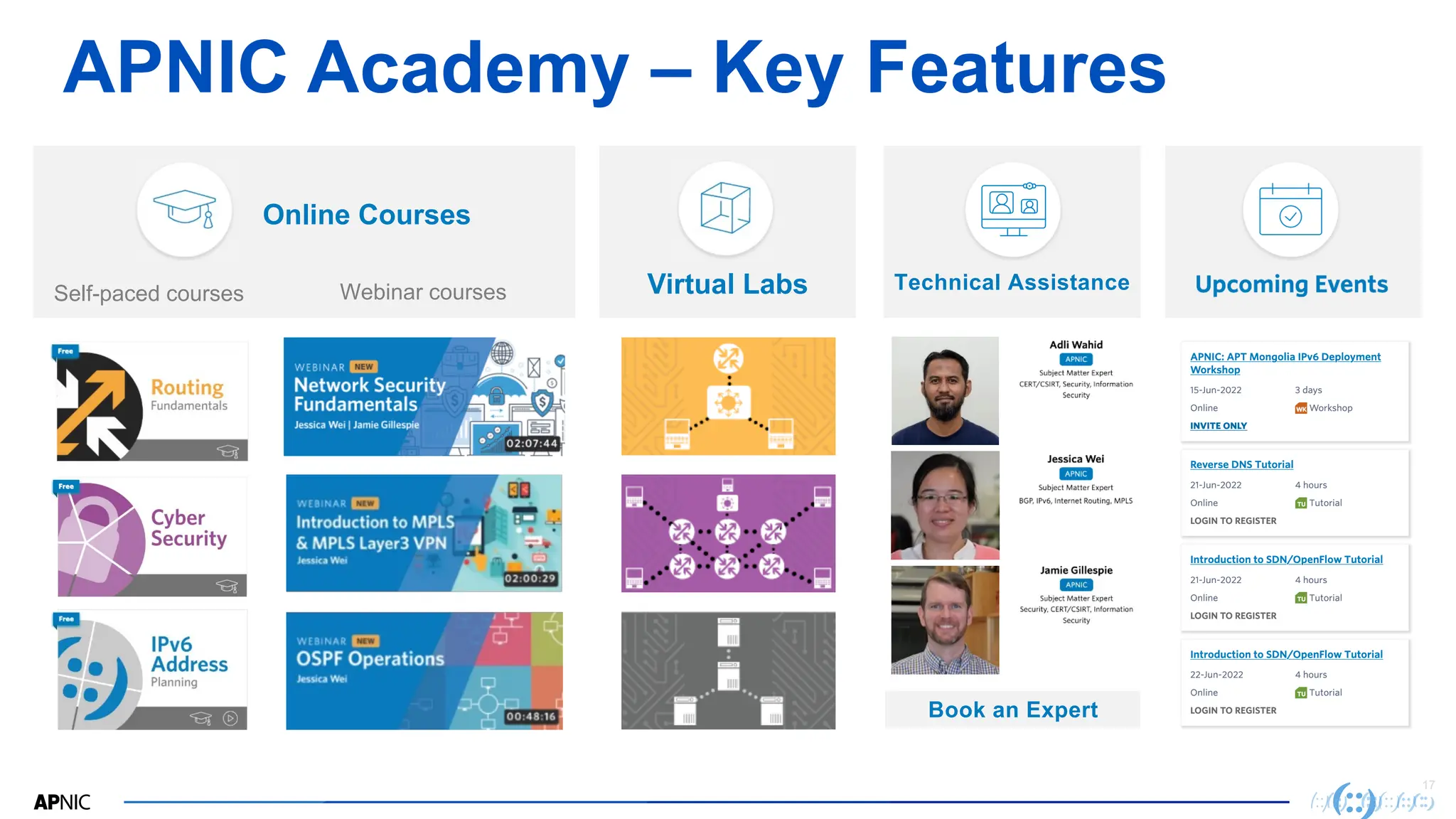
APNIC Academy – Key Features
Online Courses
Webinar courses
Self-paced courses Virtual Labs Technical Assistance
Book an Expert
18
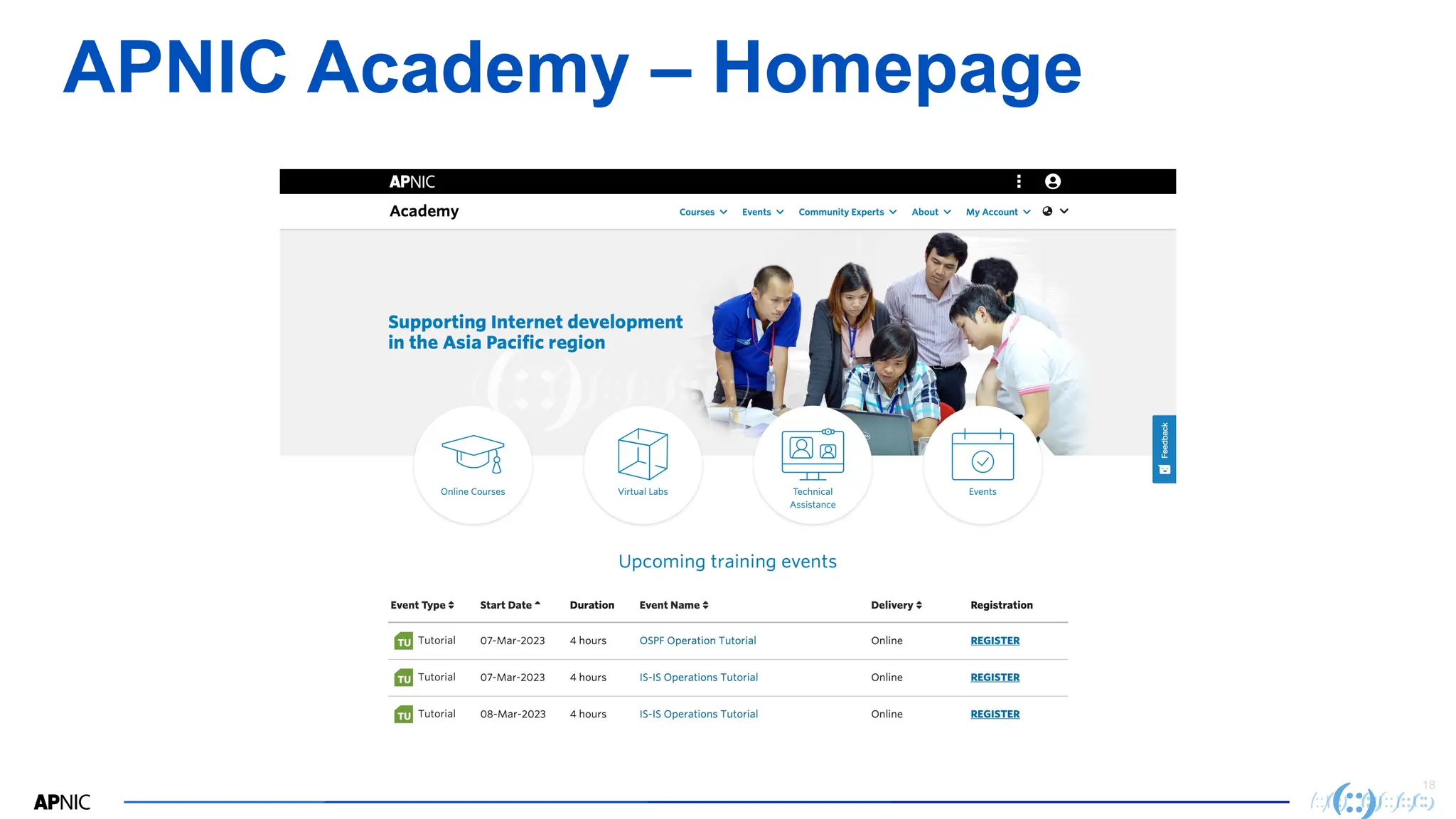
APNIC Academy – Homepage
19
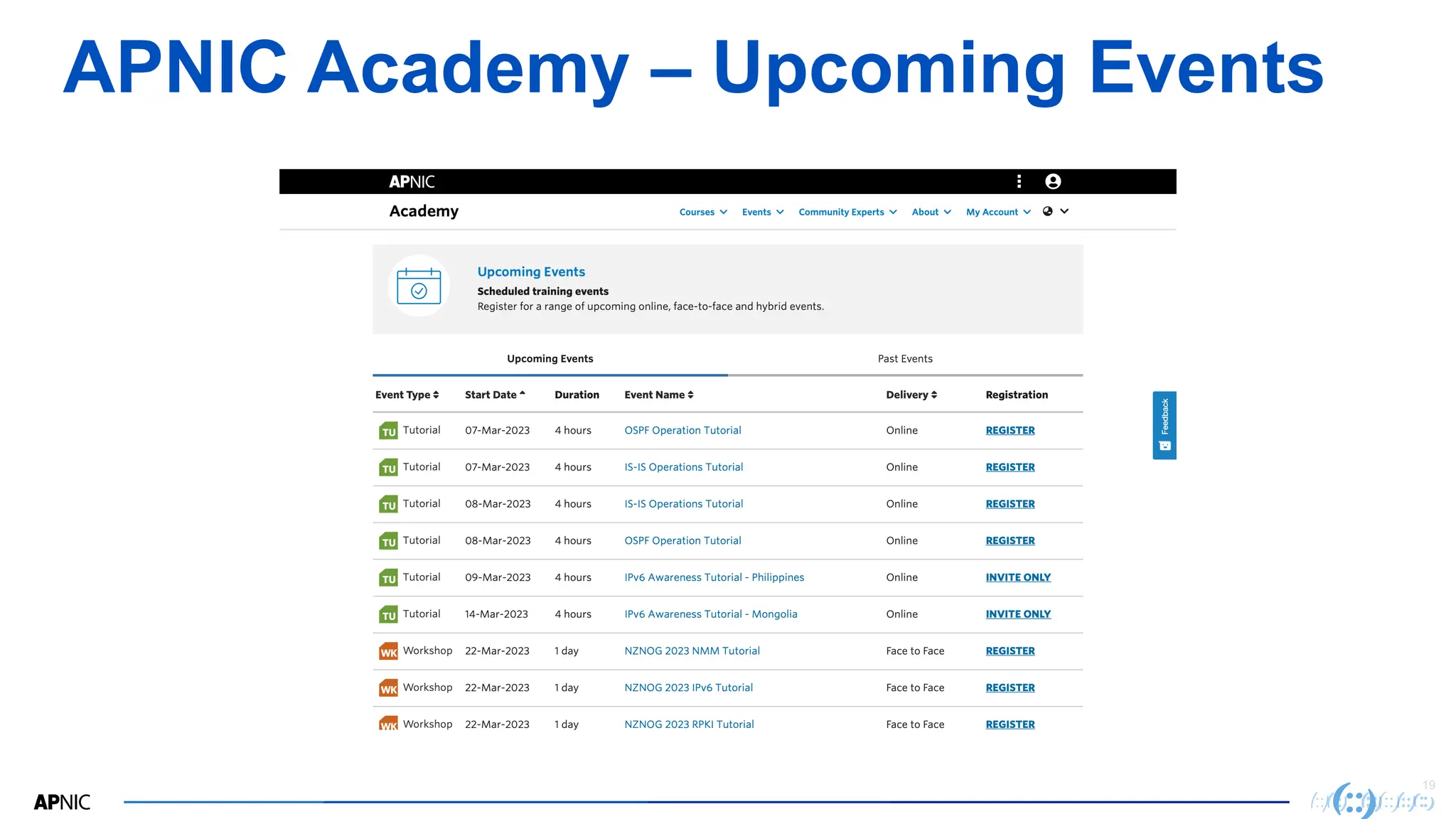
APNIC Academy – Upcoming Events
20
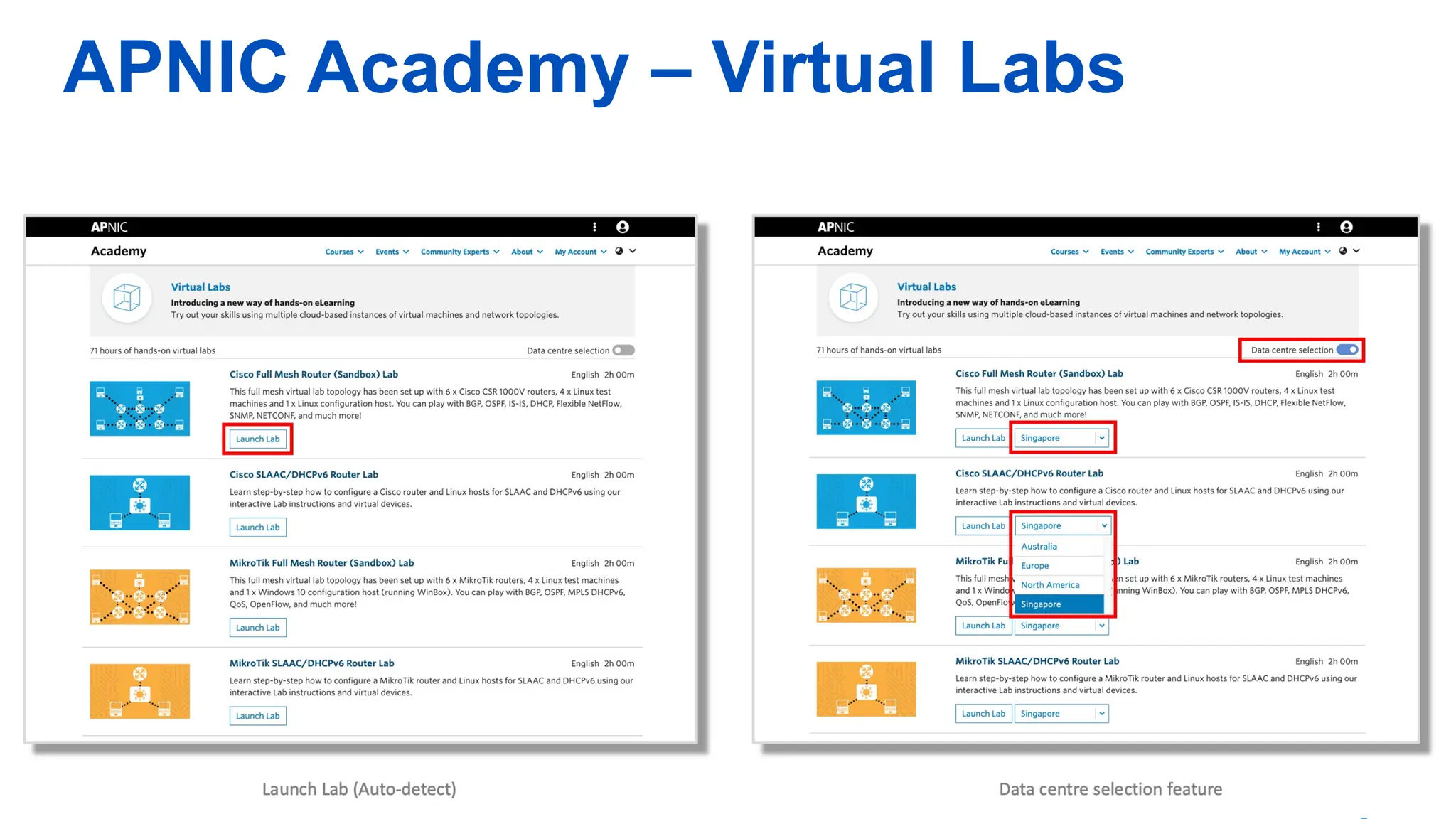
APNIC Academy – Virtual Labs
21
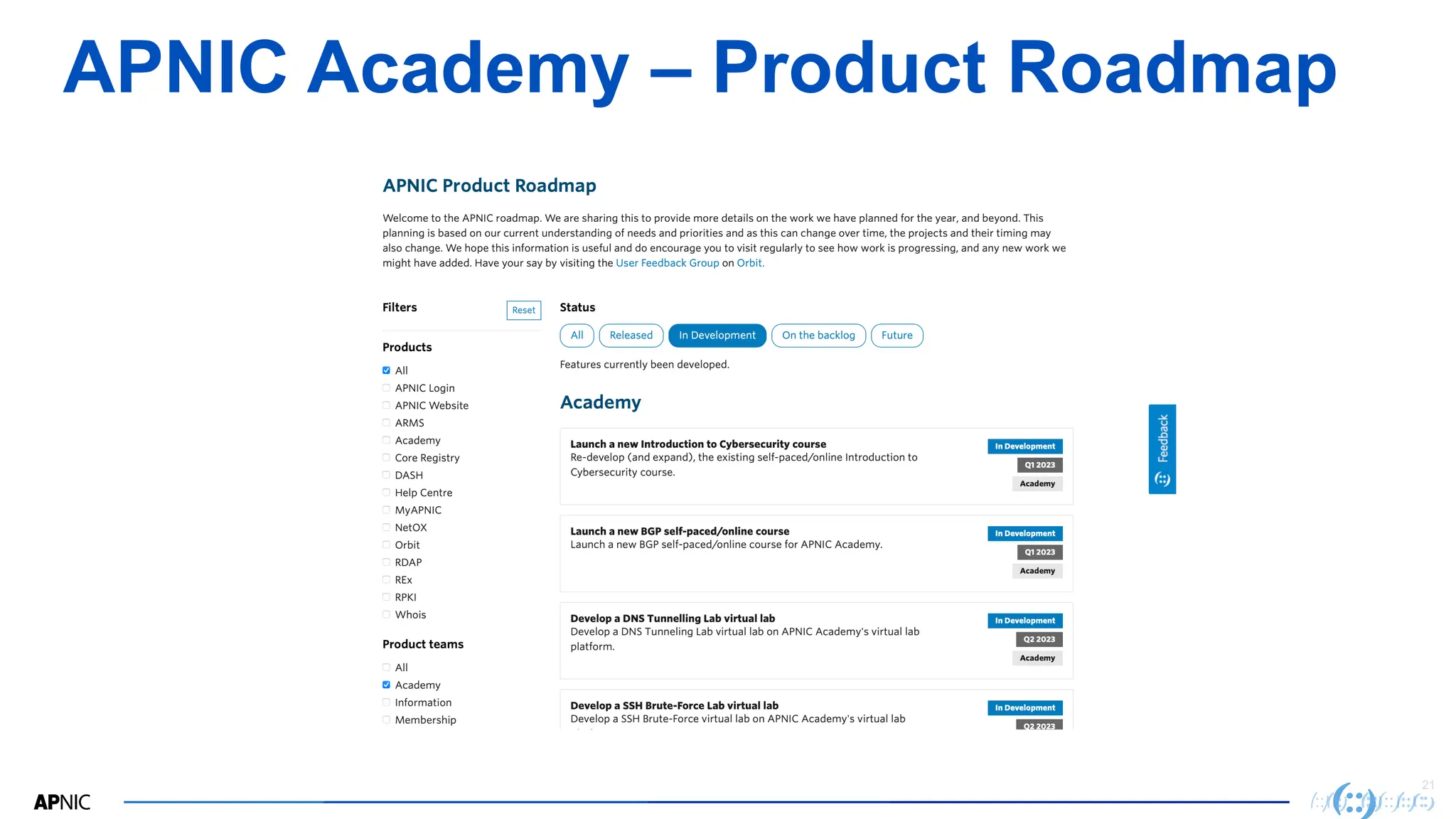
APNIC Academy – Product Roadmap
22
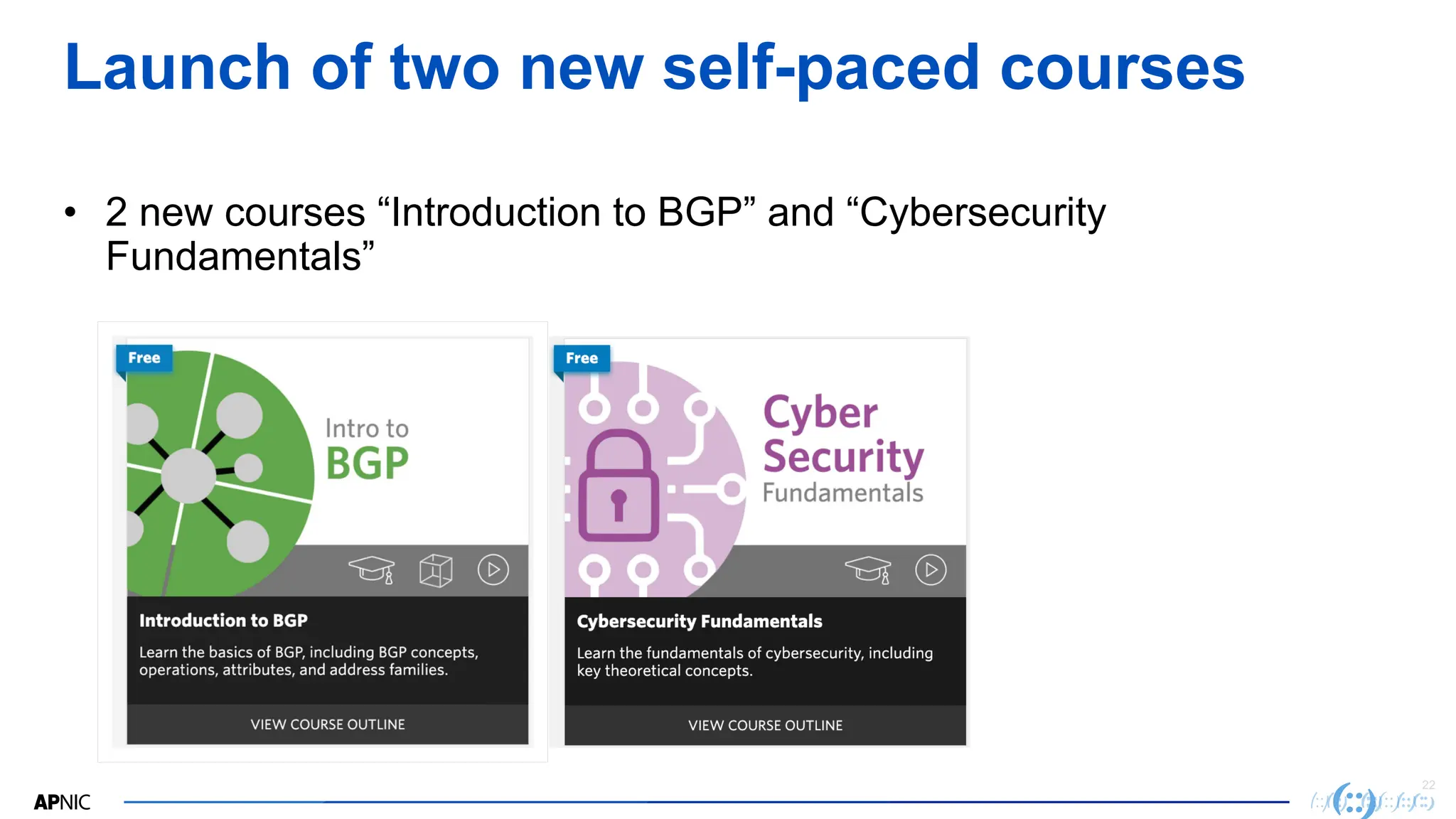
Launch of two new self-paced courses
• 2 new courses “Introduction to BGP” and “Cybersecurity
Fundamentals”
24
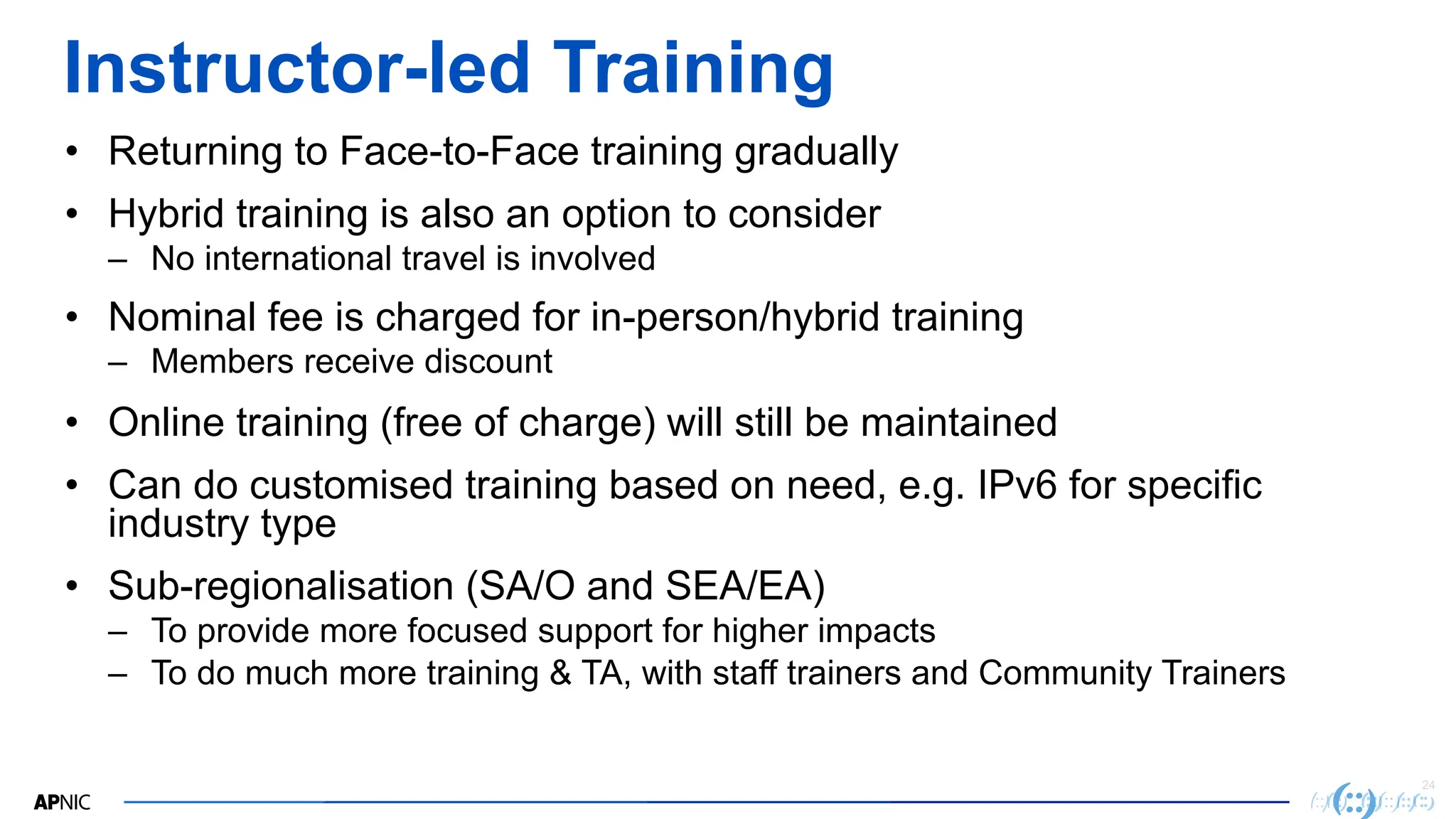
Instructor-led Training
• Returning to Face-to-Face training gradually
• Hybrid training is also an option to consider
– No international travel is involved
• Nominal fee is charged for in-person/hybrid training
– Members receive discount
• Online training (free of charge) will still be maintained
• Can do customised training based on need, e.g. IPv6 for specific
industry type
• Sub-regionalisation (SA/O and SEA/EA)
– To provide more focused support for higher impacts
– To do much more training & TA, with staff trainers and Community Trainers
25
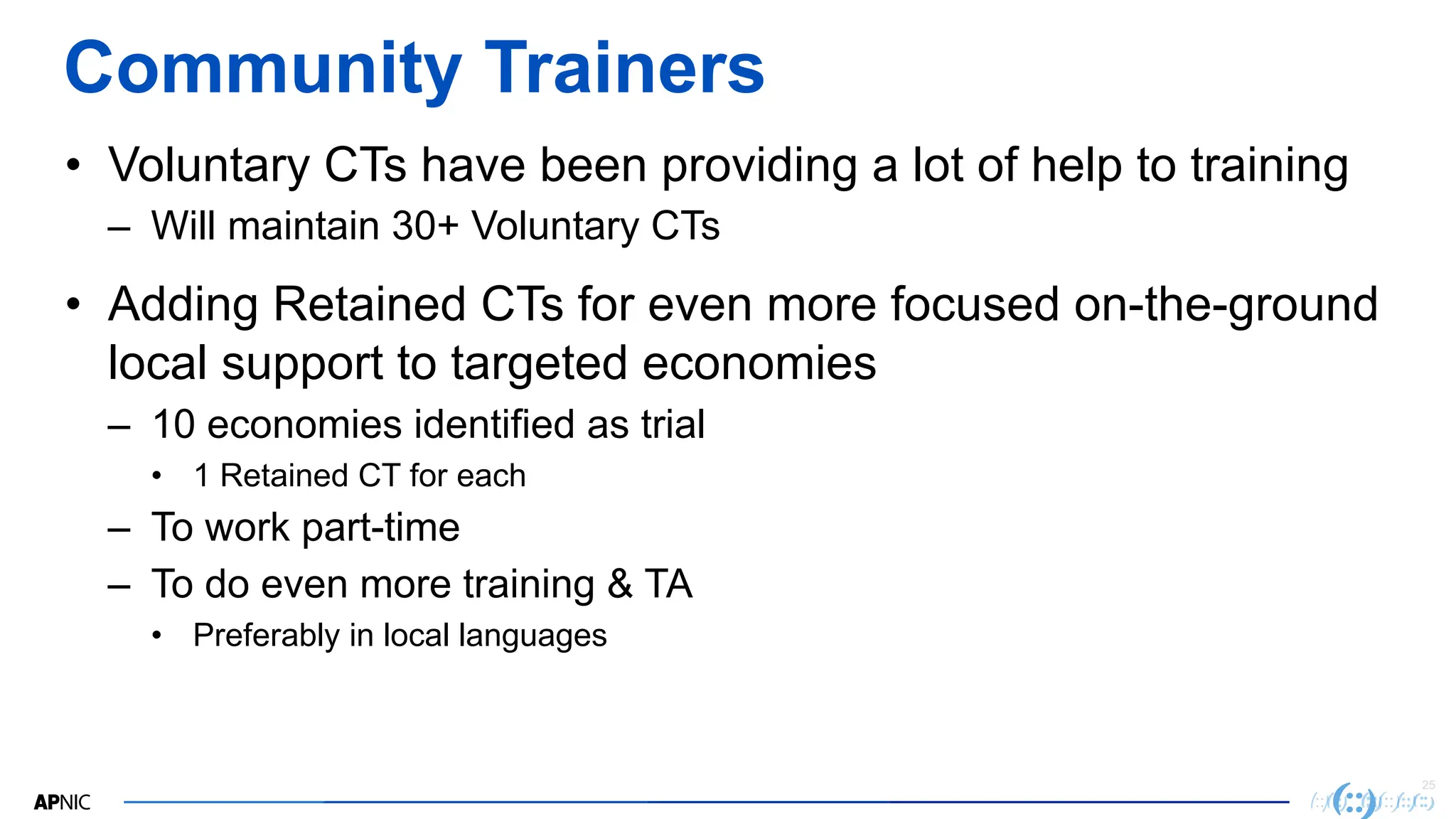
Community Trainers
• Voluntary CTs have been providing a lot of help to training
– Will maintain 30+ Voluntary CTs
• Adding Retained CTs for even more focused on-the-ground
local support to targeted economies
– 10 economies identified as trial
• 1 Retained CT for each
– To work part-time
– To do even more training & TA
• Preferably in local languages
26
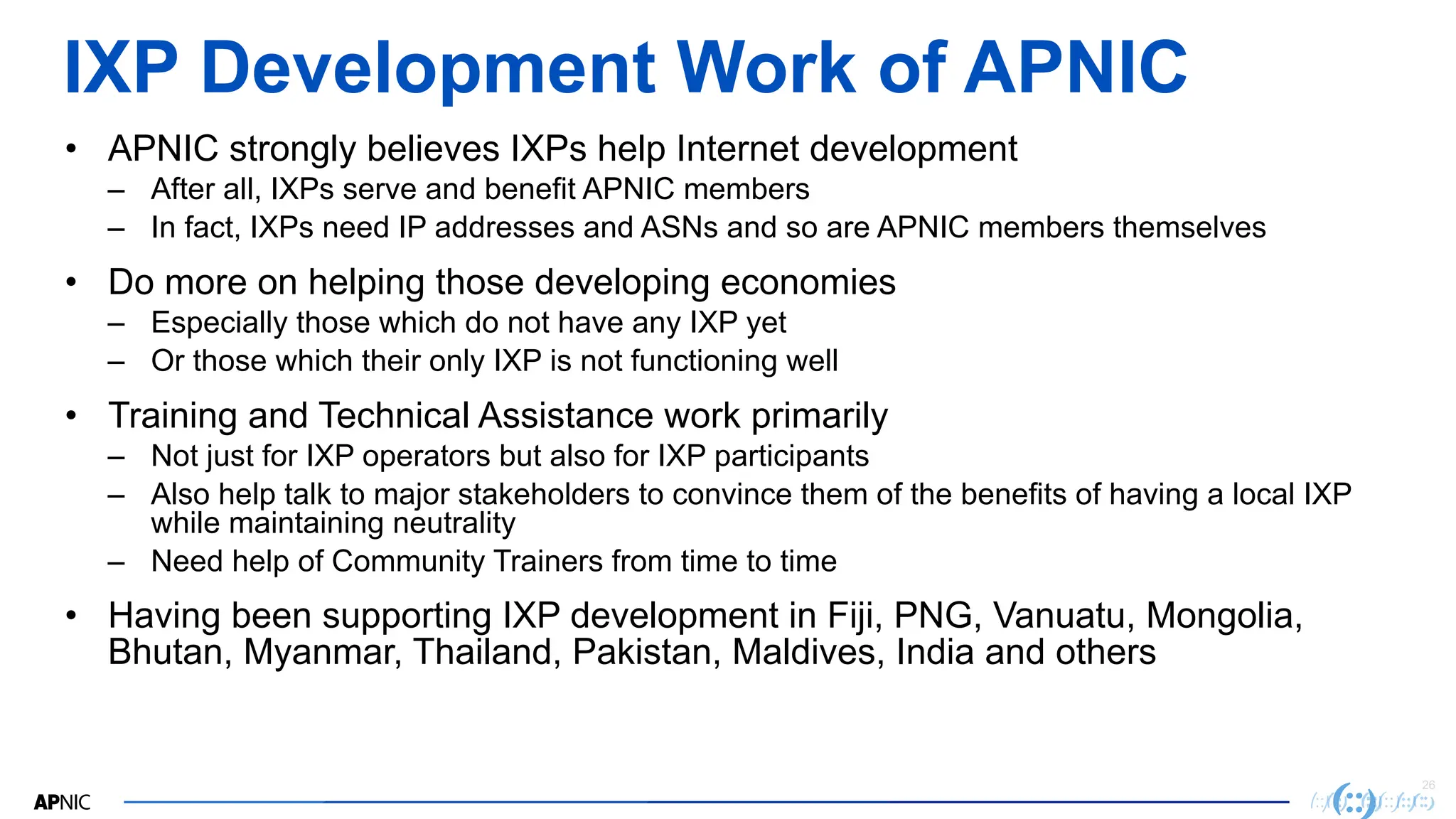
IXP Development Work of APNIC
• APNIC strongly believes IXPs help Internet development
– After all, IXPs serve and benefit APNIC members
– In fact, IXPs need IP addresses and ASNs and so are APNIC members themselves
• Do more on helping those developing economies
– Especially those which do not have any IXP yet
– Or those which their only IXP is not functioning well
• Training and Technical Assistance work primarily
– Not just for IXP operators but also for IXP participants
– Also help talk to major stakeholders to convince them of the benefits of having a local IXP
while maintaining neutrality
– Need help of Community Trainers from time to time
• Having been supporting IXP development in Fiji, PNG, Vanuatu, Mongolia,
Bhutan, Myanmar, Thailand, Pakistan, Maldives, India and others
27
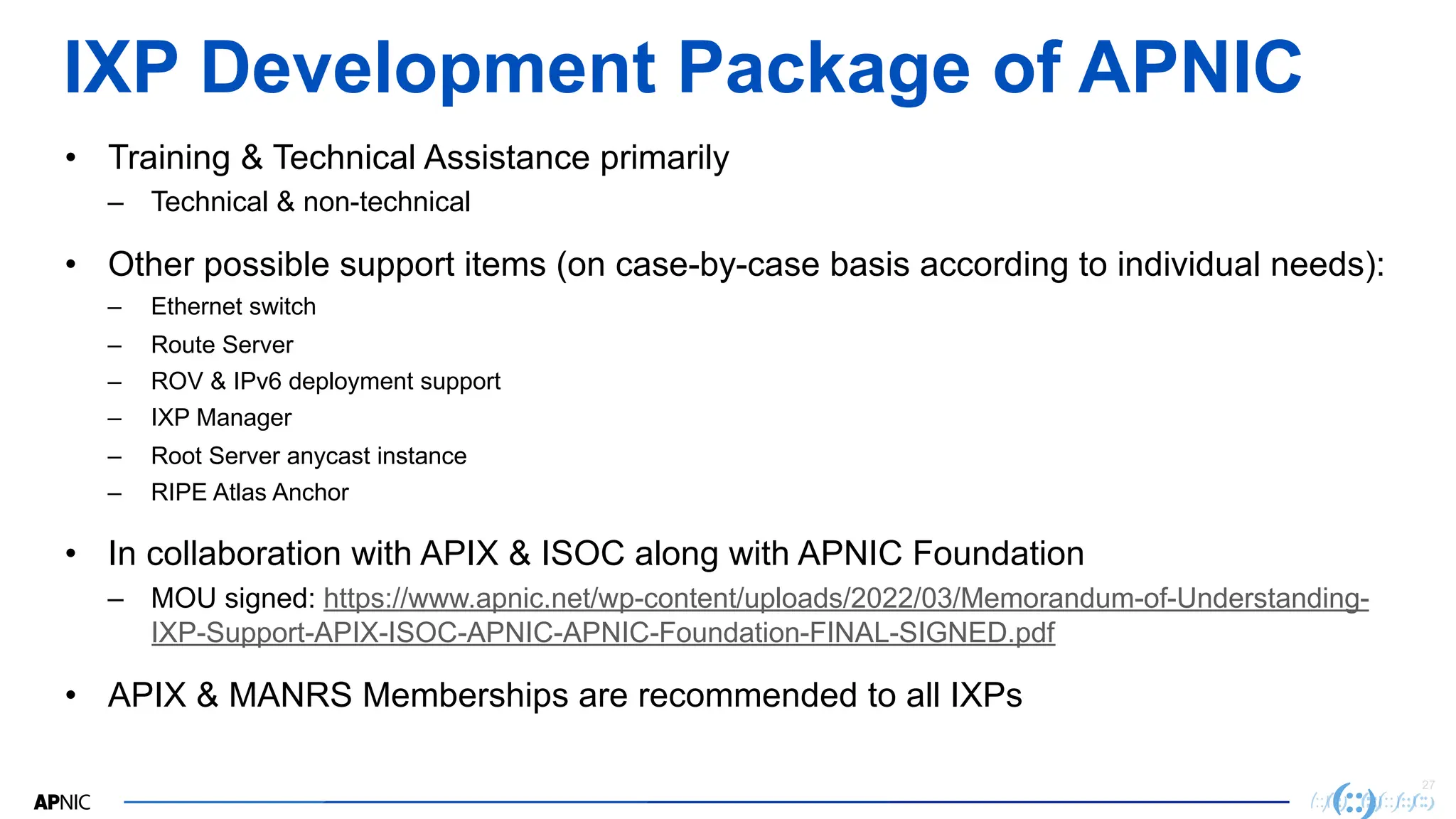
IXP Development Package of APNIC
• Training & Technical Assistance primarily
– Technical & non-technical
• Other possible support items (on case-by-case basis according to individual needs):
– Ethernet switch
– Route Server
– ROV & IPv6 deployment support
– IXP Manager
– Root Server anycast instance
– RIPE Atlas Anchor
• In collaboration with APIX & ISOC along with APNIC Foundation
– MOU signed: https://www.apnic.net/wp-content/uploads/2022/03/Memorandum-of-Understanding-
IXP-Support-APIX-ISOC-APNIC-APNIC-Foundation-FINAL-SIGNED.pdf
• APIX & MANRS Memberships are recommended to all IXPs
28
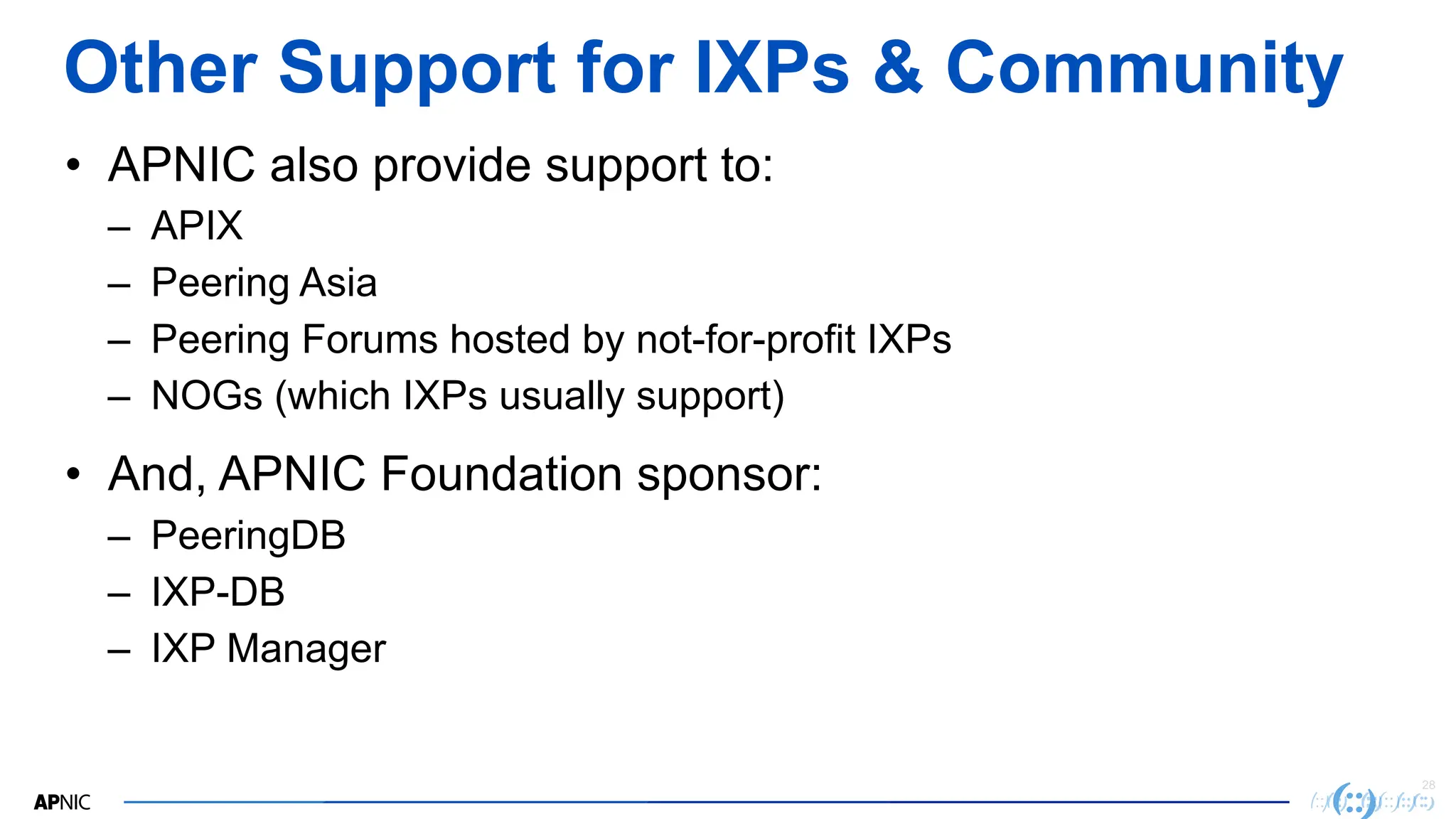
Other Support for IXPs & Community
• APNIC also provide support to:
– APIX
– Peering Asia
– Peering Forums hosted by not-for-profit IXPs
– NOGs (which IXPs usually support)
• And, APNIC Foundation sponsor:
– PeeringDB
– IXP-DB
– IXP Manager
29
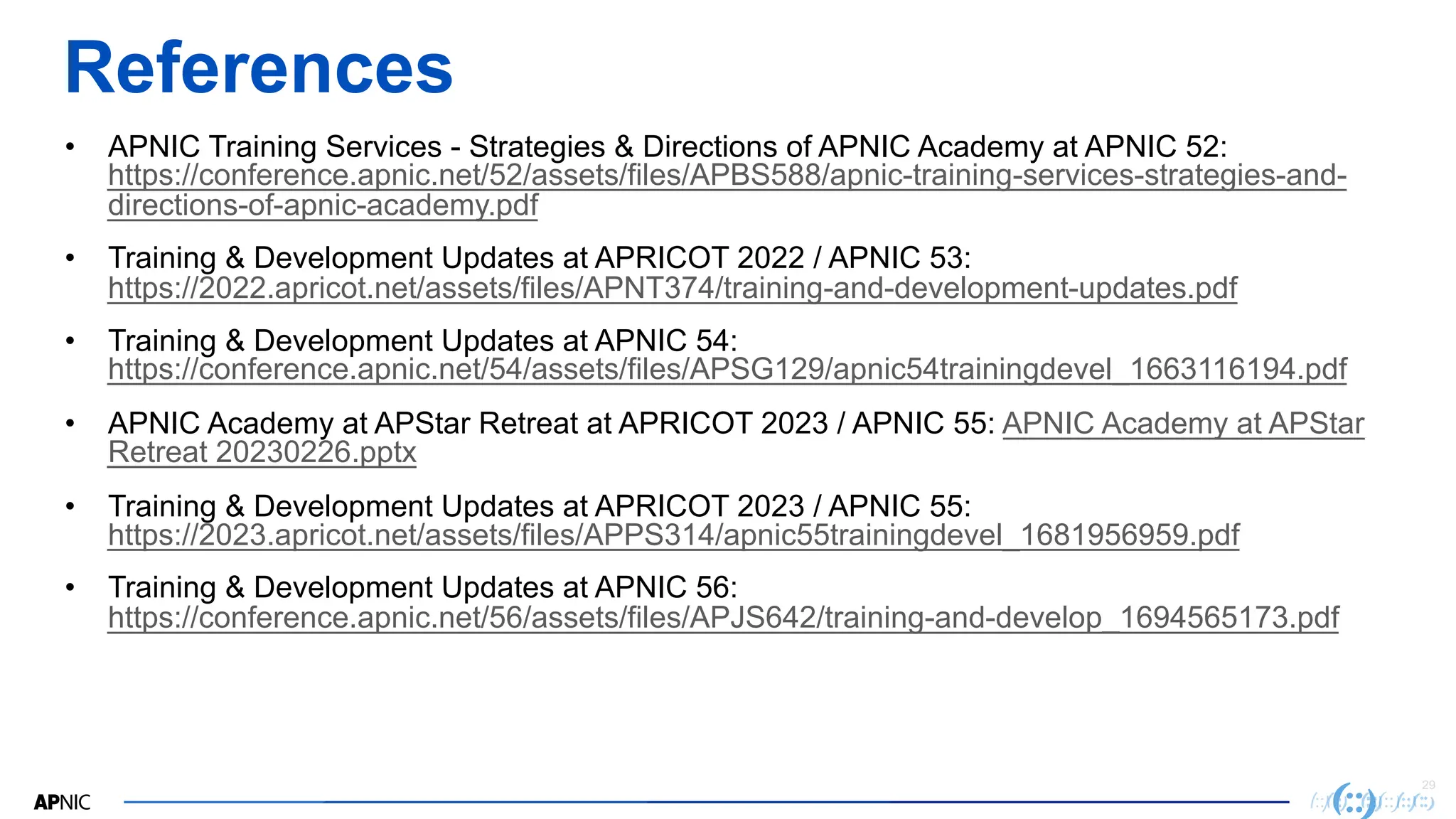
References
• APNIC Training Services - Strategies & Directions of APNIC Academy at APNIC 52:
https://conference.apnic.net/52/assets/files/APBS588/apnic-training-services-strategies-and-
directions-of-apnic-academy.pdf
• Training & Development Updates at APRICOT 2022 / APNIC 53:
https://2022.apricot.net/assets/files/APNT374/training-and-development-updates.pdf
• Training & Development Updates at APNIC 54:
https://conference.apnic.net/54/assets/files/APSG129/apnic54trainingdevel_1663116194.pdf
• APNIC Academy at APStar Retreat at APRICOT 2023 / APNIC 55: APNIC Academy at APStar
Retreat 20230226.pptx
• Training & Development Updates at APRICOT 2023 / APNIC 55:
https://2023.apricot.net/assets/files/APPS314/apnic55trainingdevel_1681956959.pdf
• Training & Development Updates at APNIC 56:
https://conference.apnic.net/56/assets/files/APJS642/training-and-develop_1694565173.pdf
30
Stay in Touch!
blog.apnic.net
apnic.net/social
31
Thank You!

AFSIG 2023: APNIC - Registry & Development

  • 1.
    1 APNIC – Registry &Development Che-Hoo Cheng Infrastructure & Development Director APNIC
  • 2.
    2 What does APNICdo? • Distribute and Manage Internet Number Resources (IPv4 addresses, IPv6 addresses and AS numbers) as the Regional Internet Registry (RIR) for Asia Pacific Region – Maintain APNIC Whois database – Provide Reverse DNS delegation service – Provide Resource Public Key Infrastructure (RPKI) service – Facilitate Policy development • Support Internet development in Asia Pacific Region – Covering IPv6, RPKI, IXPs/Peering, CERTs/CSIRTs, Cybersecurity and more
  • 3.
  • 4.
    4 APNIC Region • APNICserve – 56 economies – 9,000+ members
  • 5.
    5 APNIC’s Vision &Mission • Vision: – “A global, open, stable, and secure Internet” • Mission: – To provide essential services as a Regional Internet Registry, and to support Internet development in the Asia Pacific region
  • 6.
    6 6 APNIC’s Objects inBy-laws • to provide the service of allocating and registering Internet resources for the purpose of enabling communications via open system network protocols and to assist in the development and growth of the Internet in the Asia and Pacific Rim region; • to assist the Asia and Pacific Rim Internet community in the development of procedures, mechanisms, and standards to efficiently allocate Internet resources as a service to the community as a whole; • to provide educational opportunities to further Members’ technical and policy understanding of the industry; • to develop public policies and public positions in the best interest of the Members and to seek legislative and regulatory consideration of issues of general benefit to the Members, where and when appropriate; • to serve as the administrative, managerial and operations arm of APNIC Pty Ltd, and to transact all activities, functions and affairs on behalf, and in the name, of the corporation.
  • 7.
    7 Internet Development Workof APNIC • Human Resource Development / Capacity Building – Training & Technical Assistance on Internet infrastructure topics • Technical/Security Community Support – NOGs, Peering Forums, NRENs/RENs & CERTs/CSIRTs • Internet Infrastructure Support – IXPs, Root Servers, Honeynet & RIPE Atlas
  • 8.
    8 Positioning of Training •Internet infrastructure focused – Targeting current and future Internet engineers – Covering deployment and operations – Emphasising best practices – RFCs and other industry best practices – Vendor neutral • Standardized, well-structured training content and curriculum as solid foundation – CC BY-NC-SA 4.0 used for training content for maximum benefit to community • Inputs & feedbacks received guiding the development
  • 9.
    9 Training Curriculum • APNICPolicies and IRM • Internet Routing, IXPs and Peering • IPv6 • Network/Routing Security (including RPKI) • DNS/DNSSEC • NMM • SDN / Segment Routing • Network Automation • MPLS • CERT/CSIRT • Information/Cyber Security • System Admin (Linux)
  • 10.
    10 APNIC Academy • APNICAcademy as the branding to use for all APNIC training and technical assistance (TA) activities gradually starting 2020 • Blending Learning / Flipped Classroom / HyFlex – Face-to-Face + Online / Instructor-Led + Self-Paced • As complement, with good balance – Theories and practical exercises – Basic to advanced level – Depth and breadth
  • 11.
    11 APNIC Academy Platform •One single online platform for all users to go to for all training and TA activities – Less ambiguity after merging and integration with training website – Course catalogue and information – Training calendar and registration – Training content (current and past) – Training attendance and progress records – TA platform support – Support APNIC Login (SSO)
  • 12.
    12 APNIC Academy Platform •Integrated Virtual Labs • Multilingual support • Mobile friendliness • Also a platform for internal to manage the relevant activities – With good integration and automation
  • 13.
    13 Serving Other Projectsand Needs • APNIC Academy platform also be used to serve other projects and needs – No need to reinvent the wheel and have duplicated effort • Examples include: – MANRS & APCERT courses – APIE (Asia Pacific Internet Engineer) Program of AI3/SOI Asia – Training for non-technical audiences
  • 14.
    14 Long-Term Goal • Fullcertification with full curriculum – Leveraging APNIC Academy platform • “Certified APNIC Internet Engineer” (?)
  • 15.
    15 High Growth Starting2021 • Demand for more training is clear from surveys and feedback • APIDT/APNIC Foundation funding starting 2021 enables higher growth in training capacity – Scale up all training and TA activities – Do more and do better with good foundation and structure, leveraging APNIC Academy platform, content and curriculum • Also more focused in-person support to community – Sub-regionalization for training delivery, TA and community/infrastructure support, with more staff trainers and Community Trainers dedicated for sub-regions
  • 16.
    16 Possible Partnership • NRENs/RENs,universities and VET – Content freely available for use by all teachers/professors • To raise the standard for graduates – Courses formally incorporated into diploma/degree programs – Partnering to deliver more training for scaling up – Federated access to APNIC Academy platform – eduGAIN support • RIRs & I* organizations – Content sharing, if licensing terms are compatible – Content hosting
  • 17.
    17 APNIC Academy –Key Features Online Courses Webinar courses Self-paced courses Virtual Labs Technical Assistance Book an Expert
  • 18.
  • 19.
    19 APNIC Academy –Upcoming Events
  • 20.
  • 21.
    21 APNIC Academy –Product Roadmap
  • 22.
    22 Launch of twonew self-paced courses • 2 new courses “Introduction to BGP” and “Cybersecurity Fundamentals”
  • 23.
    24 Instructor-led Training • Returningto Face-to-Face training gradually • Hybrid training is also an option to consider – No international travel is involved • Nominal fee is charged for in-person/hybrid training – Members receive discount • Online training (free of charge) will still be maintained • Can do customised training based on need, e.g. IPv6 for specific industry type • Sub-regionalisation (SA/O and SEA/EA) – To provide more focused support for higher impacts – To do much more training & TA, with staff trainers and Community Trainers
  • 24.
    25 Community Trainers • VoluntaryCTs have been providing a lot of help to training – Will maintain 30+ Voluntary CTs • Adding Retained CTs for even more focused on-the-ground local support to targeted economies – 10 economies identified as trial • 1 Retained CT for each – To work part-time – To do even more training & TA • Preferably in local languages
  • 25.
    26 IXP Development Workof APNIC • APNIC strongly believes IXPs help Internet development – After all, IXPs serve and benefit APNIC members – In fact, IXPs need IP addresses and ASNs and so are APNIC members themselves • Do more on helping those developing economies – Especially those which do not have any IXP yet – Or those which their only IXP is not functioning well • Training and Technical Assistance work primarily – Not just for IXP operators but also for IXP participants – Also help talk to major stakeholders to convince them of the benefits of having a local IXP while maintaining neutrality – Need help of Community Trainers from time to time • Having been supporting IXP development in Fiji, PNG, Vanuatu, Mongolia, Bhutan, Myanmar, Thailand, Pakistan, Maldives, India and others
  • 26.
    27 IXP Development Packageof APNIC • Training & Technical Assistance primarily – Technical & non-technical • Other possible support items (on case-by-case basis according to individual needs): – Ethernet switch – Route Server – ROV & IPv6 deployment support – IXP Manager – Root Server anycast instance – RIPE Atlas Anchor • In collaboration with APIX & ISOC along with APNIC Foundation – MOU signed: https://www.apnic.net/wp-content/uploads/2022/03/Memorandum-of-Understanding- IXP-Support-APIX-ISOC-APNIC-APNIC-Foundation-FINAL-SIGNED.pdf • APIX & MANRS Memberships are recommended to all IXPs
  • 27.
    28 Other Support forIXPs & Community • APNIC also provide support to: – APIX – Peering Asia – Peering Forums hosted by not-for-profit IXPs – NOGs (which IXPs usually support) • And, APNIC Foundation sponsor: – PeeringDB – IXP-DB – IXP Manager
  • 28.
    29 References • APNIC TrainingServices - Strategies & Directions of APNIC Academy at APNIC 52: https://conference.apnic.net/52/assets/files/APBS588/apnic-training-services-strategies-and- directions-of-apnic-academy.pdf • Training & Development Updates at APRICOT 2022 / APNIC 53: https://2022.apricot.net/assets/files/APNT374/training-and-development-updates.pdf • Training & Development Updates at APNIC 54: https://conference.apnic.net/54/assets/files/APSG129/apnic54trainingdevel_1663116194.pdf • APNIC Academy at APStar Retreat at APRICOT 2023 / APNIC 55: APNIC Academy at APStar Retreat 20230226.pptx • Training & Development Updates at APRICOT 2023 / APNIC 55: https://2023.apricot.net/assets/files/APPS314/apnic55trainingdevel_1681956959.pdf • Training & Development Updates at APNIC 56: https://conference.apnic.net/56/assets/files/APJS642/training-and-develop_1694565173.pdf
  • 29.
  • 30.