 Anjali Nair
 Ketan Navapara
 Nirav Parmar
 Anamika Patel
 Jaydeep Hirpara
 Milan Patel
 Nirav Patel
 Jaimin Gor
Long Term FundsLong Term Funds
Venture Capital
Initial Public Offer
Secondary Public Offer
Right Issue
Private Placement
Preferential Allotment
Dilution
Obtaining a Term Loan
 Venture CapitalVenture Capital
Venture Capital represent financial investment
in a highly risky proposition made in the hope of
earning a high rate of return. It is provided mainly
in the form of equity capital.
1. The Venture capitalist is inclined to assume a high
degree of risk in the expectation of earning a high rate of
return.
2. The VC typically subscribe to equity, which enable it
to share the risks and rewards of the investee firm.
3. The VC also takes an active interest in guiding the
assisted firm.
4. The VC normally plans to liquidate its investments in
the assisted firm after 3 to 7 years.
The first public offering of equity shares of a
company, which is followed by a listing of its
shares on the stock market, is called the Initial
Public Offer (IPO). It is also initiate as decision to
go public.
1. Access to Capital
2. Respectability
3. Investor Recognition
4. Window of Opportunity
5. Liquidity
6. Benefits of Diversification
7. Signals from the Market
1. Adverse Selection
2. Dilution
3. Loss of Flexibility
4. Disclosures
5. Accountability
6. Public Pressure
7. Costs
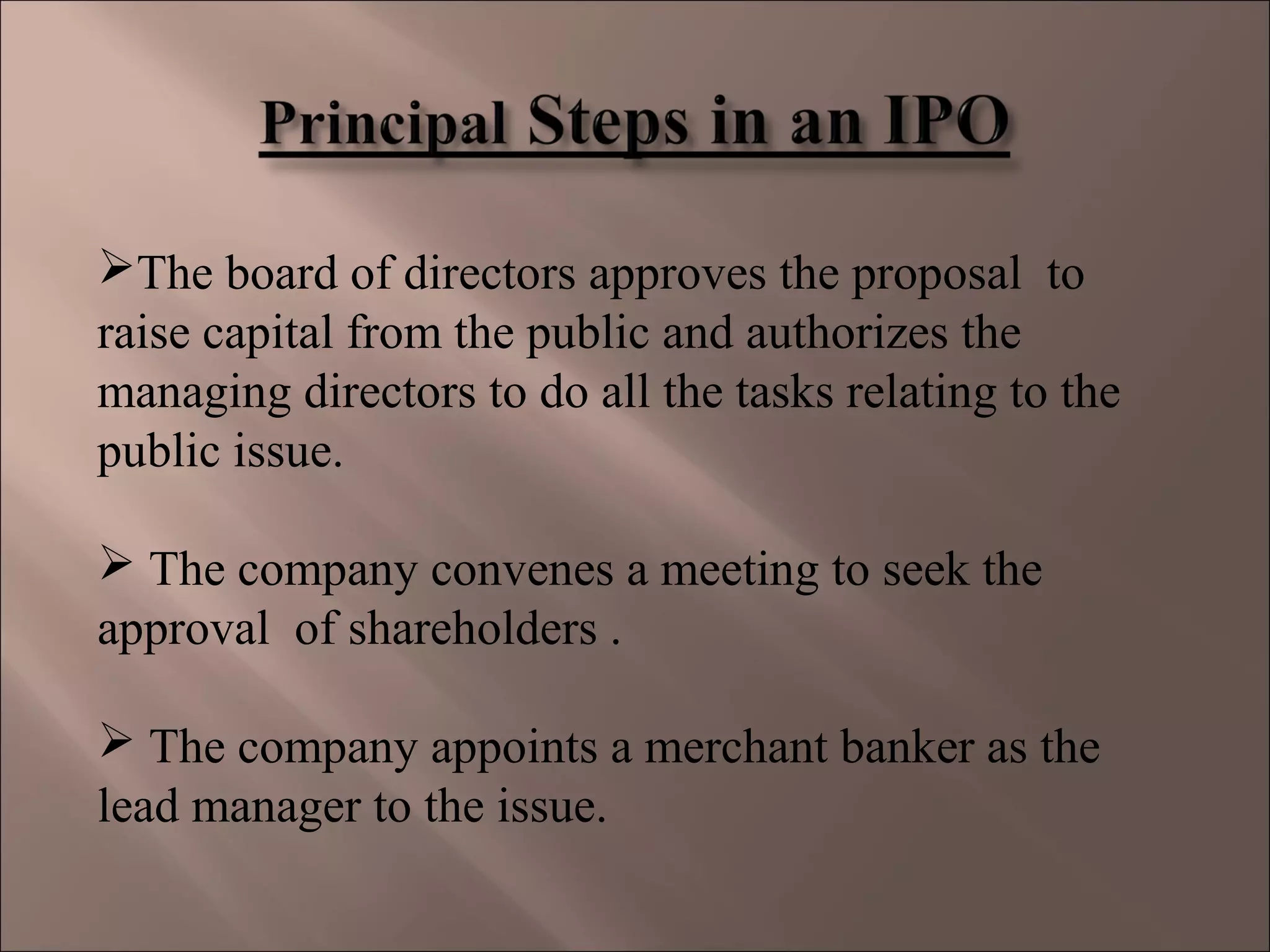
The board of directors approves the proposal to
raise capital from the public and authorizes the
managing directors to do all the tasks relating to the
public issue.
 The company convenes a meeting to seek the
approval of shareholders .
 The company appoints a merchant banker as the
lead manager to the issue.
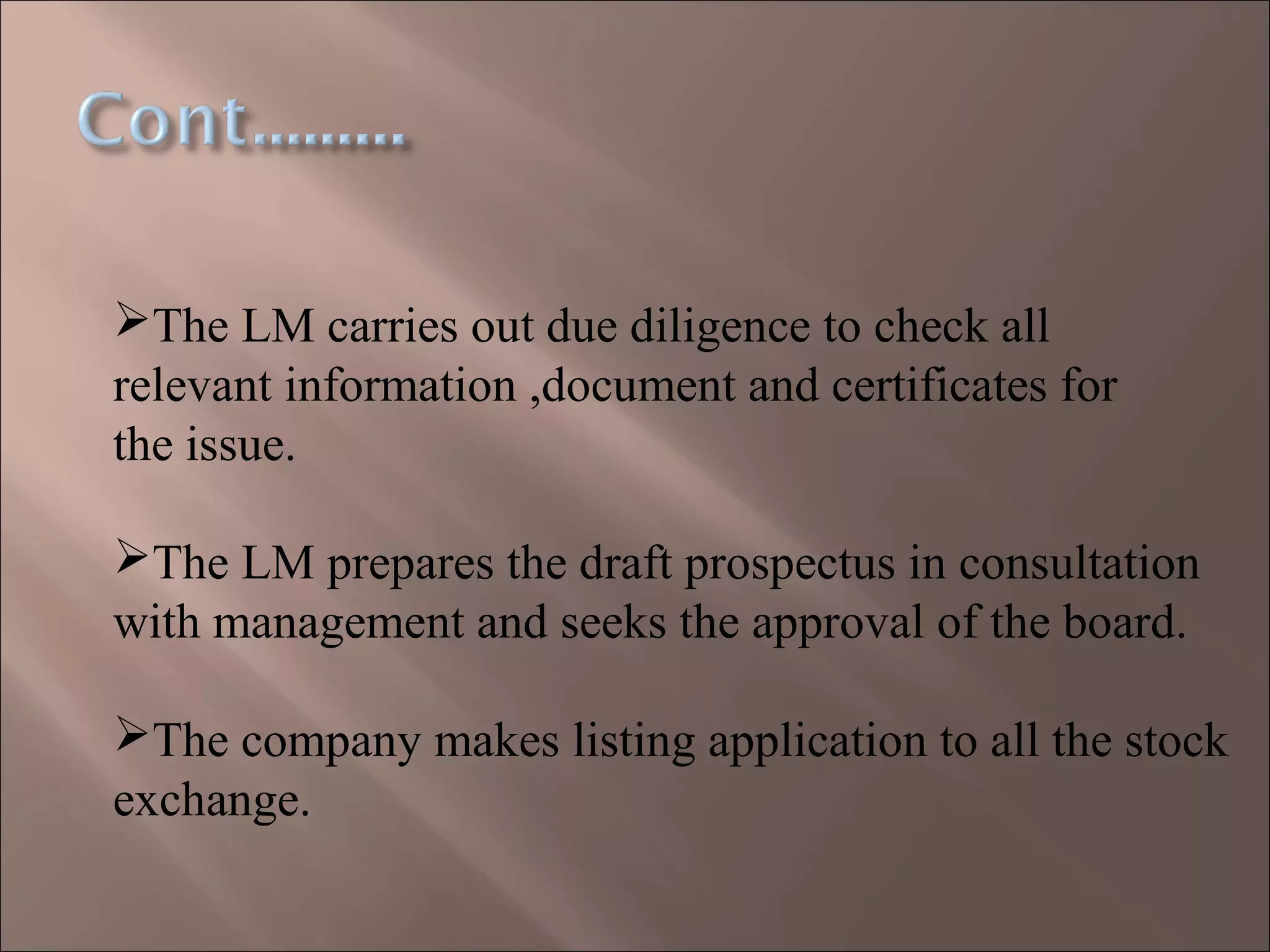
The LM carries out due diligence to check all
relevant information ,document and certificates for
the issue.
The LM prepares the draft prospectus in consultation
with management and seeks the approval of the board.
The company makes listing application to all the stock
exchange.
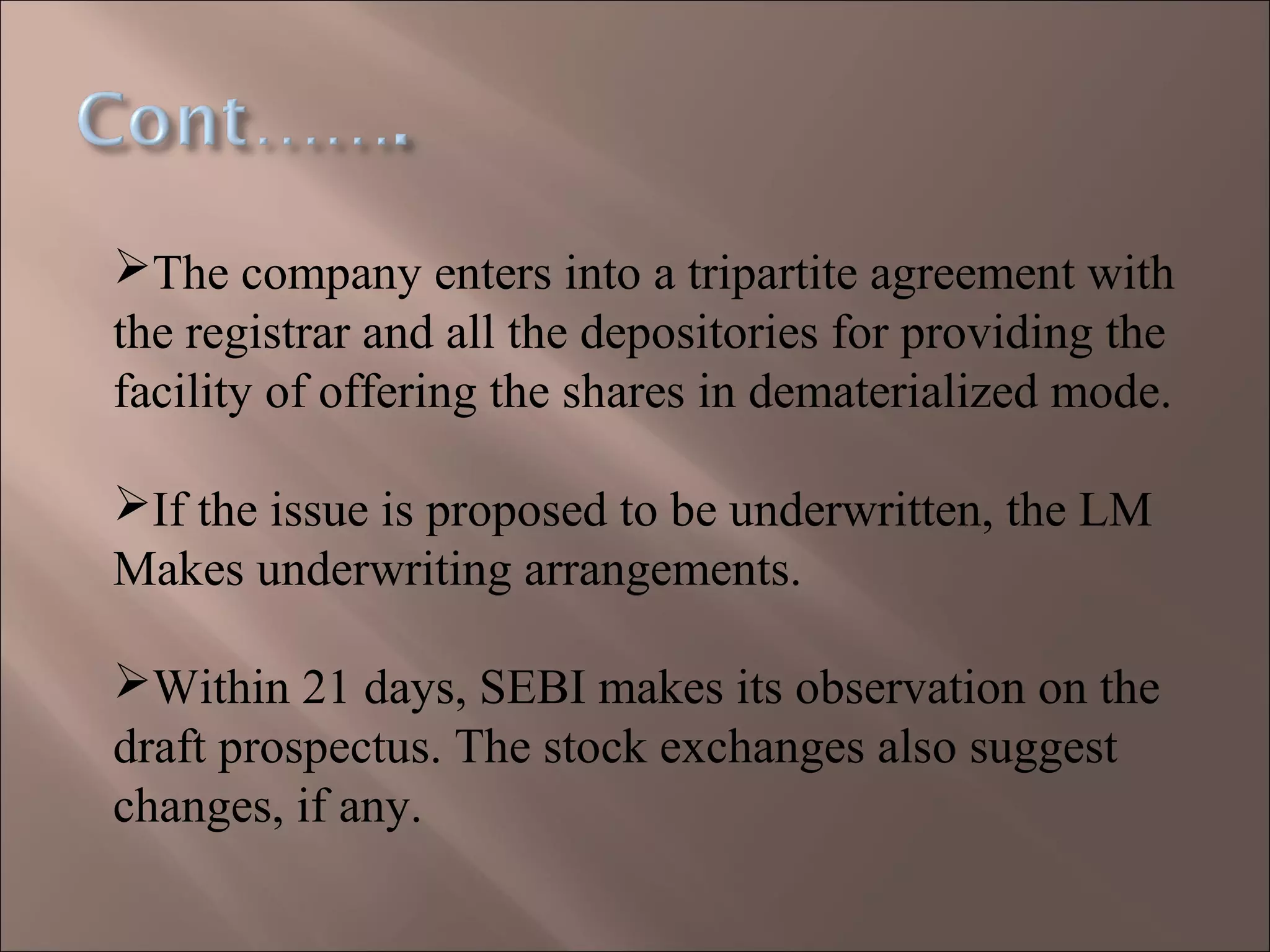
The company enters into a tripartite agreement with
the registrar and all the depositories for providing the
facility of offering the shares in dematerialized mode.
If the issue is proposed to be underwritten, the LM
Makes underwriting arrangements.
Within 21 days, SEBI makes its observation on the
draft prospectus. The stock exchanges also suggest
changes, if any.
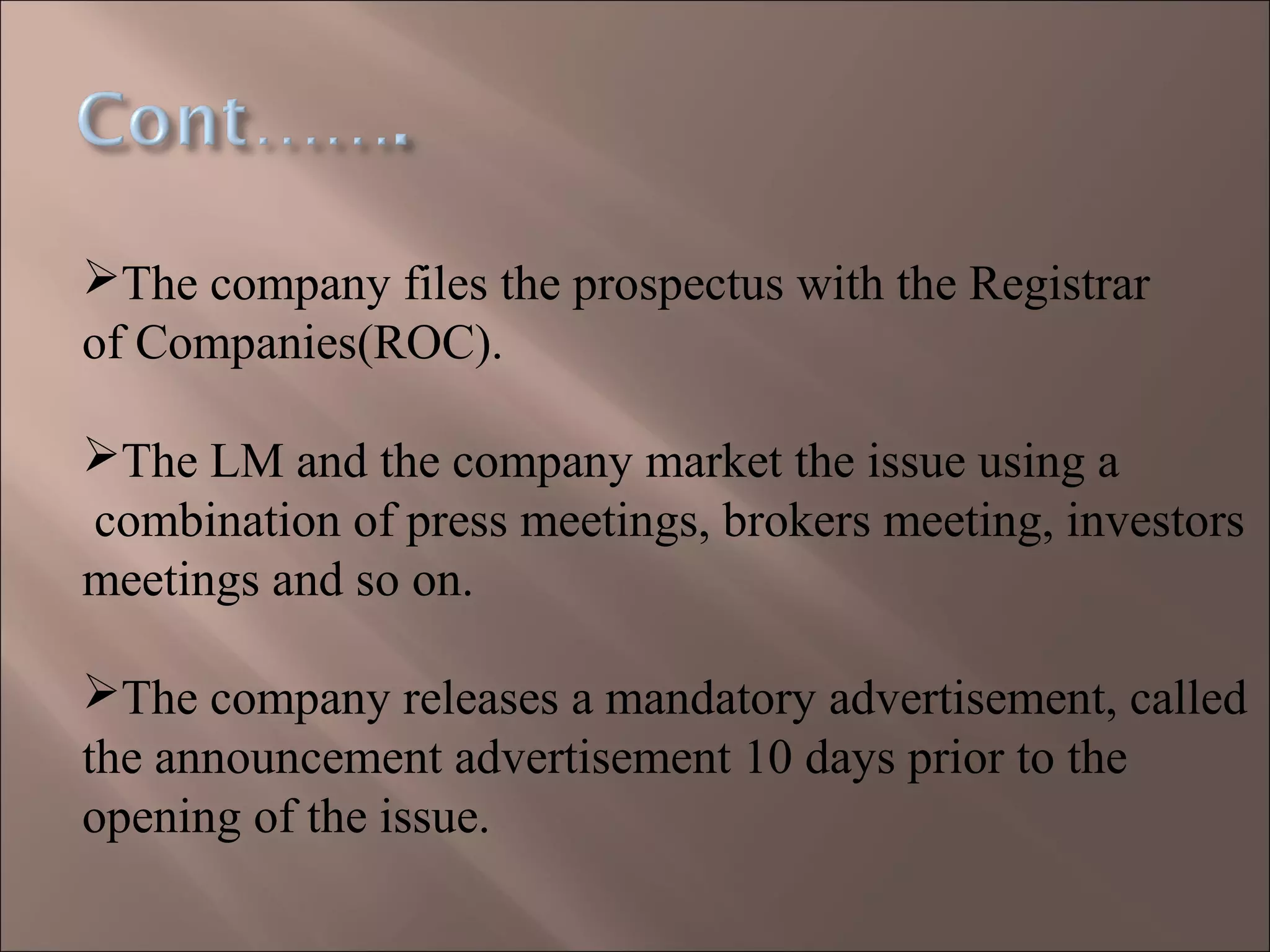
The company files the prospectus with the Registrar
of Companies(ROC).
The LM and the company market the issue using a
combination of press meetings, brokers meeting, investors
meetings and so on.
The company releases a mandatory advertisement, called
the announcement advertisement 10 days prior to the
opening of the issue.
The issue is kept open for a minimum of 3 days and
maximum of 21 days.
After the issue is closed, the basis of allotment is
finalized by the stock exchange, the LM, and the
registrar ,in conformity with SEBI-prescribed rules.
 Structure the issue, taking into account the funds requi-
rement of the company, the expectations of the investors,
and other relevant factors.
 Submit the prospectus to SEBI.
Arrange underwriting by financial institution, commercial
banks and brokers.
 Finalize the prospectus in consultation with solicitors,
stock exchange authorities, and others.
 Coordinate the efforts of brokers, registrars, advertising
agencies, printers, and others.
 Develop the strategy for marketing the issue by using
the judicious mix of conferences, advertisement ,mailing,
etc.
 Monitor the issue during the subscription period.
 Help in finalizing the basis of allotment.
 Assist in securing stock exchange listing.
The cost of public issue is normally
between 8 to 12%, depending on the size of
the issue and the level of marketing effort. The
important expenses incurred for public issue
are :
1. Underwriting Expenses
2. Brokerage
3. Fees to Manager and for registrars to the
issue
4. Printing and Postage Expenses
5. Advertising and Publicity Expenses
6. Listing fees and Stamp duty
Underpricing of IPOs appears to be a universal
phenomenon, though the degree of under pricing varies
widely across countries. Why does such under pricing
happen? Financial economists offer the following
explanations.
1.Winner’s Curse
2.Bait for Future Offerings
3.Informational Asymmetry
4.Regulatory Constraints
5.Political Goals
Key provisions for secondary public offer
1. A listed company is eligible to a public offer of equity shares or a
convertible provided that the aggregate size of the proposed issue
and all previous issues made in the same financial year by the
company doesn’t exceed 5 times its pre-issue net worth as per the
audited balance sheet of the last financial year.
2. The promoters shall participate either to the extent of 20% of the
proposed issue o ensure that their holding in the post-issue equity
capital is at least 20%.
3. If the promoter wish to subscribe in the secondary market
offer beyond the required minimum of 20%, such excess
contribution shall be subject to preferential allotment
guidelines.
4. The requirement of minimum promoters’ contribution
shall not be applicable in case of a secondary offer by a
company that has been listed on a stock exchange for a
minimum of 3 years and has a track record of dividend
payment for the immediately preceding 3 years.
 Mechanics for the public offer of debt security:
 Pure debt securities are typically offered through
The 100% retail route because the book building route is not
appropriate for them.
 Debt security are generally secured against assets of the issuing
company and that security should be created within 6 months of
the close of the issue of debentures.
 A debt issue cannot be made unless credit rating from a
credit rating agency is obtained and disclosed in the offer
document.
 It is mandatory to create a debenture redemption reserve
for every issue of debentures.
 It is necessary for a company to appoint one or more
debenture trustees before a debenture issue.
RIGHT ISSUE
Characteristics:
1. The no. of rights that a shareholder gets is equal to the number of
shares held by him.
2. The no. of rights required to subscribe to an additional share is
determined by the issuing company.
3. The price per share for additional equity, called the subscription
price, is left to the discretion of the company.
4. The rights are negotiable. The holder of rights can sell them.
5. Rights can be exercised only during a fixed period which is usually
about 30 days.
 Procedure for right issue:
A company making a rights issue sends a letter of offer,
along with a composite application form consisting of 4
forms (A,B,C and D) to the shareholders.
A: Acceptance of rights and application for additional shares.
B: Renouncing the rights in favor of someone.
C: Application by the renounce
D: To make a request for split forms.
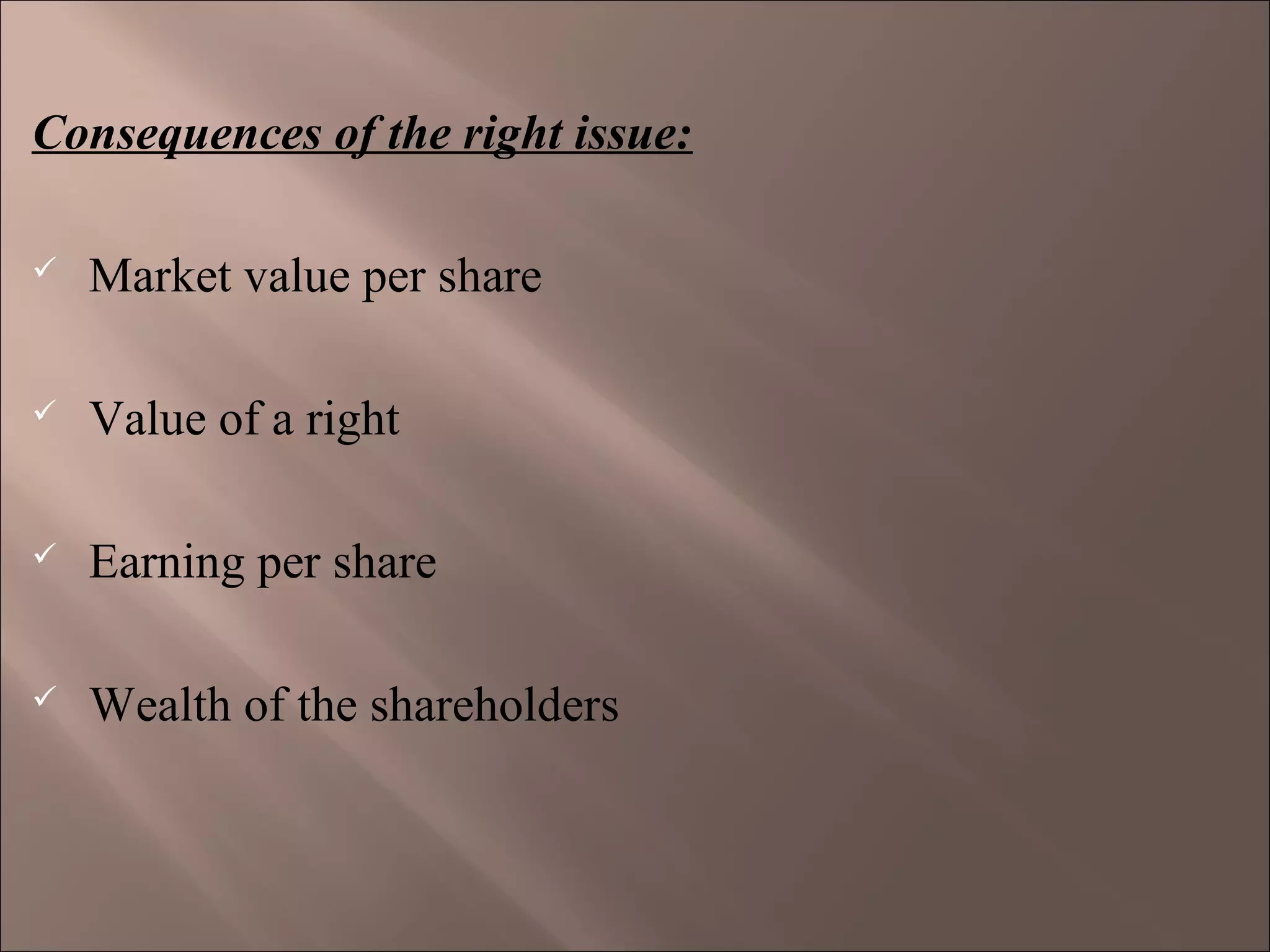
Consequences of the right issue:
 Market value per share
 Value of a right
 Earning per share
 Wealth of the shareholders
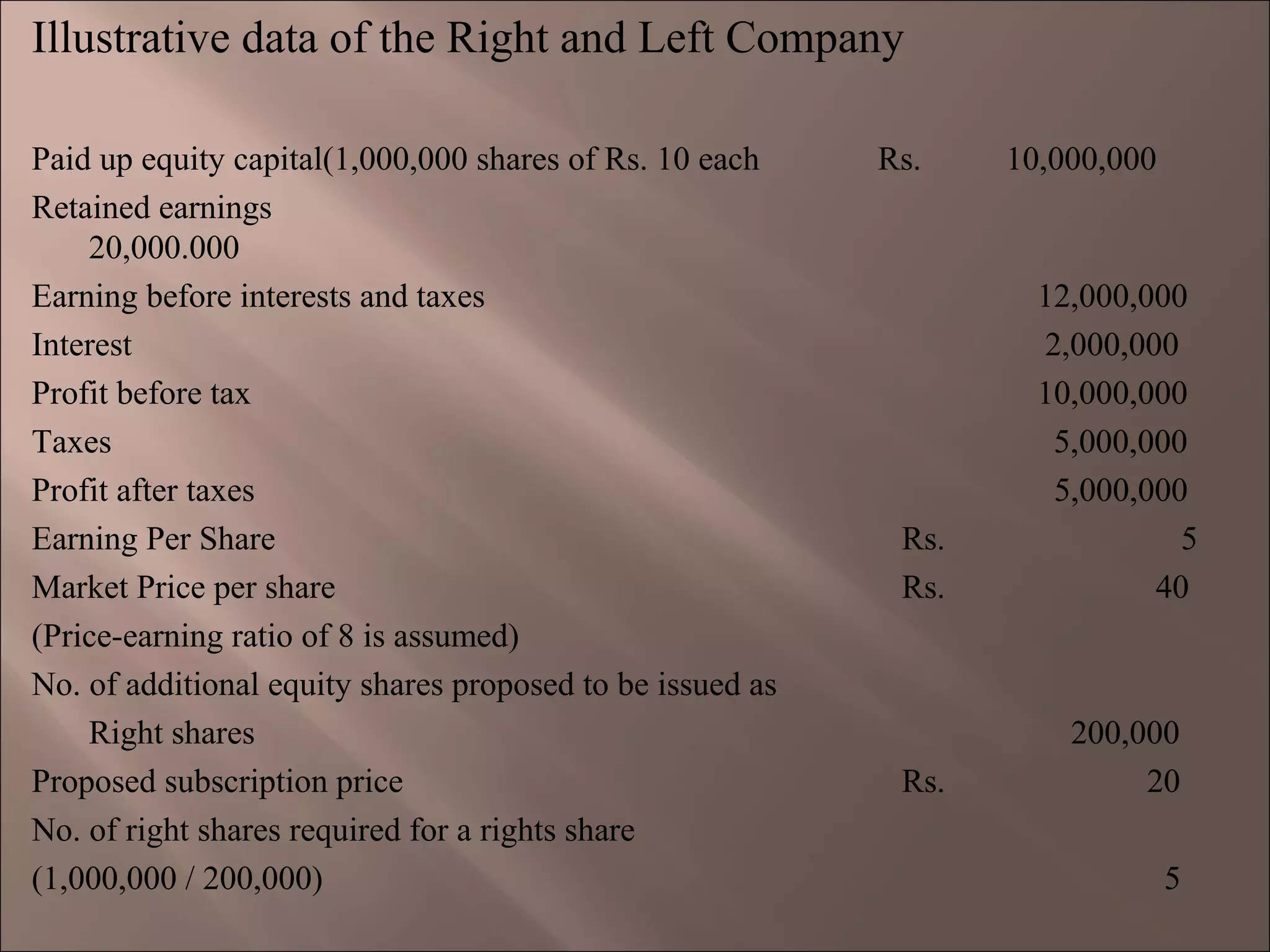
Illustrative data of the Right and Left Company
Paid up equity capital(1,000,000 shares of Rs. 10 each Rs. 10,000,000
Retained earnings
20,000.000
Earning before interests and taxes 12,000,000
Interest 2,000,000
Profit before tax 10,000,000
Taxes 5,000,000
Profit after taxes 5,000,000
Earning Per Share Rs. 5
Market Price per share Rs. 40
(Price-earning ratio of 8 is assumed)
No. of additional equity shares proposed to be issued as
Right shares 200,000
Proposed subscription price Rs. 20
No. of right shares required for a rights share
(1,000,000 / 200,000) 5
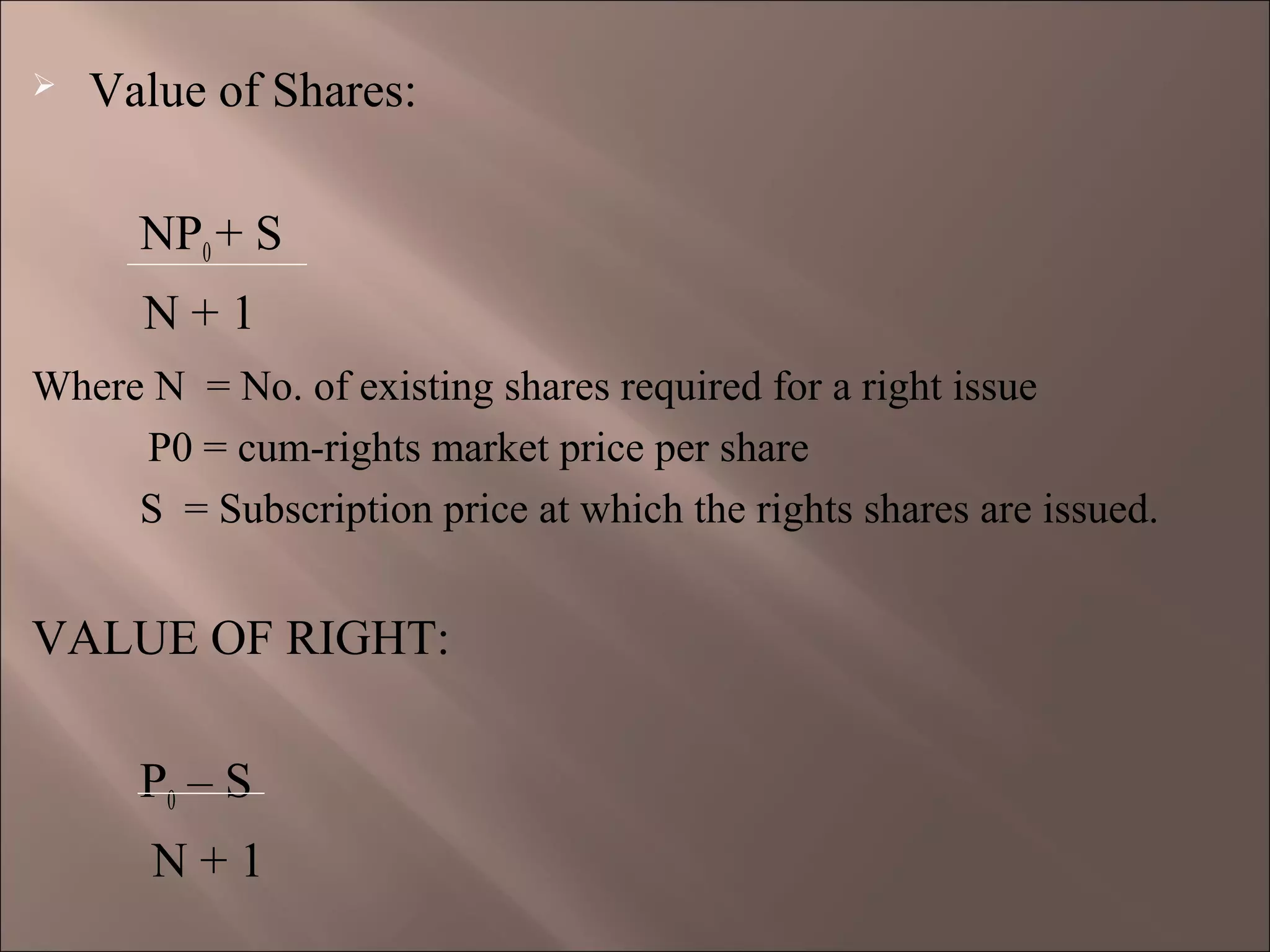
 Value of Shares:
NP0+ S
N + 1
Where N = No. of existing shares required for a right issue
P0 = cum-rights market price per share
S = Subscription price at which the rights shares are issued.
VALUE OF RIGHT:
P0 – S
N + 1
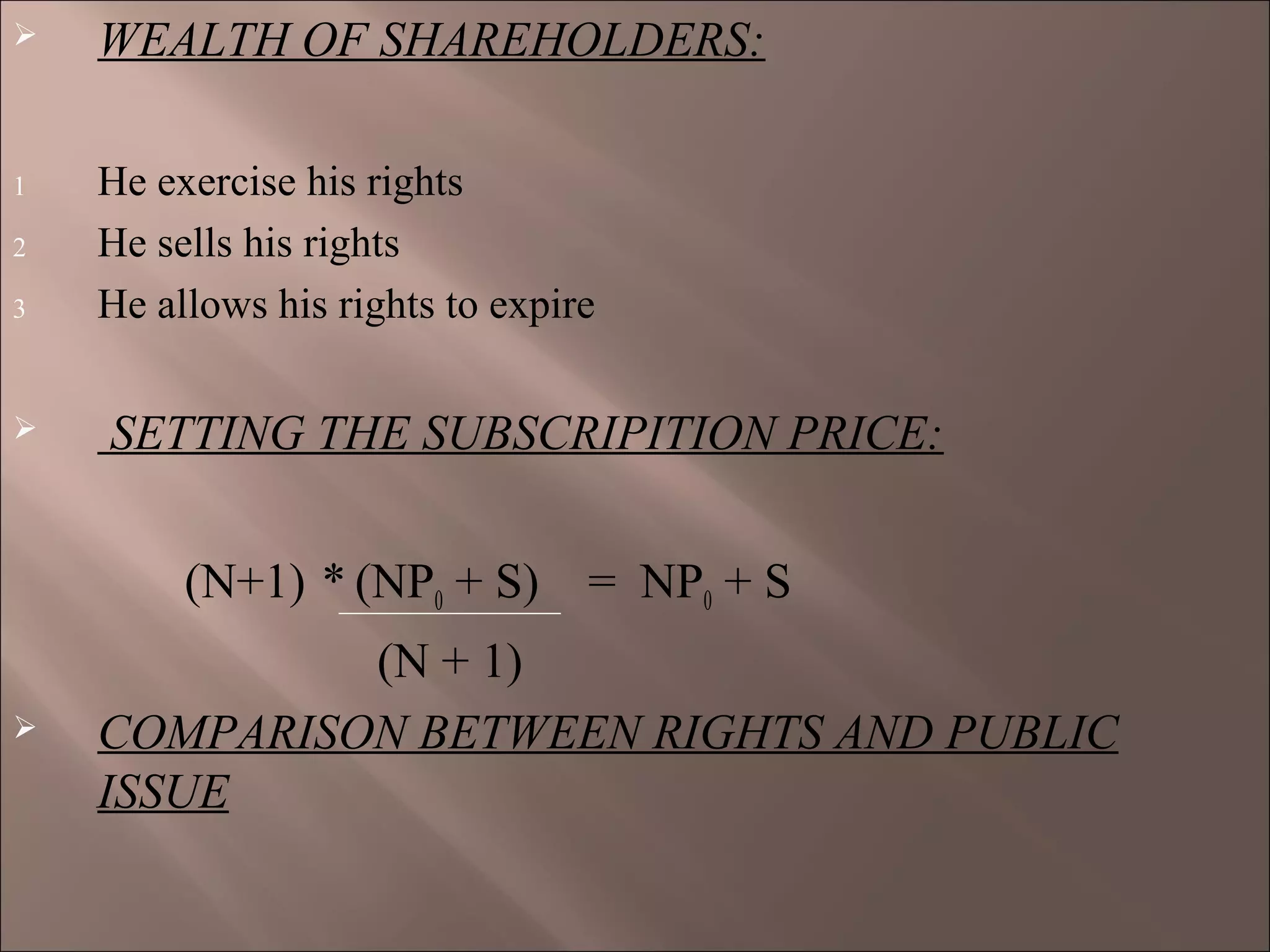
 WEALTH OF SHAREHOLDERS:
1 He exercise his rights
2 He sells his rights
3 He allows his rights to expire
 SETTING THE SUBSCRIPITION PRICE:
(N+1) * (NP0 + S) = NP0 + S
(N + 1)
 COMPARISON BETWEEN RIGHTS AND PUBLIC
ISSUE
 Private placement of equity
 Private placement of Debt
 Mutual funds , banks, Insurance Org. ,Provident fund
 Rules and Regulation for the private
placement(2003)
 Disclosure
 Bank should not invest unrated non SLR security.
 Debt securities traded in demat form
 Credit rating
 Debt security listed
 Bank should not invest in non SLR security.
 Definition:- When a listed company issues share or
debenture to select group of person in terms of
provisions of chapter VII of SEBI regulation ,it is
referred to as preferential allotment.
 Promoters, strategic investors, venture capitalist,
Financial Institute, supplier
 Regulation
1)Special resolution
2)pricing
3)Open offer
4) Lock in period
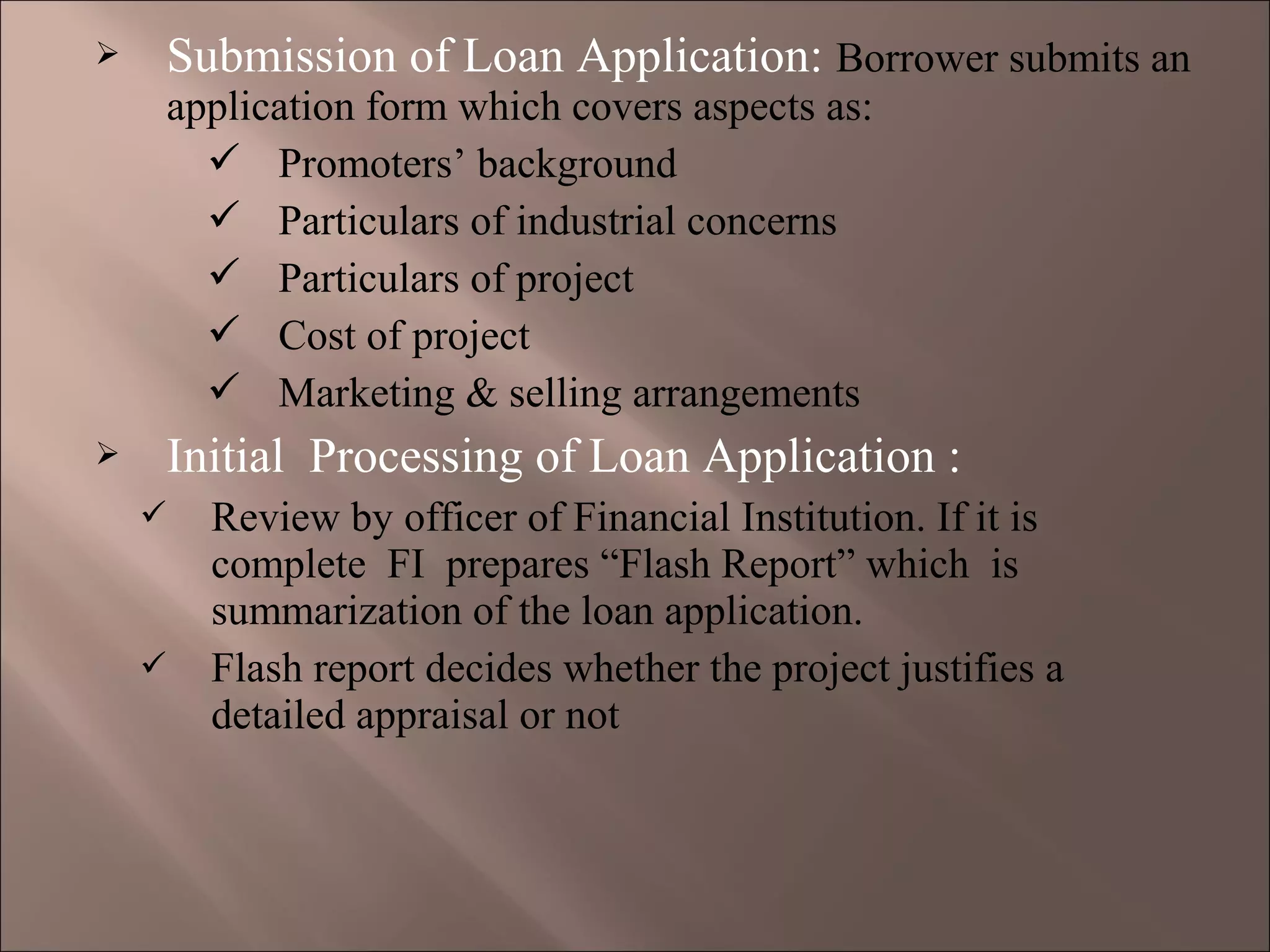
1. Submission of Loan Application
2. Initial Processing of Loan Application
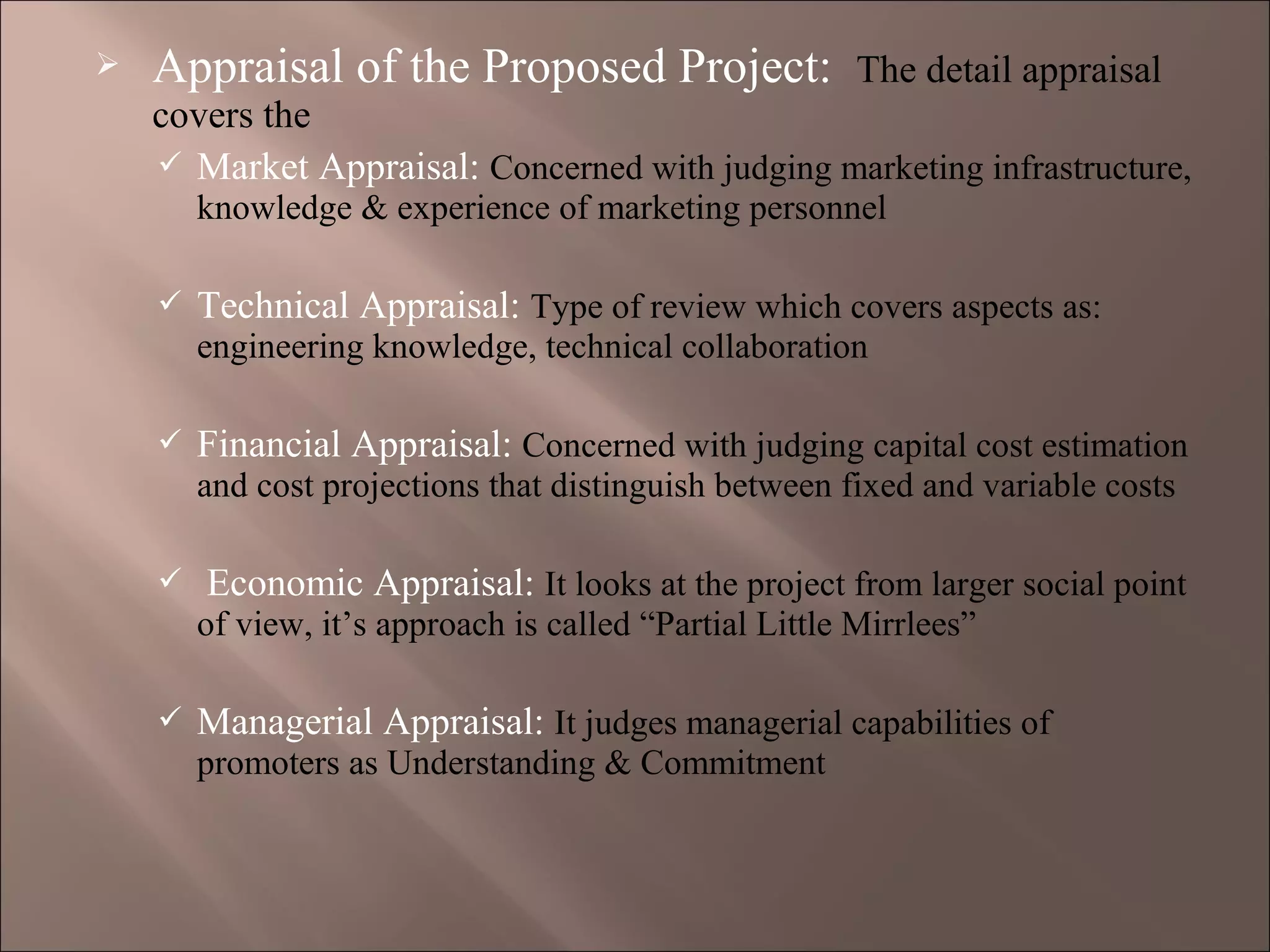
3. Appraisal of the Proposed Project
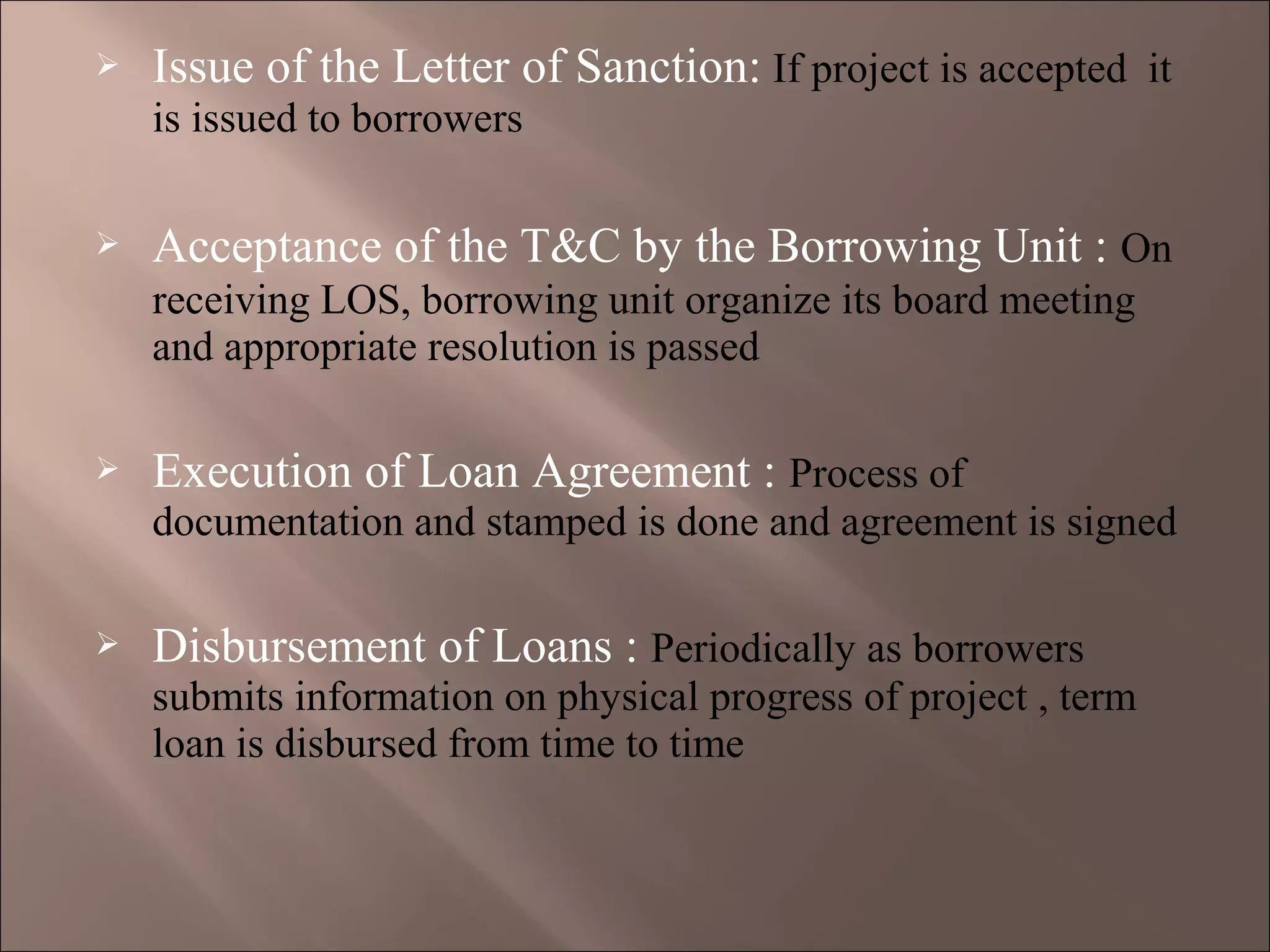
4. Issue of the Letter of Sanction
5. Acceptance of the Term and Conditions by the
Borrowing Unit
6. Execution of Loan Agreement
7. Disbursement of Loans
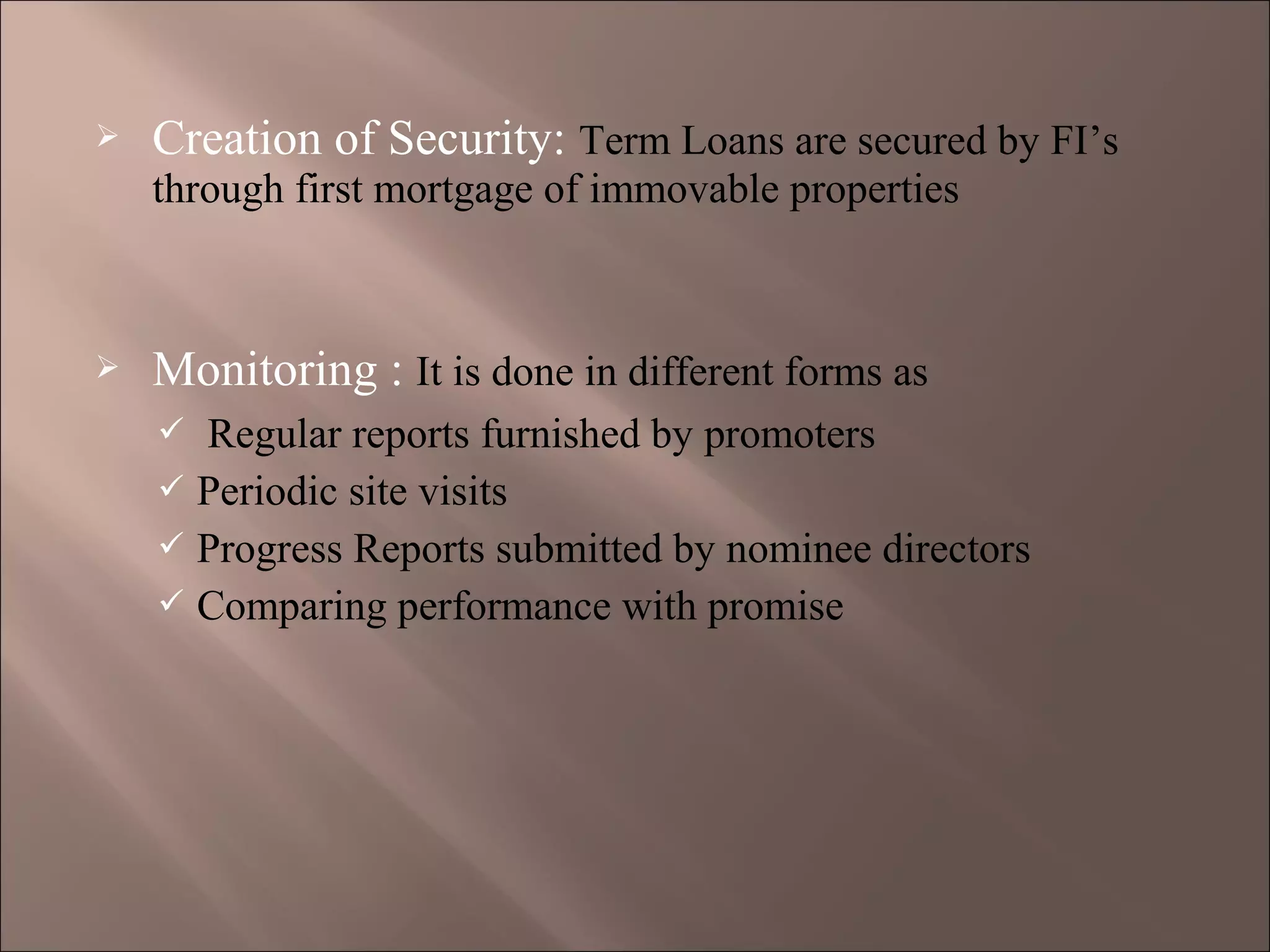
8. Creation of Security
9. Monitoring
 Submission of Loan Application: Borrower submits an
application form which covers aspects as:
 Promoters’ background
 Particulars of industrial concerns
 Particulars of project
 Cost of project
 Marketing & selling arrangements
 Initial Processing of Loan Application :
 Review by officer of Financial Institution. If it is
complete FI prepares “Flash Report” which is
summarization of the loan application.
 Flash report decides whether the project justifies a
detailed appraisal or not
 Appraisal of the Proposed Project: The detail appraisal
covers the
 Market Appraisal: Concerned with judging marketing infrastructure,
knowledge & experience of marketing personnel
 Technical Appraisal: Type of review which covers aspects as:
engineering knowledge, technical collaboration
 Financial Appraisal: Concerned with judging capital cost estimation
and cost projections that distinguish between fixed and variable costs
 Economic Appraisal: It looks at the project from larger social point
of view, it’s approach is called “Partial Little Mirrlees”
 Managerial Appraisal: It judges managerial capabilities of
promoters as Understanding & Commitment
 Issue of the Letter of Sanction: If project is accepted it
is issued to borrowers
 Acceptance of the T&C by the Borrowing Unit : On
receiving LOS, borrowing unit organize its board meeting
and appropriate resolution is passed
 Execution of Loan Agreement : Process of
documentation and stamped is done and agreement is signed
 Disbursement of Loans : Periodically as borrowers
submits information on physical progress of project , term
loan is disbursed from time to time
 Creation of Security: Term Loans are secured by FI’s
through first mortgage of immovable properties
 Monitoring : It is done in different forms as
 Regular reports furnished by promoters
 Periodic site visits
 Progress Reports submitted by nominee directors
 Comparing performance with promise
1 long term_fund 2

1 long term_fund 2

  • 2.
     Anjali Nair Ketan Navapara  Nirav Parmar  Anamika Patel  Jaydeep Hirpara  Milan Patel  Nirav Patel  Jaimin Gor
  • 3.
    Long Term FundsLongTerm Funds Venture Capital Initial Public Offer Secondary Public Offer Right Issue Private Placement Preferential Allotment Dilution Obtaining a Term Loan
  • 4.
     Venture CapitalVentureCapital Venture Capital represent financial investment in a highly risky proposition made in the hope of earning a high rate of return. It is provided mainly in the form of equity capital.
  • 5.
    1. The Venturecapitalist is inclined to assume a high degree of risk in the expectation of earning a high rate of return. 2. The VC typically subscribe to equity, which enable it to share the risks and rewards of the investee firm. 3. The VC also takes an active interest in guiding the assisted firm. 4. The VC normally plans to liquidate its investments in the assisted firm after 3 to 7 years.
  • 6.
    The first publicoffering of equity shares of a company, which is followed by a listing of its shares on the stock market, is called the Initial Public Offer (IPO). It is also initiate as decision to go public.
  • 7.
    1. Access toCapital 2. Respectability 3. Investor Recognition 4. Window of Opportunity 5. Liquidity 6. Benefits of Diversification 7. Signals from the Market
  • 8.
    1. Adverse Selection 2.Dilution 3. Loss of Flexibility 4. Disclosures 5. Accountability 6. Public Pressure 7. Costs
  • 9.
    The board ofdirectors approves the proposal to raise capital from the public and authorizes the managing directors to do all the tasks relating to the public issue.  The company convenes a meeting to seek the approval of shareholders .  The company appoints a merchant banker as the lead manager to the issue.
  • 10.
    The LM carriesout due diligence to check all relevant information ,document and certificates for the issue. The LM prepares the draft prospectus in consultation with management and seeks the approval of the board. The company makes listing application to all the stock exchange.
  • 11.
    The company entersinto a tripartite agreement with the registrar and all the depositories for providing the facility of offering the shares in dematerialized mode. If the issue is proposed to be underwritten, the LM Makes underwriting arrangements. Within 21 days, SEBI makes its observation on the draft prospectus. The stock exchanges also suggest changes, if any.
  • 12.
    The company filesthe prospectus with the Registrar of Companies(ROC). The LM and the company market the issue using a combination of press meetings, brokers meeting, investors meetings and so on. The company releases a mandatory advertisement, called the announcement advertisement 10 days prior to the opening of the issue.
  • 13.
    The issue iskept open for a minimum of 3 days and maximum of 21 days. After the issue is closed, the basis of allotment is finalized by the stock exchange, the LM, and the registrar ,in conformity with SEBI-prescribed rules.
  • 14.
     Structure theissue, taking into account the funds requi- rement of the company, the expectations of the investors, and other relevant factors.  Submit the prospectus to SEBI. Arrange underwriting by financial institution, commercial banks and brokers.
  • 15.
     Finalize theprospectus in consultation with solicitors, stock exchange authorities, and others.  Coordinate the efforts of brokers, registrars, advertising agencies, printers, and others.  Develop the strategy for marketing the issue by using the judicious mix of conferences, advertisement ,mailing, etc.
  • 16.
     Monitor theissue during the subscription period.  Help in finalizing the basis of allotment.  Assist in securing stock exchange listing.
  • 17.
    The cost ofpublic issue is normally between 8 to 12%, depending on the size of the issue and the level of marketing effort. The important expenses incurred for public issue are : 1. Underwriting Expenses 2. Brokerage 3. Fees to Manager and for registrars to the issue 4. Printing and Postage Expenses 5. Advertising and Publicity Expenses 6. Listing fees and Stamp duty
  • 18.
    Underpricing of IPOsappears to be a universal phenomenon, though the degree of under pricing varies widely across countries. Why does such under pricing happen? Financial economists offer the following explanations. 1.Winner’s Curse 2.Bait for Future Offerings 3.Informational Asymmetry 4.Regulatory Constraints 5.Political Goals
  • 19.
    Key provisions forsecondary public offer 1. A listed company is eligible to a public offer of equity shares or a convertible provided that the aggregate size of the proposed issue and all previous issues made in the same financial year by the company doesn’t exceed 5 times its pre-issue net worth as per the audited balance sheet of the last financial year. 2. The promoters shall participate either to the extent of 20% of the proposed issue o ensure that their holding in the post-issue equity capital is at least 20%.
  • 20.
    3. If thepromoter wish to subscribe in the secondary market offer beyond the required minimum of 20%, such excess contribution shall be subject to preferential allotment guidelines. 4. The requirement of minimum promoters’ contribution shall not be applicable in case of a secondary offer by a company that has been listed on a stock exchange for a minimum of 3 years and has a track record of dividend payment for the immediately preceding 3 years.
  • 21.
     Mechanics forthe public offer of debt security:  Pure debt securities are typically offered through The 100% retail route because the book building route is not appropriate for them.  Debt security are generally secured against assets of the issuing company and that security should be created within 6 months of the close of the issue of debentures.
  • 22.
     A debtissue cannot be made unless credit rating from a credit rating agency is obtained and disclosed in the offer document.  It is mandatory to create a debenture redemption reserve for every issue of debentures.  It is necessary for a company to appoint one or more debenture trustees before a debenture issue.
  • 23.
    RIGHT ISSUE Characteristics: 1. Theno. of rights that a shareholder gets is equal to the number of shares held by him. 2. The no. of rights required to subscribe to an additional share is determined by the issuing company. 3. The price per share for additional equity, called the subscription price, is left to the discretion of the company. 4. The rights are negotiable. The holder of rights can sell them. 5. Rights can be exercised only during a fixed period which is usually about 30 days.
  • 24.
     Procedure forright issue: A company making a rights issue sends a letter of offer, along with a composite application form consisting of 4 forms (A,B,C and D) to the shareholders. A: Acceptance of rights and application for additional shares. B: Renouncing the rights in favor of someone. C: Application by the renounce D: To make a request for split forms.
  • 25.
    Consequences of theright issue:  Market value per share  Value of a right  Earning per share  Wealth of the shareholders
  • 26.
    Illustrative data ofthe Right and Left Company Paid up equity capital(1,000,000 shares of Rs. 10 each Rs. 10,000,000 Retained earnings 20,000.000 Earning before interests and taxes 12,000,000 Interest 2,000,000 Profit before tax 10,000,000 Taxes 5,000,000 Profit after taxes 5,000,000 Earning Per Share Rs. 5 Market Price per share Rs. 40 (Price-earning ratio of 8 is assumed) No. of additional equity shares proposed to be issued as Right shares 200,000 Proposed subscription price Rs. 20 No. of right shares required for a rights share (1,000,000 / 200,000) 5
  • 27.
     Value ofShares: NP0+ S N + 1 Where N = No. of existing shares required for a right issue P0 = cum-rights market price per share S = Subscription price at which the rights shares are issued. VALUE OF RIGHT: P0 – S N + 1
  • 28.
     WEALTH OFSHAREHOLDERS: 1 He exercise his rights 2 He sells his rights 3 He allows his rights to expire  SETTING THE SUBSCRIPITION PRICE: (N+1) * (NP0 + S) = NP0 + S (N + 1)  COMPARISON BETWEEN RIGHTS AND PUBLIC ISSUE
  • 29.
     Private placementof equity  Private placement of Debt  Mutual funds , banks, Insurance Org. ,Provident fund  Rules and Regulation for the private placement(2003)  Disclosure  Bank should not invest unrated non SLR security.
  • 30.
     Debt securitiestraded in demat form  Credit rating  Debt security listed  Bank should not invest in non SLR security.
  • 31.
     Definition:- Whena listed company issues share or debenture to select group of person in terms of provisions of chapter VII of SEBI regulation ,it is referred to as preferential allotment.  Promoters, strategic investors, venture capitalist, Financial Institute, supplier  Regulation 1)Special resolution 2)pricing 3)Open offer 4) Lock in period
  • 32.
    1. Submission ofLoan Application 2. Initial Processing of Loan Application 3. Appraisal of the Proposed Project 4. Issue of the Letter of Sanction 5. Acceptance of the Term and Conditions by the Borrowing Unit 6. Execution of Loan Agreement 7. Disbursement of Loans 8. Creation of Security 9. Monitoring
  • 33.
     Submission ofLoan Application: Borrower submits an application form which covers aspects as:  Promoters’ background  Particulars of industrial concerns  Particulars of project  Cost of project  Marketing & selling arrangements  Initial Processing of Loan Application :  Review by officer of Financial Institution. If it is complete FI prepares “Flash Report” which is summarization of the loan application.  Flash report decides whether the project justifies a detailed appraisal or not
  • 34.
     Appraisal ofthe Proposed Project: The detail appraisal covers the  Market Appraisal: Concerned with judging marketing infrastructure, knowledge & experience of marketing personnel  Technical Appraisal: Type of review which covers aspects as: engineering knowledge, technical collaboration  Financial Appraisal: Concerned with judging capital cost estimation and cost projections that distinguish between fixed and variable costs  Economic Appraisal: It looks at the project from larger social point of view, it’s approach is called “Partial Little Mirrlees”  Managerial Appraisal: It judges managerial capabilities of promoters as Understanding & Commitment
  • 35.
     Issue ofthe Letter of Sanction: If project is accepted it is issued to borrowers  Acceptance of the T&C by the Borrowing Unit : On receiving LOS, borrowing unit organize its board meeting and appropriate resolution is passed  Execution of Loan Agreement : Process of documentation and stamped is done and agreement is signed  Disbursement of Loans : Periodically as borrowers submits information on physical progress of project , term loan is disbursed from time to time
  • 36.
     Creation ofSecurity: Term Loans are secured by FI’s through first mortgage of immovable properties  Monitoring : It is done in different forms as  Regular reports furnished by promoters  Periodic site visits  Progress Reports submitted by nominee directors  Comparing performance with promise