1
25 April 2020 Jane Lambert
i
1. Definition of a Patent
(1) A patent is a monopoly of a new invention.
1
(2) Art 28 (1)
2
of the Agreement on Trade-Related Aspects of Intellectual Property Rights (“TRIPs”)
3
provides
that a patent confers the following exclusive rights on its owner:
“(a) where the subject matter of a patent is a product, to prevent third parties not having the
owner’s consent from the acts of: making, using, offering for sale, selling, or importing (6) for these
purposes that product;
(b) where the subject matter of a patent is a process, to prevent third parties not having the
owner’s consent from the act of using the process, and from the acts of: using, offering for sale,
selling, or importing for these purposes at least the product obtained directly by that process.”
(3) Compare art 28 (1) with art 9 (1) of the Berne Convention for the Protection of Literary and Artistic Works
of 9 Sept1886;
“Authors of literary and artistic works protected by this Convention shall have the exclusive right of
authorizing the reproduction of these works, in any manner or form.”
4
(4) Art 28 (1) (a) of TRIPs prevents the making, using, offering for sale, selling, or importing: of a product
even if it is developed in good faith without any reference to the invention or even knowledge of it.
“Reproduction” is another word for copying. Art 9 (1) prohibits the copying of a copyright work but not the
creation of a work that is similar to the copyright work so long as such creation does not involve copying.
(5) A prohibition of copying is less than a monopoly because it envisages the creation of a similar work
whereas a monopoly does not.
1
“What is a patent?” http://nipclaw.blogspot.com/p/what-is-patent.html
2
https://www.wto.org/english/docs_e/legal_e/27-trips_04c_e.htm#5
3
Annex 1C to the Agreement establishing the World Trade Organizations which imposes minimum conditions for the protection
of investment in branding, design, technology and creativity to which members of the WTO are required to adhere.
4
https://wipolex.wipo.int/en/text/283698
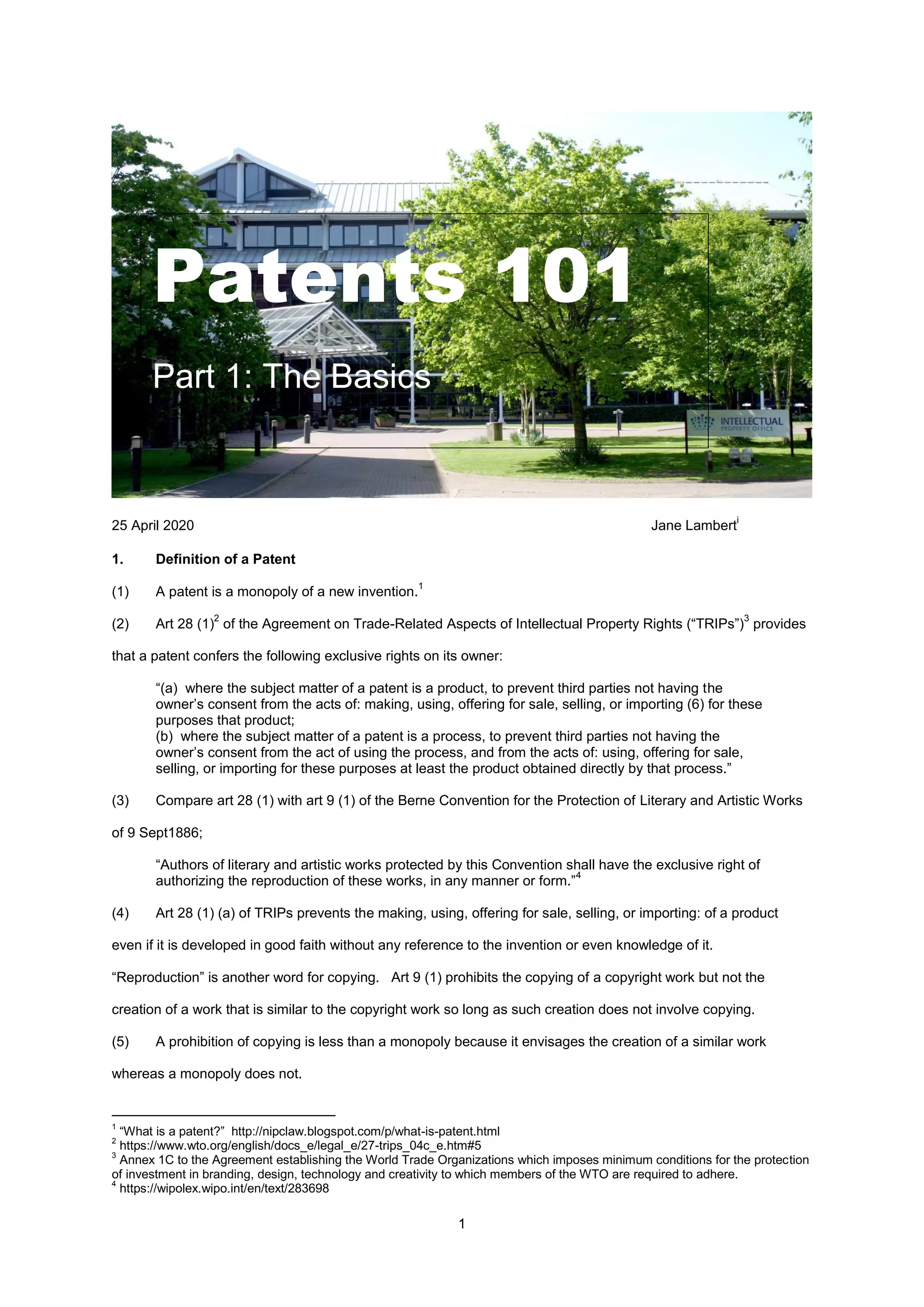
Patents 101
Part 1: The Basics
PP
2
(6) Other monopolies include the exclusive right to use a registered design and any design which does not
produce on the informed user a different overall impression conferred by s.7 (1) of the Registered Designs Act
1949 as amended
5
and the exclusive rights in a trade mark conferred by s.9 (1) of the Trade Marks Act 1994.
6
2. What is an “Invention”?
(1) There is no single definition in the Patents Act 1977.
(2) S.1 (2) declares that certain creations are not inventions for the purposes of this Act.
(3) S.60 (1) implies that inventions are either products or processes.
(4) S.125 (1) provides:
“For the purposes of this Act an invention for a patent for which an application has been made or
for which a patent has been granted shall, unless the context otherwise requires, be taken to be
that specified in a claim of the specification of the application or patent, as the case may be, as
interpreted by the description and any drawings contained in that specification, and the extent of
the protection conferred by a patent or application for a patent shall be determined accordingly”.
3. What is a “Claim”?
(1) “Claims” are mentioned for the first time is s.14 (2) (b) of the Patents Act 1977 in the context of patent
applications:
“Every application for a patent shall contain -=
(a) a request for the grant of a patent;
(b) a specification containing a description of the invention, a claim or claims and any drawing
referred to in the description or any claim; and
(c) an abstract;
but the foregoing provision shall not prevent an application being initiated by documents complying
with section 15 (1),”
4. What is a Specification?
(1) The specification is the document that sets out the bargain between the inventor and the public.
(2) The inventor’s side of the bargain is set out in s.14 (3):
“The specification of an application shall disclose the invention in a manner which is clear enough
and complete enough for the invention to be performed by a person skilled in the art.”
In other words, the inventor must tell the public how to make or use his or her invention.
(4) The public’s side is set out in s.60 (1):
“Subject to the provisions of this section, a person infringes a patent for an invention if, but only if,
while the patent is in force, he does any of the following things in the United Kingdom in relation to
the invention without the consent of the proprietor of the patent, that is to say;
(a) where the invention is a product, he makes, disposes of, offers to dispose of, uses or
imports the product or keeps it whether for disposal or otherwise;
5
https://assets.publishing.service.gov.uk/government/uploads/system/uploads/attachment_data/file/737827/Registered_Designs
_Act_1949.pdf
6
https://assets.publishing.service.gov.uk/government/uploads/system/uploads/attachment_data/file/742949/Trade-
Mark-Act-1994.pdf
3
(b) where the invention is a process, he uses the process or he offers it for use in the United
Kingdom when he knows, or it is obvious to a reasonable person in the circumstances, that
its use there without the consent of the proprietor would be an infringement of the patent;
(c) where the invention is a process, he disposes of, offers to dispose of, uses or imports any
product obtained directly by means of that process or keeps any such product whether for
disposal or otherwise.”
In return for the disclosure of the invention in accordance with s.14 (3) the public grant the inventor the right to
prevent anybody from doing any of the above acts in respect of anything that falls within the scope of his claims.
(5) Slide 9 shows an example of a specification. All the text down to “What we claim is” the disclosure of the
invention as required by s.12 (3). The numbered paragraphs after “What we claim is” are the invention for which
the inventor seeks the protection afforded by s.60 (1).
7
(6) The disclosure is required by s.14 (3) is often called the “teaching” of the patent and the “claims” are often
referred to as “the monopoly”.
i
Jane Lambert
4-5 Gray’s Inn Square
London
WC1R 3AH
jane.lambert@nipclaw.com
www.nipclaw.com
+44 (0)20 7404 5252
7
The invention in slide 9 is GB1453920A entitled Apparatus for “Extinguishing Fires on High Rise Block Buildings Uniform
Transverse Cross-Section or Plan”
(https://worldwide.espacenet.com/patent/search/family/010162107/publication/GB1453920A?q=pn%3DGB1453920). It is
probably a bit of mickey taking by Arthur C Pedrick, a retired patent examiner, who filed numerous applications for patents for
improbable inventions. To learn more about the inventor, see Dan Anthony’s article Patent Pedrick: The story of Arthur and
Ginger 20 Nov 2017 IPO Blog (https://ipo.blog.gov.uk/2017/11/20/arthur-and-ginger/).

Patents 101 Part 1 The Basics

  • 1.
    1 25 April 2020Jane Lambert i 1. Definition of a Patent (1) A patent is a monopoly of a new invention. 1 (2) Art 28 (1) 2 of the Agreement on Trade-Related Aspects of Intellectual Property Rights (“TRIPs”) 3 provides that a patent confers the following exclusive rights on its owner: “(a) where the subject matter of a patent is a product, to prevent third parties not having the owner’s consent from the acts of: making, using, offering for sale, selling, or importing (6) for these purposes that product; (b) where the subject matter of a patent is a process, to prevent third parties not having the owner’s consent from the act of using the process, and from the acts of: using, offering for sale, selling, or importing for these purposes at least the product obtained directly by that process.” (3) Compare art 28 (1) with art 9 (1) of the Berne Convention for the Protection of Literary and Artistic Works of 9 Sept1886; “Authors of literary and artistic works protected by this Convention shall have the exclusive right of authorizing the reproduction of these works, in any manner or form.” 4 (4) Art 28 (1) (a) of TRIPs prevents the making, using, offering for sale, selling, or importing: of a product even if it is developed in good faith without any reference to the invention or even knowledge of it. “Reproduction” is another word for copying. Art 9 (1) prohibits the copying of a copyright work but not the creation of a work that is similar to the copyright work so long as such creation does not involve copying. (5) A prohibition of copying is less than a monopoly because it envisages the creation of a similar work whereas a monopoly does not. 1 “What is a patent?” http://nipclaw.blogspot.com/p/what-is-patent.html 2 https://www.wto.org/english/docs_e/legal_e/27-trips_04c_e.htm#5 3 Annex 1C to the Agreement establishing the World Trade Organizations which imposes minimum conditions for the protection of investment in branding, design, technology and creativity to which members of the WTO are required to adhere. 4 https://wipolex.wipo.int/en/text/283698 Patents 101 Part 1: The Basics PP
  • 2.
    2 (6) Other monopoliesinclude the exclusive right to use a registered design and any design which does not produce on the informed user a different overall impression conferred by s.7 (1) of the Registered Designs Act 1949 as amended 5 and the exclusive rights in a trade mark conferred by s.9 (1) of the Trade Marks Act 1994. 6 2. What is an “Invention”? (1) There is no single definition in the Patents Act 1977. (2) S.1 (2) declares that certain creations are not inventions for the purposes of this Act. (3) S.60 (1) implies that inventions are either products or processes. (4) S.125 (1) provides: “For the purposes of this Act an invention for a patent for which an application has been made or for which a patent has been granted shall, unless the context otherwise requires, be taken to be that specified in a claim of the specification of the application or patent, as the case may be, as interpreted by the description and any drawings contained in that specification, and the extent of the protection conferred by a patent or application for a patent shall be determined accordingly”. 3. What is a “Claim”? (1) “Claims” are mentioned for the first time is s.14 (2) (b) of the Patents Act 1977 in the context of patent applications: “Every application for a patent shall contain -= (a) a request for the grant of a patent; (b) a specification containing a description of the invention, a claim or claims and any drawing referred to in the description or any claim; and (c) an abstract; but the foregoing provision shall not prevent an application being initiated by documents complying with section 15 (1),” 4. What is a Specification? (1) The specification is the document that sets out the bargain between the inventor and the public. (2) The inventor’s side of the bargain is set out in s.14 (3): “The specification of an application shall disclose the invention in a manner which is clear enough and complete enough for the invention to be performed by a person skilled in the art.” In other words, the inventor must tell the public how to make or use his or her invention. (4) The public’s side is set out in s.60 (1): “Subject to the provisions of this section, a person infringes a patent for an invention if, but only if, while the patent is in force, he does any of the following things in the United Kingdom in relation to the invention without the consent of the proprietor of the patent, that is to say; (a) where the invention is a product, he makes, disposes of, offers to dispose of, uses or imports the product or keeps it whether for disposal or otherwise; 5 https://assets.publishing.service.gov.uk/government/uploads/system/uploads/attachment_data/file/737827/Registered_Designs _Act_1949.pdf 6 https://assets.publishing.service.gov.uk/government/uploads/system/uploads/attachment_data/file/742949/Trade- Mark-Act-1994.pdf
  • 3.
    3 (b) where theinvention is a process, he uses the process or he offers it for use in the United Kingdom when he knows, or it is obvious to a reasonable person in the circumstances, that its use there without the consent of the proprietor would be an infringement of the patent; (c) where the invention is a process, he disposes of, offers to dispose of, uses or imports any product obtained directly by means of that process or keeps any such product whether for disposal or otherwise.” In return for the disclosure of the invention in accordance with s.14 (3) the public grant the inventor the right to prevent anybody from doing any of the above acts in respect of anything that falls within the scope of his claims. (5) Slide 9 shows an example of a specification. All the text down to “What we claim is” the disclosure of the invention as required by s.12 (3). The numbered paragraphs after “What we claim is” are the invention for which the inventor seeks the protection afforded by s.60 (1). 7 (6) The disclosure is required by s.14 (3) is often called the “teaching” of the patent and the “claims” are often referred to as “the monopoly”. i Jane Lambert 4-5 Gray’s Inn Square London WC1R 3AH jane.lambert@nipclaw.com www.nipclaw.com +44 (0)20 7404 5252 7 The invention in slide 9 is GB1453920A entitled Apparatus for “Extinguishing Fires on High Rise Block Buildings Uniform Transverse Cross-Section or Plan” (https://worldwide.espacenet.com/patent/search/family/010162107/publication/GB1453920A?q=pn%3DGB1453920). It is probably a bit of mickey taking by Arthur C Pedrick, a retired patent examiner, who filed numerous applications for patents for improbable inventions. To learn more about the inventor, see Dan Anthony’s article Patent Pedrick: The story of Arthur and Ginger 20 Nov 2017 IPO Blog (https://ipo.blog.gov.uk/2017/11/20/arthur-and-ginger/).