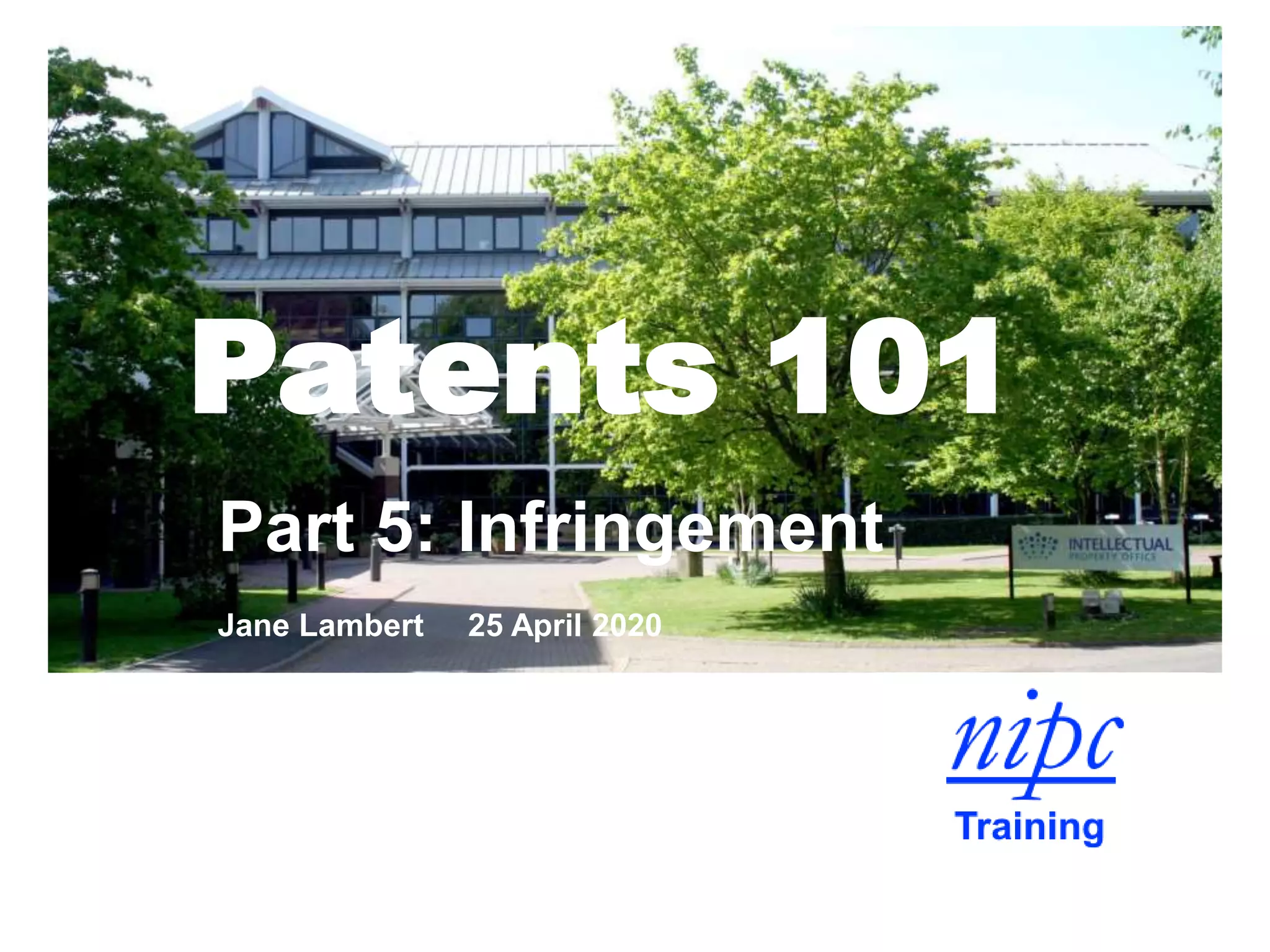
Patents 101
Part 5: Infringement
Jane Lambert 25 April 2020
Content
• Meaning of Infringement
• “The invention”
• Construing the Claim
• The Protocol
• The Case Law
• Revocation
• Threats Actions
Meaning of Infringement
S.60 (1) Patents Act provides that a
person infringes a patent if, while the
patent is in force, he or she does any of
the following things in the UK in relation
to the invention without the owner’s
consent:
Meaning of Infringement
“(a) where the invention is a product, he
makes, disposes of, offers to dispose of,
uses or imports the product or keeps it
whether for disposal or otherwise”
Meaning of Infringement
“(b) where the invention is a process, he
uses the process or he offers it for use in
the United Kingdom when he knows, or it
is obvious to a reasonable person in the
circumstances, that its use there without
the consent of the proprietor would be an
infringement of the patent”
Meaning of Infringement
“(c) where the invention is a process, he
disposes of, offers to dispose of, uses or
imports any product obtained directly by
means of that process or keeps any such
product whether for disposal or
otherwise.”
“The Invention”
S.125 (1) provides:
“For the purposes of this Act an
invention for a patent for which an
application has been made or for which a
patent has been granted shall, unless the
context otherwise requires, be taken to
be that specified in a claim of the
specification of the application or patent,
as the case may be ……..”
Construing the Claim
“……as interpreted by the description
and any drawings contained in that
specification, and the extent of the
protection conferred by a patent or
application for a patent shall be
determined accordingly.”
Most disputes over whether a patent is
infringed turn on claim construction.
The Protocol
S.125 (3) provides:
“The Protocol on the Interpretation of
Article 69 of the European Patent
Convention (which Article contains a
provision corresponding to subsection
(1) above) shall, as for the time being in
force, apply for the purposes of
subsection (1) above as it applies for the
purposes of that Article."
The Protocol – Art 1
“Article 69 should not be interpreted as meaning that the
extent of the protection conferred by a European patent is
to be understood as that defined by the strict, literal
meaning of the wording used in the claims, the description
and drawings being employed only for the purpose of
resolving an ambiguity found in the claims. Nor should it be
taken to mean that the claims serve only as a guideline and
that the actual protection conferred may extend to what,
from a consideration of the description and drawings by a
person skilled in the art, the patent proprietor has
contemplated. On the contrary, it is to be interpreted as
defining a position between these extremes which
combines a fair protection for the patent proprietor with a
reasonable degree of legal certainty for third parties.”
The Protocol – Art 2
“For the purpose of determining the
extent of protection conferred by a
European patent, due account shall be
taken of any element which is equivalent
to an element specified in the claims.”
The Case Law
Catnic Components Ltd. v. Hill & Smith
Ltd. [1982] RPC 183
Improver Corporation v Remington
Consumer Product Limited [1990] F.S.R.
181 I
Kirin-Amgen Inc. v Hoechst Marion
Roussel Ltd. [2004] UKHL 46.
The Case Law
Eli Lilly v Actavis UK Ltd and others
[2017] UKSC 48
Icescape Ltd v Ice-World International
BV and Another [2018] EWCA Civ 2219
Revocation
S.72 (1) provides that a patent may be
revoked on the following grounds:
“(a) the invention is not a patentable
invention;
(b) that the patent was granted to a
person who was not entitled to be
granted that patent;”
Revocation
“(c) the specification of the patent does
not disclose the invention clearly enough
and completely enough for it to be
performed by a person skilled in the art;
Revocation
“(d) the matter disclosed in the
specification of the patent extends beyond
that disclosed in the application for the
patent, as filed, or, if the patent was granted
on a new application filed under section
8(3), 12 or 37(4) above or as mentioned in
section 15(9) above, in the earlier
application, as filed;
(e) the protection conferred by the patent
has been extended by an amendment which
should not have been allowed.”
Threats
S.70A (1) provides:
“Subject to subsections (2) to (5), a threat
of infringement proceedings made by
any person is actionable by any person
aggrieved by the threat.”
Questions and answers
Jane Lambert
4-5 Gray’s Inn Square
London
WC1R 3AH
jane.lambert@nipclaw.com
www.nipclaw.com
+44 (0)20 7404 5252

Patents101 Part 5 -Infringement

  • 1.
    Patents 101 Part 5:Infringement Jane Lambert 25 April 2020
  • 2.
    Content • Meaning ofInfringement • “The invention” • Construing the Claim • The Protocol • The Case Law • Revocation • Threats Actions
  • 3.
    Meaning of Infringement S.60(1) Patents Act provides that a person infringes a patent if, while the patent is in force, he or she does any of the following things in the UK in relation to the invention without the owner’s consent:
  • 4.
    Meaning of Infringement “(a)where the invention is a product, he makes, disposes of, offers to dispose of, uses or imports the product or keeps it whether for disposal or otherwise”
  • 5.
    Meaning of Infringement “(b)where the invention is a process, he uses the process or he offers it for use in the United Kingdom when he knows, or it is obvious to a reasonable person in the circumstances, that its use there without the consent of the proprietor would be an infringement of the patent”
  • 6.
    Meaning of Infringement “(c)where the invention is a process, he disposes of, offers to dispose of, uses or imports any product obtained directly by means of that process or keeps any such product whether for disposal or otherwise.”
  • 7.
    “The Invention” S.125 (1)provides: “For the purposes of this Act an invention for a patent for which an application has been made or for which a patent has been granted shall, unless the context otherwise requires, be taken to be that specified in a claim of the specification of the application or patent, as the case may be ……..”
  • 8.
    Construing the Claim “……asinterpreted by the description and any drawings contained in that specification, and the extent of the protection conferred by a patent or application for a patent shall be determined accordingly.” Most disputes over whether a patent is infringed turn on claim construction.
  • 9.
    The Protocol S.125 (3)provides: “The Protocol on the Interpretation of Article 69 of the European Patent Convention (which Article contains a provision corresponding to subsection (1) above) shall, as for the time being in force, apply for the purposes of subsection (1) above as it applies for the purposes of that Article."
  • 10.
    The Protocol –Art 1 “Article 69 should not be interpreted as meaning that the extent of the protection conferred by a European patent is to be understood as that defined by the strict, literal meaning of the wording used in the claims, the description and drawings being employed only for the purpose of resolving an ambiguity found in the claims. Nor should it be taken to mean that the claims serve only as a guideline and that the actual protection conferred may extend to what, from a consideration of the description and drawings by a person skilled in the art, the patent proprietor has contemplated. On the contrary, it is to be interpreted as defining a position between these extremes which combines a fair protection for the patent proprietor with a reasonable degree of legal certainty for third parties.”
  • 11.
    The Protocol –Art 2 “For the purpose of determining the extent of protection conferred by a European patent, due account shall be taken of any element which is equivalent to an element specified in the claims.”
  • 12.
    The Case Law CatnicComponents Ltd. v. Hill & Smith Ltd. [1982] RPC 183 Improver Corporation v Remington Consumer Product Limited [1990] F.S.R. 181 I Kirin-Amgen Inc. v Hoechst Marion Roussel Ltd. [2004] UKHL 46.
  • 13.
    The Case Law EliLilly v Actavis UK Ltd and others [2017] UKSC 48 Icescape Ltd v Ice-World International BV and Another [2018] EWCA Civ 2219
  • 14.
    Revocation S.72 (1) providesthat a patent may be revoked on the following grounds: “(a) the invention is not a patentable invention; (b) that the patent was granted to a person who was not entitled to be granted that patent;”
  • 15.
    Revocation “(c) the specificationof the patent does not disclose the invention clearly enough and completely enough for it to be performed by a person skilled in the art;
  • 16.
    Revocation “(d) the matterdisclosed in the specification of the patent extends beyond that disclosed in the application for the patent, as filed, or, if the patent was granted on a new application filed under section 8(3), 12 or 37(4) above or as mentioned in section 15(9) above, in the earlier application, as filed; (e) the protection conferred by the patent has been extended by an amendment which should not have been allowed.”
  • 17.
    Threats S.70A (1) provides: “Subjectto subsections (2) to (5), a threat of infringement proceedings made by any person is actionable by any person aggrieved by the threat.”
  • 18.
    Questions and answers JaneLambert 4-5 Gray’s Inn Square London WC1R 3AH jane.lambert@nipclaw.com www.nipclaw.com +44 (0)20 7404 5252