Flattening the Forgetting Curve
2
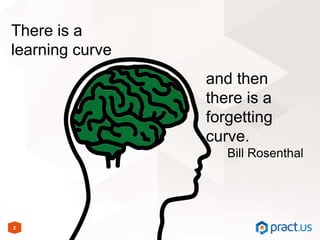
There is a
learning curve
and then
there is a
forgetting
curve.
Bill Rosenthal
3
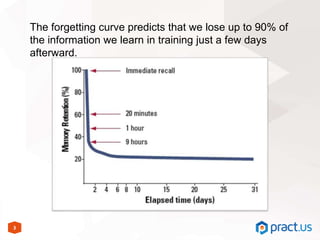
The forgetting curve predicts that we lose up to 90% of
the information we learn in training just a few days
afterward.
4
As a result, most
of what employees
learn in training
never gets applied
to work.
5
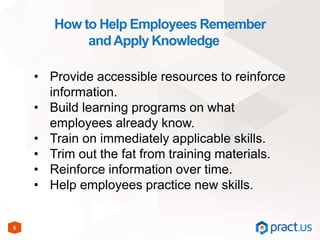
How to Help Employees Remember
andApply Knowledge
• Provide accessible resources to reinforce
information.
• Build learning programs on what
employees already know.
• Train on immediately applicable skills.
• Trim out the fat from training materials.
• Reinforce information over time.
• Help employees practice new skills.
6
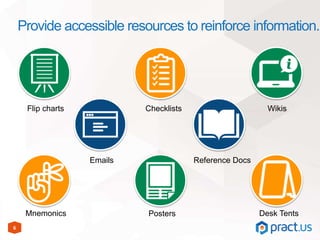
Provide accessible resources to reinforce information.
Flip charts Checklists Wikis
Emails Reference Docs
Mnemonics Posters Desk Tents
7
Even doctors benefit from
using checklists of best
practices.
8
Build on What EmployeesAlready Know
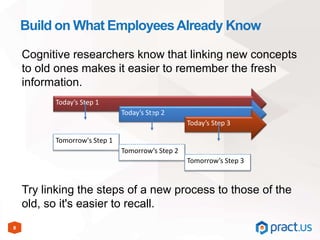
Cognitive researchers know that linking new concepts
to old ones makes it easier to remember the fresh
information.
Try linking the steps of a new process to those of the
old, so it's easier to recall.
Today’s Step 1
Tomorrow's Step 1
Today’s Step 2
Tomorrow’s Step 2
Today’s Step 3
Tomorrow’s Step 3
9
Focus on Skills Needed Now
10
Focus on Skills Needed Now
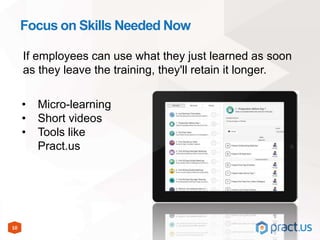
If employees can use what they just learned as soon
as they leave the training, they'll retain it longer.
• Micro-learning
• Short videos
• Tools like
Pract.us
11
Trim Out Irrelevant
Information from
your Training
12
People have a harder time
remembering important information if
it's delivered together with useless
noise.
• Ruthlessly cut anything that's not essential.
• Put additional information or background into
optional resources.
• Create extra reading/practice for people who
want a deep dive.
13
Use Spaced Retrieval for Better Recall
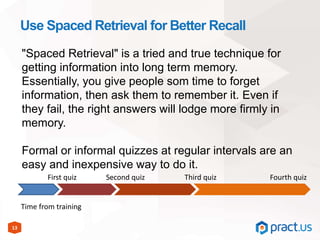
"Spaced Retrieval" is a tried and true technique for
getting information into long term memory.
Essentially, you give people som time to forget
information, then ask them to remember it. Even if
they fail, the right answers will lodge more firmly in
memory.
Formal or informal quizzes at regular intervals are an
easy and inexpensive way to do it.
Time from training
First quiz Second quiz Third quiz Fourth quiz
14
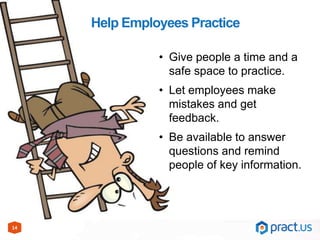
Help Employees Practice
• Give people a time and a
safe space to practice.
• Let employees make
mistakes and get
feedback.
• Be available to answer
questions and remind
people of key information.
15
Don't Forget to
Plan to Forget
Learn more about effective, low-cost,
experience-based training strategies
Pract.us
17
Creative Attributions
Many thanks to:
Nicholas Menghini from Noun Project, Poster Icon
Ryan Sun from Noun Project, Mnemonics Icon
Kelcey Hurst from Noun Project, Desk Tent Icon
Gregor Cresnar from Noun Project, Wiki Icon
Icons Bazaar from Noun Project, Reference Icon
Laymik from Noun Project, Brain Icon
Rafael Garcia Motta from Noun Project, Flip Chart Icon
Adnen Kadri from Noun Project, Email Icon

Flattening The Forgetting Curve

  • 1.
  • 2.
    2 There is a learningcurve and then there is a forgetting curve. Bill Rosenthal
  • 3.
    3 The forgetting curvepredicts that we lose up to 90% of the information we learn in training just a few days afterward.
  • 4.
    4 As a result,most of what employees learn in training never gets applied to work.
  • 5.
    5 How to HelpEmployees Remember andApply Knowledge • Provide accessible resources to reinforce information. • Build learning programs on what employees already know. • Train on immediately applicable skills. • Trim out the fat from training materials. • Reinforce information over time. • Help employees practice new skills.
  • 6.
    6 Provide accessible resourcesto reinforce information. Flip charts Checklists Wikis Emails Reference Docs Mnemonics Posters Desk Tents
  • 7.
    7 Even doctors benefitfrom using checklists of best practices.
  • 8.
    8 Build on WhatEmployeesAlready Know Cognitive researchers know that linking new concepts to old ones makes it easier to remember the fresh information. Try linking the steps of a new process to those of the old, so it's easier to recall. Today’s Step 1 Tomorrow's Step 1 Today’s Step 2 Tomorrow’s Step 2 Today’s Step 3 Tomorrow’s Step 3
  • 9.
  • 10.
    10 Focus on SkillsNeeded Now If employees can use what they just learned as soon as they leave the training, they'll retain it longer. • Micro-learning • Short videos • Tools like Pract.us
  • 11.
  • 12.
    12 People have aharder time remembering important information if it's delivered together with useless noise. • Ruthlessly cut anything that's not essential. • Put additional information or background into optional resources. • Create extra reading/practice for people who want a deep dive.
  • 13.
    13 Use Spaced Retrievalfor Better Recall "Spaced Retrieval" is a tried and true technique for getting information into long term memory. Essentially, you give people som time to forget information, then ask them to remember it. Even if they fail, the right answers will lodge more firmly in memory. Formal or informal quizzes at regular intervals are an easy and inexpensive way to do it. Time from training First quiz Second quiz Third quiz Fourth quiz
  • 14.
    14 Help Employees Practice •Give people a time and a safe space to practice. • Let employees make mistakes and get feedback. • Be available to answer questions and remind people of key information.
  • 15.
  • 16.
    Learn more abouteffective, low-cost, experience-based training strategies Pract.us
  • 17.
    17 Creative Attributions Many thanksto: Nicholas Menghini from Noun Project, Poster Icon Ryan Sun from Noun Project, Mnemonics Icon Kelcey Hurst from Noun Project, Desk Tent Icon Gregor Cresnar from Noun Project, Wiki Icon Icons Bazaar from Noun Project, Reference Icon Laymik from Noun Project, Brain Icon Rafael Garcia Motta from Noun Project, Flip Chart Icon Adnen Kadri from Noun Project, Email Icon

Editor's Notes

  • #3 http://www.trainingindustry.com/leadership/articles/combating-the-forgetting-curve.aspx
  • #5 Image courtesy of jk1991 at FreeDigitalPhotos.net