What are AI Agents? Definition and Types - Tpoint Tech
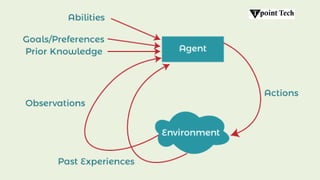
An AI system is made up of an agent and its environment. Agents work in their environment, and the environment may include other agents.
https://bit.ly/what-is-ai-agent
Artificial Intelligence isdefined as the study of rational agents.
A rational agent may take the form of a person, firm, machine,
or software to make decisions. It works with the best results
after considering past and present perceptions An AI system is
made up of an agent and its environment. Agents work in their
environment, and the environment may include other agents.
www.tpointtech.com
AI
ABOUT
3.
EXAMPLES:
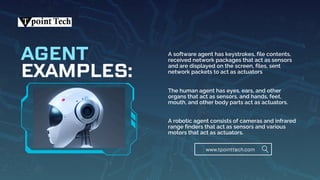
AGENT A softwareagent has keystrokes, file contents,
received network packages that act as sensors
and are displayed on the screen, files, sent
network packets to act as actuators
The human agent has eyes, ears, and other
organs that act as sensors, and hands, feet,
mouth, and other body parts act as actuators.
A robotic agent consists of cameras and infrared
range finders that act as sensors and various
motors that act as actuators.
www.tpointtech.com
AGENT
SIMPLE REFLEX
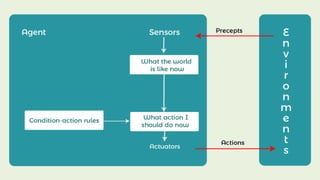
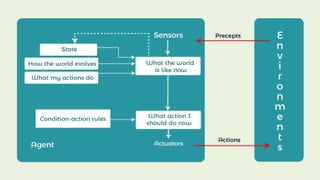
Simple reflexagents act only on the current percept, ignoring percept history. They use
condition-action rules: if a condition is true, they perform the corresponding action. These
agents work well only in fully observable environments. In partially observable settings, they
risk falling into infinite loops—unless they randomize actions to avoid them.
Minimal intelligence.
There is no knowledge of the non-perceptual parts of the state.
It is usually too large to generate and store.
If a change occurs in the environment, the rules collection needs to be
updated.
The problems with simple reflex agents are:
8.
AGENTS:
MODEL-BASED
REFLEX
A model-based agentuses a world model to handle partially
observable environments. It tracks an internal state based on
percept history, updating it with each new percept to represent
unseen parts of the world.
Updating the state requires information about:
How the world develops independently of the agent, and
How the agent's actions affect the world.
10.
www.tpointtech.com
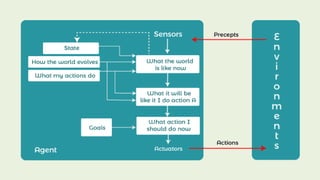
Goal-based agents makedecisions by evaluating how close they are to their goals.
Each action aims to reduce the distance to the target. Their decision-making is
flexible, supported by modifiable knowledge, and involves discovery and planning.
Their behavior is easy to change.
AGENT
GOAL-BASED
12.
AGENT
UTILITY-BASED
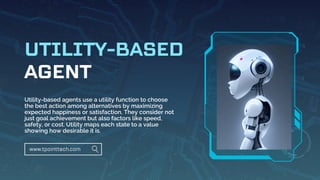
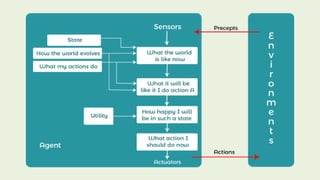
Utility-based agents usea utility function to choose
the best action among alternatives by maximizing
expected happiness or satisfaction. They consider not
just goal achievement but also factors like speed,
safety, or cost. Utility maps each state to a value
showing how desirable it is.
www.tpointtech.com
14.
AGENT
LEARNING
www.reallygreatsite.com
A learning agentin AI is the type of agent
that can learn from its past experiences or
it has learning capabilities. It starts to act
with basic knowledge and then is able to
act and adapt automatically through
learning.
15.
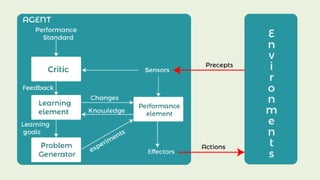
1. Learning element:It is responsible for making improvements by learning from
the environment
A learning agent has mainly four conceptual components, which are:
2. Critic: The learning element takes feedback from critics, which describe how
well the agent is doing to a fixed performance standard.
3. Performance element: It is responsible for selecting external action
4. Problem Generator: This component is responsible for suggesting actions that
will lead to new and informative experiences.
17.
www.reallygreatsite.com
ENVIRONMENT
THE NATURE OF
Someprograms run in simple artificial environments, limited to keyboard
input, file systems, and screen output. In contrast, software agents, also
known as softbots, operate in rich, complex simulated environments,
handling a wide range of real-time tasks.
For example, a softbot that recommends items based on a customer's
online behavior operates in both real and artificial environments.
A well-known artificial environment is the Turing Test, where human and
software agents are tested equally. This is highly challenging, as it's hard for
a software agent to match human performance.