MODULE 1
INTRODUCTION TO
ARTIFICIAL INTELLIGENCE
Prepared By
Sneha Kashyap
Assistant Professor
CS & IT
ARKA JAIN University
Content
▪ Artificial Intelligence: Role of AI in Engineering.
▪ AI in Daily Life
▪ Intelligence and Artificial Intelligence
▪ Different Task domain in AI.
▪ Programming Methods
▪ Limitation of AI
▪ Intelligent Agent: Agent, Performance Evaluation
▪ Task environment of agent, Agent Classification, Agent Architecture.
Intelligence and Artificial
Intelligence
▪ Intelligence : “ The Capacity to learn and solve problems.”
▪ Artificial Intelligence: It is the simulation of human intelligence by
machines.
1. The ability to solve problem.
2. The ability to act rationally.
3. The ability to act like humans.
▪ The central Principles of AI includes
1. Reasoning, knowledge, planning, learning and communication.
2. Perception and the ability to move and manipulate objects.
3. It is a Science and Engineering of making intelligent machines,
especially intelligent computer programs.
Definition
▪ Computers with the ability to mimic or
duplicate the functions of the human brain.
▪ AI is the intelligence of machines and the
branch of computer science which aims to
create it.
▪ “The branch of computer science that is
concerned with the automation of intelligent
behavior”
- Luger and Stubblefield in 1993.
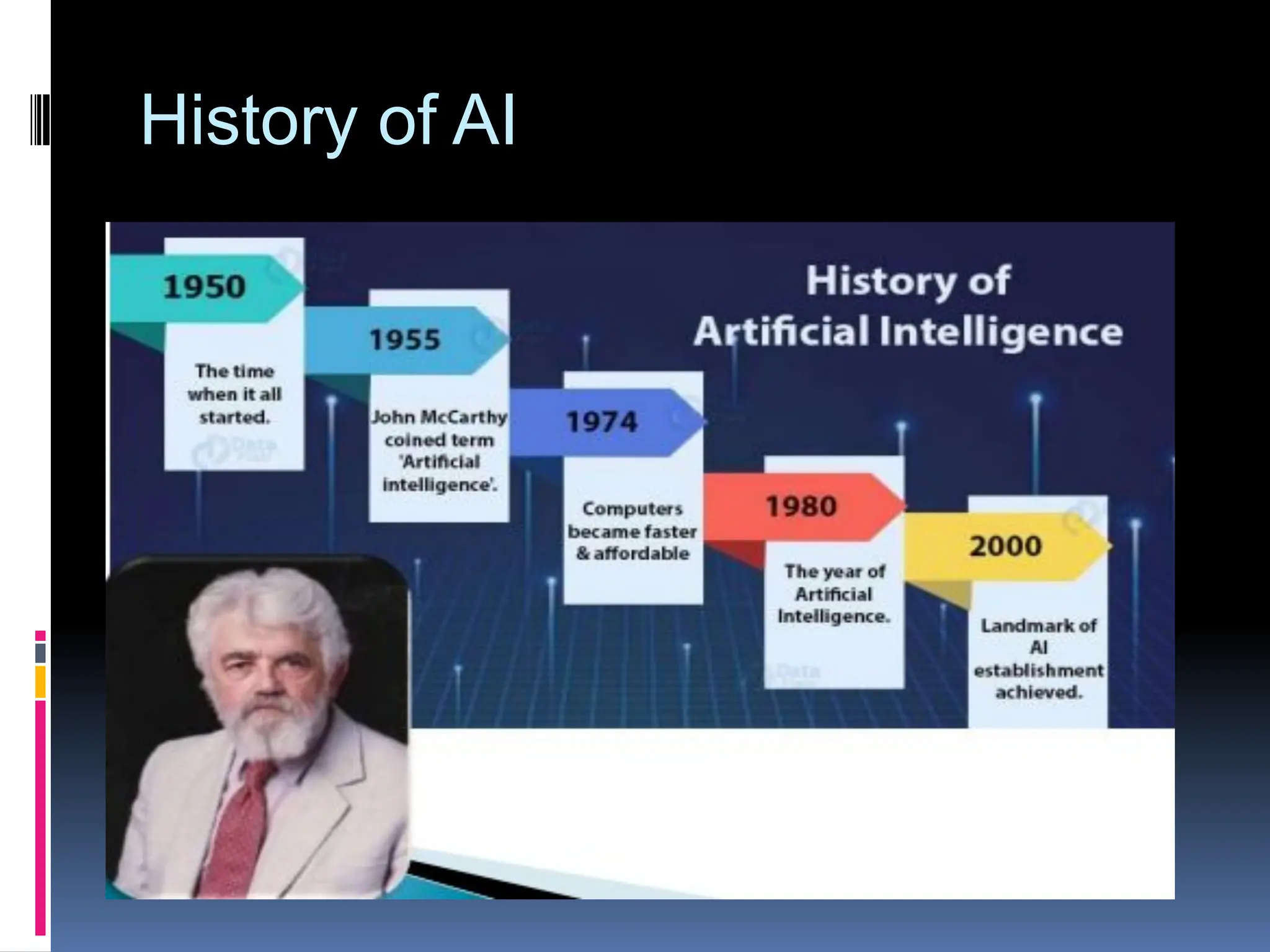
History of AI
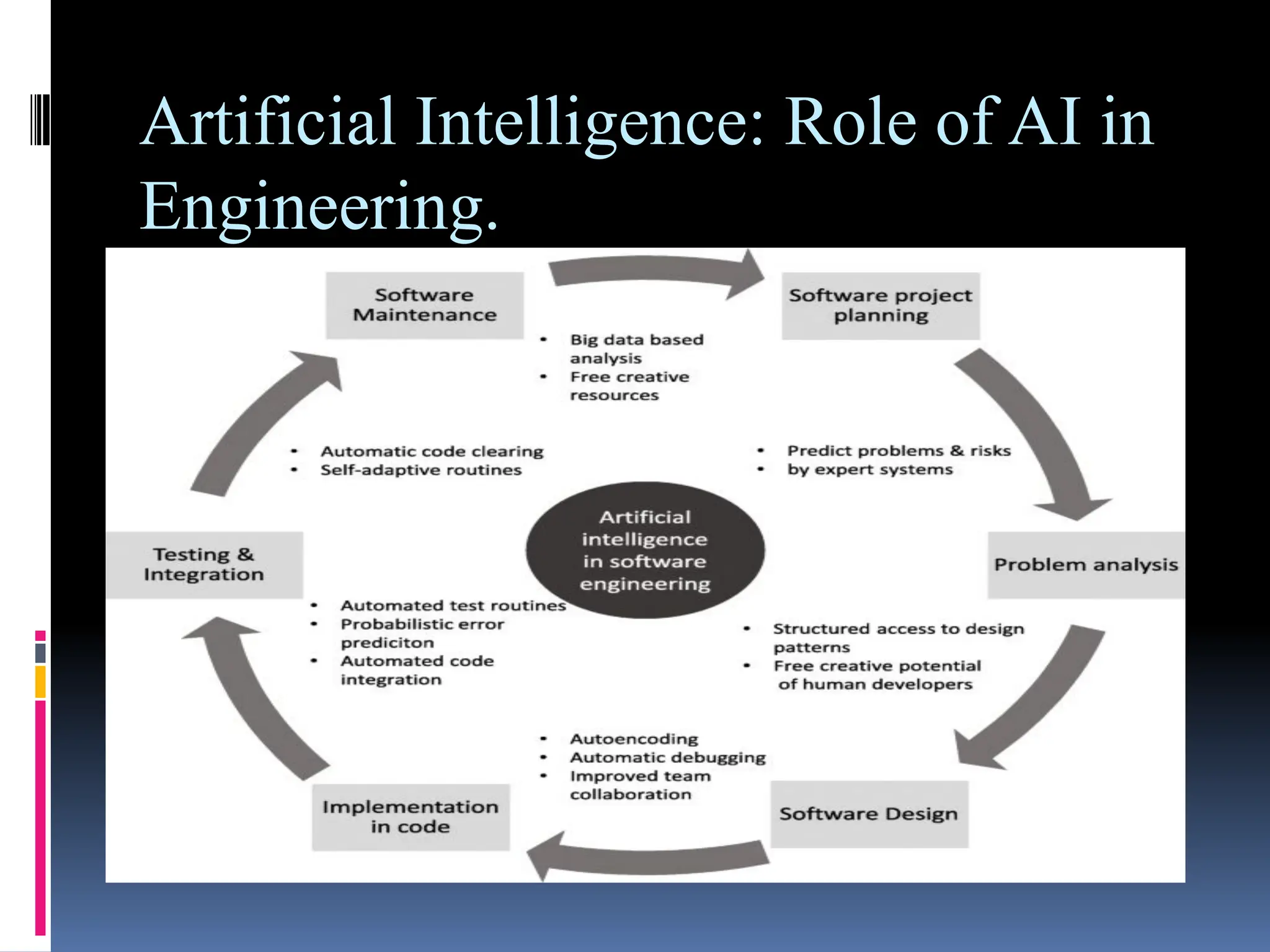
Artificial Intelligence: Role of AI in
Engineering.
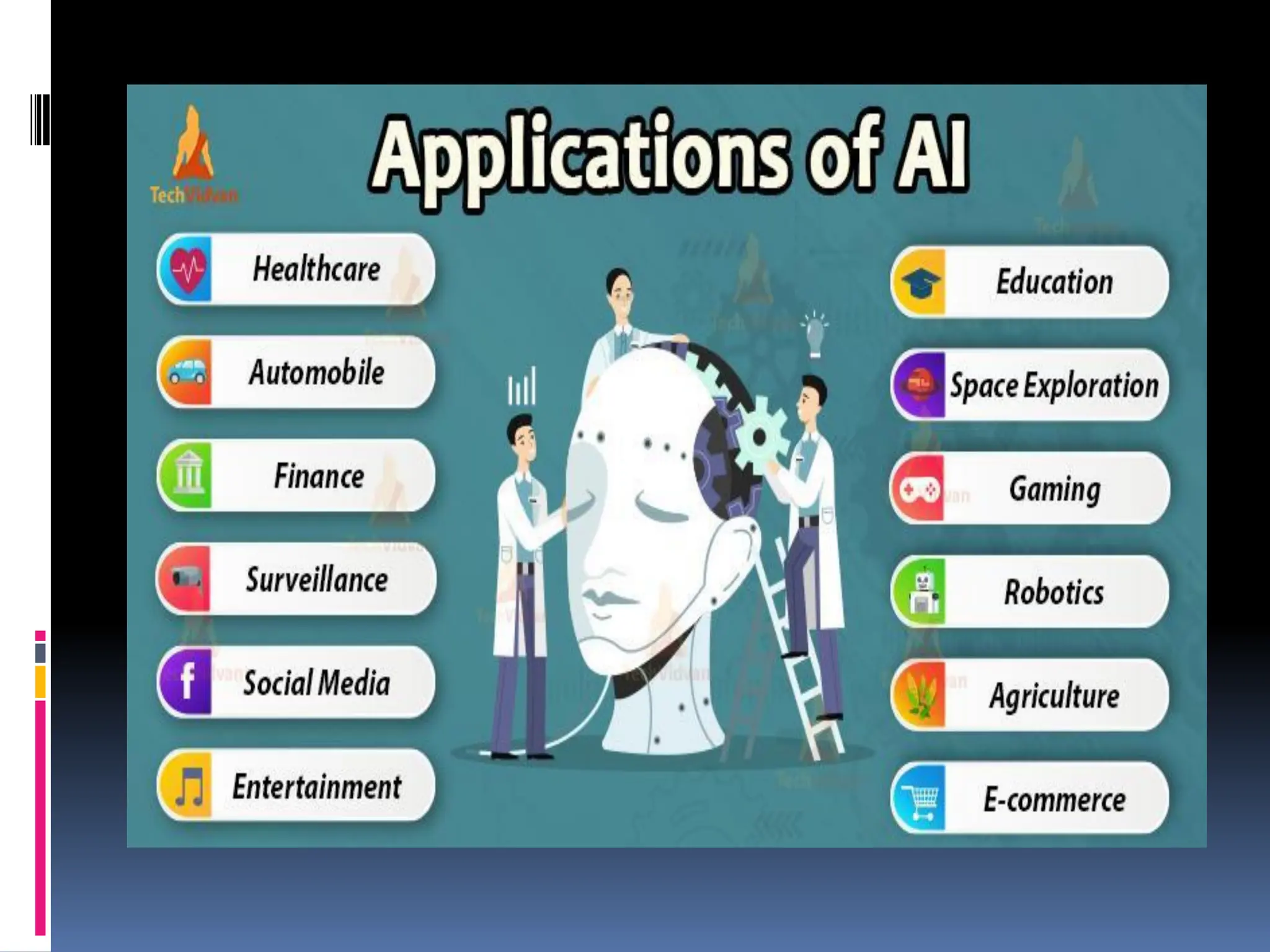
AI in Daily Life
Different Task domain in AI.
The domain of AI is huge in breadth and width.
While processing we consider the broadly common and prospering research area in the domain of AI
•Expert System
•Neural Networks
•Robotics
•Fuzzy Logic
•Natural Language Processing
Programming Methods
Limitation of AI
▪ High Cost: The hardware and software requirement of AI is very costly as it requires lots of
maintenance to meet current world requirements.
▪ Can't think out of the box: Even we are making smarter machines with AI, but still they cannot
work out of the box, as the robot will only do that work for which they are trained, or programmed.
▪ No feelings and emotions: AI machines can be an outstanding performer, but still it does not have
the feeling so it cannot make any kind of emotional attachment with human, and may sometime be
harmful for users if the proper care is not taken.
▪ Increase dependency on machines: With the increment of technology, people are getting more
dependent on devices and hence they are losing their mental capabilities.
▪ No Original Creativity: As humans are so creative and can imagine some new ideas but still AI
machines cannot beat this power of human intelligence and cannot be creative and imaginative.
Intelligent Agent: Agent, Performance
Evaluation
▪ An AI system can be defined as the study of the rational agent
and its environment. The agents sense the environment through
sensors and act on their environment through actuators. An AI
agent can have mental properties such as knowledge, belief,
intention, etc.
What is an Agent?
▪ An agent can be anything that perceive its environment through
sensors and act upon that environment through actuators. An
Agent runs in the cycle of perceiving, thinking, and acting.
An agent can be:
▪ Human-Agent: A human agent has eyes, ears, and
other organs which work for sensors and hand, legs,
vocal tract work for actuators.
▪ Robotic Agent: A robotic agent can have cameras,
infrared range finder, NLP for sensors and various
motors for actuators.
▪ Software Agent: Software agent can have keystrokes,
file contents as sensory input and act on those inputs
and display output on the screen.
▪ Hence the world around us is full of agents such as
thermostat, cell phone, camera, and even we are also
agents.
▪ Before moving forward, we should first know about sensors,
effectors, and actuators.
1. Sensor: Sensor is a device which detects the change in the
environment and sends the information to other electronic
devices. An agent observes its environment through sensors.
2. Actuators: Actuators are the component of machines that
converts energy into motion. The actuators are only
responsible for moving and controlling a system. An actuator
can be an electric motor, gears, rails, etc.
3. Effectors: Effectors are the devices which affect the
environment. Effectors can be legs, wheels, arms, fingers,
wings, fins, and display screen.
Rules for an AI agent:
▪ Rule 1: An AI agent must have the ability to perceive the
environment.
▪ Rule 2: The observation must be used to make decisions.
▪ Rule 3: Decision should result in an action.
▪ Rule 4: The action taken by an AI agent must be a rational action.
Types of AI Agent
1. Simple Reflex Agent
2. Model-based reflex agent
3. Goal-based agents
4. Utility-based agent
5. Learning agent
Simple Reflex agent
▪ The Simple reflex agents are the simplest agents. These agents
take decisions on the basis of the current percepts and ignore
the rest of the percept history.
▪ These agents only succeed in the fully observable environment.
▪ The Simple reflex agent does not consider any part of percepts
history during their decision and action process.
▪ The Simple reflex agent works on Condition-action rule, which
means it maps the current state to action. Such as a Room
Cleaner agent, it works only if there is dirt in the room.
▪ Problems for the simple reflex agent design approach:
They have very limited intelligence
They do not have knowledge of non-perceptual parts of the
current state
Mostly too big to generate and to store.
Not adaptive to changes in the environment.
Model-based reflex agent
▪ The Model-based agent can work in a partially observable
environment, and track the situation.
▪ A model-based agent has two important factors:
Model: It is knowledge about "how things happen in the
world," so it is called a Model-based agent.
Internal State: It is a representation of the current state
based on percept history.
▪ These agents have the model, "which is knowledge of the
world" and based on the model they perform actions.
▪ Updating the agent state requires information about:
How the world evolves
How the agent's action affects the world.
Goal-based agents
▪ The knowledge of the current state environment is not
always sufficient to decide for an agent to what to do.
▪ The agent needs to know its goal which describes
desirable situations.
▪ Goal-based agents expand the capabilities of the
model-based agent by having the "goal" information.
▪ They choose an action, so that they can achieve the
goal.
▪ These agents may have to consider a long sequence of
possible actions before deciding whether the goal is
achieved or not. Such considerations of different
scenario are called searching and planning, which
makes an agent proactive.
Utility-based agents
▪ These agents are similar to the goal-based agent but
provide an extra component of utility measurement
which makes them different by providing a measure of
success at a given state.
▪ Utility-based agent act based not only goals but also
the best way to achieve the goal.
▪ The Utility-based agent is useful when there are
multiple possible alternatives, and an agent has to
choose in order to perform the best action.
▪ The utility function maps each state to a real number to
check how efficiently each action achieves the goals.
Learning Agents
▪ A learning agent in AI is the type of agent which can learn from its
past experiences, or it has learning capabilities.
▪ It starts to act with basic knowledge and then able to act and adapt
automatically through learning.
▪ A learning agent has mainly four conceptual components, which are:
Learning element: It is responsible for making improvements by
learning from environment
Critic: Learning element takes feedback from critic which
describes that how well the agent is doing with respect to a fixed
performance standard.
Performance element: It is responsible for selecting external
action
Problem generator: This component is responsible for
suggesting actions that will lead to new and informative
experiences.
▪ Hence, learning agents are able to learn, analyze performance, and
look for new ways to improve the performance.
Advantages and Disadvantages
Advantage Disadvantage
▪ More powerful and more
useful computers.
▪ New and improved
interfaces
▪ Solving new Problems
▪ Better handling of
information
▪ Conversion of information
into knowledge
▪ Increased cost
▪ Difficult with software
development – slow and
expensive
▪ Few experienced
programmer
▪ Few practical product have
reached the market as yet.

AI Module 1.pptx.pdf Artificial Intelligence Notes

  • 1.
    MODULE 1 INTRODUCTION TO ARTIFICIALINTELLIGENCE Prepared By Sneha Kashyap Assistant Professor CS & IT ARKA JAIN University
  • 2.
    Content ▪ Artificial Intelligence:Role of AI in Engineering. ▪ AI in Daily Life ▪ Intelligence and Artificial Intelligence ▪ Different Task domain in AI. ▪ Programming Methods ▪ Limitation of AI ▪ Intelligent Agent: Agent, Performance Evaluation ▪ Task environment of agent, Agent Classification, Agent Architecture.
  • 3.
    Intelligence and Artificial Intelligence ▪Intelligence : “ The Capacity to learn and solve problems.” ▪ Artificial Intelligence: It is the simulation of human intelligence by machines. 1. The ability to solve problem. 2. The ability to act rationally. 3. The ability to act like humans. ▪ The central Principles of AI includes 1. Reasoning, knowledge, planning, learning and communication. 2. Perception and the ability to move and manipulate objects. 3. It is a Science and Engineering of making intelligent machines, especially intelligent computer programs.
  • 4.
    Definition ▪ Computers withthe ability to mimic or duplicate the functions of the human brain. ▪ AI is the intelligence of machines and the branch of computer science which aims to create it. ▪ “The branch of computer science that is concerned with the automation of intelligent behavior” - Luger and Stubblefield in 1993.
  • 5.
  • 6.
    Artificial Intelligence: Roleof AI in Engineering.
  • 7.
  • 8.
    Different Task domainin AI. The domain of AI is huge in breadth and width. While processing we consider the broadly common and prospering research area in the domain of AI •Expert System •Neural Networks •Robotics •Fuzzy Logic •Natural Language Processing
  • 9.
  • 11.
    Limitation of AI ▪High Cost: The hardware and software requirement of AI is very costly as it requires lots of maintenance to meet current world requirements. ▪ Can't think out of the box: Even we are making smarter machines with AI, but still they cannot work out of the box, as the robot will only do that work for which they are trained, or programmed. ▪ No feelings and emotions: AI machines can be an outstanding performer, but still it does not have the feeling so it cannot make any kind of emotional attachment with human, and may sometime be harmful for users if the proper care is not taken. ▪ Increase dependency on machines: With the increment of technology, people are getting more dependent on devices and hence they are losing their mental capabilities. ▪ No Original Creativity: As humans are so creative and can imagine some new ideas but still AI machines cannot beat this power of human intelligence and cannot be creative and imaginative.
  • 12.
    Intelligent Agent: Agent,Performance Evaluation ▪ An AI system can be defined as the study of the rational agent and its environment. The agents sense the environment through sensors and act on their environment through actuators. An AI agent can have mental properties such as knowledge, belief, intention, etc. What is an Agent? ▪ An agent can be anything that perceive its environment through sensors and act upon that environment through actuators. An Agent runs in the cycle of perceiving, thinking, and acting.
  • 13.
    An agent canbe: ▪ Human-Agent: A human agent has eyes, ears, and other organs which work for sensors and hand, legs, vocal tract work for actuators. ▪ Robotic Agent: A robotic agent can have cameras, infrared range finder, NLP for sensors and various motors for actuators. ▪ Software Agent: Software agent can have keystrokes, file contents as sensory input and act on those inputs and display output on the screen. ▪ Hence the world around us is full of agents such as thermostat, cell phone, camera, and even we are also agents.
  • 14.
    ▪ Before movingforward, we should first know about sensors, effectors, and actuators. 1. Sensor: Sensor is a device which detects the change in the environment and sends the information to other electronic devices. An agent observes its environment through sensors. 2. Actuators: Actuators are the component of machines that converts energy into motion. The actuators are only responsible for moving and controlling a system. An actuator can be an electric motor, gears, rails, etc. 3. Effectors: Effectors are the devices which affect the environment. Effectors can be legs, wheels, arms, fingers, wings, fins, and display screen.
  • 15.
    Rules for anAI agent: ▪ Rule 1: An AI agent must have the ability to perceive the environment. ▪ Rule 2: The observation must be used to make decisions. ▪ Rule 3: Decision should result in an action. ▪ Rule 4: The action taken by an AI agent must be a rational action.
  • 16.
    Types of AIAgent 1. Simple Reflex Agent 2. Model-based reflex agent 3. Goal-based agents 4. Utility-based agent 5. Learning agent
  • 17.
  • 18.
    ▪ The Simplereflex agents are the simplest agents. These agents take decisions on the basis of the current percepts and ignore the rest of the percept history. ▪ These agents only succeed in the fully observable environment. ▪ The Simple reflex agent does not consider any part of percepts history during their decision and action process. ▪ The Simple reflex agent works on Condition-action rule, which means it maps the current state to action. Such as a Room Cleaner agent, it works only if there is dirt in the room. ▪ Problems for the simple reflex agent design approach: They have very limited intelligence They do not have knowledge of non-perceptual parts of the current state Mostly too big to generate and to store. Not adaptive to changes in the environment.
  • 19.
    Model-based reflex agent ▪The Model-based agent can work in a partially observable environment, and track the situation. ▪ A model-based agent has two important factors: Model: It is knowledge about "how things happen in the world," so it is called a Model-based agent. Internal State: It is a representation of the current state based on percept history. ▪ These agents have the model, "which is knowledge of the world" and based on the model they perform actions. ▪ Updating the agent state requires information about: How the world evolves How the agent's action affects the world.
  • 21.
    Goal-based agents ▪ Theknowledge of the current state environment is not always sufficient to decide for an agent to what to do. ▪ The agent needs to know its goal which describes desirable situations. ▪ Goal-based agents expand the capabilities of the model-based agent by having the "goal" information. ▪ They choose an action, so that they can achieve the goal. ▪ These agents may have to consider a long sequence of possible actions before deciding whether the goal is achieved or not. Such considerations of different scenario are called searching and planning, which makes an agent proactive.
  • 23.
    Utility-based agents ▪ Theseagents are similar to the goal-based agent but provide an extra component of utility measurement which makes them different by providing a measure of success at a given state. ▪ Utility-based agent act based not only goals but also the best way to achieve the goal. ▪ The Utility-based agent is useful when there are multiple possible alternatives, and an agent has to choose in order to perform the best action. ▪ The utility function maps each state to a real number to check how efficiently each action achieves the goals.
  • 25.
    Learning Agents ▪ Alearning agent in AI is the type of agent which can learn from its past experiences, or it has learning capabilities. ▪ It starts to act with basic knowledge and then able to act and adapt automatically through learning. ▪ A learning agent has mainly four conceptual components, which are: Learning element: It is responsible for making improvements by learning from environment Critic: Learning element takes feedback from critic which describes that how well the agent is doing with respect to a fixed performance standard. Performance element: It is responsible for selecting external action Problem generator: This component is responsible for suggesting actions that will lead to new and informative experiences. ▪ Hence, learning agents are able to learn, analyze performance, and look for new ways to improve the performance.
  • 27.
    Advantages and Disadvantages AdvantageDisadvantage ▪ More powerful and more useful computers. ▪ New and improved interfaces ▪ Solving new Problems ▪ Better handling of information ▪ Conversion of information into knowledge ▪ Increased cost ▪ Difficult with software development – slow and expensive ▪ Few experienced programmer ▪ Few practical product have reached the market as yet.