IPCC AR5 Synthesis Report
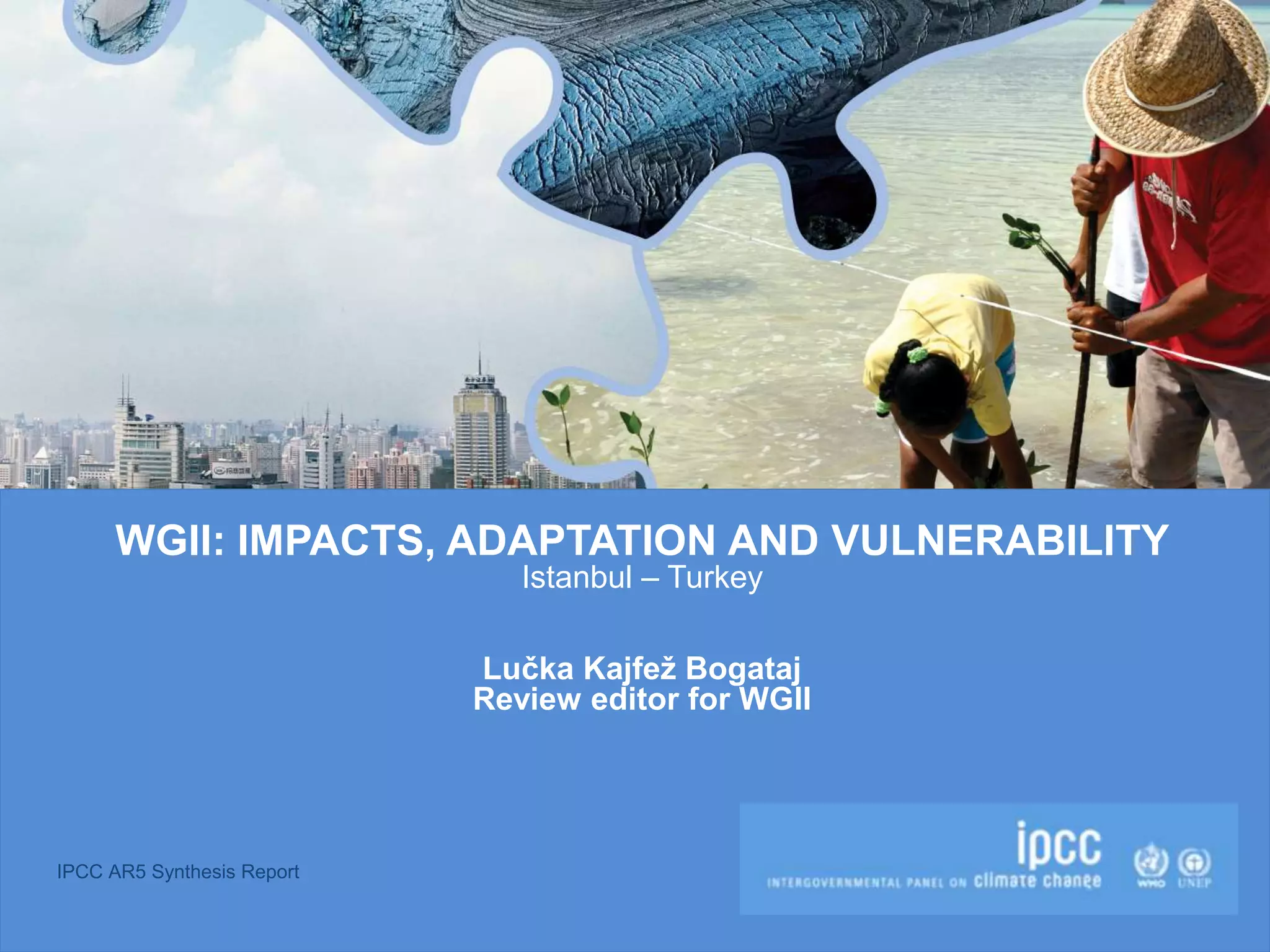
WGII: IMPACTS, ADAPTATION AND VULNERABILITY
Istanbul – Turkey
Lučka Kajfež Bogataj
Review editor for WGII
Climate Change is a Large Issue
Majority of the sciences and engineering
disciplines are involved.
Social sciences are interested.
Business/Industry has a stake.
Involves citizens, politicians, public policy experts,
and advocates.
Every sector of the economy affected.
All aspects of our lives touched:
environment, jobs, health, politics, national
security, arts, religion, etc.
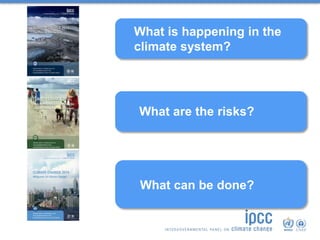
What is happening in the
climate system?
What are the risks?
What can be done?
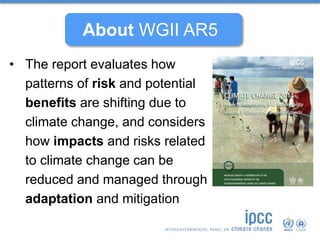
• The report evaluates how
patterns of risk and potential
benefits are shifting due to
climate change, and considers
how impacts and risks related
to climate change can be
reduced and managed through
adaptation and mitigation
About WGII AR5
IPCC AR5 Synthesis Report
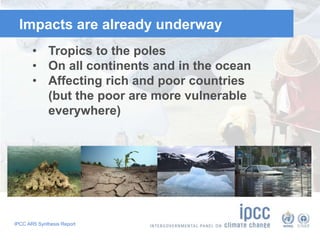
Impacts are already underway
• Tropics to the poles
• On all continents and in the ocean
• Affecting rich and poor countries
(but the poor are more vulnerable
everywhere)
AR5 WGII SPM
IPCC AR5 Synthesis Report
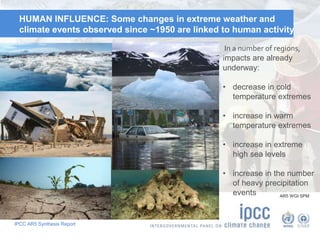
HUMAN INFLUENCE: Some changes in extreme weather and
climate events observed since ~1950 are linked to human activity
AR5 WGI SPM
In a number of regions,
impacts are already
underway:
• decrease in cold
temperature extremes
• increase in warm
temperature extremes
• increase in extreme
high sea levels
• increase in the number
of heavy precipitation
events
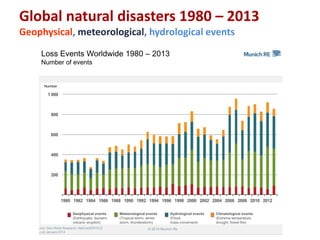
Global natural disasters 1980 – 2013
Geophysical, meteorological, hydrological events
IPCC AR5 Synthesis Report
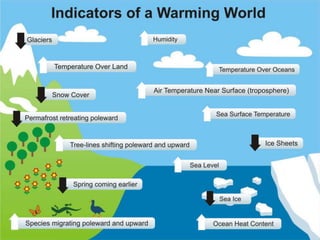
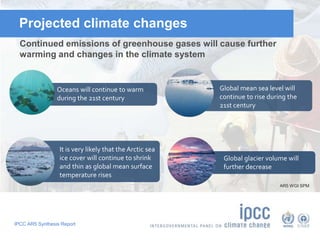
Projected climate changes
Continued emissions of greenhouse gases will cause further
warming and changes in the climate system
Global glacier volume will
further decrease
Global mean sea level will
continue to rise during the
21st century
It is very likely that the Arctic sea
ice cover will continue to shrink
and thin as global mean surface
temperature rises
Oceans will continue to warm
during the 21st century
AR5 WGI SPM
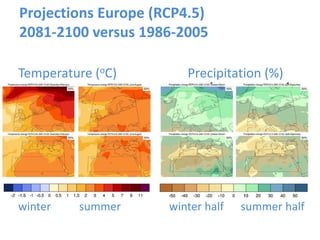
Projections Europe (RCP4.5)
2081-2100 versus 1986-2005
Temperature (oC) Precipitation (%)
winter summer winter half summer half
IPCC AR5 Synthesis Report
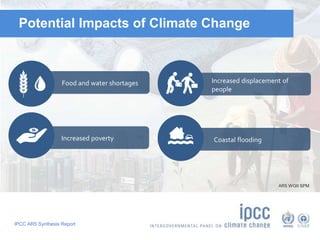
Potential Impacts of Climate Change
Food and water shortages
Increased poverty
Increased displacement of
people
Coastal flooding
AR5 WGII SPM
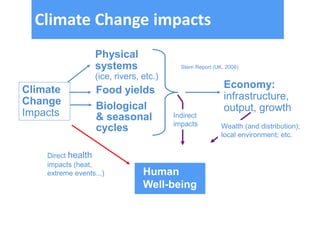
Climate Change impacts
Climate
Change
Impacts
Physical
systems
(ice, rivers, etc.)
Biological
& seasonal
cycles
Economy:
infrastructure,
output, growth
Stern Report (UK, 2006)
Human
Well-being
Indirect
impacts Wealth (and distribution);
local environment; etc.
Direct health
impacts (heat,
extreme events...)
Food yields
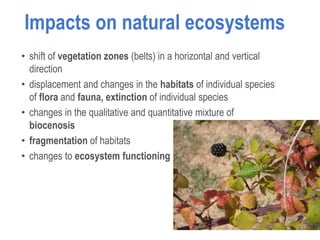
Impacts on natural ecosystems
• shift of vegetation zones (belts) in a horizontal and vertical
direction
• displacement and changes in the habitats of individual species
of flora and fauna, extinction of individual species
• changes in the qualitative and quantitative mixture of
biocenosis
• fragmentation of habitats
• changes to ecosystem functioning
Impacts of sea level rise
• Increased river and storm flooding
• Accelerated coastal erosion – impacts on tourism
• Seawater intrusion into coastal ground water –
salinization of fresh water
• Encroachment of seawater into wetlands and
estuaries – destruction of habitats
• Impacts on coastal installations.
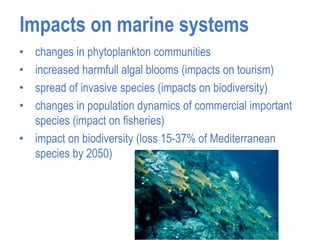
• changes in phytoplankton communities
• increased harmfull algal blooms (impacts on tourism)
• spread of invasive species (impacts on biodiversity)
• changes in population dynamics of commercial important
species (impact on fisheries)
• impact on biodiversity (loss 15-37% of Mediterranean
species by 2050)
Impacts on marine systems
IPCC AR5 Synthesis Report
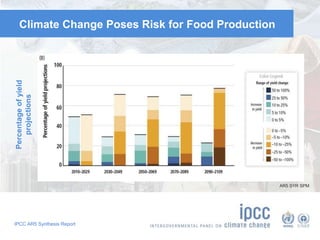
Climate Change Poses Risk for Food Production
AR5 SYR SPM
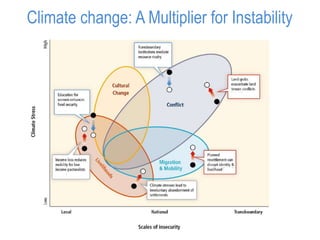
Climate change: A Multiplier for Instability
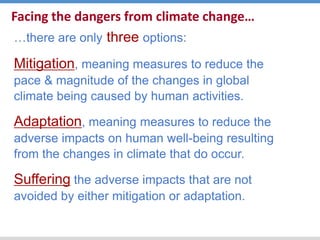
Facing the dangers from climate change…
…there are only three options:
Mitigation, meaning measures to reduce the
pace & magnitude of the changes in global
climate being caused by human activities.
Adaptation, meaning measures to reduce the
adverse impacts on human well-being resulting
from the changes in climate that do occur.
Suffering the adverse impacts that are not
avoided by either mitigation or adaptation.
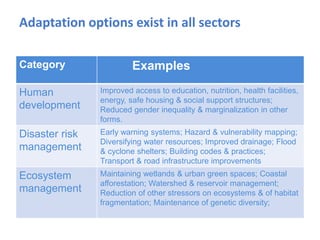
Adaptation options exist in all sectors
Category Examples
Human
development
Improved access to education, nutrition, health facilities,
energy, safe housing & social support structures;
Reduced gender inequality & marginalization in other
forms.
Disaster risk
management
Early warning systems; Hazard & vulnerability mapping;
Diversifying water resources; Improved drainage; Flood
& cyclone shelters; Building codes & practices;
Transport & road infrastructure improvements
Ecosystem
management
Maintaining wetlands & urban green spaces; Coastal
afforestation; Watershed & reservoir management;
Reduction of other stressors on ecosystems & of habitat
fragmentation; Maintenance of genetic diversity;
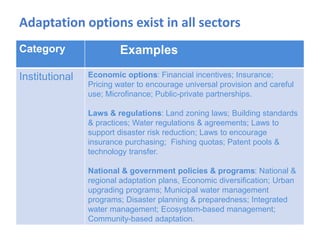
Adaptation options exist in all sectors
Category Examples
Institutional Economic options: Financial incentives; Insurance;
Pricing water to encourage universal provision and careful
use; Microfinance; Public-private partnerships.
Laws & regulations: Land zoning laws; Building standards
& practices; Water regulations & agreements; Laws to
support disaster risk reduction; Laws to encourage
insurance purchasing; Fishing quotas; Patent pools &
technology transfer.
National & government policies & programs: National &
regional adaptation plans, Economic diversification; Urban
upgrading programs; Municipal water management
programs; Disaster planning & preparedness; Integrated
water management; Ecosystem-based management;
Community-based adaptation.
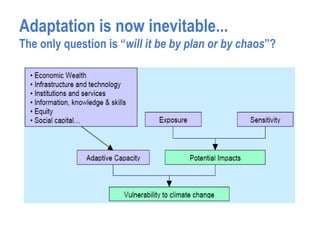
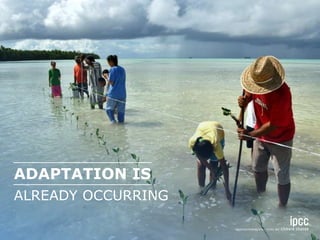
Adaptation is now inevitable...
The only question is “will it be by plan or by chaos”?
ALREADY OCCURRING
ADAPTATION IS
http://climate-adapt.eea.europa.eu/home
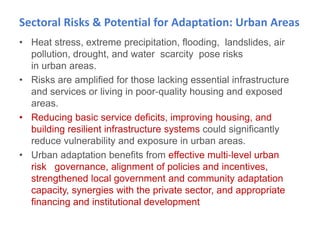
Sectoral Risks & Potential for Adaptation: Urban Areas
• Heat stress, extreme precipitation, flooding, landslides, air
pollution, drought, and water scarcity pose risks
in urban areas.
• Risks are amplified for those lacking essential infrastructure
and services or living in poor‐quality housing and exposed
areas.
• Reducing basic service deficits, improving housing, and
building resilient infrastructure systems could significantly
reduce vulnerability and exposure in urban areas.
• Urban adaptation benefits from effective multi‐level urban
risk governance, alignment of policies and incentives,
strengthened local government and community adaptation
capacity, synergies with the private sector, and appropriate
financing and institutional development
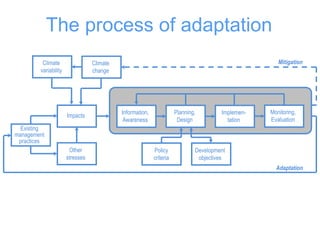
Climate
change
Impacts Response
Development
objectives
Policy
criteria
Mitigation
Adaptation
Monitoring,
Evaluation
Other
stresses
Existing
management
practices
Climate
variability
Information,
Awareness
Planning,
Design
Implemen-
tation
The process of adaptation
IPCC AR5 Synthesis Report
Conclusions
➜ IPCC WGII has made a sober assessment of the impacts
of climate change. They are significant, vary by region
and country and pose important threats to our future.
➜ The report concludes that while impacts in the next 30
years or so are not dependent on mitigation, after that
time they depend a lot on what emissions scenario we
face.
➜ On adaptation it is more optimistic for several areas. We
can adapt to a significant extent if we take the right
actions.
➜ The key is to focus on developing adaptation strategies
that are inclusive, flexible, that look at the wider picture
and that are based on a realistic estimate of the
benefits.

WGII: Overview

  • 1.
    IPCC AR5 SynthesisReport WGII: IMPACTS, ADAPTATION AND VULNERABILITY Istanbul – Turkey Lučka Kajfež Bogataj Review editor for WGII
  • 2.
    Climate Change isa Large Issue Majority of the sciences and engineering disciplines are involved. Social sciences are interested. Business/Industry has a stake. Involves citizens, politicians, public policy experts, and advocates. Every sector of the economy affected. All aspects of our lives touched: environment, jobs, health, politics, national security, arts, religion, etc.
  • 3.
    What is happeningin the climate system? What are the risks? What can be done?
  • 4.
    • The reportevaluates how patterns of risk and potential benefits are shifting due to climate change, and considers how impacts and risks related to climate change can be reduced and managed through adaptation and mitigation About WGII AR5
  • 6.
    IPCC AR5 SynthesisReport Impacts are already underway • Tropics to the poles • On all continents and in the ocean • Affecting rich and poor countries (but the poor are more vulnerable everywhere) AR5 WGII SPM
  • 7.
    IPCC AR5 SynthesisReport HUMAN INFLUENCE: Some changes in extreme weather and climate events observed since ~1950 are linked to human activity AR5 WGI SPM In a number of regions, impacts are already underway: • decrease in cold temperature extremes • increase in warm temperature extremes • increase in extreme high sea levels • increase in the number of heavy precipitation events
  • 8.
    Global natural disasters1980 – 2013 Geophysical, meteorological, hydrological events
  • 9.
    IPCC AR5 SynthesisReport Projected climate changes Continued emissions of greenhouse gases will cause further warming and changes in the climate system Global glacier volume will further decrease Global mean sea level will continue to rise during the 21st century It is very likely that the Arctic sea ice cover will continue to shrink and thin as global mean surface temperature rises Oceans will continue to warm during the 21st century AR5 WGI SPM
  • 11.
    Projections Europe (RCP4.5) 2081-2100versus 1986-2005 Temperature (oC) Precipitation (%) winter summer winter half summer half
  • 13.
    IPCC AR5 SynthesisReport Potential Impacts of Climate Change Food and water shortages Increased poverty Increased displacement of people Coastal flooding AR5 WGII SPM
  • 14.
    Climate Change impacts Climate Change Impacts Physical systems (ice,rivers, etc.) Biological & seasonal cycles Economy: infrastructure, output, growth Stern Report (UK, 2006) Human Well-being Indirect impacts Wealth (and distribution); local environment; etc. Direct health impacts (heat, extreme events...) Food yields
  • 15.
    Impacts on naturalecosystems • shift of vegetation zones (belts) in a horizontal and vertical direction • displacement and changes in the habitats of individual species of flora and fauna, extinction of individual species • changes in the qualitative and quantitative mixture of biocenosis • fragmentation of habitats • changes to ecosystem functioning
  • 16.
    Impacts of sealevel rise • Increased river and storm flooding • Accelerated coastal erosion – impacts on tourism • Seawater intrusion into coastal ground water – salinization of fresh water • Encroachment of seawater into wetlands and estuaries – destruction of habitats • Impacts on coastal installations.
  • 17.
    • changes inphytoplankton communities • increased harmfull algal blooms (impacts on tourism) • spread of invasive species (impacts on biodiversity) • changes in population dynamics of commercial important species (impact on fisheries) • impact on biodiversity (loss 15-37% of Mediterranean species by 2050) Impacts on marine systems
  • 19.
    IPCC AR5 SynthesisReport Climate Change Poses Risk for Food Production AR5 SYR SPM
  • 20.
    Climate change: AMultiplier for Instability
  • 21.
    Facing the dangersfrom climate change… …there are only three options: Mitigation, meaning measures to reduce the pace & magnitude of the changes in global climate being caused by human activities. Adaptation, meaning measures to reduce the adverse impacts on human well-being resulting from the changes in climate that do occur. Suffering the adverse impacts that are not avoided by either mitigation or adaptation.
  • 22.
    Adaptation options existin all sectors Category Examples Human development Improved access to education, nutrition, health facilities, energy, safe housing & social support structures; Reduced gender inequality & marginalization in other forms. Disaster risk management Early warning systems; Hazard & vulnerability mapping; Diversifying water resources; Improved drainage; Flood & cyclone shelters; Building codes & practices; Transport & road infrastructure improvements Ecosystem management Maintaining wetlands & urban green spaces; Coastal afforestation; Watershed & reservoir management; Reduction of other stressors on ecosystems & of habitat fragmentation; Maintenance of genetic diversity;
  • 23.
    Adaptation options existin all sectors Category Examples Institutional Economic options: Financial incentives; Insurance; Pricing water to encourage universal provision and careful use; Microfinance; Public-private partnerships. Laws & regulations: Land zoning laws; Building standards & practices; Water regulations & agreements; Laws to support disaster risk reduction; Laws to encourage insurance purchasing; Fishing quotas; Patent pools & technology transfer. National & government policies & programs: National & regional adaptation plans, Economic diversification; Urban upgrading programs; Municipal water management programs; Disaster planning & preparedness; Integrated water management; Ecosystem-based management; Community-based adaptation.
  • 24.
    Adaptation is nowinevitable... The only question is “will it be by plan or by chaos”?
  • 25.
  • 26.
  • 27.
    Sectoral Risks &Potential for Adaptation: Urban Areas • Heat stress, extreme precipitation, flooding, landslides, air pollution, drought, and water scarcity pose risks in urban areas. • Risks are amplified for those lacking essential infrastructure and services or living in poor‐quality housing and exposed areas. • Reducing basic service deficits, improving housing, and building resilient infrastructure systems could significantly reduce vulnerability and exposure in urban areas. • Urban adaptation benefits from effective multi‐level urban risk governance, alignment of policies and incentives, strengthened local government and community adaptation capacity, synergies with the private sector, and appropriate financing and institutional development
  • 28.
  • 29.
    IPCC AR5 SynthesisReport Conclusions ➜ IPCC WGII has made a sober assessment of the impacts of climate change. They are significant, vary by region and country and pose important threats to our future. ➜ The report concludes that while impacts in the next 30 years or so are not dependent on mitigation, after that time they depend a lot on what emissions scenario we face. ➜ On adaptation it is more optimistic for several areas. We can adapt to a significant extent if we take the right actions. ➜ The key is to focus on developing adaptation strategies that are inclusive, flexible, that look at the wider picture and that are based on a realistic estimate of the benefits.